

You are taking a CodeSignal assessment and fear that copied text could expose outside help. Weighing AI or other help is normal during a timed test.
Yes. CodeSignal's official blog documents that it tracks copy and paste between windows. This statement comes from 2025, not a guarantee for every 2026 assessment.
Tracking a paste event is not the same as blocking it, failing you, or proving misconduct. The blog shows a signal, not an automatic verdict.
An AI interview assistant adds no paste telemetry because dual-device mode is undetectable by software on the monitored computer. Answers stay on your phone, away from the monitored device.
How CodeSignal can observe copy/paste
CodeSignal's official blog states that the platform tracks copy and paste between windows. It also records what was copied during an assessment session.
The post carries the date April 30, 2025. It describes the capability as one part of a broader recruiting integrity model. Treat it as documented behavior, not a guarantee of how every 2026 assessment works.
Documented observability versus implementation unknowns
The public source confirms cross-window paste tracking. Instead, it does not publish every field it records or the exact mechanism behind the capture.
The source does not confirm whether it logs every paste event. Also, the source does not confirm whether prompt copying counts as a separate signal. Those details remain outside the public evidence.
Tracking, restriction, flagging, review, and verdict differ
Detect can mean several different things. Specifically, the blog shows tracking and a review signal.
It does not show that the platform blocks paste events. It does not show that they alone end an assessment. Some assessments may let an employer restrict copy and paste.
The public source does not confirm which types support that setting. Keep restriction separate from the tracking claim.
The documented mechanism runs on the interview computer itself. An assistant on that same device would add observable activity during the session.

Answers On Your Phone, Not Your Shared Screen
Skip the risky invisible-overlay tricks. Our dual-device mode keeps answers on your phone, never on the screen you're sharing or recording. Nothing for a platform or interviewer to catch, because there's nothing on the shared screen to find.
Get started. It's freeLoved by 100,000+ candidates
A dual device AI interview assistant keeps answers on your phone. Because no InterviewFox process runs on the interview computer, the monitored software cannot see the help you receive.
What changes by assessment and configuration
One blog post does not describe every CodeSignal assessment. The rules differ by assessment type, by employer configuration, and by whether proctoring is enabled.
The GCA rules are one documented assessment case
CodeSignal's General Coding Assessment (GCA) allows certain syntax-reference searches. It prohibits outside help with solution logic and any use of AI.
These GCA rules are one documented case. Other employer-created assessments may follow different instructions. Always read the rules for your specific assessment, which CodeSignal documents in its GCA setup guidance .
Proctoring is a separate conditional evidence path
Some assessments use remote proctoring. The assessment tells candidates when proctoring applies before they begin.
Proctored setups may capture the screen, camera, microphone, or ID. That capture is a separate evidence path. That does not prove detecting a paste event requires screen recording.
Why a paste signal is not the same as a misconduct finding
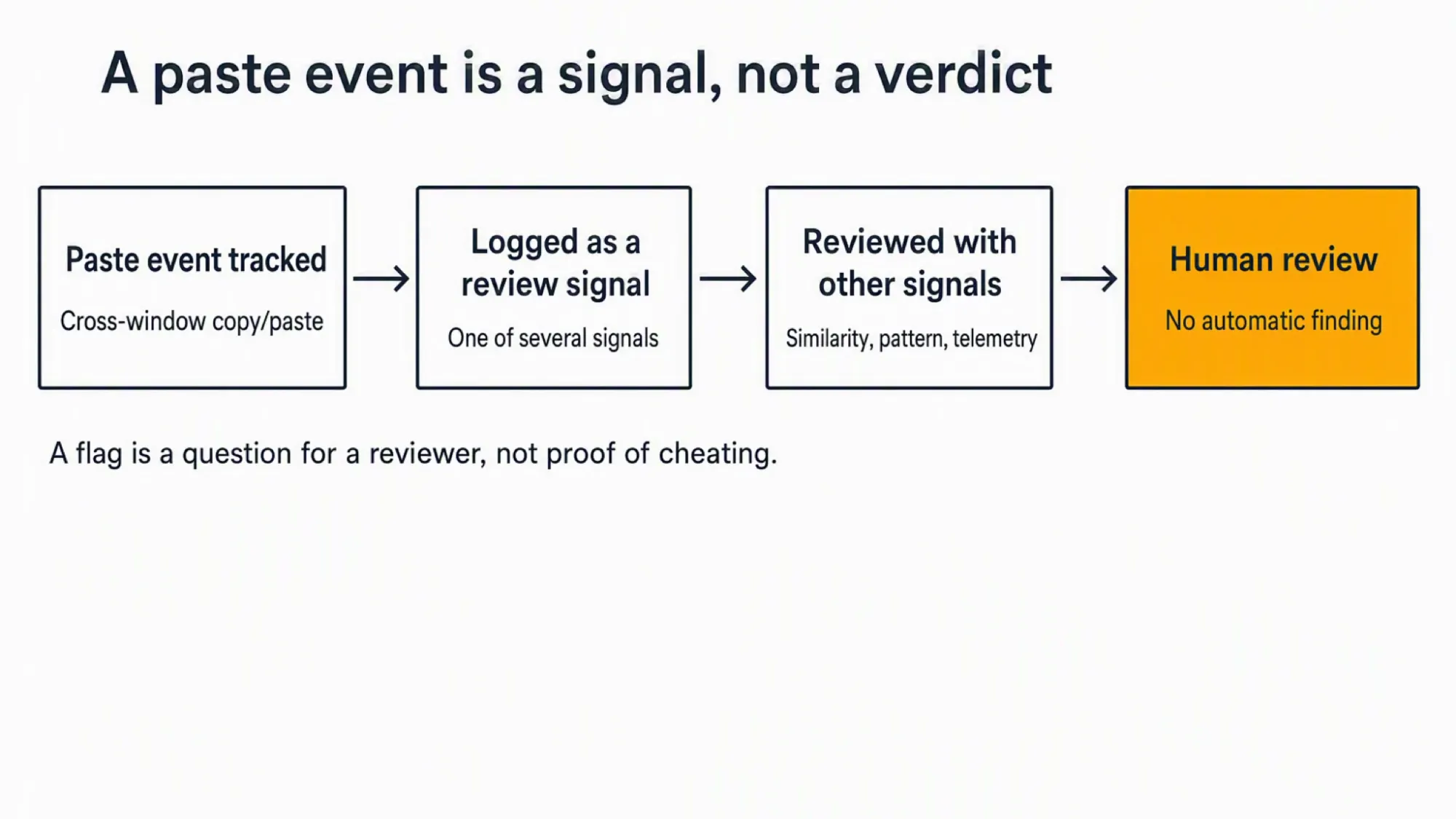
A paste event is a signal, not a verdict. CodeSignal describes paste activity as one input among several review signals.
A review signal can be combined with other evidence
The blog lists similarity checks, pattern detection, and typing or speaking telemetry. A paste event may join those signals during review.
The source also notes that some paste events are legitimate. An approved resource can make a paste event acceptable. A flag is a question for a reviewer, not an automatic finding of cheating.
Public evidence does not define the final decision
We do not know the exact score formula or threshold. Also, we do not know who reviews a flag or what the candidate sees. The public evidence stops before a final decision.
Do not read a paste event as automatic failure. Do not assume every employer receives the same report. The documented path ends at human review, not at a fixed outcome.
What to verify before or after a CodeSignal assessment
The safest move is to confirm the rules that apply to your specific assessment. Evidence and configuration differ, so verify before you rely on any assumption.
Before starting
Read the assessment's own rules and its permitted-resource instructions. Confirm which format you are taking and whether proctoring applies.
Treat the GCA rules as one example, not a universal CodeSignal policy. What applies to your assessment is whatever its instructions state.
If a review or flag is mentioned afterward
Preserve the instructions and assessment context from your session. Ask the assessment owner or CodeSignal support which review process applies.
Do not assume a paste event alone caused a final outcome. The public evidence does not define the decision after a flag.
Answers On Your Phone, Not Your Shared Screen
Skip the risky invisible-overlay tricks. Our dual-device mode keeps answers on your phone, never on the screen you're sharing or recording. Nothing for a platform or interviewer to catch, because there's nothing on the shared screen to find.
Get started. It's freeLoved by 100,000+ candidates
The Prep Agent helps you practice the exact skills an assessment measures. It works through WhatsApp or SMS, so the preparation stays off the interview device entirely.
FAQ
Does paste detection need screen recording? The documented paste tracking is separate from the proctoring capture path. Public evidence does not state that observing a paste event requires screen recording. We also do not know whether paste telemetry runs on non-proctored assessments.
Does CodeSignal share pasted text or keep it? The public evidence does not define raw paste text, access, retention, or disclosure. The proctoring retention statement covers proctored media, not paste telemetry. Do not assume the employer sees your copied text.
What happens after a CodeSignal review? The sources separate a review signal from an outcome. Proctored assessments have verified or not-verified states, but those belong to the proctored workflow. A paste event alone does not produce a documented hiring decision.