

You are about to start a HireVue interview. The question in your head is if I get a little AI help, will anyone know? You are not weighing a script to recite. You are deciding whether that help is worth the risk.
HireVue detects cheating through several independent signals plus human review, not one always-on system. It does not record your screen by default, run a dedicated AI detector, or analyze faces and emotions.
A clean default does not make every same-device tool safe. Screen sharing, focus logging, and human review can still expose help that lives on the interview computer. The risk depends on where your answers appear.
Dual Device Mode keeps answers off the interview computer. InterviewFox's dual-device mode is undetectable by software running on the monitored interview computer. A dual device AI interview assistant therefore solves the same-device exposure path directly.
How HireVue detects cheating and the signals it monitors
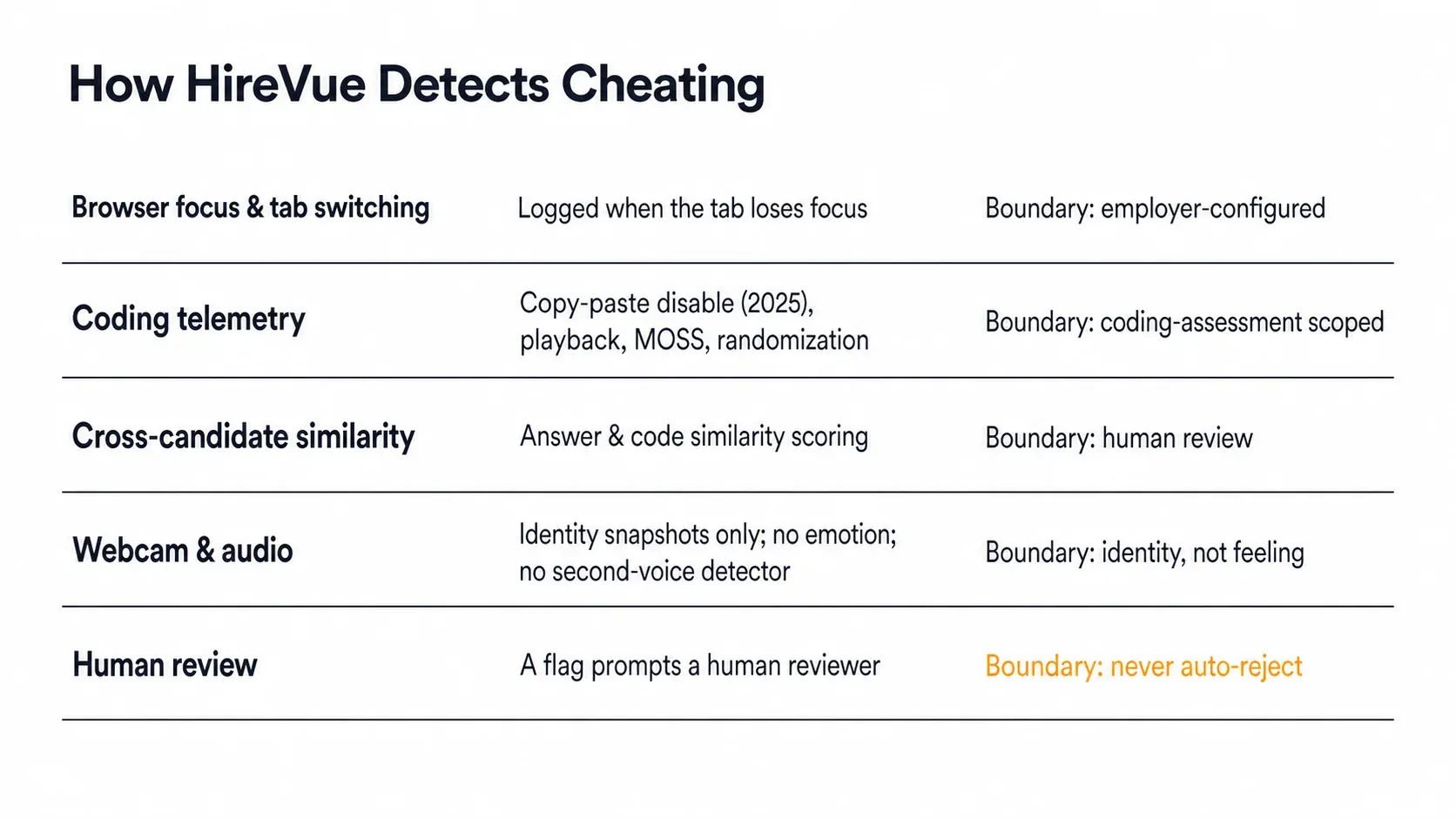
HireVue does not run one hidden system that watches everything at once. Instead, it gathers several separate signals from your interview computer and webcam. Each signal tracks a different behavior, and a human reviewer judges anything unusual.
Browser focus and tab switching
HireVue logs when your interview tab loses focus or you switch windows. It records that focus was lost, not the site you opened. The employer chooses whether this tracking is on. A brief switch to reread the question is logged but is not proof of cheating.
Coding-challenge telemetry (paste, playback, code similarity)
Inside coding assessments, employers can disable copy and paste, a control shipped in 2025. HireVue can also record a playback timeline of your code edits and run MOSS similarity checks. These signals show whether submitted code matches the work you actually typed.
Cross-candidate answer and code similarity
HireVue scores how similar your written answers are to other candidates. Its own study of 1,000 sessions found under 1 percent with high similarity. The same method also compares submitted code across candidates. High overlap becomes one input to a later human review.
Webcam identity snapshots and audio
HireVue can take periodic webcam photos to confirm identity, a feature shipped in 2025. These snapshots check who is at the camera, not mood or emotion. One rumored signal, a detector for a second voice in the room, is not in HireVue's primary materials. HireVue transcribes audio to text; it does not use that audio to detect someone else in the room.
Does HireVue record your screen by default?
HireVue does not record your screen by default. Instead, screen sharing turns on only when the employer enables it and you grant explicit permission. It is limited to coding assessments, not standard video interviews.
Continuous always-on capture was a 2024 roadmap idea but did not appear in the 2025 roadmap. HireVue still does not document it as a shipped feature. As a result, the confirmed path is employer-configured sharing with your consent, scoped to a coding test.

Answers On Your Phone, Not Your Shared Screen
Skip the risky invisible-overlay tricks. Our dual-device mode keeps answers on your phone, never on the screen you're sharing or recording. Nothing for a platform or interviewer to catch, because there's nothing on the shared screen to find.
Get started. It's freeLoved by 100,000+ candidates
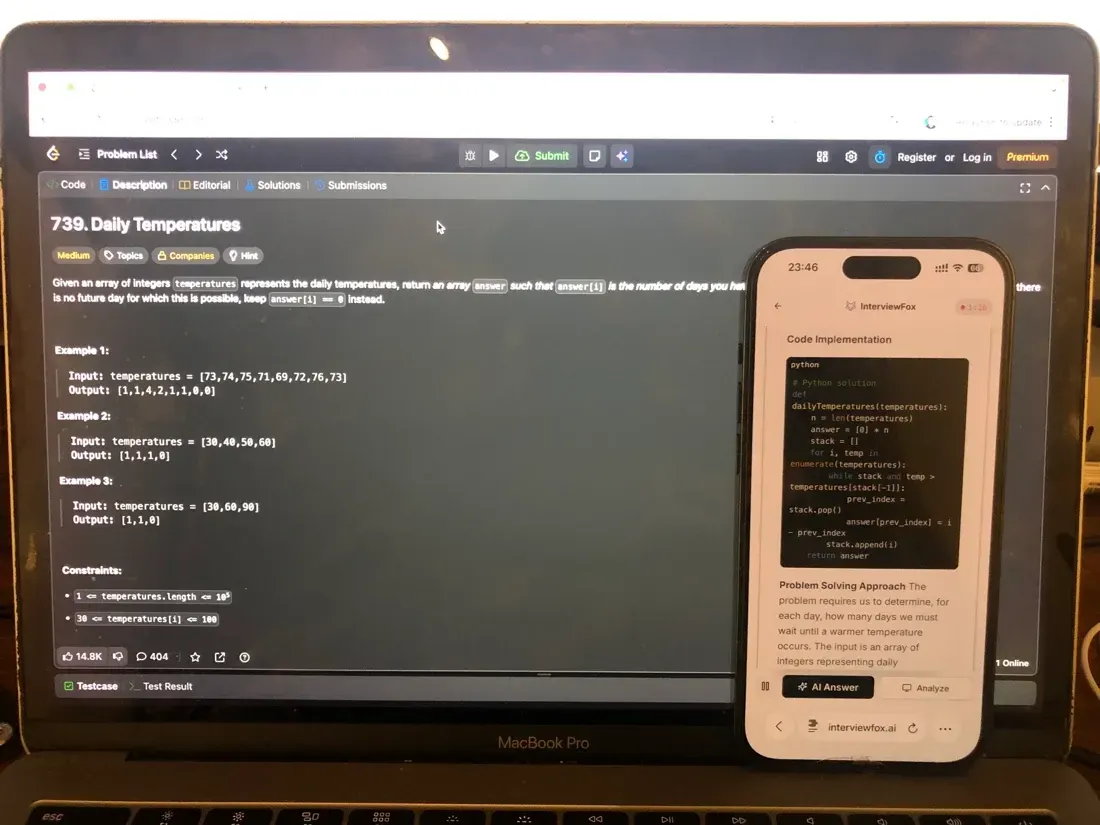
When an employer enables screen sharing, anything on your interview computer is captured. A same-device assistant surface would appear inside that capture.
In contrast, a dual device AI interview tool keeps the answer and assistant process on a separate phone. InterviewFox's dual-device mode is undetectable by software running on the monitored interview computer. No InterviewFox window, overlay, or process exists on the interview computer, so capture has no surface to inspect.
Does HireVue detect ChatGPT or AI-written answers?
HireVue does not run a dedicated detector for ChatGPT or other AI text. Its own study found that a GPT-3.5 answer scored only 1 or 2 out of 5. Generic AI writing tends to score low because it lacks your personal detail.
Human reviewers expose answers copied without real understanding. A follow-up question about your own response shows whether you can explain it. HireVue's 2025 whitepaper on whether cheaters prosper explains this scoring approach and the limits of automated detection.
Does HireVue analyze your face, eyes, or emotions?
HireVue no longer analyzes faces, eyes, or emotions. It ended that analysis after a 2021 complaint to the FTC documented by EPIC. Only periodic identity snapshots remain, used to confirm who is at the camera.
HireVue had stopped the practice by early 2021 and had not reinstated it by 2026. The EPIC record of the FTC complaint documents the regulatory action that ended the analysis.
What happens after HireVue flags a candidate
A flag is not a rejection. HireVue instead sends the session to a human reviewer who decides what the signals mean. Nothing in the platform automatically fails your interview.
The platform does not publish a global flag rate you can cite as fact. Its own bounded study of 1,000 sessions reported under 1 percent with high similarity. That figure is a study result, not a rate that applies to every assessment.
Everyday behaviors that do not get you flagged
Candidates often worry about the same small actions. Looking at notes, glancing away, and briefly switching tabs top the list. None of these alone creates a flag.
HireVue does not score your facial expressions or eye movement. That analysis ended in 2021 after a complaint to the FTC. Reading your own handwritten notes is not part of its similarity check either. The shared-script study targets responses that match another candidate, instead of notes you prepared yourself.
A short tab switch is logged as a focus event. The log records only that the tab lost focus. A single switch is not treated as cheating. Flags come from patterns like pasted code. Another pattern is a response nearly identical to another candidate's. A human reviews the context before any decision.
How to prepare and avoid false flags
To prepare honestly, practice explaining your answers out loud so a follow-up question feels natural. Ask the employer up front which tools and materials are allowed.
Prepare Once, Walk In Ready
The durable fix isn't a cleverer hiding trick, it's going in prepared. Our Prep Agent reviews your resume, builds a study plan, and runs mock interviews with you over WhatsApp or SMS, so you rehearse the content before it counts.
Get started. It's freeLoved by 100,000+ candidates
The InterviewFox Prep Agent can review your resume and build a practice plan through WhatsApp or SMS. Steady preparation beats last-minute help that you cannot defend in conversation. Know the rules before the interview starts.
FAQ
Does HireVue tell the employer I cheated? HireVue sends a flag to a human reviewer, not an automatic verdict. The employer sees a review note; no machine declares guilt.
What data does HireVue retain, and do I consent? Retention depends on the employer's configuration, and you grant consent through the interview setup. You can request deletion where the employer's policy allows it.
Can glancing at notes or briefly switching tabs get me flagged? A single glance or tab switch is logged but is not treated as cheating. Flags follow patterns like pasted code or passing without any visible editing, then a human reviews the context.
Does HireVue track your eyes or look-away? No. Eye tracking ended with the facial analysis program in 2021. The platform does not score where you look.
Can HireVue hear someone coaching you? HireVue transcribes audio to text. Its published materials do not confirm a detector for a second voice in the room.
Can HireVue see your other tabs or apps? No. A focus event only logs that the interview tab lost focus. It does not record what you opened or where you went.
Does using notes get detected? Reading your own notes is not part of the similarity check. HireVue's shared-script study targets responses that match another candidate. Your prepared notes stay outside that comparison.
How many candidates actually get flagged? In its own study of 1,000 sessions, under 1 percent showed high answer similarity. HireVue does not publish a global flag rate.