How I Took the Apple Coderpad in 2026: Real Questions and a 7-Day Prep Plan

Quick Facts
| What it is | Apple Coderpad runs in two modes: a live ~45-minute screen-share and an on-demand take-home OA. |
| Time limit | Live round is ~45 minutes (some roles 60 or 30); take-home is a fixed-length MCQ plus coding set. |
| Questions | Live: one medium problem plus a couple of follow-ups. Take-home: about 25 mixed MCQ and coding items. |
| Score | No numeric CoderPad score. An engineer judges code structure, edge cases, and communication live. |
| Proctoring | Live is interviewer-driven. Take-home Screen flags paste, tab-switch, and webcam; AI tools are banned. |
| Language | Usually your choice; some teams force Java (IS&T) or C/C++ (hardware and silicon). |
| Result timeline | Outcomes appear as advance or reject; final word can take 1 to 100 business days. |
I took the Apple Coderpad live coding round for an Apple software engineering new grad role in 2026 and solved one medium question with a couple of follow-ups in a ~45-minute screen-share. An engineer judged my code live on structure, edge cases, and how I explained my thinking. What follows is the complete process and how I prepared for it.
My worst stretch was the Basic Calculator II evaluator: I burned nearly ten minutes over-engineering a two-stack version before simplifying it, and with five minutes left I was still doubting the integer-division truncation. I used an AI interview assistant to confirm the truncation behavior, and it surfaced the int(prev/num) edge case I walk through below.
Before my test, I went through every Apple CoderPad post from the past two years on Reddit, LeetCode Discuss, and Teamblind. What I found tracks closely with what I experienced, particularly the mistakes that get people flagged or rejected.
The Real Questions on My Apple CoderPad Test
I interviewed for an Apple software engineering new grad role and got the live CoderPad round: a single ~45-minute session with the screen shared to an engineer. Here is exactly what I got.
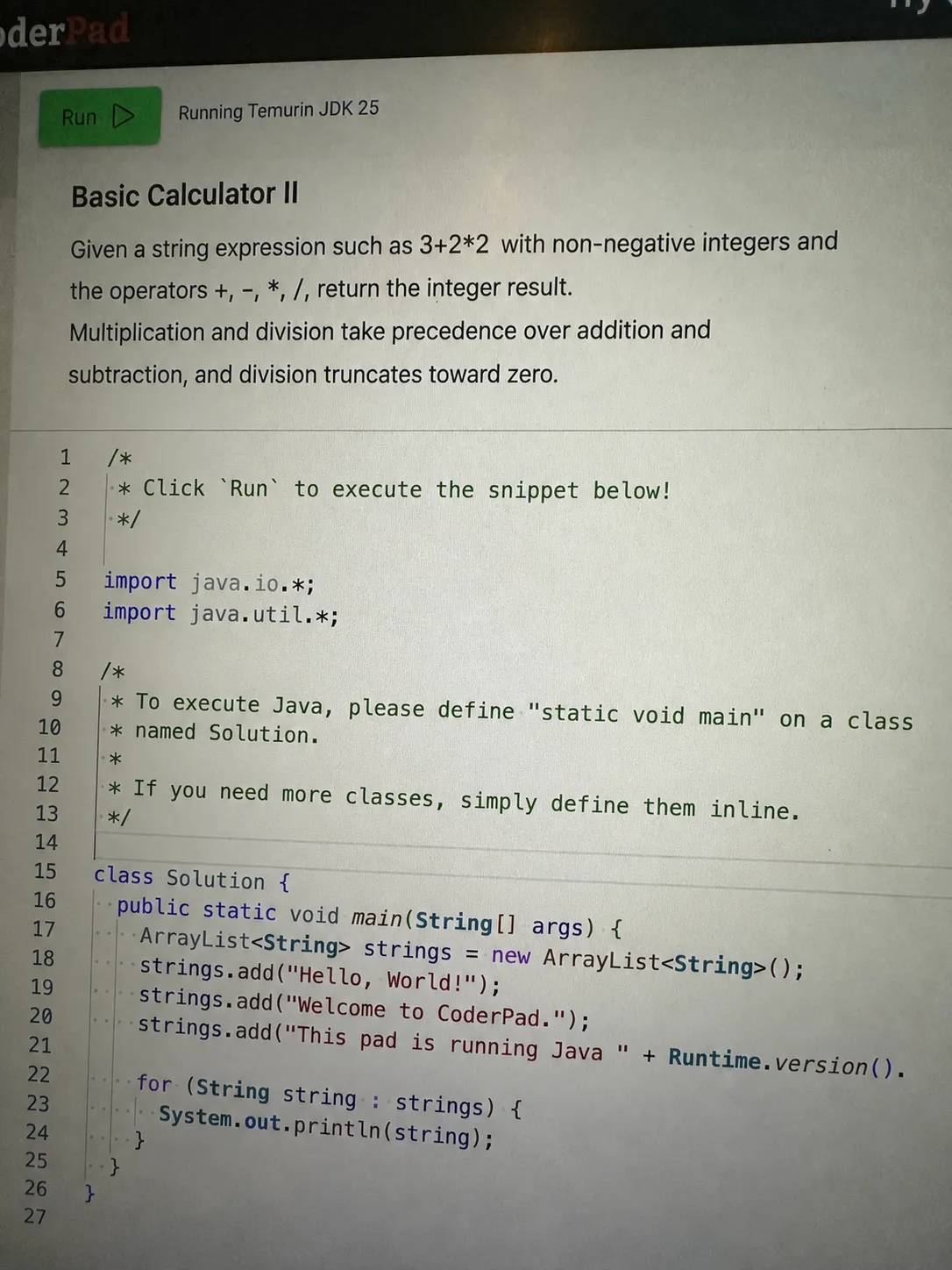
Question 1: Basic Calculator II (parsing and evaluation)
The problem I got: The question was a string expression evaluator. I had to take a string like "3+2*2" and return the integer result, respecting multiplication and division precedence over addition and subtraction. There were spaces scattered through the input, such as " 3/2 " and " 3+5 / 2 ", and all numbers were non-negative integers.
My approach: I first reached for a full two-stack evaluator that would hold numbers and operators in separate piles, but that was more machinery than the problem needed. Because multiplication and division only bind their immediate neighbor, I could resolve them the moment I saw one, then keep a running list of finished terms to add at the end. I tracked the number I was currently reading and the operator that preceded it. When the next operator was + or -, I just pushed the finished term. When it was * or /, I popped the last term, combined it with the current number, and pushed the result back. Integer division had to truncate toward zero, so I used int(prev / num) rather than floor division. At the end I summed everything on the stack.
def calculate(s: str) -> int:
    stack = []
    num = 0
    op = '+'
    for i, ch in enumerate(s):
        if ch.isdigit():
            num = num * 10 + int(ch)
        if ch in '+-*/' or i == len(s) - 1:
            if op == '+':
                stack.append(num)
            elif op == '-':
                stack.append(-num)
            elif op == '*':
                stack.append(stack.pop() * num)
            elif op == '/':
                stack.append(int(stack.pop() / num))
            op = ch
            num = 0
    return sum(stack)
Time complexity: O(n) | Space complexity: O(n)
I lost nearly ten minutes building the two-stack version before I cut it down to the single stack. The integer-division truncation was the last thing I doubted, and I was still re-reading that line when the interviewer said we had five minutes left.
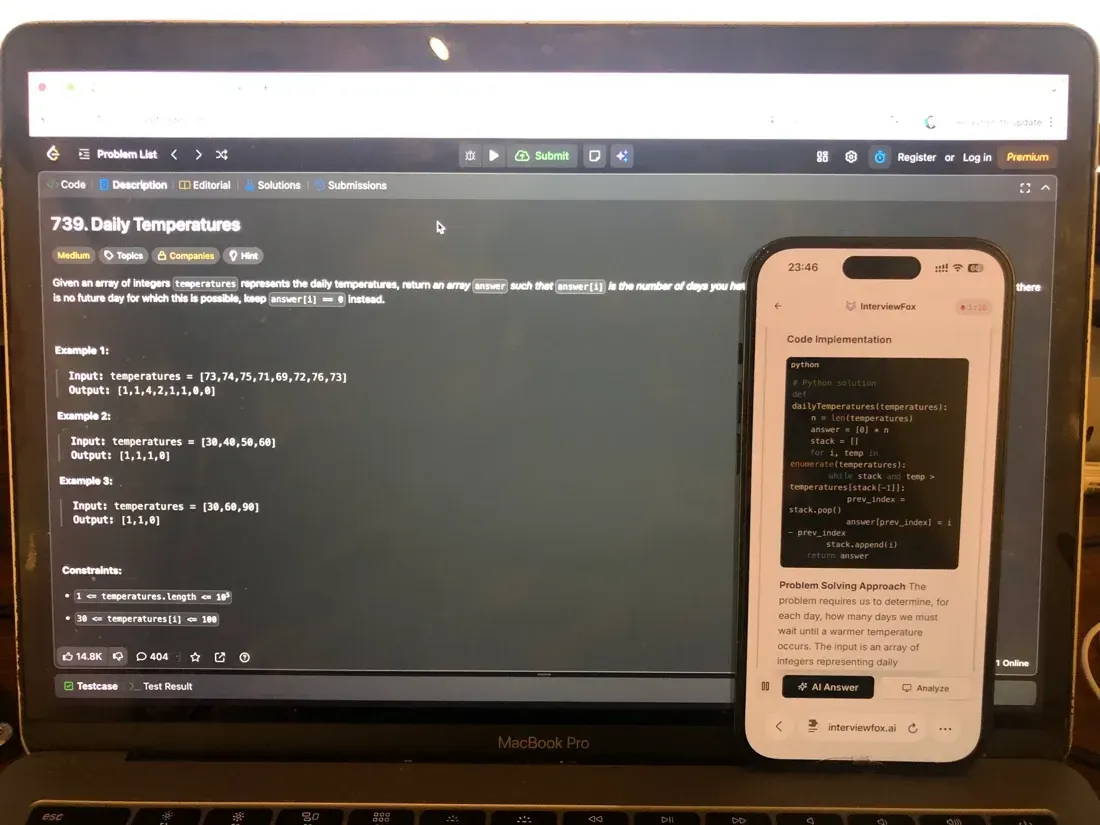
I avoided a desktop overlay because the answer would have sat on the same screen the interviewer was watching, hidden by a basic OS-layer rendering trick, and I did not want that exposure in the background. Instead I reached for a real-time AI interview helper: a keyboard shortcut auto-captured the problem and pushed the answer to my phone through InterviewFox's dual-device mode. My approach stayed clear, the laptop screen never changed, and the answer sat completely outside the shared screen.
Land offer with Safer AI Interview Assistant
Skip the risky invisible apps. Our dual-device mode keeps it simple and undetectable. You crush the interview, we handle the answers.
Get started. It's freeLoved by 100,000+ candidates
Apple's Proctoring Policy for CoderPad
Live screen-share is interviewer-driven, not automated
The live round runs on CoderPad's Collaborate product, where an engineer watches your screen in real time. The only automated signals are basic window-leave and paste flags, so the person watching is the real proctor, not the software.
Take-home Screen mode flags paste, tab-switch, and webcam
Apple's on-demand take-home runs on CoderPad Screen, which detects plagiarism, leaving the IDE, copy-paste, and geolocation changes and stores occasional webcam snapshots for at most 90 days. A full-screen alert fires after a 10-second grace period when the monitor changes.
Apple bans AI tools and ends sessions on detection
Apple's recruiter emails state plainly not to use AI in the round. Candidates who used it were declined at the first technical round, so the ban is enforced rather than symbolic.
Other Confirmed Apple CoderPad Questions
Beyond my own round, confirmed first-person accounts from other candidates show how the question set varies by team.
Dictionary search in a sorted list (QA / SDET)
A QA candidate described a round with a couple of dictionary-based questions plus an ask to implement a search function in a sorted list, about two or three items per round.
def search_in_sorted_list(arr, key):
    lo, hi = 0, len(arr) - 1
    while lo <= hi:
        mid = (lo + hi) // 2
        if arr[mid] == key:
            return mid
        elif arr[mid] < key:
            lo = mid + 1
        else:
            hi = mid - 1
    return -1
Time complexity: O(log n) | Space complexity: O(1)
Medium DSA plus read-and-fix code (debug)
One SDE candidate got one medium Python DSA problem plus a task to read existing code and make a small fix, with a light performance angle.
# Buggy (O(n^2)): brute-force pair scan, revisited on every call
# def has_pair(nums, target):
#     for i in range(len(nums)):
#         for j in range(len(nums)):
#             if i != j and nums[i] + nums[j] == target:
#                 return True
#     return False
# Fix: single pass with a seen set drops it to O(n)
def has_pair(nums, target):
    seen = set()
    for x in nums:
        if target - x in seen:
            return True
        seen.add(x)
    return False
Time complexity: O(n) | Space complexity: O(n)
WatchOS Swift DSA and memory trivia
A WatchOS candidate reported a standard priority queue DSA question in the phone screen plus Swift trivia on memory management, OOP, and multithreading.
// Typical phone-screen DSA: kth largest element via a min-heap (priority queue)
import Foundation

func kthLargest(_ nums: [Int], _ k: Int) -> Int {
    var heap = nums.prefix(k).sorted()   // keep the smallest k at the front
    for n in nums.dropFirst(k) {
        if n > heap[0] {
            heap.removeFirst()
            heap.append(n)
            heap.sort()
        }
    }
    return heap[0]
}
Time complexity: O(n log k) | Space complexity: O(k)
Collaborative open problem solved live together
One candidate described the interviewer and them looking at a problem and solving it together live, rather than the candidate coding alone.
# Illustrative: a typical live-collaborative medium problem (valid parentheses),
# the kind worked through together rather than solved solo under time pressure.
def is_valid(s: str) -> bool:
    stack = []
    pairs = {")": "(", "]": "[", "}": "{"}
    for ch in s:
        if ch in "({[":
            stack.append(ch)
        else:
            if not stack or stack.pop() != pairs[ch]:
                return False
    return not stack
Time complexity: O(n) | Space complexity: O(n)
Rotate a Matrix 90° and Merge K Sorted Lists (Reliability Eng IS&T)
A Reliability Eng IS&T candidate got a ~50-minute CoderPad with Rotate Matrix 90°, Merge K Sorted Lists, Max Length of Mountain in Array, and LRU Cache, plus complexity questions, and was shortlisted within 30 minutes.
def rotate_90(matrix):
    n = len(matrix)
    for i in range(n):
        for j in range(i + 1, n):
            matrix[i][j], matrix[j][i] = matrix[j][i], matrix[i][j]
    for row in matrix:
        row.reverse()
    return matrix
Time complexity: O(n^2) | Space complexity: O(1)
import heapq

def merge_k_lists(lists):
    heap = []
    for i, lst in enumerate(lists):
        if lst:
            heapq.heappush(heap, (lst[0], i, 0))
    out = []
    while heap:
        val, i, j = heapq.heappop(heap)
        out.append(val)
        if j + 1 < len(lists[i]):
            heapq.heappush(heap, (lists[i][j + 1], i, j + 1))
    return out
Time complexity: O(N log k) | Space complexity: O(k)
LRU Cache with HashMap and Doubly LL (Reliability Eng)
The same Reliability Eng round included LRU Cache, built with a HashMap plus a doubly linked list for O(1) get and put.
class DLinkedNode:
    def __init__(self, k=0, v=0):
        self.key, self.val, self.prev, self.next = k, v, None, None

class LRUCache:
    def __init__(self, cap):
        self.cap = cap
        self.head, self.tail = DLinkedNode(), DLinkedNode()
        self.head.next, self.tail.prev = self.tail, self.head
        self.cache = {}

    def _add(self, node):
        node.prev, node.next = self.head, self.head.next
        self.head.next.prev, self.head.next = node, node

    def _drop(self, node):
        node.prev.next, node.next.prev = node.next, node.prev

    def get(self, key):
        if key not in self.cache:
            return -1
        node = self.cache.pop(key)
        self._drop(node)
        self._add(node)
        self.cache[key] = node
        return node.val

    def put(self, key, value):
        if key in self.cache:
            self._drop(self.cache.pop(key))
        node = DLinkedNode(key, value)
        self._add(node)
        self.cache[key] = node
        if len(self.cache) > self.cap:
            lru = self.tail.prev
            self._drop(lru)
            del self.cache[lru.key]
Time complexity: O(1) average | Space complexity: O(capacity)
Check endianness and debug a kernel deadlock (Kernel Eng, all C)
A Kernel Engineer Core-OS candidate faced 45 minutes of all-C problems: check endianness, debug a kernel deadlock, and a medium binary search, and said they solved all but messed up explaining their thought process.
/* Check machine endianness */
#include <stdio.h>

int is_little_endian(void) {
    unsigned int x = 1;
    return *(unsigned char *)&x == 1;   /* 1 -> little-endian */
}
Time complexity: O(1) | Space complexity: O(1)
/*
 * Kernel deadlock fix: acquire locks in one global order.
 * Wrong:  thread A locks(m1) then m2; thread B locks(m2) then m1  -> deadlock
 * Right:  always lock m1 before m2, in every path
 */
void safe_transfer(lock_t *m1, lock_t *m2, int *a, int *b, int v) {
    lock(m1);
    lock(m2);
    *a -= v;
    *b += v;
    unlock(m2);
    unlock(m1);
}
Time complexity: O(1) | Space complexity: O(1)
Group anagrams and file-tree edge cases (Full Stack)
A Full Stack candidate in Hyderabad got an OA of about 25 questions mixing MCQs and coding, then a loop with a file-tree of employees and reportees edge case plus group anagrams via hashmap, and finished with a rejection.
def group_anagrams(words):
    groups = {}
    for w in words:
        key = tuple(sorted(w))
        groups.setdefault(key, []).append(w)
    return list(groups.values())
Time complexity: O(n * k log k) | Space complexity: O(n)
// Build a tree of employees with reportees; handle the "no reportees" leaf
function build_tree(people) {
  const map = new Map();
  people.forEach(p => map.set(p.id, { ...p, reportees: [] }));
  const roots = [];
  people.forEach(p => {
    if (p.managerId && map.has(p.managerId)) {
      map.get(p.managerId).reportees.push(map.get(p.id));
    } else {
      roots.push(map.get(p.id));
    }
  });
  return roots;
}
Time complexity: O(n) | Space complexity: O(n)
Medium DSA plus a testing or data-parsing script (SDE Automation HW/RF)
An SDE Automation HW/RF candidate got a one-hour CoderPad with one medium DSA problem plus a practical scripting task, and noted that an hour means expect two LeetCode-style problems in the team's primary language.
# Medium DSA: longest consecutive sequence
def longest_consecutive(nums):
    s = set(nums)
    best = 0
    for x in s:
        if x - 1 not in s:
            y = x
            while y + 1 in s:
                y += 1
            best = max(best, y - x + 1)
    return best

# Practical parsing task that often accompanies it
def parse_log_line(line):
    ts, level, msg = line.split(" | ", 2)
    return {"ts": ts, "level": level, "msg": msg}
Time complexity: O(n) | Space complexity: O(n)
Merge two sorted lists in C++ and bit extraction from a register (GPU IP Validation)
A 2026 new grad in GPU IP Validation ran five 45-minute CoderPad sessions: multithreading, OS and race conditions, shared memory with MESI, merge two sorted linked lists in C++ plus a shared-memory protocol, and bit extraction from a register with const/volatile pointers.
// Merge two sorted linked lists in C++
struct ListNode { int val; ListNode* next; };

ListNode* mergeTwoLists(ListNode* a, ListNode* b) {
    ListNode dummy{0, nullptr}, *tail = &dummy;
    while (a && b) {
        if (a->val < b->val) { tail->next = a; a = a->next; }
        else { tail->next = b; b = b->next; }
        tail = tail->next;
    }
    tail->next = a ? a : b;
    return dummy.next;
}
Time complexity: O(n + m) | Space complexity: O(1)
// Bit extraction from a register using const/volatile pointers
volatile unsigned int* REG = reinterpret_cast<volatile unsigned int*>(0x4000);

unsigned int extract_field(unsigned int field_mask, int shift) {
    return (*REG & field_mask) >> shift;   // volatile: re-read on each access
}
Time complexity: O(1) | Space complexity: O(1)
Intersection of two integer arrays (LinkedIn SDET)
A LinkedIn SDET snippet listed an intersection-of-two-integer-arrays problem solved via CoderPad.
def intersection(a, b):
    set_b = set(b)
    return [x for x in a if x in set_b]   # preserves a's order
Time complexity: O(n + m) | Space complexity: O(m)
What Apple's CoderPad Test Format Actually Looks Like
Live mode is a 45-minute screen-shared session
The live mode is a 45-minute screen-shared session. The most-cited pattern is a single medium problem with a couple of follow-ups, though some roles stretch to 60 minutes (Cloud, SDE Automation HW/RF) or one reported 30-minute Full Stack round.
Async on-demand assessment is a take-home MCQ plus coding OA
The async on-demand assessment is a take-home MCQ plus coding OA. Reports describe about 25 mixed multiple-choice and coding questions, and an SDET variant with one medium coding question plus thirty multiple-choice questions.
Language is usually your choice, sometimes forced
Language is usually your choice; some teams force it. Candidates typically tell the interviewer their language at the start, but IS&T mandates Java and hardware or silicon roles use C or C++.
How Apple's CoderPad Scoring Works
No numeric score, engineers judge your code live
There is no numeric CoderPad score for the live round. An engineer judges your code live on structure, edge-case handling, communication, and whether you can explain your thought process. A solution that appears magically with no explanation is a red flag.
Outcomes show up as advance or reject, not a number
Outcomes show up as advance or reject, not a number. A Reliability Eng IS&T candidate was shortlisted within 30 minutes of finishing, while a Full Stack candidate and a GPU IP Validation candidate received rejections, one of them verbal with no formal feedback.
Apple CoderPad Exam-Day Strategy
Clarify inputs, state your approach, then code
I made a habit of clarifying inputs and constraints up front, stating my approach before typing, coding it cleanly, walking through an example, and naming edge cases at the end. This kept the interviewer aligned with my plan before I committed to code.
Talk through your plan when you get stuck
When I got stuck, I talked through my plan out loud instead of freezing. Freezing mid-CoderPad happens to plenty of people, so I trained myself to hit a few edge cases up front and state time and space complexity at the end.
Communicate your reasoning out loud
I communicated my reasoning out loud as I worked, because the interviewer evaluates the problem-solving approach as much as the final code. Magically arriving at the optimal answer without explaining it reads as a tell.
Why Candidates Fail the Apple CoderPad Assessment
The breakdown below shows the dominant failure is an AI-tool or overlay caught during screen-share, followed by weak communication and rusty fundamentals.
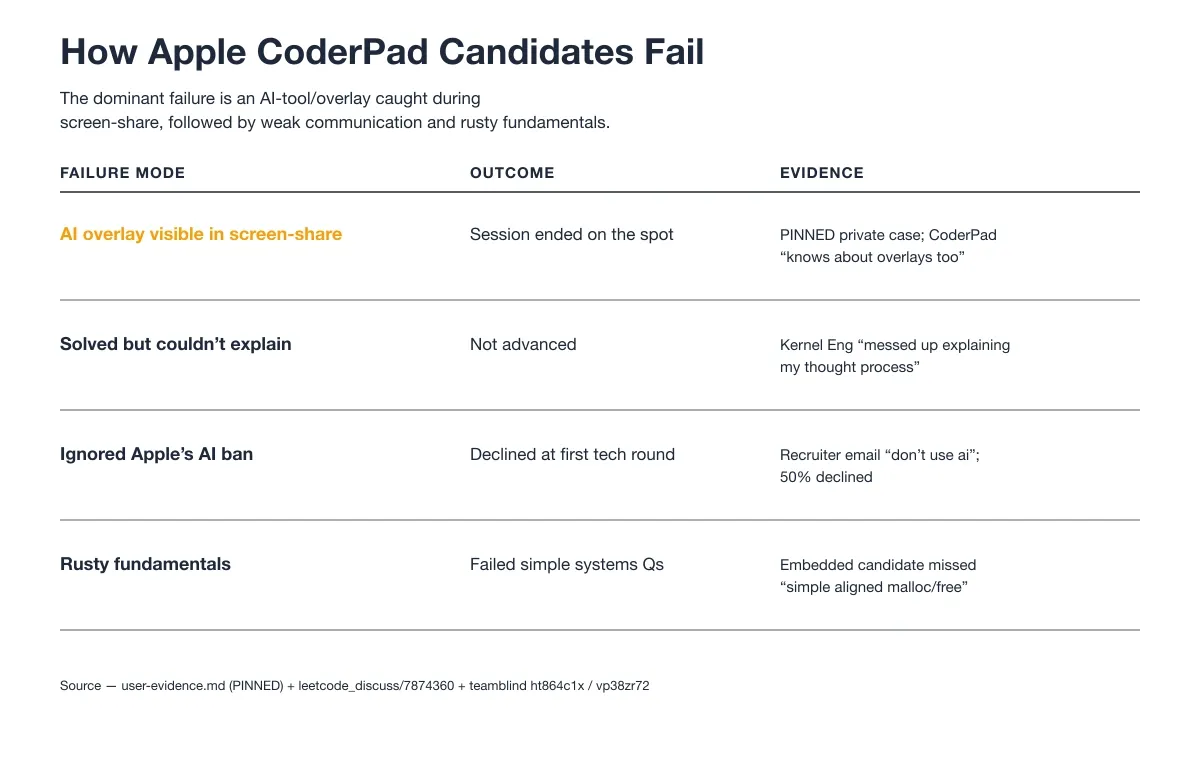
AI overlay visible during screen-share ends the session
The most direct failure is an AI overlay visible during screen-share. A candidate ran a Desktop Overlay during the live coding round; it became visible while the screen was shared, and the interviewer ended the session on the spot.
Public reporting shows CoderPad flags when a candidate leaves the screen and knows about overlays too, and a translucent overlay that keeps focus on CoderPad is still caught by the watching interviewer, not the platform.
At least one candidate was flagged for a desktop overlay during the live coding round because the tool renders the AI's answer on the same screen the interviewer was watching, hidden by a basic OS-layer trick. InterviewFox works differently: the answer goes to my phone, a physically separate device that no screenshot, screen recording, or session monitoring can reach by design.
Land offer with Safer AI Interview Assistant
Skip the risky invisible apps. Our dual-device mode keeps it simple and undetectable. You crush the interview, we handle the answers.
Get started. It's freeLoved by 100,000+ candidates
Nerves and weak explanation fail solved problems
Solving every problem is not enough. A Kernel Engineer Core-OS candidate solved all of them but messed up explaining their thought process and was not advanced.
Ignoring Apple's AI ban gets you declined
Apple states plainly not to use AI, and candidates who did were declined at the first technical round. The recruiter email sets this expectation before the round starts.
Rusty fundamentals break on simple systems questions
An embedded candidate failed a simple aligned malloc/free, and other rejections came from not handling follow-up questions. Basic systems fluency matters as much as the headline algorithm.
How to Prepare for the Apple CoderPad in 7 Days
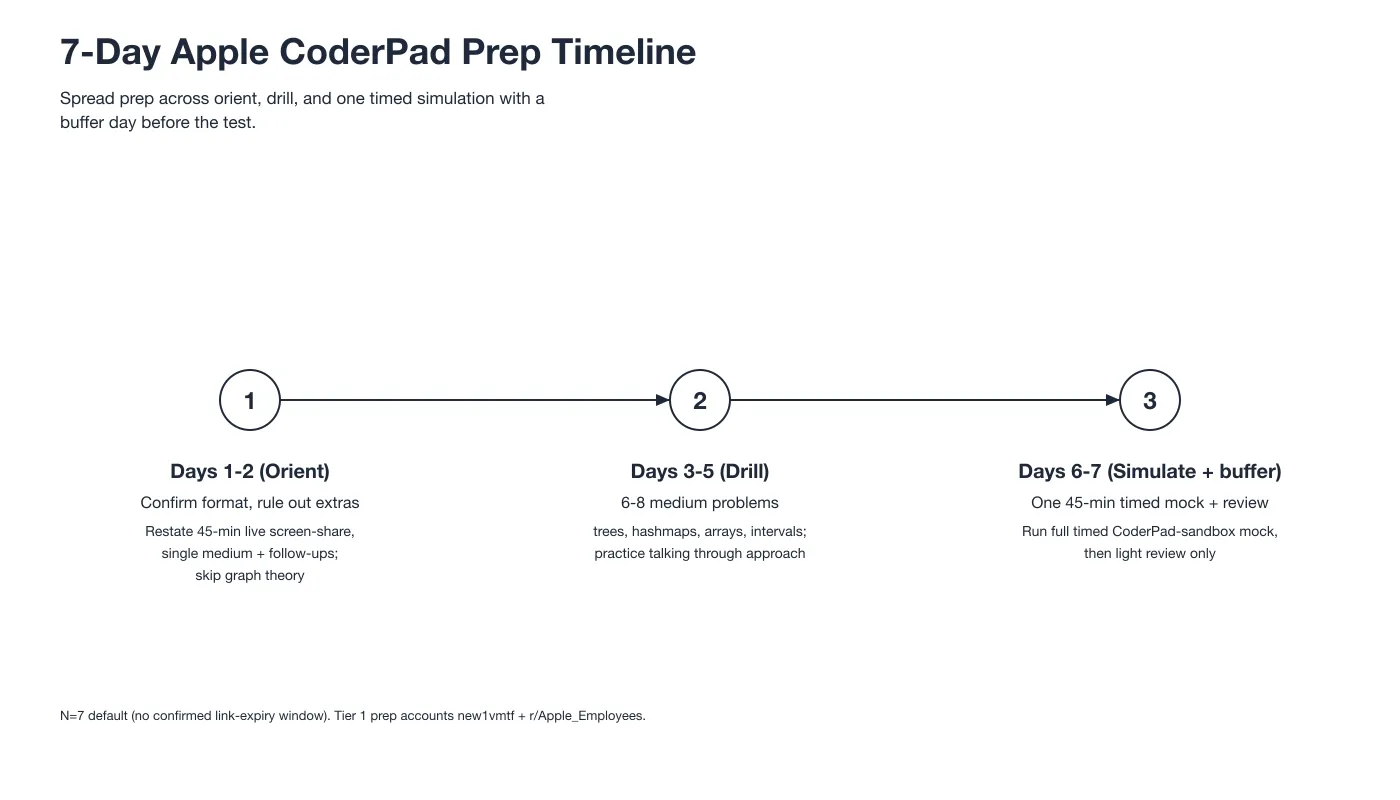
The timeline below spreads prep across orient, drill, and one timed simulation with a buffer day before the test.
Orient
I confirmed the format was a live 45-minute screen-share with one medium problem and follow-ups, then cut extras I did not need. I skipped graph-algorithm drilling because every reported Apple CoderPad question set (Basic Calculator II, dictionary search, LRU, rotate matrix, merge lists, endianness, MESI) shows zero graph problems.
I also skipped system-design deep dives, since the round is a live coding and debug session, not a system-design interview.
Before drilling, I used the Prep Agent from InterviewFox over WhatsApp and SMS. I sent it the confirmed Apple CoderPad question patterns I had gathered and got back a personalized drill plan.
Drill
I did six to eight medium problems covering trees, hashmaps, arrays, and intervals, and practiced talking through my approach before typing. I picked the language I move fastest in and reviewed time and space complexity after each solve.
Simulate and buffer
I ran one full 45-minute timed mock in the CoderPad sandbox, then spent the final day on light review only. The buffer day kept me from cramming and let the drill work settle.
What Happens After You Submit the OA
CoderPad leads into a 6-9 round onsite loop
CoderPad leads into a 6-9 round onsite loop. The path runs phone screen to a CoderPad technical, then an onsite or virtual onsite of six to nine rounds, with some teams running two or three CoderPad coding sessions of about 45 minutes each.
Results take 1-100 business days and ghosting is common
Results take 1-100 business days and ghosting is common. One candidate got a verbal rejection with no formal feedback and no cooling period, which matches reports of auto-email rejections with no detail.
Some roles stack multiple CoderPad sessions
Some roles stack multiple CoderPad sessions. A GPU IP Validation loop ran five 45-minute CoderPad sessions covering multithreading, OS, cache coherence, C++ lists, and bit extraction.
Apple's Two CoderPad Modes: Live Screen-Share vs On-Demand Take-Home
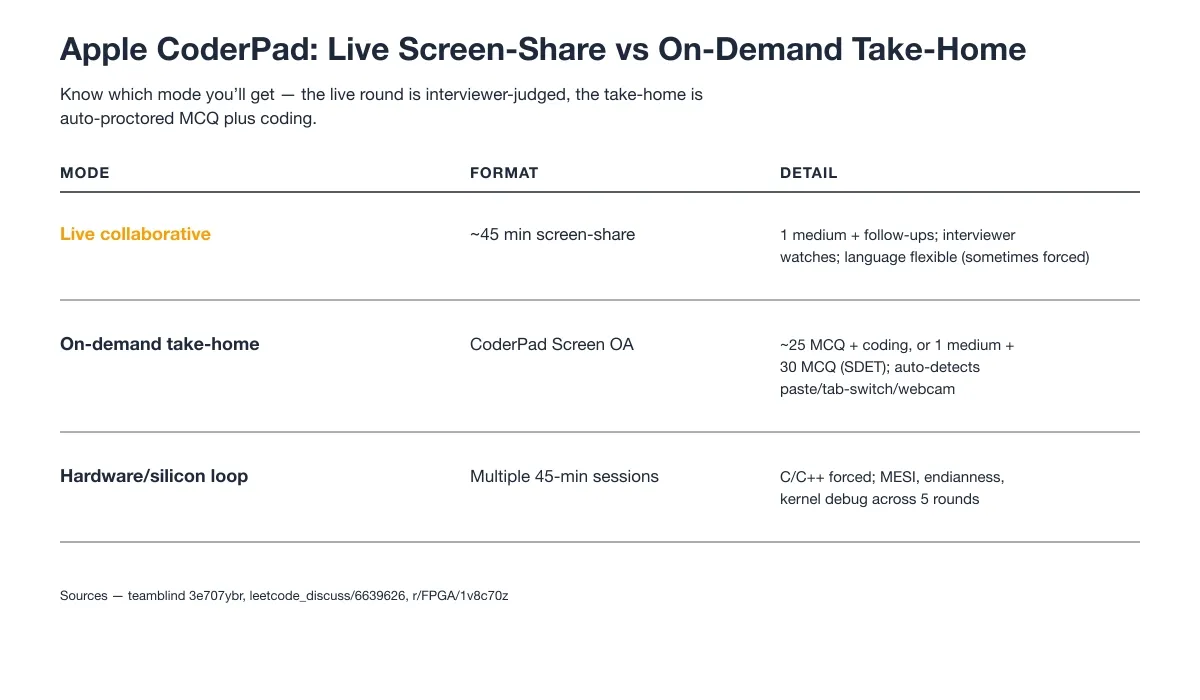
The table below separates the two modes so you know which one you will get before the round starts.
The live round is a single medium with follow-ups, watched in real time
The live round is a single medium problem with follow-ups, watched in real time. An interviewer evaluates your code and communication as you work, and language is usually flexible, sometimes forced.
The take-home is an auto-proctored CoderPad Screen OA
The take-home is an auto-proctored CoderPad Screen OA. It mixes MCQ and coding, detects paste, tab-switch, and geolocation, and takes webcam snapshots.
Some teams send the on-demand assessment before the loop
Some teams send the on-demand assessment before the loop. One report describes an on-demand CoderPad assessment ahead of the interview, and an SDET path that ran an OA then three rounds of MCQ plus coding.
Apple CoderPad for Hardware and Silicon Candidates
Silicon loops stack multiple 45-minute CoderPad sessions
Silicon loops stack multiple 45-minute CoderPad sessions. A GPU IP Validation new grad ran five sessions on multithreading, OS and race conditions, shared memory with MESI, C++ linked-list merges, and register bit extraction.
Questions are C/C++ systems problems, not LeetCode toys
Questions are C/C++ systems problems, not LeetCode toys. A Kernel Engineer Core-OS round was all C: check endianness, debug a kernel deadlock, and a medium binary search.
Drill MESI, virtual memory, and const/volatile pointers
The real preparation for these loops is drilling MESI cache coherence, virtual memory page tables and traps, and const/volatile pointer declarations in C, not algorithm practice. These systems topics show up directly in silicon-loop questions.
FAQ
What is the Apple CoderPad interview like?
The Apple CoderPad interview is a live 45-minute screen-share with one medium problem and a couple of follow-ups. An engineer watches your code and communication in real time.
What are the Apple CoderPad interview questions?
Apple CoderPad questions lean on parsing and evaluation, hashmaps, arrays, and intervals, with Basic Calculator II the most reported. Hardware loops add C/C++ systems problems like endianness and MESI.
Is there an Apple CoderPad interview Reddit thread with real experiences?
Yes. Candidates post real Apple CoderPad experiences on Reddit, LeetCode Discuss, and Teamblind covering questions, format, and rejections. These threads track closely with what most people actually get.
How does the Apple interview CoderPad round fit into the process?
The Apple interview CoderPad round sits after the phone screen and before a 6 to 9 round onsite loop. Some teams run two or three CoderPad coding sessions of about 45 minutes each.
Is CoderPad used for Apple interviews, and what shows up?
CoderPad is used for Apple interviews in both a live screen-share and an on-demand take-home mode. The take-home mixes multiple-choice questions with coding and auto-detects paste and tab switches.
What are the CoderPad Apple interview questions for hardware candidates?
CoderPad Apple interview questions for hardware candidates are C/C++ systems problems, not LeetCode toys. They cover multithreading, kernel debug, cache coherence with MESI, and const/volatile pointers.
Can I use an AI tool or invisible app during the Apple CoderPad OA?
Desktop overlay tools put the AI's answer on your computer screen, rendered as a hidden layer above the browser with a basic OS-layer trick, and while the hiding is basic, proctoring software keeps adding detection capabilities as AI tools become more common, so the exposure is not fixed.
InterviewFox pushes the answer to your phone, a physically separate device that no screenshot, screen recording, or session monitoring can reach by design, so the laptop screen stays on the exam editor, unchanged. If you use AI assistance during the OA, an AI coding interview assistant built on the dual-device architecture removes the answer from your screen entirely.
Land offer with Safer AI Interview Assistant
Skip the risky invisible apps. Our dual-device mode keeps it simple and undetectable. You crush the interview, we handle the answers.
Get started. It's freeLoved by 100,000+ candidates