
Capital One Virtual Job Tryout: What to Expect in 2026

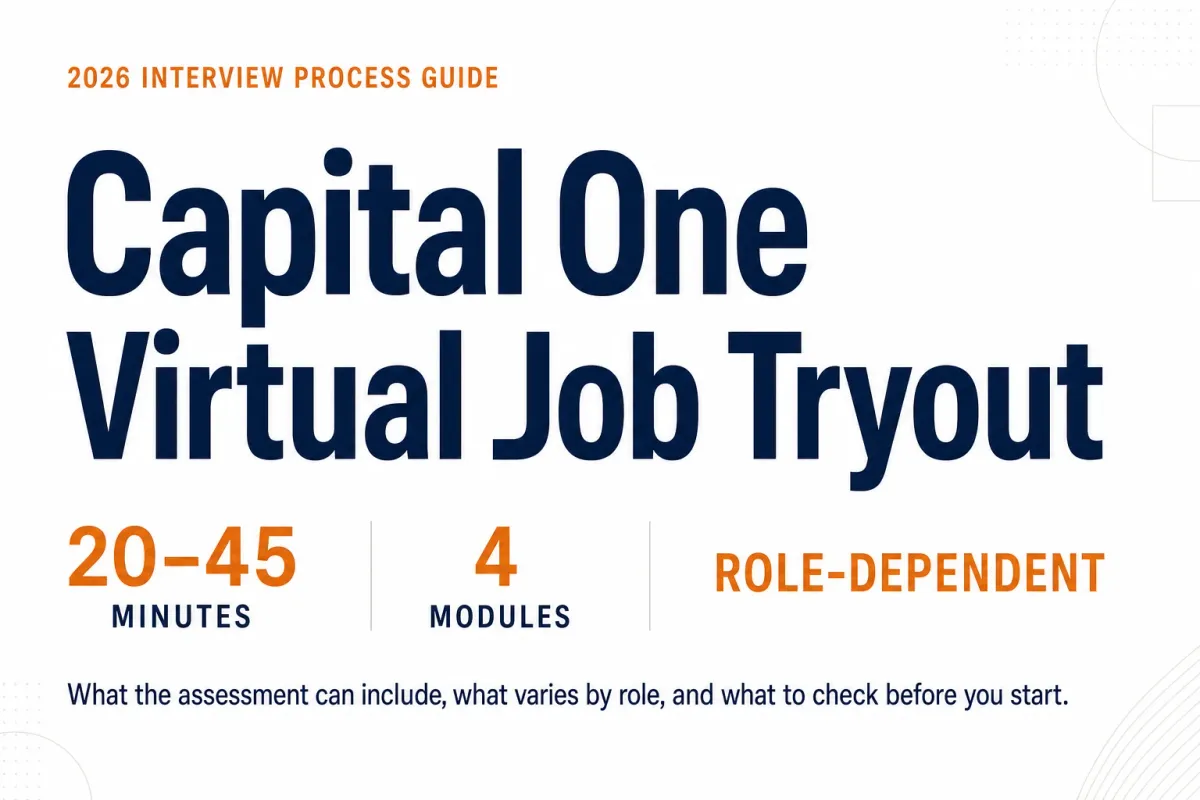
The Capital One Virtual Job Tryout is an individualized, role-dependent assessment sent by email. It is not a fixed four-part test that every candidate receives in the same order. Capital One says the modules can change based on the role and on modules you have already completed, so the invitation attached to your application controls what you actually need to do.
The official Capital One candidate FAQ names four possible modules: Manage Relationships, Work Your Business Case, Tell Us Your Story, and Describe Your Approach. The FAQ gives an average completion time of 20–45 minutes. That is an average planning range, not a universal timer or question bank. For a separate live-interview stage, InterviewFox's AI interview assistant can use role and resume context to support personalized answers; that workflow is separate from the VJT.
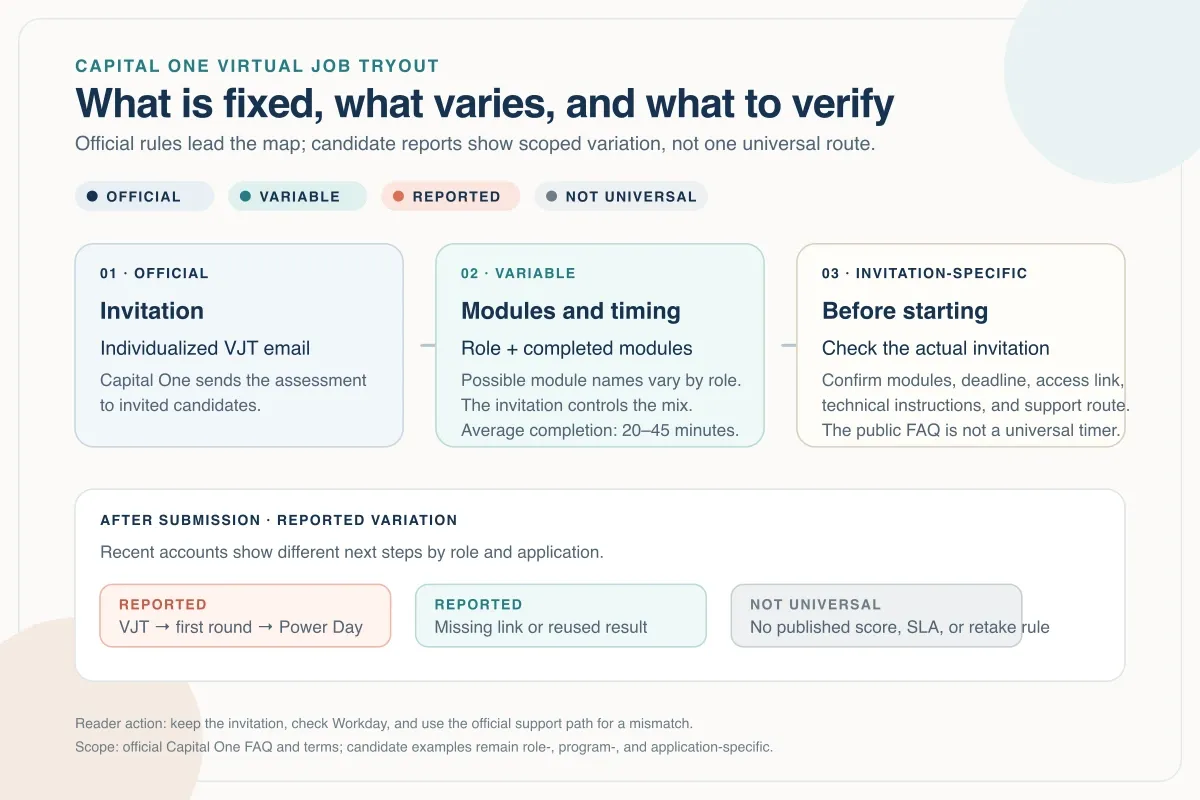
What is fixed, what varies, and what Capital One has not published as a universal VJT rule.
What the Capital One Virtual Job Tryout is
Capital One describes the VJT as an individualized assessment email for invited candidates. The assessment gives Capital One a better understanding of candidates’ experiences, strengths, and approach to work. The exact invitation depends on the role and on modules already completed.
Keep nearby recruiting labels separate:
- Virtual Job Tryout: the individualized assessment covered by the Capital One FAQ and the possible modules below.
- CodeSignal: a separate coding-assessment stage. A VJT invitation does not establish that the VJT runs on CodeSignal.
- Virtual Test: a position-dependent event listed separately in Capital One’s broader student interview guide.
- Automated assessment: a broader label that the same guide says may evaluate communication, customer focus, leadership, and problem solving. That wording is not a universal VJT scorecard.
- Interview and Power Day: adjacent recruiting events that can appear in some role-specific processes, not modules inside every VJT.
Match the exact assessment name in your invitation before preparing. The application may contain a VJT, a coding assessment, a live interview, or Power Day without making those events interchangeable.
Capital One VJT Monitoring, Proctoring, and AI-Use Policy
Capital One's Candidate Terms and Conditions require independent completion. Unless the invitation specifically grants permission, the terms prohibit external resources, third-party assistance, programs, AI tools, existing materials, screenshots, screen recordings, and transcription. The VJT is an assessment to complete inside its own instructions, not a screen to capture for an outside assistant.
For roles that require proctoring, the same terms direct candidates to complete an Honorlock System Check before starting. Honorlock may flag unusual sounds, eye movements, and device use for Capital One review; the terms do not establish Honorlock as a universal VJT control. First Round and Power Day video or recording rules belong to interview stages and should not be transferred to every VJT invitation.
An Invisible App is not truly invisible. When the answer appears on the same device as the interview, it is exposed to the device, screen, and session controls monitoring that environment. InterviewFox's real-time AI interview assistant Dual-Device Mode displays the answer on a phone while the interview computer stays focused on the call.
Land offer with Safer AI Interview Assistant
Skip the risky invisible apps. Our dual-device mode keeps it simple and undetectable. You crush the interview, we handle the answers.
Get started. It's freeLoved by 100,000+ candidates
What can appear in the assessment
The official FAQ gives possible module names and general purposes, not one guaranteed combination or sequence. Prepare for the modules named in your invitation.
Manage Relationships
Manage Relationships presents decisions or responses to scenarios common to the role. Prepare examples that show how you handle competing priorities, stakeholder needs, disagreement, and follow-through. Make the decision, reason, and result visible.
One Business Analyst ADP candidate report for an August 2026 start describes a manager considering whether to buy a new product for the team. The candidate reported choosing the action most likely to happen and the action least likely to happen. This is one role- and program-scoped situational-judgment example; it does not establish the format of every Manage Relationships module or every Capital One VJT.
Work Your Business Case
Work Your Business Case asks you to review and integrate information from multiple sources about a fictitious business and offer solutions. The supported preparation target is the reasoning process: gather relevant facts, connect them, identify the business problem, and recommend a practical response.
One Business Analyst rotational-program candidate report for a February 2027 program, found during the 2026 recruiting-cycle research, describes one VJT version in a restricted Google Sheets interface. The candidate reported moving through sheet tabs where each tab represented a new question.
The report describes comparing delivery-carrier success rates from volume and successful-delivery data. It also describes evaluating a trade-off between one high-performing driver and three lower-performing drivers. The report says there were 12 questions, an approximately 2.5-hour completion window, and about 1.5 hours of personal completion time.
Those details belong to that February 2027 BA rotational-program report. They do not establish that every VJT uses Google Sheets, delivery-carrier data, 12 questions, or a 2.5-hour window.
The official description does not establish a fixed dataset, question count, scoring formula, or universal math section. A Summer 2027 Finance, Management, and Commercial Internship candidate report describes concern about business-case math after completing a VJT. That is a narrow reported concern, not a universal question pattern. Refresh basic quantitative reasoning without treating any one report as a promised question bank.
Tell Us Your Story
Tell Us Your Story covers work experiences and background. Build concise resume-backed examples showing ownership, learning, communication, problem solving, and impact. State your own contribution and the result.
Describe Your Approach
Describe Your Approach focuses on preferred style or approach to work. Answer consistently with how you actually operate. Specific examples of planning, decision-making, collaboration, and adjustment are stronger than an invented “correct” personality.
There is no public fixed question count or universal four-section order. Capital One’s invitation controls the applicable modules.
InterviewFox can use your resume, target role, and personal examples as rich context, then provide personalized answers in the interview through its personalized AI interview assistant.
How long it takes and what to verify before starting
Capital One publishes an average VJT completion time of 20–45 minutes. Treat that as an average planning range, not as a fixed timer or guaranteed completion window.
Before opening the assessment, verify these items from your invitation and candidate account:
- Assessment name: confirm that the email says Virtual Job Tryout rather than CodeSignal, Virtual Test, an automated assessment, or an interview event.
- Modules: record the modules named in the invitation. Role and previously completed modules can change the assessment.
- Deadline and access link: use the deadline and link supplied by Capital One. The published VJT material does not establish one universal deadline.
- Technical instructions: follow the device, browser, recording, and other requirements in your own invitation. The public FAQ does not establish one universal rule for every VJT.
- Support route: keep the email and attachments. Capital One directs candidates to the Workday email, the Workday profile task and its PDF link, and careers support when application access needs attention.
The published material does not establish a universal question count, score or pass line, section sequence, fixed deadline, device/browser rule, retake rule, or result SLA. Apply the instructions attached to your invitation.
What Capital One says it evaluates
For the VJT specifically, Capital One says the assessment helps it understand experiences, strengths, and approach to work. The module descriptions add role-scenario judgment, background, work style, and business-case reasoning.
The separate student interview guide describes an automated assessment that may evaluate communication, customer focus, leadership, and problem solving. Keep that statement in the guide’s broader scope; it is not a published universal VJT rubric. Capital One does not publish a VJT pass score, weighting model, ranking formula, or section-by-section grading key in the FAQ.
Prepare to make reasoning visible, connect decisions to role responsibilities, use specific evidence from experience, and offer solutions that follow from the case information. Do not optimize for an invented threshold.
Why another candidate’s VJT may look different
Recent candidate reports show role and application variation. Each account below remains separate; none defines a standard Capital One route.
Strategy Analyst: a complete progression after the VJT
In a 2026 new-grad Strategy Analyst report, InspectorNo9372 reported applying on February 17 and completing the VJT on February 20. The account then described a first round on March 6, Power Day on March 23 and 25, and a later signed offer. This is a role-specific timeline and outcome, not a universal sequence or SLA.
The same thread includes a question about math and break-even analysis. The author replied that the assessment type matters and that Capital One sent a guide. That exchange reinforces the invitation-specific boundary; it does not establish a universal math section.
Business Analyst rotational program: missing link and reused result
In a Business Analyst rotational program report, NoVariation6812 reported applying on June 15 without receiving a confirmation email or VJT link. The author had applied the previous year, reported not passing that VJT, and later reported that the new application reused the previous year’s score. The author also reported that first-time candidates received a VJT in about 73 hours.
That account is useful when an application appears to skip the expected assessment: check the application record and official support route before assuming failure. The 73-hour observation and reported score reuse are role- and account-specific; they do not establish a universal invitation, validity, expiry, or retake policy.
Summer 2027 internship: business-case concern and candidate review
In the Summer 2027 Finance, Management, and Commercial Internship report, No-Neighborhood2564 reported completing a VJT and seeing In progress – candidate review in Workday for about a month. The candidate was concerned about business-case math and later reported that the same VJT was reused on a later application.
A commenter in that thread reported being in candidate review for weeks and relayed a recruiter’s interpretation that reaching that stage meant the VJT had been passed in the finance-internship context. That interpretation was limited to that program and does not define every Capital One status.
The practical rule is direct: interpret Workday status alongside the role and application you actually submitted. Candidate review is not a published universal pass/fail display rule, and no candidate report establishes a guaranteed result timeline.
What to do after submitting
- Save the invitation and completion confirmation. Keep the assessment name, role, deadline, and confirmation together.
- Check Workday. Capital One’s FAQ identifies Workday as the place to review application status.
- Resolve a missing link through the official path. Check the Workday email, the task in your Workday profile, and the PDF inside that task. If access is still missing, use Capital One careers support rather than duplicating applications.
- Treat the next stage as role-specific. The Strategy Analyst account reports a VJT-to-first-round-to-Power-Day progression; the Business Analyst account reports a missing link and reused result; the Summer 2027 internship account reports extended candidate review. These are different application outcomes, not a standard sequence.
- Do not infer a result from elapsed time alone. The FAQ supplies status and support routes, not a VJT result SLA. Candidate reports of days, weeks, or about a month have different roles and timing anchors.
If you need an accommodation, use the accommodation contact listed in the official FAQ. Tie the request to the invitation and application record so the recruiting team can identify the correct assessment.
Preparation checklist for this invitation
Use the invitation to choose the final preparation set. The checklist below transfers across possible modules without pretending that every candidate receives every module.
Prepare your experience evidence
- Select several resume-backed examples with clear actions and results.
- Include one example of resolving a relationship or stakeholder problem.
- Include one example of making a decision with incomplete or competing information.
- Explain your specific contribution rather than the team’s general result.
Practice the business-case process
- Read every source before choosing a solution.
- Separate facts, assumptions, risks, and recommendations.
- Check arithmetic and units before finalizing a business conclusion.
- State why the recommendation solves the stated problem and what you would monitor next.
This prepares the reasoning demanded by Work Your Business Case without relying on an invented Capital One question bank.
Match the role and invitation
- Use the role description to select examples and scenarios.
- Review the exact modules named in the invitation.
- Remove preparation for CodeSignal, Virtual Test, interviews, or Power Day unless recruiting instructions separately schedule those stages.
- Reserve a quiet, private completion window that covers the official 20–45 minute average and any setup required by your invitation.
Finish with a submission check
- Confirm the correct application and assessment name.
- Confirm that every required module is submitted.
- Save the confirmation and return to Workday.
- Record any status mismatch immediately and use the official support route.
For candidates who later receive a separate CodeSignal invitation, coding preparation belongs to that adjacent assessment stage, not to the Capital One Virtual Job Tryout. Keep the two assessments and preparation plans separate.
FAQ
What is the Capital One Virtual Job Tryout?
It is an individualized, role-dependent assessment sent by email. The applicable modules can change by role and by modules already completed, so the invitation controls the version you receive.
How long does the Capital One VJT take?
Capital One gives an average completion time of 20–45 minutes. That is a planning range, not a universal timer or guaranteed completion window.
Does every Capital One VJT use the same questions?
No. The possible modules are Manage Relationships, Work Your Business Case, Tell Us Your Story, and Describe Your Approach, but the combination, question count, interface, and sequence can vary by role and application.
What should I do if the VJT link or status is missing?
Check the Workday email, the task in your Workday profile, and the PDF inside that task. If the assessment still does not appear, use the Capital One careers support route tied to your application instead of assuming that the application failed.