
I Passed Cisco HackerRank Questions in 2026: Real Questions

Quick Facts
| Platform | HackerRank |
| Questions | 3 to 5 coding questions (most recent 2025 first-person report: 5) |
| Time limit | 90 minutes |
| Difficulty | Easy to Medium |
| Languages | Candidate-chosen (Python3, JavaScript reported) |
| Proctoring | HackerRank Proctor Mode (AI-powered) may be enabled |
| AI-tool risk | An overlay or answer window can trigger integrity review and a suspended session |
| Guide year | 2026 (assessment reported late April 2026) |
I took the Cisco HackerRank OA for a new grad software engineering role in late April 2026. The assessment gave me five coding questions in a 90 minute window, and I solved them in Python. What follows is the complete process and how I prepared for the Cisco HackerRank questions.
One question nearly broke my run: a coin change variant where the constraints were never stated clearly, and I was still debugging hidden tests with the clock running down. I used AI interview assistant to check the edge cases I might be missing. It surfaced the negative-value ambiguity I had not considered, which I break down in the walkthrough below.
Before my test, I went through every Cisco HackerRank post from the past two years on Reddit, LeetCode Discuss, and Teamblind. What I found tracks closely with what I experienced. The rest of this guide covers the specific traps that get people flagged or rejected.
The Real Questions on My Cisco HackerRank Test
I sat the Cisco HackerRank OA in late April 2026. It was five coding questions in a 90 minute window, and I worked in Python.
Question 1: Apple Grouping with Max Weight Difference
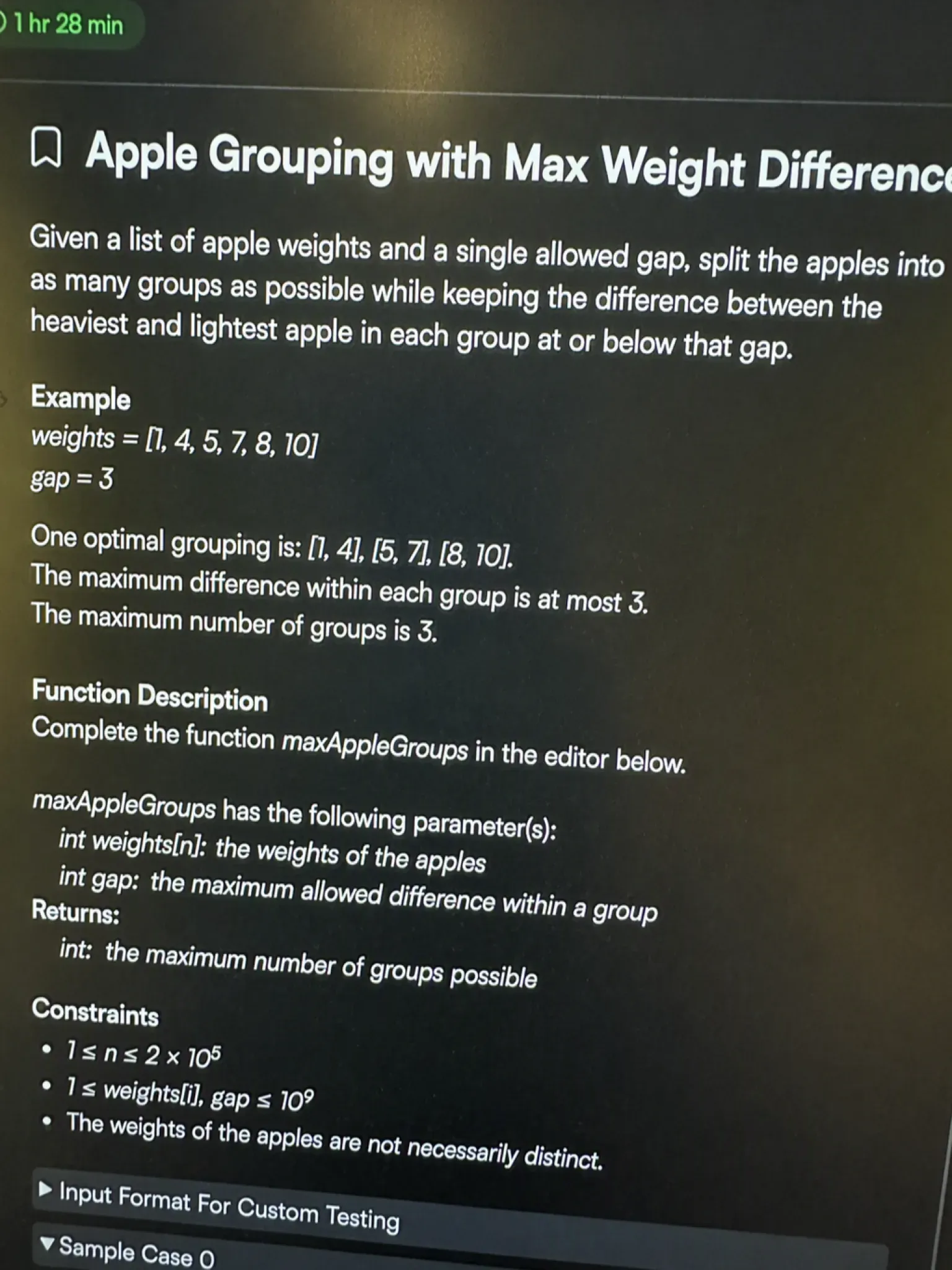
The problem handed me a list of apple weights and a single allowed gap. I had to split the apples into as many groups as possible while keeping the difference between the heaviest and lightest apple in each group at or below that gap.
My approach was to sort the weights first, then sweep left to right with a running window. Whenever adding the next apple would break the gap limit, I closed the current group and started a new one. The greedy sweep runs in O(n log n) from the sort, and it passed every test case.
Question 2: Water Jug Target Volume
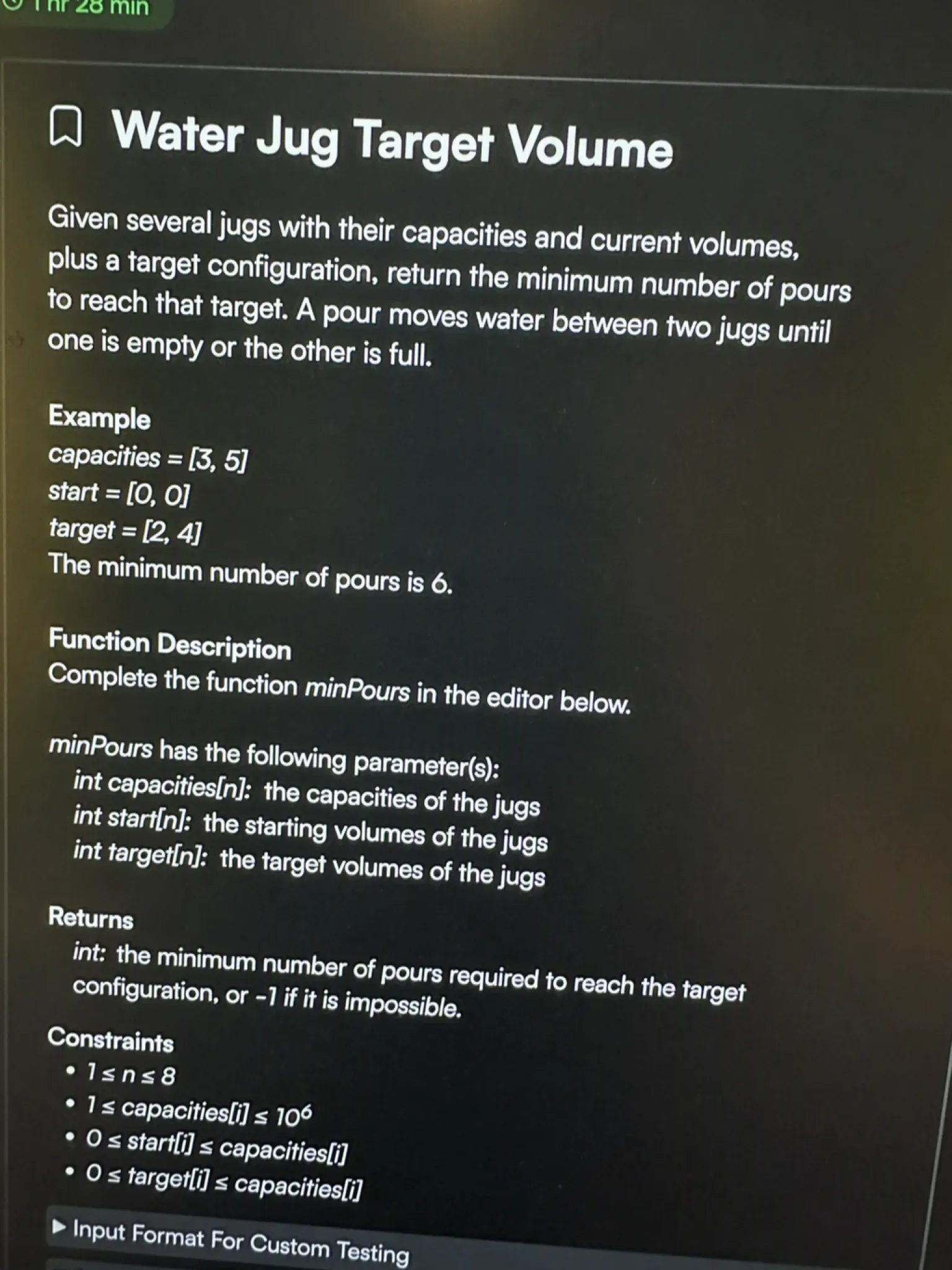
I was given several jugs with their capacities and current volumes, plus a target configuration. The task was the minimum number of pours to reach that target, where a pour moves water between two jugs until one is empty or the other is full.
I treated each full state of the jugs as a node and poured to its neighbors, then ran a breadth first search from the start state to the goal. BFS finds the shortest pour sequence, and the queue stays small for the given limits, so it cleared all the hidden cases.
Question 3: Longest Subarray via Sliding Window
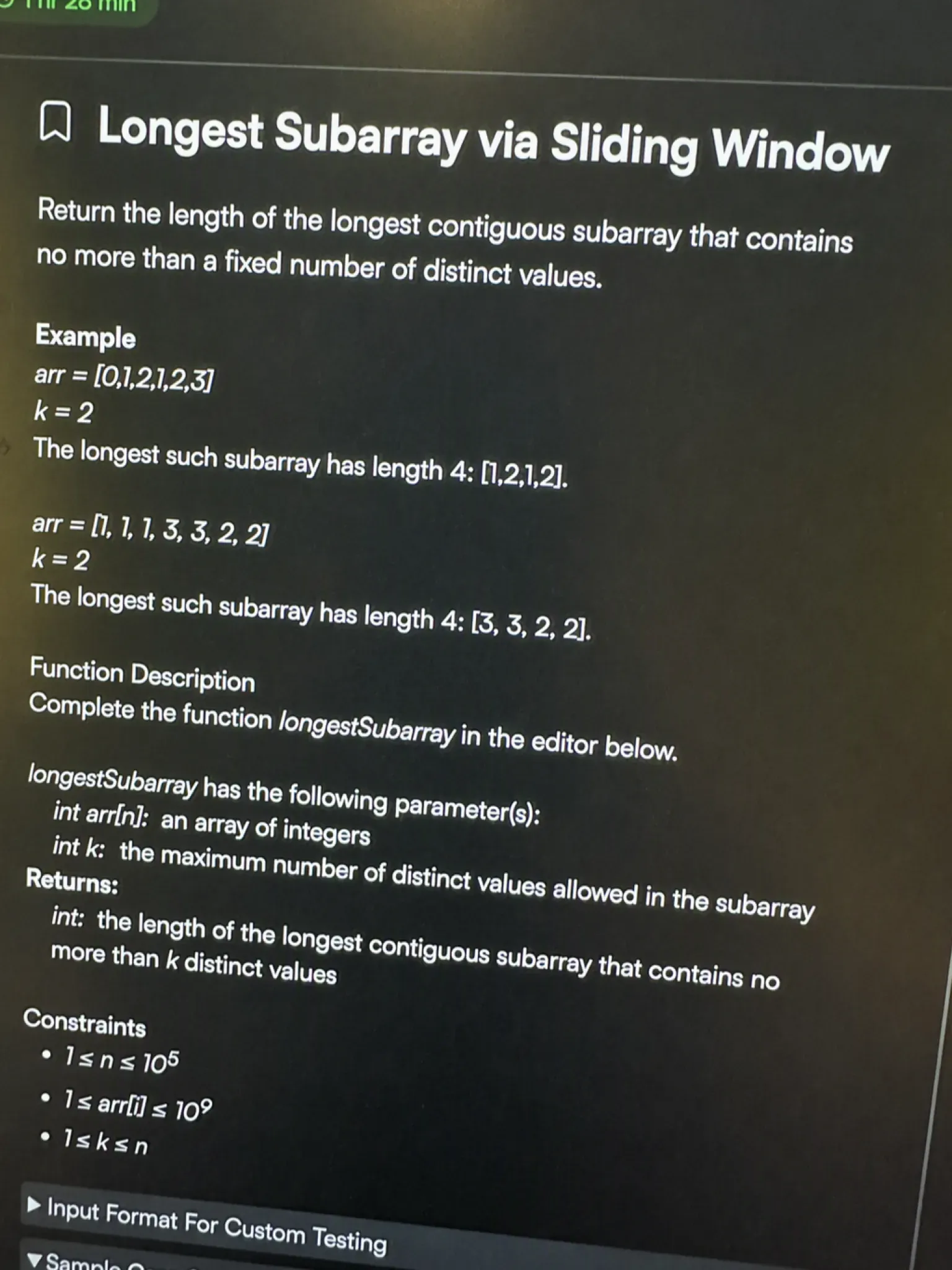
This was a basic sliding window question. I had to return the length of the longest contiguous subarray that contained no more than a fixed number of distinct values.
I moved two pointers across the array and kept a frequency count of the values inside the window. When the distinct count went over the limit, I shrank the left side until it was valid again, and tracked the widest window I saw. It took me about ten minutes and passed cleanly.
Question 4: Maximum Coins for a Target Sum
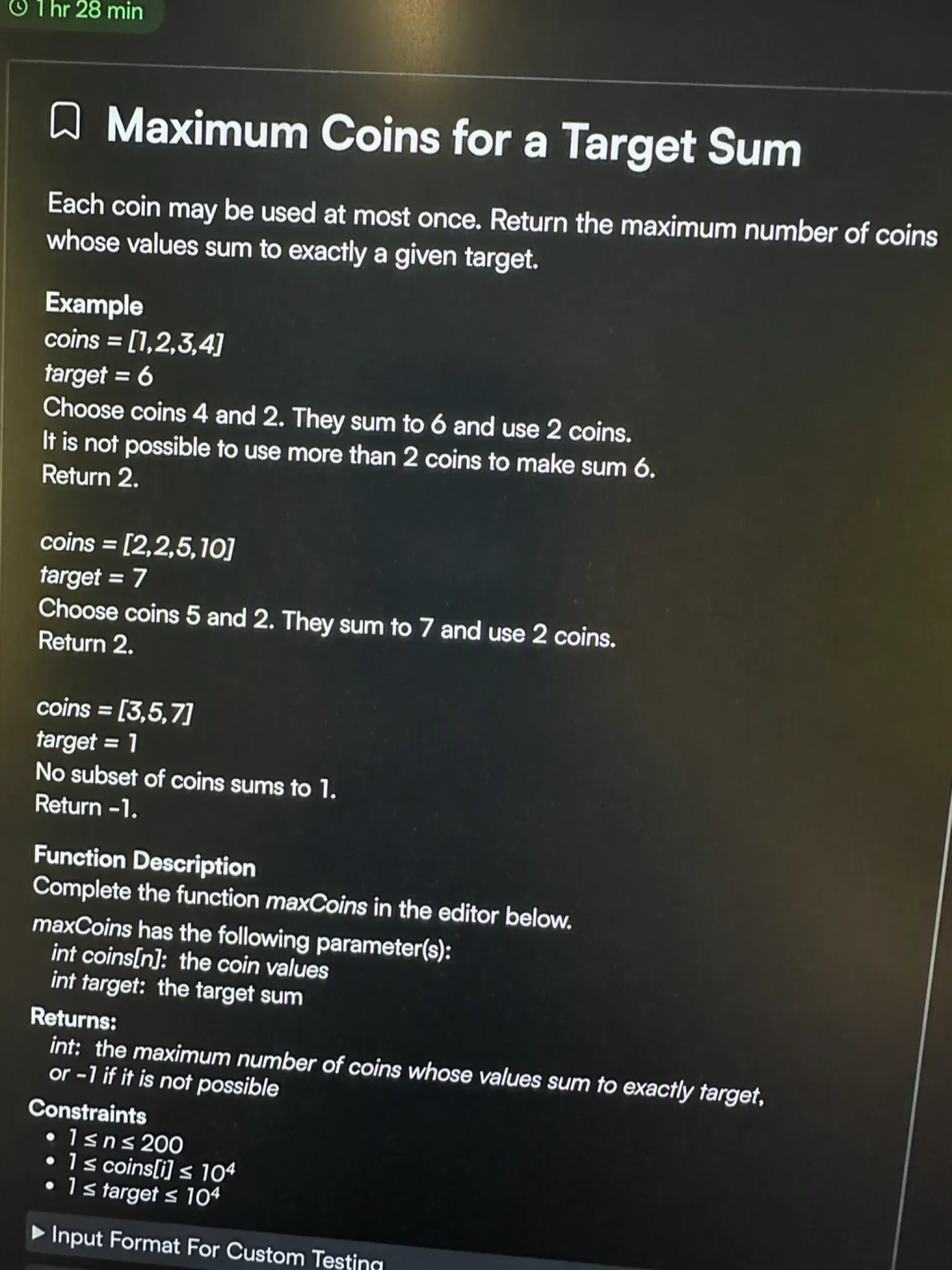
The fourth problem was a coin change variant. Each coin could be used at most once, and I had to return the maximum number of coins whose values summed to exactly a given target.
I first reached for dynamic programming, but the constraints were never stated clearly, so I doubted whether negative coin values or a negative target were possible. Without the DP I passed nine of twelve cases; with the DP I only passed three, which told me the constraint assumption was wrong. I was still debugging the hidden tests when the screen changed on me.
Question 5: Binary Linked List to Integer
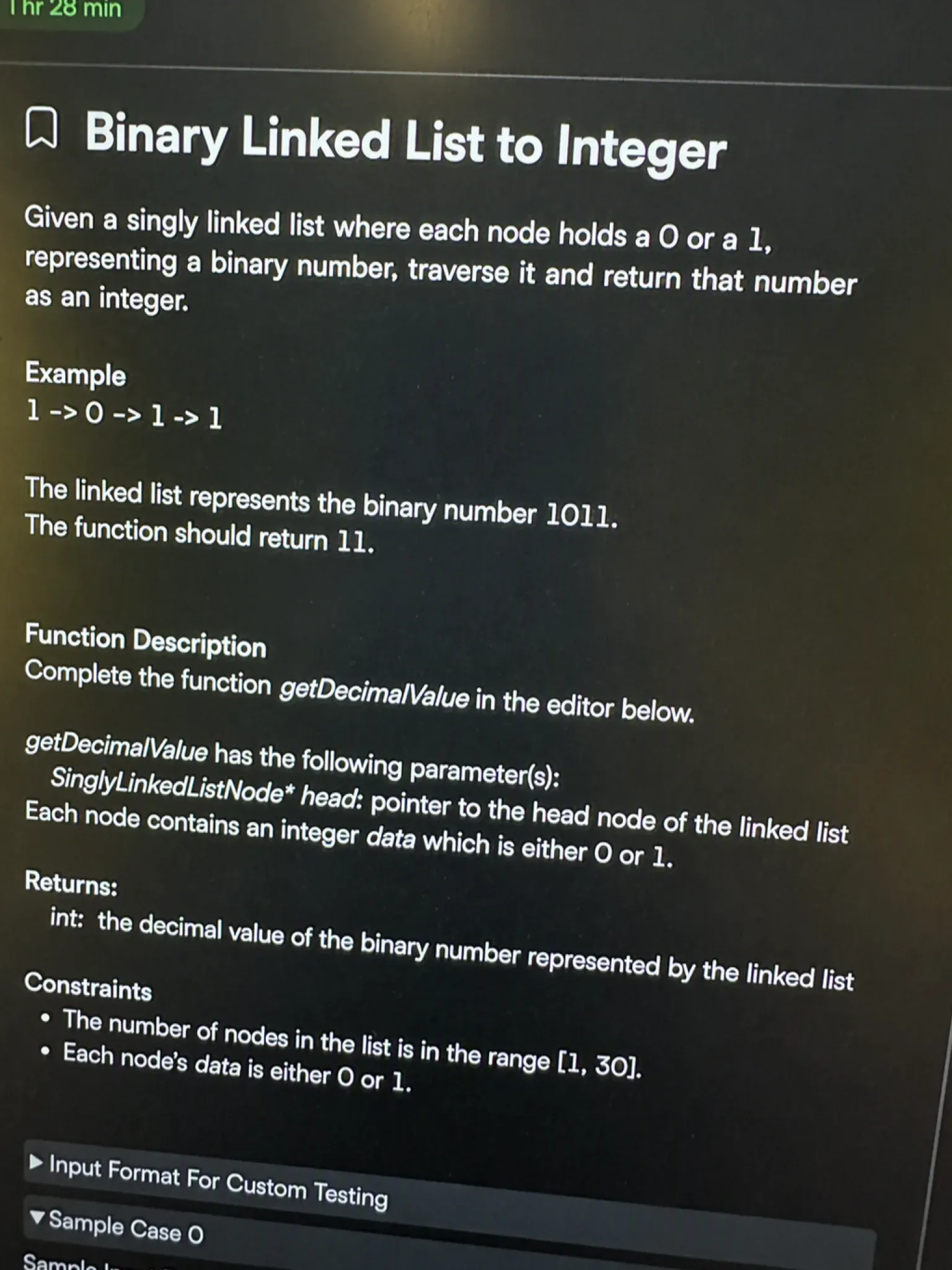
The fifth problem showed a singly linked list where every node held a 0 or a 1, and the whole list represented a binary number. I was meant to traverse it and return that number as an integer.
My plan was a single pass: carry the running value, shift left by one, and add the current bit at each node. I never got to write it.
While I was running a hidden test debugging pass on the coin change problem, the test jumped to an integrity review screen instead of returning me to the question. The session was suspended, and the invitation link would no longer reopen the assessment.
When I hit that coin change variant and the constraints never showed up, I did not want to open a desktop overlay tool for help. The answer would have sat on the same screen the proctoring system watches, hidden by a basic rendering trick, and I did not want that uncertainty behind me.
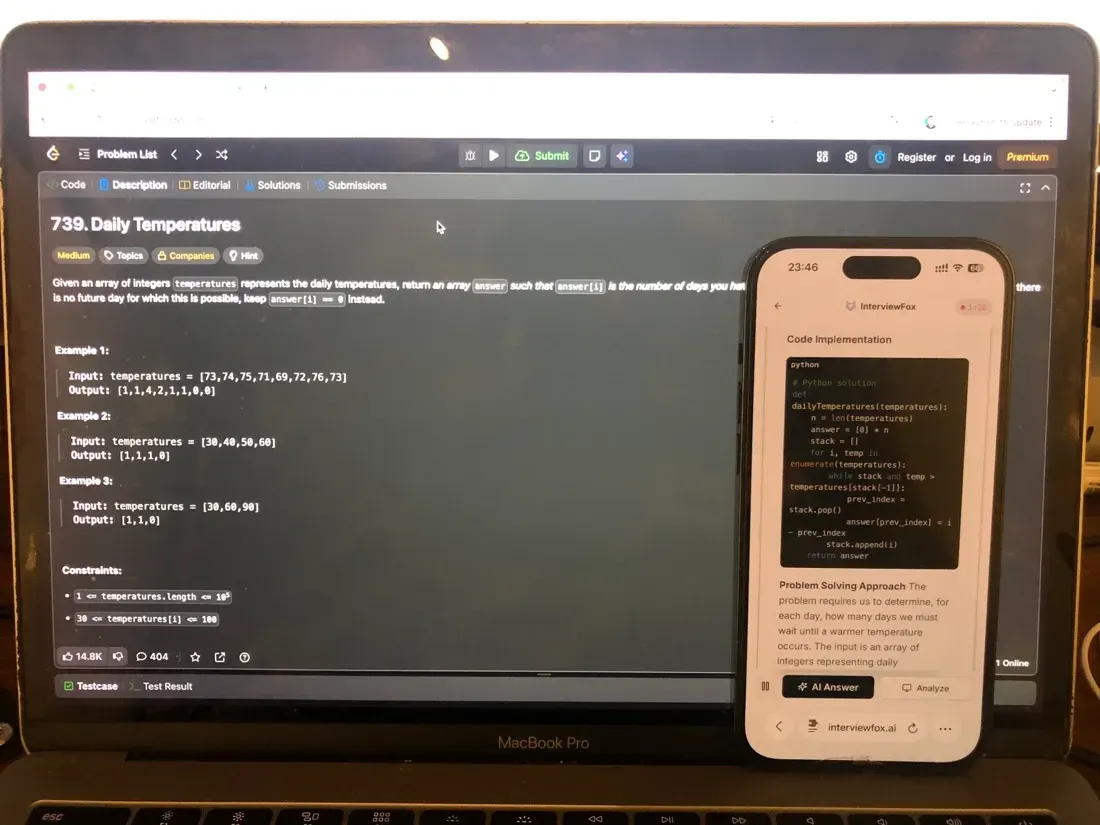
Instead I used the AI interview assistant, which pushed the approach to my phone. My laptop screen stayed on the problem editor, unchanged, while I read the hint on a separate device.
Land offer with Safer AI Interview Assistant
Skip the risky invisible apps. Our dual-device mode keeps it simple and undetectable. You crush the interview, we handle the answers.
Get started. It's freeLoved by 100,000+ candidates
Cisco's Proctoring Policy for HackerRank
Cisco runs the OA on HackerRank, and HackerRank Proctor Mode may be enabled for the test. This AI-powered layer watches more than the code you submit. The official Proctor Mode documentation explains how the monitoring behaves during a live assessment.
What Proctor Mode Actually Watches
Proctor Mode tracks tab switching, unauthorized tools, face anomalies, and webcam object detection. It also reads code-editor conversation patterns and gaze direction. One thing people wonder is whether HackerRank logs a tab switch while the timer runs.
The system also captures what is on your display. The full scope of what HackerRank records from your screen goes beyond a single snapshot and feeds the post-test review.
When the Session Gets Flagged
A flag raises an integrity indicator and produces a summary report after the test. If the review confirms a problem, the candidate gets the integrity summary and the session status updates. This is the moment the private case below lands.
10 Other Confirmed Cisco HackerRank Questions
These are real questions other candidates reported, kept separate from my own exam above. Each one is sourced to a named candidate report.
Apple Grouping (max weight diff)
LeetCode Discuss candidate #5546515 reported this as a Cisco OA problem in 2024. You get a list of apple weights and a maximum allowed gap, then group them so each group's spread stays within the gap. Sort, then sweep with a running window and close a group when the next apple breaks the limit. The greedy pass is O(n log n).
Water Jugs Target Volume
Also from #5546515: several jugs with capacities and current volumes, plus a target. Find the minimum pours to reach it. Model each jug configuration as a node and pour to neighbors, then BFS from start to goal. BFS gives the shortest sequence and the state space stays small.
Sliding Window (easy)
Candidate #5908835 (SDE-2, 2024) saw a longest-subarray sliding window: return the longest contiguous run with at most k distinct values. Two pointers with a frequency map, shrink from the left when distinct exceeds k. This is a clean warm-up in the Easy band.
Coin-Change Variant (max coins)
Also #5908835: a coin change variant asking for the maximum number of coins that sum to an exact target, each coin used at most once. The report notes lost cases from unstated constraints, likely negative values. Clarify the constraint range before committing to DP.
4-Jug Pouring
Still #5908835: a four-jug pouring puzzle, the same BFS-over-states idea as the two-jug version but with more dimensions. Encode the full jug tuple as the node, pour between any pair, and BFS for the shortest sequence to the goal.
Binary Linked List to Number
Candidate #1816650 (2022, Easy-Medium) got a singly linked list of 0/1 bits representing a binary number, return it as an integer. Single pass: carry the running value, shift left by one, add the current bit. Watch for overflow on long lists.
Count Sundays in a Year
Also #1816650: count how many Sundays fall in a given year. Iterate the dates or use Zeller's congruence per month start. The trick is the leap year rule, not the loop itself. Straightforward once the calendar math is right.
Circular Primes Below n
Also #1816650: list circular primes below n, primes whose every rotation is also prime. Generate primes up to n, then rotate digits and re-check primality for each. Keep the primality test tight since you repeat it on every rotation.
Max Subsequence (adjacent diff 0/1)
Also #1816650: a max subsequence where adjacent chosen elements differ by 0 or 1. DP over the value domain works: for each value track the best chain ending there, then extend by one step up or down. O(n) after counting frequencies.
Perfect Number Check
Also #1816650: test whether a number is perfect, equal to the sum of its proper divisors. Sum divisors up to sqrt(n); the trap is double counting the square root. Small input ranges make a simple divisor loop fast enough.
What Cisco's HackerRank Test Format Actually Looks Like
The format is consistent across candidate reports from 2021 to 2025. The bar is 90 minutes, and the question count lands between three and five depending on role and level.
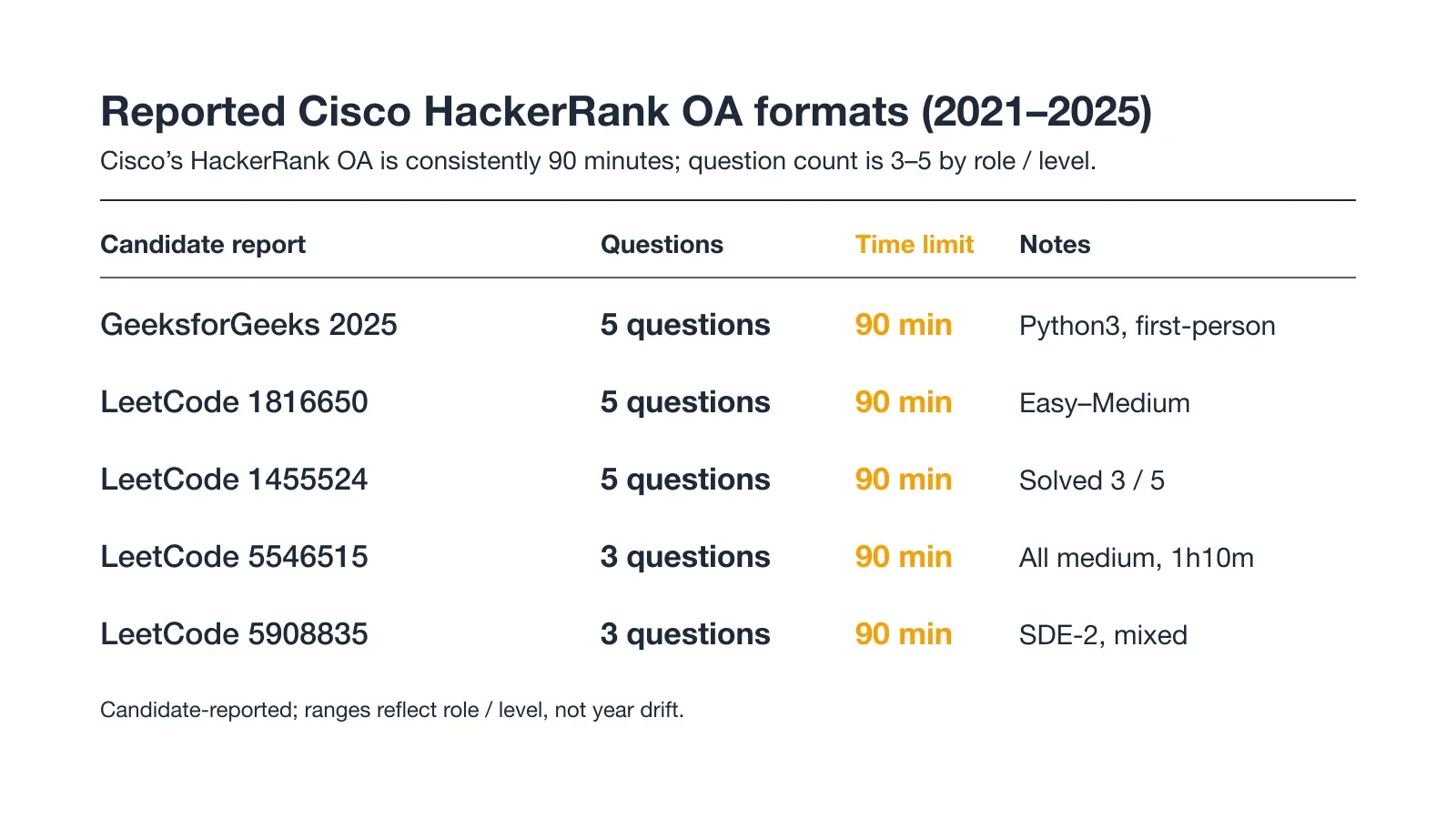
Question Count and Time Box
GeeksforGeeks 2025 reports five questions in 90 minutes in Python3. LeetCode candidates #1816650, #1455524, and #5546515 all describe a 90 minute window, with question counts of five, five, and three. The time box is the one fixed constant.
Difficulty and Language
Most reports place the questions in the Easy to Medium band. #5546515 calls them all medium, while #1816650 mixes easy and medium. The platform lets you pick the language, with Python3 and JavaScript both seen in real attempts.
How Cisco's HackerRank Scoring Works
HackerRank scores each question by the test cases you pass. There is no single published Cisco cutoff, so completion is the only observable bar.
Test-Case Scoring and Partial Credit
Scoring is per question, by cases passed. Candidate #5908835 is the clearest proof of partial credit: nine of twelve cases passed without the DP, three of twelve with a wrong constraint assumption. Each case you clear is real progress.
What "Enough" Looks Like
Cisco does not publish a pass threshold for the OA. What we can say is that finishing cleanly correlates with moving forward, while a suspended or mostly empty submission does not. Treat full completion as the target, not a guess at a number.
Cisco HackerRank Exam-Day Strategy
These are moments pulled from real attempts, not generic advice. The clock is tight, and how you spend it decides the outcome.
Pace for the 90-Minute Box
Candidate #5546515 finished all three medium questions in about 1 hour 10 minutes, leaving a buffer. Candidate #5908835 cleared question one in roughly ten minutes. A steady pace on the first question buys room for the harder ones later.
When You Get Stuck Mid-Problem
Candidate #5908835 stalled on the coin change variant from unclear constraints. When that happens, write the brute force, then test both constraint assumptions against the hidden cases instead of over-engineering one guess. I hit the same wall on my own coin change question.
Don't Expect to Finish Everything
Candidate #1455524 solved only three of five questions in the time box. That is normal, not a failure. Prioritizing the questions you can finish cleanly matters more than starting at the top and stalling.
Why Candidates Fail the Cisco HackerRank Assessment
The failures below are specific and named. The first one comes from a late April 2026 candidate report.
The Overlay / AI-Tool Trap
One candidate report from late April 2026 left a borderless desktop answer window active for a Cisco assessment. The tool rendered its answer on the same screen the proctoring system monitors. It hid by a basic OS-layer trick but stayed on-screen.
During a hidden-test debugging pass the screen jumped to an integrity review instead of the question. The session was suspended, and the invitation link would not reopen it.
HackerRank's Review Integrity Issues flow documents how a flagged session moves to that integrity summary and suspension.
The deeper question is how HackerRank flags cheating and launches an integrity review once the monitoring suspects a tool. InterviewFox works differently: the answer goes to my phone, a physically separate device that no screenshot or session recording can reach by design.
Land offer with Safer AI Interview Assistant
Skip the risky invisible apps. Our dual-device mode keeps it simple and undetectable. You crush the interview, we handle the answers.
Get started. It's freeLoved by 100,000+ candidates
Losing Cases to Unclear Constraints
Candidate #5908835 lost cases on the coin change variant because the constraints were never stated. Possible negative values or a negative target changed which DP was correct. The only fix is to test both assumptions against the hidden cases rather than trust one.
Running Out of Time
Candidate #1455524 solved only three of five questions in the time box. That is a common outcome, not a disqualifier by itself. The risk is spending the whole window on one problem and leaving the rest untouched.
How to Prepare for the Cisco HackerRank in 7 Days
The plan below is built from the confirmed question categories, the scoring model, and the failure causes above. It skips anything the evidence does not support.
Days 1-2: Greedy Grouping and BFS Jug Problems
My first drills covered greedy grouping and BFS state-space problems because they appear in two of the four real exams, the highest frequency in the bank. I skipped system-design prep and any deep Big-O theory grind. The OA is pure DSA at Easy-Medium, so those did not earn their time.
Days 3-5: Sliding Window and DP Under the 90-Minute Cap
I practiced sliding window and DP, especially coin-change style variants, because they show up on the SDE-2 real questions and carry the most scoring weight. Every set was timed under 90 minutes so the cap felt normal by test day.
Days 6-7: Simulate the OA and Clarify Constraints
I ran a full mock in one sitting, then drilled constraint clarification, the exact failure cause from candidate #5908835. Stating the constraint assumptions out loud before coding caught the negative-value traps that cost real cases.
In the days before the OA, I used the InterviewFox Prep Agent over WhatsApp. I sent it the confirmed Cisco question patterns and got a personalized drill plan and strategy back. It sat alongside the drills above as one practical step, not a separate pitch.
What Happens After You Submit the OA
A clean OA is the first filter, not the whole process. Here is what the reports show happens next.
The Cisco Interview Sequence
GFG's 2025 Cisco experience shows the loop after the OA: HackerRank round, then Tech I, Tech II, Managerial, and HR. The OA gets you into the pipeline, and the later rounds test depth the test cannot.
Real Wait-Time and Outcome Reports
A March 2026 LinkedIn post from a cleared candidate shows advancing past the OA is real and recent. Wait times vary by team, but a clean submission clearly moves you forward. If you want to compare platforms, another company's HackerRank OA with real questions and a prep plan follows the same engine and a similar loop.
FAQ
How many questions are on the Cisco HackerRank OA?
Most recent first-person reports describe five questions in 90 minutes. Older reports list three. The range is three to five depending on role and level, so prepare for the longer end.
How long is the Cisco HackerRank test?
The time limit is 90 minutes for every reported attempt from 2021 to 2025. Question counts vary, but the clock does not. Plan your pace around that fixed window.
What is the difficulty of Cisco HackerRank questions?
The questions sit in the Easy to Medium band. Some candidates call all five medium, while others mix easy and medium. The challenge is time pressure more than raw difficulty.
Does a single tab switch fail the Cisco OA?
A tab switch is logged by Proctor Mode, but a single switch is not automatically a failure. What triggers a suspension is a pattern or a tool signal, like an overlay window, that the integrity review flags.
Can I use an AI tool or invisible app during the Cisco HackerRank OA?
Desktop overlay tools put the AI's answer on your computer screen, rendered as a hidden layer above the browser using a basic OS trick. Proctoring software keeps adding detection as AI tools spread, so the answer is on-screen and the risk is not fixed.
InterviewFox pushes the answer to your phone, a separate device no screenshot or session monitoring can reach, so your laptop screen stays on the exam editor.
Land offer with Safer AI Interview Assistant
Skip the risky invisible apps. Our dual-device mode keeps it simple and undetectable. You crush the interview, we handle the answers.
Get started. It's freeLoved by 100,000+ candidates
What happens after you pass the Cisco HackerRank OA?
Reports from 2025 and 2026 show the next steps are technical interviews, then managerial and HR rounds. The OA is the entry filter, and a clean pass moves you into the full loop.