
How I Passed the Dropbox CodeSignal OA in 2026: Real Questions

Quick Facts
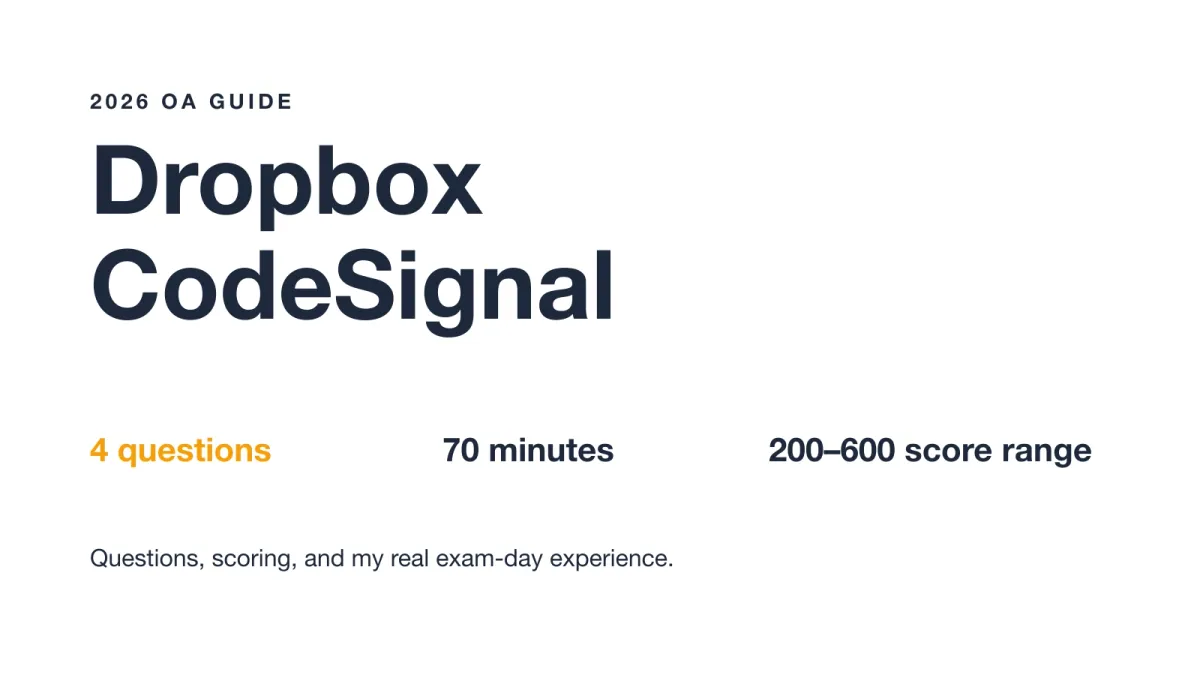
| codesignal dropbox format | Four questions in 70 minutes in the strongest February 2026 intern report |
| Current question mix | One algorithm question, two SQL tasks, and one Pandas data-manipulation task |
| Platform baseline | CodeSignal GCA documentation describes four questions in 70 minutes, but an invitation can use a different duration |
| Scoring | Certified-assessment Coding Score from 200 to 600; no Dropbox-specific cutoff verified |
| Proctoring | Conditional at the platform level; camera, microphone, screen, ID, and face-photo requirements depend on the setup flow |
| Current outcome evidence | No score or final result was documented in the strongest 2026 intern report; other outcomes vary by role and assessment variant |
I took the codesignal dropbox assessment for the Summer 2026 SWE intern track in Canada and received four questions in 70 minutes: one algorithm problem, two SQL tasks, and one Pandas task. What follows is the complete process, including the format, scoring, failure patterns, and preparation plan.
With the SQL section eating into my buffer, I kept checking whether an April 1 row could slip into the signup-count query and then used an AI interview assistant to check the retention denominator. It surfaced the inactive-January-user edge case, which I break down in the walkthrough below.
Before my test, I went through every Dropbox CodeSignal post from the past two years on Reddit, LeetCode Discuss, and Teamblind. What I found tracks closely with what I experienced, especially around mixed-format friction, uncertain proctoring, and the mistakes that can leave an assessment rejected or uncertified.
The Real Questions on My Dropbox CodeSignal Test
That four-question mix set the frame for the walkthrough below, where I show what each task demanded.
Question 1: Candy
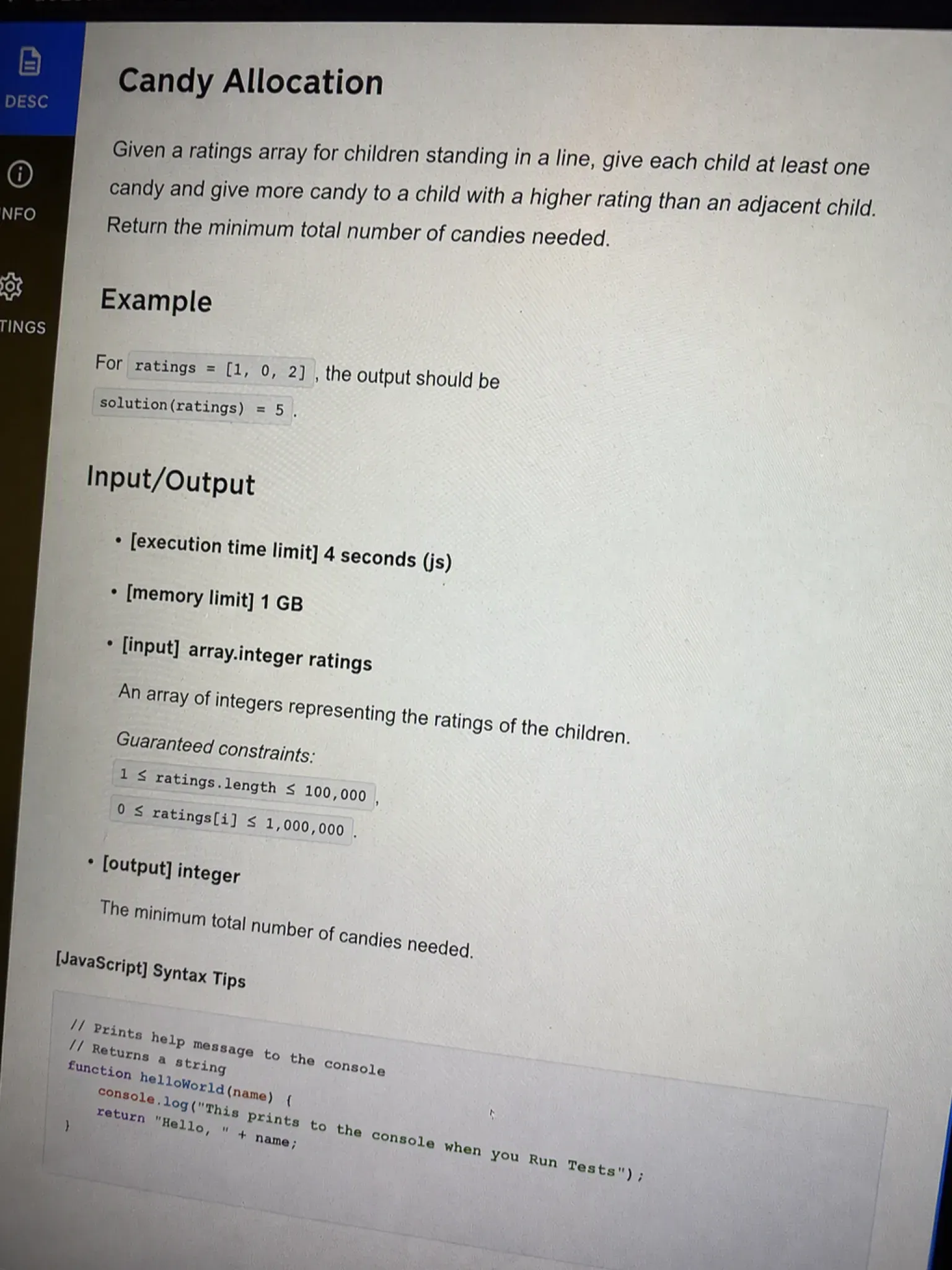
The problem I got: I had a ratings array for children standing in a line. I had to give each child at least one candy, give more candy to a child with a higher rating than an adjacent child, and minimize the total number of candies.
My approach: I made one pass from left to right for increasing ratings, then a second pass from right to left for decreasing ratings. The second pass kept the larger requirement from either direction, which handled a peak without breaking the rule from the first pass.
from typing import List


def candy(ratings: List[int]) -> int:
    if not ratings:
        return 0

    candies = [1] * len(ratings)

    for i in range(1, len(ratings)):
        if ratings[i] > ratings[i - 1]:
            candies[i] = candies[i - 1] + 1

    for i in range(len(ratings) - 2, -1, -1):
        if ratings[i] > ratings[i + 1]:
            candies[i] = max(candies[i], candies[i + 1] + 1)

    return sum(candies)
Time complexity: O(n) | Space complexity: O(n)
I recognized the two-pass invariant quickly, so this gave me a stable start. The database section demanded more careful syntax and date handling than this algorithm question did.
Question 2: Monthly Signup Counts
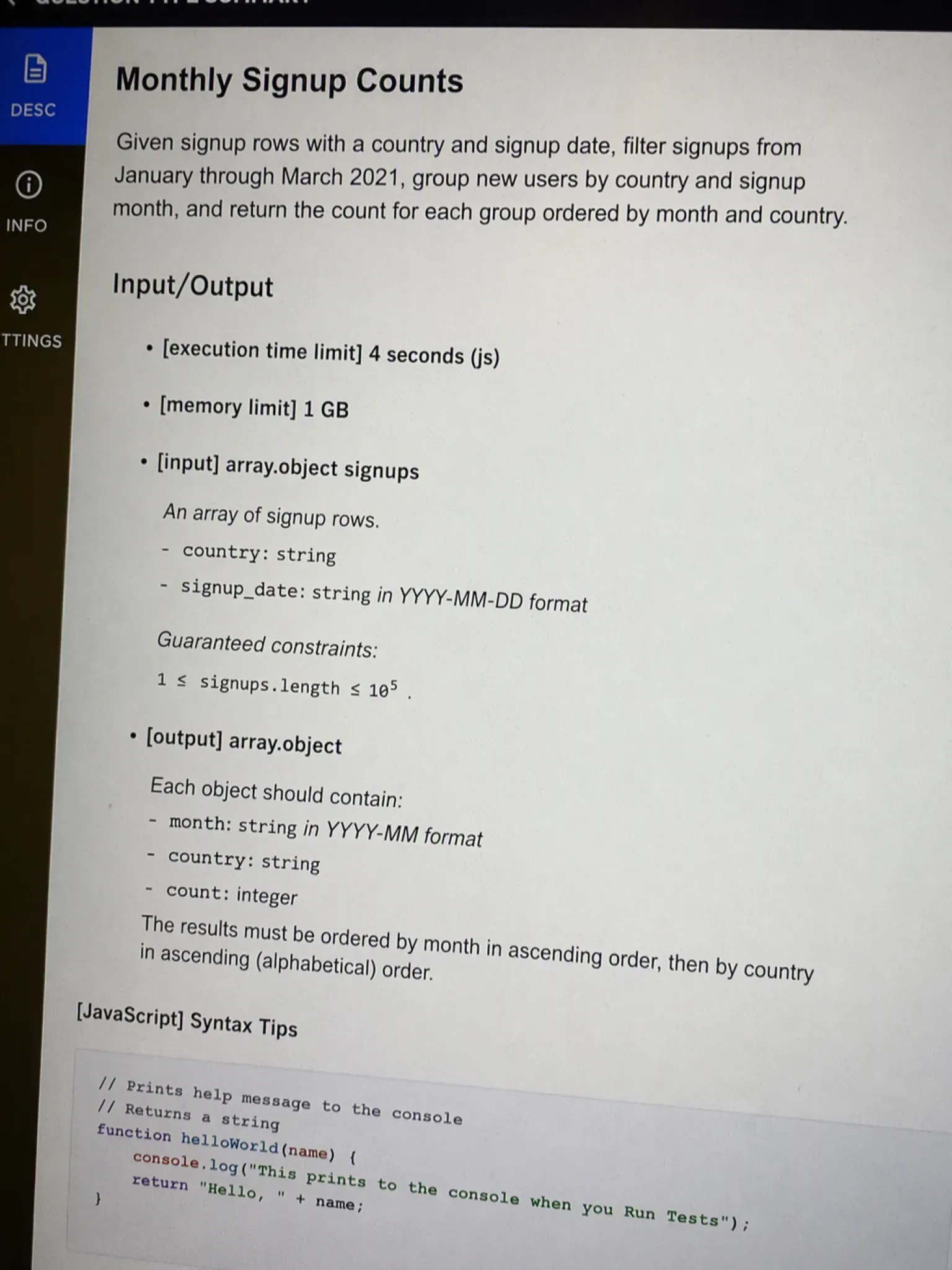
The problem I got: I had signup rows with a country and a signup date. I needed to filter the first quarter of 2021, group the new users by country and month, and return the count for each group.
My approach: I used a half-open date range so April 1 could not slip into the first-quarter result. I grouped by the truncated month and country, then ordered the output by month and country so the result was easy to check.
SELECT
    country,
    DATE_TRUNC('month', signup_date)::date AS signup_month,
    COUNT(*) AS signup_count
FROM user_signups
WHERE signup_date >= DATE '2021-01-01'
  AND signup_date < DATE '2021-04-01'
GROUP BY
    country,
    DATE_TRUNC('month', signup_date)
ORDER BY
    signup_month,
    country;
Time complexity: O(r) | Space complexity: O(g)
This was where the clock started to feel tight. I spent extra time checking the date boundary and the country-month grouping, and I carried that caution into the next SQL task.
Question 3: January-to-February Retention
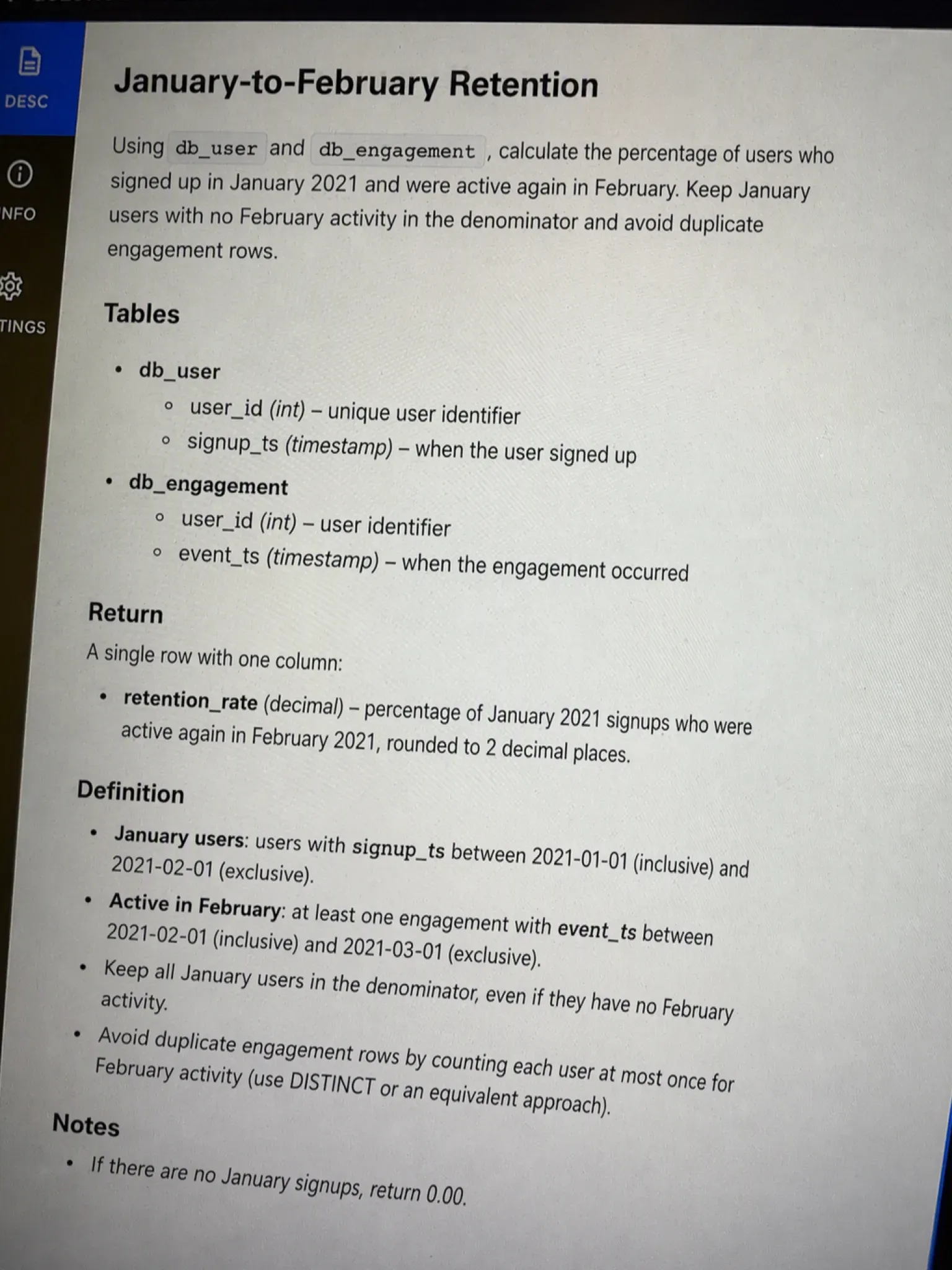
The problem I got: I had to calculate how many users from the January cohort were active again in February. The tables were db_user and db_engagement, and the result depended on keeping January users with no February activity in the denominator.
My approach: I built a distinct January cohort and a distinct February-active set first. Then I used a LEFT JOIN from the January cohort so inactive users stayed in the count, and divided the matched February users by the full January cohort.
WITH january_users AS (
    SELECT DISTINCT user_id
    FROM db_user
    WHERE signup_date >= DATE '2021-01-01'
      AND signup_date < DATE '2021-02-01'
),
february_active AS (
    SELECT DISTINCT user_id
    FROM db_engagement
    WHERE engagement_date >= DATE '2021-02-01'
      AND engagement_date < DATE '2021-03-01'
)
SELECT
    COUNT(f.user_id) * 100.0 / NULLIF(COUNT(j.user_id), 0) AS retention_pct
FROM january_users AS j
LEFT JOIN february_active AS f
    ON f.user_id = j.user_id;
Time complexity: O(u + e) | Space complexity: O(u + e)
This one took longer because I had to protect the cohort from duplicate engagement rows. By the time I submitted it, I had lost the comfortable buffer I had after the algorithm question.
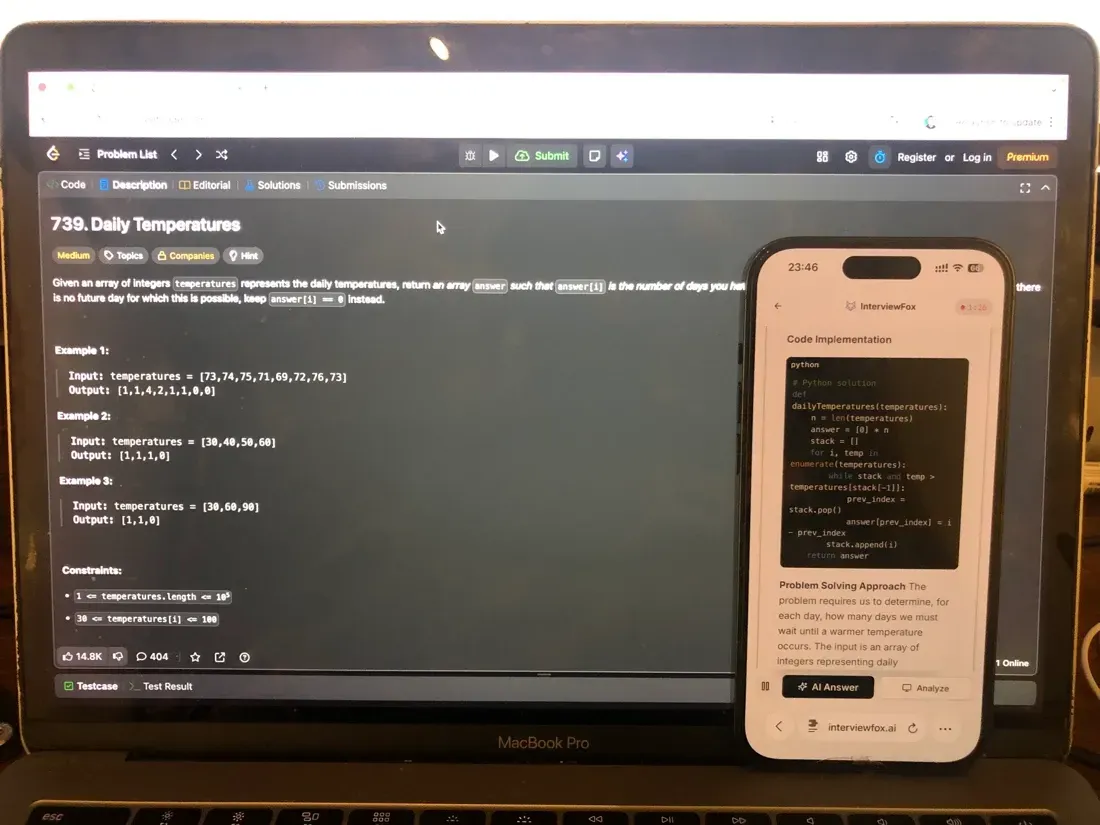
I did not want to use a desktop overlay. The answer would have been on the same screen the proctoring system was monitoring, hidden by a basic rendering layer. Whether that gets flagged depends on what detection is currently running, and I did not want that uncertainty in the background. Instead, I used InterviewFox's dual device AI interview assistant: a keyboard shortcut auto-captured the problem and pushed the answer to my phone, a separate device outside the platform's screenshot monitoring; the approach became clear while my laptop screen stayed on the CodeSignal editor, unchanged.
Land offer with Safer AI Interview Assistant
Skip the risky invisible apps. Our dual-device mode keeps it simple and undetectable. You crush the interview, we handle the answers.
Get started. It's freeLoved by 100,000+ candidates
Question 4: Country Contract Tie-Breaks
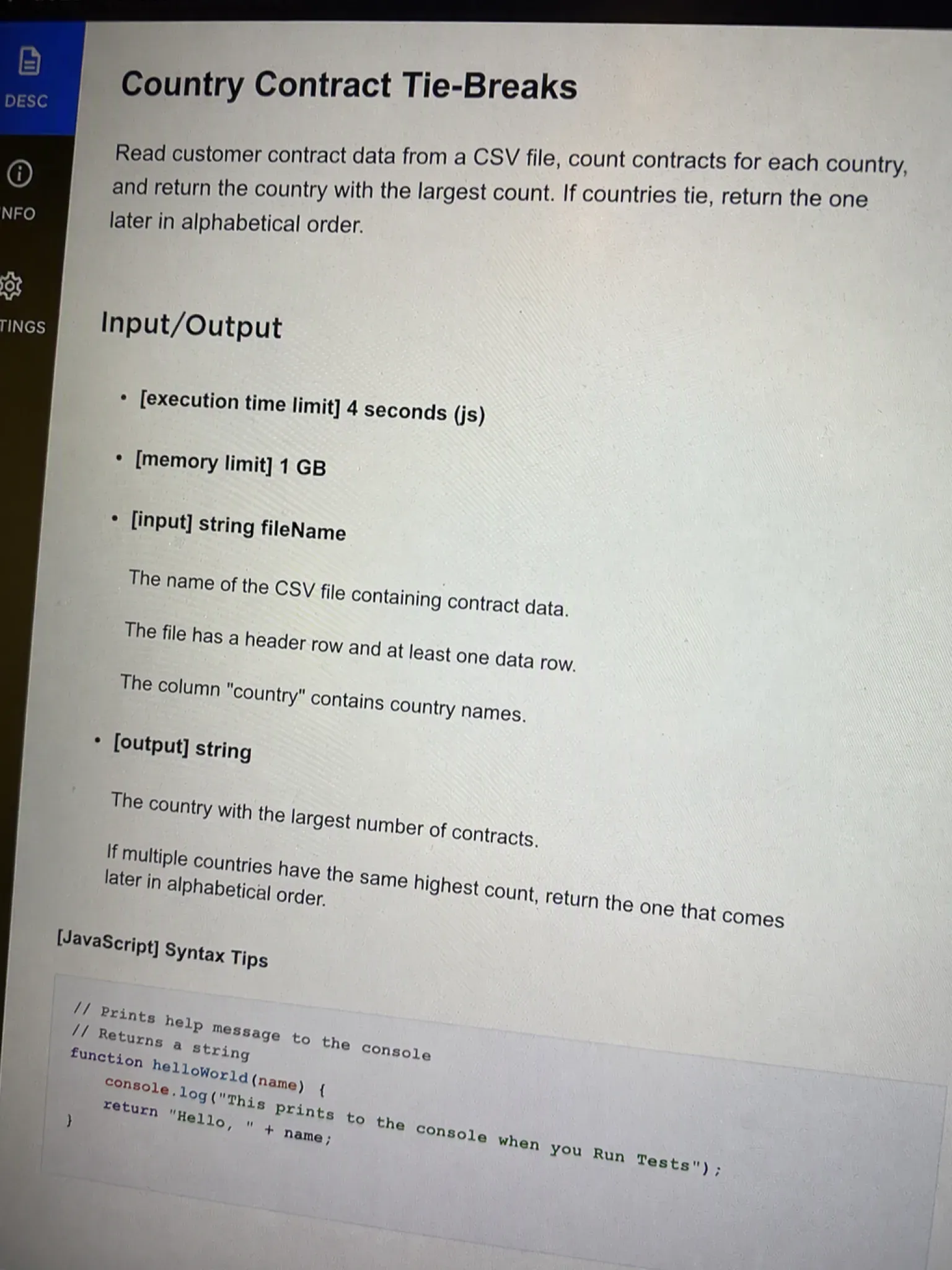
The problem I got: I had to read customer contract data from a CSV file, count the contracts for each country, and return the country with the largest count. If two countries tied, the required answer was the one later in alphabetical order.
My approach: I grouped the rows by country, counted each group, and sorted by contract count descending and country descending. That made the tie rule part of the sort instead of a separate conditional branch.
import pandas as pd


def country_with_most_contracts(csv_path: str) -> str:
    contracts = pd.read_csv(csv_path)
    counts = (
        contracts.groupby("country")
        .size()
        .reset_index(name="contract_count")
    )

    winners = counts.sort_values(
        ["contract_count", "country"],
        ascending=[False, False],
        kind="mergesort",
    )
    return str(winners.iloc[0]["country"])
Time complexity: O(r log r) | Space complexity: O(c)
This was the last task, and the output rule was easy to overlook after two database problems. I checked the alphabetical tie order before submitting, and the switch from SQL to Pandas used the remaining time I had.
The four-question mix I described matches a February 2026 Dropbox SWE intern assessment account, but I treat it as a current question pool, not a universal bank for every role. I found no score, final outcome, or proctoring configuration in that account, so I do not fill those gaps with assumptions.
Dropbox’s Proctoring Policy for CodeSignal
I treat Dropbox’s proctoring answer as conditional, not universal. CodeSignal can enable camera, microphone, screen sharing, government-issued photo ID, and a face photo. The invitation and setup screen control whether that branch applies to my assessment.
When proctoring is enabled, the setup flow asks me to share the camera, microphone, and selected screen for the session. It also includes identity steps. I could not identify which Dropbox roles or cycles use those requirements.
The next question is what the platform can review beyond a camera feed. For the wider CodeSignal detection process, I separate review signals from proof of cheating. I also keep both separate from this Dropbox-specific invitation boundary.
CodeSignal Review Signals
I treat CodeSignal’s Suspicion Score as a platform review signal. It can involve paste activity, copied problem descriptions, language changes, solution similarity, and possible outside assistance. An integrity flag is a prompt for review, not proof that cheating occurred. I do not present those signals as a Dropbox-specific caught case.
The camera branch raises a narrower question: what does the actual stream include? The CodeSignal camera recording guide covers the continuous video and identity-photo steps. It also states the retention boundary.
The screen branch has its own boundary. The CodeSignal screen capture details explain the entire-display rule. They also show what remains outside the recorded frame.
I also keep platform rules separate from Dropbox policy. Under the CodeSignal GCA rules and setup details, I can distinguish permitted syntax or documentation lookup from the outside-solution ban. The guidance also covers submission behavior and configurable duration.
The practical boundary is simple. Before starting, I would read the exact rules shown. I would confirm whether the assessment asks for camera or screen sharing. The invitation is the only reliable configuration source, so I would not claim a universal Dropbox setup.
What Dropbox’s CodeSignal Test Format Actually Looks Like
I read the codesignal dropbox format as an invitation-specific state, not a universal Dropbox rule. I had four questions in 70 minutes. The official GCA baseline uses the same count and duration. A company can configure a different duration.
Those variants stay in one comparison below. I would confirm the invitation’s duration and task count first. I would also check its proctoring and rule set before treating another candidate’s experience as mine.
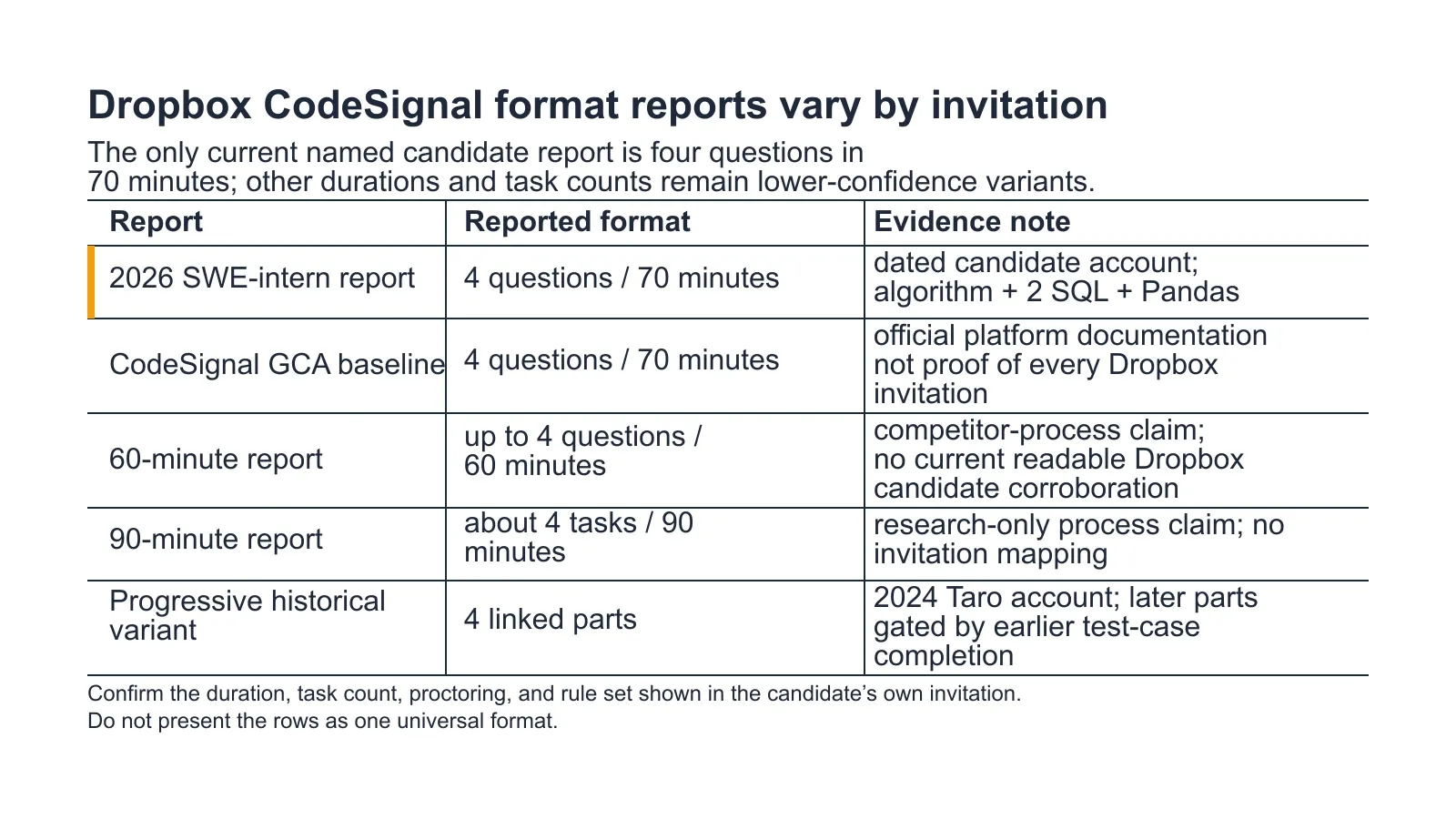
I found lower-confidence claims of up to four questions in 60 minutes and about four tasks in 90 minutes. A historical 2024 assessment gated later bank-transaction parts behind earlier test-case completion. I keep those as variants, not the normal 2026 intern format.
Dropbox also appears in more than one recruiting context on CodeSignal. That gives me another reason to separate the named 2026 intern assessment from event, role, and cycle-specific formats.
The current answer is therefore bounded. Four questions in 70 minutes matches the current evidence and official GCA documentation. My invitation still controls the actual test.
How Dropbox’s CodeSignal Scoring Works
CodeSignal Uses a 200–600 Coding Score
I treat 200 to 600 as the platform’s certified-assessment Coding Score range, not as a Dropbox cutoff. CodeSignal gives base points for module progress and bonus points for full completion.
In general, more completed questions raise the score. The Dropbox-specific formula remained unverified beyond the platform range and mechanics. I do not convert question count into a guaranteed pass line.
Dropbox Has No Verified Universal Cutoff
I could not verify a universal Dropbox cutoff, pass rate, or minimum number of completed questions. The February 2026 intern candidate had a pending outcome and supplied no score or final result.
| Score or signal | What I can conclude |
|---|---|
| 200–600 | The documented certified-assessment Coding Score range |
| Base points and completion bonus | Module progress contributes to the score, with extra points for full completion |
| Pending, no score reported | The strongest current intern account does not establish a cutoff |
| 25 of 40 test cases | Historical 2022 evidence; threshold and outcome were not verified |
| Rejected after the OA | A role-specific April 2026 Boston outcome, not a universal rule |
| Held for review, score not certified | The pinned January 2026 private case in this article |
I keep those signals in separate buckets. A platform score range is a STATE fact. Pending status, rejection, an uncertified attempt, and an unverified test-case count are POOL outcomes. They come from different roles, dates, and evidence classes.
Dropbox CodeSignal Exam-Day Strategy
Mixed Formats Expose SQL and Pandas Blind Spots
I stopped treating the assessment as four algorithm questions. My current mix had one algorithm problem, two SQL tasks, and one Pandas task. Each switch carried a different kind of risk.
The algorithm slot rewarded a familiar two-pass invariant. The SQL tasks demanded clean half-open date ranges, month grouping, and distinct cohorts. They also required a denominator that kept inactive January users. The Pandas task added a later-alphabetical tie-break after two database problems.
I used the task boundaries as checkpoints. I checked the date range before the query output. Then I protected the retention denominator before calculating the percentage. Finally, I read the sort order before submitting the Pandas result.
Submit Before Leaving a Task
I submit before moving away from a task whenever the invitation permits it. That keeps the current code saved. It also gives me a recoverable submission instead of leaving a finished attempt only in the editor.
Under the stated CodeSignal mechanics, I can make multiple submissions. The highest-scoring submission is retained. I still treat the invitation’s displayed rules as controlling because a company-created assessment can configure different behavior.
I also check the submission state before switching tasks. That small pause protects the work I already finished. It keeps the exam from becoming a series of unverified assumptions about the platform.
Progressive Variants Can Gate Later Parts
I keep the progressive format as a historical contingency, not as the default Dropbox CodeSignal layout. In a 2024 bank-transaction assessment, later parts stayed unavailable until every earlier test passed. Speed was named as a failure factor.
That structure changes the pacing decision. A partial solution may not unlock the next part. My choice would be to test the current part’s edge cases before polishing code that has not passed its gate.
The historical variant did not rewrite my own four-question narrative. I could not map progressive gating to the 2026 intern invitation.
Why Candidates Fail the Dropbox CodeSignal Assessment
A Floating Widget Can Leave the Attempt Uncertified
A private account from a Dropbox candidate in January 2026 described a floating answer widget left active during the assessment. During the final submission check, the final score screen never appeared and the attempt was held for review. The candidate closed the tool and finished, yet the final score was never certified.
The risk was structural: the AI answer stayed on the same computer screen the proctoring software monitored, hidden by a basic OS-layer trick that kept the window out of visible view while it remained on-screen.
InterviewFox works differently: the answer goes to a physically separate phone that no screenshot, screen recording, or session monitoring can reach by design.
Land offer with Safer AI Interview Assistant
Skip the risky invisible apps. Our dual-device mode keeps it simple and undetectable. You crush the interview, we handle the answers.
Get started. It's freeLoved by 100,000+ candidates
I treat this as a private company-and-platform-specific case. It has no public URL, and I do not expand it into a claim about every Dropbox assessment.
Progressive Gating Can Turn Speed Into a Failure Risk
I keep the historical progressive pattern separate from the current intern format. It shows a possible gated sequence, not the 2026 invitation's behavior.
The failure mechanism is concrete even though the variant is old. A gated sequence can turn one slow or incomplete part into a blocked path. I use it as a contingency to recognize, not as a fact about every 2026 invitation.
Rejection Can Follow the OA Without a Human Conversation
In April 2026, a Boston outcome ended in rejection after the CodeSignal assessment without speaking to a human. A Toronto monitored flow led to later interviews and eventual rejection.
Those outcomes show why I do not promise a fixed next step after submission. They are role- and variant-specific outcomes, not proof that every Dropbox candidate receives the same sequence.
Mixed-Format Blind Spots Create Avoidable Friction
I had to switch from a two-pass algorithm to SQL date logic. Then I moved to a Pandas grouping and tie-break rule inside one 70-minute assessment. The named friction was SQL syntax and date filtering, followed by the Pandas task.
That mix can expose a narrow blind spot even when algorithm preparation is solid. I treated syntax, half-open date ranges, distinct joins, grouping, sorting, and exact output rules as separate practice targets.
How to Prepare for the Dropbox CodeSignal in 7 Days
Days 1–2 SQL Date Filters and Monthly Joins
I started with the two SQL shapes from the current report. First, I counted Q1 signups by country and month. Next, I measured January-to-February retention with a LEFT JOIN. The named friction was syntax and date filtering, so I trained the boundaries before adding speed.
In the days before the OA, I also used InterviewFox's Prep Agent through WhatsApp: I sent it the confirmed algorithm, SQL, and Pandas patterns and got back a personalized drill plan and strategy. It sat alongside the blank-table practice rather than replacing it.
Both tasks came from blank tables. I used half-open date ranges and truncated the month explicitly. Distinct January and February sets protected the cohort. I also checked that inactive January users stayed in the denominator.
The success check was two timed SQL solutions. Both needed correct month grouping and retention output without syntax repair. I skipped a broad Dropbox-specific question-bank grind because the only independently confirmed current set is the dated algorithm, SQL, and Pandas mix. The repeated three-question list lacks independent corroboration.
Days 3–5 Candy Greedy and Pandas Tie-Breaks
I used days three and four to rebuild Candy from a blank file. I tested increasing ratings, decreasing ratings, equal neighbors, and a peak. The two-pass invariant had to work in both directions.
On day five, I practiced the Pandas task shape from a CSV-shaped dataset. I grouped by country, counted rows, and sorted by contract count descending and country descending. I checked the later-alphabetical tie-break.
The success check was a plain-language explanation of the greedy invariant. I also finished one timed Pandas task with the correct country and tie-break result from blank code. A solution was not ready if it passed only after I copied a remembered pattern.
Days 6–7 Mixed-Format Simulation and Integrity Setup
I ran one mixed simulation with an algorithm question, two SQL tasks, and one Pandas task. I stayed inside the assigned window. Before switching tasks, I submitted each task, checked its submission state, and read the exact invitation rules for allowed lookups and assessment behavior.
I also kept the exam surface free of unauthorized floating tools. The pinned January case explains why I treat a floating answer widget as a certification risk. I kept that concern even after the tool was closed before finishing.
The final success check was a complete simulation inside the assigned window. I verified each submission state. I also stated which lookups the invitation permits. The seven-day number is a planning default, not a claimed Dropbox deadline. No current fixed link-expiry window was verified.
What Happens After You Submit the OA
CodeSignal Reviews the Score Before Certification
I separate the automatic Coding Score from certification or integrity review. The score range and module mechanics are platform facts. A review signal or pending status sits beside the score rather than changing it.
When a technical problem interrupts the assessment, I would contact CodeSignal support promptly. I would also alert the company contact that sent the assessment. I could not verify a response time for this Dropbox track.
Dropbox Outcomes Vary by Role and Cycle
The February 2026 intern assessment remained pending, with no score or final result documented. One April 2026 Boston outcome ended in rejection after the OA. A Toronto monitored flow included later interviews before rejection. The historical progressive assessment ended at the assessment stage.
These form a pool of possible outcomes, not a fixed Dropbox sequence. I could not verify a universal response time, pass rate, or interview step after submission.
FAQ
How many questions are on the Dropbox CodeSignal assessment?
The strongest current 2026 variant had four questions in 70 minutes. CodeSignal’s GCA baseline uses the same count and duration, but the invitation can differ.
What is the time limit for the Dropbox CodeSignal OA?
I had 70 minutes for the Summer 2026 intern assessment. Reports of 60 or 90 minutes remain lower-confidence variants. I would use the invitation’s timer as the final answer.
How hard is the Dropbox CodeSignal assessment?
I found the pressure in switching among algorithm, SQL, and Pandas demands inside one timer. The evidence does not establish a universal difficulty score. The mix matters more than a single label.
Can I use an AI tool or invisible app during the Dropbox CodeSignal OA?
Desktop overlay tools put the AI's answer on your computer screen, rendered as a hidden layer above the browser with a basic OS-layer trick. The answer remains on-screen, proctoring software keeps adding detection capabilities as AI tools become more common, and the risk exposure is not fixed.
InterviewFox pushes the answer to your phone, a physically separate device that no screenshot, screen recording, or session monitoring can reach by design, so the laptop screen stays on the exam editor, unchanged.
The result is a simple device-level boundary: the answer is removed from the monitored computer screen entirely.
Land offer with Safer AI Interview Assistant
Skip the risky invisible apps. Our dual-device mode keeps it simple and undetectable. You crush the interview, we handle the answers.
Get started. It's freeLoved by 100,000+ candidates
What happens after I submit the Dropbox CodeSignal assessment?
I found no universal response time or next step. I saw pending status, rejection after the OA, later interviews, and a private attempt whose score was never certified.