
How I Passed the Hudson River Trading OA on CodeSignal in 2026: Real Questions and Prep Plan

Quick Facts
| Platform | CodeSignal GCA, with a possible quant-research variant |
| Questions | 4 coding problems, difficulty rising per question |
| Time limit | 70 minutes, auto-submits at the bell |
| Score scale | 200 to 600, with 600 as the perfect result |
| Proctoring | Webcam, audio, full-screen capture, government ID check |
| Anti-cheat | CodeSignal Integrity status plus LeakSweep takedowns |
| Link valid | About 7 days (CodeSignal standard) |
| Retake limits | 2 per 30 days, 3 per 6 months (2026) |
I took the hudson river trading oa, a CodeSignal online assessment for a software engineering role at Hudson River Trading, in 2026. I solved three of the four questions clean and recovered the third after it timed out. What follows is the complete process and how I prepared for it.
Question 3 was a step-function sweep that didn't click on the first read. For a few minutes I thought I might not get through the hardest problem on the test. When the step-function sweep wouldn't click, I pulled up a real time AI interview copilot on my phone, so the rescue stayed off the captured display.
Before my test, I went through every hudson river trading oa post from the past two years on Reddit, LeetCode Discuss, and interview writeups. What I found tracks closely with what I experienced. The article below covers the specific traps, in particular the Question 3 timeout wall and the proctoring mistakes that get scores thrown out.
The Real Questions on My Hudson River Trading CodeSignal Test
I sat the Hudson River Trading CodeSignal online assessment in 2026, firing off applications to a stack of trading and tech firms at the same time, with a little over a hundred LeetCode problems behind me.
Below is exactly what the four questions looked like from my side of the screen, in the order they appeared. The whole thing ran seventy minutes, and the difficulty climbed with each problem.
Question 1: Array Simulation
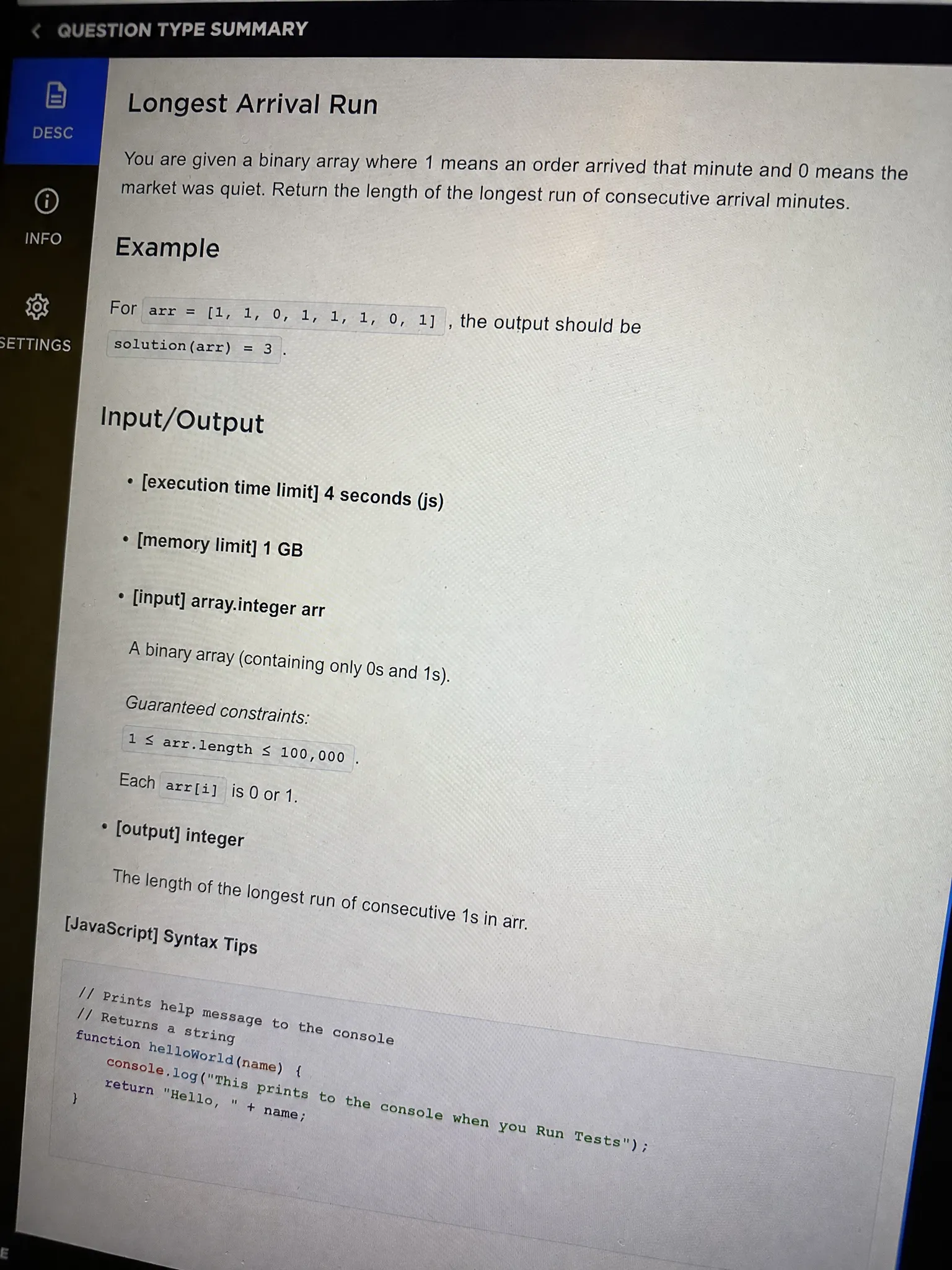
The problem I got: The first task gave me a binary array where a 1 meant an order arrived that minute and a 0 meant the market was quiet. I had to return the longest run of consecutive arrival minutes.
My approach: This is a single left-to-right scan. I keep a running count of the current streak and reset it whenever I see a 0, storing the best streak I have seen. The scan is linear and the state is tiny, so it reads cleanly under time pressure. I wrote it in Python to avoid syntax slips on question one.
def longest_arrival_run(arrivals):
    best = cur = 0
    for a in arrivals:
        if a == 1:
            cur += 1
            best = max(best, cur)
        else:
            cur = 0
    return best
Time complexity: O(n) | Space complexity: O(1)
This one felt like a warm up, which I expected from the format. I finished it in a few minutes and moved on with some confidence.
Question 2: Sliding Window and Hashmap
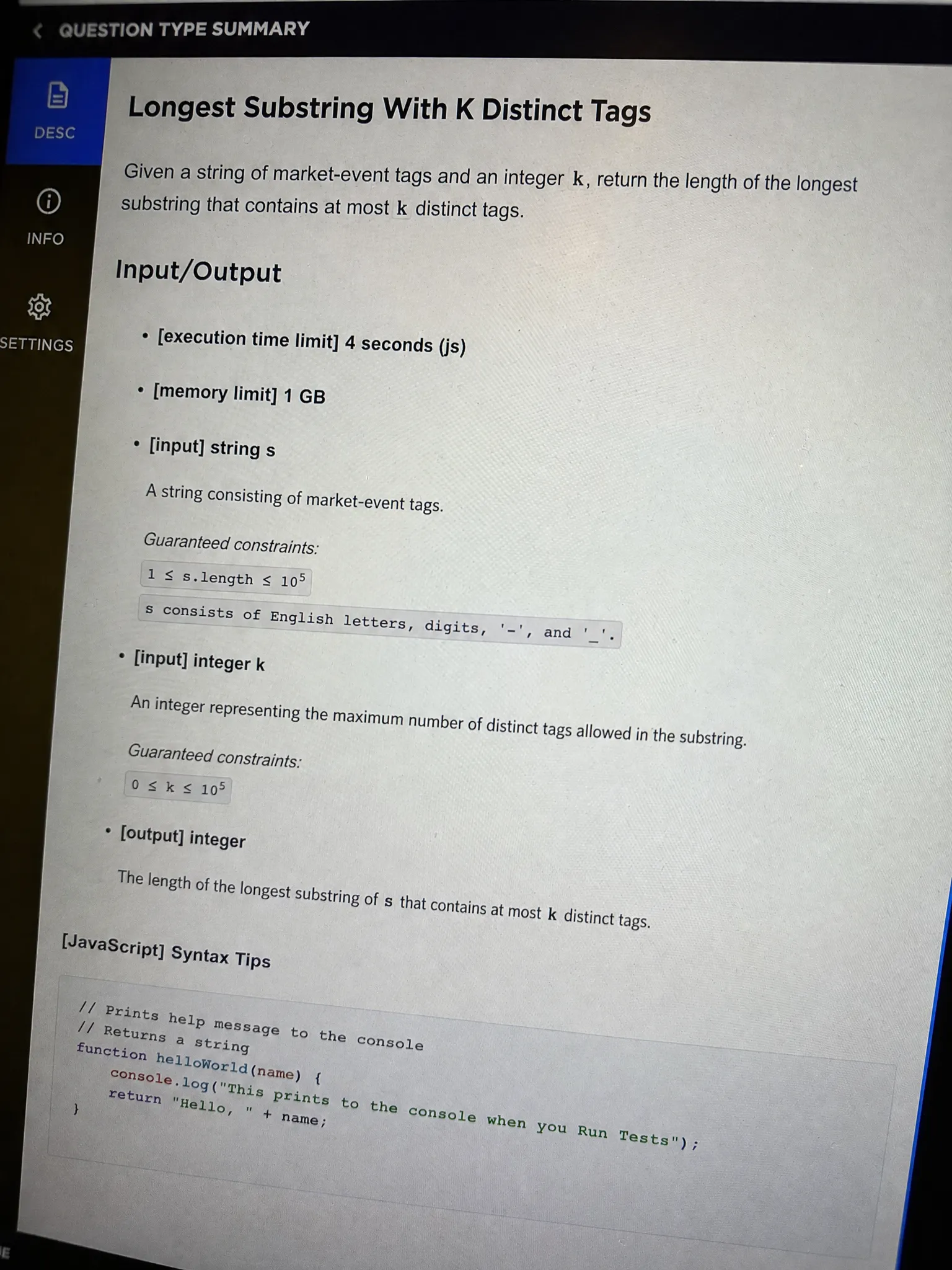
The problem I got: Question two handed me a string of market-event tags and an integer k. I had to return the length of the longest substring that contained at most k distinct tags.
My approach: A sliding window with a frequency map fits this exactly. I move a right pointer to add tags, and whenever the map holds more than k distinct tags, I shrink from the left until it drops back to k. The best window length seen during the pass is the answer. The window only ever grows and shrinks once per index, so the work stays linear.
def longest_substring_k_distinct(tags, k):
    from collections import defaultdict
    freq = defaultdict(int)
    left = best = 0
    for right, tag in enumerate(tags):
        freq[tag] += 1
        while len(freq) > k:
            freq[tags[left]] -= 1
            if freq[tags[left]] == 0:
                del freq[tags[left]]
            left += 1
        best = max(best, right - left + 1)
    return best
Time complexity: O(n) | Space complexity: O(k)
I double checked the empty-string and k-equals-zero edge cases on paper and they held. A bit more thinking than Q1, but still comfortable.
Question 3: Step Function Sweep
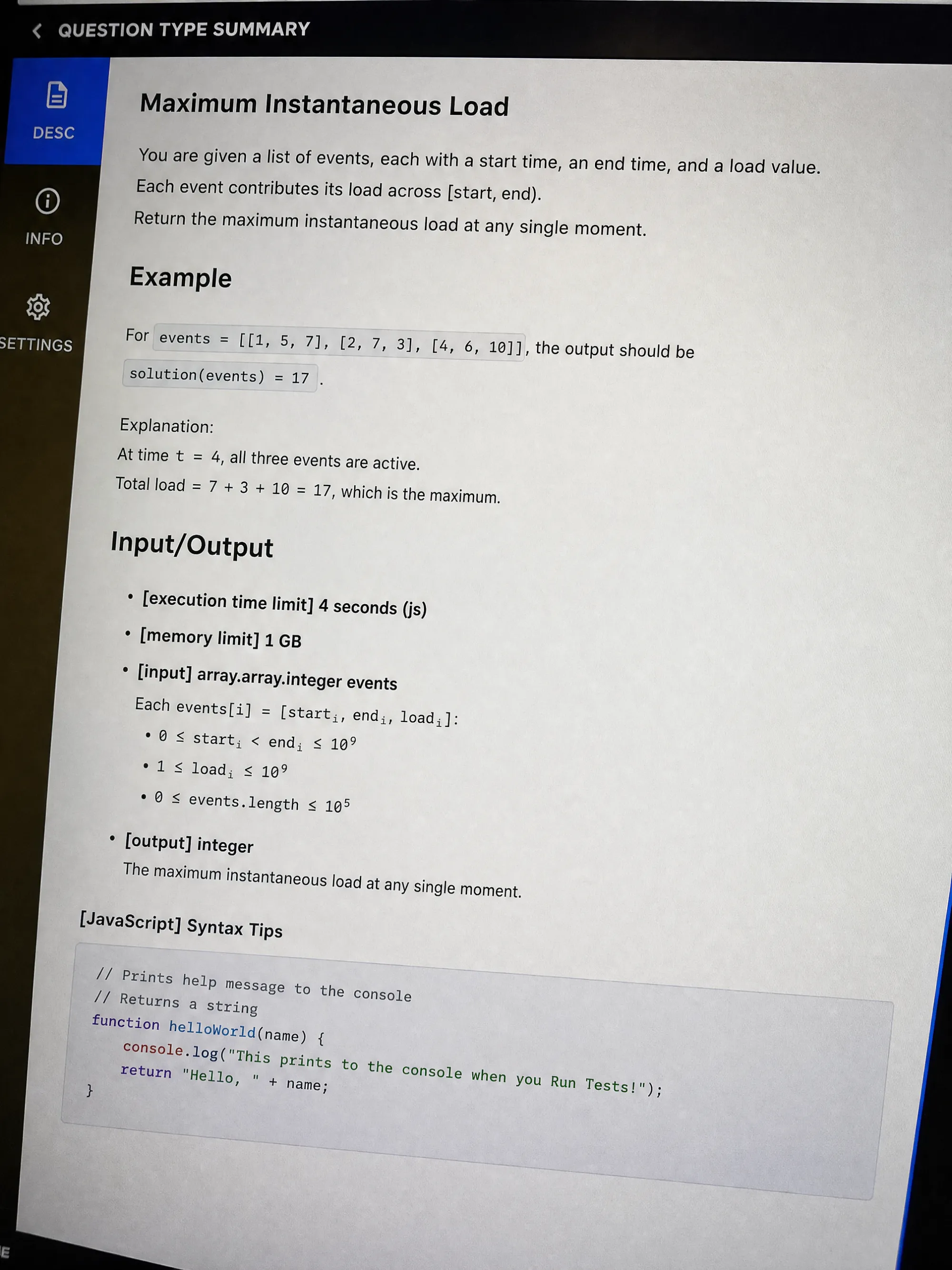
The problem I got: The third question gave me a list of events, each with a start time, an end time, and a load value. Every event contributed its load across the half open interval from start to end. I had to return the maximum instantaneous load at any single moment.
My approach: My first instinct was the lazy path: build a timeline array and, for each event, walk every tick between its start and end adding the load, then return the max. It is simple and it cleared the small sample cases. On the full test set it failed with a timeout, because scanning every tick inside every event is far too slow once the ranges get large.
def max_load_brute(events):
    timeline = [0] * 1000001
    for s, e, v in events:
        for t in range(s, e):
            timeline[t] += v
    return max(timeline)
Time complexity: O(n * m) | Space complexity: O(m)
The clock was deep in the red and I had burned minutes watching it time out, not understanding at first why a working solution kept getting rejected. I had ruled out a desktop overlay during prep, so I did not want any answer sitting on the same screen the platform was monitoring.
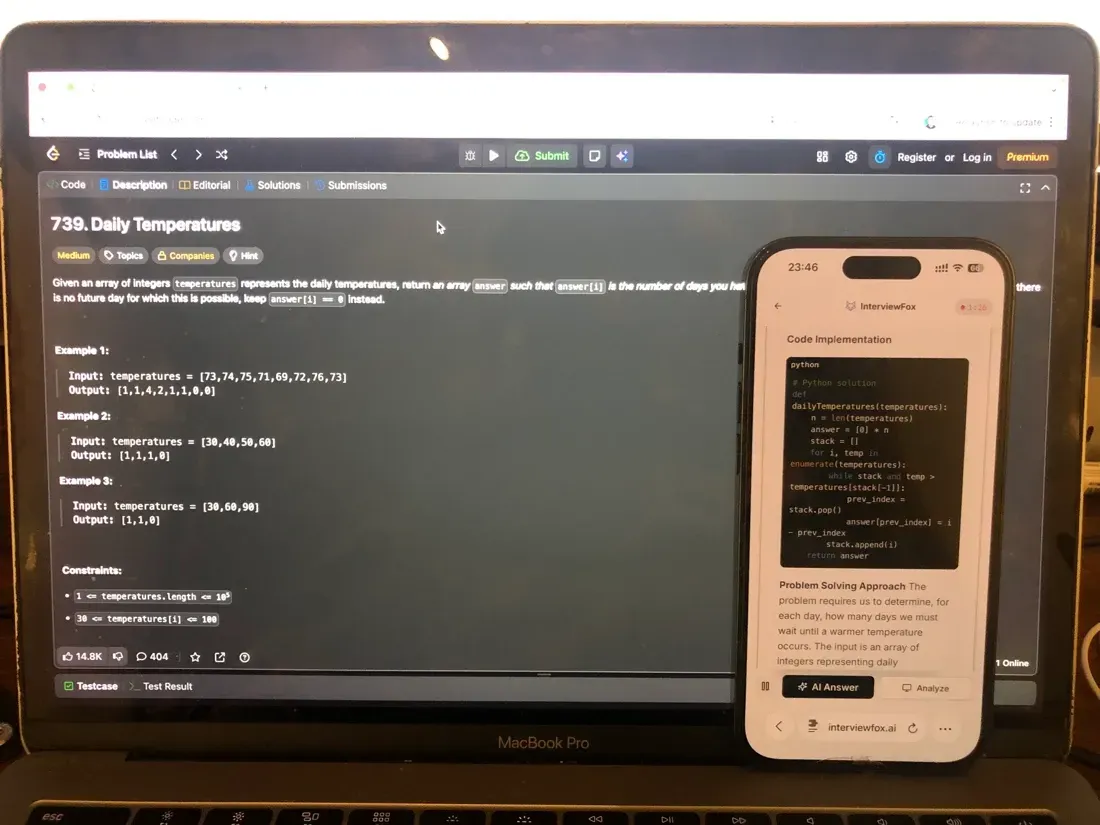
I didn't want to use a desktop overlay, the answer would have been on the same screen the proctoring system was monitoring, hidden by a basic rendering layer. Whether that gets flagged depends on what detection is currently running, and I didn't want that uncertainty in the background. I hit the keyboard shortcut, the problem auto-captured, and the dual-device Coding Assistant from AI interview helper pushed the approach to my phone. The laptop screen stayed on the exam editor the whole time, and the sweep idea finally clicked.
Land offer with Safer AI Interview Assistant
Skip the risky invisible apps. Our dual-device mode keeps it simple and undetectable. You crush the interview, we handle the answers.
Get started. It's freeLoved by 100,000+ candidates
I had to throw out the per-tick scan and rebuild around an event sweep instead. Each event is just two points: a load enters at its start and leaves at its end. I collect every point, sort them, and walk once, adding on entry and subtracting on exit while tracking the running peak. That turned the quadratic blowup into a sort plus a single pass.
def max_load(events):
    points = []
    for s, e, v in events:
        points.append((s, v))
        points.append((e, -v))
    points.sort()
    cur = best = 0
    for _, delta in points:
        cur += delta
        best = max(best, cur)
    return best
Time complexity: O(n log n) | Space complexity: O(n)
That question was the low point of the whole test, the moment I nearly walked away with nothing on the hardest problem. I got it in, but only after the panic of a dead end and a full rewrite under pressure.
Question 4: Time-Series Heap
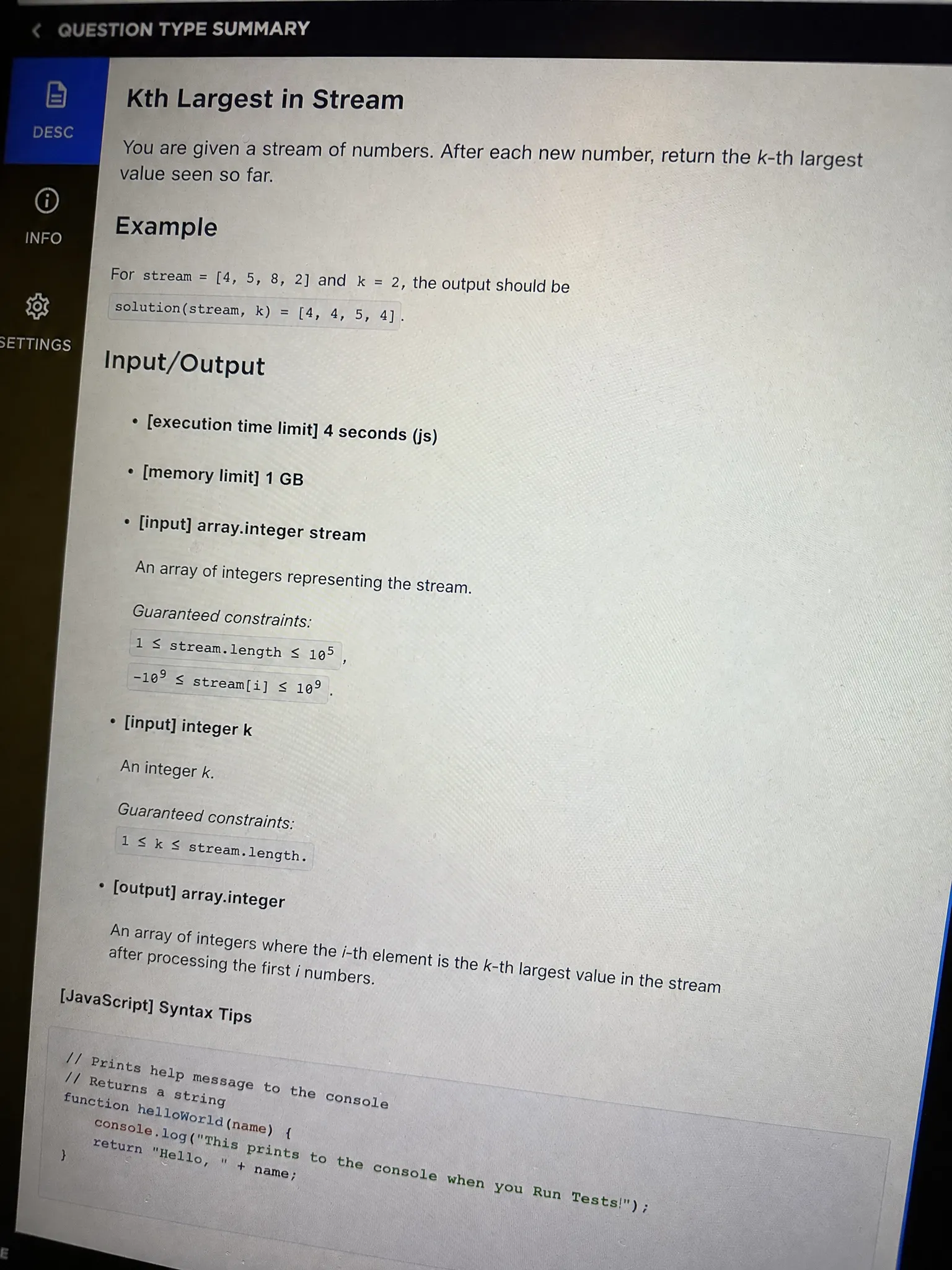
The problem I got: The final question fed me a stream of numbers and, after each new number, asked for the k-th largest value seen so far. The sample cases were tiny and passed without trouble.
My approach: I kept a min-heap that holds only the k largest values seen. After pushing each new number, if the heap grows past k I pop the smallest, so the root is always the k-th largest. Using a heap keeps both ends cheap, so even a long stream stays fast. I had done a problem like this during my LeetCode grinding, so the shape was familiar and I did not waste time planning.
import heapq

class KthLargest:
    def __init__(self, k, nums):
        self.k = k
        self.heap = []
        for n in nums:
            self.add(n)

    def add(self, val):
        heapq.heappush(self.heap, val)
        if len(self.heap) > self.k:
            heapq.heappop(self.heap)
        return self.heap[0]
Time complexity: O(n log k) | Space complexity: O(k)
Each number is pushed and popped at most once, so the per call cost stays flat. I was about sixty minutes in and had a small cushion, which mattered after the Q3 scramble.
Hudson River Trading's Proctoring Policy for CodeSignal
What Gets Recorded
HRT's CodeSignal exam uses the standard CodeSignal proctoring stack. Identity is verified against a government photo ID that must match the person on camera. The session captures webcam video, audio, and a full-screen recording for the entire test, and results return after an automated review plus a human check.
The Integrity Status
The Integrity status is the main anti-cheat signal. It flags outside help, solution similarity to other submissions, paste events, and odd typing or telemetry patterns. A flag that reads "Integrity Flagged" does not mean proven cheating. It routes the submission to a recruiter for review, and it is not a verdict on its own.
When Proctoring Gets Rejected
A proctoring rejection overrides even a strong score. The common triggers are not being alone in the room, leaving the camera view, dropping the screen share, or failing ID verification. When that happens the employer sees "Proctoring Rejected" with a reason, and the round typically ends there regardless of how the coding went.
Other Confirmed Hudson River Trading CodeSignal Questions
Step Function Maximum Load
A candidate sitting in 2026 reported the maximum-concurrent-load problem: given events as (start, end, value), return the peak instantaneous load. The optimal fix is an event sweep with a difference array, O(n log n), the same shape as my Q3.
Sliding-Window Max Price
Another 2026 report described a stream of (timestamp, price) ticks where you return the maximum price in the past five seconds for each tick. A monotonic deque gives an O(n) pass, and the trading flavor is classic HRT.
Order-Matching Engine Simulation
A frequently shared account covers an order book: buy orders match the lowest sell first, sell orders match the highest buy first, and ties break by timestamp. Max and min heaps give O(n log n), but partial fills and duplicate prices are the real trap.
Obstacle Placement and Interval Checking
One 2026 breakdown listed obstacle placement with interval checks: maintain obstacle coordinates in an ordered set and, for each query, binary search the nearest neighbors. That keeps each operation at O(log n).
Lexicographically Smallest String
A reported problem allowed reversing any prefix or suffix of a string any number of times to reach the lexicographically smallest result. The reachable states stay bounded enough for an O(n squared) brute force under the constraints.
Bubble Elimination Game
Another 2026 account described a grid game: click a cell, eliminate it and diagonally adjacent same-color cells, then apply column gravity. A flood fill plus per-column gravity solves it, and the edge cases are where candidates lose points.
Digit-Reversal Pairs
A 2026 writeup covered counting pairs where a number minus its digit reversal equals a target. Storing the difference in a frequency map turns it into a single linear pass with no nested loop.
What Hudson River Trading's CodeSignal Test Format Actually Looks Like
Four Questions in Seventy Minutes
The hudson river trading coding assessment, when HRT sends the standard GCA, runs four coding questions in seventy minutes with difficulty rising by question. The standard CodeSignal framework also allows more than forty languages, so the format is broad rather than locked to one stack.
Pick-Your-Language Support
Candidates pick their own language and can switch between problems. Python, Java, C++, and Go are all supported, and the choice stays with the solver per question. Most people default to Python for its clean syntax under time pressure.
Auto-Submit and Partial Credit
The timer auto-submits when it hits zero, so nothing is left unsaved by accident. Since spring 2023 the GCA awards partial credit, which means a brute force that clears some tests still earns points even when it fails the largest ones.
How Hudson River Trading's CodeSignal Scoring Works
The current GCA score runs on a 200 to 600 scale that replaced the older 300 to 850 range in early 2023. A 600 is perfect, roughly 550 plus is strong, and about 500 plus sits at the competitive bar, though each company keeps its own hidden cutoff. The chart below shows where a result lands on that scale.
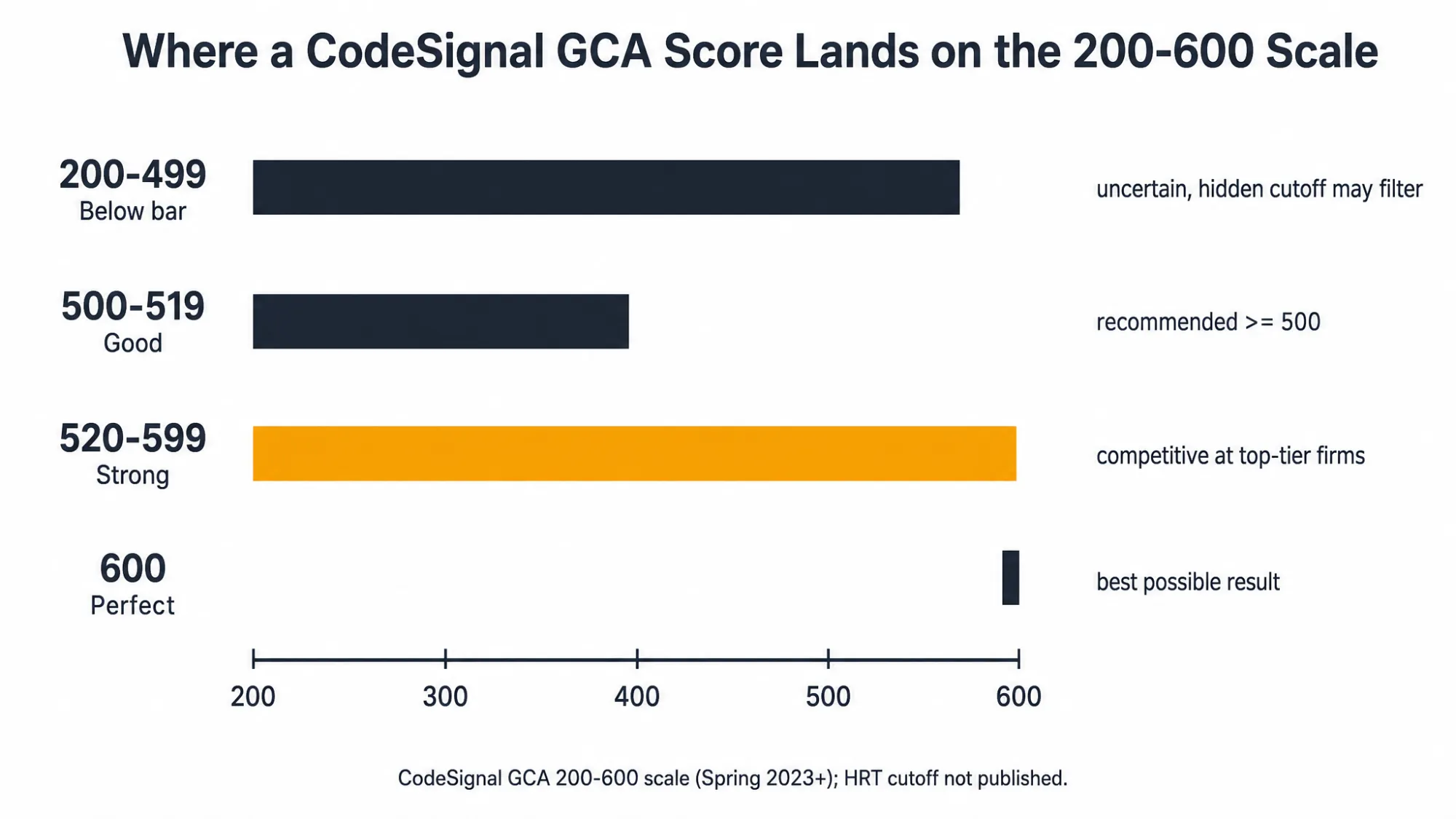
The 200-600 Scale
The 200 to 600 scale is the only live range for a standard GCA. Company thresholds are not published, so a score in the strong band improves odds without guaranteeing a pass. The retired 300 to 850 range no longer applies to any current submission.
Score Modifiers and Partial Credit
A score shifts by about plus or minus twelve points based on attempts, time, and code quality. Failed test cases still return partial credit, so a solution that handles most inputs beats a blank problem. The old Glassdoor "1200/1200" figure does not fit the 200 to 600 scale and should not be read as a real GCA result.
Score Reuse and Retake Limits
One GCA score attaches to a candidate's CodeSignal profile and can be shared with any GCA-using company for about six months. The 2026 retake limits are two attempts per rolling thirty days and three per rolling six months. Plan the first attempt as if it counts, because the window to redo it is narrow.
Hudson River Trading CodeSignal Exam-Day Strategy
Bank Time on the First Two Questions
My 2026 sitting taught me to move fast on the opening pair. The questions get harder as you go, so solving Q1 and Q2 quickly builds a buffer for the back half. I treated the first two as speed rounds and it paid off when Q3 and Q4 arrived.
Dodge the Q3 TLE Trap
Q3 is where my plan nearly broke. My first pass scanned every tick and it failed on the large test set with a timeout, so I had to rebuild around an event sweep under the clock. I now reserve a deliberate optimization pass for the third problem instead of trusting a first solution.
Never Leave the Last Problem Blank
The platform still awards partial credit for a working brute force, so a blank final problem wastes free points. I keep a simple correct solution in the editor even if I cannot finish the fast version. That habit turned a near-zero Q4 into a scored one.
Why Candidates Fail the Hudson River Trading CodeSignal Assessment
A Desktop Overlay Passed the Test, Then a Review Invalidated the Score
The most concrete case I found for HRT's CodeSignal did not come from my own sitting. A candidate completed the test with a Desktop Overlay running, then a later review invalidated the score and ended the application. The test looked clean from the candidate's side, but the result did not survive scrutiny.
What matters is the timing of the catch. The Integrity status flags outside help through solution similarity, paste events, and telemetry like typing rhythm, and routes a flagged submission to a recruiter for review rather than deciding on the spot. That is the gap the "it never interrupted me" stories miss: a clean session does not mean a safe one, because the score can still be pulled after you finish.
Desktop overlay tools render the AI's answer on the same screen the proctoring system is monitoring, hidden only by a basic OS rendering trick. That is exactly the surface the Integrity status is built to catch.
AI interview tool works the other way: the answer goes to my phone, a physically separate device that no screenshot or session recording can reach by design.
Running Out of Time on Q3 and Q4
The clearest named failure on this exam is the Q3 timeout wall. My own third question passed small cases but timed out on large inputs until I swapped the per-tick scan for a sweep, and candidates who skip that optimization pass fail Q3 despite clean Q1 to Q3. Reserving a rewrite window is the difference.
Proctoring Rejection Overrides Your Score
A proctoring failure ends the round no matter how well the code runs. The triggers are practical: not being alone, leaving the camera, a dropped screen share, or a failed ID check. Each one shows up as "Proctoring Rejected" with a reason and overrides a good score.
Land offer with Safer AI Interview Assistant
Skip the risky invisible apps. Our dual-device mode keeps it simple and undetectable. You crush the interview, we handle the answers.
Get started. It's freeLoved by 100,000+ candidates
How to Prepare for the Hudson River Trading CodeSignal in 7 Days
Orient (Days 1-2)
I confirmed the shape of this exam before writing practice code. The hudson river trading oa runs four questions in seventy minutes with difficulty rising per question, and HRT's CodeSignal proctoring captures webcam, audio, and full-screen for the whole sitting.
I also confirmed the recurring question categories: array simulation, sliding window with a hashmap, step-function sweeps, time-series heaps, and ordered structures like bisect. One thing I did not drill was graph algorithms, because no confirmed HRT problem has ever been a graph problem, and the failure patterns here are proctoring slips and timeouts rather than weak fundamentals.
Drill (Days 3-5)
I spent the middle of the window on the confirmed HRT patterns instead of random LeetCode grinding. The step-function sweep and sliding-window problems deserved the most reps, since both show up across sittings and both hide a timeout trap if the first approach is brute force.
In the days before the OA, I used the Prep Agent from interviewfox.ai over WhatsApp, sent it the confirmed HRT question patterns, and got a personalized drill plan and strategy back.
Simulate and Buffer (Days 6-7)
The final days mirror the real clock. A seventy minute mock with four problems trains the Q1 to Q2 speed burst and leaves twenty to thirty minutes for a Q3 or Q4 optimization pass.
I rehearsed the proctoring setup in a quiet room with a working webcam, screen share, and ID ready, and the last day before the test was review only, no new material, so nothing surprised me on the day.
What Happens After You Submit the OA
After the CodeSignal submit, the SWE and quant-dev pipeline moves to a phone screen and then an onsite loop. The chart below lays out the steps that follow a pass.
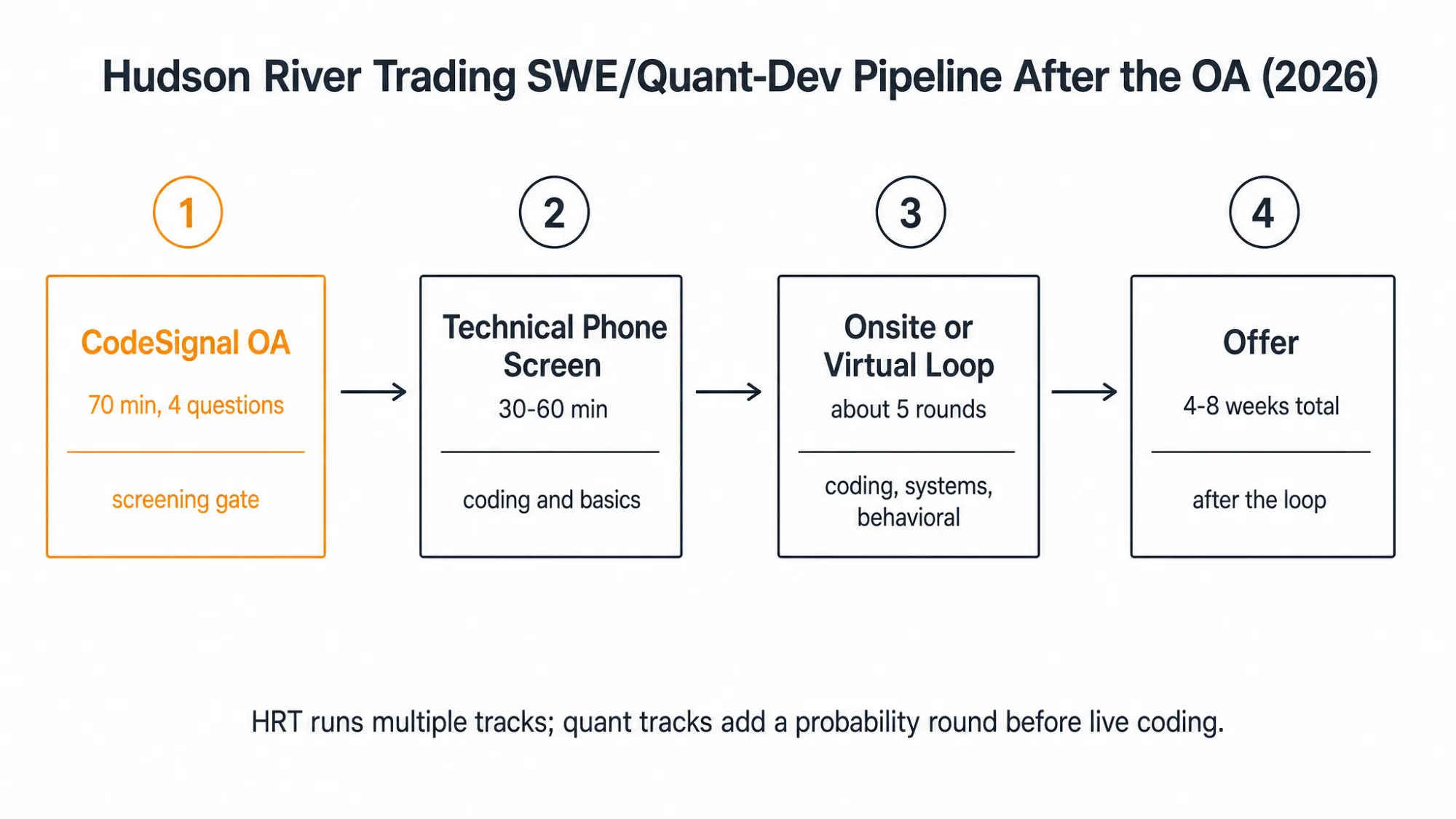
The Phone Screen After the OA
The next step is a thirty to sixty minute phone screen that covers background and basics. It is a lighter conversation than the coding rounds and confirms fit before the heavier technical loop. Candidates who clear it move to the full interview.
The Onsite Loop
The main loop is about five rounds with engineers and quant researchers. It mixes live coding, systems design, and behavioral discussion, and quant-leaning tracks add a probability round before the coding. The bar is higher than the OA but built on the same fundamentals.
What the Role Pays
The median HRT software engineer total compensation in the US is about $200,000 as of 2026. New grads land near $160,000, mid engineers near $230,000, and senior engineers past $300,000. The pay is a real draw for the effort the screening demands.
HRT Sends More Than One CodeSignal Shape
The 70-Minute SWE and Quant-Dev GCA
For the hudson river trading online assessment on the SWE and quant-dev track, HRT sends the standard four-question GCA described in this guide. That version produces a 200 to 600 score and feeds the phone screen next. Treat any invite on those tracks as this test.
The 150-Minute Quant Research Variant
HRT also sends a Quant Research Platform assessment on CodeSignal with three questions in one hundred fifty minutes. The last problem carries follow-ups and needs deeper reasoning, so the pace is slower but the depth is greater. Candidates on the quant-research track should expect this shape instead.
Why Your Track Changes the Test
Your track decides the test you get, not just the difficulty. Some candidates report a HackerRank screen for HRT while the SWE and quant-dev route is CodeSignal, so the invite language is the only reliable signal. Read the platform named in your email before you prep, and drill for that one.
FAQ
Is the hudson river trading oa on CodeSignal, or does HRT use another platform?
HRT screens the SWE and quant-dev route with a CodeSignal GCA. Some candidates report a HackerRank screen or a 150-minute quant-research CodeSignal variant, so read the platform named in your invite. Treat the invite as CodeSignal unless it says otherwise.
What hudson river trading codesignal questions should I expect in 2026?
Expect four questions that rise in difficulty: an array or string warm-up, a sliding-window or hashmap problem, a step-function or interval-sweep problem, and a time-series heap or binary-search problem. The third problem is the usual timeout trap.
How hard is the hudson river trading codesignal test, and what score do I need?
It is harder than a typical Big-Tech OA because the problems mix coding with trading-flavored data. Aim for 500 plus on the 200 to 600 scale. A 520 to 600 result is strong, but HRT keeps its real cutoff hidden.
Where can I find hudson river trading codesignal reddit and hudson river trading oa reddit threads, and should I trust them?
Candidates post both hudson river trading codesignal reddit and hudson river trading oa reddit threads, but no dated, verified HRT CodeSignal writeup surfaced in research. Treat them as anecdote, not fact. The question content here comes from a documented 2026 sitting, not forum claims.
What is the hudson river trading online assessment, and how long is the link valid?
The hudson river trading online assessment is the screening test sent after application, here a CodeSignal GCA. CodeSignal's standard invite buffer is about seven days, so schedule it as soon as it lands. Do not let the link sit unused.
Can I use an AI tool or invisible app during the Hudson River Trading CodeSignal OA?
Desktop overlay tools put the AI's answer on your computer screen, rendered as a hidden layer above the browser using a basic OS-layer trick. Proctoring software keeps adding detection capabilities, so the risk exposure is not fixed.
interviewfox.ai pushes the answer to your phone, a physically separate device that no screenshot or session recording can reach by design. If you use AI help during the OA, the dual-device setup removes the answer from your screen entirely.
Land offer with Safer AI Interview Assistant
Skip the risky invisible apps. Our dual-device mode keeps it simple and undetectable. You crush the interview, we handle the answers.
Get started. It's freeLoved by 100,000+ candidates