I Passed the Jefferies HackerRank OA in 2026: Real Questions
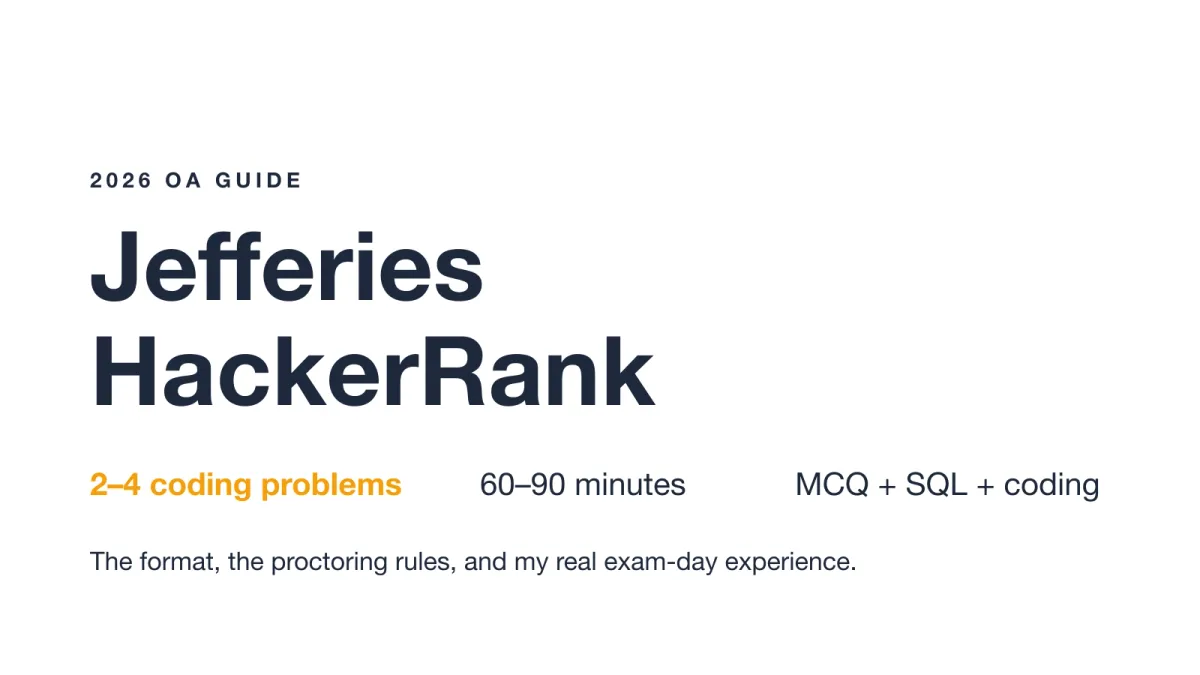
Quick Facts
| Company | Jefferies |
| Platform | HackerRank |
| Role | Technology, new grad and early career |
| Format | Multiple-choice, one or more SQL questions, and coding |
| Language | Self-selected |
| Coding questions | Two to four, count varies by test window |
| Time limit | 60 to 90 minutes, one sitting |
| Difficulty | LeetCode easy to medium |
| Reported patterns | Arrays, strings, hash maps, two-pointer, sliding window |
| Proctoring | HackerRank Secure Mode and Proctor Mode may apply |
| Pass bar | Not published by Jefferies |
| Year | 2026 |
I took the Jefferies HackerRank assessment for a technology role in 2026 and finished both coding problems in Python. The test mixed multiple-choice and SQL questions with the coding work, and the coding count can shift per window. What follows is the full process and how I prepared for it.
On problem two, my first pass pushed the left pointer past a repeat. I had little time to fix it. I used a dual device live AI interview helper to check the logic. The answer reached my phone, off the screen the exam watched, and exposed the case I missed. The full fix is below.
Before my test, I read every Jefferies HackerRank post from the past two years on Reddit, LeetCode Discuss, and Teamblind. What I found tracks closely with what I experienced. The sections below cover the questions I saw, the proctoring rules, and the mistakes that get candidates flagged.
The Real Questions on My Jefferies HackerRank Test
I took the Jefferies HackerRank assessment for technology, and the coding portion draws fresh problems for each test window. Here is exactly what I got.
Question 1: First Unique Character Index
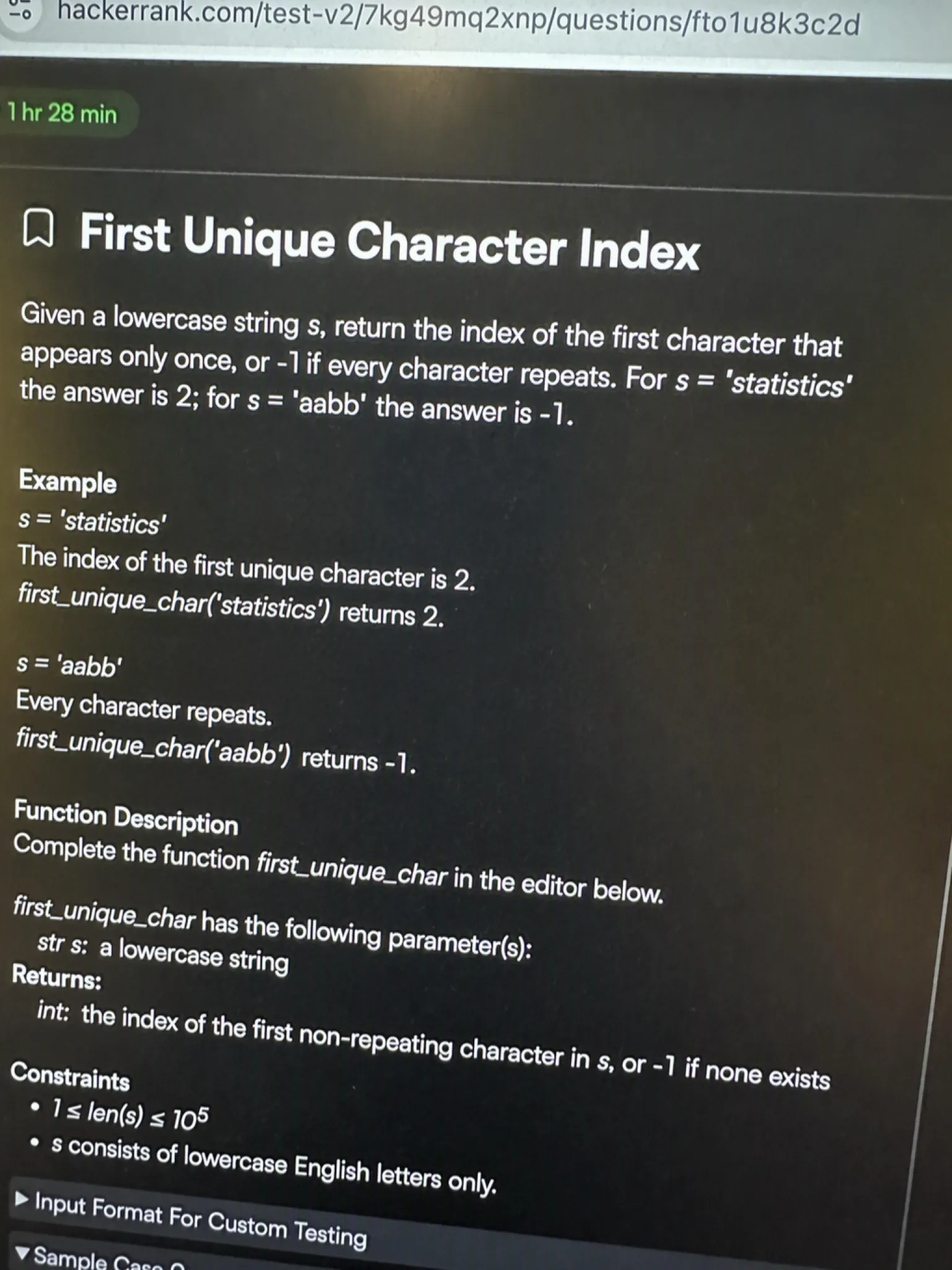
The problem I got: The first question handed me a lowercase string. It asked for the index of the first character that appears only once. If every character repeats, the expected return is -1. So for s = "statistics" the response is 2, since the "a" never repeats. For s = "aabb" the response is -1.
My approach: The statement asked for the first character that appears only once, and it wanted the index, not the character. I built a count map in a first pass, then walked the string again from the left. The first index whose count is one is the answer. If the loop ends without a hit, I return -1.
def first_unique_char(s):
    counts = {}
    for ch in s:
        counts[ch] = counts.get(ch, 0) + 1
    for i, ch in enumerate(s):
        if counts[ch] == 1:
            return i
    return -1
Time complexity: O(n) | Space complexity: O(1)
This was the warm-up. I finished it in a few minutes and moved to the next problem, where the clock got tight.
Question 2: Longest Repeat-Free Substring
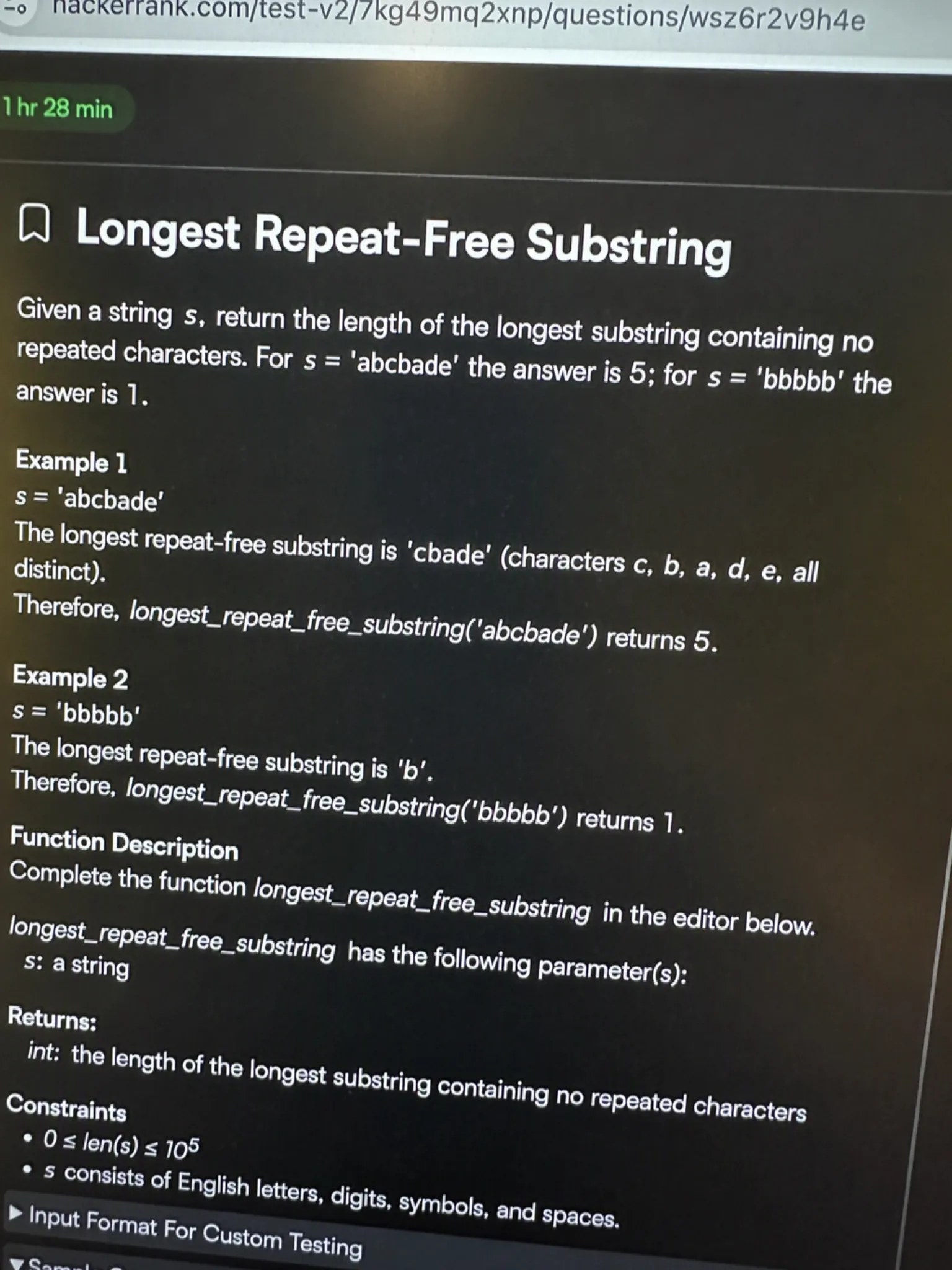
The problem I got: The second question gave me a string. It asked for the length of the longest substring with no repeated characters. For s = "abcbade" the answer is 5, from the substring "cbade". A string such as "bbbbb" returns 1.
My approach: The trick is a sliding window, not a nested scan. I tracked the window with a left index and a map from each character to its last position. When a repeat landed inside the window, I moved left just past the earlier copy. When the repeat sat before left, I left the window alone. That distinction was the whole problem.
def longest_repeat_free_substring(s):
    seen = {}
    left = 0
    best = 0
    for right, ch in enumerate(s):
        if ch in seen and seen[ch] >= left:
            left = seen[ch] + 1
        seen[ch] = right
        best = max(best, right - left + 1)
    return best
Time complexity: O(n) | Space complexity: O(k)
This one ate my time. My first attempt pushed the left pointer backward past a repeat, leaving me little time to verify the fix.
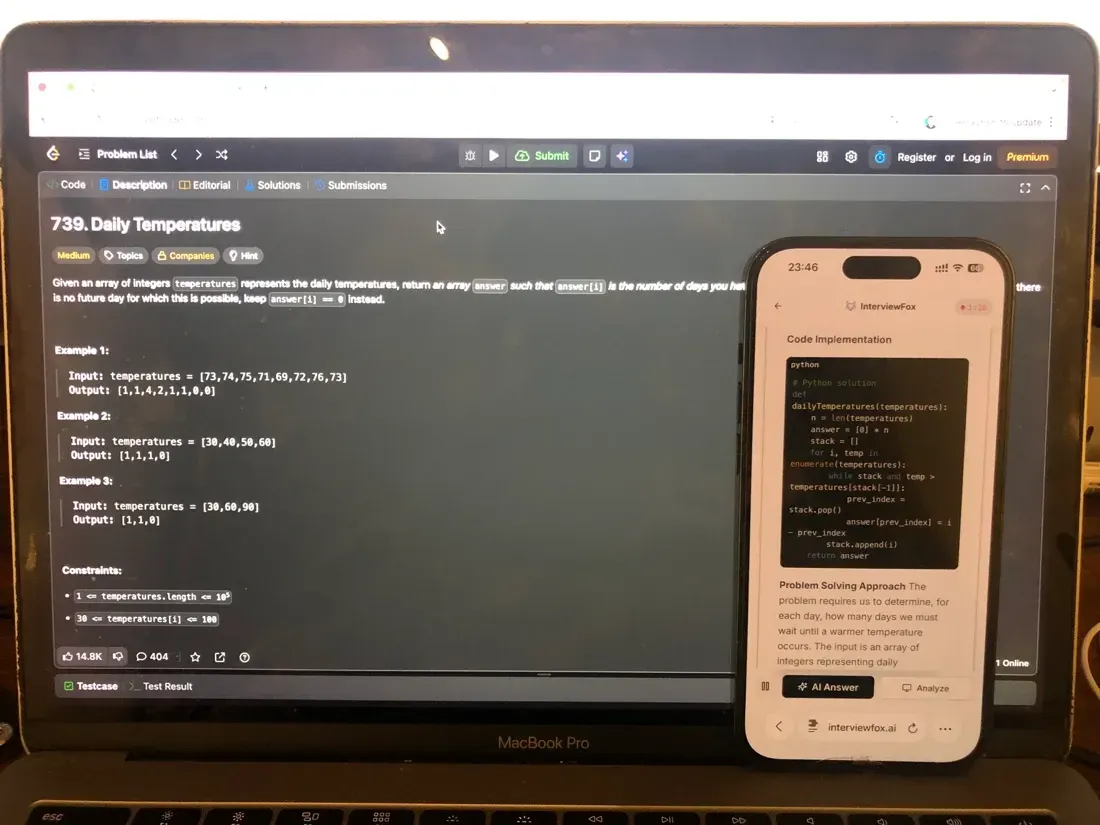
I never wanted a desktop overlay, since it renders the answer on the same screen the proctoring system monitors. So I hit a keyboard shortcut, the tool auto-captured the problem, and the fix came back on my phone through a dual device AI interview assistant. The laptop screen never changed, and that is how I caught the left-pointer case I had missed before the timer ran out.
Land offer with Safer AI Interview Assistant
Skip the risky invisible apps. Our dual-device mode keeps it simple and undetectable. You crush the interview, we handle the answers.
Get started. It's freeLoved by 100,000+ candidates
Jefferies's Proctoring Policy for HackerRank
Jefferies does not publish which HackerRank integrity mode it enables for this test. The platform documents its own rules, so everything below is platform policy and not a confirmed Jefferies setting.
HackerRank's Secure Mode runs the assessment in a controlled browser. It enforces full-screen mode, blocks copy and paste, prevents a second monitor, and alerts when a candidate switches tabs. Proctor Mode adds AI screenshot analysis, plagiarism detection, and webcam anomaly detection on top of those rules.
The full-screen rule is the one to respect. Leaving the test window gets logged and flagged. The report carries a window-exit count next to the total time spent outside it. Both details are spelled out in HackerRank's proctoring guide.
Copy-paste is its own signal. When a candidate pastes text, the platform records it and shows the content in the report. Knowing what those paste events expose pays off before you sit down. Every paste event is logged and surfaces as a copy-paste frequency reading in the candidate report.
The add-on modes. Proctor Mode is the AI layer. Its behavioral monitoring applies only to tests created after July 2025. A Desktop App Mode goes further and watches at the operating-system level. Image Proctoring captures periodic webcam snapshots for the report, and Photo Identification requires a face image before the test begins.
Secure Mode and Proctor Mode record different signals, and the chart below lays out which one captures what.
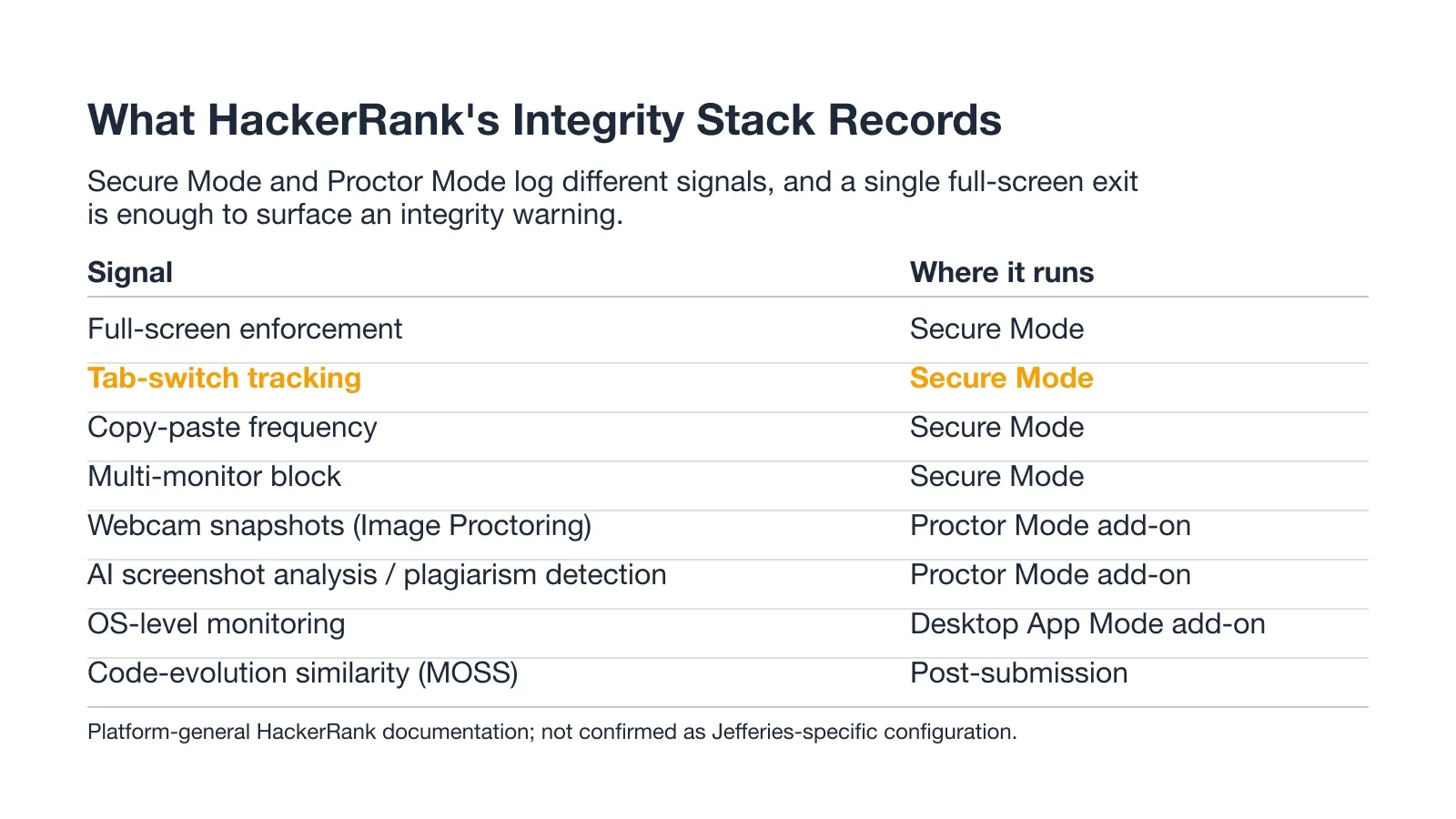
No published source names which of these modes Jefferies turns on. The rules above are the platform's, and the platform's rules are the ones that apply once you start the test.
What Jefferies's HackerRank Test Format Actually Looks Like
Most candidates face a mix of question types. Expect multiple-choice questions, at least one SQL query, and at least one coding problem. You also pick your own language. The coding portion usually runs two to four problems inside a 60-to-90-minute window.
That count is a range, not a fixed number. It shifts from one test window to the next, so do not plan around an exact total.
One figure circulates widely: six questions in 60 minutes, with a 48-hour window to finish. That number appears only on unverified third-party prep pages, so it remains a claim, not a confirmed count. Nothing official states a retake or cooldown rule either.
How Jefferies's HackerRank Scoring Works
This one is a gap. No published source states a Jefferies score, a pass threshold, a partial-credit rule, or a retake policy.
What does exist is the output side. The platform generates a per-candidate report after you submit, and a recruiter reviews it. So the report content matters even though the cutoff is unknown. I would not assume partial credit either, since nothing documents it.
Why Candidates Fail the Jefferies HackerRank Assessment
Most candidates who fail this test do not fail on the coding itself. They run out of time, trip a quiet integrity signal, or lose the whole attempt to one slip. I saw all three patterns come up.
The voided attempt. One candidate kept a borderless desktop answer window open beside his test. When he reopened the problem statement, the assessment dropped out of full-screen and showed an integrity warning. His attempt ended before submission, and no score was issued. That overlay had drawn its answer on the same screen the proctoring system was already watching.
That is the whole problem with any tool that draws its answer on your screen: it sits exactly where the proctoring system can see it, hidden by a basic OS-layer trick.
InterviewFox works differently: it is a dual device AI interview tool that puts the answer on my phone, a separate device that no screenshot, screen recording, or session monitor can reach by design.
Land offer with Safer AI Interview Assistant
Skip the risky invisible apps. Our dual-device mode keeps it simple and undetectable. You crush the interview, we handle the answers.
Get started. It's freeLoved by 100,000+ candidates
What the platform logs. Leaving the window is never quiet. Does it fire on a single exit, and how do the counts surface? The way tab-switch logging is recorded and reported is worth understanding before you start.
Detection keeps improving. Proctor Mode runs plagiarism detection and code-similarity analysis, and it flags unusual typing patterns too. That capability is documented. The platform's own writeup explains how its ML plagiarism detection scores code similarity and typing cadence.
False flags are real. Detection is not precise. Detection tools falsely flagged 61.2% of TOEFL essays in a Stanford study, a number HackerRank cites. Even a clean solve can draw a second look.
The full detection picture runs wider than one signal, and how HackerRank detects cheating across AI tools, plagiarism, and integrity signals is worth reading in full.
How to Prepare for the Jefferies HackerRank in 7 Days
Seven days is enough when the time goes to the right places. Three priorities shaped my plan, and each one is tied to something this test actually does.
Days 1-2: MCQ and SQL Recall Under the Clock
The multiple-choice and SQL sections are scored and easy to under-prepare. I ran two short timed sweeps, each mixing CS and data-structure questions with one SQL pattern. My success check was a mixed set finished under 20 minutes at 80 percent or better.
I skipped deep system design and heavy dynamic-programming or graph grinding. The reported pattern set is arrays, strings, hash maps, and the occasional two-pointer, sliding window, or simple graph traversal. No design round or DP round is reported for this test.
In the days before the OA, I also used the Prep Agent from InterviewFox over WhatsApp to send it the confirmed question patterns for this company, and it sent back a personalized drill plan and strategy. It was one practical tool among several in my prep routine, not the whole plan.
Days 3-5: Easy-to-Medium Speed on the Reported Patterns
The coding section decides the score, and the bar sits at LeetCode easy to medium. I did timed reps on arrays, strings, hash maps, two-pointer, sliding window, and simple graph traversal. I finished each one in interview-typical time rather than to perfection. My check was two easy problems and one medium on those patterns inside 45 minutes.
Days 6-7: Full Timed Run and a Clean-Screen Dry Run
One full-length run in the exact exam setup caught problems practice never would. I kept to a single monitor, with no overlays or extra windows open and no tab switches. My check was a complete run with zero window exits and no integrity warning.
What Happens After You Submit the OA
You do not see a score. A report goes to the recruiter instead, and from there the process moves in steps.
The sequence runs in stages. First comes the online assessment, then a technical phone screen with one live coding problem and a project walkthrough. After that comes a Superday of about five 30-minute rounds. The gaps between rounds tend to be short, often just a few days. One 2026 process ran about two months end to end.
The one link that does not exist is the OA-to-outcome link. Nothing public connects a specific assessment score to a specific next-round decision, so I stopped looking for one.
Your Jefferies Track May Skip the HackerRank OA
Jefferies technology hiring is not a single funnel, and the online assessment is not always part of it. A 2019 technology role went straight to an onsite with no HackerRank OA at all. A 2025 software internship ran as a 30-minute behavioral video interview with no assessment.
The 2026 information-technology analyst track is the one that runs the mixed assessment you have been reading about. This is a pattern across first-person accounts, not company policy, and I will not pretend otherwise. The invite itself tells you which track you are on. It settles the question before you assume a coding test is next.
FAQ
Is the Jefferies HackerRank assessment timed?
Yes, and the clock is the real constraint. The window runs 60 to 90 minutes, and the coding portion takes most of it. Plan around the timer, not around perfect code.
How many coding questions are on the Jefferies HackerRank?
Two to four coding problems is the most reliable reported range. The exact count varies by test window, so treat any fixed number as unverified.
What language can I use on the Jefferies HackerRank?
You choose. Python, Java, and C++ all appear in the reported setups, and the platform runs whatever you select.
Does the Jefferies HackerRank test include SQL?
Yes. Multiple-choice questions plus at least one SQL query are the reported mix.
Is the Jefferies HackerRank assessment proctored?
HackerRank offers Secure Mode and Proctor Mode, and Jefferies does not publish which it enables. Expect at least full-screen enforcement and tab-switch logging.
Can I use an AI tool or invisible app during the Jefferies HackerRank OA?
Desktop overlay tools put the answer on your own screen, hidden by a basic OS-layer trick. The answer stays on-screen even when it is out of view. Whether that gets caught depends on the monitoring that is running, and proctoring keeps adding new detection.
InterviewFox pushes the answer to your phone instead. That phone is a physically separate device, so no screenshot or session monitor can reach it. The laptop screen stays on the exam editor. The dual-device setup moves the answer off your screen entirely.
Land offer with Safer AI Interview Assistant
Skip the risky invisible apps. Our dual-device mode keeps it simple and undetectable. You crush the interview, we handle the answers.
Get started. It's freeLoved by 100,000+ candidates