
I Passed the MathWorks HackerRank in 2026: The Real Questions I Got and a Prep Strategy

Quick Facts
| Assessment | The MathWorks HackerRank EDG online assessment I took in 2026 is a HackerRank Code Challenge plus a HireVue video. |
| Opening section | A compulsory math and analytical MCQ block of 5 to 7 questions runs about 15 minutes. |
| The fork | After the math block you get either 2 coding problems (~45 to 60 min) or ~45 to 50 MATLAB MCQs (~30 to 50 min). Durations float by batch. |
| Total length | The OA runs about 60 minutes on the coding track and up to 1.5 hours on some variants (duration floats by batch). |
| Languages | C, C++, Java, and JavaScript are allowed. Python is permitted in most 2024 and later batches but restricted in a few older or role-specific sittings, so many candidates default to C++ or Java. |
| Proctoring | HackerRank logs copy and paste plus tab switches, and Desktop App Mode can lock the whole operating system. |
| Scoring | Partial credit is awarded per problem, so an inefficient but working solution still earns points. |
| Selectivity | The EDG US pool shows about an 18% pass rate across 96 reported experiences (Jointaro, 2025). |
I am a software engineering candidate who sat the MathWorks HackerRank assessment for the Engineering Development Group in 2026. The test was the coding track: a math and analytical MCQ block followed by two LeetCode-style coding problems. I cleared the OA and moved into the interview pipeline. What follows is the complete process and how I prepared for it.
The harder moment came on the second coding problem, the minimum cost tree from leaf values. The base tree built cleanly, but its complexity threw me at first. I reached for an AI interview assistant — the answer landed on my phone, screen still on the editor — and how it worked mid-test is what I'll show you.
Before my test I read two years of MathWorks HackerRank posts on Reddit, LeetCode Discuss, and Teamblind. What I found tracks closely with what I experienced. This article covers the exact traps that flag or reject candidates, from overlay tools to a missed test case.
The Real Questions on My MathWorks HackerRank Test
The MathWorks HackerRank questions on my EDG coding sitting were two problems plus a math MCQ block.
I took the EDG software engineer coding track on HackerRank. My sitting opened with a math and analytical MCQ block, then gave me two coding problems. Here is exactly what I got. (I wrote both in C++ since a few MathWorks batches still restrict Python, making C++ the safe default.)
Question 1: Binary Linked List to Integer (Variant)
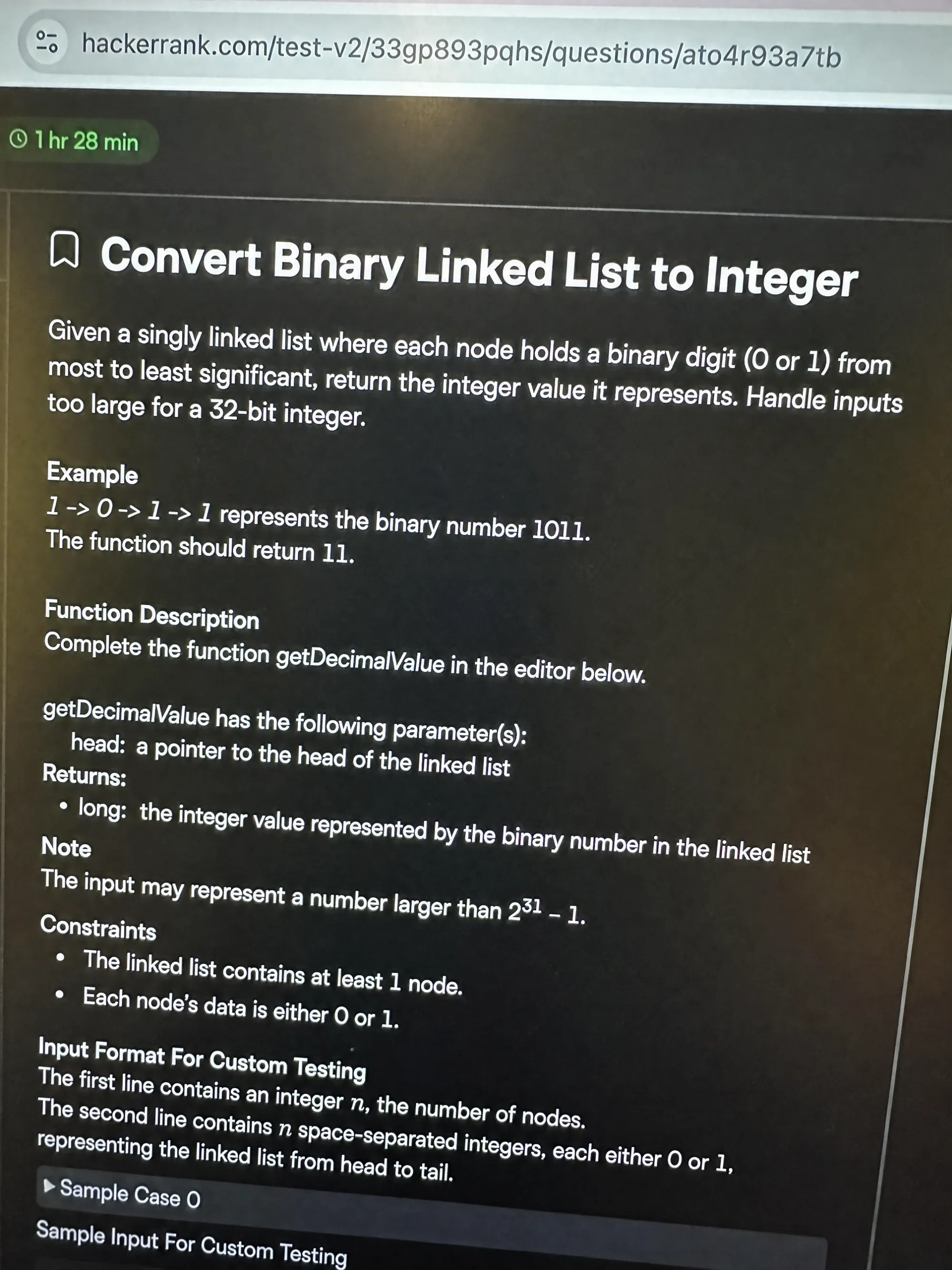
The problem I got: They gave me a singly linked list where each node held a bit, 0 or 1. The most significant bit was at the head, and I had to return the integer value of the whole number. The twist was inputs longer than 32 bits, so a plain int would overflow.
My approach: I walked the list once and built the value from left to right. At each node I shifted my running total left by one place and then added the current bit. I used a 64-bit type to survive long inputs. Shifting before adding was the key detail.
#include <iostream>

struct ListNode {
    int val;
    ListNode* next;
    ListNode(int v) : val(v), next(nullptr) {}
};

long long binaryLinkedListToInteger(ListNode* head) {
    long long result = 0;
    ListNode* curr = head;
    while (curr != nullptr) {
        result = (result << 1) | curr->val;
        curr = curr->next;
    }
    return result;
}
Time complexity: O(n) | Space complexity: O(1)
I finished this one in about 12 minutes. I was calm and confident, and it set a good tone for the rest of the test.
Question 2: Minimum Cost Tree From Leaf Values
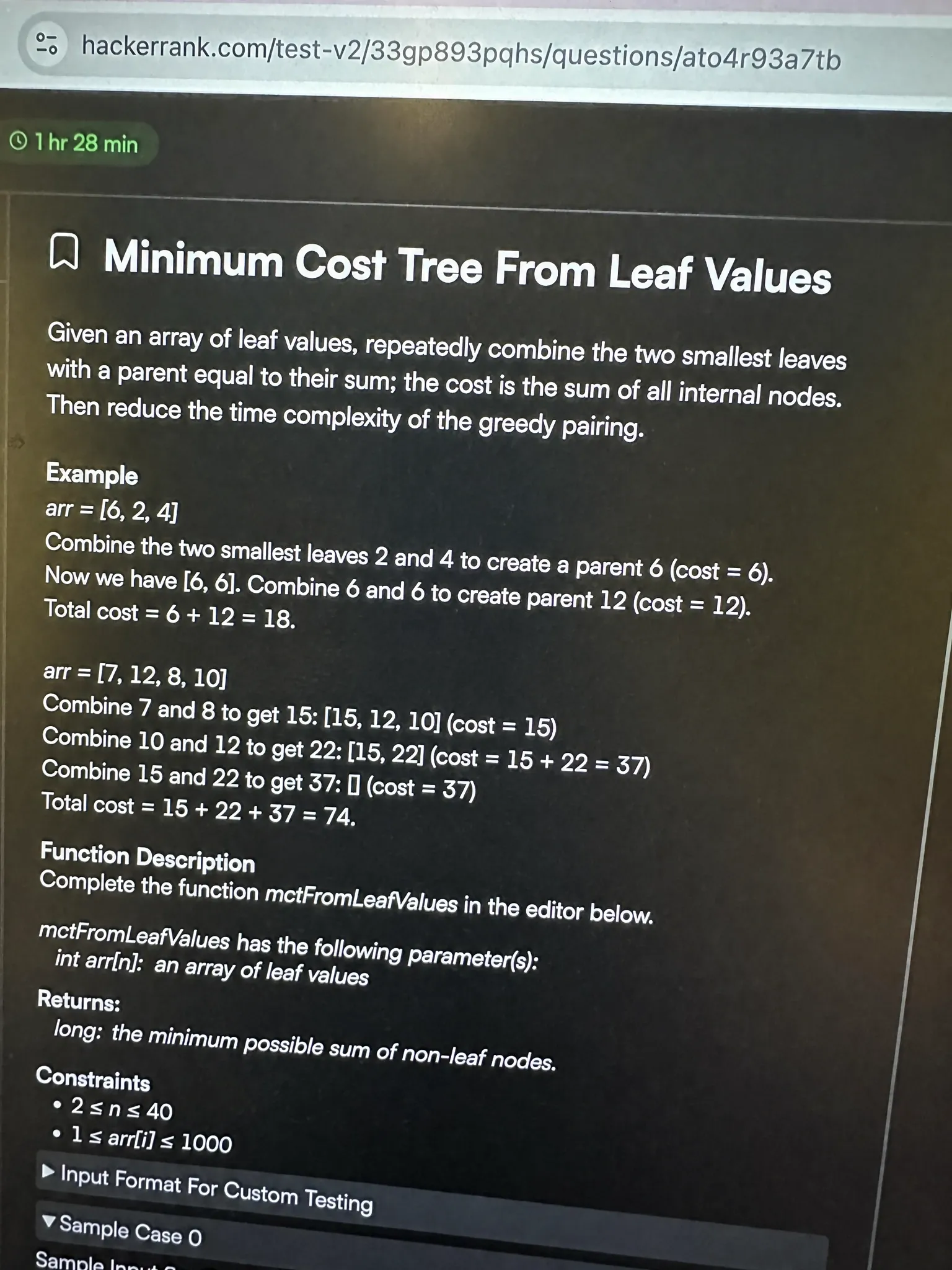
The problem I got: I was given an array of leaf values. I had to build a binary tree from those leaves and report the minimum possible cost. Each non-leaf node cost the product of the maximum leaf values in its two subtrees, and total cost was the sum of all non-leaf costs.
My approach: The safe play was the greedy pairing. I repeatedly took the smallest leaf, paired it with its smallest available neighbor, and added that product to the total. This dropped the smaller leaf each step and kept the larger one for later pairings. Then the modification ask hit me, cut the time complexity of that greedy scheme, and I froze.
#include <vector>
#include <algorithm>
#include <climits>

int minCostTreeFromLeafValues(std::vector<int>& arr) {
    int cost = 0;
    std::vector<int> stack;
    stack.push_back(INT_MAX);
    for (int x : arr) {
        while (stack.back() < x) {
            int mid = stack.back();
            stack.pop_back();
            cost += mid * std::min(stack.back(), x);
        }
        stack.push_back(x);
    }
    while (stack.size() > 2) {
        int top = stack.back();
        stack.pop_back();
        cost += top * stack.back();
    }
    return cost;
}
Time complexity: O(n) | Space complexity: O(n)
The base tree built cleanly, but the time-complexity modification tripped me up hard. I stalled for close to 20 minutes trying to restructure the pairing logic.
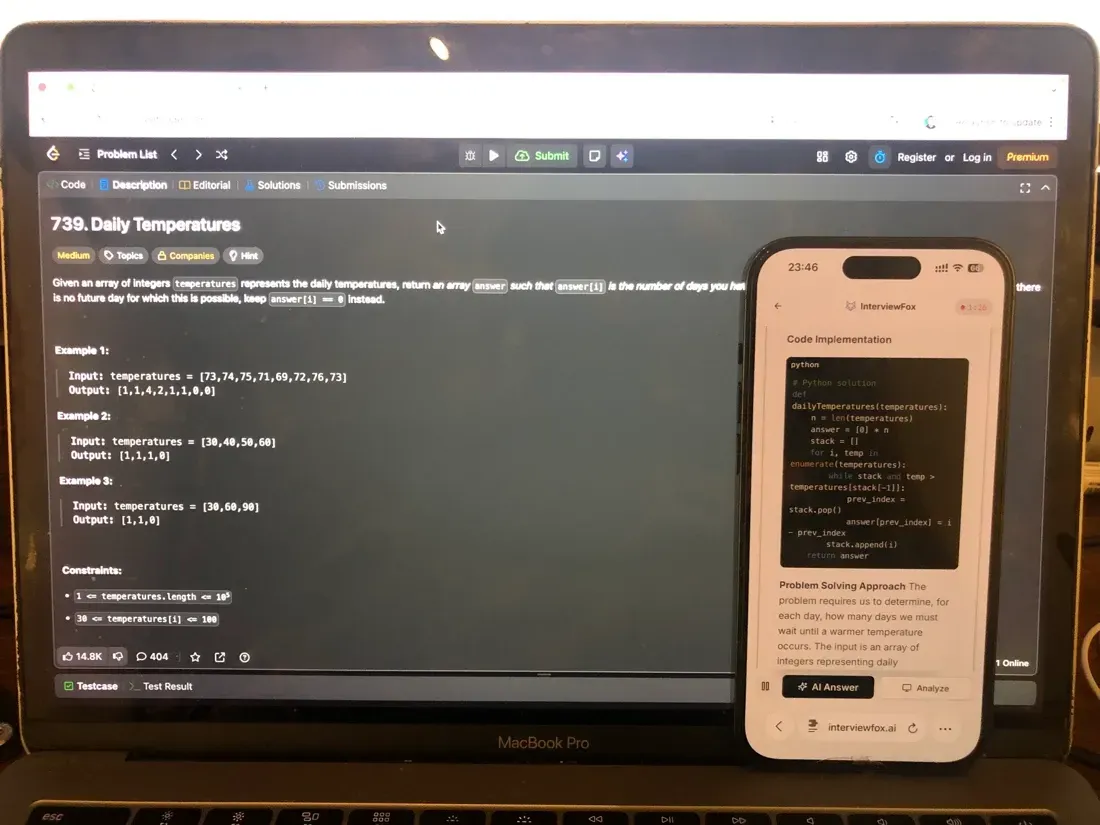
I had decided before the test not to run a desktop overlay. The answer would have sat on the same screen the proctoring system was monitoring, hidden by a basic rendering layer, and I did not want that uncertainty running in the background. When the modification beat me, I hit a keyboard shortcut that auto-captured the problem on my screen and pushed the answer to my phone, a separate device outside the platform's screenshot monitoring. The path became clear and my laptop screen never left the exam editor.
Land offer with Safer AI Interview Assistant
Skip the risky invisible apps. Our dual-device mode keeps it simple and undetectable. You crush the interview, we handle the answers.
Get started. It's free Loved by 100,000+ candidates
Even with that help, I left that part only partly answered.
MathWorks's Proctoring Policy for HackerRank
MathWorks runs its HackerRank test with HackerRank's built-in integrity tooling, and some sittings use the stricter Desktop App Mode. The rules below are the current 2026 behavior on the platform.
Built-In Tracking and Integrity Modes
HackerRank tracks copy and paste and logs tab switches by default, with no setup on your side. Secure Mode adds a fullscreen lock that blocks copy and paste, multi-monitor use, and tab switches.
Proctor Mode adds AI screenshot analysis, plagiarism checks, and webcam anomaly detection. Desktop App Mode is the strictest: it installs a native app that locks the operating system and blocks screenshots, remote access, other apps, and virtual machines.
AI Plagiarism Detection Is Recruiter-Enabled
Recruiters control the AI-plagiarism check. They must switch it on first; it stays off by default and covers coding questions only, not the math or MATLAB sections. A clean, hand-written solution will not trip it.
The Desktop Overlay Termination Case
A candidate's Desktop Overlay was discovered mid-test, and the assessment was terminated before submission. The tool was an invisible desktop overlay layer, and the attempt was voided. That outcome fits the OS-level lockdown Desktop App Mode applies to detect overlay tools. It contradicts the forum claim that the MathWorks OA is never proctored.
11 Other Confirmed MathWorks HackerRank Questions
These other confirmed MathWorks HackerRank questions come from independent candidate reports across LeetCode and GeeksforGeeks. I list each with its source and give runnable code where the report carries enough detail.
Subsequence (Distinct-Subsequences Style)
A candidate shared this on LeetCode Discuss (post 830767) alongside the binary linked list variant, as an image-attached problem. The report gives no LeetCode link or statement, so I skip the code and record it as confirmed.
Reverse Linked List + k-Group Follow-Up
A 2019 Natick candidate (LeetCode post 420967) and a phone-interview candidate (post 483920) both reported this: give an iterative reverse, then convert it to reverse linked list in groups of k. This same task reappears in later rounds.
#include <vector>

struct ListNode {
    int val;
    ListNode* next;
    ListNode(int v) : val(v), next(nullptr) {}
};

ListNode* reverseKGroup(ListNode* head, int k) {
    ListNode* curr = head;
    int count = 0;
    while (curr && count < k) { curr = curr->next; count++; }
    if (count == k) {
        ListNode* prev = reverseKGroup(curr, k);
        curr = head;
        while (count-- > 0) {
            ListNode* next = curr->next;
            curr->next = prev;
            prev = curr;
            curr = next;
        }
        return prev;
    }
    return head;
}
Time complexity: O(n) | Space complexity: O(n) due to recursion.
Group Anagrams
The same 2019 Natick candidate (post 420967) listed Group Anagrams as a phone-screen problem. It is the standard LeetCode Medium: group words that are anagrams of each other.
#include <vector>
#include <string>
#include <map>
#include <algorithm>

std::vector<std::vector<std::string>> groupAnagrams(std::vector<std::string>& strs) {
    std::map<std::string, std::vector<std::string>> m;
    for (auto& s : strs) {
        std::string key = s;
        std::sort(key.begin(), key.end());
        m[key].push_back(s);
    }
    std::vector<std::vector<std::string>> res;
    for (auto& p : m) res.push_back(p.second);
    return res;
}
Time complexity: O(n * k log k) | Space complexity: O(n * k).
Shortest Distance from All Buildings (Variation)
The same candidate (post 420967) saw a Shortest Distance from All Buildings variation during the onsite. The report names it only as a variation, so I record it confirmed and skip the code.
Palindrome (SDET Role)
An SDET onsite candidate (LeetCode post 504480) was asked to write palindrome code with three approaches and test cases. The two-pointer check below is the clearest of the three.
#include <string>
bool isPalindrome(const std::string& s) {
    int i = 0, j = (int)s.size() - 1;
    while (i < j) {
        if (s[i] != s[j]) return false;
        i++; j--;
    }
    return true;
}
Time complexity: O(n) | Space complexity: O(1). The other two approaches are reverse-and-compare and recursion, each with its own test cases.
Bot Reachability (Two Movements Allowed)
A phone-interview candidate (post 483920) and GeeksforGeeks describe a bot reachability problem where two movement types are allowed. A grid BFS solves it.
#include <vector>
#include <queue>
#include <string>

bool canReach(std::vector<std::string>& grid, int sx, int sy, int tx, int ty) {
    int n = grid.size(), m = grid[0].size();
    std::vector<std::vector<bool>> seen(n, std::vector<bool>(m, false));
    std::queue<std::pair<int,int>> q;
    q.push({sx, sy}); seen[sx][sy] = true;
    int dir[4][2] = {{1,0},{-1,0},{0,1},{0,-1}};
    while (!q.empty()) {
        auto [x,y] = q.front(); q.pop();
        if (x == tx && y == ty) return true;
        for (auto& d : dir) {
            int nx = x + d[0], ny = y + d[1];
            if (nx>=0 && nx<n && ny>=0 && ny<m && grid[nx][ny]!='#' && !seen[nx][ny]) {
                seen[nx][ny] = true; q.push({nx,ny});
            }
        }
    }
    return false;
}
Time complexity: O(n * m) | Space complexity: O(n * m).
CUSTOM-SORT Even-Before-Odd
A 2021 EDG intern candidate (post 460973) got a custom-sort task: minimum swaps to put even elements first, then odd, with order inside each group free. The swaps equal the misplaced odds in the even prefix.
#include <vector>
#include <algorithm>

int minSwapsEvenBeforeOdd(std::vector<int>& a) {
    int n = a.size();
    int evenCount = 0;
    for (int x : a) if (x % 2 == 0) evenCount++;
    int swaps = 0, oddSeen = 0;
    for (int i = 0; i < evenCount; i++) {
        if (a[i] % 2 != 0) {
            while (oddSeen < n && a[n - 1 - oddSeen] % 2 != 0) oddSeen++;
            std::swap(a[i], a[n - 1 - oddSeen]);
            oddSeen++;
            swaps++;
        }
    }
    return swaps;
}
Time complexity: O(n) | Space complexity: O(1).
Binary Sequence Min-k Problem
A 2025 on-campus candidate (GeeksforGeeks) reported a binary sequence problem: find the minimum k so the sum of the first k bits beats the sum of the rest. Example 101011 gives k = 6, 1001001 gives k = 0.
#include <string>
#include <numeric>

int minK(std::string& s) {
    int n = s.size();
    int total = 0;
    for (char c : s) total += c - '0';
    int prefix = 0;
    for (int k = 0; k < n; k++) {
        prefix += s[k] - '0';
        if (prefix > total - prefix) return k + 1;
    }
    return 0;
}
Time complexity: O(n) | Space complexity: O(1).
Minimum Steps by a Knight
The same on-campus report (GeeksforGeeks) includes minimum knight steps to a target on a board. A BFS over the eight knight moves finds it.
#include <vector>
#include <queue>

int minKnightSteps(int n, int m, int sx, int sy, int tx, int ty) {
    if (sx == tx && sy == ty) return 0;
    std::vector<std::vector<bool>> seen(n, std::vector<bool>(m, false));
    std::queue<std::pair<int,int>> q;
    q.push({sx, sy}); seen[sx][sy] = true;
    int steps = 0;
    int dir[8][2] = {{2,1},{1,2},{-1,2},{-2,1},{-2,-1},{-1,-2},{1,-2},{2,-1}};
    while (!q.empty()) {
        int sz = q.size();
        while (sz--) {
            auto [x,y] = q.front(); q.pop();
            for (auto& d : dir) {
                int nx = x + d[0], ny = y + d[1];
                if (nx>=0 && nx<n && ny>=0 && ny<m && !seen[nx][ny]) {
                    if (nx == tx && ny == ty) return steps + 1;
                    seen[nx][ny] = true; q.push({nx,ny});
                }
            }
        }
        steps++;
    }
    return -1;
}
Time complexity: O(n * m) | Space complexity: O(n * m).
Max Sum With No Adjacent Elements
Also from that on-campus report: maximum sum of an array such that no two chosen elements are adjacent. The standard DP tracks include and exclude states.
#include <vector>
#include <algorithm>

int maxSumNoAdjacent(std::vector<int>& a) {
    int incl = 0, excl = 0;
    for (int x : a) {
        int newExcl = std::max(incl, excl);
        incl = excl + x;
        excl = newExcl;
    }
    return std::max(incl, excl);
}
Time complexity: O(n) | Space complexity: O(1).
Non-Palindrome Minimum Lexicographic
A 2026 candidate blog (CSDN, June 2026) reported a non-palindrome task: change exactly one character to make the string non-palindromic and lexicographically smallest, or return empty if impossible.
#include <string>

std::string makeNonPalindrome(std::string s) {
    int n = s.size();
    if (n == 1) return "";
    for (int i = 0; i < n; i++) {
        if (s[i] != 'a') {
            char orig = s[i];
            s[i] = 'a';
            bool pal = false;
            for (int j = 0; j < n/2; j++) if (s[j] != s[n-1-j]) { pal = true; break; }
            if (pal) return s;
            s[i] = orig;
        }
    }
    s[n-1] = 'b';
    for (int j = 0; j < n/2; j++) if (s[j] != s[n-1-j]) return s;
    return "";
}
Time complexity: O(n^2) | Space complexity: O(1).
Index of all 13 confirmed MathWorks HackerRank questions
My two problems plus the eleven above make thirteen questions that keep appearing in candidate reports. This table is the fast map for the "mathworks hackerrank questions" search: name, type, difficulty, and where it was reported.
| # | Question | Type | Difficulty | Source |
|---|---|---|---|---|
| 1 | Convert Binary Linked List to Integer (variant) | Linked list | Easy-Medium | My sitting (2026) |
| 2 | Minimum Cost Tree From Leaf Values (modification) | Tree DP | Hard | My sitting (2026) |
| 3 | Subsequence (Distinct-Subsequences style) | DP / counting | Medium | LeetCode 830767 |
| 4 | Reverse Linked List + k-Group follow-up | Linked list | Medium | LeetCode 420967, 483920 |
| 5 | Group Anagrams | Hash map / string | Medium | LeetCode 420967 |
| 6 | Shortest Distance from All Buildings (variation) | BFS / grid | Hard | LeetCode 420967 |
| 7 | Palindrome check (SDET role) | String | Easy | LeetCode 504480 |
| 8 | Bot Reachability (two movements) | BFS / grid | Medium | LeetCode 483920, GeeksforGeeks |
| 9 | Custom-sort even-before-odd | Array / greedy | Easy-Medium | LeetCode 460973 |
| 10 | Binary Sequence Min-k | Prefix sum | Easy | GeeksforGeeks (2025) |
| 11 | Minimum Steps by a Knight | BFS | Medium | GeeksforGeeks |
| 12 | Max Sum With No Adjacent Elements | DP | Easy | GeeksforGeeks |
| 13 | Non-Palindrome Minimum Lexicographic | String / greedy | Easy-Medium | CSDN (Jun 2026) |
What MathWorks's HackerRank Test Format Actually Looks Like
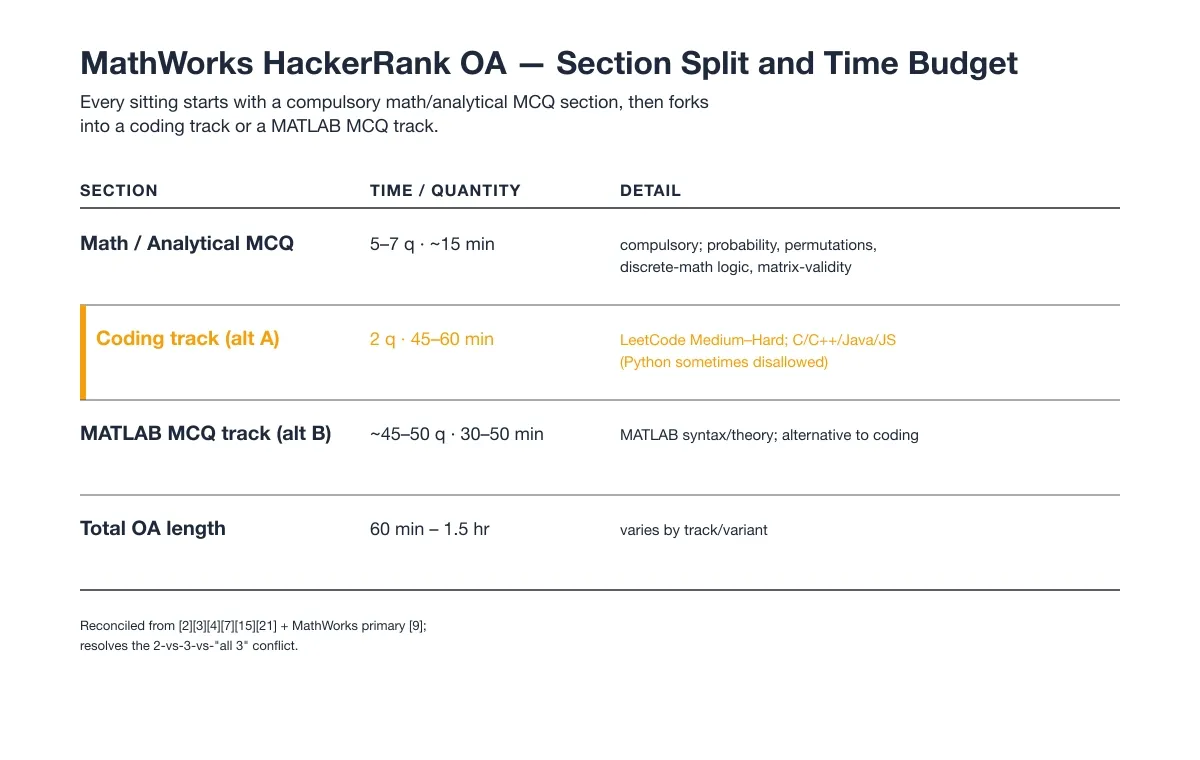
The MathWorks OA format splits into a compulsory math block and a coding or MATLAB fork. The table below shows the section split and the time budget for each track.
The Compulsory Math Section
Every sitting opens with 5 to 7 math and analytical MCQs in about 15 minutes. The topics are probability, permutations and combinations, discrete-math logic, and matrix-multiplication validity. This block is confirmed across six or more independent sources and you cannot skip it.
The Coding or MATLAB Fork
After the math block, pick two coding problems or 45 to 50 MATLAB MCQs on syntax and theory. This MATLAB-or-coding choice is MathWorks's company-specific structural fingerprint, since MathWorks makes MATLAB itself. The exact counts float by batch.
Languages and Time Limits
The allowed languages are C, C++, Java, and JavaScript. Some older batches limit Python, but most 2026 sittings allow it, so be ready in C, C++, or Java.
The total OA runs about 60 minutes on the coding track and up to 1.5 hours on some variants. Duration and question counts float by batch, so treat the table as the common shape rather than a fixed contract.
For example, 2024 sittings ran about 60 minutes with two coding problems; some 2025 variants added a ~70-minute MATLAB track.
How MathWorks's HackerRank Scoring Works
HackerRank scores each problem with visible and hidden test cases, and the rules below are the current 2026 platform behavior.
Partial Credit Is Real
An inefficient but working solution still earns partial credit on the problem. A fast but broken solution earns nothing, so finishing a slow correct pass beats a clever crash. The scoring is per problem, not all or nothing.
What Gets Logged and Flagged
Copy and paste events and tab switches are recorded and shown to recruiters. Plagiarism checkers flag copied solutions, and AI-plagiarism detection is recruiter-enabled and covers coding only. You may look up syntax, but pasting a full solution gets flagged.
A Flag Is Not an Auto-Rejection
The system flags suspicious AI or plagiarism use, but the hiring team makes the final decision. A flag opens a human review; it does not remove you on the spot. Clean, original code keeps you out of that queue.
Why Candidates Fail the MathWorks HackerRank Assessment
Real failure patterns on this test are proctoring and thin execution, not raw difficulty. The cases below are confirmed across candidate reports.
The Desktop Overlay Termination (AI-Tool-Detection)
This same termination appears in the proctoring section above. A candidate's overlay was found mid-test; the attempt was voided, proving the real risk is an assist tool, not difficulty.
At least one candidate was flagged for using a Desktop Overlay during a MathWorks HackerRank sitting. The tool shows the AI's answer on the monitored screen, hidden by a basic OS-layer trick.
The window stays out of visible view but is still on-screen. A real-time AI interview assistant works on a different structure. The answer goes to the candidate's phone — a physically separate device that no screenshot, screen recording, or session monitoring can reach by design.
Land offer with Safer AI Interview Assistant
Skip the risky invisible apps. Our dual-device mode keeps it simple and undetectable. You crush the interview, we handle the answers.
Get started. It's free Loved by 100,000+ candidates
One Hidden Test Failure Can End It
A 2024 candidate was rejected after failing a single hidden test case on the second coding problem. OA performance carries straight into the outcome, so one missed edge case can close the loop.
A Strong OA Still Loses on Season
That same 2024 source full-scored the MATLAB MCQ plus three LeetCode Medium to Hard problems but got no response. He applied too late into the internship season. Timing matters as much as the score.
Your OA Code Gets Re-Litigated
In a later round, a candidate fielded this question: "What is wrong in your code, referring to the initial OA, and how do you fix it?" If you cannot explain or fix your own OA solution, you fail that round even after a strong test.
As covered above, a flag opens human review rather than auto-removal. The specific point for this section is that a stray paste is recoverable. An overlay tool still ends the attempt on the spot.
How to Prepare for the MathWorks HackerRank in 7 Days
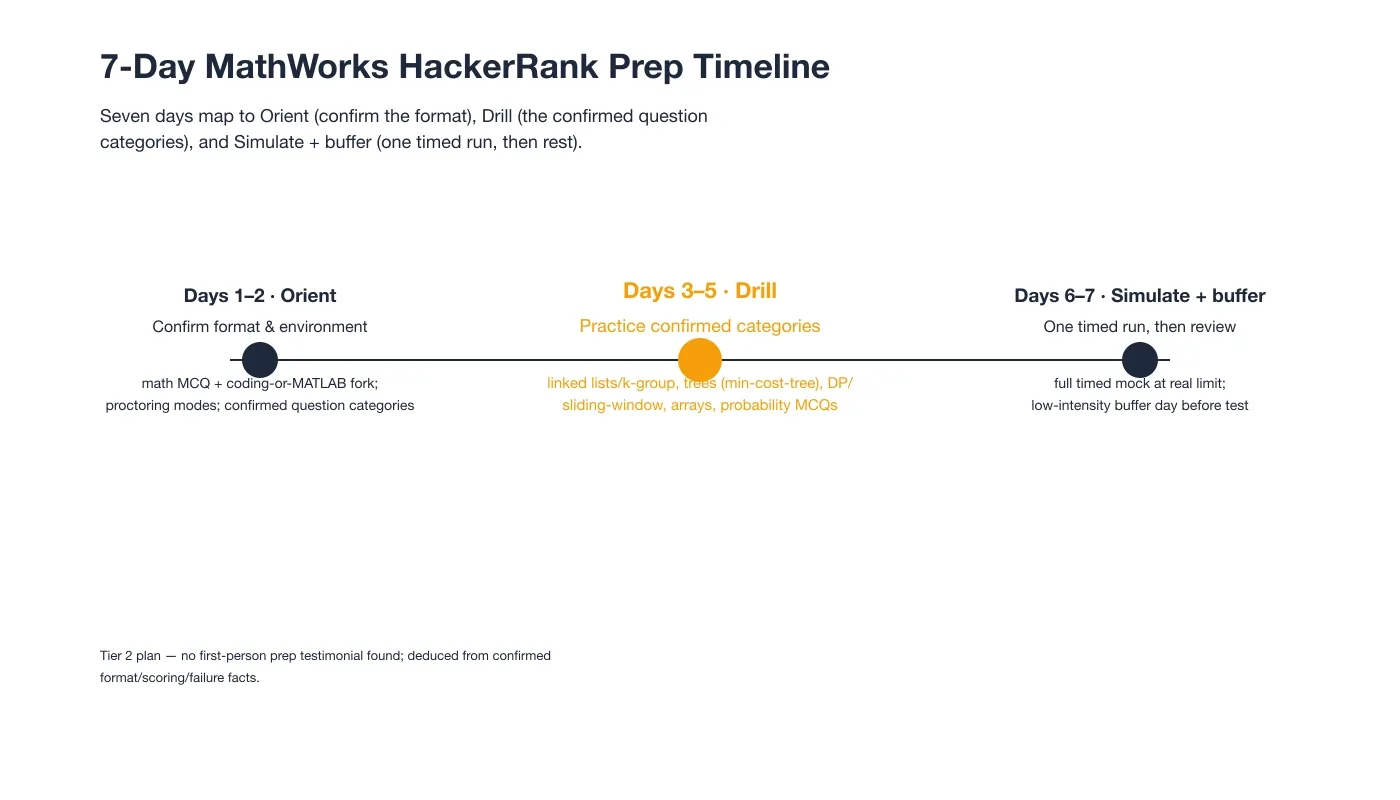
My seven day plan below is reasoned from the confirmed format, scoring, and failure facts. It carries a mandated skip list, because not every LeetCode topic helps here.
Orient (Days 1-2)
I spent the first two days confirming the format itself. The OA opens with a math MCQ block, then forks into coding or MATLAB. I took coding and learned the proctoring modes.
Skip graph-theory drilling. The confirmed MathWorks question pool never includes graph problems, so I moved that time to linked lists and trees.
Skip heavy Big-O and asymptotic drilling. The failure pattern here is proctoring violations, not weak algorithm analysis, so I invested that effort in clean, honest execution.
Drill (Days 3-5)
My drill set covered the confirmed recurring categories. Linked lists with k-group reversal, trees including the minimum cost tree, DP and sliding window, arrays, and probability MCQs made up my core set.
My study stack was the HackerRank Interview Prep Kit, LeetCode Medium to Hard problems, and the GeeksforGeeks top 300. I skipped MATLAB basics because I chose the coding track.
Before the OA I also used the Prep Agent from an AI interview tool over WhatsApp, sending it the confirmed MathWorks question patterns for a personalized drill plan and strategy.
Simulate + Buffer (Days 6-7)
One full timed mock ran at the real limit: about 45 to 60 minutes of coding plus the 15 minute math block. I treated partial credit as the bar, since a working but slow solution still scores.
The final day was a low intensity review only. I reread my own solutions so I could defend them later, then rested before the test.
What Happens After You Submit the OA
Submitting the OA is not the end, because MathWorks reuses the work later. Below are the current 2026 pipeline and timelines, as laid out in MathWorks's own hiring process.
The Interview Pipeline After the OA
Full-time EDG: Code Challenge plus HireVue, then virtual interviews with the hiring manager and HR (about four hours). The internship path runs Code Challenge plus video, then a phone technical, then manager, then recruiter.
Compensation is strong. Levels.fyi (2026) lists a US SWE median of $167,000, from $126,188 (Associate) to $275,000 (Principal). Jointaro reports about an 18% EDG US pass rate.
Real Timelines, OA to Offer
Candidates received the OA about two hours after applying and reached an interview about a week later. The full process ran one to two months. A 2024 candidate got an interview a week after the OA and HireVue.
Your OA Code Gets Re-Litigated
MathWorks reuses your OA code in later rounds, and the dedicated section below explains how to prep for that defense.
The MATLAB-or-Coding Fork Is MathWorks's Signature OA Choice
This fork is the one detail that sets the MathWorks OA apart from most other tests.
Why the Fork Exists
MathWorks makes MATLAB, so its OA uniquely lets you pick a general-coding section or a MATLAB MCQ section. No other major OA guide frames this as a company fingerprint, and it is the choice that shapes your whole sitting.
How to Choose
Take coding if you are stronger in LeetCode-style data structures (in C, C++, Java, or JS, since a few batches still restrict Python). Take MATLAB if you know the product well. Either way the math MCQ is compulsory. Prep it regardless.
MathWorks Re-Litigates Your OA Code in Later Rounds
Most OAs are never revisited, but MathWorks treats your submission as live material for later rounds.
They Reopen Your Submission
A phone interviewer asked a candidate to explain the logic of the OA code and do live modifications, moving from reverse linked list to iterative to k-group. Another round asked directly what was wrong in the initial OA code and how to fix it.
What This Means for Prep
Keep your OA solutions and reasoning memorized, not just submitted. You will be asked to defend and modify them on a call. Write code you can still explain a week later. An AI interview helper can drill you on those exact solutions so the later-round defense feels routine instead of improvised.
MathWorks Proctoring Is Not as Casual as Forums Claim
Forums downplay the proctoring, but the honest picture is stricter than they say.
Forums Say "Not Proctored" and They're Wrong
A Reddit thread claims the webcam is off and the test is not proctored. That is wrong. The evidence above, the Desktop Overlay termination plus Desktop App Mode, shows that at least some MathWorks OAs use OS-level overlay detection with immediate termination.
What to Do Instead
Never run a desktop overlay or invisible assist tool during the test. HackerRank logs copy and paste and tab switches and shows them to recruiters. A flag triggers human review, not auto-fail, but an overlay tool ends the attempt on the spot.
FAQ
What is the MathWorks OA like in 2026?
The MathWorks OA opens with a math and analytical MCQ block. It then forks into a coding track or a MATLAB MCQ track.
Is the MathWorks EDG HackerRank test hard?
The EDG HackerRank test is selective, with about an 18% pass rate reported. The coding problems run Medium to Hard on LeetCode.
How many questions are on the MathWorks EDG OA?
The EDG OA gives two coding problems plus a math MCQ block. The MATLAB track instead gives about 45 to 50 MATLAB questions.
What kinds of MathWorks HackerRank questions show up?
Confirmed questions include linked lists, trees, DP, and array tasks. The pool also spans anagrams, palindromes, and subsequence problems.
How long is the MathWorks online assessment?
The coding track runs about 60 minutes including the math block. Some MATLAB or variant sittings run up to 1.5 hours.
Can I use an AI tool or invisible app during the MathWorks HackerRank OA?
Desktop overlay tools put the AI's answer on your computer screen, rendered as a hidden layer above the browser using a basic OS-layer trick.
The answer stays on-screen and the hiding is basic. Proctoring software keeps adding detection capabilities as AI tools become more common, so the risk exposure isn't fixed.
An AI interview copilot instead pushes the answer to your phone. It lands on a physically separate device that no screenshot, screen recording, or session monitoring can reach by design, so the laptop screen stays on the exam editor, unchanged.
If you're going to use AI assistance during the OA, the dual-device architecture removes the answer from your screen entirely.
Land offer with Safer AI Interview Assistant
Skip the risky invisible apps. Our dual-device mode keeps it simple and undetectable. You crush the interview, we handle the answers.
Get started. It's free Loved by 100,000+ candidates