
I Passed the Maven Securities HackerRank OA: 2026 Questions

Quick Facts
| Company and role | Maven Securities, quant-trading graduate applicant (2026) |
| Stages | Math and probability OA, then HackerRank coding round, then Arctic Shores, then interviews |
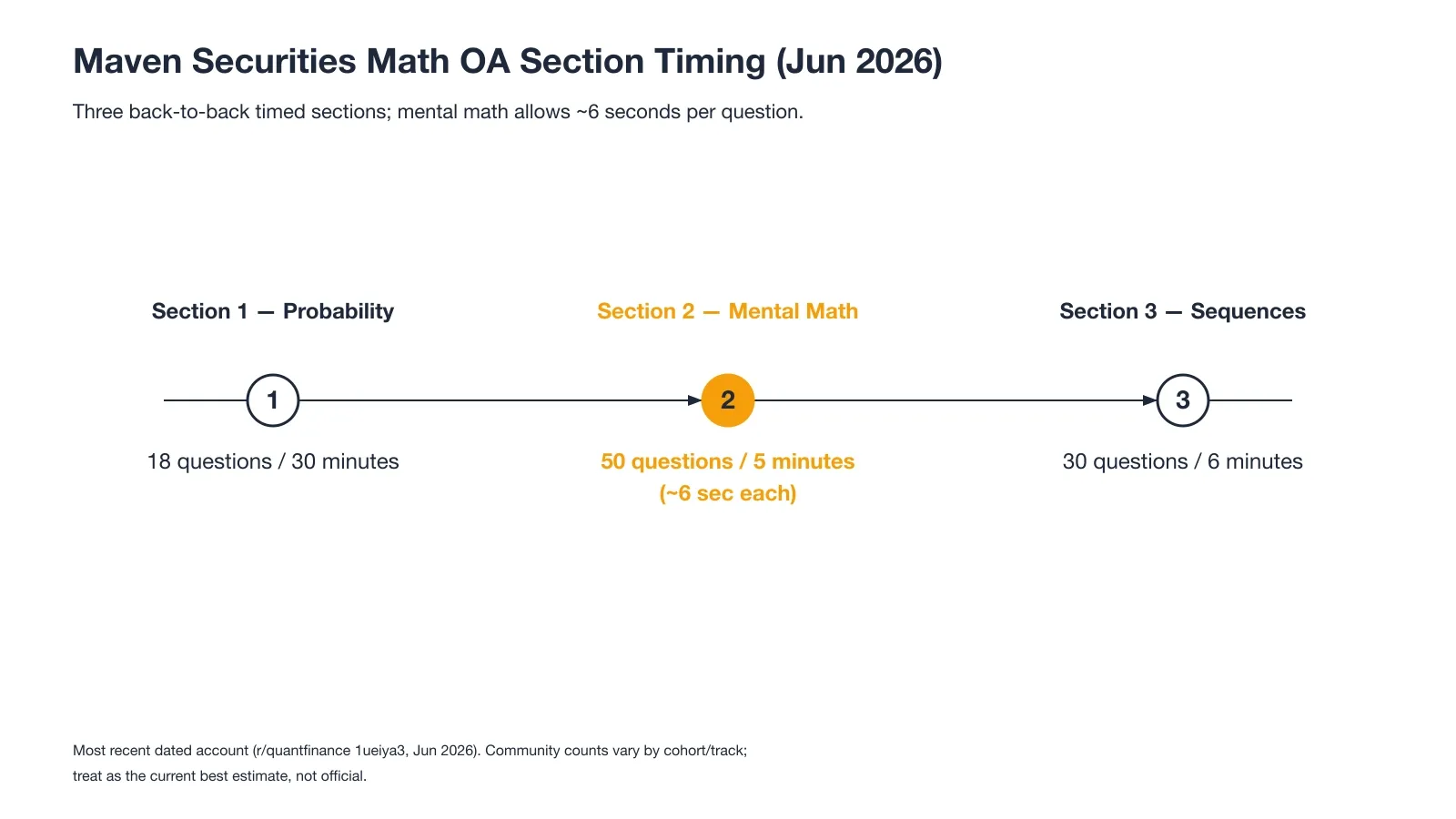
| Math OA | 18 probability questions (30 min), 50 mental-math (5 min), 30 sequences (6 min) |
| Coding problems | 3: Max Occurring Character, Max Array Correlation, Max Distance |
| Proctoring | Webcam and microphone on; calculator and scratch paper restricted |
| Scoring | Unofficial ~70% bar; scoring stays opaque with no feedback |
| Reapplication | Permanent graduate ban after one unsuccessful attempt |
I took the Maven Securities OA for a quant-trading graduate role in 2026. It is not one test but a chain: a math and probability screen, a HackerRank coding round, and later Arctic Shores and interviews. What follows is the full walkthrough of every stage I sat, the questions that appeared, and how I prepared.
What catches most applicants off guard is the order of difficulty. The coding round is real, but the math OA is where the cut happens. Only tools that keep your screen clean help here, like an AI interview copilot on a separate device.
Eighteen probability questions in thirty minutes, then fifty mental-math questions in five minutes, then thirty sequences in six, all under a webcam. I break down each stage below, starting with the one that decides most outcomes. One honest caveat: the exact problem sets move between cohorts, so prep for the pattern, not the literal list.
What the Maven Securities OA Actually Is
Maven's online assessment is a staged gauntlet, and the coding round is only one leg of it. The sequence that reached me, and that candidate reports consistently describe, runs like this:
- A numerical and probability screen (mental math, sequences, and eighteen probability or combinatorics multiple-choice questions).
- The HackerRank coding stage with three back-to-back problems.
- Arctic Shores, a game-based cognitive assessment.
- HR screening, interview rounds, and an assessment centre.
The coding stage gets the most attention online, but the math screen is the wider filter. Most rejections I traced through community reports came from a missed math threshold, not a failed coding problem. Treat the two as one assessment and weight your prep accordingly.
The Math OA Sections
The math OA is three timed sections. The counts below are what candidate reports and the vendor prep sites agree on, with the conflicts noted where they exist.
The Probability Section
The first-round multiple choice is eighteen probability, combinatorics, and logic questions in thirty minutes. That is roughly one every ninety seconds, and several are genuine brain-teasers. Maven even publishes a sample on its early-talent page, which is the best official look at the shape of this section.
Maven's official sample: Alex rolls an 8-sided die and stops once he rolls two 8s in a row. What is the expected number of rolls?
Options: A) 76 B) 72 C) 68 D) 64 E) 60
This is a standard expected-value setup. Let E₀ be the expected remaining rolls from a cold start, and E₁ the expected remaining rolls right after one 8.
From cold you roll once; with probability 1/8 you reach the one-8 state, otherwise you stay cold. So E₀ = 1 + (1/8)·E₁ + (7/8)·E₀.
From the one-8 state you roll once; with probability 1/8 you finish, otherwise you drop back to cold, so E₁ = 1 + (7/8)·E₀. Solving gives E₀ = 72. The rigorous answer is B) 72.
One trap worth locking in: Maven's own answer key for this sample marks D) 64. That comes from reading (1/8)² = 1/64 as the expectation directly, which ignores the cost of reaching the first 8. The true expectation is 8 + 8² = 72. Know that trap before the timed section.
What candidates reported
The circulating candidate-reported set goes well beyond this sample. The questions below are reported by multiple candidates and reposted across prep sites. They are candidate-reported, not official, so treat them as a study guide rather than a guarantee of what you will see:
- Knockout tournament: 100 teams, single elimination, no draws. Least games to decide a winner? Answer: 99 (every game eliminates one team, so n−1 games).
- Circular table: three legs placed uniformly at random on a circular tabletop. Probability the table can stand? Answer: 1/4 (the three legs must not all fall inside a single semicircle; probability they do is 3/4, so the table stands with probability 1/4).
- Disease screening: a condition affects 1% of the population. A test is positive 99% of the time if you have it, and 5% of the time if you do not. Given a positive result, approximate probability you actually have it? Answer: 17% (Bayes: 0.0099 / (0.0099 + 0.0495) ≈ 0.167).
- STATISTICS arrangements: number of distinct arrangements of the letters in STATISTICS? Answer: 50400 (10! / (3!·2!·3!·2!)).
- Consecutive heads or tails: flip a fair coin until two consecutive results match. Probability the number of flips is even? Answer: 2/3.
- Coupon collection: five toys, one random toy per box at £4 each. Expected cost to collect all five? Answer: £45.68 (5 · (1 + 1/2 + 1/3 + 1/4 + 1/5) · £4 ≈ £45.68).
The full reported list also includes dice-sum, squash-tournament, labeled-dice, pigeonhole-divisibility, three-dice-ordering, syllable-counting, and ball-in-bag problems. The pattern is consistent: short, multiple-choice, and meant to be solved in under two minutes each. Speed matters more than depth here.
Worked practice problems (full derivations)
The reported patterns reward recognition over long algebra. The same skills appear as longer problems across quant screens. Drilling a few with full working keeps you steady when a question looks unfamiliar. Three representative ones:
- Bankruptcy Markov chain. Two players start with 1 and 2 dollars. The poorer wins 2/3 of games. They play until one is bankrupt. Let sᵢ be the win chance from i dollars, with s₀=0 and s₃=1.
From state 1, s₁=(1/3)·0+(2/3)·s₂. From state 2, s₂=(1/3)·s₁+(2/3)·1. Solving gives s₁=4/7. The poorer player wins with probability 4/7.
- Coupon collector, fair die. Expected throws to see all six faces? The first new face takes 1 throw. Each later face appears with success chance 5/6, 4/6, down to 1/6, so mean waits are 6/5, 6/4, and on to 6/1. Sum them: 6·(1+1/2+1/3+1/4+1/5+1/6)=14.7. Expected throws: 14.7.
- Three dice, even product. Roll three fair dice and multiply the faces. The product is odd only if all three are odd. That happens with chance (1/2)³=1/8. So the even product chance is 7/8.
The Mental-Math Section
The mental-math block is fifty arithmetic questions in five minutes, about six seconds each. Sources disagree on the exact count: vendor prep sites list both 50 questions in 5 minutes and 40 in 6 minutes. Either way the pace is the point. There is no calculator, and in this section even scratch paper is reportedly not allowed, so the arithmetic has to happen in your head.
I drilled this on a timed trainer until the six-second pace felt automatic. The mistakes here are not conceptual; they are the ones you make when the clock forces a guess.
The Sequences Section
The sequences block is thirty pattern-recognition questions in six minutes. These are number and shape sequences where you infer the next term. Like the mental-math section, the reported counts vary (30 in 6 minutes versus 15 in 15 minutes across sources), but the cognitive load is the same: recognize the pattern fast, commit, move on.
The HackerRank Coding Round
After the math screen comes the HackerRank coding stage: three problems given back to back. The three-question format is consistent across cohorts, but the exact set is not a fixed bank. Pandas-style data-processing tasks, market-making simulations, and standalone algorithm questions all show up alongside the string and array problems below. Treat the three that follow as one real instance, not the only possible set.
Question 1: Max Occurring Character
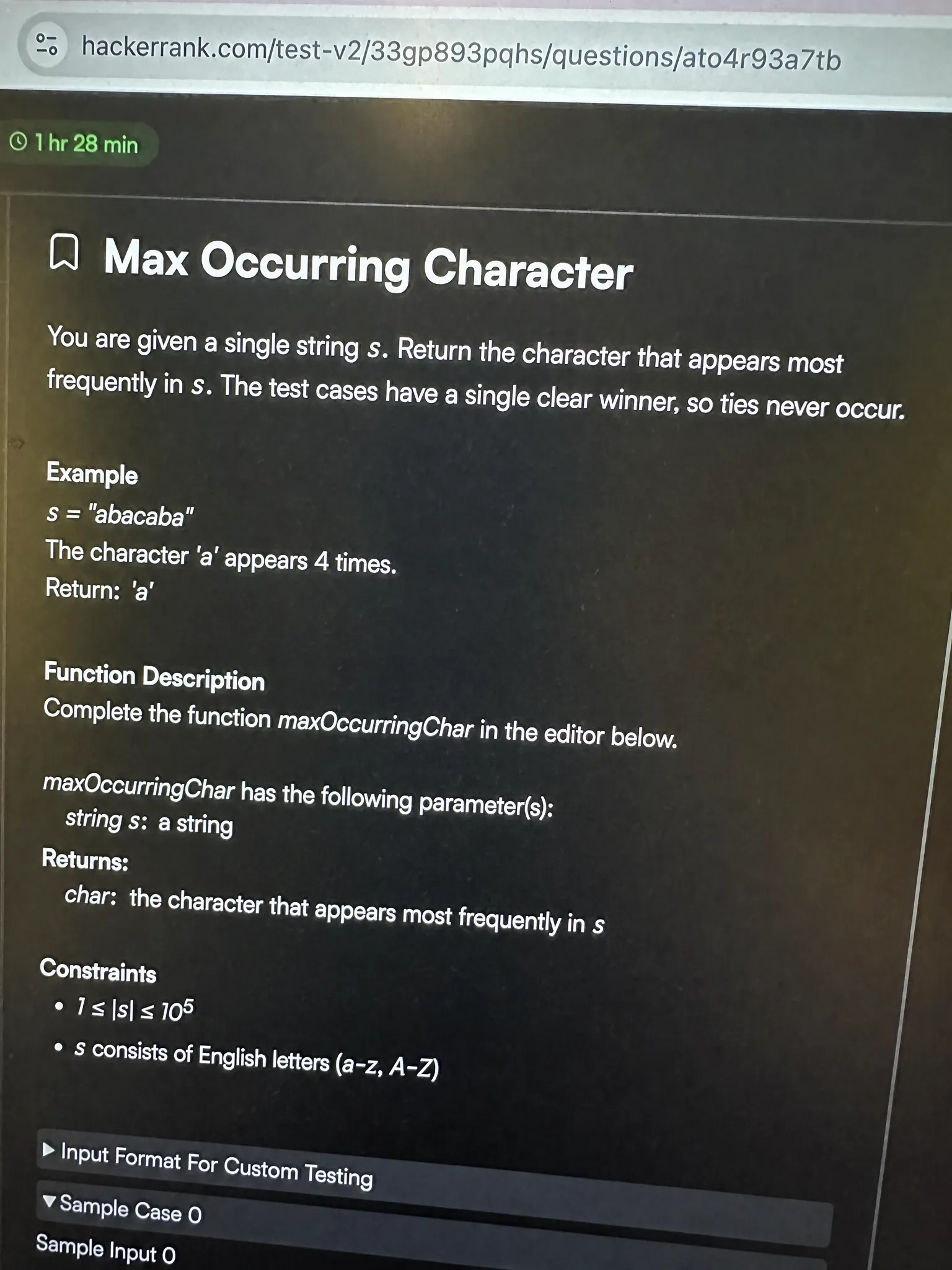
The problem I got: a single string and a request for the character that appears most often, returned as that one character. The test cases had a clear single winner, so ties never came up.
My approach: count every character in one pass with a frequency map, then walk the map for the highest count. One pass and constant-time lookups keep it linear.
def max_occurring_char(s):
    counts = {}
    for ch in s:
        counts[ch] = counts.get(ch, 0) + 1
    best_char = ''
    best_count = -1
    for ch, count in counts.items():
        if count > best_count:
            best_count = count
            best_char = ch
    return best_char
Time complexity: O(n) | Space complexity: O(k) This one was the warm up and I finished it quickly, so I moved to the second problem with time in the bank.
Question 2: Max Array Correlation
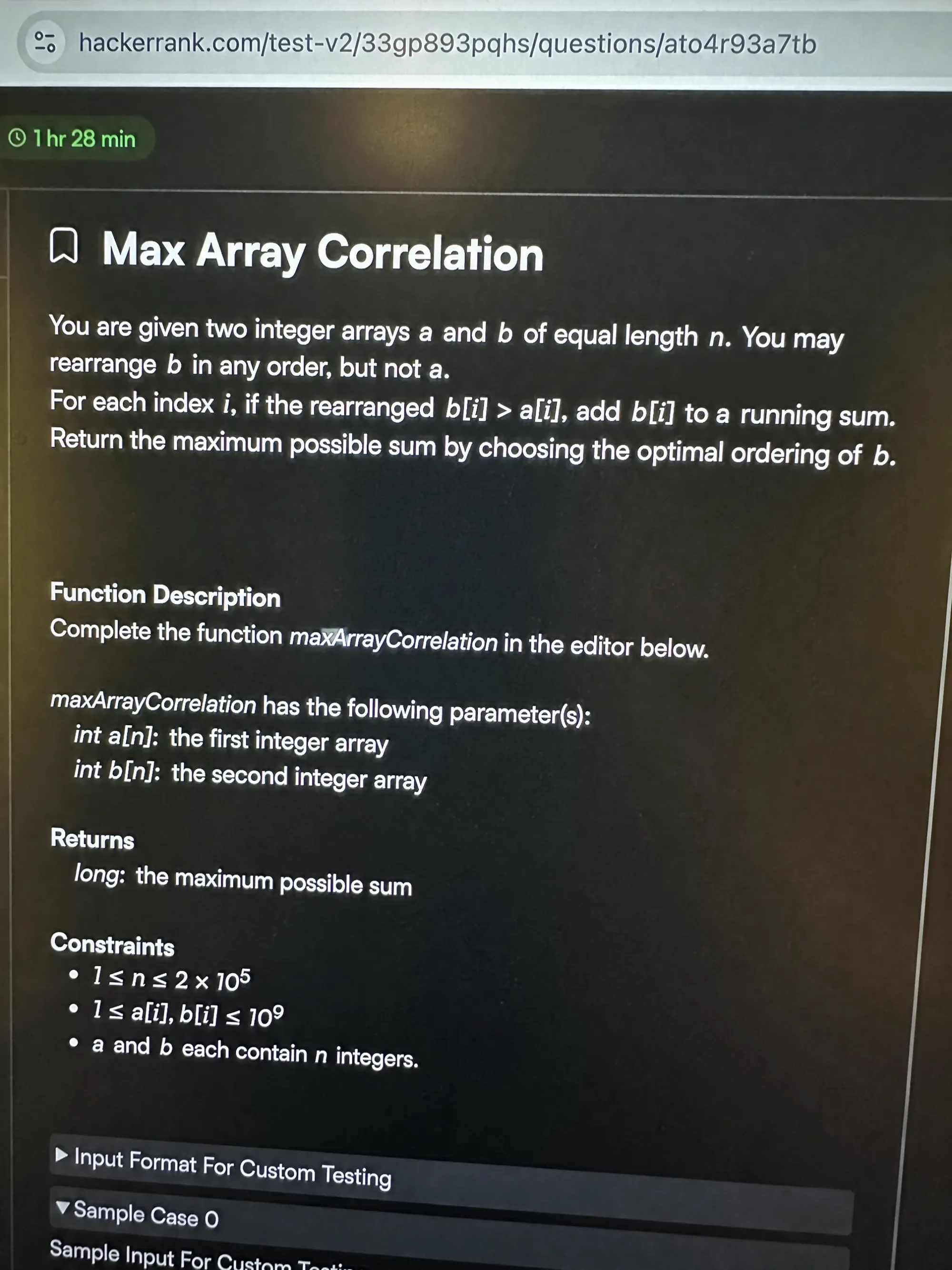
The problem I got: two integer arrays a and b of equal length n. Rearrange b freely, but not a. For each index i, if the rearranged b[i] is greater than a[i], add that b value to a running correlation sum. Pick the order of b that maximizes the sum. Sample: a = [1,2,3,4,5], b = [5,4,3,2,6], answer 20.
My approach: testing orders directly is factorial cost and far too slow. The winning idea is to sort both arrays ascending and pair the smallest a with the smallest b that still beats it.
Every b placed above an a adds to the sum, and we want as many such pairs as possible. Walk a from smallest to largest with one pointer on b, skip any b that cannot beat the current a, and add b to the total the moment it does.
def max_array_correlation(a, b):
    a_sorted = sorted(a)
    b_sorted = sorted(b)
    n = len(a)
    i = j = 0
    total = 0
    while i < n and j < n:
        if b_sorted[j] > a_sorted[i]:
            total += b_sorted[j]
            i += 1
            j += 1
        else:
            j += 1
    return total
Time complexity: O(n log n) | Space complexity: O(n) I burned a real stretch of time on a brute force that passed the sample but hit a timeout on a hidden case. I only recovered after I scrapped it and sorted, which left me tighter on the clock than I wanted going into the last problem.
When I got stuck on Max Array Correlation, I triggered the real time AI interview helper with a keyboard shortcut. It auto-captured the problem and pushed the approach to my phone, a separate device outside the platform's screenshot monitoring. The idea cleared up, and my laptop screen stayed exactly as the exam editor left it.
Land offer with Safer AI Interview Assistant
Skip the risky invisible apps. Our dual-device mode keeps it simple and undetectable. You crush the interview, we handle the answers.
Get started. It's freeLoved by 100,000+ candidates
Question 3: Max Distance
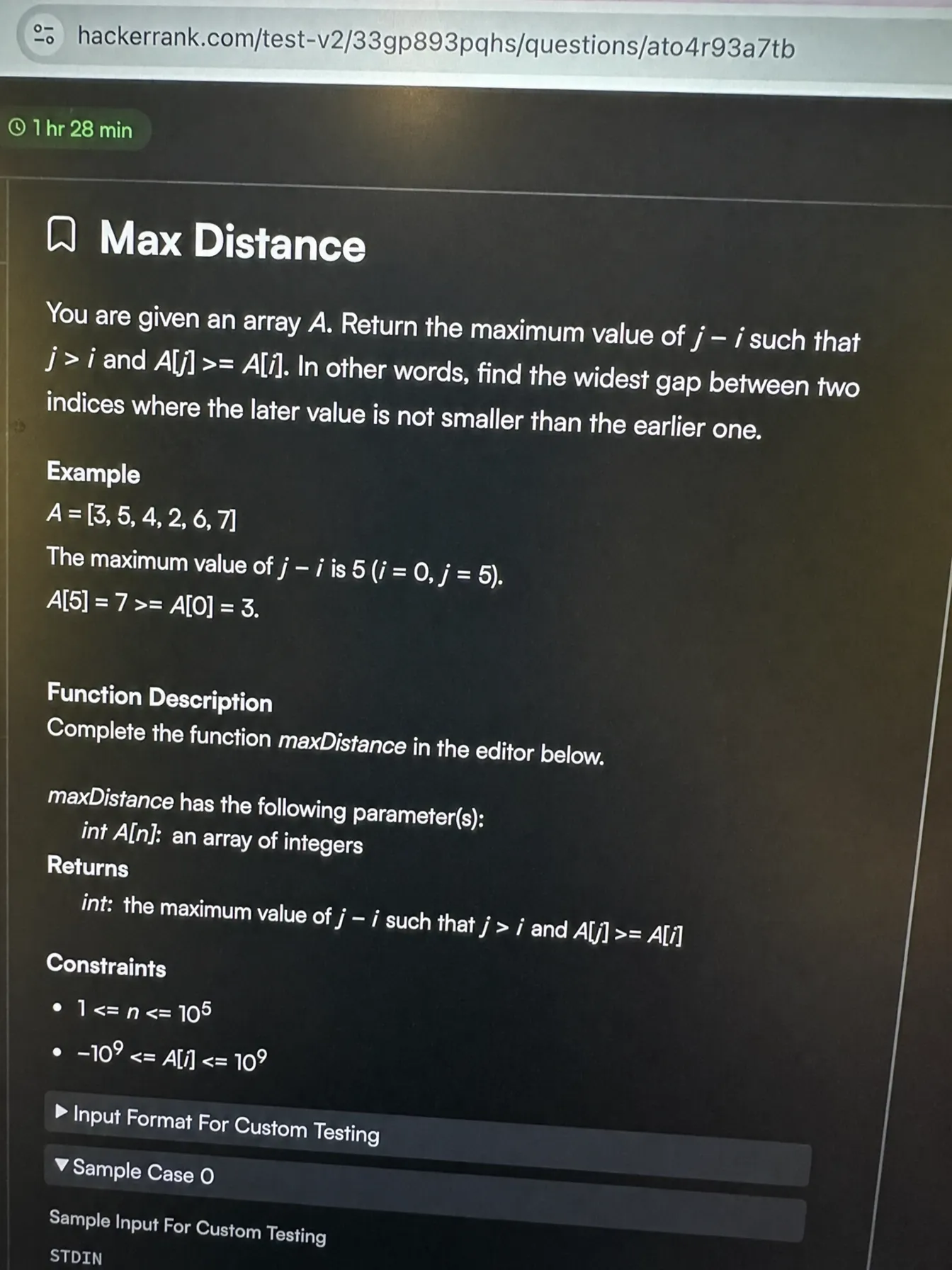
The problem I got: a single array A, return the maximum j − i such that j > i and A[j] >= A[i]. In plain terms, the widest gap between two indices where the later value is not smaller than the earlier one.
My approach: the brute force is a double loop, too slow for the largest inputs. Precompute two helper arrays, the smallest value from the start up to each index and the largest from each index to the end.
Then a two-pointer scan lets the left anchor sit at a prefix minimum while the right pointer pushes forward whenever the suffix maximum still clears it. The result is any valid widening gap captured in one linear sweep after the two precomputes.
def max_distance(A):
    n = len(A)
    if n == 0:
        return 0
    left_min = [0] * n
    right_max = [0] * n
    left_min[0] = A[0]
    for i in range(1, n):
        left_min[i] = min(left_min[i - 1], A[i])
    right_max[n - 1] = A[n - 1]
    for j in range(n - 2, -1, -1):
        right_max[j] = max(right_max[j + 1], A[j])
    i = j = 0
    best = 0
    while i < n and j < n:
        if left_min[i] <= right_max[j]:
            best = max(best, j - i)
            j += 1
        else:
            i += 1
    return best
Time complexity: O(n) | Space complexity: O(n) This was the last screen and I was already watching the timer, but the two-pointer version came together and I submitted with the clock still running.
How Maven Proctors the OA
The webcam and microphone stay on for the full length of the test. I confirmed this in the invitation email, and it holds across cohorts.
Maven's own rules go further than the generic platform settings. No calculator is allowed, and in the numerical sections even scratch paper is reportedly barred while the probability section permits it. Leaving the test window is treated as an automatic disqualification, so the tab has to stay put.
HackerRank's Proctor Mode and Secure Mode supply the underlying mechanism: AI behavioral monitoring, webcam anomaly detection, and plagiarism checks at 93 percent accuracy . Those are platform-level rules that apply across companies, not Maven-specific, so I cover the details in the linked proctoring guide rather than repeating them here.
How Maven Scores the OA
The exact scoring signs shift between cohorts in candidate reports. Some describe negative marking where a wrong answer costs a point, which makes blind guessing expensive in the timed multiple-choice sections.
Others describe a scheme where a correct answer scores, but both a wrong answer and a blank score zero, which argues for guessing rather than leaving blanks. Confirm the rule on your own invitation, because the two give opposite advice.
Either way, the timed math sections punish hesitation most.
The unofficial pass bar sits north of 70 percent, but Maven has never published that cutoff. Scoring comes back opaque: a generic result with no breakdown, and often a generic rejection that says it was not quite a match. You rarely see why you passed or failed.
My Exam-Day Strategy
I built my plan around the brutal mental-math clock. I drilled the six-second pace until answering became automatic, then went after the easiest problems first to bank points before the harder ones.
Going in, I also knew that a weak opening round does not end the process. A fumbled first round still leads to round two, and round two is winnable from there. That single fact kept the panic down when the probability section got tight.
Why Candidates Fail the Maven Securities OA
The failure modes range from a missed math threshold to a silent integrity cancellation. The most common one is a low math score: a self-estimate below 70 percent lines up with the rejection, and the timed sections make that bar hard to reach.
Some candidates clear the coding test and then stall at Arctic Shores, the game-based stage after the coding round. Rejections land right after that stage, and others hear nothing at all. Maven permanently bars reapplication to its graduate programmes after one unsuccessful attempt, which turns any single failure into a final one and raises the cost of every mistake above.
On integrity: a candidate who submitted the OA while using a desktop overlay initially saw the result recorded, then received a cancellation email three days later voiding the attempt for an integrity violation.
HackerRank logs the moment the test window loses focus, flags any click or key press into an outside window, and catches the rest through webcam review. A tool that renders an answer on the same screen you are monitored on leaves a trace the system is built to find.
That is the exposure a desktop overlay creates. A dual-device setup routes the answer to a phone, a device the session recording never sees, which is the only way to keep the laptop screen exactly as the exam editor left it.
Land offer with Safer AI Interview Assistant
Skip the risky invisible apps. Our dual-device mode keeps it simple and undetectable. You crush the interview, we handle the answers.
Get started. It's freeLoved by 100,000+ candidates
How I Prepared for the Maven Securities OA
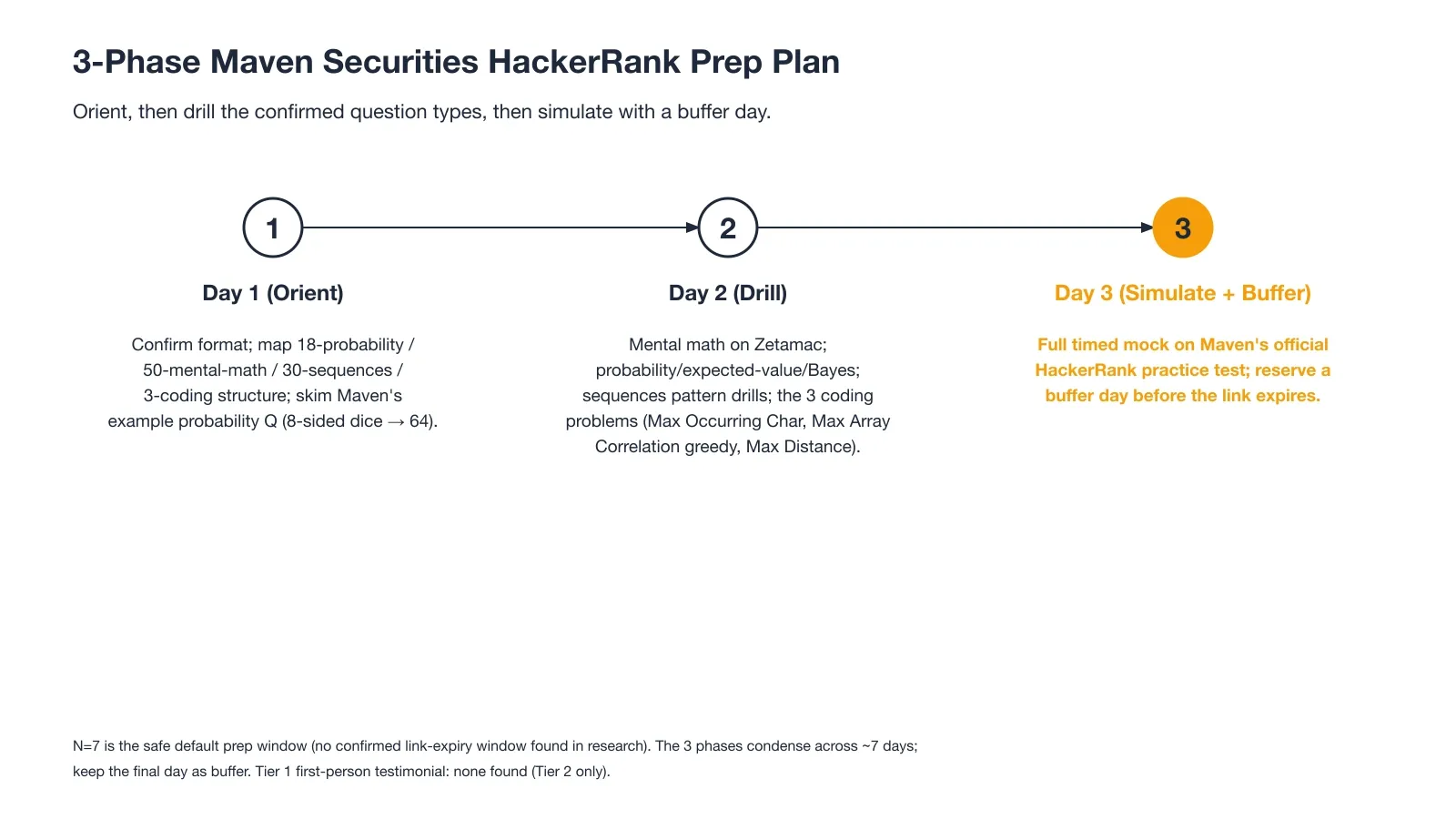
I planned my prep around the confirmed question types, not a generic LeetCode list. Candidates who fail this OA miss the timed mental-math and sequence sections, not the coding problems, so I aimed my time there first.
Confirm the Format Before You Drill
I started by confirming the format instead of drilling blind. I skipped random LeetCode medium practice. The confirmed shape is 18 probability, 50 mental-math, 30 sequence questions, and three coding problems, so I aimed my time at the math screen first and the coding problems second.
Drill Mental Math, Probability, and the Three Problems
I drilled mental math on a timed trainer, then probability and expected value, then the three coding problems. The correlation problem rewards a sort and two-pointer sweep. The distance problem needs the prefix-minimum and suffix-maximum trick. I practiced both until the pattern was automatic.
Simulate and Keep a Buffer Day
I ran one full timed mock before the real thing. The negative marking and the six-second mental-math pace make a dry run worth more than extra reading. Invitation windows vary in candidate reports (some cite roughly a week for the math stage and two weeks for later stages, others a 72-hour window), so I kept a buffer day in case the link expired sooner than expected.
What Happens After the Maven Securities OA
After the coding test, the pipeline moves to Arctic Shores, a game-based cognitive assessment. Candidate reports describe about five games measuring roughly five traits, with a window of around two weeks. It is a separate gate, not a formality, and rejections or silence after it are common.
Strong candidates then reach HR and interview rounds, continuing toward an assessment centre and a final decision.
Those later rounds are where the quant depth really lands. Candidates report being asked to compare 10⁴⁰ against 40! and to build a confidence interval around it, to design a stopping rule for a symmetric random walk, and to judge whether a coin is fair or biased from a short flip sequence. The OA screens speed. The interviews screen that same probability intuition under pressure.
FAQ
What is the Maven Securities OA?
The Maven Securities OA is a staged online assessment for quant-trading graduate roles. It includes a math and probability screen, a HackerRank coding round, and later Arctic Shores and interviews. The coding stage gives three back-to-back problems inside a proctored browser.
How many questions are on the Maven Securities OA?
The math screen has 18 probability questions, 50 mental-math questions, and 30 sequence questions, each under hard time limits. The HackerRank coding stage adds three problems: Max Occurring Character, Max Array Correlation, and Max Distance. This three-problem format is consistent, but the specific problems vary between cohorts.
Does Maven Securities use webcam proctoring?
Yes. The webcam and microphone stay on for the whole attempt. Maven also restricts calculators and, in the numerical sections, scratch paper, and treats leaving the test window as an automatic disqualification. HackerRank's Proctor Mode and Secure Mode supply the underlying monitoring.
Can I use an AI tool during the Maven Securities OA?
Desktop overlay tools render an answer on your computer screen as a hidden layer above the browser. Proctoring software keeps adding detection capabilities, so the on-screen exposure stays a real risk.
A dual-device setup routes the answer to your phone, a physically separate device no screenshot or session monitoring can reach, which keeps your laptop screen unchanged. If you want that separation, an AI interview tool on a second device is the only layout that stays off the monitored screen.
Land offer with Safer AI Interview Assistant
Skip the risky invisible apps. Our dual-device mode keeps it simple and undetectable. You crush the interview, we handle the answers.
Get started. It's freeLoved by 100,000+ candidates
What is the pass rate for the Maven Securities OA?
Maven does not publish a cutoff, and the unofficial bar sits north of 70 percent. Scoring stays opaque, so candidates see a generic result rather than a detailed score.
Can you reapply to Maven Securities after failing the OA?
No, not for graduate programmes. Maven permanently bars reapplication after one unsuccessful attempt, so a single failed OA closes that door for good.
What happens after the Maven Securities OA?
Most candidates move to Arctic Shores about two weeks later, then HR and interview rounds. Rejections arrive as a generic note with no feedback, and some are ghosted after Arctic Shores.