
How I Passed the Meta CodeSignal OA in 2026: Real Questions

Quick Facts
| Time limit | 90 minutes |
| Format | 1 problem, 4 sequential stages |
| Platform | CodeSignal (Meta's proctored OA) |
| Proctoring | Camera + microphone + full screen recording |
| Languages | Python, Java, JavaScript, C++ and more |
| Score | CodeSignal Assessment Score 200–600 |
I took the Meta online assessment on CodeSignal for a new-grad software engineer role in 2026. It was a 90-minute, proctored session built around one problem split into four stages. I passed, and below is the complete format, the questions I actually got, and how I prepared.
For prep, I drilled the confirmed Meta CodeSignal question patterns, an in-memory key-value store with versioned queries, until the four-stage structure felt routine, then replayed it under a 90-minute timer. I kept an AI interview assistant on my phone through both prep and the real test, so any help I needed stayed off the proctored screen.
During the test, one staged question came up that I blanked on and nearly failed: I walk through exactly how I recovered later in this guide.
The Real Questions on My Meta CodeSignal Test
Before my test, I went through every Meta CodeSignal post from the past two years on Reddit, LeetCode Discuss, and Teamblind, and I built my prep workflow around interviewfox.ai for both the practice days and the test itself. What I found tracks closely with what I experienced.
I took the Meta CodeSignal OA for a new-grad SWE role in 2026. It was one problem split into four stages that unlocked in order: a build-a-system task, not a set of separate algorithm puzzles.
I write the two stages that mattered most to my result below, Stage 1 (where I found my footing) and Stage 3 (where I stalled).
Question 1: Key-Value Get and Set
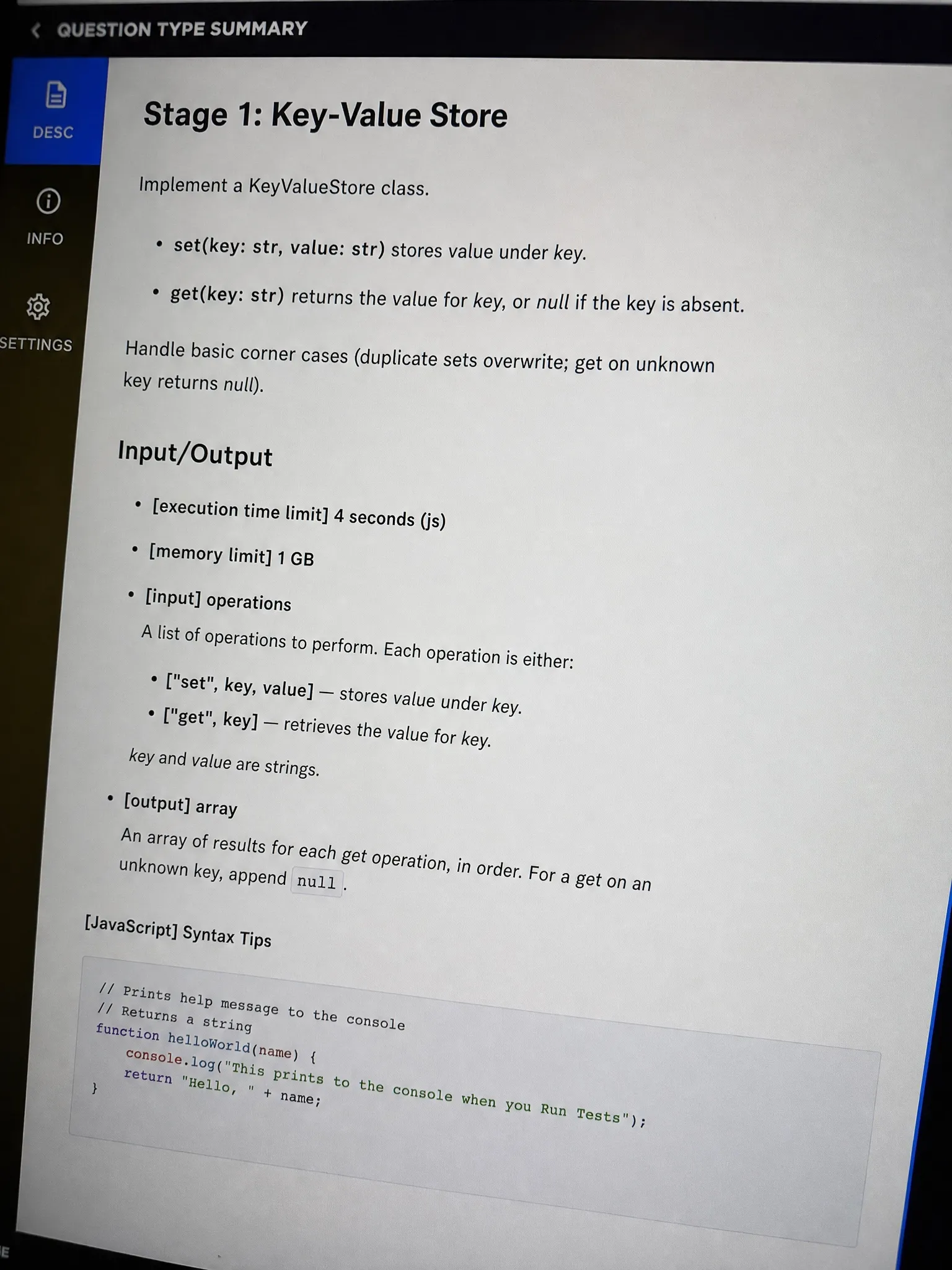
The problem I got: Stage 1 asked for a KeyValueStore class with two methods. set(key, value) stores a value under a key, overwriting any previous value. get(key) returns the stored value or null if the key was never set.
The hidden tests pushed corner cases: repeated sets on the same key, gets on keys that did not exist, and interleaved operations across many keys.
My approach: This was a warm-up stage, so I reached for the obvious structure: a dictionary keyed by string. set just writes into it; get returns the value or None. The only thing worth a second thought was the "return null" rule, which in Python means returning None rather than raising.
I kept the implementation flat and readable because later stages would extend this same class.
class KeyValueStore:
    def __init__(self):
        self.data = {}

    def set(self, key: str, value: str) -> None:
        self.data[key] = value

    def get(self, key: str):
        return self.data.get(key, None)
Time complexity: O(1) average for both set and get (hash map operations). Space complexity: O(n), where n is the number of distinct keys stored.
I finished Stage 1 in about nine minutes with every test green. That early clean pass mattered, because it left buffer for the stages that followed.
Question 2: Point-in-Time Queries
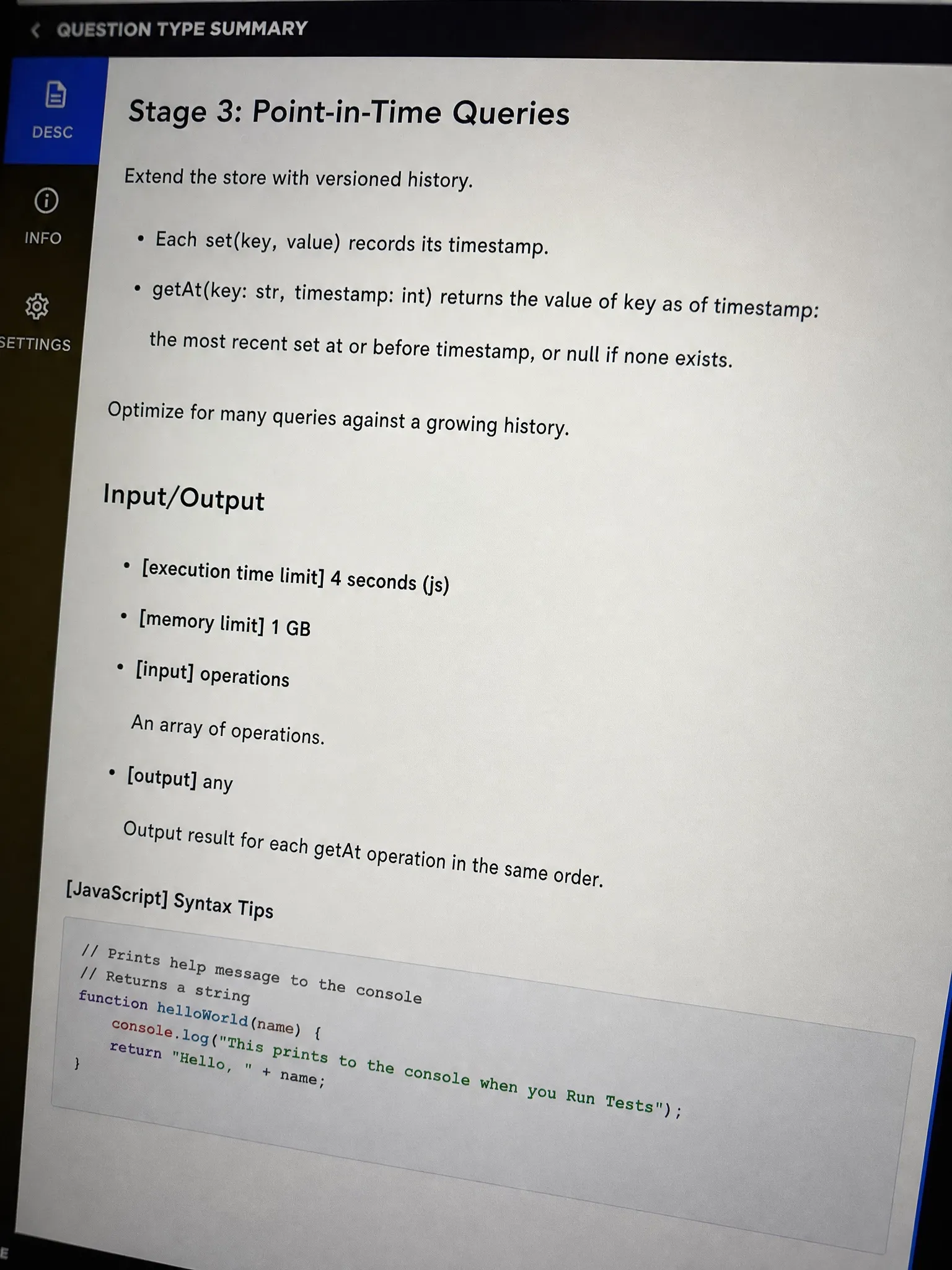
The problem I got: Stage 3 extended the same store with versioned history. Every set now recorded a timestamp, and a new method getAt(key, timestamp) had to return the value of key as of that moment: the most recent set at or before the given timestamp, or null if no such version existed.
The tests fired many queries against a growing history, so a naive "keep only the latest value" design could not answer a past timestamp at all.
My approach: I started by keeping just the current value, the same shape as Stage 1, and only then noticed the method name demanded a point-in-time lookup.
That was the moment I lost the thread, and I didn't want to reach for a desktop overlay tool: the answer would have landed on the same screen the proctoring system was monitoring, hidden by a basic rendering trick.
Instead I hit the keyboard shortcut for the dual-device Coding Assistant from AI interview helper. It auto-captured the problem and pushed the answer to my phone, a separate device outside the platform's screenshot monitoring, while my laptop screen stayed exactly as the exam editor left it.
With the approach clear, I spent roughly twelve minutes building the versioned list instead of fighting the wrong structure.
Land offer with Safer AI Interview Assistant
Skip the risky invisible apps. Our dual-device mode keeps it simple and undetectable. You crush the interview, we handle the answers.
Get started. It's freeLoved by 100,000+ candidates
The clean design is a dictionary from key to a list of (timestamp, value) pairs, appended in increasing timestamp order, so getAt becomes a binary search for the latest version at or before the query time.
class VersionedStore:
    def __init__(self):
        self.history = {}   # key -> list of (timestamp, value)
        self.clock = 0

    def set(self, key: str, value: str) -> None:
        self.clock += 1
        self.history.setdefault(key, []).append((self.clock, value))

    def getAt(self, key: str, timestamp: int):
        versions = self.history.get(key)
        if not versions:
            return None
        lo, hi = 0, len(versions) - 1
        ans = -1
        while lo <= hi:
            mid = (lo + hi) // 2
            if versions[mid][0] <= timestamp:
                ans = mid
                lo = mid + 1
            else:
                hi = mid - 1
        if ans == -1:
            return None
        return versions[ans][1]
Time complexity: O(1) for set, O(log n) for getAt where n is the number of versions for that key. Space complexity: O(total versions stored).
I had burned about twelve minutes before the versioned design clicked, and Stage 4 (concurrent deletion) was still locked. I will not pretend that stall did not cost me, because it shaped how I finished the session.
Meta's Proctoring Policy for CodeSignal
Meta's CodeSignal OA is fully proctored. The monitoring is the part candidates underestimate, so it is worth describing exactly what the session records.
What the Session Records
Before the clock starts, you share your camera, microphone, and screen, then hold up a government photo ID. The timer does not begin until setup finishes, and you must close unrelated tabs and apps. CodeSignal records your video, audio, and screen for the full 90 minutes.
The company that requested your report receives only the score and result; the proctoring data is reviewed by CodeSignal and deleted within 15 days.
The Suspicion Score
CodeSignal rolls several signals into one Suspicion Score that recruiters can see, and in 2026 it explicitly flags signs of generative-AI help. It compares your solution against every submission on the platform and the open web, watches typing and speaking patterns through telemetry, and logs every paste and code-copy event.
The flags can point to copying another test-taker's answer, using leaked materials, or generating code with an AI tool. A high or medium score routes the submission to a human reviewer rather than an automatic pass or fail. In 2025, 35 percent of proctored assessments triggered a flag, which tells you the system is aggressive.
One detail worth knowing: whether outside-AI is allowed is employer-configured, but Meta runs the standard proctored mode where AI tools are blocked.
What the Rules Actually Allow
You may open reference tabs for programming syntax, such as a language standard-library page. You cannot search for solutions, and you cannot use AI tools or overlay assistants.
The IDE shows the unit tests for each stage, though you cannot edit them, and a scratch area lets you print and debug. Treat the rules as fixed, because the monitoring is built to catch exactly the shortcuts candidates reach for under time pressure.
Other Confirmed Meta CodeSignal Questions
Two problem archetypes show up repeatedly in reported Meta CodeSignal sittings. They are the same "build a working system" shape as my own exam, not classic algorithm puzzles.
In-Memory Key-Value Database
Multiple candidate reports describe a staged in-memory data store: get and set first, then TTL expiration, then point-in-time or versioned queries, then concurrent deletion. My own exam followed this exact arc. The throughline is that each stage extends the same data structure, so a clean Stage 1 pays off three stages later.
Cloud-Based File Storage Service
A second recurring prompt asks for a cloud file storage service built across progressive stages. The early stages cover basic upload and retrieval, later stages add constraints such as access control or metadata indexing. Candidates who treat it as one growing module, rather than four disconnected problems, report finishing more of it.
What Meta's CodeSignal Test Format Actually Looks Like
Meta's OA is not the standard four-question CodeSignal GCA that other employers use. It is a single problem broken into four stages that unlock in sequence.
The 90-Minute, Four-Stage Structure
The first stage asks for basic core features, such as simple get and set operations. Stage 2 adds a constraint, commonly a TTL expiration mechanism. Stage 3 introduces an advanced capability, such as point-in-time queries or data versioning. The final stage is the performance-intensive step, often deletion with concurrency handling.
You can see the high-level shape of all four stages up front, but each stage's detailed requirements only appear once you pass the previous one's tests.
The chart below contrasts Meta's staged format with the variant some candidates report and the standard GCA used elsewhere.
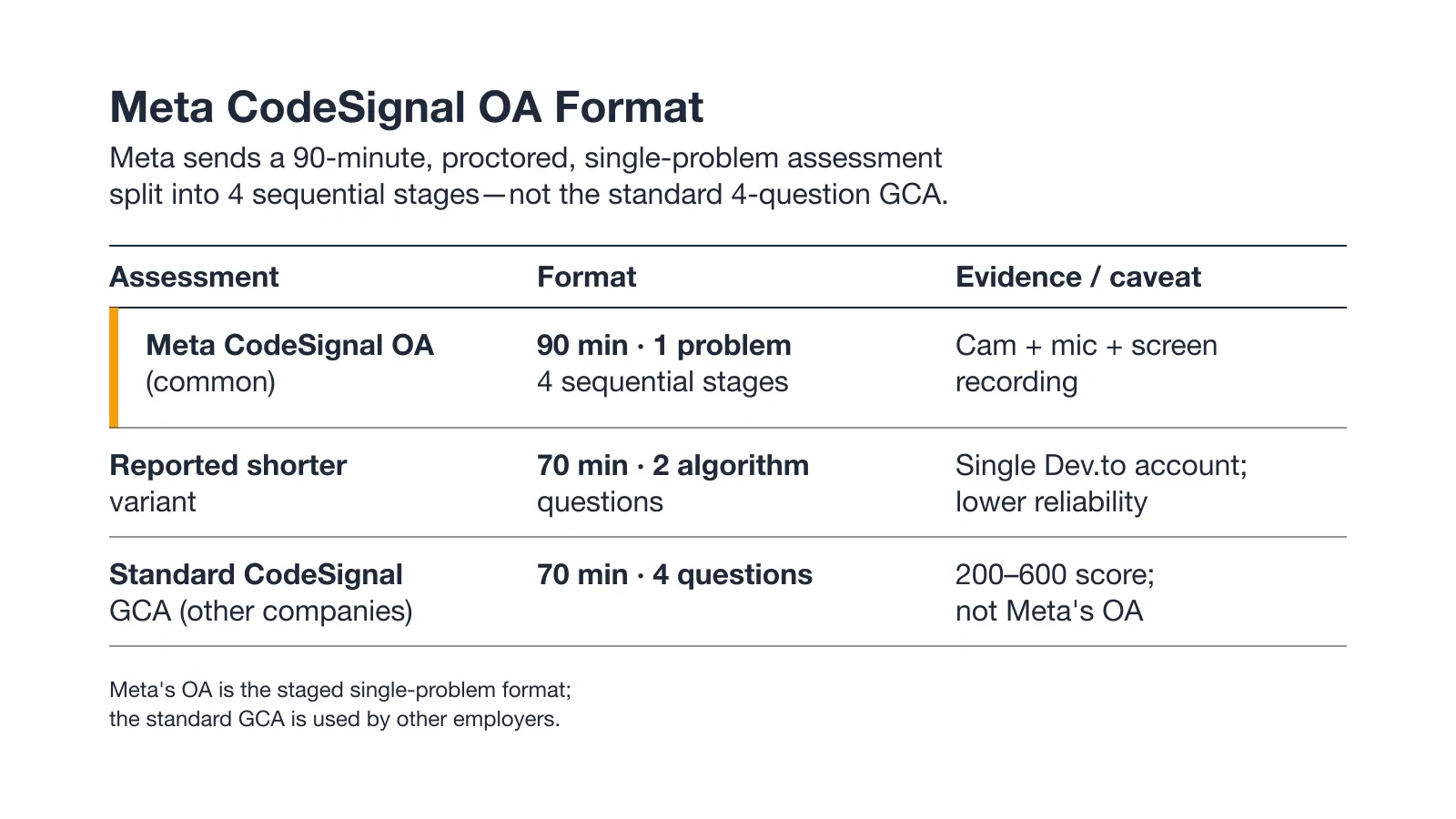
The "70 minutes, four separate questions" description online is CodeSignal's standard GCA used by other employers, not this OA. CodeSignal's own GCA docs set that 70-minute, four-problem baseline; Meta runs the 90-minute, single-problem, four-stage build above.
Prep differs: the GCA rewards speed across four independent problems, while Meta's staged OA rewards depth and progression on one system.
What the Environment Looks Like
The assessment runs in a single full-screen window with video and microphone monitoring throughout. You may keep reference tabs open for syntax, but solution search and AI tools are blocked.
Unit tests for the current stage are visible and you get a scratch area for debug code. Most candidates do not finish all four stages, and CodeSignal's own guidance says that is expected, so partial completion of the later stages is normal rather than a failure.
How Meta's CodeSignal Scoring Works
The OA produces a CodeSignal Assessment Score on a 200 to 600 scale. The number has no built-in meaning until a company sets a bar against it.
The 200-600 Assessment Score
CodeSignal recalibrated the scale in Spring 2023, replacing the older 300 to 850 range. A higher score means you completed more of the assessment correctly. Because the problem is staged, your stage progression and the correctness of each revealed test set drive the result more than raw speed.
Two-Tier Base and Bonus Points
Questions are grouped into modules, and scoring has two tiers. The first tier is base points you earn by completing questions within a module.
The second tier is bonus points, awarded only when you solve 100 percent of a module, with more bonus going to harder modules. Leaving a stage half-finished forfeits that module's bonus even if earlier parts passed.
What Score Meta Expects
Meta publishes no per-role cutoff, and community-reported 200-600 bands are not official thresholds. The commonly cited reading of the scale is that 475 to 525 is competitive, 525 to 580 is strong for FAANG-tier screens, and 580 to 600 is elite.
Meta weighs your OA alongside your phone screen, so the OA is one signal in a larger decision rather than a single pass line.
| Score band | Interpretation | Typical outcome |
|---|---|---|
| 200-350 | Below most thresholds | Usually screened out |
| 475-525 | Competitive | Recruiters engage at many companies |
| 525-580 | Strong | Clears most FAANG-tier screens |
| 580-600 | Elite | Clears essentially every threshold |
Meta CodeSignal Exam-Day Strategy
The hardest part of this OA is pacing across stages, because the difficulty ramps and the later stages are where time disappears.
Pace for Stages, Not Questions
Spend the first minutes locking Stage 1 cleanly so you bank a working module and its base points. Resist the urge to rush into Stage 3 or 4 early, since each stage depends on the one before it. A steady, in-order progression beats a heroic attempt at the final stage that leaves earlier work unfinished.
When You Stall on a Hard Stage
I stalled hard on Stage 3, the versioned point-in-time queries, and lost about twelve minutes before the design clicked. The lesson was not that I lacked the skill but that I had built the wrong structure in Stage 1 and tried to patch it under pressure.
When a stage will not yield, write the simplest correct version you can and move forward rather than perfecting one branch.
Don't Panic at Stage 4
Most candidates do not finish Stage 4, and CodeSignal's own documentation says that is expected. A partially solved final stage with solid earlier work beats a abandoned later stage after burning the clock. Treat Stage 4 as upside, not a gate you must clear to have a good result.
Why Candidates Fail the Meta CodeSignal Assessment
Failure on this OA is rarely about a single wrong answer. The patterns below are the ones that actually end attempts.
Unfinished Stages, Not Wrong Answers
The dominant cause of a weak result is running out of time on Stage 3 or 4. Meta scales the problem deliberately so the later stages are hard to finish, and candidates who over-invest in one branch pay for it on the next. Pacing, not knowledge, is the deciding factor for most people.
Invisible-App Results Get Voided
A candidate saw no issue while using an Invisible App during the assessment, but later received an email saying the result had been voided. The session is screen-recorded and reviewed, and the answer an overlay tool renders sits on the same screen the monitoring captures.
Proctoring data is deleted within 15 days, but a voided result is a final outcome that no retry undoes.
AI interview tool works differently: the answer goes to my phone, a physically separate device that no screenshot or session recording can reach by design.
Land offer with Safer AI Interview Assistant
Skip the risky invisible apps. Our dual-device mode keeps it simple and undetectable. You crush the interview, we handle the answers.
Get started. It's freeLoved by 100,000+ candidates
A Weak OA Leans on Your Phone Screen
Meta considers your OA alongside your phone screen. A poor OA does not automatically end the process, but it forces you to excel at the next round to compensate. Candidates who treat the OA as a throwaway step often discover it set the tone for everything after.
How to Prepare for the Meta CodeSignal in 3 Days
Meta sends the OA with a completion window, so a tight three-day plan fits the realistic prep timeline.
The goal is to practice building systems under a clock, not to grind isolated algorithm tags.
In the days before my test, I used the Prep Agent from interviewfox.ai over WhatsApp: I sent it the confirmed Meta CodeSignal question patterns, an in-memory key-value store with versioned queries, and it returned a personalized drill plan and strategy.
Day 1 Learn the Format
Spend day one understanding that this is a four-stage build, not four separate questions. Read the proctoring and environment rules so nothing surprises you on test day. Set up your language of choice and confirm you can move between a code file and a scratch area comfortably.
Day 2 Build a Working System
Practice the recurring archetypes: an in-memory key-value store with TTL and versioned queries, and a small file or object storage service. For each, implement Stage 1 cleanly first, then extend it stage by stage. The skill Meta tests is evolving one module into the next without rewriting the base.
Day 3 Run the Timed Mock
Run a full 90-minute mock where you force yourself to progress in order and stop at the clock. Review where you stalled and which stage ate your time. A mock that ends with an unfinished Stage 4 but solid earlier work is a realistic, acceptable result.
What Happens After You Submit the OA
Submission is not the end of the process, and the OA result feeds directly into the next round.
Score Verification and Timeline
CodeSignal delivers proctoring decisions quickly once reviewed, sometimes within an hour in its hiring suite. Your score and the certified result reach Meta, and the proctoring check runs before the result is accepted. Plan for a short wait rather than an instant pass or fail.
Phone Screen or Rejection
A passing OA typically moves you to a technical phone screen. A weak OA does not always mean rejection, but it shifts the burden onto the phone screen to prove you belong. Either way, the OA is the gate that decides whether a recruiter looks at your loop at all.
Can You Reuse or Retake
The standard CodeSignal GCA has cooldown tiers that limit retakes, but Meta's OA is a company-specific assessment and is not shared the way a certified GCA score can be. If you are applying to several companies, expect each to run its own OA rather than reusing one result.
Meta's OA Is a Hard Gate, Not a Filter
Meta's OA is the first automated screen before a recruiter spends time on your loop. Understanding that changes how you approach it.
Unfinished Stage 4 Is Normal
CodeSignal's own guidance says most candidates do not finish all stages, and the staged format is built so the last stage is a stretch. Walking out having left Stage 4 incomplete is not the same as failing. The strong signal is clean, correct work on the stages you did finish.
The OA Buys You the Phone Screen
The OA's real job is to earn you the phone screen, where the rest of the decision happens. A good OA makes the phone screen a formality; a weak one forces you to overperform later. Spend your prep energy making the OA a clean, in-order pass rather than a heroic final stage.
FAQ
What is the Meta online assessment?
The Meta online assessment is a proctored CodeSignal session sent early in the SWE hiring process. It is a 90-minute test built around one problem split into four sequential stages, with camera, microphone, and screen recording throughout.
How long is the Meta OA and what format is it?
The Meta OA runs 90 minutes. It presents a single system-building problem in four stages that unlock in order, starting with basic operations and ending with performance and concurrency work. Most candidates do not finish the final stage.
Does Meta use CodeSignal for its online assessment?
Yes. Meta administers its proctored online assessment through CodeSignal, and not every role receives one, since some candidates are routed straight to a phone screen. When it is sent, it must be passed before the phone screen.
What is the Meta online coding assessment like?
It feels like building a small system under a clock rather than solving classic algorithm puzzles. You implement basic features first, then add constraints and advanced capabilities in later stages, with unit tests revealed as each stage unlocks.
What does the Meta CodeSignal assessment involve?
It involves a camera and microphone check, a photo ID, full screen sharing, and four progressive problem stages. You may open syntax reference tabs but cannot use AI tools or search for solutions during the session.
Is the Meta coding assessment hard?
It is hard in pace more than in isolated difficulty. The stages ramp deliberately and the later ones are designed to be hard to finish, so time management matters as much as coding skill. A clean pass on the early stages carries more weight than a perfect final stage.
Can I use an AI tool or invisible app during the Meta CodeSignal OA?
Desktop overlay tools put the AI's answer on your computer screen: it renders as a hidden layer above the browser using a basic OS-layer trick.
interviewfox.ai pushes the answer to your phone, a physically separate device that no screenshot, screen recording, or session monitoring can reach by design, so your laptop screen stays on the exam editor, unchanged.
If you are going to use AI assistance during the OA, the dual-device architecture removes the answer from your screen entirely.
Land offer with Safer AI Interview Assistant
Skip the risky invisible apps. Our dual-device mode keeps it simple and undetectable. You crush the interview, we handle the answers.
Get started. It's freeLoved by 100,000+ candidates