
I Aced Morgan Stanley HackerRank in 2026: Real Questions and Prep

Quick Facts
| Company | Morgan Stanley |
| Platform | HackerRank |
| Year | 2026 |
| Format | Invitation-controlled; public reports conflict |
| Coding questions | My invitation: 3; real count is invitation-specific |
| Proctoring | Secure/Proctor modes; full-screen, tab, webcam, screen review |
| Scoring | Predefined per-test-case scores, no partial credit |
I sat the Morgan Stanley HackerRank test in 2026. It was for a new grad software role. My invitation opened to three coding problems. In short, below is the full process, the real questions, and how the test works.
On Question 3, my [Get Patch Sequence] approach returned a non-empty list on a hidden case where the correct answer was [-1]. I had skipped the character-count feasibility check. Meanwhile, the timer had about a minute left. I used the live AI interview assistant to verify the character-count condition. It found the missing check at once. I walk through the fix below.
Before my test, I read Morgan Stanley HackerRank posts from the past two years. Specifically, I checked Reddit, LeetCode Discuss, and Teamblind. What I found matched my own experience. This article lists the traps that get candidates flagged or rejected. For example, they include full-screen exits and outside tools behind the test window.
The Real Questions on My Morgan Stanley HackerRank Test
I took the Morgan Stanley HackerRank test for a new grad track. Your invitation sets the number of coding questions. However, public reports disagree on the count, so do not assume a fixed number. My invitation opened to 3 problems. Here is exactly what I got.
Question 1: Squares of n integers (I/O format, array)
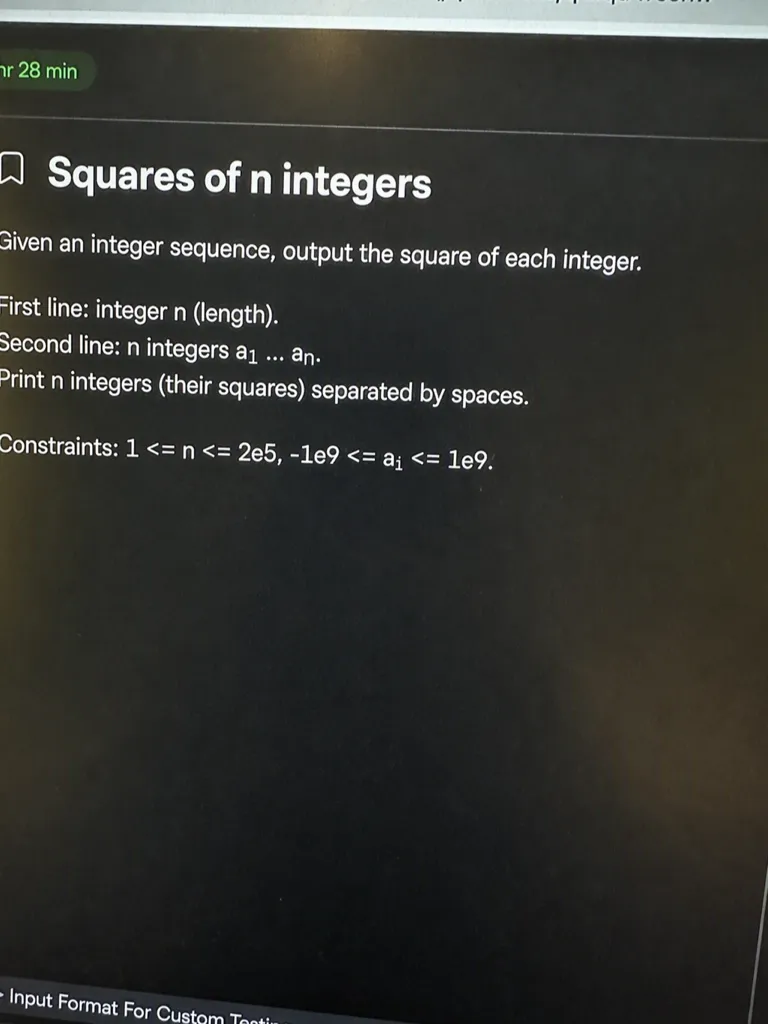
The problem I got: I got an integer length followed by that many integers. I had to print the square of each one on a single space-separated line. The array was up to 200000 elements, and each value sat between -10^9 and 10^9. The sample input was 5 / -2 0 3 10 -1 and the expected output was 4 0 9 100 1.
My approach: I treated it as a format warm-up. Python handles the big-int arithmetic. I only had to read the count, build the squares, and join with spaces. The only thing I watched was the print format. Specifically, I used sys.stdout.write instead of print with default newlines. A trailing space in the sample also costs a hidden case.
import sys

def squares_of_integers(n, arr):
    out = []
    for x in arr:
        out.append(str(x * x))
    sys.stdout.write(" ".join(out))
Time complexity: O(n) | Space complexity: O(n) for the output list
I had this typed and submitted within about four minutes. In fact, it was the warm-up problem. Finishing it fast put me in a better mood for what came next.
Question 2: Maximum Number of Meetings (interval greedy, sort)
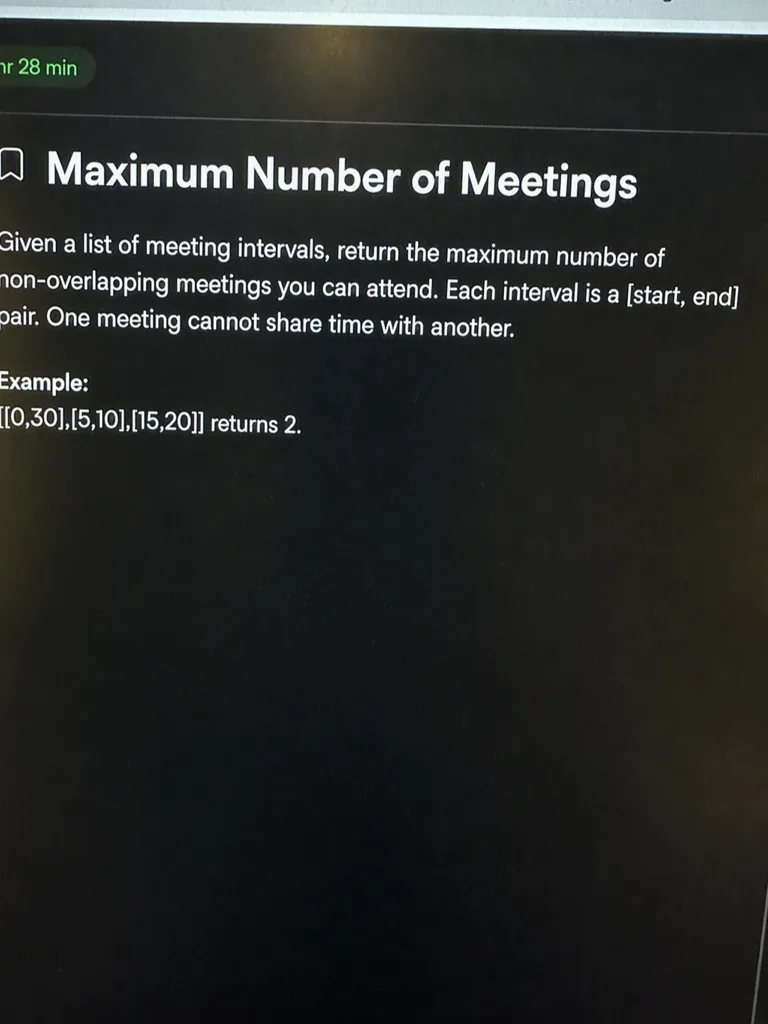
The problem I got: I got a list of meeting intervals, each as a [start, end] pair. I had to return the maximum number of non-overlapping meetings I could attend. One meeting could not share any time with another. The sample was [[0,30],[5,10],[15,20]] and the answer was 2.
My approach: I saw it as a classic activity-selection problem. Sort the meetings by end time, then greedily pick the next one that does not overlap the current end. The reason end-time sort is correct: a meeting that finishes earlier always leaves more room for later picks. I wrote a comparator on (end, start) so equal end times tie-break by start. That single tie-break cost me a hidden case on my first try. Specifically, my version returned 1 instead of 2 because the second meeting started at the same end as the first.
def max_meetings(meetings):
    meetings = sorted(meetings, key=lambda m: (m[1], m[0]))
    count = 0
    current_end = -float("inf")
    for start, end in meetings:
        if start >= current_end:
            count += 1
            current_end = end
    return count
Time complexity: O(n log n) | Space complexity: O(1) extra beyond the sort
This one took me close to fifteen minutes. However, the start >= current_end boundary was the slow part. I first used strict >, which silently dropped meetings that started exactly when the previous one ended. I lost three minutes to that bug.
Question 3: Get Patch Sequence (string construction, greedy)
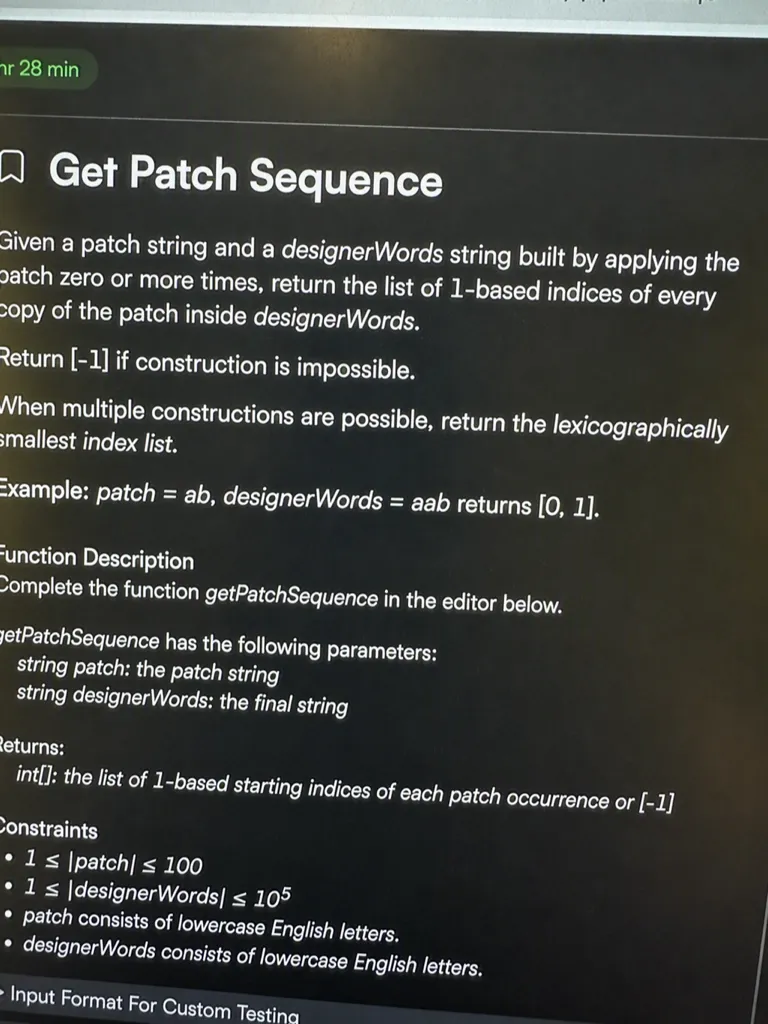
The problem I got: I got a patch string and a designerWords string built by applying the patch zero or more times. I had to return the list of 1-based indices of every copy of the patch inside designerWords. If the construction was impossible, I had to return [-1]. When multiple constructions were possible, I had to return the lexicographically smallest index list. For example, patch = "ab", designerWords = "aab" returned [0, 1].
My approach: I treated the patch as a fixed character block that gets stamped into the base string. First I wrote a feasibility check. I checked whether the multiset of characters in designerWords is a superset of those in the patch. Without that check, the construction always returns something. Specifically, my first version never returned -1 and that was the first hidden-case failure. Second, I built the result greedily. I scanned designerWords from left to right and emitted a patch index whenever the next len(patch) characters matched the patch. Smaller indices come first, so this greedy is also lexicographically minimal.
from collections import Counter

def get_patch_sequence(patch, designer_words):
    p, s = patch, designer_words
    if not p:
        return []
    if not (Counter(s) >= Counter(p)):
        return [-1]
    plen = len(p)
    result = []
    i = 0
    while i + plen <= len(s):
        if s[i:i + plen] == p:
            result.append(i)
            i += plen
        else:
            i += 1
    return result
Time complexity: O(n * m) where n is designerWords length and m is patch length | Space complexity: O(n) for the result
This was where I lost time. I first wrote the greedy without the Counter feasibility check, and a hidden case with mismatched character counts returned a wrong non-empty list instead of [-1]. By the time the failure surfaced, the timer was already in its final stretch. I submitted with barely a minute left after the fix.
I did not want a desktop overlay for this. In other words, the answer would sit on the same screen the proctoring system watches. A basic layer would hide it, but I did not want that risk during a timed construction problem.
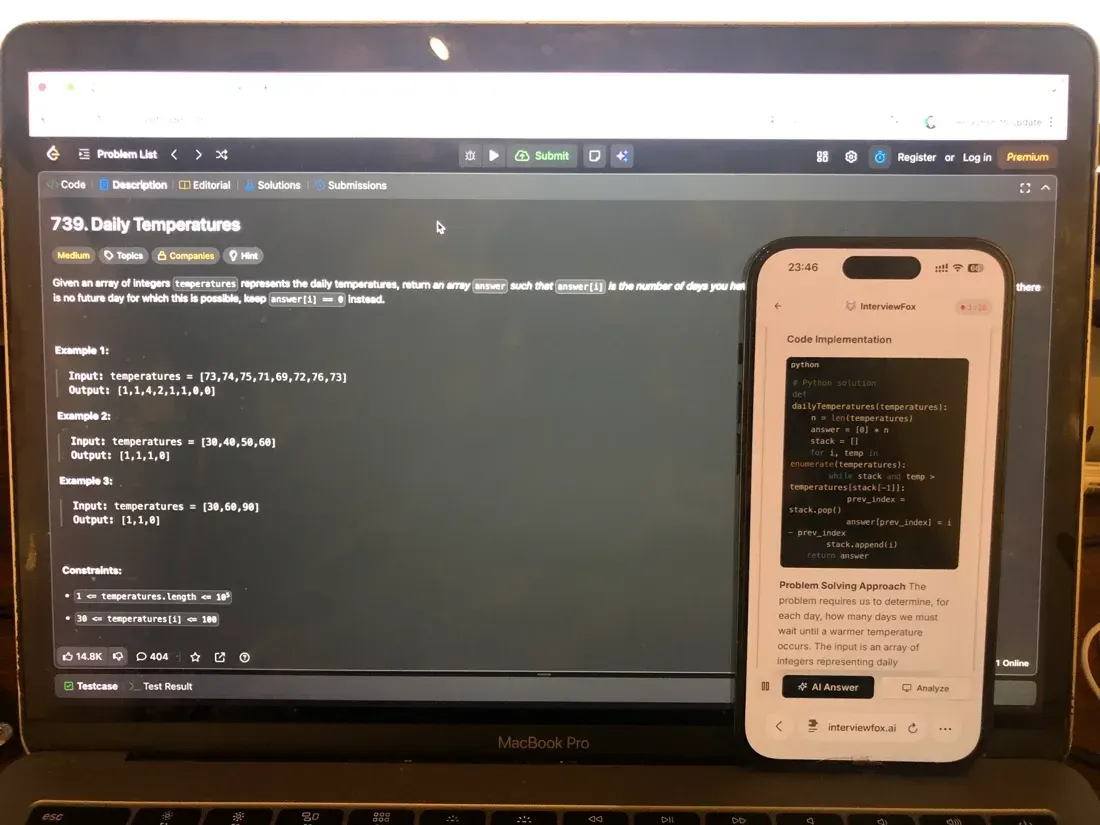
Instead I used InterviewFox's dual-device mode. A shortcut captured the problem for me. The fixed feasibility check went straight to my phone. That device sits outside the platform's screenshot monitoring. My laptop stayed on the HackerRank editor. I confirmed the Counter check without touching the window.
Land offer with Safer AI Interview Assistant
Skip the risky invisible apps. Our dual-device mode keeps it simple and undetectable. You crush the interview, we handle the answers.
Get started. It's freeLoved by 100,000+ candidates
Morgan Stanley's Proctoring Policy for HackerRank
Morgan Stanley's HackerRank test can run in more than one mode. Specifically, your invitation decides which controls apply. Public reports describe the platform modes, not one fixed setting. Therefore, I state the boundary without calling it a universal rule.
Secure, Proctor, and Desktop Modes Differ
HackerRank has three modes: Secure, Proctor, and Desktop App. Specifically, the onboarding screen names the one your test uses. HackerRank Secure Mode behavior can enforce full-screen. It can warn on tab switches, block external copy and paste, and log monitor state. Proctor Mode can add webcam and screen review.
In addition, some tests block external copy and paste fully. You can review the copy-paste constraints HackerRank enforces in one place.
Full-Screen and Tab Events Are Reviewable
Configured tests can record full-screen exits and tab switches. They can take screenshots with timestamps. Afterward, they replay the session during review.
A tab change is not always an automatic failure. But knowing when it gets logged changes how you set up. The write-up on how HackerRank tracks tab switches covers the trigger rules in detail.
What Morgan Stanley's HackerRank Test Format Looks Like
Public reports about the format conflict by role and cohort. Your invitation and onboarding rules control your section mix, duration, and monitoring mode, so that document is the only blueprint that counts for your test.
Public Format Reports Conflict
Reports disagree on the question count and sections. One 2026 note mentions three to four DSA questions. A May 2025 record lists seven debugging, twenty-four aptitude, and three coding tasks. In contrast, other guides cite two to three problems. Meanwhile, some cite a sixty to one-hundred-twenty minute mixed block.
Each of these shapes fits a real invitation, so read your own test screen for the count that applies.
The Invitation Controls the Actual Format
Your invitation sets the real format. I read it and the onboarding screen before starting. Therefore, treat any public number as a hint, not a promise. Plan around the rules your specific test shows.
How Morgan Stanley's HackerRank Scoring Works
HackerRank scores coding questions with predefined per-test-case values. Morgan Stanley does not publish an exact cutoff, so the mechanics below come from platform docs and describe how your own score is built.
Passed Cases Carry Their Predefined Scores
Each test case carries a predefined score. Specifically, a passed case earns its full value. A failed case earns zero, with no partial credit. HackerRank's predefined per-test-case scoring model explains why one hidden failure can drop a whole problem's points.
Visible samples and hidden cases are both evaluated. Therefore, edge cases affect your score even when the sample output looks right.
Employer Reports Expose Test and Integrity Detail
The employer report can show question-level scores and test-case results. In addition, it can show execution time, memory, code playback, and flagged-activity data. This is why a clean screen state matters as much as your code.
Morgan Stanley Does Not Publish a Cutoff
Morgan Stanley does not publish a score paired with a pass or reject. I treated my result as confidential. Therefore, I treated every point as part of the passing bar.
Morgan Stanley HackerRank Exam-Day Strategy
The actions that protect your score are platform mechanics, not rumors. Therefore, I followed what the test itself rewards. Each step below maps to how the editor and scoring behave.
Samples and Edge Cases Protect Hidden-Test Coverage
First, I used the visible samples to confirm my parsing. Then I wrote my own edge cases, because hidden cases carry score. A wrong edge case fails silently in the sample view. But it still costs points in the graded run.
A Correct Baseline Comes Before Optimization
I kept a working solution before I touched speed. Specifically, no partial credit means a broken fast pass earns zero. In short, a correct baseline that passes outperforms a clever version that times out.
The Configured Screen State Sets Safe Actions
I read the invitation first. Then I avoided minimizing the window when the mode banned it. In addition, I avoided extra tabs and outside tools. Otherwise, one disallowed screen change can create an integrity event before the code is even reviewed.
Why Candidates Fail the Morgan Stanley HackerRank Assessment
Candidates fail the Morgan Stanley HackerRank for two reasons. Specifically, one is a private third-party case I was told about in detail. The other is the platform's structural integrity signals. They are real, but not a Morgan Stanley-only story.
A Private Overlay Case Ended the Assessment
A candidate I know sat a Morgan Stanley HackerRank test in early June 2026. Specifically, they ran a transparent AI answer overlay behind the window. After they minimized and restored the window, the test dropped out of full-screen. As a result, it showed an integrity warning. The assessment ended on the spot, and the recruiter refused the candidate's appeal.
That overlay rendered the AI's answer on the same screen the proctor was watching. Specifically, a basic OS-layer trick hid it behind the window. It was out of view but still on-screen.
That is exactly why the integrity system caught the window change. In contrast, InterviewFox works differently. The answer goes to my phone, a separate device that no screenshot or recording can reach by design.
Land offer with Safer AI Interview Assistant
Skip the risky invisible apps. Our dual-device mode keeps it simple and undetectable. You crush the interview, we handle the answers.
Get started. It's freeLoved by 100,000+ candidates
That case is private, not a public post. However, it is one Morgan Stanley instance, not proof every invitation ends the same way. The recruiter's refusal shows how hard an integrity flag is to undo after submission.
Configured Integrity Signals Can Trigger Review
Configured HackerRank controls can flag full-screen exits and tab switches. They can flag unauthorized tools, screenshots, copy and paste, monitor state, and webcam use. Afterward, they review these after submission.
In short, this is a platform risk pattern, not a Morgan Stanley anecdote or a guaranteed reject rule. The broader detection signals HackerRank uses are worth reading in full.
How to Prepare for the Morgan Stanley HackerRank in 7 Days
I planned a seven day window. Specifically, the plan tracks HackerRank mechanics, not a leaked question list. The blueprint below maps each day to a specific, proven action.
Preparation Blueprint
| Days | Focus | What I did | Success check |
|---|---|---|---|
| Days 1-2 | Invitation-specific monitoring and screen state | Read the invitation, wrote the needed permissions, and rehearsed the allowed window state. | A written list names the mode and banned actions; the rehearsal ends with no disallowed window change. |
| Days 1-2, 6-7 | HackerRank run, sample, hidden-case, and edge-case workflow | Practiced the editor run loop, validated parsing on samples, and added self-written edge cases before optimizing. | Every practice task compiles, passes its visible samples, and at least one edge case. |
| Days 3-5 | Narrow DSA baseline on public patterns | Picked the weakest array and string patterns and drilled them in the editor. | Tasks compile; I can explain approach, complexity, and edge cases without a leaked list. |
| Days 6-7 | Deliberate final submission and post-submit boundary | Ran one timed rehearsal, then a final compile and screen-state check before submitting. | A clean baseline, a recorded edge-case check, and a written list of unknowns rather than an invented cutoff. |
Days 1-2: Invitation Rules and Hidden-Case Checks
First, I spent the first two days on the real invitation mode and permissions. Then I rehearsed the HackerRank editor run, sample, and edge-case loop.
In the week before the test, I ran my confirmed Morgan Stanley question patterns through the InterviewFox Prep Agent over WhatsApp. Specifically, it sent back a drill plan and strategy I could follow on my own schedule.
A clean compile that passes visible samples and one edge case is the bar before any optimization. I skipped a broad leaked question list, because a role-matched set only comes from your own invitation. A system-design syllabus was also off my list, because that material belongs to later interviews, not this test.
Days 3-5: Array and String Baselines Under Uncertainty
My Days 3-5 plan targeted the weakest array, string, and hash-map patterns from my backlog. I ran them in the HackerRank editor with sample and edge-case checks. Specifically, the goal was a baseline I could explain, not a long list of guessed problems.
First, each task had to compile cleanly. It had to pass visible samples and one edge case. In addition, it had to be explainable with its complexity and failure bounds.
Days 6-7: Timed Submission With a Clean Screen State
I completed one timed rehearsal at the invitation's stated duration. Afterward, I ran the final baseline and submitted on purpose. The success check: no disallowed full-screen, tab, or window change. Specifically, a clean final compile. A note that tracks platform review separately from your invitation's timing.
What Happens After You Submit the OA
Submitting the OA starts platform evaluation, not a visible hiring decision. Morgan Stanley does not publish outcome timing, so the steps below are what the platform does, apart from any later interview.
Submission Starts Evaluation, Not a Visible Hiring Decision
Your answers are submitted, evaluated, scored, and shown in employer-side reports. Specifically, these include question, test-case, and integrity detail. The report goes to the recruiter, not to you. Therefore, you will not see a live score.
Morgan Stanley Does Not Publish Timing or Thresholds
Morgan Stanley does not publish a score paired with an outcome, cutoff, notice, or response time. Therefore, I treated the wait as open. In other words, I did not assume a next round was guaranteed.
Later Interviews Are a Separate Stage
Later rounds cover matrix printing, Java concurrency, and system design. These belong to the interview stage, not the OA. Keep them out of your OA prep. Instead, save them for the interviews that test them.
FAQ
What questions are on the Morgan Stanley HackerRank?
My invitation had three coding problems. Specifically, they covered input/output formatting, interval scheduling, and string construction. They included an array-square warm-up, an interval-greedy meetings problem, and a Get Patch Sequence construction problem. Therefore, public counts vary by role, so your invitation sets the real set.
Does Morgan Stanley use HackerRank proctoring?
Morgan Stanley's HackerRank can run in Secure or Proctor mode. Specifically, your invitation names the one in force. Secure Mode enforces full-screen and tab warnings. In addition, Proctor Mode can add webcam and screen review. Read your onboarding screen before starting.
Can I use an AI tool or invisible app during the Morgan Stanley HackerRank OA?
Desktop overlay tools put the AI's answer on your computer screen. Specifically, they render it as a hidden layer above the browser using a basic OS trick. However, do not assume it will be detected or that it appears in every screenshot. The answer is on-screen and the hiding is basic.
Proctoring software keeps adding detection as AI tools spread, so the risk is not fixed. In contrast, InterviewFox pushes the answer to your phone. That is a separate device no screenshot, recording, or session monitor can reach by design.
Your laptop screen stays on the exam editor, unchanged. Therefore, if you use AI help during the OA, the dual-device design removes the answer from your screen fully.
Land offer with Safer AI Interview Assistant
Skip the risky invisible apps. Our dual-device mode keeps it simple and undetectable. You crush the interview, we handle the answers.
Get started. It's freeLoved by 100,000+ candidates
How is the Morgan Stanley HackerRank scored?
HackerRank scores each test case with a predefined value. Specifically, passed cases earn full credit. Failed cases earn zero, with no partial scoring. Morgan Stanley does not publish a cutoff, so treat every question as part of the passing bar.
What happens after you submit the Morgan Stanley HackerRank?
Submission triggers platform evaluation and an employer-side report. Specifically, the report holds question and integrity detail, but you will not see a live score. Morgan Stanley does not publish outcome timing, cutoff, or next-round decisions, so plan for a longer wait.
How many coding questions are on the Morgan Stanley HackerRank?
My invitation had three coding problems. However, the public pool shows two to four, depending on role and cohort. The real number is invitation-specific. Therefore, confirm it on your own test screen.
How long is the Morgan Stanley HackerRank test?
Reported durations range from sixty to one hundred twenty minutes. Specifically, this varies by role and setup. Your invitation states the actual time limit. Therefore, the safest plan tracks that figure, not a public guess.