I Took the NVIDIA Ignite OA on HackerRank in 2026: Real Questions and Prep Plan

Quick Facts
| Platform | HackerRank (NVIDIA Ignite OA, SWE new-grad track) |
| Question mix | 2 coding problems plus N multiple-choice (this sitting: 3 coding) |
| Timing | 48-hour window to start, then about 90 minutes once started |
| Proctoring | webcam required (candidate-confirmed) |
| Scoring | HackerRank auto-grades, partial credit, negative marking on some tracks |
| Language | Python, Java, C++, C (some teams restrict to C) |
I took the nvidia ignite oa, NVIDIA's HackerRank online assessment for a software engineering new-grad role through the Ignite track, in 2026. I solved three coding problems in about ninety minutes, though one needed a rewrite after a hidden test failed on a 32-bit edge case. What follows is the complete walkthrough of those questions and how I prepared for them.
Question 2, building the bit mask, did not click on the first read. My first submission failed a hidden test on a 32-bit edge case, and for a few minutes I thought I might not get through it. I used AI interview assistant to re-check the band logic, and the masking fix became obvious — I break that moment down in the walkthrough below.
Before my test, I went through every NVIDIA HackerRank post from the past two years on Reddit, LeetCode Discuss, and Teamblind. What I found tracks closely with what I experienced. Further down, I cover the exact mistakes that get candidates flagged or rejected, and the prep moves that beat them.
The Real Questions on My NVIDIA HackerRank Test
I sat the NVIDIA HackerRank online assessment for a software engineering new-grad role through the Ignite track in 2026, firing off applications to a stack of tech firms at the same time, with about a hundred and twenty LeetCode problems behind me.
Below is exactly what the three questions looked like from my side of the screen, in the order they appeared.
Question 1: Address on Same Page (Bit Manipulation)
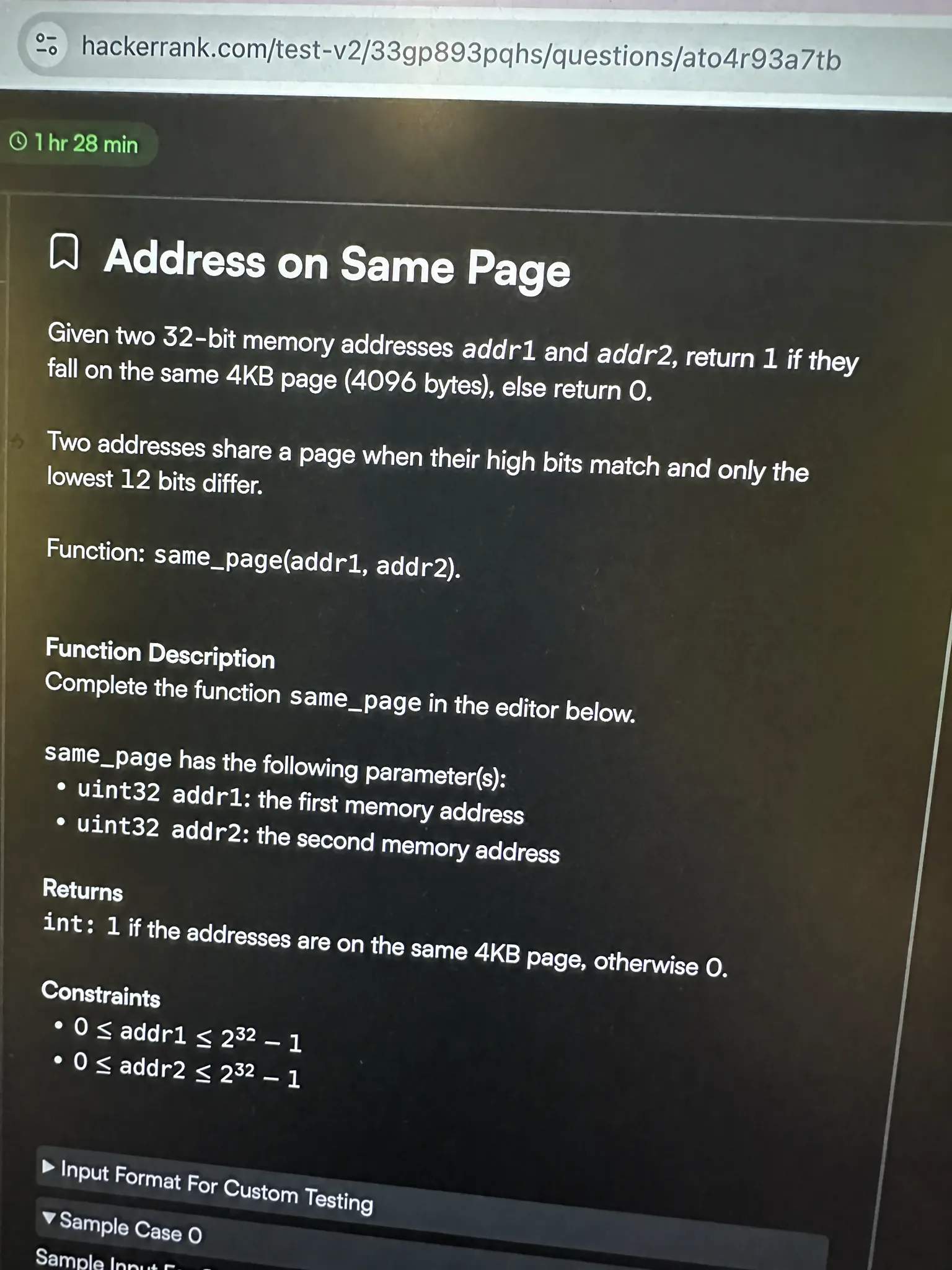
The problem I got: The first task was about memory pages. I was given two 32-bit memory addresses and had to return whether they fell on the same 4KB page. A 4KB page is 4096 bytes, so two addresses share a page when their high bits match and only the lowest 12 bits differ. I had to return 1 if they were on the same page, 0 otherwise.
My approach: This is pure bit masking. I clear the lowest 12 bits of each address with a mask of ~0xFFF and compare the results. If they are equal, the page numbers are equal. No loop, no division, just one bitwise AND and a comparison. I wrote it in Python since the syntax reads cleanly under time pressure.
def same_page(addr1, addr2):
    return 1 if (addr1 & ~0xFFF) == (addr2 & ~0xFFF) else 0
Time complexity: O(1) | Space complexity: O(1)
This one felt like a warm up, which I expected from the format. The logic was obvious and the sample passed on the first run, so I moved on with some confidence and a little time in the bank.
Question 2: Generate Bit Mask (Bit Manipulation)
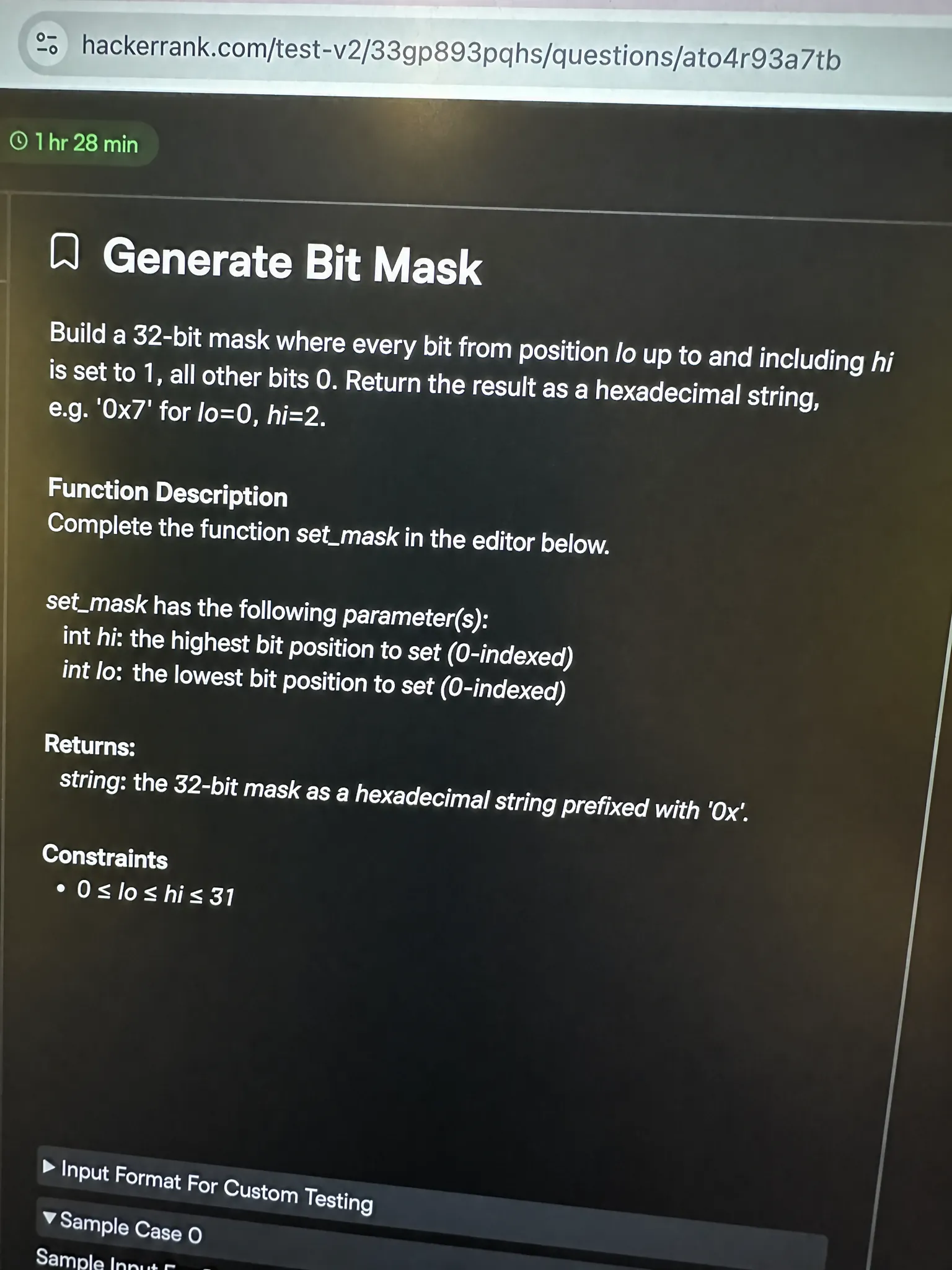
The problem I got: The second task asked me to build a 32-bit mask where every bit from position lo up to and including hi was set to 1, and every other bit was 0. The function returned the result as a hexadecimal string, like "0x7" when lo = 0 and hi = 2. Constraints kept both values inside 32 bits.
My approach: My first thought was to assemble the mask in two halves. A full run of 1s from bit 0 up to hi is (1 << (hi + 1)) - 1. The bits below lo that I need to clear form (1 << lo) - 1. Intersecting the two with a bitwise AND leaves exactly the lo..hi band set. I printed the hex with a "0x" prefix.
def set_mask(hi, lo):
    mask = ((1 << (hi + 1)) - 1) & ~((1 << lo) - 1)
    return "0x" + format(mask, "x")
Time complexity: O(1) | Space complexity: O(1)
This question is where I hit the wall. My first submission failed a hidden test, and it took me a while to see why: when lo was 0 the lower clear-term became (1 << 0) - 1, which is 0, so the AND looked harmless, but on the 32-bit edge cases my intermediate shift overflowed the Python int assumptions I had carried from C. The clock was deep in the red by the time I rewrote the band logic to stay inside 32 bits, and I burned minutes I could not get back on question three.
Desktop overlay tools render the AI's answer on the same screen the proctoring system is monitoring. The hiding is done at the OS rendering layer, a basic trick. Whether the current version of that monitoring actively catches it isn't something I could verify, and proctoring software keeps adding detection capabilities. InterviewFox works differently: the answer goes to my phone, a physically separate device that no screenshot or session recording can reach by design.
I didn't want to use a desktop overlay on this test. The answer would have been on the same screen the proctoring system was monitoring, hidden by a basic rendering-layer trick, and whether that gets flagged depends on what detection is currently running. So when I stalled on the band logic, I reached for the dual-device Coding Assistant from an AI interview helper instead. I hit the shortcut, the screen auto-captured, and the answer pushed to my phone while the laptop stayed on the exam editor the whole time. Nothing on the proctored display changed, and that is how I got the band logic clear enough to rewrite it inside 32 bits.
Land offer with Safer AI Interview Assistant
Skip the risky invisible apps. Our dual-device mode keeps it simple and undetectable. You crush the interview, we handle the answers.
Get started. It's freeLoved by 100,000+ candidates
Question 3: Maximum Score (Greedy Heap)
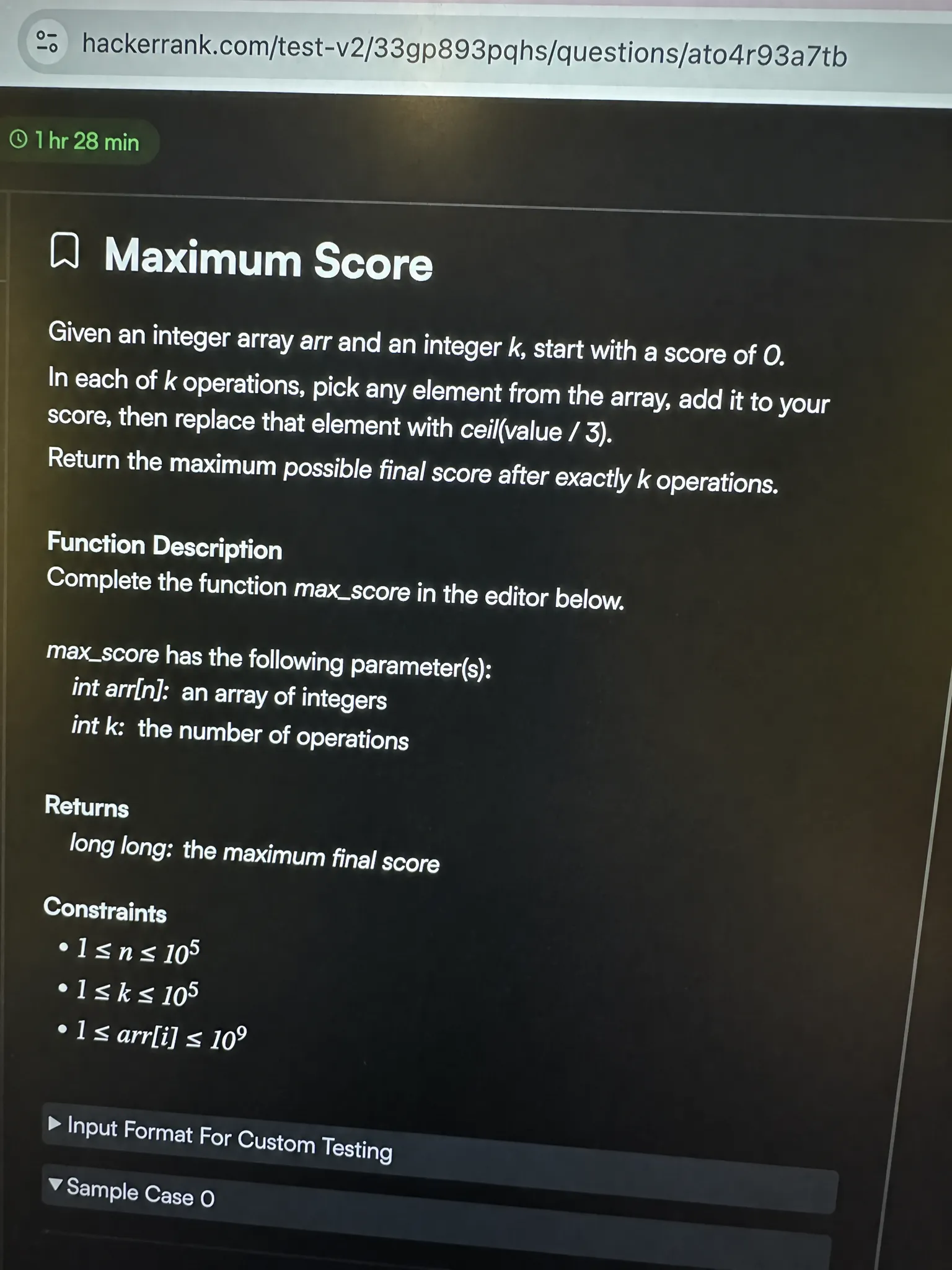
The problem I got: The third task gave me an integer array and a count k. I started with a score of 0, and in each of k operations I picked one element, added it to my score, then replaced that element with ceil(value / 3). I had to return the maximum possible final score. The array could be large, with n and k both up to 10^5.
My approach: The greedy choice is always the largest available number, so a max-heap does the work. Each operation pops the top, adds it to the score, computes its ceiling-third as (val + 2) // 3 to avoid floats, and pushes that back. The heap keeps every step efficient even when both n and k are large. I confirmed the samples, then let it run against the hidden tests.
import heapq

def max_score(arr, k):
    heap = [-x for x in arr]
    heapq.heapify(heap)
    score = 0
    for _ in range(k):
        val = -heapq.heappop(heap)
        score += val
        heapq.heappush(heap, -((val + 2) // 3))
    return score
Time complexity: O((n + k) log n) | Space complexity: O(n)
I finished this one with seconds to spare, still rattled from the time I lost on question two. The three problems together were the whole test, and walking away I knew the bit-mask stumble had cost me a cleaner result.
NVIDIA's Proctoring Policy for HackerRank
Webcam and Camera Requirement
The Ignite OA turns the webcam on. When one candidate asked outright whether the test was proctored, the reply was yes, the camera had to be on. A Glassdoor IGNITE intern writeup from April 2026 adds that the HackerRank screen was video recorded during the session. NVIDIA's 2026 campus notice also requires a device with a camera and runs the test in one round only.
What HackerRank Monitors
HackerRank's top integrity tier is Proctor Mode, and it is part of the platform toolkit rather than something NVIDIA adds. It tracks tab and window focus, logs copy and paste, and detects a second monitor. Its machine learning layer compares submissions for code similarity and flags pasted or generated code, so the monitoring runs even when a human is not watching.
When Proctoring Can Reject You
A session gets flagged when the webcam is blocked, a second monitor is detected, the test window loses focus, or a prohibited tool is found running. NVIDIA states that using unapproved outside tools such as ChatGPT during an assessment leads to disqualification. A flagged session can end the round regardless of how the code itself runs.
Other Confirmed NVIDIA HackerRank Questions
Bitwise XOR Subarray (Coding)
A July 2026 Glassdoor IGNITE intern report names Bitwise XOR Subarray as a real Ignite OA coding problem, and pairs it with hardware concepts like GND connections and FIFO. The public writeup gives the topic but not a full problem statement, so I will not invent a worked solution here. Treat it as a known variant in the bit-manipulation family and drill subarray XOR counting before your link opens.
Ideal Numbers (3^x·5^y)
A 2026 high-frequency writeup lists Ideal Numbers as the top recurring problem: count the numbers in a range whose only prime factors are 3 and 5. Enumerate exponent pairs because 3^x times 5^y grows logarithmically, then count the values that land inside the range. It is a clean enumeration, not a sieve, and it shows up often enough to drill cold.
def ideal_numbers(low, high):
    res = []
    x = 0
    while 3 ** x <= high:
        y = 0
        while 3 ** x * 5 ** y <= high:
            val = 3 ** x * 5 ** y
            if val >= low:
                res.append(val)
            y += 1
        x += 1
    return len(res)
Time complexity: O(log_3(high) * log_5(high)) | Space complexity: O(1) excluding output
Recover Array from Prefix XOR
Another recurring problem gives a prefix XOR array and asks you to recover the original array. The first element equals the first prefix, and each later element is the XOR of the current prefix with the previous one. A single linear pass rebuilds the whole array with no extra storage beyond the output.
def recover(pref):
    arr = [pref[0]]
    for i in range(1, len(pref)):
        arr.append(pref[i] ^ pref[i - 1])
    return arr
Time complexity: O(n) | Space complexity: O(n)
Spiral Matrix and Container With Most Water
A LinkedIn report from a candidate who took the NVIDIA campus OA for a QA tools role lists Spiral Matrix and Container With Most Water as the coding problems. Both are standard LeetCode mediums, which fits the pattern that most NVIDIA problems are LeetCode-style algorithm questions on fundamental data structures. They appear on the non-Ignite tracks more than on the core SWE screen.
What NVIDIA's HackerRank Test Format Looks Like
Two Coding Problems Plus N Multiple-Choice Questions
Two coding problems plus a block of multiple-choice questions is the dominant NVIDIA HackerRank shape. One candidate ran two DSA problems with ten data-structures multiple-choice questions in ninety minutes. Others saw two coding with twenty five multiple-choice, and two coding with about twenty eight multiple-choice in sixty minutes. My own sitting was three coding problems, a real-instance variant of that same pattern.
48-Hour Start Window, Then ~90 Minutes
The OA link stays open for forty eight hours once it arrives, then the clock runs about ninety minutes from the moment you start. A freshman-track Ignite sitting runs forty five minutes instead. A hardware intern reported fifteen questions in fifty minutes, and the IGNITE intern track pairs two LeetCode easy problems with hardware multiple-choice.
Team Format Varies
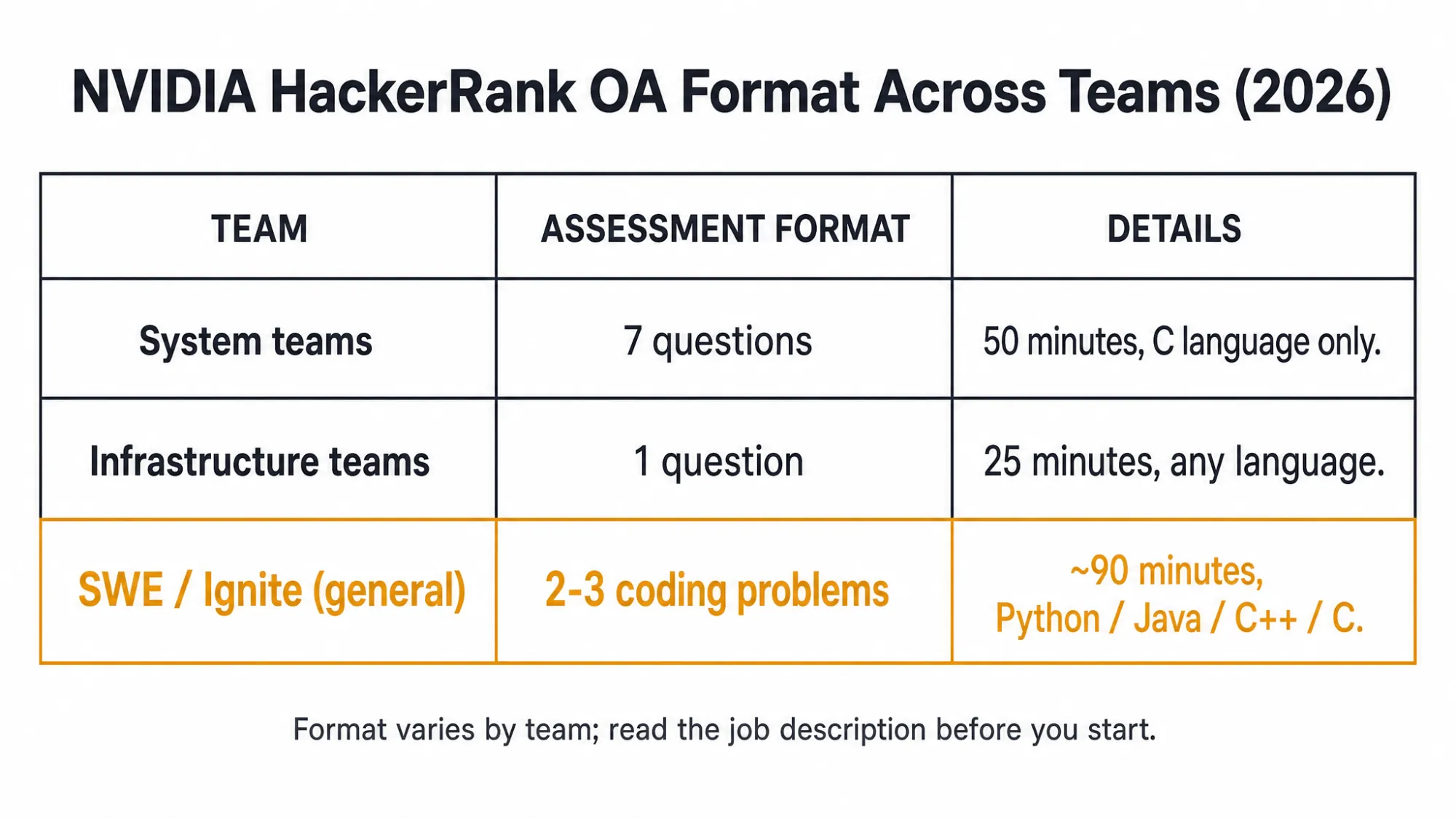
The format shifts by team, and candidates underrate this. System teams have run seven questions in fifty minutes and accept C only. Infrastructure has run a single question in twenty five minutes. SWE sittings are usually two or three coding problems plus fundamentals multiple-choice, so the track you applied to decides the real length.
The chart below shows how far the format drifts across tracks.
Pick Your Language (Read the JD)
Candidates pick their language when the team allows it, with Python, Java, C++, and C all supported. Some teams restrict the language to C, so read the job description before the clock starts or you lose minutes switching mid-problem. I default to Python for clean syntax under time pressure, but only when the JD does not forbid it.
How NVIDIA's HackerRank Scoring Works
HackerRank Auto-Grades by Test Cases
HackerRank scores each problem by the test cases it passes, visible and hidden together, and reports the result automatically. A partial pass on a hard problem still earns credit, because the platform awards points per case rather than an all-or-nothing mark. The score you see is the score NVIDIA sees, with no human in the first pass.
Negative Marking Can Apply
Some tracks apply negative marking on the multiple-choice block. A System SE intern reported losing points for wrong answers on a sixty-minute NVIDIA HackerRank OA with twenty nine total questions. Read the instructions per section before you guess, because a wrong answer can cost more than leaving it blank.
Hidden Tests Punish Slow or Wrong Code
The hidden tests are where weak solutions die. A brute force that passes the samples can fail every large case, and a bit-mask solution that overflows on 32-bit edges loses credit the same way. Optimal logic and correct boundaries are graded, not optional, so the samples passing is never proof the problem is done.
The Score-Driven Shortlist
NVIDIA shortlists from the OA score without a human in the first pass. One candidate moved from the OA to an HR call within days. A campus round filtered two hundred and six students down to four for the technical interview, so a clean hidden-test result is what separates advance from filter.
NVIDIA HackerRank Exam-Day Strategy
Budget About 25-30 Minutes Per Problem
Spread the time across the coding problems, about twenty five to thirty minutes each, with a buffer for the one that goes wrong. The multiple-choice block eats significant time: one sitting packed twenty eight multiple-choice plus two coding into sixty minutes, and finishing cleanly was hard. Force a decision once the buffer runs low.
Don't Rush to Start the 48-Hour OA Link
The OA link stays valid for forty eight hours from when it lands, so there is no reason to start the moment it arrives. Prep first, because the test is not rolling and the clock only starts when you open it. A quiet room and a rehearsed bit-manipulation set beat a rushed first attempt every time.
Read the JD for the Language Rule
The clearest mistake is starting in the wrong language. System teams accept C only, so a Python draft there is wasted effort. Read the job description for the language rule before the test opens, because switching mid-exam is time you cannot recover. The rule is stated in the JD, not announced inside the test.
Recognize Bit Manipulation Fast
The NVIDIA problems lean hard on bit manipulation, so pattern recall beats brute force under the clock. Same-page checks, bit masks, and prefix tricks show up often. I drilled these shapes until the (addr & ~0xFFF) and ((1 << (hi+1)) - 1) forms were instant, which is what saved question one and the rewritten question two.
Why Candidates Fail the NVIDIA HackerRank Assessment
Slow or Wrong Code on Hidden Tests
The most named failure is a solution that misses the hidden set. Bit-mask edge cases like lo = 0 and 32-bit overflow, or a brute force that times out, fail silently on the large tests. A candidate who treats the samples as proof of correctness loses the round on the cases that actually matter.
Weak CS-Fundamentals MCQs
Several NVIDIA teams pair coding with multiple-choice on C or C++, operating systems, probability, and databases. Candidates strong on LeetCode but weak on fundamentals get filtered here. One campus round ran twenty five such questions alongside two coding problems, and the fundamentals block decided who advanced.
The AI-Tool-Detection Risk
HackerRank's Proctor Mode tracks tab and window focus, copy-paste, and webcam snapshots, and its code-similarity layer flags submissions that match others by roughly seventy five percent or more. NVIDIA's own policy disqualifies the use of unapproved outside tools such as ChatGPT during an assessment.
Desktop overlay tools try to hide the AI's answer on the same screen the proctoring system is watching with a basic OS trick. That is exactly the surface the detection is built to catch, so an overlay is not a safe play.
The safe play is a separate device that pushes the answer to your phone, so the laptop screen stays on the exam editor. Nothing on the proctored display changes, and that is the setup I relied on.
An Invisible App Was Flagged, and the Result Was Canceled
The most concrete case I came across did not come from my own sitting. An Invisible App was flagged during a coding test, and the candidate's result was canceled on the spot.
The test did not pause or warn. The score was pulled the moment detection fired.
That is the failure an overlay invites: it runs on the same machine the proctoring software is watching. The answer never leaves the monitored screen, so the detection sees exactly what the candidate is shown.
A separate-device setup removes that risk entirely. The answer lands on a phone, a physically different device that no screenshot, screen recording, or session check can reach.
Your laptop display stays exactly on the exam editor, unchanged.
Land offer with Safer AI Interview Assistant
Skip the risky invisible apps. Our dual-device mode keeps it simple and undetectable. You crush the interview, we handle the answers.
Get started. It's freeLoved by 100,000+ candidates
How to Prepare for the NVIDIA HackerRank in 7 Days
NVIDIA OAs can arrive with only a day or two of notice, so I started the drill the week I applied rather than waiting for the link. A focused one-week block beats broad random grinding because the question shapes repeat across sittings.
In the days before my link opened, I also ran the Prep Agent from InterviewFox over WhatsApp. I sent it the confirmed NVIDIA question patterns and got back a personalized drill plan and strategy, which is what shaped the one-week block below.
Drill Bit Manipulation and Heaps
A one-week plan targets the patterns this exam actually uses. The confirmed set leans on bit manipulation, prefix XOR, greedy heaps, and enumeration over small exponent spaces. An Ignite-specific prep signal points at math plus bit-manipulation LeetCode Easy problems first, then a short OS fundamentals crash, because the multiple-choice block rewards exactly that.
Run a 90-Minute Timed Mock
The best preparation mirrors the real clock. A ninety-minute mock with three problems trains the question-one speed burst and leaves an honest block for the harder ones. Treat the mock's tough problem as the one that needs a rewrite, not a first try, and check complexity before you submit.
Rehearse the Webcam Setup
Set up the proctored environment before test day. Use a single device with the camera ready and no second screen, since a blocked webcam or extra monitor can flag the session. The same Ignite prep signal suggests a three to four hour OS-basics crash course to steady the fundamentals multiple-choice.
What Happens After You Submit the OA
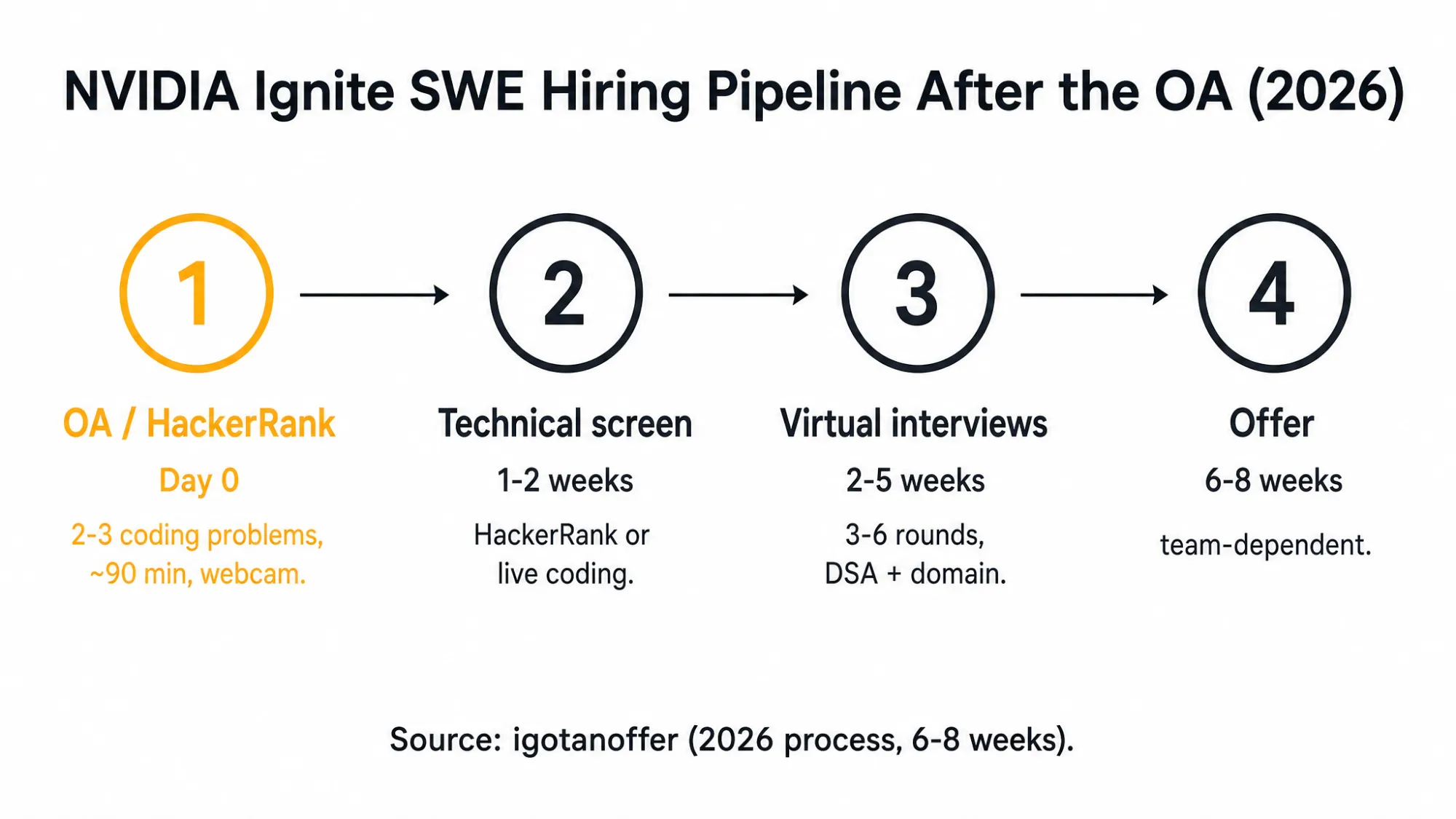
The full Ignite loop runs six to eight weeks, and the OA is the widest filter of all. The chart below lays out the pipeline after you submit.
The Technical Screen and Virtual Rounds
The next step is a technical screen, often on HackerRank or in a live coding call, followed by two to six virtual interview rounds. Expect DSA, system design for infra tracks, and deep questions on your resume projects. Receiving the OA already means you are shortlisted, because NVIDIA does not mass-send it.
How Long the Process Takes
The NVIDIA process runs about six to eight weeks from the first interview to an offer. First-person hear-back reports cluster around twenty seven days after the OA, with a range from one week to literal months, and many rejections along the way. A Glassdoor IGNITE intern aggregate puts the average at forty days to hire.
NVIDIA Ignite OA vs. Other NVIDIA Assessments
Ignite Is the New-Grad SWE Track
The Ignite name covers NVIDIA's early-career hiring, and for software engineers the Ignite OA is the HackerRank screen described here. When people search "nvidia ignite oa," this HackerRank test is the assessment they mean, not a later interview round. It is the first and widest gate into the new-grad funnel.
The OA Is Selective, Not Mass-Sent
Receiving the OA is a signal in itself. Candidates report the test is not sent to everyone, only to selected people, so getting the link already means you cleared an early filter. Treat the invite as shortlist confirmation, not a mass email, and prepare for it with the same seriousness as the interviews that follow.
Not the Internal Training Courses
Do not confuse this OA with NVIDIA's internal training products, such as DGX or AI-training assessments built for customers and employees. Those are enablement tools, not a hiring screen, and they share nothing with the coding problems on the Ignite HackerRank test. The names overlap, but the purpose does not.
Not the Pre-Internship Either
NVIDIA also runs a twelve-week Ignite pre-internship, but that program targets first and second year students as a summer experience. The new-grad and early-career SWE OA is a different funnel, so pre-internship posts online describe a different population than the one taking this test. Watch the dates and the year in any thread you read.
FAQ
What questions show up on the nvidia ignite oa?
The nvidia ignite oa leans on bit manipulation, greedy heaps, and prefix tricks. My 2026 sitting had an address-on-same-page check, a generate-bit-mask problem, and a maximum-score greedy, all medium with a hidden-test bar that punishes edge-case misses. Other reported problems include ideal numbers and prefix-XOR recovery.
Can you use AI tools or an invisible app on the nvidia ignite oa?
Desktop overlay tools put the AI's answer on your computer screen. They render it as a hidden layer above the browser using a basic OS-layer trick, while NVIDIA disqualifies unapproved outside tools such as ChatGPT and HackerRank's code-similarity layer flags generated code.
Whether that gets flagged depends on the detection running at the time, and proctoring software keeps adding capabilities, so the exposure isn't fixed. An AI interview tool pushes the answer to your phone instead, a physically separate device that no screenshot or session monitoring can reach by design. Your laptop screen stays on the exam editor, unchanged.
Land offer with Safer AI Interview Assistant
Skip the risky invisible apps. Our dual-device mode keeps it simple and undetectable. You crush the interview, we handle the answers.
Get started. It's freeLoved by 100,000+ candidates
Is the nvidia hackerrank test proctored, and what does it check?
Yes. NVIDIA's 2026 notice requires a working webcam, and candidates confirm the camera must be on, with the screen video recorded. HackerRank Proctor Mode tracks tab focus, copy-paste, a second monitor, and webcam snapshots, and a flagged session can end the attempt.
What is the nvidia hackerrank format, time limit, and does it have multiple choice?
The dominant Ignite shape is two coding problems plus a block of multiple-choice questions in about ninety minutes, though my sitting was three coding. The link stays open forty eight hours, then the clock runs once you start. Team format varies, and some tracks restrict the language to C.
Where do I find nvidia ignite oa reddit and community threads?
Candidates post nvidia ignite oa reddit and nvidia ignite hackerrank threads, but treat them as anecdote, not fact. The question content here comes from documented 2025 to 2026 sittings and high-frequency problem writeups, not forum claims. Start with the r/csMajors and r/InterviewCoderHQ threads.
Does NVIDIA send the nvidia oa to everyone, or is it selective?
For software engineering through Ignite, the OA is selective and not mass-sent, so receiving the link already means you are shortlisted. The gate is not the invite, it is the score, so the OA itself is the real filter regardless of how you entered the pipeline.