How I Passed the OpenAI HackerRank OA in 2026: Real Questions
Quick Facts
| Assessment | OpenAI new-grad HackerRank (openai oa), Applied Emerging Talent 2026 |
| Year | 2026 |
| Questions | 2 coding problems, both dynamic programming, one graph-related |
| Time per round | 45 to 60 minutes, single sitting |
| Proctoring | HackerRank Proctor Mode (webcam, screen recording, AI flagging) and Secure Mode (full-screen lock, tab-switch alerts) |
| AI detection | Plagiarism engine at ~93% accuracy; copy/paste tracking on by default |
| Scoring | By test cases passed (visible plus hidden); OpenAI's cut-off is not public |
| Language | Free choice by candidate |
I took the openai oa for OpenAI's Applied Emerging Talent 2026 new-grad SWE track on HackerRank and solved both coding questions. Both were dynamic programming, one graph-related, and the whole screen ran inside a single timed sitting in 2026. What follows is the complete process and how I prepared for it.
The second problem was a grid infection spread that needed a multi-source BFS, and I had burned close to twelve minutes coding one BFS per infected cell before the right structure clicked. I used an AI interview assistant to verify the seeding step, and it confirmed all infected cells had to enter the queue at depth zero. I walk through how I handled it in the Real Questions section below.
Before my test, I went through every OpenAI HackerRank post from the past two years on Reddit, LeetCode Discuss, and Teamblind. What I found tracks closely with what I experienced. The article goes deep on the mistakes that get candidates flagged or rejected, from proctoring violations to freezing on a familiar problem under pressure.
The Real Questions on My OpenAI HackerRank Test
I sat the Applied Emerging Talent 2026 HackerRank screen for a new-grad SWE track (the openai oa), and it served exactly two coding questions. Both were dynamic programming, and here is exactly what I got.
Question 1: Two-Part Dynamic Programming
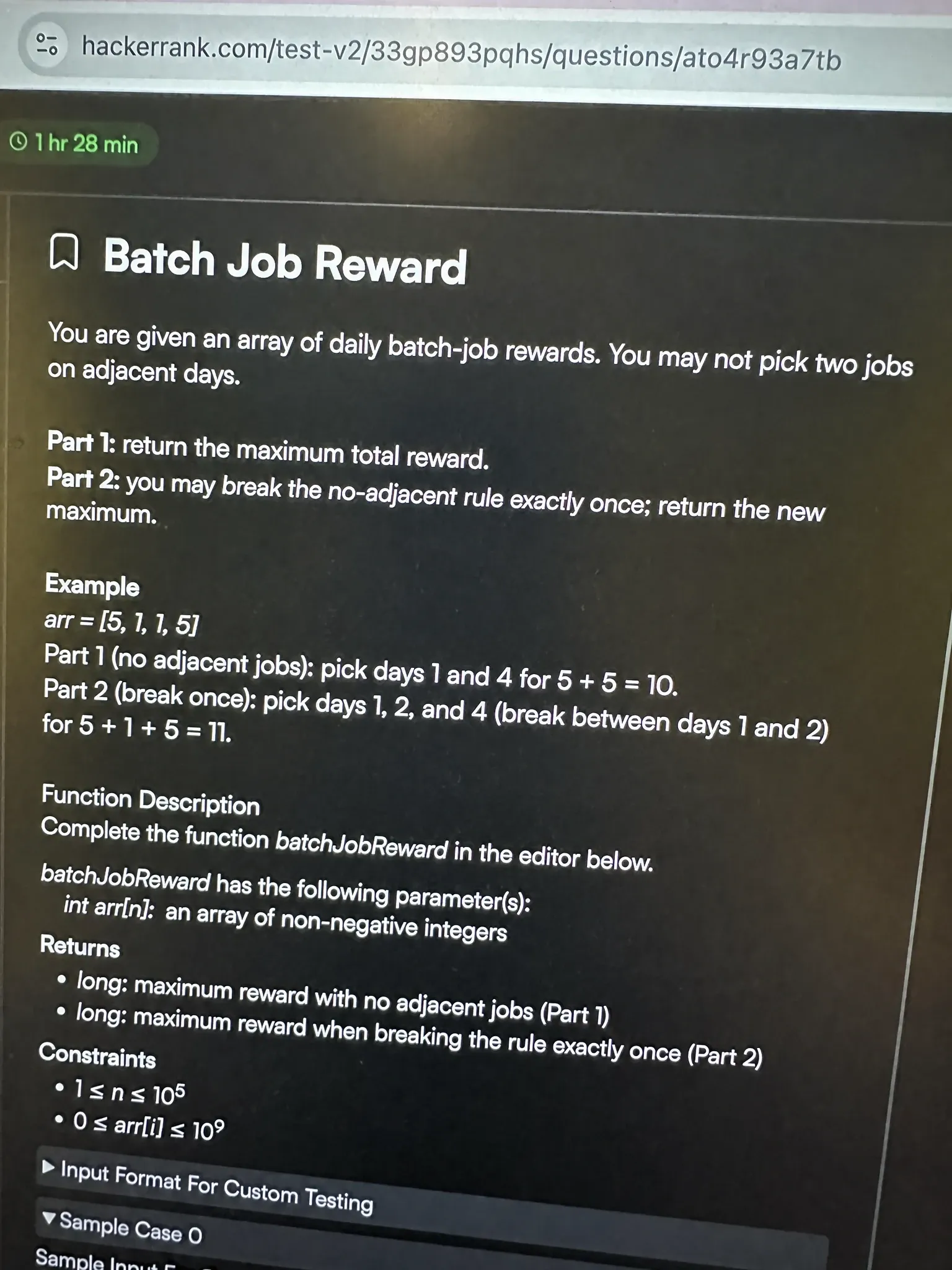
The problem I got: I was given an array of n integers, each one the reward for shipping a batch job on a consecutive day. I could not pick two jobs on adjacent days, because the cluster needed a cooldown between them. Part 1 asked for the maximum total reward. Part 2 changed the rule: I was now allowed to break the no-adjacent rule exactly once, but only once, and had to return the new maximum.
My approach: Part 1 is the classic one-dimensional take or skip decision. For each day I keep the best total if I skip it (carry the previous best) or take it (previous best where the prior day was skipped, plus today's reward). The twist in part 2 is only that taking two days in a row spends one "exception," so the real state I track is how many exceptions I have already used, not the day index. I built one table that carries both the used-exception count and whether the previous day was taken, then part 1 is just the k equals zero call and part 2 is k equals one.
def max_reward(rewards, k):
    n = len(rewards)
    NEG = float('-inf')
    # dp[used][sel]: best reward on the prefix so far,
    # used  = number of adjacency exceptions already spent
    # sel   = 1 if the previous day was taken, else 0
    dp = [[NEG, NEG] for _ in range(k + 1)]
    dp[0][0] = 0
    for val in rewards:
        ndp = [[NEG, NEG] for _ in range(k + 1)]
        for used in range(k + 1):
            for sel in (0, 1):
                cur = dp[used][sel]
                if cur == NEG:
                    continue
                # option 1: skip today's job
                ndp[used][0] = max(ndp[used][0], cur)
                # option 2: take today's job
                if sel == 0:
                    ndp[used][1] = max(ndp[used][1], cur + val)
                elif used < k:
                    ndp[used + 1][1] = max(ndp[used + 1][1], cur + val)
        dp = ndp
    return max(dp[used][sel] for used in range(k + 1) for sel in (0, 1))


# Part 1: no two adjacent days
# max_reward(rewards, 0)
# Part 2: at most one adjacent pair allowed
# max_reward(rewards, 1)
Time complexity: O(n * k) | Space complexity: O(k)
The whole question ate about half my time. I burned the first ten minutes forcing a two-dimensional table before I saw that the only extra state I needed was a count of how many adjacency exceptions I had spent.
Question 2: Graph Traversal and BFS
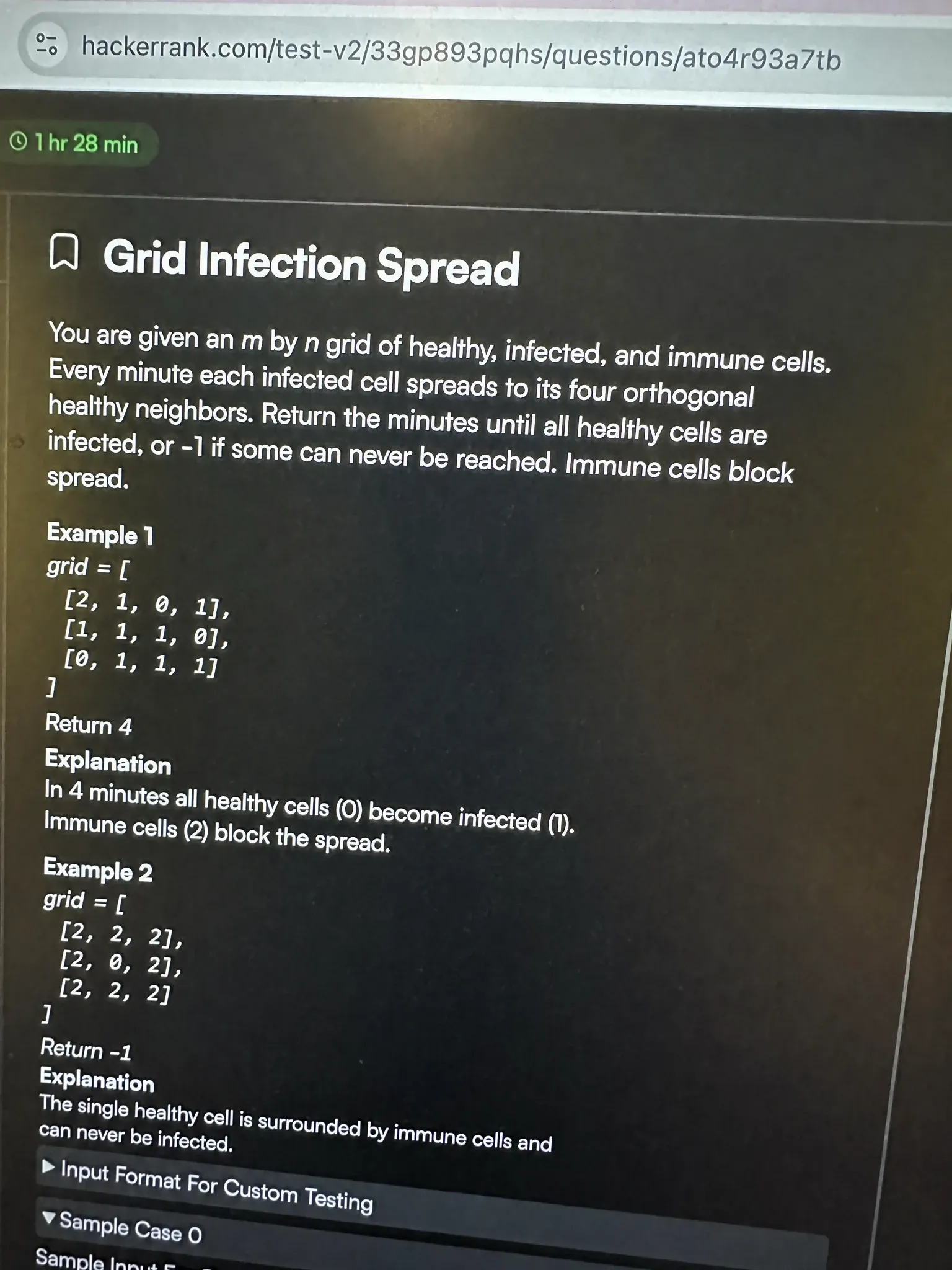
The problem I got: I was given an m by n grid where each cell was healthy, infected, or immune. Immune cells acted as walls and could never change. Every minute, each infected cell spread to its four orthogonal healthy neighbors, and the new cells became infected at the next minute. I had to return the number of minutes until every healthy cell was infected, or negative one if some healthy cell could never be reached.
My approach: This is a breadth-first search, but it has to start from every infected cell at the same time, not from one corner. I seeded the queue with all infected cells at depth zero and ran a normal level-by-level BFS, marking immune cells as already seen so the spread never enters them. The answer is the deepest depth I reached, and if any healthy cell stays unvisited after the queue empties, I return negative one. The clean part is that a multi-source BFS is just a single-source BFS where you happen to enqueue several roots before the first pop.
from collections import deque


def min_infection_time(grid):
    m, n = len(grid), len(grid[0])
    q = deque()
    seen = set()
    for r in range(m):
        for c in range(n):
            if grid[r][c] == 2:        # immune wall
                seen.add((r, c))
            elif grid[r][c] == 1:      # already infected
                q.append((r, c, 0))
                seen.add((r, c))
    dirs = [(1, 0), (-1, 0), (0, 1), (0, -1)]
    time = 0
    while q:
        r, c, t = q.popleft()
        time = t
        for dr, dc in dirs:
            nr, nc = r + dr, c + dc
            if 0 <= nr < m and 0 <= nc < n and (nr, nc) not in seen and grid[nr][nc] != 2:
                seen.add((nr, nc))
                q.append((nr, nc, t + 1))
    if len(seen) < m * n:
        return -1
    return time
Time complexity: O(m * n) | Space complexity: O(m * n)
I finished with maybe eight minutes left and my hands were shaking. I had wasted close to twelve minutes coding one BFS per infected cell before I accepted that all sources had to enter the queue at depth zero.
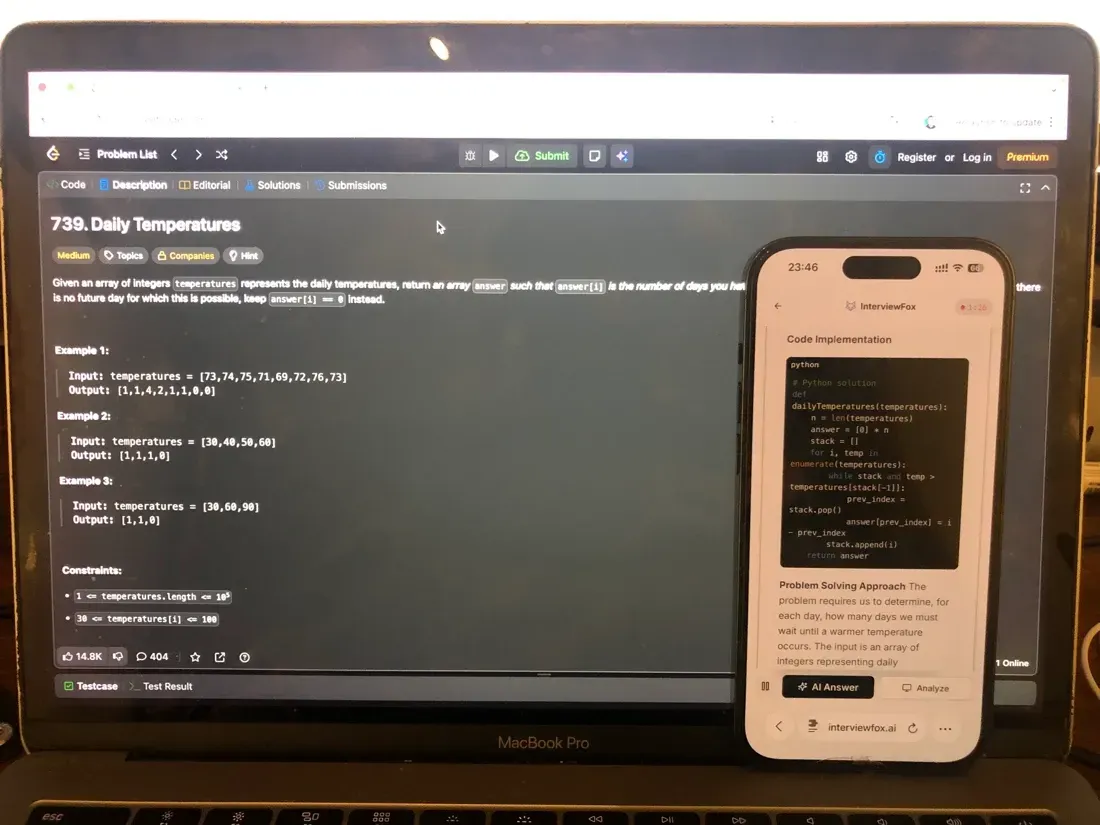
I didn't want to use a desktop overlay during this, because the answer would have been on the same screen the platform's screenshot monitoring was watching, hidden by a basic rendering layer. Whether that gets flagged depends on what detection is currently running, and I didn't want that uncertainty in the background. So when the multi-source BFS structure finally clicked, I triggered a real-time AI interview helper with a keyboard shortcut, it auto-captured the problem, and the answer landed on my phone. The approach stayed clear in my head and the laptop screen never changed from the exam editor.
Land offer with Safer AI Interview Assistant
Skip the risky invisible apps. Our dual-device mode keeps it simple and undetectable. You crush the interview, we handle the answers.
Get started. It's free Loved by 100,000+ candidates
OpenAI OA Proctoring on HackerRank
The proctoring layer on this test is HackerRank's integrity stack, and OpenAI decides which parts to switch on. The proctoring and AI-detection mechanics HackerRank documents match what candidates report seeing during the OpenAI screen.
Proctor Mode Watches via Webcam and Screen Recording
Proctor Mode applies to tests created after July 2025, and it runs webcam surveillance, screen recording, and real-time AI flagging through the whole attempt. I treat the webcam as live the entire time, even when nothing on screen looks sensitive.
Secure Mode Locks the Screen and Blocks Tab-Switches
Secure Mode forces a full-screen lock, throws tab-switch alerts, and restricts copy/paste. I kept one browser window and no second monitor, because the platform also flags window-inactive and outside-window clicks.
AI Plagiarism Detection Runs at 93% Accuracy
The AI plagiarism engine reads coding behavior, submission patterns, and question features at about 93% accuracy. Copy/paste tracking is on by default for every test, so any pasted block is logged whether or not a human reviewer looks at it.
2 Other Confirmed OpenAI HackerRank Questions
Beyond my two-question screen, other candidates have reported a set of practical OpenAI problems that show up across 2026 posts. Each one below is a distinct reported instance, not part of my own test.
GPU Credit Calculator
The GPU Credit Calculator appeared in early 2026 candidate reports as a time-ordered ledger of ADD, EXPIRE, and USE events where timestamps can arrive out of order, solved with a dual min-heap. The task is to answer USE requests by spending the oldest-available credit first while expired credit drops out automatically.
import heapq


class GpuCredit:
    def __init__(self):
        self.avail = []   # min-heap of (expiry, amount)
        self.balance = 0

    def add(self, exp, amt):
        heapq.heappush(self.avail, (exp, amt))
        self.balance += amt

    def use(self, now, amt):
        # lazy expiry: drop credit that has already expired
        kept = []
        while self.avail:
            exp, a = heapq.heappop(self.avail)
            if exp > now:
                kept.append((exp, a))
            else:
                self.balance -= a
        for item in kept:
            heapq.heappush(self.avail, item)
        if self.balance < amt:
            return False
        self.balance -= amt
        remaining = amt
        while remaining > 0:
            exp, a = heapq.heappop(self.avail)
            take = min(a, remaining)
            a -= take
            remaining -= take
            if a > 0:
                heapq.heappush(self.avail, (exp, a))
        return True
Time complexity: O(n log n) over events | Space complexity: O(n)
In-Memory Data Store and Time-Versioned KV
The in-memory store and time-versioned key-value problem showed up across 2026 reports where every write creates a new version and a read can ask for the value at a past version. The versioned layer works as a map from key to a list of (version, value) pairs, then binary-search the version.
class VersionedKV:
    def __init__(self):
        self.data = {}      # key -> [(version, value), ...]  sorted by version
        self.version = 0

    def put(self, key, value):
        self.version += 1
        self.data.setdefault(key, []).append((self.version, value))
        return self.version

    def get(self, key, version=None):
        if key not in self.data:
            return None
        version = self.version if version is None else version
        arr = self.data[key]
        lo, hi = 0, len(arr) - 1
        res = None
        while lo <= hi:
            mid = (lo + hi) // 2
            if arr[mid][0] <= version:
                res = arr[mid][1]
                lo = mid + 1
            else:
                hi = mid - 1
        return res
Time complexity: O(log v) per get, O(1) per put | Space complexity: O(total writes)
Other practical problems show up often in 2026 reports: an in-memory database with SQL backed by LSM, memtable, and SSTable structures, a resumable iterator for a large dataset, an LRU or LFU cache paired with a devbox CI/CD design, a multi-source BFS variant sometimes called Rotting Oranges 2.0, and tree problems like Count Complete Tree Nodes and Binary Tree Cameras.
None of these came from my own test, but each is a distinct reported instance worth drilling.
OpenAI OA Test Format on HackerRank
The format is a settled 2026 value, not something that shifts year to year.
Two Coding Questions Per Attempt
OpenAI's new-grad and emerging-talent HackerRank screen serves two coding questions, both dynamic programming with one graph-related. Some candidates also get a later CoderPad stage with camera and mic, but the OA itself is the two-question block.
45 to 60 Minutes Per Round
Each round runs 45 to 60 minutes, and the candidate generally picks the language. Visible and hidden test cases both run, and syntax lookups are usually allowed unless the invite says otherwise.
How OpenAI's HackerRank Scoring Works
Scoring Is by Test Cases Passed, Threshold Not Public
Scoring runs on test cases passed, with visible and hidden cases both counting and hidden cases blocking hard-coded answers. OpenAI does not publish its OA cut-off, so the only actionable target is to pass every visible case and as many hidden cases as possible.
OpenAI HackerRank Exam-Day Strategy
The exam-day difficulty on the openai oa is the clock and the follow-through, not the algorithms.
A Full Screen Runs About 45 Minutes
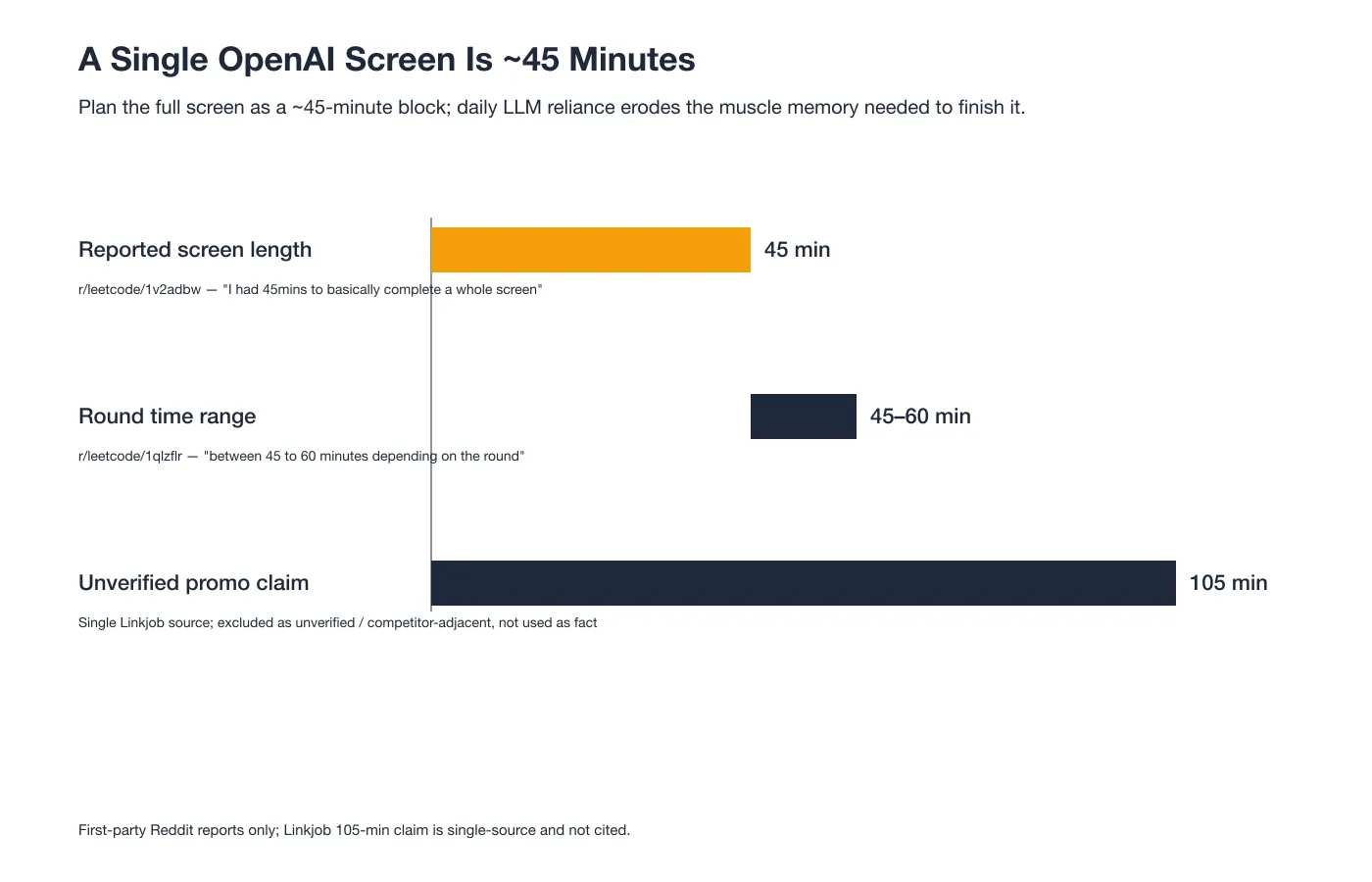
One candidate finished a whole OpenAI screen in about 45 minutes and still called it not good enough. The clock, not the algorithms, was the real pressure. I plan every screen as a single 45-minute block and protect it from distraction.
Follow the Instructions Literally
Mid-implementation follow-ups land if you drift from the prompt, and OpenAI's practical style expects concurrency follow-ups on top of the base solution. I read the instruction set as the actual task list and implement it line by line.
Re-Read the Prompt Before You Code
A prepped candidate solved a familiar problem the night before, then froze and missed the last sentence of the first instruction block under pressure. I re-read the full prompt before writing any code, even when the problem looks known.
As the chart below shows, a reported OpenAI screen runs about 45 minutes against a 45 to 60 minute round range, while the 105-minute claim from one unverified source does not hold up.
Why Candidates Fail the OpenAI HackerRank Assessment
An Invisible App Ends the Attempt
The most final failure mode is an Invisible App identified before the assessment ended, resulting in a terminated attempt and a canceled application. An overlay tool like that Invisible App leaves exactly the kind of signal these systems flag, which is why the attempt ended and the application was canceled.
HackerRank Proctor Mode makes this catchable, as I detailed in the proctoring section above: it watches through the webcam, records the screen, and applies real-time AI flagging on tests created after July 2025, with Secure Mode and the 93%-accuracy plagiarism engine reinforcing that coverage.
InterviewFox is a dual-device AI interview assistant: the answer goes to my phone, a physically separate device that no screenshot, screen recording, or session monitoring can reach by design.
Land offer with Safer AI Interview Assistant
Skip the risky invisible apps. Our dual-device mode keeps it simple and undetectable. You crush the interview, we handle the answers.
Get started. It's free Loved by 100,000+ candidates
Freezing on a Familiar Problem
A prepped candidate blanked on a problem they had solved the night before and missed a key instruction under pressure. I treat that as a process failure, not an algorithm failure, and re-read the prompt before each step.
Lost Coding Muscle Memory From Daily LLM Use
Another candidate relied on LLMs every day and almost finished a 45-minute screen but called it not good enough. Daily tool reliance erodes the hands-on fluency the timed screen needs, so I rebuild it with untimed practice before any test.
How to Prepare for the OpenAI HackerRank in 7 Days
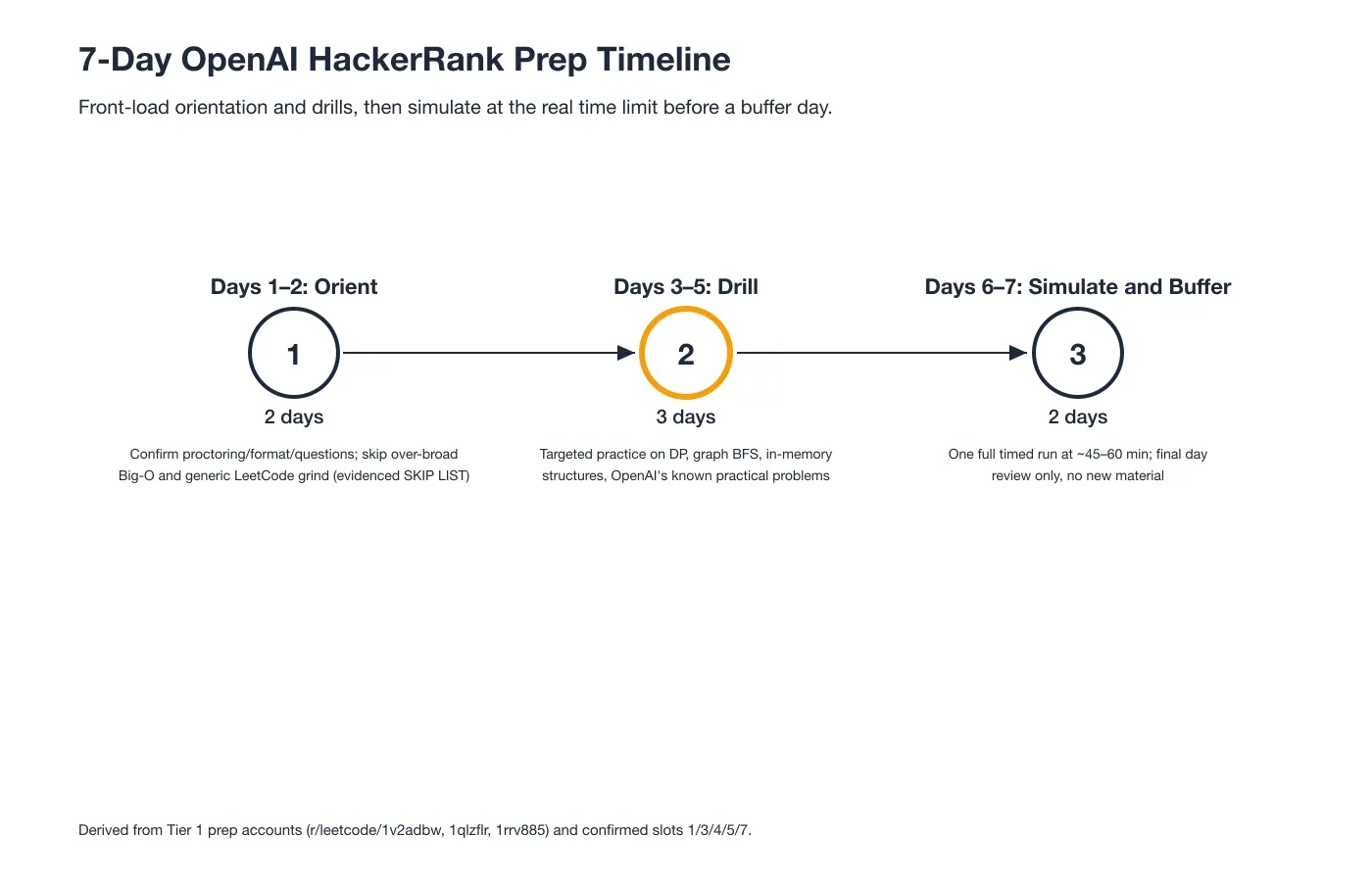
Days 1–2: Orient
I confirmed the proctoring, format, and question shape first, then built my skip list. I skipped over-broad Big-O drilling because the failure pattern here is proctoring violations and practical-style follow-ups, not weak algorithms. I also skipped a generic LeetCode grind because OpenAI repeats its own practical problems at a high rate, and drilling its known set beats broad LC.
Days 3–5: Drill
I drilled the confirmed recurring categories: dynamic programming, graph and multi-source BFS, in-memory data structures, and OpenAI's known practical problems like the GPU Credit Calculator and the time-versioned key-value store. Each drill ran against the real hidden-case bar, not just the visible examples.
In the days before the OA, I also used the Prep Agent from InterviewFox over WhatsApp and SMS, sending it the confirmed OpenAI question patterns and getting a personalized drill plan and strategy back.
Days 6–7: Simulate and Buffer
I ran one full timed screen at the real 45 to 60 minute limit with hidden cases, then spent the last day on review only with no new material. The buffer day keeps me sharp without the burnout that hurts memory and speed on test day.
As the chart below shows, the plan front-loads orientation and drills, then simulates at the real time limit before a low-intensity buffer day.
What Happens After You Submit the OA
The Skills-Based Assessment and the One-Week Reply
The HackerRank screen is OpenAI's skills-based assessment step, and OpenAI's interview guide lays out what follows: a reply within about a week, and possibly more than one assessment including a take-home.
Final Interviews Run 4–6 Hours Over One or Two Days
Final interviews run 4 to 6 hours with 4 to 6 people across one or two days, virtual by default with onsite San Francisco optional. The engineering bar is well-designed, high-quality, performant, tested code.
The Decision Lands Within a Week
The decision lands within about a week of the final interviews, and references may be requested. Recruiter reply after applying tends to run about a week as well.
OpenAI Repeats Problems, So Drill Its Known Set
OpenAI Repeats Its Questions at a High Rate
Across 2026 reports, OpenAI repeats its coding questions at a high rate, and grinding its known practical problems beats broad preparation. I treat the confirmed set as the highest-ROI drill list rather than an open-ended problem bank.
The Practical Style Is Hard to BS and Easy to Flag
OpenAI's practical, code-heavy style with concurrency follow-ups is hard to fake and easy to flag under the 93% accuracy detection stack. An overlay tool cannot safely supply that style, which is why I keep the screen clean and do the coding myself.
FAQ
What does the openai oa reddit community report about the questions?
The openai oa surfaces two coding questions on Reddit in 2025 and 2026, both dynamic programming with one graph-related. The reports match my own screen, so the questions stay consistent rather than random.
How hard is the openai hackerrank assessment for new grads?
The openai hackerrank assessment is moderate on algorithm difficulty but tight on time, with a 45 to 60 minute window for two DP problems. The real difficulty is the clock and the proctoring, not the problem types.
What is the openai online assessment format and time limit?
The openai online assessment is a two-question HackerRank screen with visible and hidden test cases and a 45 to 60 minute per-round limit. Some candidates also get a later CoderPad stage with camera and mic.
What is the openai emerging talent oa like in 2026?
The openai emerging talent oa in 2026 is the Applied Emerging Talent 2026 HackerRank screen with two DP questions, one graph-related, under HackerRank Proctor and Secure Mode. It runs inside a single timed sitting.
Can I use an AI tool or invisible app during the OpenAI HackerRank OA?
Desktop overlay tools put the AI's answer on your computer screen, rendered as a hidden layer above the browser with a basic OS-layer trick, and because the hiding is basic, the answer stays on-screen, and proctoring software keeps adding detection capabilities, the risk exposure is not fixed.
InterviewFox pushes the answer to your phone, a physically separate device that no screenshot, screen recording, or session monitoring can reach by design, so the laptop screen stays on the exam editor, unchanged.
If you are going to use AI assistance during the OA, the dual-device architecture removes the answer from your screen entirely.
Land offer with Safer AI Interview Assistant
Skip the risky invisible apps. Our dual-device mode keeps it simple and undetectable. You crush the interview, we handle the answers.
Get started. It's free Loved by 100,000+ candidates
Does the openai new grad oa repeat its coding questions?
The openai new grad oa repeats its coding questions at a high rate across 2026 reports, so drilling OpenAI's known practical problems is the best prep. The confirmed set includes DP, multi-source BFS, and in-memory data structures.