
I Passed HackerRank PayPal in 2026: Real Questions and Prep Plan

Quick Facts
| Company | PayPal |
| Platform | HackerRank |
| My result | Advanced to next round (2 coding problems, 60 minutes) |
| Format | 1 DSA plus MCQs to 4 coding questions; 2 coding in 60 minutes is common |
| Time limit | 45 minutes to 3 hours reported |
| Proctoring | Webcam Image Proctoring plus Proctor Mode (employer-enabled, off by default) |
| Cutoff | None published |
I took the hackerrank paypal test for a new-grad SWE role in 2026. I solved both coding problems in 60 minutes and advanced to the next round. What follows is the complete process and how I prepared for it.
Question 1 cost me eight minutes on a wrong DP start, and the clock was already tight. I used an AI interview assistant to check my prefix-scan logic, and it surfaced the shared-prefix shortcut. I break that exact moment down in the walkthrough below.
Before my test, I read every paypal hackerrank post from the past two years on Reddit, LeetCode Discuss, and Teamblind. What I found tracks closely with what I experienced, especially the mistakes that get people flagged or rejected.
The Real Questions on My PayPal HackerRank Test
My PayPal OA landed as two coding problems on HackerRank with 60 minutes on the clock. Here is exactly what I got.
Question 1: String and Array Manipulation
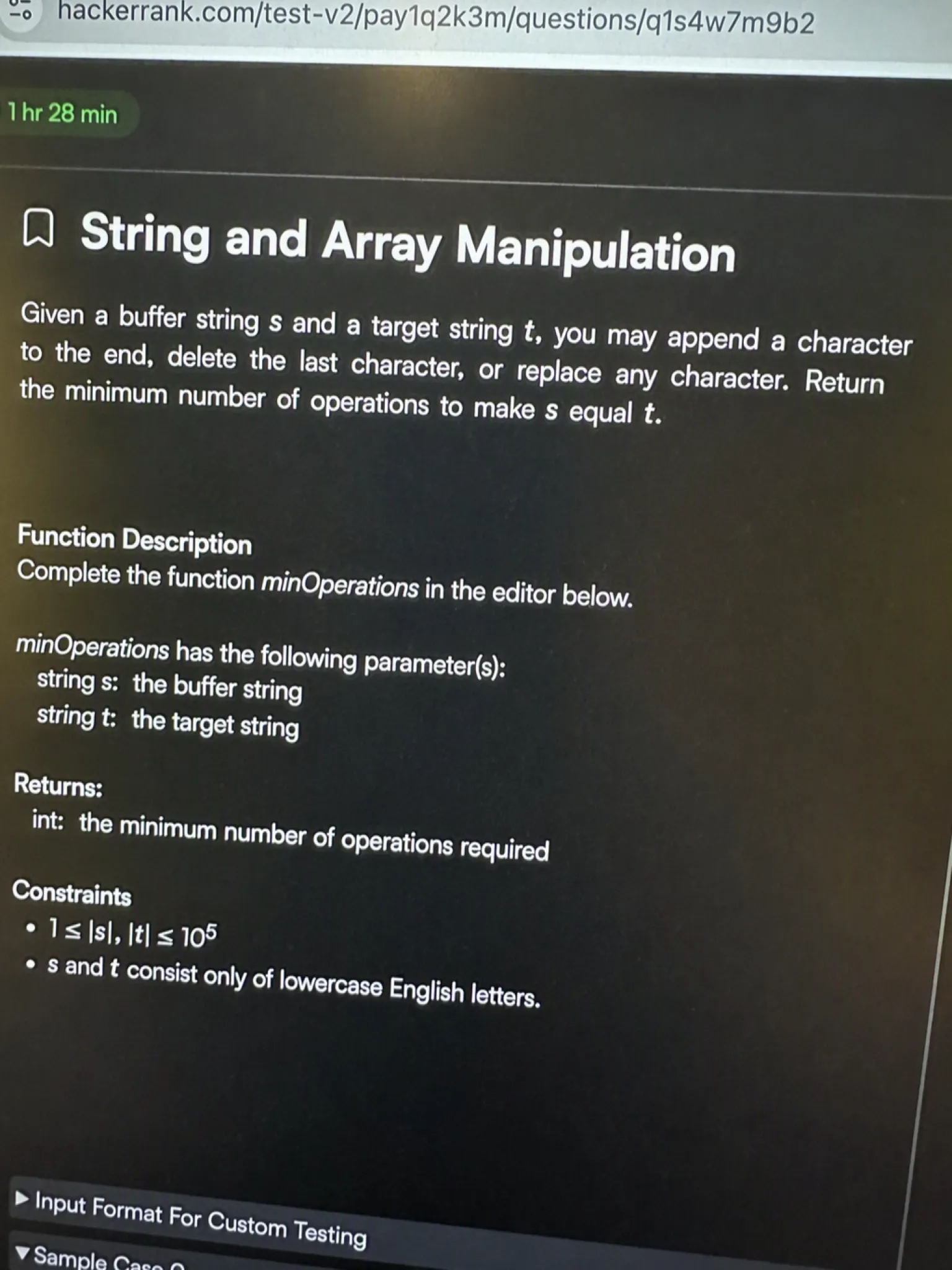
The problem I got: I was given a starting buffer string s and a target string t. I could append a character to the end, delete the last character, or replace a character at any index. I had to return the minimum number of operations to make s equal t.
My approach: I first reached for a full edit-distance DP. That was overkill. The allowed operations only touch the end for add and delete, and replace works anywhere. So I scanned for the longest shared prefix, then handled the tails.
def min_operations(s: str, t: str) -> int:
    n, m = len(s), len(t)
    L = 0
    while L < n and L < m and s[L] == t[L]:
        L += 1
    ops = 0
    if n > m:
        ops += n - m
        for i in range(L, m):
            if s[i] != t[i]:
                ops += 1
    elif m > n:
        for i in range(L, n):
            if s[i] != t[i]:
                ops += 1
        ops += m - n
    else:
        for i in range(L, n):
            if s[i] != t[i]:
                ops += 1
    return ops
Time complexity: O(n + m) | Space complexity: O(1)
I spent the first eight minutes on the DP table before the prefix trick clicked. That lost buffer I needed later, and I finished Q1 with the clock already tight.
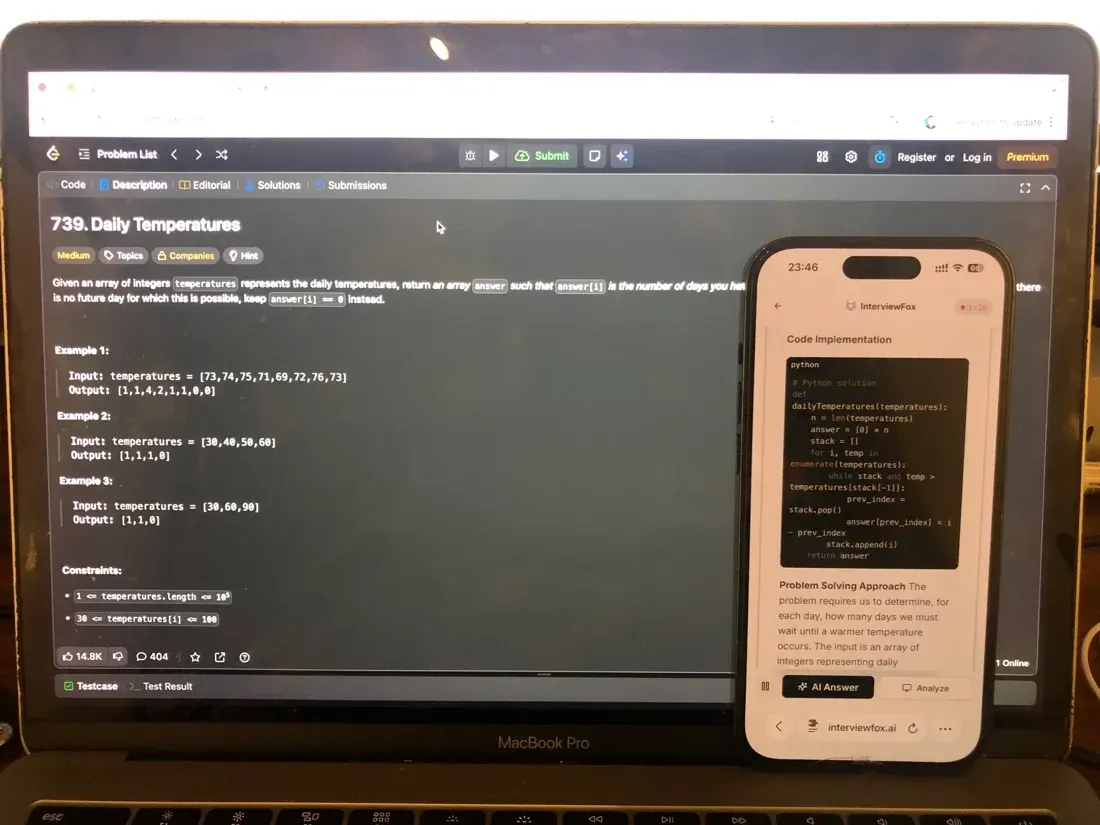
I did not want a desktop overlay on my laptop, since the answer would sit on the same screen the proctoring system watches. When Q1's prefix logic still felt thin, I pressed the shortcut and the problem captured to my phone. The answer came back on a separate device, and my laptop screen never changed.
Land offer with Safer AI Interview Assistant
Skip the risky invisible apps. Our dual-device mode keeps it simple and undetectable. You crush the interview, we handle the answers.
Get started. It's freeLoved by 100,000+ candidates
Question 2: Heap or Greedy Problem
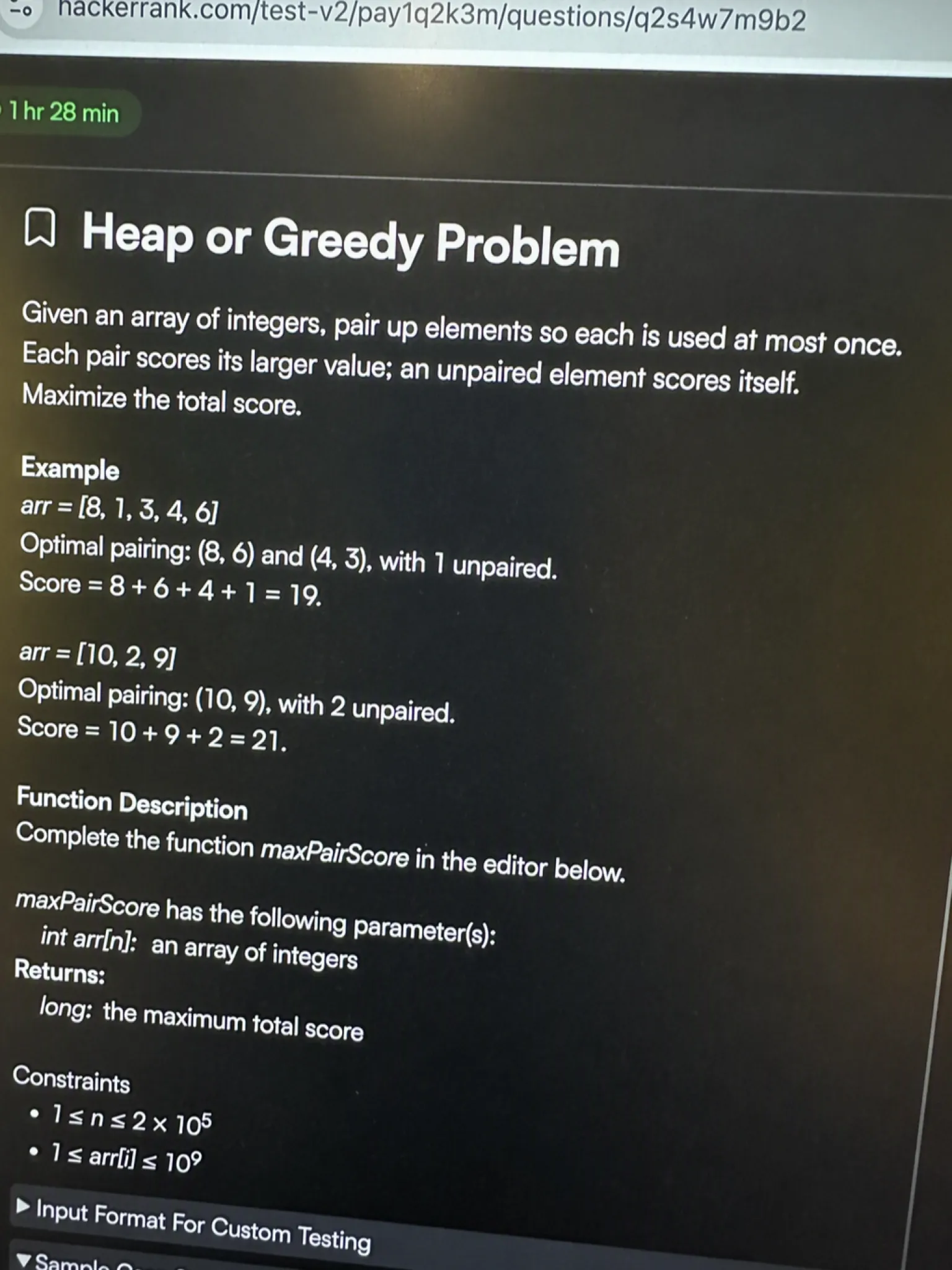
The problem I got: I got an array of integers. I had to pair up elements so each element was used at most once. Each pair scored the larger of its two numbers. Any number left alone counted its own value. I had to maximize the total score.
My approach: I sorted the array ascending. Each pair forces me to drop its smaller value. To lose as little as possible, I drop the smallest floor(n / 2) values and keep the rest. A heap would give the same result with more code.
def max_pair_score(nums):
    nums.sort()
    total = sum(nums)
    drop = sum(nums[: len(nums) // 2])
    return total - drop
Time complexity: O(n log n) | Space complexity: O(1)
The spec mentioned treating 1 as standalone and pairing 0 with a negative to neutralize it. My sort and drop already covered both, but I paused to double check. I submitted with about four minutes left.
PayPal's Proctoring Policy for HackerRank
PayPal can turn proctoring on for a HackerRank invite, but the specifics differ by employer setting. The three layers below cover what a candidate actually faces when it is enabled.
Webcam and Image Proctoring
The webcam check asks you to show your face and grants periodic image capture. HackerRank's Image Proctoring overview explains how AI analysis flags a missing, extra, or static face and catches spoofing. Employers turn this on per invite, and it is off by default.
AI Proctor Mode and Tab Monitoring
Proctor Mode, live for tests created after July 2025, auto-flags and logs every tab or fullscreen exit. My separate guide on how HackerRank catches tab switching shows what that exit log shows a recruiter. Object detection in the webcam can flag a phone or tablet, and multiple-monitor use gets caught too.
What Recruiters Actually See
Recruiters review periodic webcam snapshots after the test. Proctor Mode also takes session screenshots and logs tab and fullscreen exits, which my walkthrough on how HackerRank logs copy-paste activity details. The session-recording detection guide shows what gets captured frame by frame.
Other Confirmed PayPal HackerRank Questions
These are real problems candidates reported beyond my own exam. Each comes from a named source, not a guess.
OOP Design
LeetCode Discuss user 7295033 (October 2025) reported an OOP design question on their PayPal OA. A candidate's full LeetCode write-up lists the exact OOP and SQL mix they faced.
Purchase Optimization
LeetCode 7295033 also lists a purchase optimization problem using prefix sum, binary search, and greedy. The shape is "maximum number whose price sum stays at or under K". This recurs across several reported PayPal OAs.
String Rebuild With Operations
dev.to (November 2025) published a PayPal OA with a string rebuild problem: append, delete, and replace on a mutable buffer. The tricky part is boundary handling on the replace step. Hidden tests punish an inefficient replace.
Maximize Sum After Pairing
dev.to's second problem pairs array elements to maximize the score of larger values. Treat 1 as standalone, and pair 0 with a negative to neutralize it. Sorting and dropping the smallest half covers both rules.
SQL Aggregation and Filtering
LeetCode 7295033 includes a hard SQL item: GROUP BY, HAVING, and ORDER BY on aggregated data. Some backend invites require this section. Practice the aggregation pattern before the test.
What PayPal's HackerRank Test Format Actually Looks Like
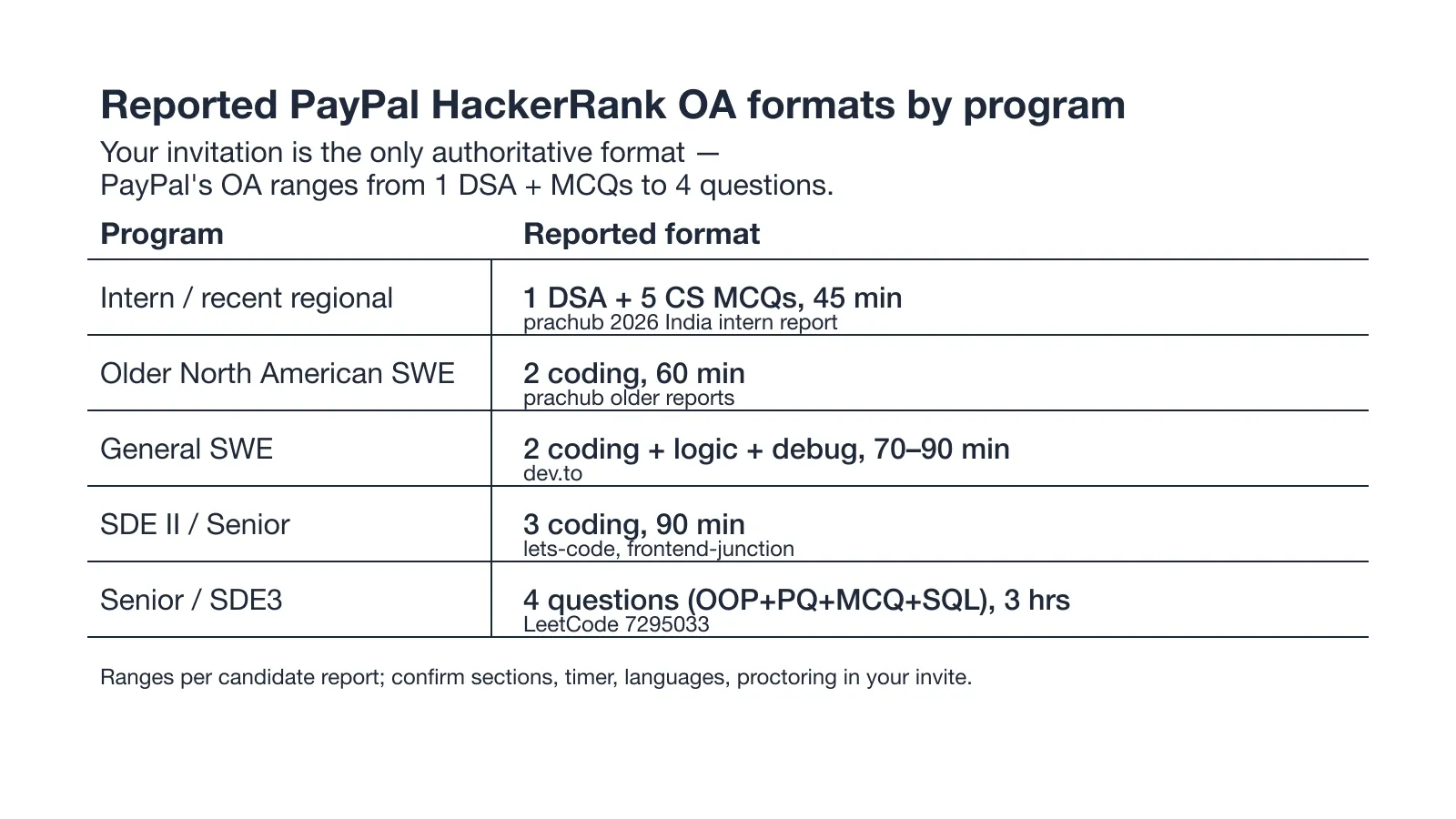
This is the part candidates ask about most, because PayPal's format shifts by program. The infographic below shows the reported format range across recent invites.
Question Count and Sections
Reported shapes run from one DSA problem plus MCQs to four coding questions. A two-coding, 60-minute test is a common early-career shape. Some invites add logic or debug sections.
Time Limit and Link Mechanics
Timers range from 45 minutes to 3 hours depending on the invite. Hidden tests run after submission. The invitation email sets the clock, not the candidate.
Languages and IDE
HackerRank's standard IDE supports Java, Python, and C++ for most SWE tests. Some backend invites require Java or SQL sections. The editor has limited autocomplete, so practice there first.
How PayPal's HackerRank Scoring Works
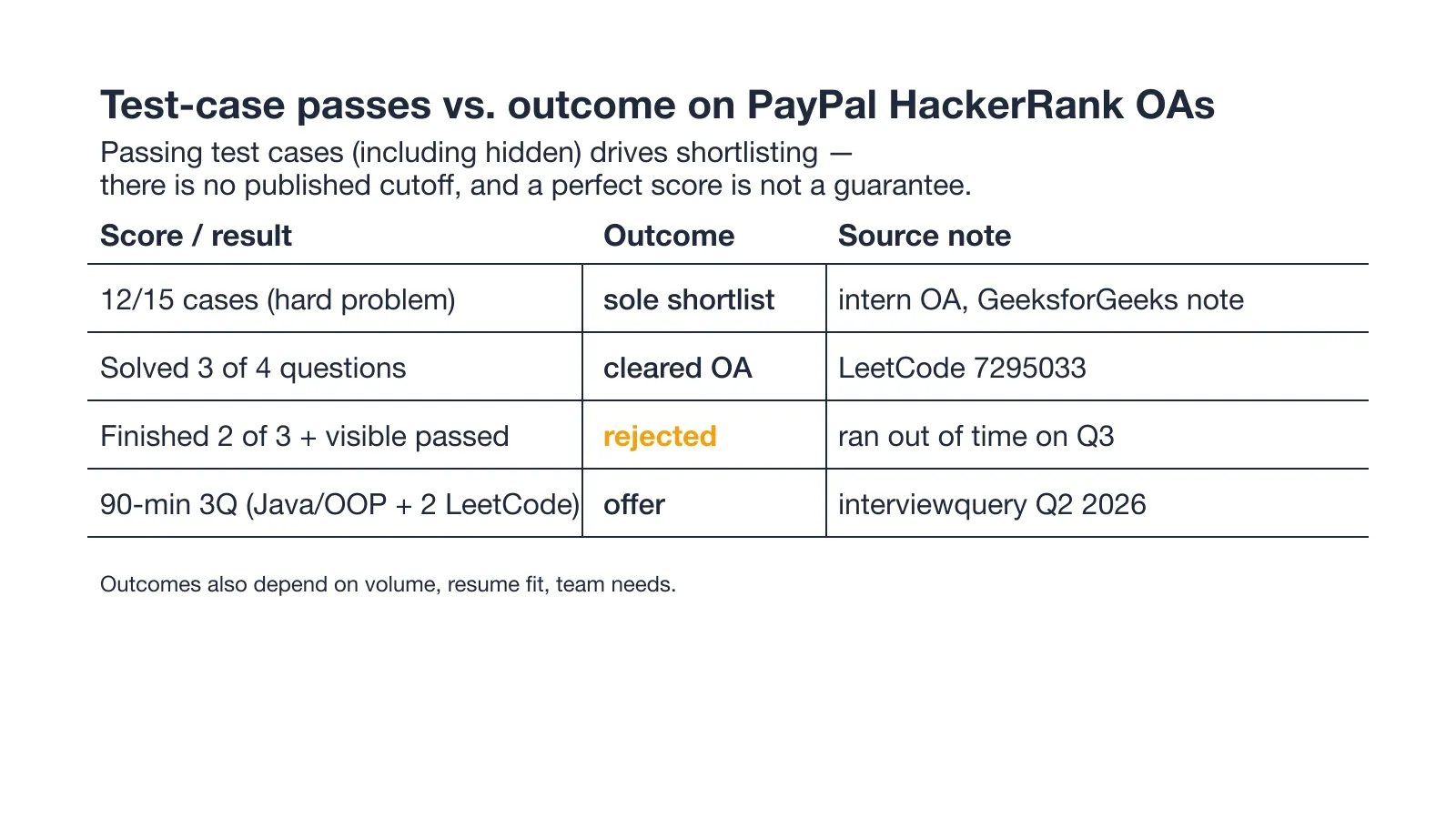
Scoring is test-case based, and the score breakdown below reflects what candidates report.
Test-Case and Hidden-Test Scoring
Each problem scores on visible and hidden test cases. Passing the samples does not mean passing the hidden set. A clean sample run can still fail on boundary inputs.
No Published Cutoff
PayPal publishes no global OA cutoff. A strong score does not guarantee an interview, since volume, resume fit, and team needs all matter. Treat a high score as necessary, not sufficient.
PayPal HackerRank Exam-Day Strategy
Bank the Solvable Problem First
Skim all problems before coding. Solve the clearest one first, then move to the harder heap. Do not donate forty minutes to a hard problem while an easy string sits unattempted.
Protect the Clock on Every Problem
A Senior SE finished two of three problems with visible tests passing, then ran out of time on Q3 and got rejected. Reserve a buffer for hidden tests on every problem, not just the last.
Read Edge Cases Before Coding
Coaching recaps warn that students trip on one-related corner cases and inefficient replaces. Read the edge cases before you write code. Hidden tests expose assumptions the prompt never granted.
Why Candidates Fail the PayPal HackerRank Assessment
AI-Tool and Overlay Detection
One candidate report from December 2025 describes a click-through desktop overlay they expected to stay invisible. About 12 minutes into Question 1, a window-focus warning appeared immediately after the overlay opened. The page locked immediately, and they were marked ineligible for a retake.
Proctor Mode logs tab and fullscreen exits and detects phones, tablets, and multiple monitors in the webcam feed. It also flags conversation patterns inside the editor. Overlay help carries real detection risk even when the tool claims to be invisible.
InterviewFox works differently: the answer goes to a phone, a physically separate device that no screenshot, screen recording, or session monitoring can reach by design.
Land offer with Safer AI Interview Assistant
Skip the risky invisible apps. Our dual-device mode keeps it simple and undetectable. You crush the interview, we handle the answers.
Get started. It's freeLoved by 100,000+ candidates
Running Out of Time on the Last Problem
A Senior SE US candidate reported a one-hour HackerRank with three medium problems. They finished two and passed the visible tests but needed more time on the third. A rejection email arrived soon after, citing an incomplete submission.
Losing Marks on Hidden and Edge Cases
dev.to's recap notes most students trip on one-related corner cases or inefficient replace implementations. Hidden tests are built to expose assumptions the prompt never granted. A working sample pass can still fail the full set.
Clearing the OA but Not the Later Rounds
Multiple reports show candidates clearing the OA and failing later rounds. LeetCode 7295033 cleared the OA then fell at system design. The OA is a filter, not a guarantee of an offer.
How to Prepare for the PayPal HackerRank in 7 Days
In the days before the OA, I used the Prep Agent from InterviewFox over WhatsApp. I sent it the confirmed PayPal question patterns and got a personalized drill plan and strategy back. The plan below is built from those patterns and the failure causes above.
Days 1-4: String, Array, Hash Map, Heap, and Greedy
PayPal's reported patterns are strings, arrays, hash maps, heaps, and greedy; OOP and SQL appear on backend tracks. I drilled two unseen timed problems each day and held myself to 25 minutes with edge cases. The success check was two clean solves per day.
Days 5-6: OOP, SQL Warm-Up, and a Full Timed Simulation
Backend invites add OOP and SQL sections, so I solved one abstract-class problem and one GROUP BY/HAVING query without docs. Then I ran a 70 to 90 minute mock and reserved 15 percent of the clock for edge cases.
Day 7: Edge-Case Review and Platform Familiarity
I re-solved every miss and practiced in the HackerRank editor with its limited autocomplete. I skipped heavy DP and graph theory, because PayPal's OA checks fundamentals and carefulness, not obscure tricks. The success check was zero compile or edge errors.
What Happens After You Submit the OA
Recruiter Contact and Follow-Up Rounds
A 2025 backend-intern timeline went OA January 29, recruiter screen January 30, two 45-minute interviews February 11, and offer February 28. Interviewquery maps OA to screen, then Karat or live, tech, system design, and behavioral rounds.
Wait Times Vary Widely
Contact ranges from next-day to weeks of silence. One jointaro candidate heard nothing for two months, then a rejection. A same-day HR message is not the same as an offer, so read it as one step.
Keep Other Applications Live
The OA is a filter, not a guarantee. Cleared-OA-then-rejected is common across reports. Hold your other processes open until you have a written offer in hand.
PayPal's HackerRank OA Changes by Role Track
Backend and SWE OAs Add OOP and SQL
LeetCode 7295033's backend OA mixed OOP, purchase optimization, auth and cache MCQs, and SQL. A backend invite can include Java or SQL sections beyond the DSA problems. Prepare those sections if your track lists them.
Android OAs Add Platform MCQs
One LinkedIn Android report lists 18 Android-specific MCQs plus two coding problems at easy and medium. The MCQs test platform knowledge, not just algorithms. Brush up on Android basics if you applied for that track.
Frontend OAs Add JS and React
A frontend-junction Senior FE report describes a 90-minute OA with three questions: a DSA string, a JS class OOP item, and a React cart state problem. Frontend candidates should practice JS class design and React state.
FAQ
Does PayPal use HackerRank?
Yes. PayPal commonly uses HackerRank for SWE and intern online assessments across many regions. Several candidate reports and PayPal's own intern guidance name the platform. Expect it unless your invite says otherwise.
How many questions are on the PayPal HackerRank OA?
The count varies by program. Reports range from one DSA problem plus MCQs to four coding questions, with two coding problems in 60 minutes a common shape. Your invitation is the only authoritative source for your test.
What score do I need to pass the PayPal HackerRank?
PayPal publishes no global cutoff. Scoring is test-case based, and a strong score still depends on applicant volume and team fit. Treat a clean, hidden-test-passing submission as the real goal, not a fixed number.
Is the PayPal HackerRank OA proctored?
It can be. Webcam Image Proctoring and Proctor Mode are employer-enabled and off by default, so some invites add them and others do not. Assume proctoring is possible and prepare as if it is on.
Can I use an AI tool or invisible app during the PayPal HackerRank OA?
Desktop overlay tools put the AI's answer on your computer screen, rendered as a hidden layer above the browser with a basic OS trick. Proctoring software keeps adding detection as AI tools spread, so the exposure is not fixed.
InterviewFox pushes the answer to your phone, a physically separate device no screenshot or session recording can reach by design, so your laptop screen stays on the exam editor. The dual-device setup removes the answer from your screen entirely if you use AI help during the OA.
Land offer with Safer AI Interview Assistant
Skip the risky invisible apps. Our dual-device mode keeps it simple and undetectable. You crush the interview, we handle the answers.
Get started. It's freeLoved by 100,000+ candidates
Can system design appear on the PayPal HackerRank OA?
Not usually. System design belongs to later interview rounds, not the OA itself. The OA tests coding fundamentals, and a few OOP or SQL sections at most. Save system-design prep for the rounds after you clear the test.