
I Aced Qualcomm HackerRank Test in 2026: Real Questions and Prep

Quick Facts
| Test | Qualcomm HackerRank test, new-grad software engineer |
| Format | 2-3 coding problems plus an MCQ section |
| Time limit | 60-90 minutes, set by the recruiter and shown in the invitation |
| Coding questions I received | 2 (tree diameter, first bad version) |
| MCQ topics | C/C++, OS, networks, OOP, and digital electronics for hardware roles |
| Proctoring | HackerRank Secure Mode, with the Proctor Mode add-on covering screenshots and webcam images |
| Languages | 35 supported; I wrote my solutions in Python |
| Score and cutoff | No public Qualcomm cutoff exists |
| Rescheduling | Handled only by Qualcomm, not by the platform |
I took the Qualcomm HackerRank test for a new-grad software engineer role in late February 2026. My invitation listed two coding problems plus an MCQ set. The first ran clean, and the second came down to a boundary bug that kept one hidden test failing for close to fifteen minutes. What follows is the complete process and how I prepared for it.
The sample passed while a hidden test failed on one boundary line, fifteen minutes into the second problem. I used a dual device AI interview helper to trace the binary search window. It surfaced the lower-bound error, and the walkthrough below breaks down the fix.
Before my test, I went through every Qualcomm HackerRank post from the past two years on Reddit, LeetCode Discuss, and Teamblind. What I found tracks closely with what I experienced. The traps that end attempts early, from an unread proctoring layer to a hidden-test shortcut, appear further down.
The Real Questions on My Qualcomm HackerRank Test
I sat Qualcomm's new-grad software engineer assessment on HackerRank in late February 2026, with a stack of other OAs open that season. My invitation listed two coding problems and an MCQ set in one timed window. Here is exactly what I got.
Question 1: Tree Diameter
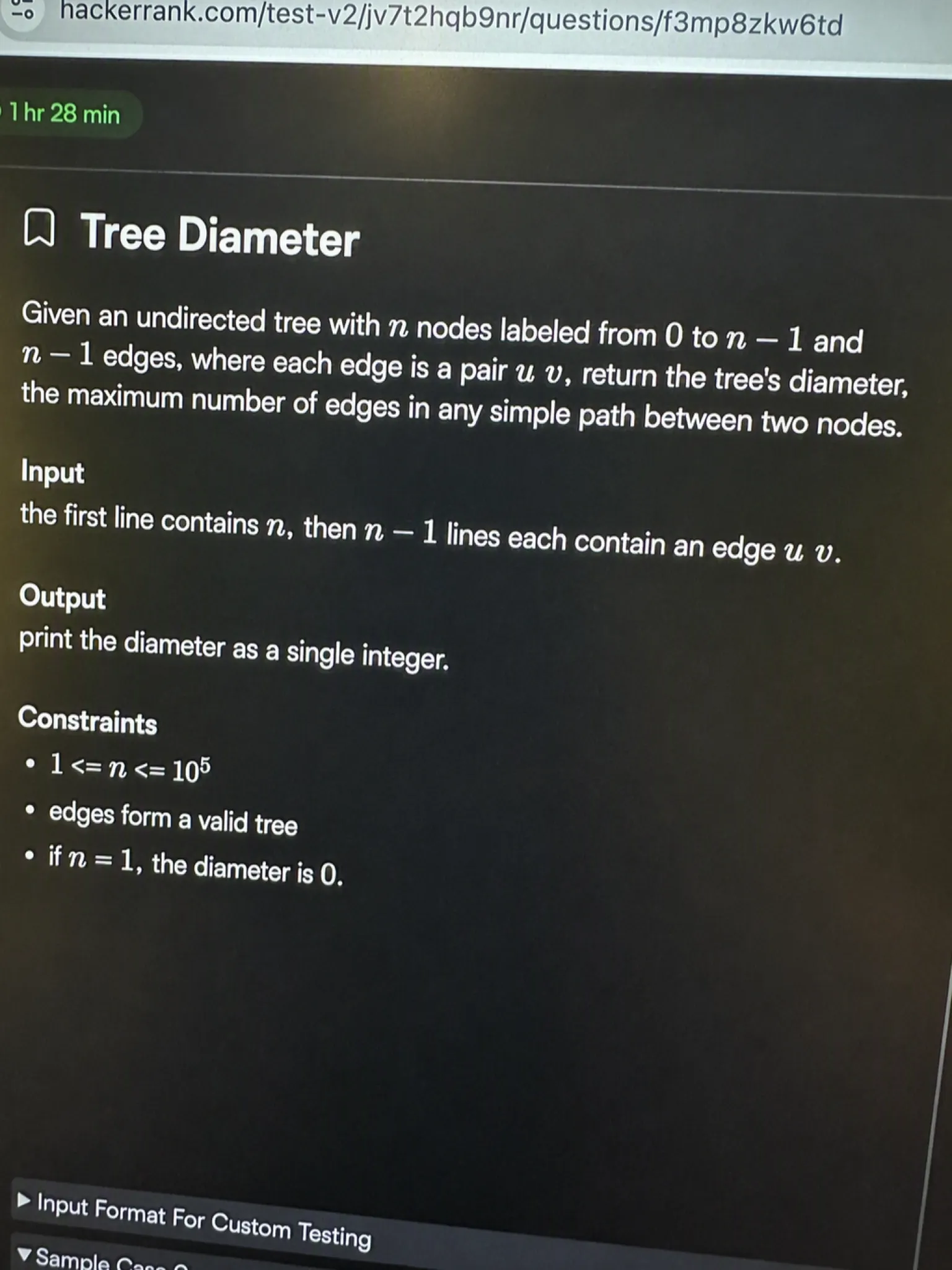
The problem I got: The first task was a tree problem with no picture, just an edge list. I got an undirected tree with n nodes labeled 0 to n - 1 and n - 1 edges, each edge a pair u v, and I had to return the tree's diameter. The statement defined the diameter as the largest number of edges on any simple path between two nodes. The input came in as n on the first line, then n - 1 lines of edges, and the answer printed as a single integer. Their first example was four nodes with edges 0-1, 0-2, and 1-3, and the answer was 3 along the path 2 -> 0 -> 1 -> 3. The constraint that shaped my whole approach was n up to 10^5, with the stated special case that a single node has diameter 0.
My approach: My first instinct was to think about all-pairs distances, and the 10^5 bound killed that idea in about ten seconds. The tree structure gives a shortcut instead. I ran two breadth-first traversals. The first starts from any node, in my case node 0, and finds the node farthest from it. The second starts from that farthest node, and the farthest distance it reaches is the diameter. I used an explicit queue rather than recursion, because a chain of 10^5 nodes would exceed Python's recursion limit and I did not want to fight that under the clock. I also considered a single DFS that returns the two deepest heights per node, then set it aside for the two-pass version, which is harder to get subtly wrong.
import sys
from collections import deque

def main():
    data = sys.stdin.buffer.read().split()
    if not data:
        return
    n = int(data[0])
    adj = [[] for _ in range(n)]
    idx = 1
    for _ in range(n - 1):
        u = int(data[idx])
        v = int(data[idx + 1])
        idx += 2
        adj[u].append(v)
        adj[v].append(u)

    def farthest(start):
        dist = [-1] * n
        dist[start] = 0
        queue = deque([start])
        far = start
        while queue:
            node = queue.popleft()
            for nxt in adj[node]:
                if dist[nxt] == -1:
                    dist[nxt] = dist[node] + 1
                    if dist[nxt] > dist[far]:
                        far = nxt
                    queue.append(nxt)
        return far, dist[far]

    end_of_diameter, _ = farthest(0)
    _, diameter = farthest(end_of_diameter)
    print(diameter)

main()
Time complexity: O(n) | Space complexity: O(n)
This one went in comfortably. Each pass touches every node once, the samples and the cases I could see all cleared, and I moved on with time in the bank.
Question 2: First Bad Version
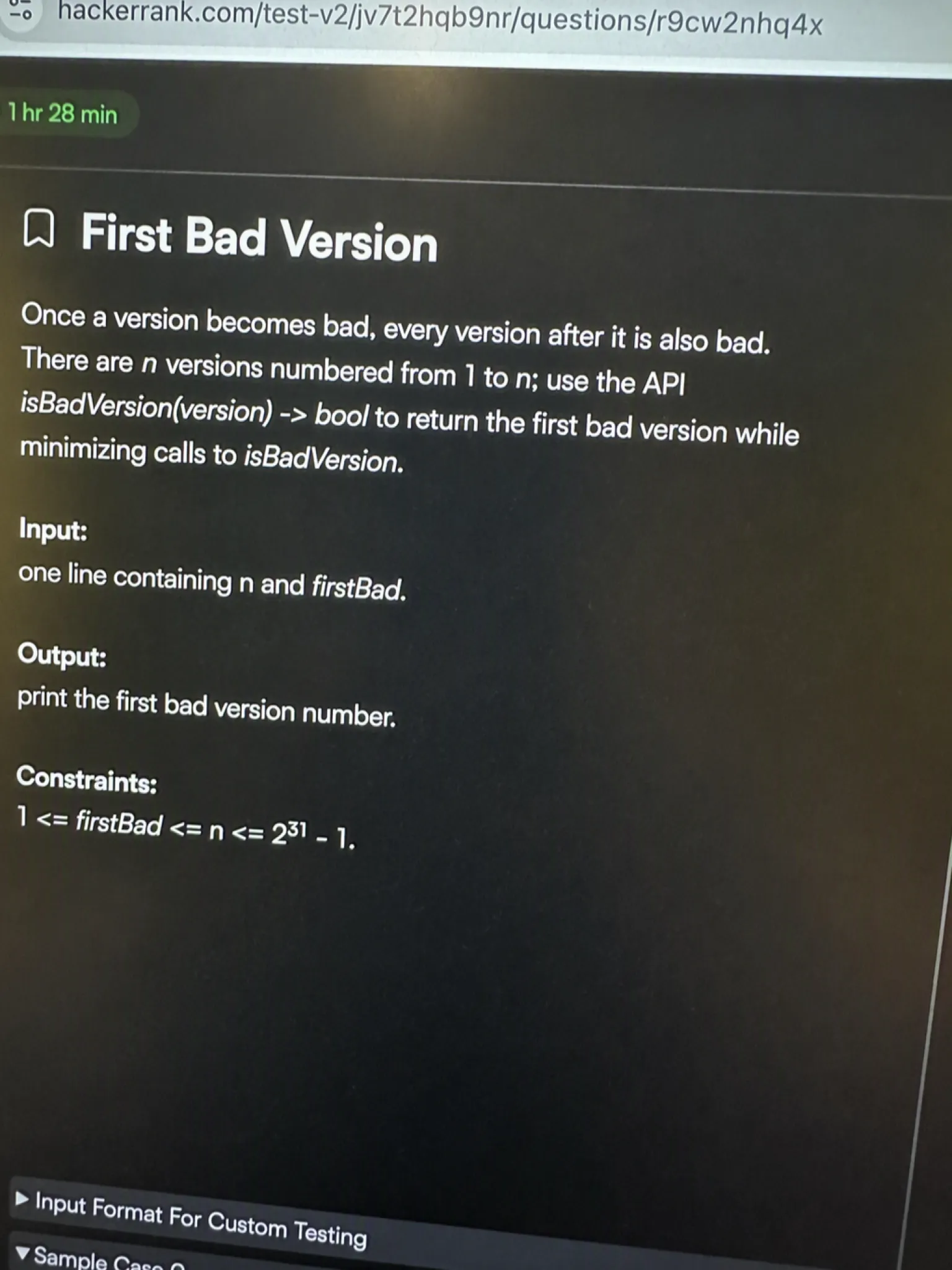
The problem I got: The second task was the version-history search. There were n versions numbered 1 to n, and the rule was that once a version is bad, every version after it is bad as well. I had to return the first bad version while calling the checker as few times as possible. The checker was already defined for me as isBadVersion(version), returning True or False, and the input was one line with n and the first bad version, with my answer printed as a single integer. The constraint I underlined was 1 <= firstBad <= n <= 2^31 - 1, and the largest case ran all the way up to 2147483647.
My approach: A linear scan from version 1 upward is correct but can call the checker close to n times, and n goes over two billion, so that was out. What opens binary search is the monotone rule itself. If the midpoint version is bad, the first bad version is at that midpoint or earlier. If the midpoint is fine, the first bad version is strictly after it. I kept a window from lo = 1 to hi = n and shrank it until the two pointers met, where they name the first bad version. The bad branch pulls hi down to the midpoint, and the not-bad branch pushes lo up to the midpoint plus one, which is the detail my first draft got wrong. For the midpoint I wrote lo + (hi - lo) // 2. Python integers do not overflow, but that form is what my hands reach for after C and Java, and the top of this range sits right at the 32-bit signed limit.
import sys

def main():
    data = sys.stdin.buffer.read().split()
    if not data:
        return
    n = int(data[0])
    first_bad = int(data[1])

    def isBadVersion(version):
        return version >= first_bad

    lo, hi = 1, n
    while lo < hi:
        mid = lo + (hi - lo) // 2
        if isBadVersion(mid):
            hi = mid
        else:
            lo = mid + 1
    print(lo)

main()
Time complexity: O(log n) calls to isBadVersion | Space complexity: O(1)
My first version pointed the lower bound at the midpoint itself instead of the position after it, so with only two versions left the window stopped shrinking and the loop hung. The sample kept passing while a hidden test kept failing, and that one boundary cost me close to fifteen minutes I could not get back.
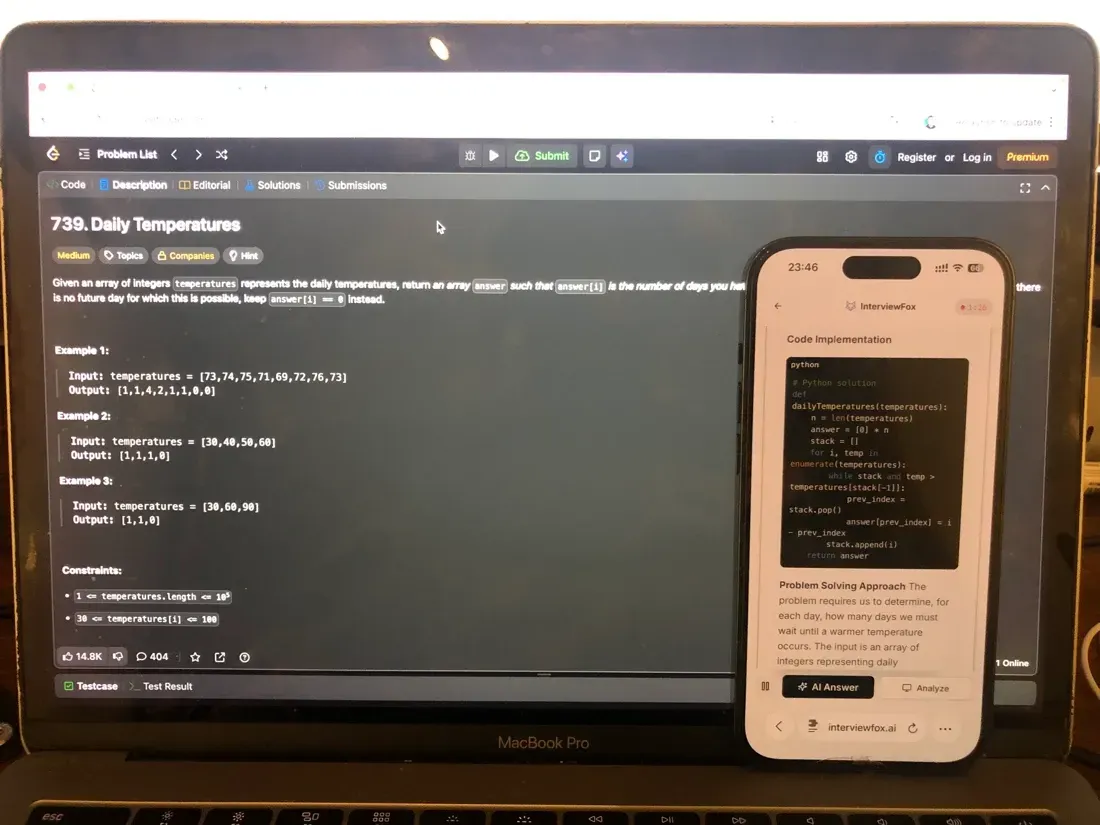
Fifteen minutes in, I had already ruled out a desktop overlay, because its answer would sit on the same screen HackerRank's proctoring was monitoring. I hit the keyboard shortcut, the tool captured the editor and pushed its read of the boundary to my phone, a device outside the platform's screenshot monitoring. The approach was clear inside a minute, and the laptop screen stayed on the editor the whole time.
Land offer with Safer AI Interview Assistant
Skip the risky invisible apps. Our dual-device mode keeps it simple and undetectable. You crush the interview, we handle the answers.
Get started. It's freeLoved by 100,000+ candidates
Qualcomm's Proctoring Policy for HackerRank
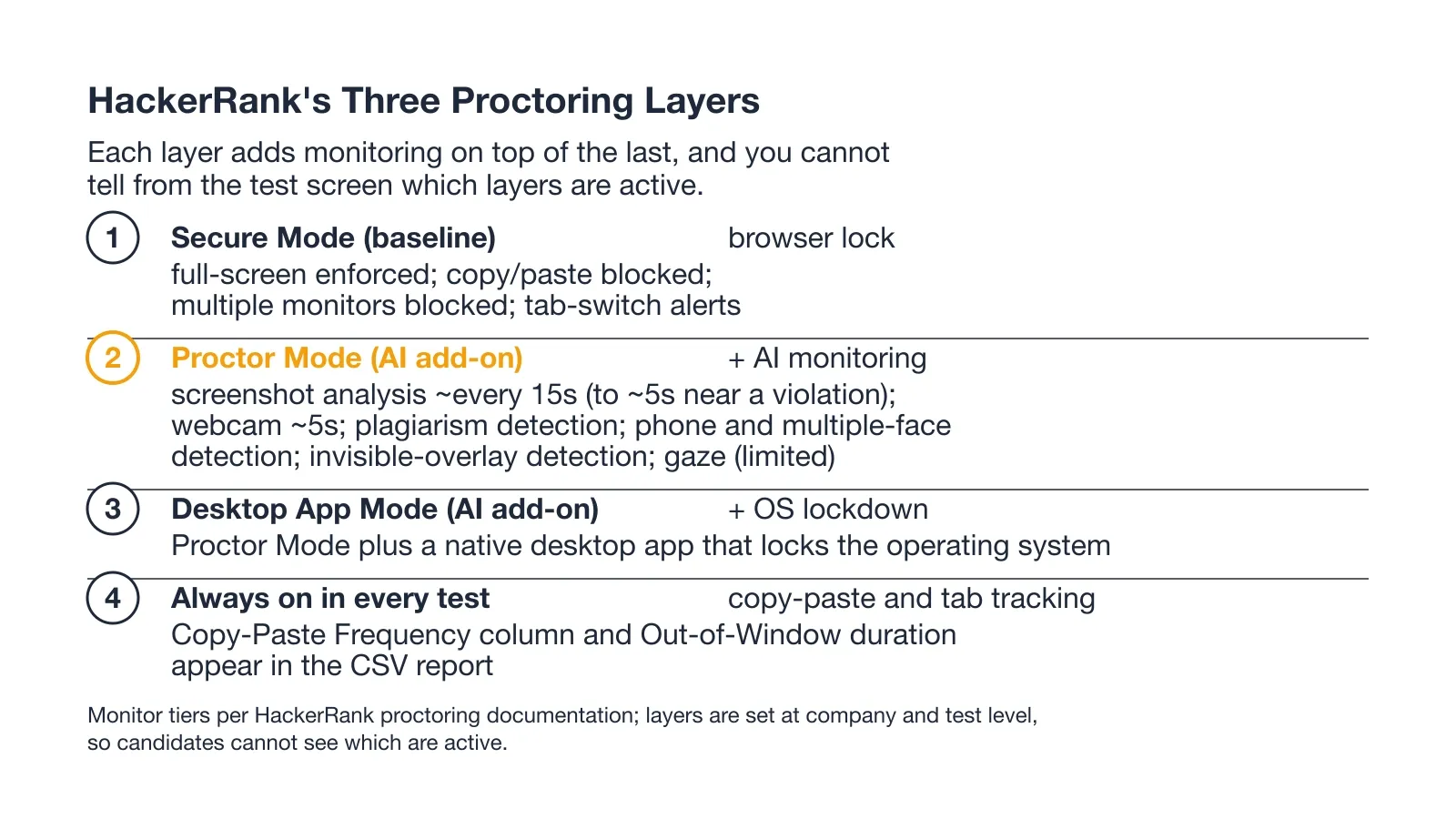
Qualcomm's HackerRank test runs inside HackerRank's own integrity stack, and that stack has three layers. The chart below lays them out in the order they stack, with the AI add-on in the middle.
I could not tell from my own test screen which layers were switched on. HackerRank enables them at the company level and again at the test level, so the interface looks identical either way.
The Three Proctoring Layers You Cannot See
Secure Mode is the baseline. The browser locks to full-screen, and the platform blocks copy and paste. It blocks additional monitors, and switching tabs raises an alert.
Proctor Mode adds the AI layer on top. It covers screenshots, webcam images, plagiarism checks, and phone or multiple-face detection. Conversation detection and limited gaze tracking are part of the same layer.
Desktop App Mode is the third layer. A native application locks down the operating system itself, so the platform sees more than the browser alone.
Secure Mode blocks a paste before it reaches the editor. HackerRank also logs a Copy-Paste Frequency column in the report the recruiter receives. The HackerRank copy-paste detection breakdown explains how that column fills up.
The tab-switch alert is only the visible half of that control. HackerRank also records the time spent outside the test window. The HackerRank tab-switching detection breakdown covers how that record is built.
Screenshot Analysis Flags Invisible Overlays
HackerRank's Proctor Mode documentation names overlay tools directly: "specialized browser extensions or invisible overlay applications that assist in answering coding questions." That clause covers most hidden-app setups.
The same page records the capture cadence. Screenshots land roughly every fifteen seconds, tightening to about five seconds near a violation. Webcam images run roughly every five seconds.
The HackerRank Proctor Mode capture documentation covers that cadence.
Seeing the capture cadence is what makes a session replay worth understanding. The HackerRank screen recording and screenshot capture breakdown covers the replay.
Qualcomm's Policy Bans AI Tools Outright
Qualcomm bans any AI tool, bot, or LLM used to generate answers or complete an assessment. It also bars recording or transcribing in any form, including browser extensions. Disqualification is the stated consequence.
Qualcomm also reserves the right to verify identity at any stage, per its interview policy on AI tools.
That company rule sits on top of a broader platform question. Beyond the overlay case, the HackerRank cheating detection overview maps the rest of the signal set.
What Qualcomm's HackerRank Test Format Actually Looks Like
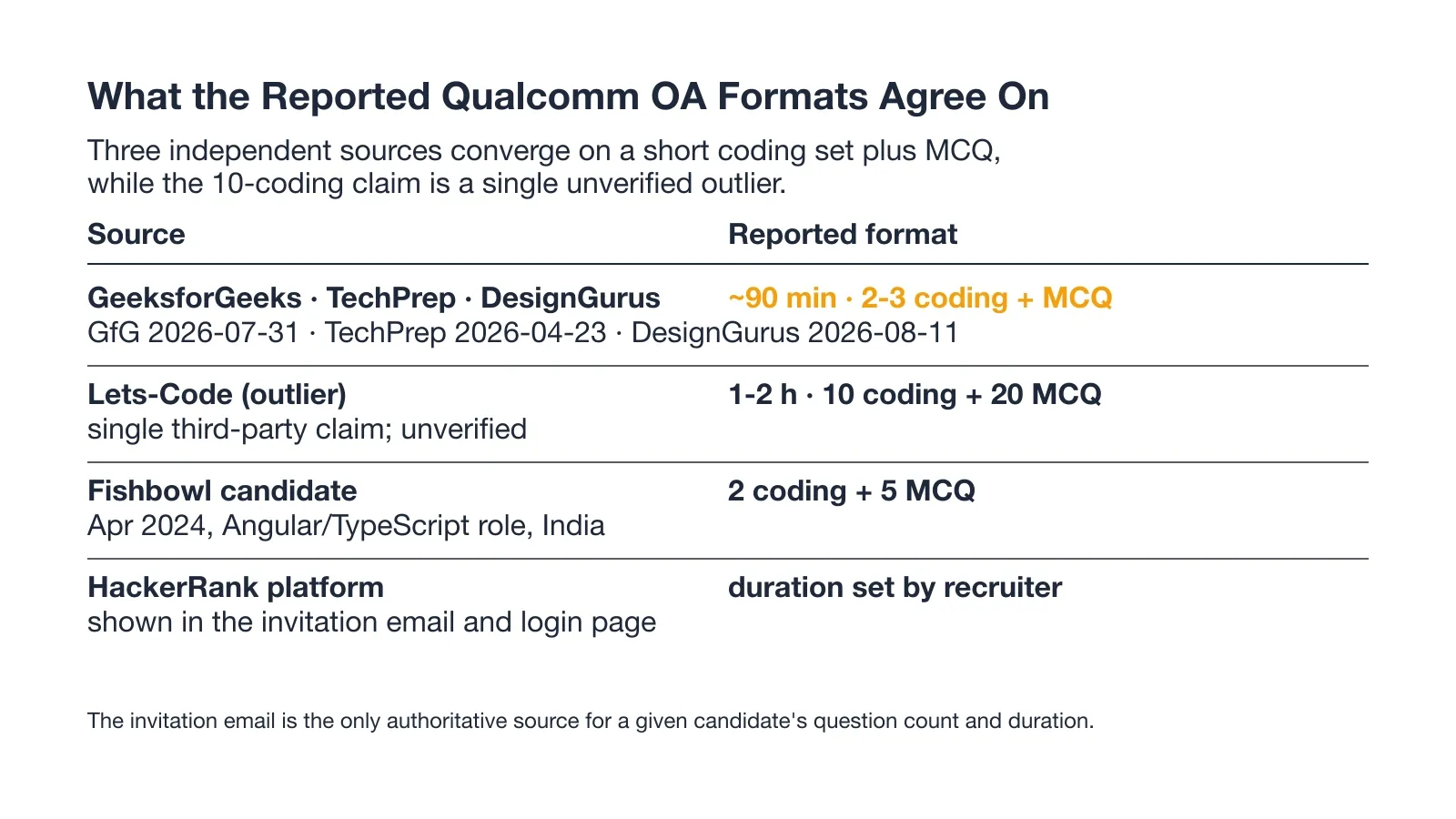
The reported software format is 2 to 3 coding problems plus an MCQ section. It runs inside a 60 to 90 minute window, and the chart below collects what the independent sources agree on. The chart also marks the one outlier.
MCQ coverage is where the format is most stable. Its domains follow the role rather than the window.
Question Count, Time Limit, and MCQ Sections
Across every account, the format is 2 to 3 coding problems plus multiple-choice questions, and the sitting runs roughly 90 minutes.
MCQ domains track the role. C and C++, operating systems, networks, and OOP appear across tracks, and hardware roles add digital electronics.
The Invitation Email Is the Only Count That Matters
The lone dissenting number is 1 to 2 hours with 10 coding problems and 20 MCQs, and nothing else supports it.
HackerRank lets the recruiter set the duration, and the login page displays it next to the question list. The invitation email is the only count that describes the test in front of you. No published count matches the one I received, which is a fair warning against treating any number as fixed.
Link Expiry and No Platform Rescheduling
HackerRank does not reschedule tests. Only the hiring company manages a reschedule. An expired link needs a fresh invitation, so a missed window becomes a recruiter conversation.
The test also requires a PC or laptop running a current Chrome or Firefox build. Mobile devices are unsupported.
How Qualcomm's HackerRank Scoring Works
Scoring is where the public record runs out. HackerRank grades each submission with test cases. The platform passes a result to the recruiter, not a number to the candidate.
Hidden Tests Decide the Score You Never See
HackerRank runs a visible sample set and a hidden set the candidate never sees. The hidden set exists to defeat hard-coding. A sample-tuned solution can clear every example and still score zero.
Failing hidden inputs are never shown, which is why a long debug session gives no signal about what broke.
No Public Qualcomm Cutoff Exists
No public Qualcomm HackerRank score, percentile, cutoff, or pass threshold exists in any source I could find. The percentile table that circulates under Qualcomm's name describes the pre-2019 HirePro written test, not this assessment. That older format is not a usable bar, and nothing more specific is published.
Why Candidates Fail the Qualcomm HackerRank Assessment
Four failure modes recur across the Qualcomm HackerRank material, and they are not all about coding skill. The first is the one that ends the attempt outright.
A Forbidden-App Banner Ended One Candidate's Attempt
At least one candidate was flagged for keeping a hotkey-activated invisible app open during a late February 2026 assessment. During a hidden-test debugging pass, a forbidden-application banner appeared before the editor locked. The attempt ended before submission, and no score was issued.
That result was structural, not bad luck. An invisible overlay draws its output on the same screen the proctoring system captures. The hiding is a basic OS-layer trick, so the answer and the monitoring share one surface. InterviewFox works differently. The answer goes to my phone, a separate device no screenshot can reach by design.
Land offer with Safer AI Interview Assistant
Skip the risky invisible apps. Our dual-device mode keeps it simple and undetectable. You crush the interview, we handle the answers.
Get started. It's freeLoved by 100,000+ candidates
Weak OS Knowledge Sinks Strong Coders
Weak operating-system knowledge is one of the most common reasons for rejection even when coding skills are solid. That is a specific claim about the MCQ section, not a general warning. Qualcomm's software surface sits close to the hardware, so scheduling, paging, and deadlock questions carry real weight.
Brute Force Passes Samples, Fails Hidden Tests
As the scoring section above explains, the hidden set is what separates a passing sample run from a graded score. Brute force is the pattern that runs straight into it.
Running Out of Time Before the Second Problem
One 2024 Qualcomm HackerRank candidate for an Angular role cleared the first task. Every test case passed, and so did the five MCQs. That candidate never submitted the second coding task, because time ran out.
The role is not classic software engineering, so I treated it as a shape signal. The second problem is still where the clock runs out.
How to Prepare for the Qualcomm HackerRank in 7 Days
I built the seven days below from the confirmed question shapes, the named rejection cause, and HackerRank's own prep guidance. In the days before the test, I sent the two confirmed Qualcomm question patterns to the InterviewFox Prep Agent. It answered over WhatsApp with a personalized drill plan and an MCQ strategy, and I folded both into the same week.
Days 1-2: Solve the Two Confirmed Question Shapes Cold
Two questions in the Qualcomm pool are fully specified: a tree diameter problem and a first-bad-version binary search. Both are implementable cold, so the first two days went to writing each from scratch with no hints.
I used an overflow-safe midpoint and an iterative traversal. A chain of 10^5 nodes breaks a recursive DFS under the clock. The check was mechanical: each solved in under fifteen minutes with the boundary cases passing. Those cases included a single-node tree and the top of the 2^31-1 range.
I skipped advanced dynamic programming, segment trees, and hard graph theory. The confirmed Qualcomm set is two coding problems plus MCQ inside a roughly 90 minute window. No design round exists, so that breadth spends preparation where the test does not score.
Days 3-4: Close the OS and C/C++ MCQ Gap
The named rejection cause is weak operating-system knowledge. The middle two days went to multiple-choice drilling, not more algorithms. I worked 60 mixed questions across CPU scheduling, paging, deadlock, C and C++ storage classes, pointers, and vtables.
The check was a score, not a feeling. I aimed for at least 85 percent on a timed mixed set, then rewrote every miss from memory the same day.
Days 5-7: Run One Full Proctored Mock
The last three days went to one full mock inside a single roughly 90 minute window with the full-screen lock on. I ran both confirmed question shapes and the mixed MCQ set back to back under the same clock. The proctored window cannot be paused, so that constraint had to be rehearsed rather than read about.
The check was completing the mock inside the window with every sample passing and no second device open.
I skipped system design, low-level design, and broad LeetCode-tag grinding. Qualcomm's OA is coding plus MCQ only, so that breadth spends the seven days where the exam does not score.
What Happens After You Submit the OA
Submission is the start of the hiring process proper, and the timeline runs longer than the test itself.
From Submission to the Recruiter Screen
Qualcomm's process of record runs apply, recruiter contact, interview, offer, and onboarding. A recruiter follow-up can take longer than a few days.
The process starts with a recruiter screen, then a technical screen. A loop of three or four rounds follows, then HR, and the whole sequence runs several weeks.
Post-OA Timelines Run Several Weeks
A 2024 internship timeline started with an early-October application and an OA. Two 45-minute interviews followed in late October and early November. The offer arrived about three weeks after that.
I found no published cooldown or second-attempt policy for the HackerRank assessment. The first sitting is the only confirmed one.
FAQ
How many questions are on the Qualcomm HackerRank OA?
The reported software format is 2 to 3 coding problems plus an MCQ section. My invitation listed two coding problems and an MCQ set. HackerRank shows the exact question list on the login page, so the invitation email is the authoritative count.
How long is the Qualcomm HackerRank test?
The window runs about 60 to 90 minutes for the software track. The recruiter sets the exact duration, and HackerRank displays it on the login page and in the invitation email. There is no pause, and a single outlier source claims 1 to 2 hours with a much larger question count.
Can I use an AI tool or a second device during the Qualcomm HackerRank OA?
Desktop overlay tools render the answer on your computer screen, hidden above the browser by a basic OS-layer trick. HackerRank keeps adding detection capabilities as AI tools spread, so that exposure is not fixed.
InterviewFox uses a dual-device design instead. The answer goes to your phone, a device no screenshot or session monitoring can reach. The laptop screen stays on the exam editor. If you're going to use AI assistance during the OA, the dual-device architecture removes the answer from your screen entirely.
Land offer with Safer AI Interview Assistant
Skip the risky invisible apps. Our dual-device mode keeps it simple and undetectable. You crush the interview, we handle the answers.
Get started. It's freeLoved by 100,000+ candidates
What score do I need to pass the Qualcomm HackerRank OA?
No public Qualcomm cutoff, percentile, or pass threshold exists. HackerRank runs visible and hidden test cases and reports a pass or fail result to the recruiter. The percentile table that circulates under Qualcomm's name belongs to an older written-test format, so it is not the bar.
Does the Qualcomm HackerRank OA use a webcam?
It can. Secure Mode is the baseline, and the optional Proctor Mode add-on captures webcam images roughly every five seconds. Proctor Mode also includes multiple-face and phone detection. A second person in frame is a signal the platform records.
Can I retake the Qualcomm HackerRank test?
No retake or cooldown policy is published. HackerRank does not reschedule tests on its own, and only Qualcomm can issue a new invitation after a link expires. A second attempt depends on the recruiter, so the first sitting is the only guaranteed one.