
I Aced Revolut HackerRank in 2026: Real Questions and Prep

Quick Facts
| Test | Revolut ops analytical test on HackerRank, graduate and analytical tracks |
| Format | One 60-minute sitting: probability and statistics items plus one SQL task |
| Interface | HackerRank code editor with a visible Run Code button |
| Proctoring | HackerRank sells Secure, Proctor, and Desktop monitoring modes; Revolut's settings are undisclosed |
| Scores | Never shown to candidates; results arrive as contact, rejection, invalidation, or silence |
| Retakes | A failed attempt typically means waiting before reapplying |
I took the Revolut ops analytical test on HackerRank in late June 2026. I was a new grad with about 120 LeetCode problems done and OAs pending at five other companies. It was one 60-minute sitting: probability and statistics items first, then a single SQL analytics task, submitted with five minutes to spare.
The SQL task nearly broke the hour. My first query passed the sample case and failed every hidden case on a tied-maximum rule. It cost me ten minutes. With five left, I checked the stuck problem against an AI interview copilot. That pointed me to the ranking fix, and I locked in the final query.
Before my test, I went through every Revolut HackerRank post from the past two years. I checked Reddit, LeetCode Discuss, and Teamblind. What I found tracks closely with what I experienced. The sections below cover the mistakes that get people flagged, rejected, or ignored, starting with the questions themselves.
The Real Questions on My Revolut HackerRank Test
My invite was for the ops analytical track: one 60-minute HackerRank test, statistics first, then a SQL task. Here is exactly what the two sections put in front of me.
Question 1: Probability and Statistics Problems
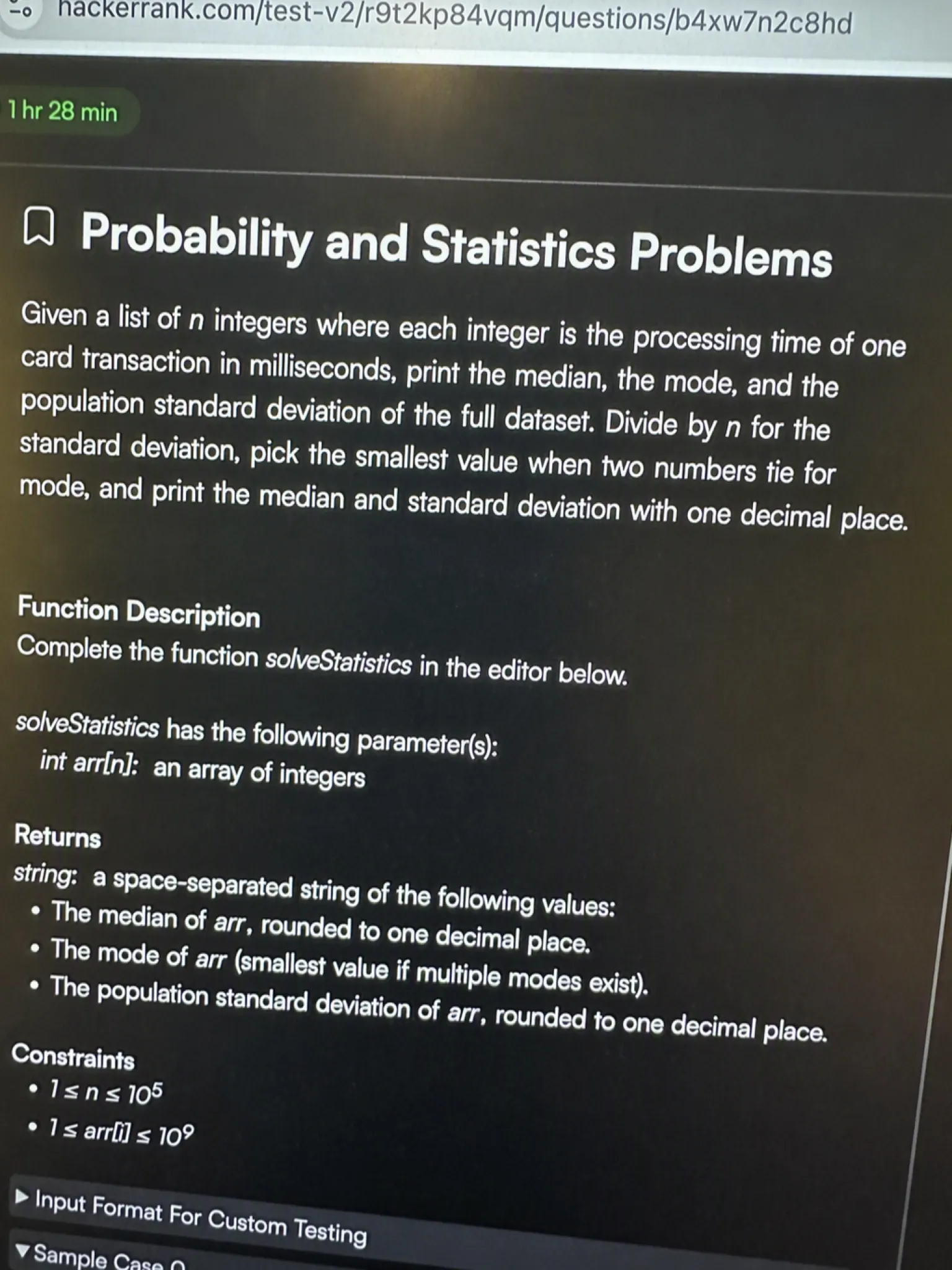
The problem I got: a list of n integers, where each integer was the processing time of one card transaction in milliseconds. The task was to print three summary values for the full dataset: the median, the mode, and the standard deviation. The statement pinned down the details that decide the answer. It wanted a population standard deviation, dividing by n instead of n minus 1, and it wanted the smallest value whenever two numbers tied for mode. Median and standard deviation were to come out with one decimal place.
My approach: sorting came first, because the median falls straight out of a sorted array and the even-length case is the real trap. With an even count, the median is the average of the two middle elements, and muscle memory from practice drills defaults to the odd version. For the mode I counted values with a hash map, took the maximum frequency, then picked the smallest value carrying it. Standard deviation was three steps: compute the mean, average the squared distances from that mean, take the square root. The denominator is the one spot I tend to slip, since the sample formula divides by n minus 1, so I reread the statement twice before submitting.
import math
from collections import Counter

n = int(input())
values = sorted(int(x) for x in input().split())

if n % 2 == 1:
    median = values[n // 2]
else:
    median = (values[n // 2 - 1] + values[n // 2]) / 2

counts = Counter(values)
top_frequency = max(counts.values())
mode = min(v for v, c in counts.items() if c == top_frequency)

mean = sum(values) / n
variance = sum((x - mean) ** 2 for x in values) / n

print(f"{float(median):.1f}")
print(mode)
print(f"{math.sqrt(variance):.1f}")
Time complexity: O(n log n) | Space complexity: O(n)
About twelve minutes gone. I wrote the odd-length median branch first, caught the missing even case on my second read, fixed it, and got the green check beside the Run Code button before moving on.
Question 2: SQL Analytics Task
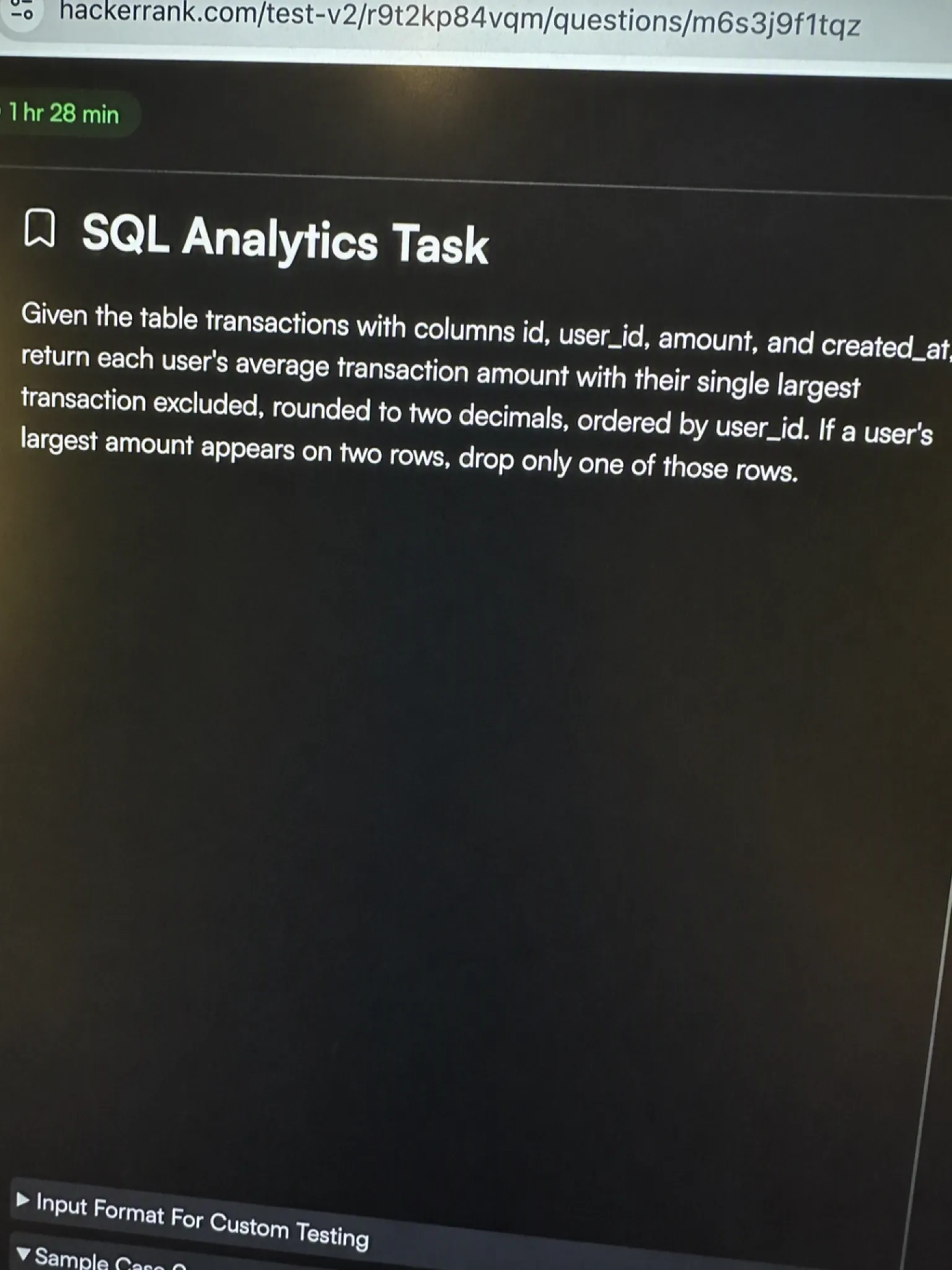
The problem I got: one table called transactions with columns id, user_id, amount, and created_at. The ask was to return each user's average transaction amount with their single largest transaction excluded, rounded to two decimals, ordered by user_id. One clause in the statement mattered a lot: if a user's largest amount appeared on two rows, only one of those rows should drop out.
My approach: my first draft grouped by user and filtered out rows matching each user's MAX(amount) in a subquery. It passed the sample case and failed the hidden ones, because a user with two tied maximums lost both rows when the statement allowed dropping only one. The fix was to rank instead of filter: ROW_NUMBER partitioned by user_id, ordered by amount descending, keep ranks above 1, then aggregate what remains. Which duplicate lands on rank 1 is arbitrary when amounts tie, but the surviving set is identical either way, so the average does not move. I knew the window-function route existed; I just reached for it one failed submission too late.
WITH ranked AS (
    SELECT
        user_id,
        amount,
        ROW_NUMBER() OVER (
            PARTITION BY user_id
            ORDER BY amount DESC
        ) AS rn
    FROM transactions
),
kept AS (
    SELECT user_id, amount
    FROM ranked
    WHERE rn > 1
)
SELECT
    user_id,
    ROUND(AVG(amount), 2) AS avg_amount_ex_top
FROM kept
GROUP BY user_id
ORDER BY user_id;
Time complexity: O(n log n) | Space complexity: O(n)
This is where the hour went bad: the failed filter-first attempt ate roughly ten minutes, and I locked in the final query with about five left on the clock.
What that moment actually looked like: I deliberately stayed away from the desktop overlay route, because having watched how the June invalidation played out for another candidate, I did not want the answer sitting on-screen where every monitoring tier looks. Instead I ran the shortcut on my real time AI interview assistant, which auto-captured the stuck SQL task and pushed the worked approach straight to my phone, a separate device outside the platform's screenshot monitoring. The ranking fix was clear within a minute of reading it there, and my laptop screen never showed anything but the editor.
Land offer with Safer AI Interview Assistant
Skip the risky invisible apps. Our dual-device mode keeps it simple and undetectable. You crush the interview, we handle the answers.
Get started. It's freeLoved by 100,000+ candidates
Revolut's Proctoring Policy for HackerRank
Before interpreting anything, here is what the platform can see. HackerRank ships monitoring in three tiers, and the employer picks the tier per test. Its base Secure Mode locks the test full screen, blocks copy and paste, prevents multiple monitors, and alerts on every tab switch.
The higher tiers stack on top of it:
- Proctor Mode adds screenshot analysis, plagiarism detection, and webcam anomaly detection.
- Desktop App Mode adds operating-system-level monitoring for a fully locked-down environment.
- Full-screen exits record themselves into the candidate report automatically, and hiring managers can replay an answer keystroke by keystroke.
The AI layer. On top of the modes sits an AI plagiarism model. It reads code writing patterns, solve time, copy-paste activity, and tab-switching behavior. Recruiters then see advisory flags rated High or Medium, with 85 percent flag precision. The model only watches coding questions, and consent is required wherever it runs.
Do those signals combine into one overall cheating verdict? One guide walks that chain step by step. How HackerRank detects cheating across modes, models, and replays covers each step in order.
Paste blocking deserves a second look for this test specifically, because a SQL section tempts pasting more than anything else. The blocked keys are only the visible half. Whether HackerRank detects copy and paste covers what else gets logged when someone tries.
The assistant dial. Which of these features Revolut actually switched on is not publicly documented. Revolut's own career content walks candidates through its interview process without mentioning an online assessment at all.
The built-in AI assistant is likewise a per-test dial. It ranges from freely interactive to a guarded mode. That mode helps with syntax and navigation but stops short of complete solutions.
Keep that capability list in mind. It is the exact context that explains how an overlay user collects a warning banner mid-test, told in full in the failure section below.
6 Other Confirmed Revolut HackerRank Questions
My two slots were not the whole question bank. Six more prompts survive from one candidate's published account of a Revolut HackerRank sitting on an APM-adjacent analytical track. None of it carries a date, so treat the phrasing as possibly a cycle old; every item still lands inside the two families my own sitting confirmed.
Math reaches non-engineering tracks too: a technical-recruiter candidate's HackerRank test mixed mathematical formulas in alongside Boolean-search questions.
Standard Deviation Computation Inside the HackerRank
The candidate's first named item computes a standard deviation outright. The trap is the denominator, since the population formula divides by n and the sample formula divides by n minus 1.
My Question 1 above already solves this exact computation with runnable code. The same steps apply here at O(n) with running sums, or O(n log n) if sorting comes first.
Tricky Median and Mode Question
Second on the same list pairs a median with a mode and calls it tricky. The difficulty lives in the edge cases, which match what my Question 1 drilled. Even-length medians average the two middle values. Tied modes go to the smallest value. No separate algorithm exists for this one; the hash-map count covers it.
Estimating How Many Users Revolut Has
Third comes an estimation prompt, and no code attaches to it because none is wanted. The graded skill is structure. Start from any customer figure Revolut has stated publicly. Apply a growth assumption, then sanity-check the result against something independent, such as revenue per user. Writing the assumptions into the answer matters more than landing the exact number.
Shortening Delivery Time for Some Countries
Fourth, a product-operations prompt about cutting delivery times for select countries. A working answer segments the map first. High-volume countries justify local hubs or alternate courier contracts. Low-volume ones may only warrant adjusted delivery promises at checkout. Every proposal should tie back to cost per delivery so the tradeoff stays explicit.
Cost of an International Transfer Versus a Regular Bank
Fifth, a fintech estimation prompt comparing international transfer costs. The honest skeleton has three layers. Correspondent banks charge per hop. Traditional banks widen the exchange-rate spread. A multi-currency operator holds balances in both currencies and skips the middlemen. Estimating each layer separately beats guessing one blended fee.
Convincing a Friend to Join Revolut
Sixth is a motivation-fit prompt, testing product empathy rather than arithmetic. Strong answers run through one concrete personal moment, a specific fee avoided or feature used, instead of a feature tour. It doubles as an enthusiasm check at a company that openly prizes entrepreneurial flair.
What Revolut's HackerRank Test Format Actually Looks Like
The invite arrives by email with a login link. My sitting ran as one continuous 60-minute block: statistics items first, then the SQL task, with no separate sections on screen.
The only published description matching this shape says the same thing. It describes a 60-minute HackerRank OA combining probability-and-statistics math with SQL coding. I treated it as my anchor, and it held.
The interface itself was plain HackerRank. It had a problem panel beside a code editor and a language selector. A Run Code button executed against the visible test cases. That button matters later in this story, so note where it sits.
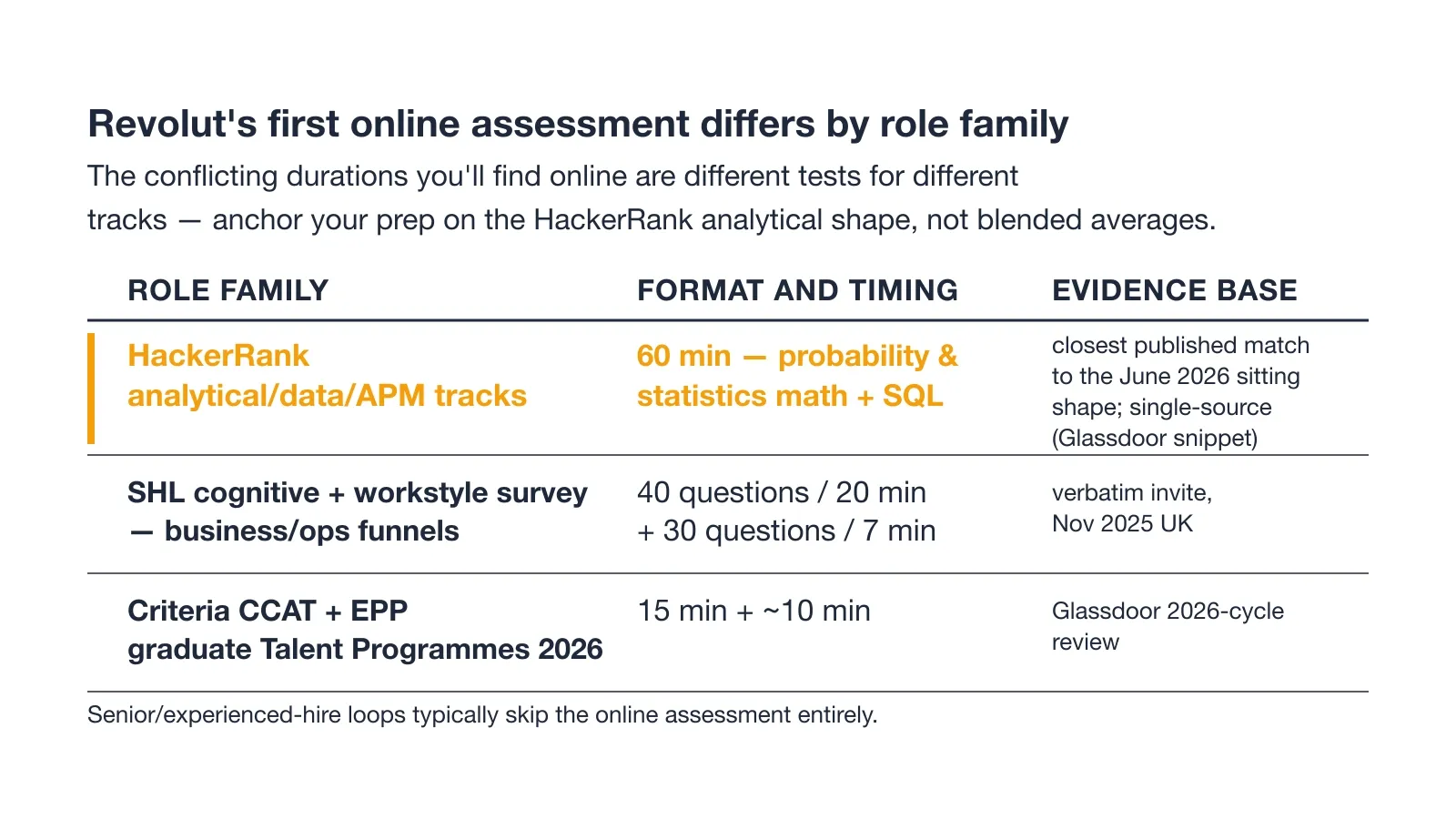
The 30-, 85-, and 90-minute figures floating around other guides are real numbers for different tests, as the chart above shows.
Business and operations funnels get an SHL cognitive screen. It runs 40 questions through 20 minutes plus a shorter workstyle survey. The 2026 Talent Programmes scheme used Criteria's 15-minute CCAT with a personality test attached. Senior and experienced-hire loops usually skip the online assessment entirely.
One number nobody has published is the completion window. Claims about a seven-day link expiry and 48-hour scheduling circulate on prep sites with nothing verifiable behind them. I sat the test promptly and treated the deadline stated in my own invite email as the only real number.
How Revolut's HackerRank Scoring Works
Start with what the employer sees, because it is not a score. Recruiters receive a candidate report where the AI plagiarism model contributes advisory flags rated High or Medium, backed by 85 percent flag precision on the signals it watches.
Those flags classify how suspicious an attempt looks for reviewer attention; nothing on the employer side announces a passing grade.
Candidates see none of it. No documented path, passing or failing, has ever shown anyone a numeric score before or after a Revolut online assessment. The outcome travels only four ways: an invitation to the next step, a rejection, an invalidation, or silence.
A "hard cutoff score" gets quoted on prep sites anyway. No primary source backing that claim has surfaced anywhere, and every dated first-person account lines up with the four-outcome picture instead.
| Score shown | Sitting | Outcome |
|---|---|---|
| None | Engineering graduate, HackerRank OA, January 2026 | Passed; hiring-manager interview done, live coding and team rounds next |
| None | Graduate programme OA (Criteria CCAT), Talent Programmes 2026 | Cleared; rejected 1-2 days after the HR screen, no feedback given |
| None | Graduate aptitude assessment, 2024 (historical) | Completed; no result ever communicated |
| Advisory flags only (High/Medium) | HackerRank reporting layer, 2026 | Recruiter-side suspicion ratings, never a candidate-visible score |
Why Candidates Fail the Revolut HackerRank Assessment
Two failure modes dominate everything I found, and they fail different people for opposite reasons: loud invalidation and quiet administrative silence.
Overlay AI Tools Get Flagged and Void the Assessment
At least one candidate sitting this same test in June 2026 mapped a floating answer widget to a keyboard shortcut. On the second overlay hotkey press, a warning banner appeared after the overlay briefly covered the Run Code button. The assessment was marked invalid. An interview the candidate had already scheduled was withdrawn.
The platform-side machinery explains the catch without any mystery. Focus and tab tracking logs every departure from the test window. The plagiarism model times keystrokes and pastes against expected solving cadence. Full-screen exits record themselves automatically. A widget flashing over the Run Code button trips at least two of those wires at once.
Reading a banner correctly starts with knowing the tripwire, and what HackerRank registers when you switch tabs spells out the alert conditions event by event.
Publicly, almost nobody documents this ending. Dated first-person accounts of a voided Revolut HackerRank sit nowhere I could find. Partly because the people affected lose the interview and move on quietly. The mechanism is verifiable, and the warning-banner account above matches it step for step.
The structural trap. An overlay renders the AI's answer on the same computer screen the proctoring software monitors. A basic OS-layer trick keeps the window out of visible view while leaving it physically on-screen.
InterviewFox is built on the opposite architecture: a dual device AI interview tool puts the answer on your phone, a physically separate device no screenshot, screen recording, or session monitoring can reach, because the answer never renders on the monitored machine at all.
That is a difference in where the answer lives, not a marginally lower chance of getting caught. It is the observation that decided how I handled my own sitting.
Land offer with Safer AI Interview Assistant
Skip the risky invisible apps. Our dual-device mode keeps it simple and undetectable. You crush the interview, we handle the answers.
Get started. It's freeLoved by 100,000+ candidates
Quiet Rejections Arrive With No Score and No Feedback
The quieter mode is administrative. In the 2026 Talent Programmes cycle, one candidate cleared the online assessment. They sat an HR screening call one to two weeks later. The rejection landed within two days of that call. Feedback was explicitly requested and explicitly not given.
Silence has a history too. A 2024 graduate candidate completed a Revolut aptitude assessment. They emailed the recruiter the following Monday and never received a reply. The passing-score question went unanswered as well. That account sits outside the last twelve months, labeled historical, but nothing found since suggests the pattern changed.
The asymmetry is the point. A pass moves forward within weeks; a fail produces a form letter at best and typically a waiting period before reapplying. No branch of the outcome tree ever surfaces a number that says what to fix.
How to Prepare for the Revolut HackerRank in 7 Days
Seven days is enough if each day maps to a confirmed component of this test. The plan below runs on the two evidenced question families, the 60-minute cap, and the monitoring discipline my own sitting proved unforgiving.
Part of that schedule came together with the Prep Agent from InterviewFox. In the days before the OA, I sent it the confirmed Revolut question patterns over WhatsApp. It returned a personalized drill plan and pacing strategy that shaped the seven days below. Useful, but only one practical tool among others. The timed reps were still mine to sit.
Days 1-2: Timed Probability and Statistics Reps at a 60-Second-per-Item Cap
Statistics is the most consistently evidenced family on this test. Named standard deviation and median-mode instances come from a real sitting. So it takes the first two days.
I drilled three shapes against a 60-second cap per item. They were standard deviation computations. Also median-and-mode combinations with tie-breaking, and estimation prompts shaped like the users-count, delivery-time, and transfer-cost items above.
The cap borrows from Revolut's cognitive screens on other tracks, which push 40 questions through 20 minutes. Tighter than strictly needed per item, which is exactly the point.
I skipped grinding named LeetCode problems for this test entirely. The problem-name lists circulating for Revolut trace to unattributed aggregations of the SWE coding track. That is a different role family with a different test.
System design and take-home prep got skipped too. Every loop account places those stages after the OA. Experienced-hire loops skip this gate altogether.
The bar I set: ten representative items solved inside ten minutes, better than 80 percent correct, two days running. Missing the bar meant shrinking the item pool, not extending the timer.
Days 3-5: SQL Drills on Payments Data Plus the Official Sample Test Walkthrough
SQL is the second confirmed family. The transaction-shaped table in my Question 2 is the right practice surface. It means joins and aggregations over payment schemas, daily, until the patterns feel boring.
One habit entered the routine after a tied-maximum clause cost me ten minutes. Read the full task statement twice before writing a single character. Hunt for the line that breaks the obvious solution.
Mid-window I walked the official sample test linked from the test-login instructions, full screen. I checked input and output handling and custom test cases the way the platform's own guidance advises. HackerRank also runs free preparation kits on its site, and the invite email remains the only place a real completion window ever appears.
Success looked mechanical. One join-plus-aggregation query was written correctly in under ten minutes without schema hints. One sample test completed with nothing left in the interface that could surprise me.
Days 6-7: Full Simulation Under Monitoring Discipline With Zero Overlay Events
The last two days rehearse conduct, because one slip erases a passing paper regardless of the answers on it. I reran the sample test under exam rules. Single monitor, phone in another room, browser locked full screen. Zero secondary windows, no widgets or overlays anywhere near the code panel.
Focus losses and full-screen exits record themselves into the report automatically. The simulation counted every one of those events as an instant failure.
Calibration stays realistic. An ordinary graduate candidate passed this OA in January 2026. They reached hiring-manager interviews within the same month. The bar is reachable without heroics. Conduct discipline is what separates a scored submission from an invalidated one.
The success condition: one complete simulated sitting with zero focus-loss or tab events in the report. Both question families finished inside 60 minutes.
What Happens After You Submit the OA
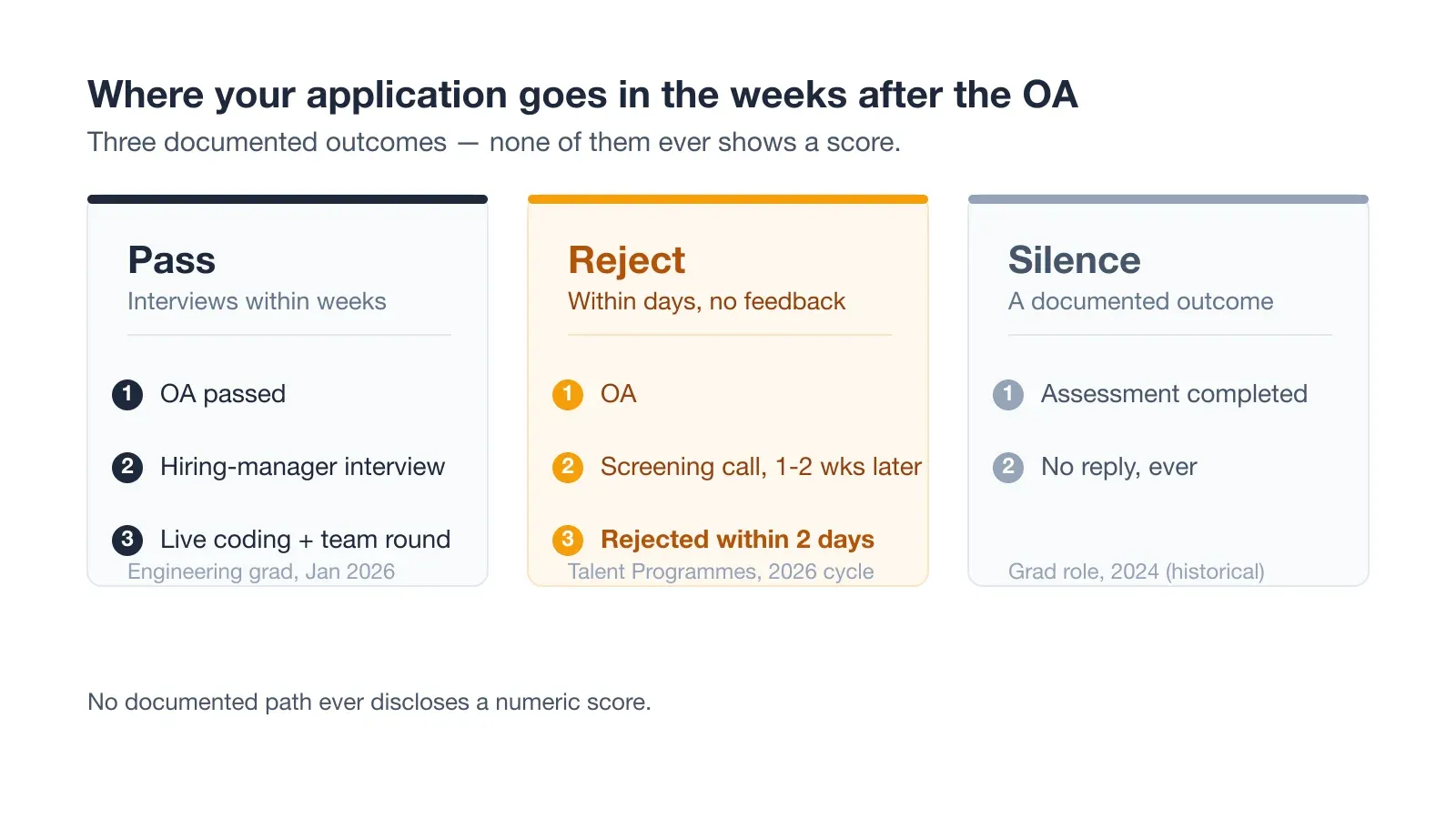
After submit, the process forks fast, and the three branches below are documented with dates rather than blended averages.
Passing Moves You Into Interviews Within Weeks
The pass branch is the fastest documented. One engineering-graduate candidate passed the HackerRank OA in January 2026. They had already completed the hiring-manager interview by the time they posted. Live coding and a team round were still ahead.
A companion post that same month tracked the iOS graduate engineer funnel on the same rhythm. The published funnel order agrees: OA, then an HR personality-fit screen, then live coding, then a final round.
Rejection and Silence Come Without Feedback or Scores
Rejections move faster and say less. The 2026 Talent Programmes timeline runs OA. Screening comes one to two weeks later. Rejection lands within two days of that call, and no feedback is given on request.
The silence branch is older but unretracted: a 2024 graduate candidate completed an aptitude assessment and never heard anything again. The contrast cuts upward too. Experienced hires bypass this gate entirely. 2025 senior-loop accounts begin at recruiter screening plus live coding, with no online assessment anywhere.
FAQ
Does the Revolut HackerRank test have a passing score?
No. No candidate has ever been shown a numeric score on any documented path, before or after the test. Recruiters see advisory plagiarism flags rather than pass marks. The "hard cutoff" claim on prep sites has no verifiable source behind it.
Does HackerRank use a camera during the Revolut test?
It can. Proctor Mode includes webcam anomaly detection, employers pick the mode per test, and Revolut's configuration has never been documented. Whatever the invite email says about proctoring outranks any general guide, including this one.
Can I use an AI tool or invisible app during the Revolut HackerRank OA?
Desktop overlay tools put the AI's answer on your computer screen itself, rendered as a hidden layer through a basic OS-layer trick; the exposure sits on-screen, the hiding is basic, and proctoring software keeps adding detection capabilities, so the risk is not fixed.
InterviewFox takes the opposite structure: it pushes the answer to your phone, a physically separate device no screenshot, screen recording, or session monitoring can reach by design, and your laptop screen stays on the exam editor unchanged. If you are going to use AI assistance during the OA anyway, the dual-device architecture removes the answer from your screen entirely.
Land offer with Safer AI Interview Assistant
Skip the risky invisible apps. Our dual-device mode keeps it simple and undetectable. You crush the interview, we handle the answers.
Get started. It's freeLoved by 100,000+ candidates
Can you retake the Revolut HackerRank assessment?
Not right away. Failing a Revolut online assessment typically means waiting before reapplying, and no public retake policy overrides that.
How long does it take to hear back after the Revolut OA?
Passes travel fastest: the documented January 2026 case reached hiring-manager interviews within the month. Rejections land within two days of the HR screen, and silence is a documented outcome rather than an anomaly. No branch includes a score.
What kind of math is on the Revolut HackerRank test?
Probability and statistics, per the closest published format description and the named items. Standard deviation, median, and mode, plus estimation prompts about users, delivery times, and transfer costs. Calculus never appeared anywhere in the material reviewed for this guide.