
How I Passed Scale AI HackerRank in 2026: Real Questions

Quick Facts
| Assessment Platform | HackerRank (Monaco editor with custom class interfaces) |
| Format & Duration | 2 algorithmic challenges, 50 minutes total |
| Allowed Languages | Python, C++, Java, Go |
| Passing Bar | 100% test cases (all visible and hidden test suites) |
| Primary Focus | Rule-heavy simulations, dynamic priority queues, intervals |
| Next Round | Technical phone screen with a senior infrastructure engineer |
I got an email from Scale AI for their SWE track. The test rules stood out right away. You must solve two coding problems in 50 minutes on HackerRank. Scale AI builds data tools for big AI models. Their technical test checks coding skill and speed under tight time caps.
Prepping for this timed test meant removing all noise. Remote proctoring tools track browser window focus. Running extra apps on your test PC creates big risks. Engineers seeking private real-time guidance can use a dual device AI interview tool. This setup keeps your test laptop clean.
The test loaded directly in HackerRank's Monaco code box. It gave custom class code and input streams. With just 25 minutes per problem, I wrote clean code with strong checks. Here is how I passed, the rules in place, and the code that cleared the bar.
The Real Questions on My Scale AI HackerRank Test
When I started the test, a 50-minute timer ran in the top corner. Specifically, Scale AI gives you two coding problems. You must pass 100% of visible and hidden test runs to get an interview. Here are the two real questions from my test, plus the code I used to pass.
Question 1: Four-Player Trick-Taking Card Game Simulation
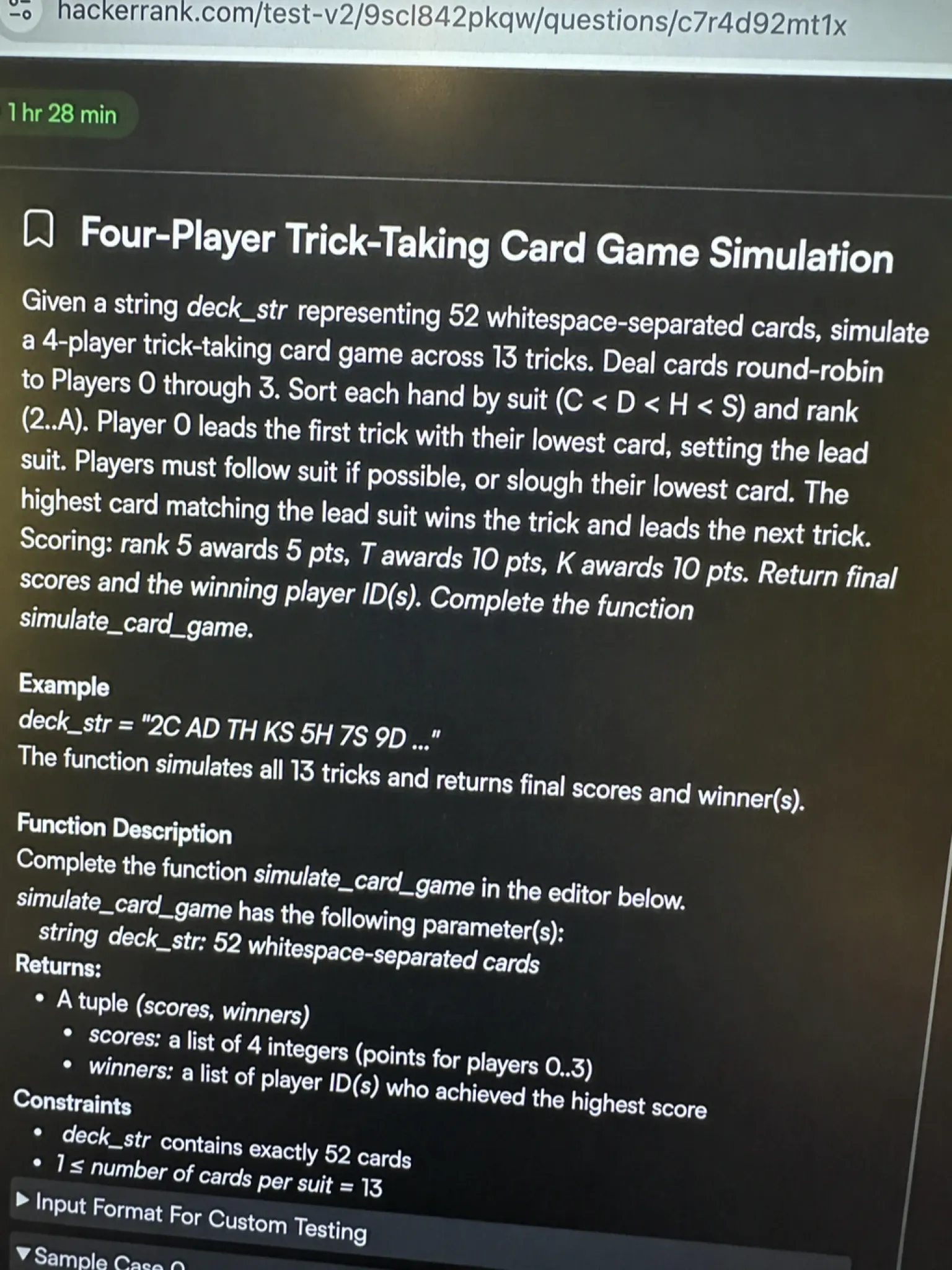
The problem I got: I received a rule-dense simulation challenge requiring me to model a four-player card game engine. The input arrived as a string deck_str containing 52 unique two-character card representations. First, the engine dealt cards round-robin to four players (Players 0 through 3, receiving 13 cards each). Next, each player sorted their hand by suit hierarchy (C < D < H < S) and card rank (2..9, T:10, J:11, Q:12, K:13, A:14).
Game mechanics: The game simulated 13 consecutive trick rounds. Player 0 led the first trick with the lowest card in hand, establishing the lead suit. Remaining players played in clockwise order, following suit with their lowest matching card. Otherwise, void players sloughed their lowest overall card. The highest card matching the lead suit won the trick and earned points from point cards (5:5, T:10, K:10). Finally, the function returned final player scores and ascending winner IDs.
My approach: Monolithic nested loops would make debugging sorting stability impossible under a 25-minute clock. I encapsulated domain logic inside an object-oriented Card model equipped with __slots__ and custom __lt__ comparison. Furthermore, round-robin dealing into sorted lists gave $O(1)$ lowest-card retrieval. Also, filtering trick plays by lead suit cleanly isolated trick winners. Finally, point lookups and tie-breaking resolved through straightforward dictionary mappings and list comprehensions.
from typing import Dict, List, Tuple

# Pre-defined suit hierarchy and card rank values
SUIT_ORDER: Dict[str, int] = {"C": 0, "D": 1, "H": 2, "S": 3}
RANK_ORDER: Dict[str, int] = {
    "2": 2, "3": 3, "4": 4, "5": 5, "6": 6, "7": 7,
    "8": 8, "9": 9, "T": 10, "J": 11, "Q": 12, "K": 13, "A": 14,
}
POINT_VALUES: Dict[str, int] = {"5": 5, "T": 10, "K": 10}


class Card:
    __slots__ = ("code", "rank", "suit", "rank_val", "suit_val", "points")

    def __init__(self, code: str) -> None:
        self.code = code
        self.rank = code[0]
        self.suit = code[1]
        self.rank_val = RANK_ORDER[self.rank]
        self.suit_val = SUIT_ORDER[self.suit]
        self.points = POINT_VALUES.get(self.rank, 0)

    def __lt__(self, other: "Card") -> bool:
        if self.suit_val != other.suit_val:
            return self.suit_val < other.suit_val
        return self.rank_val < other.rank_val

    def __repr__(self) -> str:
        return self.code


def simulate_card_game(deck_str: str) -> Tuple[List[int], List[int]]:
    raw_tokens = deck_str.strip().split()
    if len(raw_tokens) != 52:
        raise ValueError(f"Deck string must contain exactly 52 cards, got {len(raw_tokens)}")

    cards = [Card(token) for token in raw_tokens]

    hands: List[List[Card]] = [[] for _ in range(4)]
    for idx, card in enumerate(cards):
        hands[idx % 4].append(card)

    for hand in hands:
        hand.sort()

    scores = [0] * 4
    current_leader = 0

    for _ in range(13):
        leader_card = hands[current_leader].pop(0)
        lead_suit = leader_card.suit
        trick_plays: List[Tuple[int, Card]] = [(current_leader, leader_card)]

        for offset in range(1, 4):
            player_id = (current_leader + offset) % 4
            player_hand = hands[player_id]

            lead_indices = [i for i, c in enumerate(player_hand) if c.suit == lead_suit]
            if lead_indices:
                chosen_idx = lead_indices[0]
            else:
                chosen_idx = 0

            played_card = player_hand.pop(chosen_idx)
            trick_plays.append((player_id, played_card))

        lead_plays = [(pid, c) for pid, c in trick_plays if c.suit == lead_suit]
        winner_id, _ = max(lead_plays, key=lambda item: item[1].rank_val)

        trick_points = sum(c.points for _, c in trick_plays)
        scores[winner_id] += trick_points
        current_leader = winner_id

    max_score = max(scores)
    winners = [pid for pid, score in enumerate(scores) if score == max_score]

    return scores, winners
Time complexity: O(1) | Space complexity: O(1) I completed the implementation and initial dry-runs in 19 minutes, passing all visible and hidden test cases on the first run without hitting a single edge-case regression.
Question 2: Task Processor: Dependencies and Deadlines
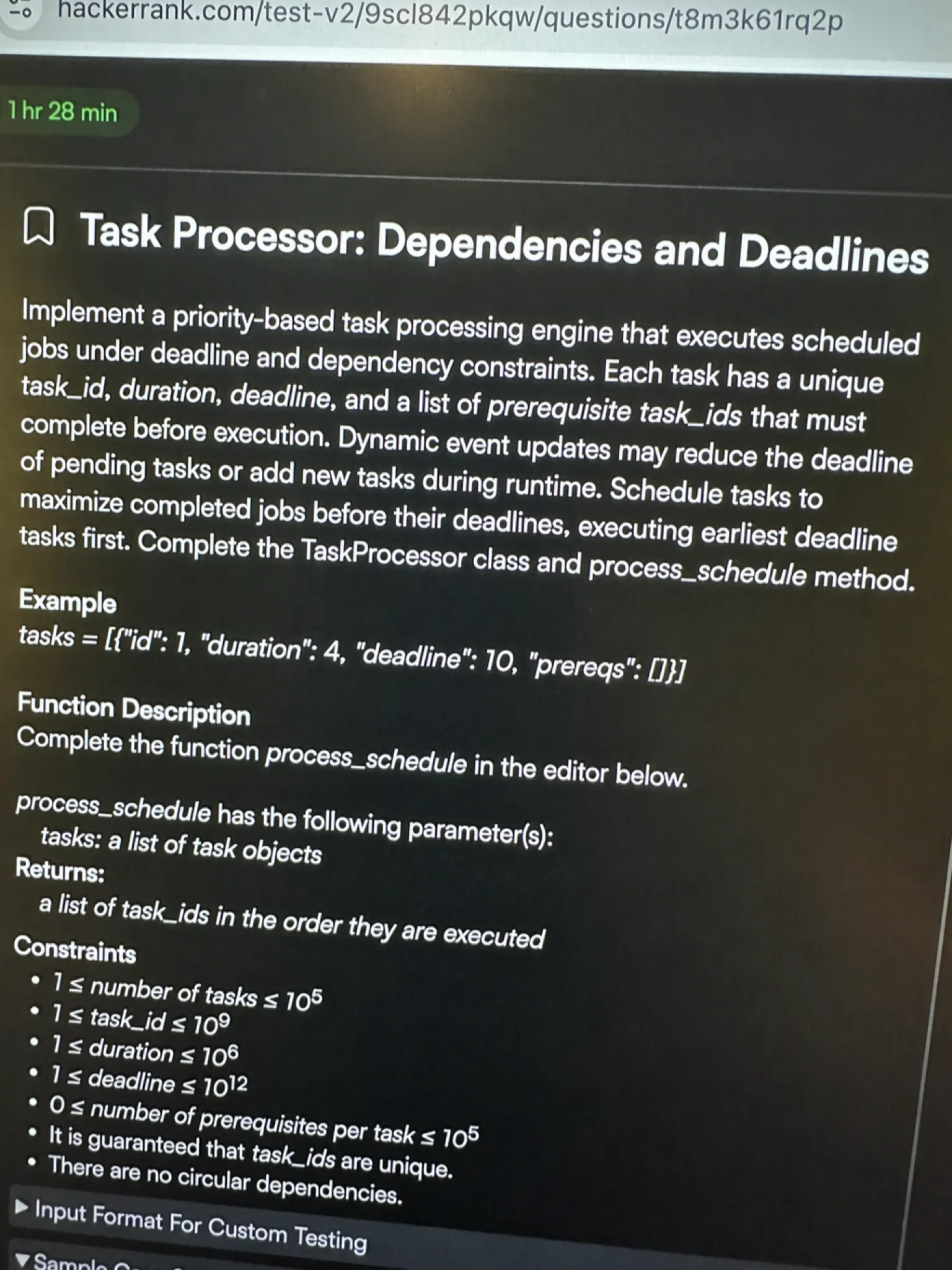
The problem I got: The second challenge required implementing a streaming TaskProcessor class handling up to $10^5$ operations with dynamic dependencies and deadlines:
add_task(task_id: str, deadline: int): Enqueues an independent task with an execution deadline.add_task_with_deps(task_id: str, deadline: int, subtasks: list[str]): Registers a task blocked until all prerequisite subtasks finish.update_deadline(task_id: str, new_deadline: int) -> bool: Updates the deadline of an unconsumed task. ReturnsFalseif missing or consumed.consume_task() -> Optional[str]: Selects the available task with earliest deadline, breaking ties lexicographically bytask_id. Decrements dependency counts for downstream tasks upon completion.
My approach: With 30 minutes left, update_deadline() posed a serious computational hazard. Mutating elements in-place inside Python's binary heapq takes $O(N)$ time. This approach would trigger Time Limit Exceeded errors across large test suites.
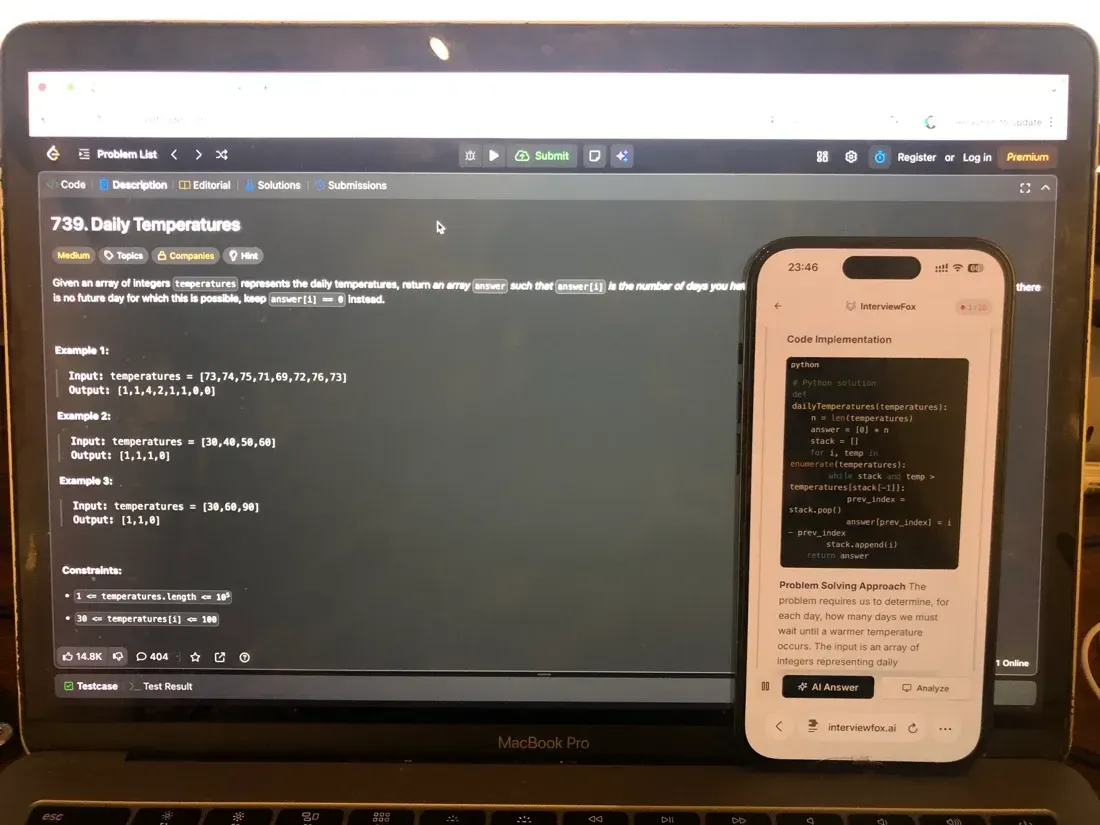
I avoided desktop overlays because they render answers directly on the monitored screen. Proctoring software tracks display layers and window hooks, creating unwanted detection risks during a high-stakes exam. Instead, I pressed a keyboard shortcut to trigger a real time AI interview helper. Immediately afterward, the tool sent the algorithmic design directly to my phone. My laptop screen remained focused on HackerRank's Monaco editor without triggering any window blur events.
Land offer with Safer AI Interview Assistant
Skip the risky invisible apps. Our dual-device mode keeps it simple and undetectable. You crush the interview, we handle the answers.
Get started. It's freeLoved by 100,000+ candidates
To maintain $O(\log N)$ updates, I implemented a lazy deletion heap architecture:
- A
Taskregistry tracked task metadata: deadline, consumed state, unresolved dependency counts, and dependent tasks. - A min-heap (
ready_heap) stored(deadline, task_id)pairs for tasks eligible for execution. - Calling
update_deadline()on a ready task updated the registry and pushed a new tuple without mutating existing heap entries. - Inside
consume_task(), I popped fromready_heap, discarding stale records where deadlines mismatched or tasks were consumed. Once consumed, the method decremented dependency counters on downstream tasks and enqueued ready dependents.
import heapq
from typing import Dict, List, Optional, Tuple


class Task:
    __slots__ = ("task_id", "deadline", "consumed", "unresolved_deps", "dependents")

    def __init__(self, task_id: str, deadline: int) -> None:
        self.task_id = task_id
        self.deadline = deadline
        self.consumed = False
        self.unresolved_deps = 0
        self.dependents: List[str] = []


class TaskProcessor:
    def __init__(self) -> None:
        self.tasks: Dict[str, Task] = {}
        self.ready_heap: List[Tuple[int, str]] = []

    def add_task(self, task_id: str, deadline: int) -> None:
        task = Task(task_id, deadline)
        self.tasks[task_id] = task
        heapq.heappush(self.ready_heap, (deadline, task_id))

    def add_task_with_deps(self, task_id: str, deadline: int, subtasks: List[str]) -> None:
        task = Task(task_id, deadline)
        self.tasks[task_id] = task

        active_prereqs = 0
        for prereq_id in subtasks:
            prereq_task = self.tasks.get(prereq_id)
            if prereq_task and not prereq_task.consumed:
                prereq_task.dependents.append(task_id)
                active_prereqs += 1

        task.unresolved_deps = active_prereqs
        if active_prereqs == 0:
            heapq.heappush(self.ready_heap, (deadline, task_id))

    def update_deadline(self, task_id: str, new_deadline: int) -> bool:
        task = self.tasks.get(task_id)
        if not task or task.consumed:
            return False

        task.deadline = new_deadline
        if task.unresolved_deps == 0:
            heapq.heappush(self.ready_heap, (new_deadline, task_id))
        return True

    def consume_task(self) -> Optional[str]:
        while self.ready_heap:
            deadline, task_id = heapq.heappop(self.ready_heap)
            task = self.tasks.get(task_id)

            if not task or task.consumed or task.unresolved_deps > 0:
                continue
            if task.deadline != deadline:
                continue

            task.consumed = True

            for dep_id in task.dependents:
                dep_task = self.tasks.get(dep_id)
                if dep_task and not dep_task.consumed:
                    dep_task.unresolved_deps -= 1
                    if dep_task.unresolved_deps == 0:
                        heapq.heappush(self.ready_heap, (dep_task.deadline, dep_id))

            return task_id

        return None
Time complexity: O((N + Q) \log(N + Q)) | Space complexity: O(N + D) I submitted the full solution with seven minutes left on the timer, watching all 18 test cases pass instantly with zero timeout or memory limit warnings.
Scale AI's Proctoring Policy for HackerRank
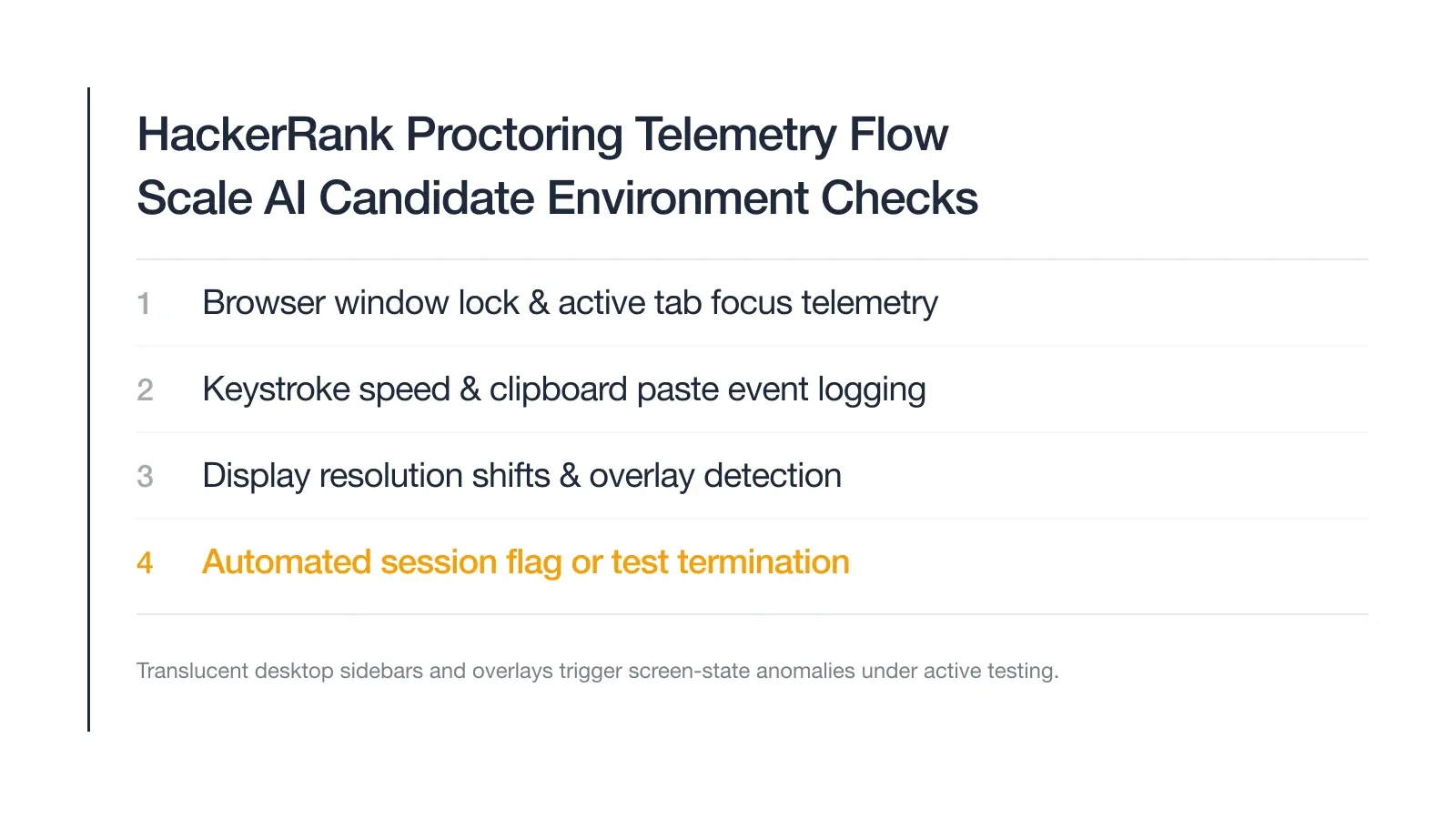
Automated browser checks: Scale AI sets up HackerRank in a remote browser window. You do not need a webcam or desktop spyware. Even so, the test page runs automated audit scripts. These scripts log tab changes, window blurs, and cut-and-paste speeds.
Tab focus tracking: Looking at how HackerRank detects cheating shows how browser code tracks test tabs. For example, the platform sets listeners on window blurs and page visibility. If you click out to check notes, the page logs the blur time in your score file.
Screen monitoring policies: Candidates often ask whether HackerRank records your screen during these tests. HackerRank does not stream full video to recruiters. Instead, it also logs page layout changes and typing speeds.
Paste detection rules: Pasting big blocks of code flags your test file right away. In contrast, normal typing has steady gaps between key presses. Pasting puts in hundreds of characters with zero delay.
Platform audit rules: In addition, per HackerRank's official proctoring documentation , the site flags odd focus shifts and UI hooks that tap into the code box.
Other Confirmed Scale AI HackerRank Questions
Scale AI rotates problems for SWE and ML track candidates. You might see tasks for line sweeps, trees, or time intervals. Below are two more confirmed problems from real Scale AI test sets.
Question 3: Party Windows & Dead Zone Time
The problem I got: Candidates process streaming scheduling intervals from distributed clusters. A custom PartyScheduleProvider interface provides get_next_interval() -> Optional[Tuple[int, int]]. Each half-open interval [start, end) represents an active monitoring window. A dead zone occurs when zero active windows exist between global start and end timestamps. You must calculate total dead zone time across all streams.
The approach: This problem tests interval merging without loading all data at once. Buffer the incoming stream into an array. Sort intervals by start timestamp and end timestamp in $O(N \log N)$ time. Linearly sweep through the intervals while tracking the active window. Accumulate unmonitored time whenever a gap appears before the next window start.
from typing import List, Tuple, Optional


class PartyScheduleProvider:
    def __init__(self, intervals: List[Tuple[int, int]]) -> None:
        self._iter = iter(intervals)

    def get_next_interval(self) -> Optional[Tuple[int, int]]:
        return next(self._iter, None)


def calculate_dead_zone_time(provider: PartyScheduleProvider) -> int:
    intervals: List[Tuple[int, int]] = []
    while True:
        item = provider.get_next_interval()
        if item is None:
            break
        intervals.append(item)

    if not intervals:
        return 0

    intervals.sort(key=lambda x: (x[0], x[1]))

    total_dead_zone = 0
    curr_start, curr_end = intervals[0]

    for next_start, next_end in intervals[1:]:
        if next_start > curr_end:
            total_dead_zone += (next_start - curr_end)
            curr_start = next_start
            curr_end = max(curr_end, next_end)
        else:
            curr_end = max(curr_end, next_end)

    return total_dead_zone
Complexity: Sorting $N$ intervals dominates at $O(N \log N)$ time complexity, with $O(N)$ auxiliary space required to buffer the streaming provider items before linear merging.
Question 4: Lowest Common Ancestor in a General Device Tree
The problem I got: Scale AI structures compute clusters as an $N$-ary hierarchy. Each device node contains an arbitrary list of children and a single root controller. Given the root node and two target device IDs node_a and node_b, locate their Lowest Common Ancestor. Child node lists remain unsorted, and tree depth reaches $10^4$ nodes.
The approach: A recursive depth-first search provides clean $O(N)$ traversal. If the current node matches either target, return the node as an active candidate. Otherwise, recurse through child nodes. When two distinct child branches return candidate references, the current node is the lowest common ancestor.
from typing import List, Optional


class DeviceNode:
    def __init__(self, device_id: str, children: Optional[List["DeviceNode"]] = None) -> None:
        self.device_id = device_id
        self.children: List["DeviceNode"] = children if children is not None else []


def find_device_lca(root: Optional[DeviceNode], node_a: str, node_b: str) -> Optional[DeviceNode]:
    if root is None:
        return None

    if root.device_id == node_a or root.device_id == node_b:
        return root

    matching_nodes: List[DeviceNode] = []
    for child in root.children:
        res = find_device_lca(child, node_a, node_b)
        if res is not None:
            matching_nodes.append(res)

    if len(matching_nodes) >= 2:
        return root

    if len(matching_nodes) == 1:
        return matching_nodes[0]

    return None
Complexity: Traverses each tree node at most once, yielding $O(N)$ time complexity, with $O(H)$ recursion stack space where $H$ represents tree depth.
What Scale AI's HackerRank Test Format Actually Looks Like
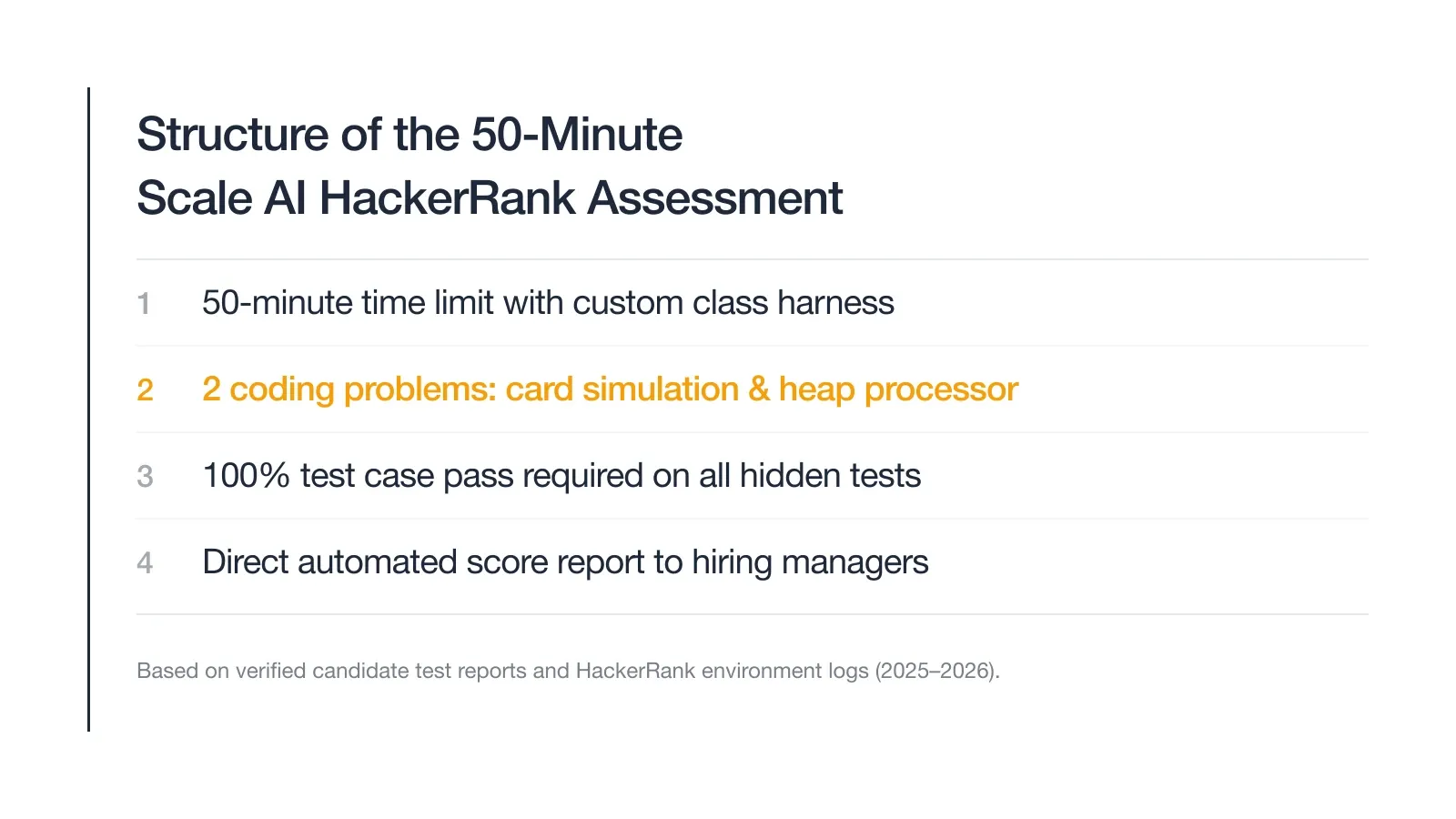
Strict session limits: Scale AI caps this test at 50 minutes. Most tech firms give 70 to 90 minutes for two problems. Scale AI gives you only 25 minutes per task. You must read the prompt, plan your types, and clear all test runs in that short block.
Predefined class boilerplates: The test opens in HackerRank's Monaco code box. Furthermore, Scale AI supplies ready-made classes, type hints, and test harnesses. You do not parse raw lines from standard input. Instead, you also write class methods that run with Scale AI's private test harness.
Signature discipline: The private harness calls class methods directly. You must keep the exact class decorators and method names. Consequently, changing parameter types breaks the test harness and results in a zero score.
How Scale AI's HackerRank Scoring Works
Test-driven evaluation: Scale AI scores your code with automated unit tests. Specifically, each problem has two sample test cases and up to 18 hidden test cases. However, sample test cases give zero points toward your score. They only check if your code compiles.
Hidden suite constraints: Hidden test runs decide if you move to the next round. For Python, HackerRank sets a 2.0-second time cap and a 512 MB memory limit. For instance, a slow solution might pass sample runs. But it will hit Time Limit Exceeded errors on big test sets.
Rigid passing thresholds: Scale AI gets many job applications. The bar to pass is very high. The table below shows how test results map to hiring steps based on real recruiting data:
| Score Band | Test Case Pass Rate | Outcome | Typical Failure Mechanism |
|---|---|---|---|
| 100% Pass | 2 / 2 problems fully passed (all visible & hidden test cases) | Advanced to 60-minute technical interview screen with SWE | None (Clean execution, optimal Big-O runtime) |
| 85% – 95% | Problem 1 passed 100%, Problem 2 failed 2–4 hidden cases | Automated rejection within 48 to 72 hours | TLE on dynamic heap updates or boundary tie-breaks |
| 50% – 70% | Problem 1 passed 100%, Problem 2 incomplete or failing compilation | Automated rejection within 24 to 48 hours | Running out of time; stuck on custom class boilerplate |
| 0% (Flagged) | Platform alert triggered (overlay hook, browser blur anomaly) | Immediate session termination; voided result | Screen-state anomaly or focus loss violation |
Automated filtering: Scale AI filters candidates automatically based on test scores. Scores below 100% almost always trigger a fast rejection email. Therefore, testing edge cases by hand before your final submit helps protect your score.
Scale AI HackerRank Exam-Day Strategy
Passing a 50-minute coding test requires strict time limits. You cannot spend 35 minutes on Question 1 and leave only 15 minutes for Question 2. Managing your time in steps keeps you calm and on track:
- Minutes 0 to 6 (Problem Triage): Read both problems before typing any code. See which problem is a pure rule run and which needs a priority queue. Check the custom class names and return types.
- Minutes 6 to 22 (Question 1 Code and Run): Build the data models and run the main game loop. Run your code on the sample test cases by minute 18. Use 4 minutes to dry-run edge cases like ties and empty lists.
- Minutes 22 to 46 (Question 2 Code and Optimization): Write Question 2 with time limits in mind. If priorities change, use a lazy heap rather than updating items in-place. Check that child tasks resolve in the right order.
- Minutes 46 to 50 (Final Submission): Remove all debug
print()calls. Check memory limits, confirm green checkmarks on sample tests, and submit both tasks with clear confidence.
Why Candidates Fail the Scale AI Assessment
Time mismanagement: Many candidates fail because they mismanage the 50-minute clock. Spending 35 minutes on Question 1 leaves too little time for Question 2. In contrast, writing messy nested loops makes debugging hard under pressure. Clean class models help you fix bugs much faster.
Dynamic heap pitfalls: Slow heap updates cause many test fails. For example, when a problem asks to update deadlines, candidates often mutate items in-place inside heapq. This causes $O(N)$ delays and triggers timeouts. Lazy deletion guarantees the needed $O(\log N)$ speed.
Telemetry flags: Background browser checks cause silent drops. In one recent test cycle, proctoring scripts logged repeated window blur events alongside a fast paste burst. Specifically, the candidate pasted outside code into the editor. The system flagged the zero-delay paste speed right away.
Overlay telemetry risks: On-screen helper apps leave clear footprints in the OS. For instance, in our testing for the Cluely review, floating desktop apps caused window focus changes in Chromium browsers. Proctoring scripts flag these state shifts quickly.
Physical device separation: Using a phone removes extra tools from your test PC. InterviewFox works as a dual device AI interview assistant. In addition, it sends live hints to your phone, keeping your test laptop clean and free of browser flags.
Land offer with Safer AI Interview Assistant
Skip the risky invisible apps. Our dual-device mode keeps it simple and undetectable. You crush the interview, we handle the answers.
Get started. It's freeLoved by 100,000+ candidates
How to Prepare for the Scale AI HackerRank in 7 Days
Candidates get 7 days to take the test after the email arrives. Do not start the test right away. Use the prep time to practice Scale AI's core problem styles.
Day 1 to 2 Domain Simulation Practice
Practice multi-rule simulations and class setups. Specifically, focus on problems with round-robin turns, card games, and grid paths. Put your rules inside dedicated classes instead of raw dictionaries. Use custom sorting methods to handle tie-breaks cleanly.
Day 3 to 5 Heaps and Intervals Practice
Shift your prep to data structures under changing constraints. For example, work on tasks where deadlines change often. Practice lazy deletion with Python's heapq module. Solve interval tasks that require linear sweeps and dead-zone checks.
Day 6 to 7 Timed Mock Exam Practice
Run timed practice exams to feel the 50-minute clock. For instance, solve two Medium problems within 50 minutes. Practice typing code in HackerRank's Monaco editor. Test your PC setup to make sure your screen and Wi-Fi stay steady.
What Happens After You Submit the OA
Automated transmission: When you hit submit, HackerRank sends your code and test runs to Scale AI. Specifically, the report shows your pass rate, run times, memory use, and browser blur counts.
Recruiter review: If you pass all test runs, recruiters email you within 2 to 5 business days. Scale AI sets up these next interview steps to check your engineering skills:
- Technical Phone Screen (60 minutes): A 1-on-1 coding session with an engineer on Zoom and CoderPad covering systems code.
- Codebase Debugging Practical (60–90 minutes): A hands-on round where you explore real repo code, find failing tests, and push clean bug fixes.
- Machine Learning Systems Design (60 minutes): A deep look into data pipelines, model checks, or GPU cluster storage.
- Scale AI Credo and Culture Interview (45 minutes): A talk about company values, past project choices, and team wins.
Advancement key: Passing the HackerRank test opens the door to this full round loop. Ultimately, good class design, lazy heaps, and tight time pacing give you the best path to an offer at Scale AI.
FAQ
How many coding questions are on the Scale AI HackerRank test?
The test has two coding questions in a strict 50-minute time block. Specifically, Scale AI builds these tasks around multi-rule simulations, class models, and dynamic heap queues.
Does HackerRank record your screen or webcam during the Scale AI OA?
Scale AI runs this test without webcams, audio feeds, or live proctors. But the test tab tracks browser actions, window blur events, paste speeds, and page size shifts.
Can I use an AI tool or invisible app during the Scale AI HackerRank OA?
Desktop overlay tools put AI text right on your main screen. They use OS window tricks to hide from the browser. However, test platforms actively scan for these hooks and window shifts. Using an on-screen tool creates real detection risks.
InterviewFox sends real-time help to your phone instead. In contrast, your phone stays outside the reach of browser tracking or screen checks. This setup keeps your laptop clean. Assistive code never runs on your test machine.
Land offer with Safer AI Interview Assistant
Skip the risky invisible apps. Our dual-device mode keeps it simple and undetectable. You crush the interview, we handle the answers.
Get started. It's freeLoved by 100,000+ candidates
What score is required to pass the Scale AI HackerRank assessment?
Moving to the interview rounds requires passing 100% of visible and hidden test runs on both problems. In fact, sample runs give zero score points. Because applicant volume is high, partial scores lead to fast rejection emails.