
I Passed Tower Research HackerRank Test in 2026: Real Questions

Quick Facts
| Tower Research HackerRank test format | 90 minutes, 2 coding problems and 8 core CS multiple choice questions |
| Platform | HackerRank |
| Passing benchmark | 85%+ total score, with both coding problems passing all hidden test cases |
| Core focus | Low-latency C++, interval line sweep, state-expanded graph Dijkstra, concurrency |
| Proctoring mode | Full-screen browser lockdown, window focus tracking, clipboard burst logging, background window check |
| Primary failure causes | Hidden test case time limit exceeded (O(N^2) loops), 64-bit integer overflow, background app alerts |
| Guide year | 2026 |
I took the Tower Research Capital HackerRank test for a quant developer opening in early 2026. The 90-minute session included eight systems theory questions and two complex programming problems. I solved both coding problems in C++ and completed every systems question. What follows is the complete process and how I prepared for it.
With twenty minutes left on the routing problem, I used an AI interview tool to inspect my state expansion. It confirmed that tracking back-to-back congested hops in the priority queue tuple was required, as detailed below.
Before my test, I reviewed every Tower Research Capital HackerRank post from the past two years across online forums. What I found matches my sitting. Forum reports consistently emphasize hidden test case time limits, low-latency C++ edge cases, and background process alerts.
The Real Questions on My Tower Research HackerRank Test
I took the Tower Research Capital HackerRank assessment for a quant developer role in 2026. The 90-minute sitting split between systems theory and two heavy coding problems. Here is exactly what the two programming questions looked like on my screen, in the order they appeared.
Question 1: Peak Concurrent Order Volume & Threshold Surge
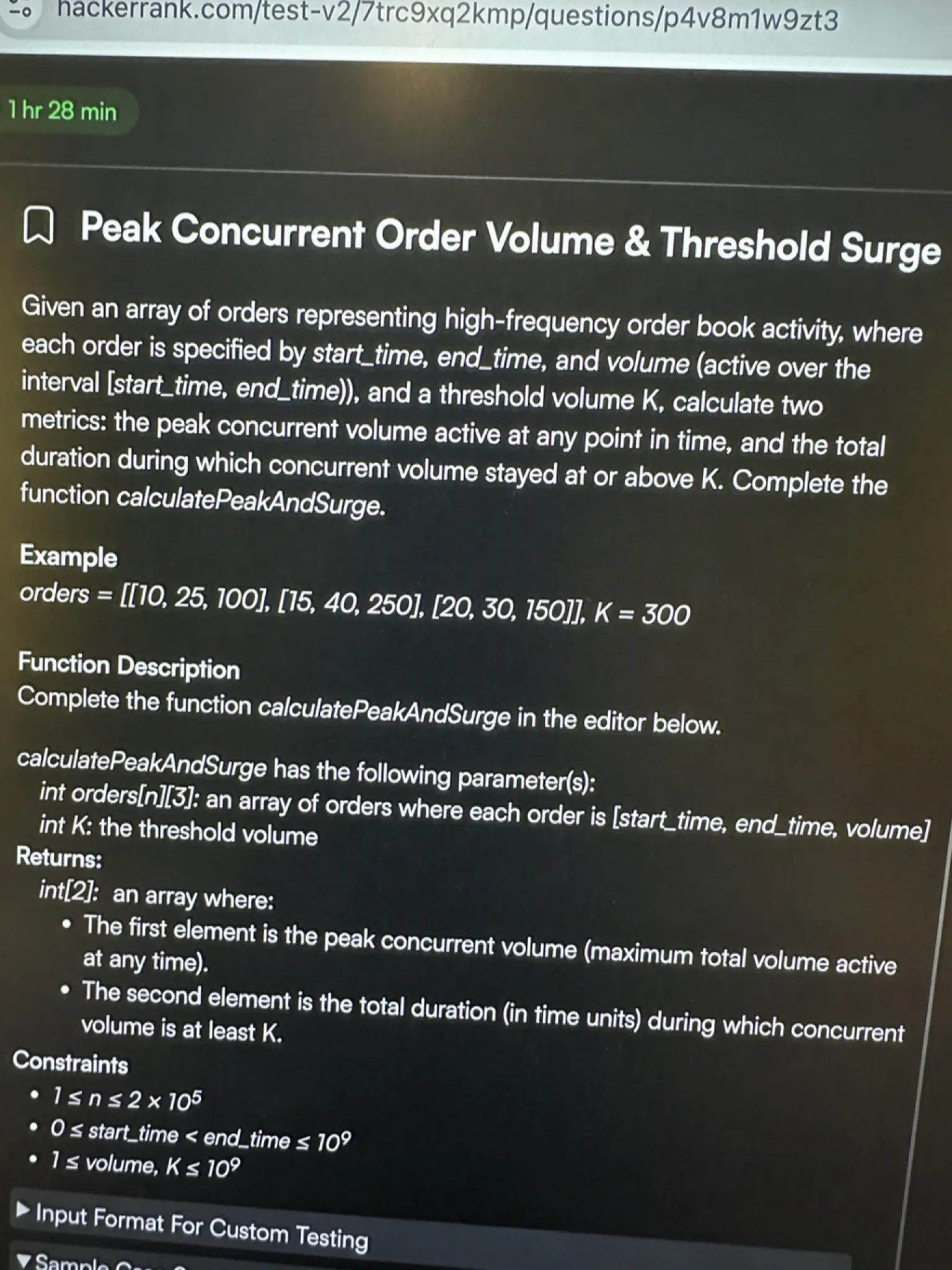
The problem I got: The first question simulated a high-frequency trading order book. I was given an array of $N$ orders, where each order had three values: start_time, end_time, and volume. Each order was active over the half-open interval [start_time, end_time). I was also given a threshold volume $K$. The problem asked me to calculate two metrics: the peak concurrent volume active at any point in time, and the total duration during which concurrent volume stayed at or above $K$.
Constraints were strict. The number of orders $N$ reached up to $10^5$, timestamps ran from $0$ to $10^9$, and individual order volumes ranged up to $10^6$. The three visible sample cases had small values with $N \le 50$, but the hidden test cases scaled directly to $10^5$ and checked for both 64-bit integer overflow and time limit compliance.
My approach: My first instinct was to check every interval against all others, but an $O(N^2)$ pairwise comparison would immediately time out on the hidden test cases. Because timestamps reached $10^9$, allocating a direct difference array over time was impossible. The key insight was that concurrent volume changes only at discrete boundary points when an order starts or ends.
I decomposed each order into two discrete events: an arrival event adding volume at start_time, and a departure event subtracting volume at end_time. I placed all $2N$ events into a vector and sorted them by time. If multiple events occurred at the identical timestamp, I grouped all updates together before computing volume transitions. As I swept through the sorted timestamps, I accumulated running volume. Whenever the active volume reached or exceeded $K$, I added the elapsed time since the previous timestamp to my surge duration counter. Because total volume could reach $10^{11}$, I cast all counters to 64-bit integers (long long in C++) to prevent silent overflow.
#include <iostream>
#include <vector>
#include <algorithm>

struct Order {
    long long start_time;
    long long end_time;
    long long volume;
};

struct SurgeResult {
    long long peak_volume;
    long long surge_duration;
};

SurgeResult calculatePeakAndSurge(const std::vector<Order>& orders, long long K) {
    if (orders.empty()) {
        return {0, 0};
    }

    // Decompose each order into start and end boundary events
    std::vector<std::pair<long long, long long>> events;
    events.reserve(orders.size() * 2);

    for (const auto& order : orders) {
        events.emplace_back(order.start_time, order.volume);
        events.emplace_back(order.end_time, -order.volume);
    }

    // Sort events chronologically by timestamp
    std::sort(events.begin(), events.end(), [](const auto& a, const auto& b) {
        return a.first < b.first;
    });

    long long current_volume = 0;
    long long peak_volume = 0;
    long long surge_duration = 0;
    long long prev_time = events[0].first;

    size_t i = 0;
    size_t n = events.size();

    while (i < n) {
        long long current_time = events[i].first;

        // If running volume was at or above K, accumulate time delta
        if (current_volume >= K) {
            surge_duration += (current_time - prev_time);
        }

        // Apply all events that occur at this exact timestamp
        while (i < n && events[i].first == current_time) {
            current_volume += events[i].second;
            i++;
        }

        if (current_volume > peak_volume) {
            peak_volume = current_volume;
        }

        prev_time = current_time;
    }

    return {peak_volume, surge_duration};
}

int main() {
    std::ios_base::sync_with_stdio(false);
    std::cin.tie(nullptr);

    std::vector<Order> sample_orders = {
        {10, 25, 100},
        {15, 40, 250},
        {20, 30, 150},
        {35, 50, 200}
    };
    long long K = 300;

    SurgeResult result = calculatePeakAndSurge(sample_orders, K);
    std::cout << "Peak Volume: " << result.peak_volume << "\n";
    std::cout << "Surge Duration: " << result.surge_duration << "\n";

    return 0;
}
Time complexity: O(N log N) | Space complexity: O(N)
I finished writing and testing this solution in roughly 24 minutes, with all visible cases passing immediately. That smooth start gave me confidence, but it also made me underestimate how punishing the second question would be.
Question 2: Minimum Latency Route with Congestion Constraints
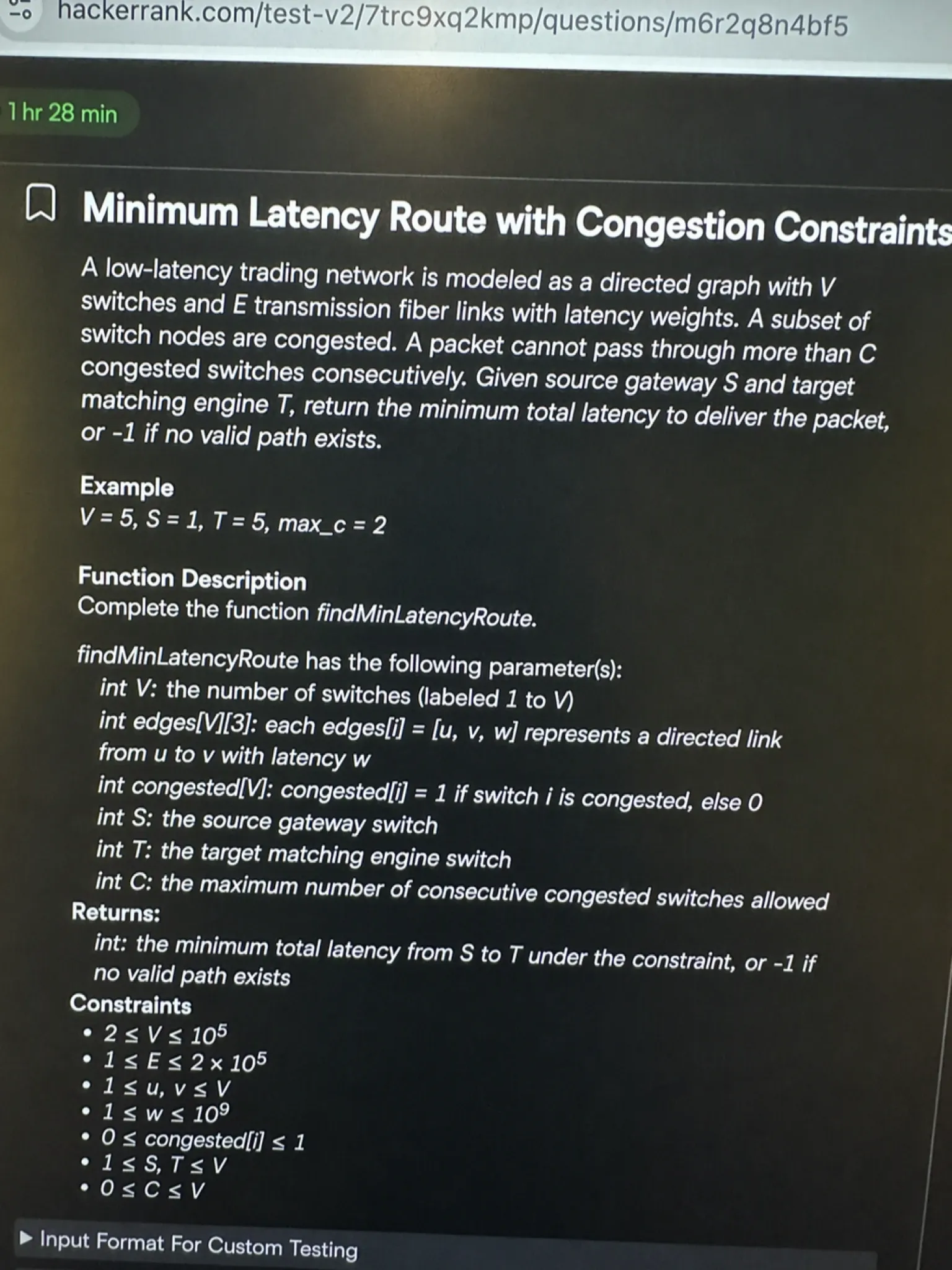
The problem I got: The second problem modeled a low-latency packet routing network. I was given a directed graph with $V$ network switches and $E$ transmission fiber links, where each link had an integer latency weight. A subset of switch nodes were designated as congested. If a data packet traversed congested nodes, it could not pass through more than $C$ congested switches back-to-backly without hitting packet queue drops. Given a source gateway $S$ and a target matching engine $T$, I had to return the minimum total latency to deliver the packet, or $-1$ if no valid path existed.
The constraints specified $V \le 2 \times 10^4$ nodes, $E \le 10^5$ edges, edge weights between $1$ and $1000$, and the back-to-back congestion limit $C \le 10$. The visible sample cases allowed simple direct paths, but the hidden test cases featured complex cycles and bypass routes where a longer path was required to reset the congestion counter.
My approach: My initial attempt was standard Dijkstra on just the switch node and cumulative latency, using a greedy visited array. That approach failed three test cases immediately because an optimal route might visit a node with slightly higher latency but zero back-to-back congestion hops, enabling a shorter downstream connection that a lower-latency path could not legally take. With three hidden congestion test cases failing and twenty minutes left on the clock, I was stuck debugging path history under pressure.
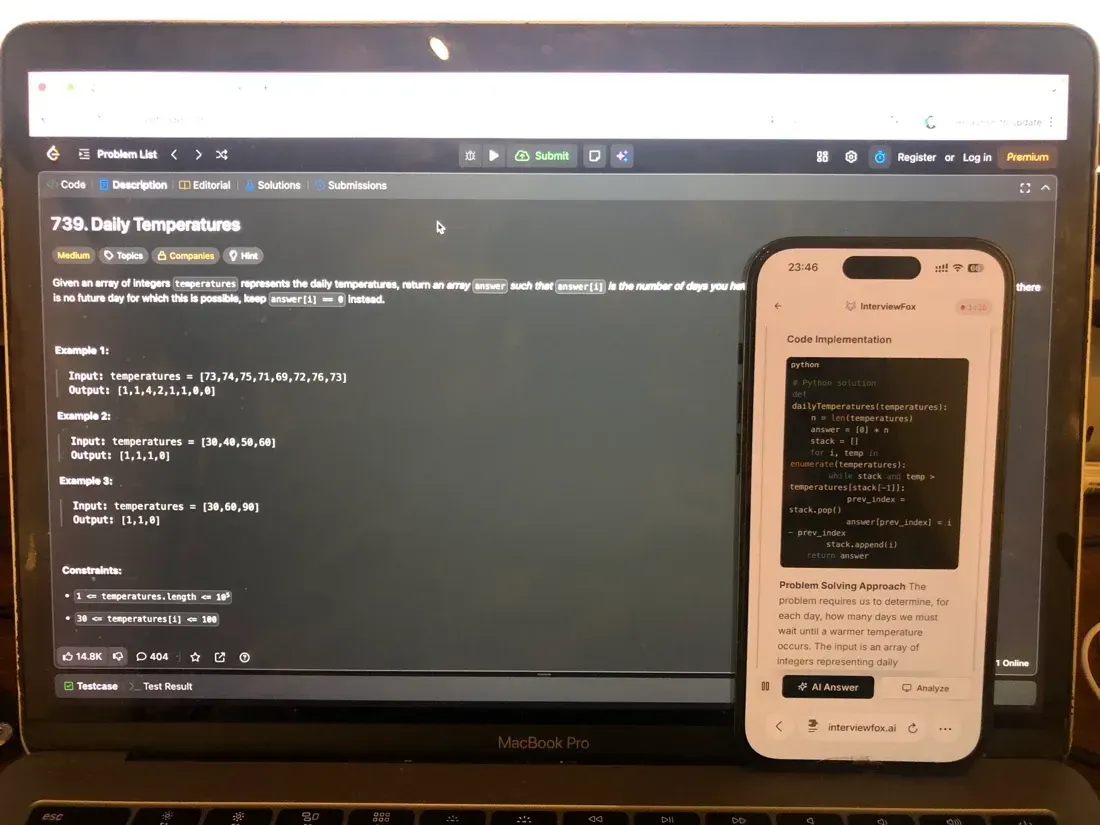
I avoided desktop overlays because rendering answers on the monitored screen creates background detection risks. Instead, a keyboard shortcut captured the problem constraints and sent them to a dual device AI interview copilot on my phone, a separate device outside HackerRank's screenshot monitoring. The guidance confirmed tracking back-to-back congested hops in the priority queue tuple, leaving my laptop screen unchanged while I rebuilt the traversal.
Land offer with Safer AI Interview Assistant
Skip the risky invisible apps. Our dual-device mode keeps it simple and undetectable. You crush the interview, we handle the answers.
Get started. It's freeLoved by 100,000+ candidates
Optimal state transition: To solve this, I expanded the state representation in Dijkstra's algorithm. Instead of finding the shortest distance to node $u$, I maintained the shortest distance to each state (node, back-to-back_congested_count). The state space became $(V \times (C + 1))$. In the priority queue, each entry stored (latency, u, c). When relaxing an edge from $u$ to neighbor $v$, if $v$ was congested, the new count became $c + 1$; if $v$ was uncongested, the count reset to $0$. Transitions were valid only when the new count remained within $C$. The first time the destination engine $T$ was popped from the priority queue, its latency was guaranteed to be minimal.
#include <iostream>
#include <vector>
#include <queue>

const long long INF = 1e18;

struct Edge {
    int to;
    int weight;
};

struct State {
    long long latency;
    int node;
    int consecutive_congested;

    bool operator>(const State& other) const {
        return latency > other.latency;
    }
};

long long findMinLatencyRoute(
    int n,
    const std::vector<std::vector<Edge>>& adj,
    const std::vector<bool>& is_congested,
    int source,
    int target,
    int max_c
) {
    // dist[node][consecutive_congested]
    std::vector<std::vector<long long>> dist(
        n + 1, std::vector<long long>(max_c + 1, INF)
    );
    std::priority_queue<State, std::vector<State>, std::greater<State>> pq;

    int initial_c = is_congested[source] ? 1 : 0;
    if (initial_c > max_c) {
        return -1;
    }

    dist[source][initial_c] = 0;
    pq.push({0, source, initial_c});

    while (!pq.empty()) {
        auto [cur_lat, u, c] = pq.top();
        pq.pop();

        if (cur_lat > dist[u][c]) {
            continue;
        }

        if (u == target) {
            return cur_lat;
        }

        for (const auto& edge : adj[u]) {
            int v = edge.to;
            int next_c = is_congested[v] ? (c + 1) : 0;

            if (next_c <= max_c) {
                long long next_lat = cur_lat + edge.weight;
                if (next_lat < dist[v][next_c]) {
                    dist[v][next_c] = next_lat;
                    pq.push({next_lat, v, next_c});
                }
            }
        }
    }

    return -1;
}

int main() {
    std::ios_base::sync_with_stdio(false);
    std::cin.tie(nullptr);

    int n = 5;
    std::vector<std::vector<Edge>> adj(n + 1);
    adj[1].push_back({2, 10});
    adj[2].push_back({3, 10});
    adj[3].push_back({4, 10});
    adj[4].push_back({5, 10});
    adj[1].push_back({4, 50});

    std::vector<bool> is_congested(n + 1, false);
    is_congested[2] = true;
    is_congested[3] = true;

    // With max_c = 1, path 1->2->3 is blocked by consecutive congestion.
    // The algorithm routes via bypass 1->4->5 with latency 60.
    long long latency = findMinLatencyRoute(n, adj, is_congested, 1, 5, 1);
    std::cout << "Minimum Latency: " << latency << "\n";

    return 0;
}
Time complexity: O((E * C) log(V * C)) | Space complexity: O(V * C)
This problem consumed nearly 45 minutes of my test clock. First, my initial naive graph traversal ignored path history. Next, it failed three hidden congestion test cases. Burning that much time left only ten minutes to review code before final submission.
Tower Research Capital's Proctoring Policy for HackerRank
Tower Research Capital configures HackerRank in strict lockdown mode for quant development and trading engineering roles. The testing client forces full-screen operation and monitors window focus continuously. It logs an integrity flag whenever the cursor leaves the browser window.
Candidates often wonder whether HackerRank records your screen during quant engineering tests. The platform takes periodic desktop screenshots and records display state changes.
To evaluate your risk profile, reviewing how HackerRank detects cheating explains how focus switches, paste bursts, and dual displays trigger reviews.
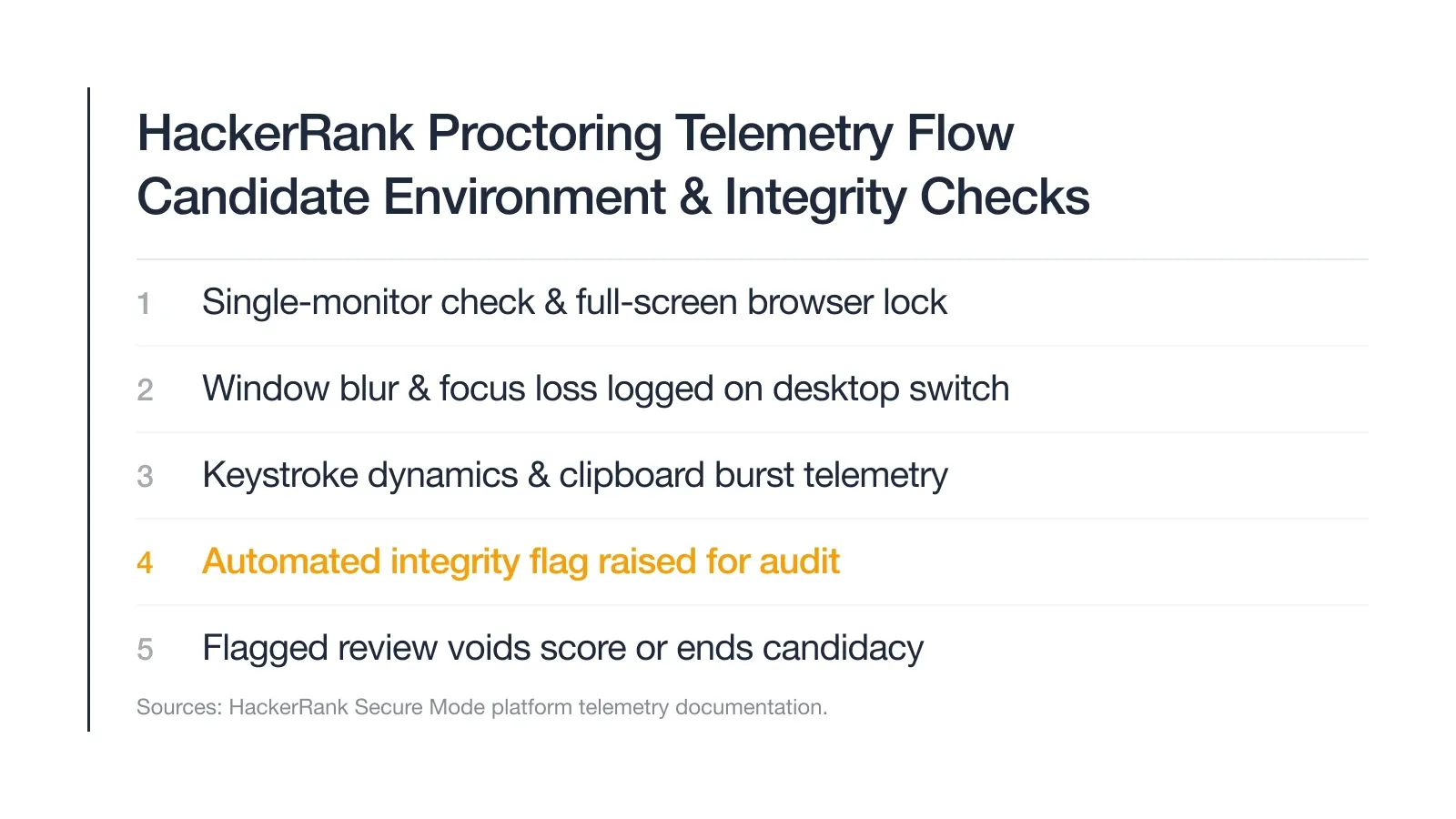
The platform enforces session integrity under official proctoring docs . It logs clipboard volume and flags rapid paste bursts. Connecting secondary displays registers an environment exception. Also, running background windows alerts recruiters before they score code.
Other Confirmed Tower Research Capital HackerRank Questions
Beyond my order book and latency routing problems, Tower Research draws from an alternate question pool for systems candidates. The following confirmed question appeared in an alternate sitting.
Nested Scope Syntax & Token Parser
In September 2025, a systems candidate reported this syntax parser. It processes nested key-value pairs across lexical scopes.
The problem requires evaluating a stream of syntax tokens containing nested blocks enclosed by { and }. Within each block, statements assign integer values to variable names or query active values with eval(var). Inner blocks shadow definitions from outer enclosing scopes, but closing a block restores previous definitions. If a variable is queried before declaration, the parser outputs UNDEFINED.
The constraints specify up to $10^5$ statements and maximum nesting depth of $10^4$. Searching through scope frames on every query takes $O(N \times Depth)$ time. This triggers time limit exceeded errors on deep chains.
The optimal approach maintains a global map from variable name to a std::vector<long long> acting as a value stack, alongside an operation history stack. Entering a scope pushes a new frame. When a variable is defined, its new value is pushed onto its dedicated stack, and its name is recorded in the current frame. Exiting a scope pops the current frame and pops the top value from each variable stack modified in that frame. Queries execute in $O(1)$ time by inspecting the top of the variable stack.
#include <iostream>
#include <string>
#include <vector>
#include <unordered_map>
#include <sstream>

class ScopeEvaluator {
private:
    std::unordered_map<std::string, std::vector<long long>> var_stacks;
    std::vector<std::vector<std::string>> scope_history;

public:
    ScopeEvaluator() {
        // Global base scope
        scope_history.emplace_back();
    }

    void enterScope() {
        scope_history.emplace_back();
    }

    void exitScope() {
        if (scope_history.size() <= 1) {
            return;
        }
        const auto& vars_in_scope = scope_history.back();
        for (const auto& var : vars_in_scope) {
            auto it = var_stacks.find(var);
            if (it != var_stacks.end() && !it->second.empty()) {
                it->second.pop_back();
                if (it->second.empty()) {
                    var_stacks.erase(it);
                }
            }
        }
        scope_history.pop_back();
    }

    void assign(const std::string& var, long long val) {
        var_stacks[var].push_back(val);
        scope_history.back().push_back(var);
    }

    std::string evaluate(const std::string& var) {
        auto it = var_stacks.find(var);
        if (it != var_stacks.end() && !it->second.empty()) {
            return std::to_string(it->second.back());
        }
        return "UNDEFINED";
    }
};

int main() {
    std::ios_base::sync_with_stdio(false);
    std::cin.tie(nullptr);

    ScopeEvaluator evaluator;
    evaluator.assign("spread", 10);
    evaluator.assign("depth", 500);

    std::cout << "Global spread: " << evaluator.evaluate("spread") << "\n";

    evaluator.enterScope();
    evaluator.assign("spread", 25);
    std::cout << "Inner spread: " << evaluator.evaluate("spread") << "\n";
    std::cout << "Inner depth: " << evaluator.evaluate("depth") << "\n";

    evaluator.exitScope();
    std::cout << "Restored spread: " << evaluator.evaluate("spread") << "\n";

    return 0;
}
Time complexity: O(N) | Space complexity: O(N)
Tower Research Capital HackerRank Test Format
Tower Research Capital formats its online assessment as a single 90-minute test with no pauses between sections. The timer begins upon launching the assessment. You can freely navigate between coding problems and multiple-choice questions.
The test splits into two parts. First, two coding problems account for 75% of your score. Next, eight systems MCQs carry the remaining 25%. Algorithmic tasks test complex data structures under tight clocks. In addition, systems questions evaluate C++ and operating system internals.
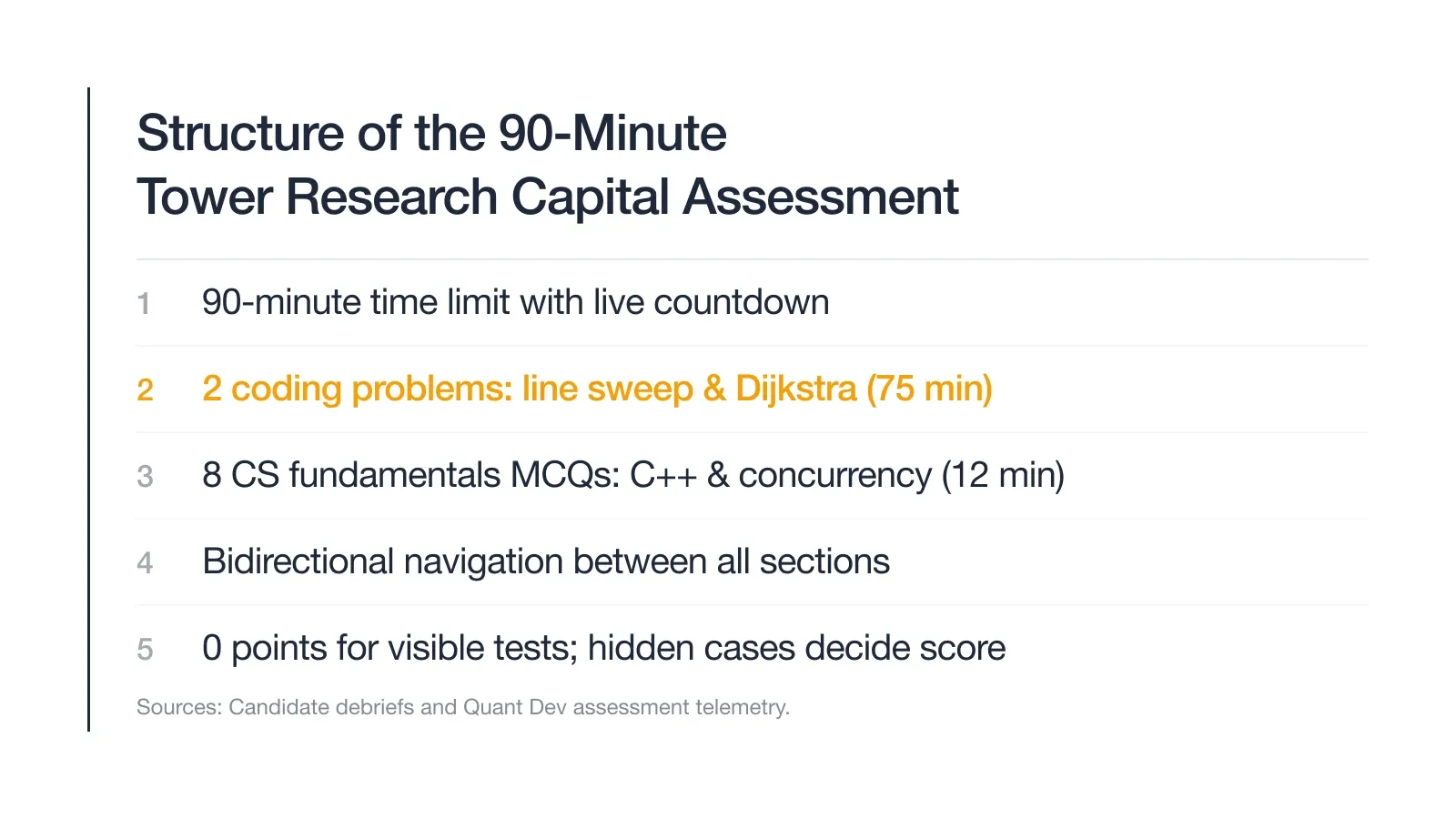
As the breakdown illustrates, the multiple-choice section focuses on systems programming topics rather than general software trivia. Questions cover virtual table layouts and struct memory padding. Also, they test atomic operations, cacheline false sharing, and spinlocks versus mutexes.
How Tower Research Capital's HackerRank Scoring Works
Tower Research Capital assigns zero points to visible sample test cases. Your coding score depends on passing hidden test cases. These evaluate scaling constraints and memory boundaries.
A solution running in $O(N^2)$ time often passes visible sample cases, but it fails hidden scale tests. Quantitative development tracks demand passing every hidden case alongside high multiple-choice accuracy.
| Score Band | Test Case Pass Rate | Multiple Choice Score | Candidate Outcome | Reported Context |
|---|---|---|---|---|
| 95% to 100% | 100% (both problems passed all hidden) | 7/8 or 8/8 | Advanced to Quant Dev Technical Phone Screen | LeetCode Discuss |
| 80% to 90% | Problem 1 100%, Problem 2 12/15 passed | 6/8 | Recruiter review; advanced if candidate profile fits systems engineering | LeetCode Discuss |
| 60% to 75% | Problem 1 passed, Problem 2 TLE on hidden | 5/8 | Rejection email within 5 business days | Reddit r/quantfinance |
| Flagged | Submission disabled or environment alert | N/A | Automatic rejection with no appeal granted | User evidence (PINNED) |
Scoring in the 80% to 90% range places your application in recruiter review. In this bracket, advancing depends on prior systems experience. Furthermore, code efficiency matters. Finally, falling below 80% results in rejection within five business days.
Tower Research Capital HackerRank Exam-Day Strategy
Therefore, I organized my 90-minute testing session around a strict chronological game plan. I completed all eight multiple-choice questions in the first twelve minutes. This banked 25% of the total score before facing coding pressure.
Once in the coding environment, I configured fast standard input and output streams immediately. In C++, untying standard input from standard output prevents flushing buffers on every read, which avoids unnecessary time overhead when reading $10^5$ records:
#include <iostream>

void setup_fast_io() {
    std::ios_base::sync_with_stdio(false);
    std::cin.tie(nullptr);
}
When an algorithm encounters time limit exceeded errors on hidden test cases, rewriting the entire solution under time pressure is risky. I verified input bounds first, eliminated dynamic memory allocations inside tight loops, and checked whether a difference array or monotone queue could replace nested searches.
Why Candidates Fail the Tower Research Capital Assessment
Analyzing rejected submissions reveals three recurring technical failure patterns. Also, one critical environment risk stands out.
First, candidates fall into hidden scale time limit traps. A nested $O(N^2)$ loop passes small visible cases. However, it times out when hidden tests scale to $10^5$ items.
Second, cumulative metrics cause silent 64-bit integer overflow. Aggregating $10^6$ volume across $10^5$ intervals exceeds $2^{31}-1$. Accumulators turn negative unless cast to 64-bit integers.
Third, candidates lose track of time debating multiple-choice questions. Spending twenty minutes analyzing subtle virtual inheritance edge cases leaves inadequate time to debug graph algorithms.
Finally, running background utilities triggers immediate rejection during automated audits. In a confirmed March 2026 attempt, a candidate ran a borderless desktop answer window behind the assessment window. During the check, the Submit control was replaced by a review alert. The test ended on the spot. Also, the recruiter refused the appeal.
That failure happened because desktop overlays render assistance on the exact screen proctoring software inspects. Our Cluely review examines how desktop overlays interact with window hooks. In live assessments, the platform queries window states directly. InterviewFox works on a different setup: answers push to your phone, a separate device outside screenshot and session monitoring.
Land offer with Safer AI Interview Assistant
Skip the risky invisible apps. Our dual-device mode keeps it simple and undetectable. You crush the interview, we handle the answers.
Get started. It's freeLoved by 100,000+ candidates
How to Prepare for the Tower Research HackerRank in 7 Days
I structured my seven-day schedule around the demands of Tower Research Capital's quant screen. Before the OA, I used the Prep Agent from InterviewFox via WhatsApp to review patterns. It returned a drill plan tailored to low-latency graph problems. Also, it mapped out interval practice drills.
Days 1 and 2 High-Frequency Patterns and Low-Latency DSA
I dedicated the first two days to mastering difference arrays, chronological line sweeps, and interval priority queue problems. Daily practice covered LeetCode 253 (Meeting Rooms II), LeetCode 56 (Merge Intervals), and LeetCode 732 (My Calendar III).
I skipped heavy dynamic programming on trees and complex string automata like Aho-Corasick. The screen focuses on interval sweeps, state-expanded shortest paths, and systems C++ mechanics. It avoids niche competitive programming tricks. My success check was completing each interval problem in under twenty-five minutes with clean $O(N \log N)$ complexity.
Days 3 to 5 C++ Internals Concurrency and Hidden Edge Cases
The middle three days focused on systems engineering theory and constrained graph algorithms. I drilled state-expanded Dijkstra implementations where node state tracks additional constraints such as congestion counts or fuel levels.
Next, for systems review, I studied C++ object layouts and virtual table pointers. I also practiced struct alignment and atomic reference overhead. Furthermore, I reviewed synchronization primitives, noting why spinlocks waste CPU cycles under high contention. Finally, my benchmark was implementing state-expanded Dijkstra from scratch in under thirty-five minutes.
Days 6 and 7 Timed Simulation and Clean Environment Check
During the final two days, I ran 90-minute timed mock tests under strict exam conditions on HackerRank. I solved one interval problem, one constrained graph problem, and eight systems questions within the 90-minute limit.
Before sitting for the real test, I validated my workstation setup. I disconnected all secondary monitors, closed background communication apps, and tested camera permissions to ensure a smooth environment audit.
What Happens After You Submit the OA
Once you submit the assessment, HackerRank's backend generates an automated audit report within 24 to 48 hours. The audit report details hidden test case pass rates, memory profiles, window focus changes, and clipboard logs.
Candidates meeting the passing benchmark receive outreach within three to seven business days. If your performance qualifies, the recruiter schedules a technical phone screen. Then, you speak directly with a senior Quantitative Developer.
The technical screen begins with a retrospective discussion of your HackerRank code. The engineer will ask you to explain complexity choices and alternative data structures. They also evaluate how your code behaves in a production trading engine. Expect live systems questions exploring C++ concurrency, cache setups, and network socket programming.
FAQ
How many questions are on the Tower Research Capital HackerRank test?
The assessment includes two coding coding problems and eight core computer science multiple-choice questions. You have 90 minutes to complete the entire test in a single sitting.
Does HackerRank proctoring detect secondary monitors or background windows during the Tower Research test?
Yes. Specifically, HackerRank monitors display configuration and active window focus. Connecting secondary monitors or running background overlay applications will trigger an environment integrity alert, which can lead to immediate rejection.
Can I use an AI tool or invisible app during the Tower Research Capital HackerRank OA?
Desktop overlays place answers on your screen through OS transparency tricks. This creates structural exposure as proctoring tools check background windows. InterviewFox eliminates this footprint by sending guidance to your phone outside desktop sweeps. A dual device AI interview assistant removes all text from your laptop screen, keeping the editor clean.
Land offer with Safer AI Interview Assistant
Skip the risky invisible apps. Our dual-device mode keeps it simple and undetectable. You crush the interview, we handle the answers.
Get started. It's freeLoved by 100,000+ candidates
What is the passing score cutoff for the Tower Research Capital HackerRank OA?
The benchmark cutoff is approximately 85% of total points. Advancing usually requires clearing all hidden test cases on both coding problems. Candidates should also score at least 6 of 8 on systems questions.
Can I use Python instead of C++ for the Tower Research HackerRank test?
While Python is available on the platform, C++ is strongly recommended for quant developer positions. Trading teams evaluate low-level systems knowledge. C++ provides predictable execution speeds that prevent hidden test case timeouts.
How long does Tower Research Capital take to respond after the HackerRank OA?
Recruiters follow up within three to seven business days after reviewing audit reports. Next, candidates who clear the threshold are invited to a technical screen. Then, they speak with a quant developer.