
I Passed the Visa CodeSignal in 2026: The Actual Questions and 7-Day Prep Plan

Quick Facts
| Company / Platform | Visa × CodeSignal General Coding Assessment (GCA), the visa codesignal SWE new-grad and intern OA. |
| Questions | 4 per test: 2 easy, 1 medium, 1 hard. |
| Time limit | 70 minutes, one sitting, no pause. |
| Total score | 600 points (CodeSignal GCA default for SWE). |
| Cutoff | ~540/600 earns a next-round look. |
| Proctoring | Camera plus browser focus monitoring; the Suspicion Score flags incidents. |
| AI-tool risk | A Desktop Overlay can get a finished score withdrawn. |
| Prep window | 7 days to prepare before the invite. |
I took the visa codesignal assessment for a new-grad SWE role in 2026, solved three of four questions, and finished with a passing score. What follows is the complete process and how I prepared for it.
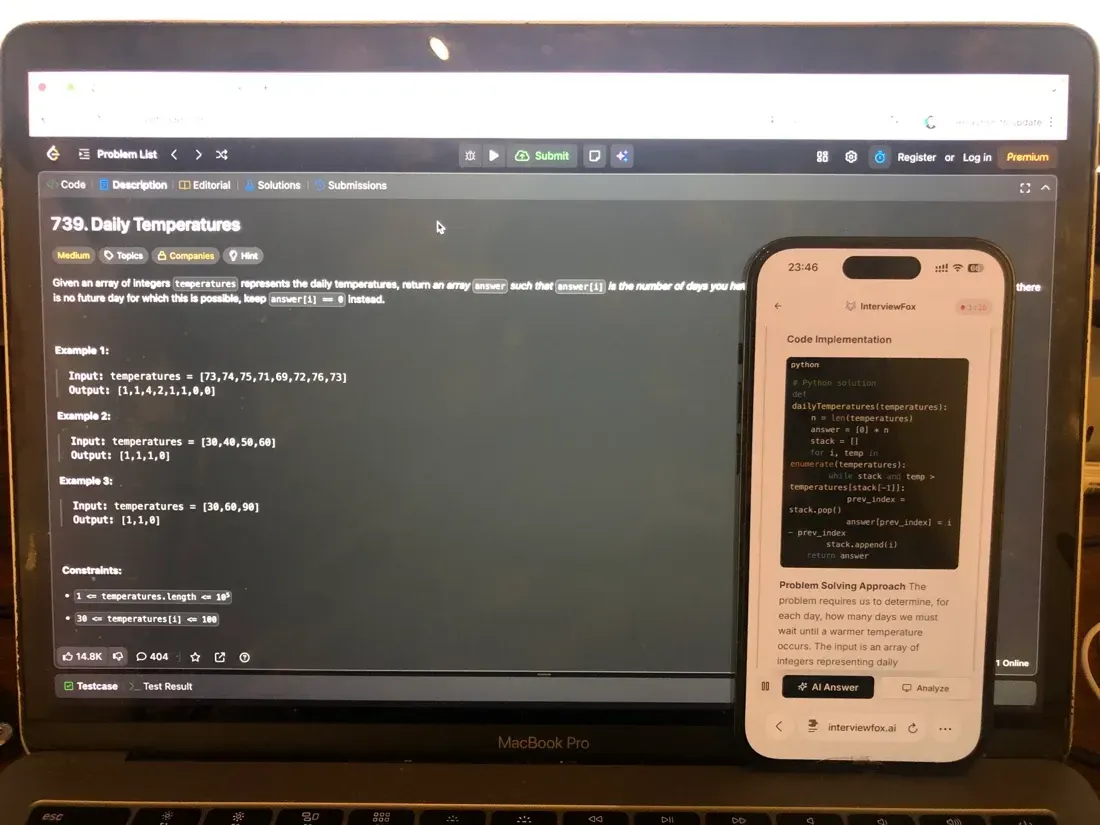
Question 3 was a verbose capacity queue simulation that did not click on the first read. For a few minutes I thought I might not get through it. When the capacity-queue problem stalled me, I leaned on an AI interview assistant on my phone, so the help never reached the proctored window.
Before my test, I went through every visa codesignal post from the past two years on Reddit, LeetCode Discuss, and Teamblind. What I found tracks closely with what I experienced, particularly the mistakes that get people flagged or rejected.
The Real Questions on My Visa CodeSignal Test
My visa codesignal test delivered four questions in seventy minutes, two easy, one medium, and one hard. The chart below shows how that difficulty split landed and where the time went.
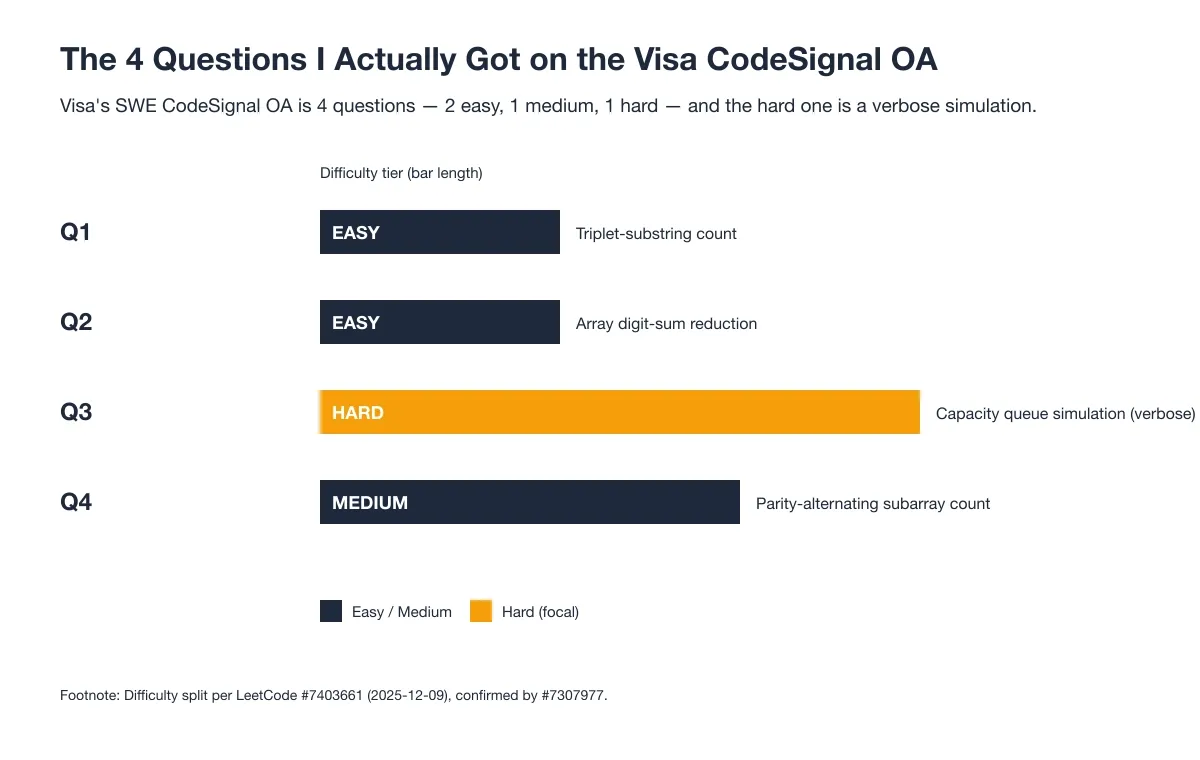
I sat the Visa SWE new-grad CodeSignal General Coding Assessment: 70 minutes, 4 questions, 600 points. I remember the broad shape of each question, in the order they appeared.
Question 1: Short-Window String Count
The first question was a clean string warm-up that set the pace for the rest of the test.
What I Remember: I remember a short string-counting task built around checking a small, fixed-length window.
A Similar Public Problem: LeetCode 1876 — Substrings of Size Three with Distinct Characters. Count each substring of length three whose characters are all different.
My approach: I checked each length-three window once and counted it when it contained three distinct characters.
def count_good_length_three_substrings(s: str) -> int:
    count = 0
    for start in range(len(s) - 2):
        window = s[start:start + 3]
        if len(set(window)) == 3:
            count += 1
    return count
Time complexity: O(n) | Space complexity: O(1)
This was the warm-up and I cleared it in under five minutes, which settled my nerves for the harder ones.
Question 2: Number Transformation
Question 2 was another concise task, and I remember needing to handle the numeric transformation carefully.
What I Remember: I remember a number-focused task where careful digit handling mattered more than using a complex data structure.
A Similar Public Problem: LeetCode 258 — Add Digits. Repeatedly add the decimal digits of a non-negative integer until only one digit remains, then return it.
My approach: I summed the current number's digits and repeated that process while the result still had more than one digit.
def add_digits(num: int) -> int:
    while num >= 10:
        digit_total = 0
        while num > 0:
            digit_total += num % 10
            num //= 10
        num = digit_total
    return num
Time complexity: O(log n) | Space complexity: O(1)
Straightforward, but I paused briefly to check the boundary cases before moving on.
Question 3: Queue and Event Simulation
This was the verbose hard question everyone warned about, and it ate most of my remaining time.
What I Remember: I remember a queue or event-simulation task. Following how the system changed from one event to the next took the most concentration.
A Similar Public Problem: LeetCode 622 — Design Circular Queue. Implement a fixed-capacity first-in, first-out queue whose indices wrap around so freed slots can be reused.
My approach: I stored queue values in a fixed-size array and tracked the front index and current size. The rear position follows from those two values, with modulo arithmetic wrapping each index back to the start of the array.
class MyCircularQueue:
    def __init__(self, capacity: int):
        self.data = [0] * capacity
        self.front = 0
        self.size = 0

    def enQueue(self, value: int) -> bool:
        if self.isFull():
            return False
        rear = (self.front + self.size) % len(self.data)
        self.data[rear] = value
        self.size += 1
        return True

    def deQueue(self) -> bool:
        if self.isEmpty():
            return False
        self.front = (self.front + 1) % len(self.data)
        self.size -= 1
        return True

    def Front(self) -> int:
        return -1 if self.isEmpty() else self.data[self.front]

    def Rear(self) -> int:
        if self.isEmpty():
            return -1
        rear = (self.front + self.size - 1) % len(self.data)
        return self.data[rear]

    def isEmpty(self) -> bool:
        return self.size == 0

    def isFull(self) -> bool:
        return self.size == len(self.data)
Time complexity: O(1) per operation | Space complexity: O(k), where k is the queue capacity
I left this until last and had only about 18 minutes. I got a working pass in place, but I could not finish checking the edge cases before time ran out, so I did not get a clean full solve on the hardest question.
When Question 3 started to slip, I used the dual-device Coding Assistant on AI interview helper. I captured the problem and it pushed the approach to my phone, a separate device no CodeSignal screenshot or screen recording can reach. My laptop screen stayed exactly as the proctor saw it, and I got back on track in time to lock in a partial solve.
Land offer with Safer AI Interview Assistant
Skip the risky invisible apps. Our dual-device mode keeps it simple and undetectable. You crush the interview, we handle the answers.
Get started. It's freeLoved by 100,000+ candidates
Question 4: Alternating Sequence Count
I remember this as a medium counting task built around alternating runs in a sequence.
What I Remember: I focused on extending the current run when the next value alternated with the previous one, then adding the valid run lengths.
A Similar Public Problem: LeetCode 3101 — Count Alternating Subarrays. For a binary array, count the contiguous subarrays in which adjacent values differ.
My approach: I tracked how many alternating subarrays ended at the current index. If the current value differed from the previous one, each alternating subarray ending at the previous index could extend by one; otherwise, the run restarted at length one.
def count_alternating_subarrays(nums):
    total = 0
    run = 0

    for index, value in enumerate(nums):
        if index > 0 and value != nums[index - 1]:
            run += 1
        else:
            run = 1
        total += run

    return total
Time complexity: O(n) | Space complexity: O(1)
I lost a couple of minutes checking boundary cases, then corrected the issue and submitted with time to spare before the hard question dragged on.
Visa's Proctoring Policy for CodeSignal
Visa's CodeSignal run is proctored end to end, and the monitoring is stricter than most candidates expect. Know the rules before you open the test, because a small slip can undo a clean solve.
Camera and Browser Focus Monitoring
CodeSignal GCA records your camera and your browser focus events through the whole session. The official proctoring setup watches both identity and attention, so the test is not a casual at-home attempt you can walk away from mid-question.
What Triggers a Suspicion Flag
Resizing the window or leaving the tab fires a focus event that the system logs. CodeSignal's Suspicion Score then auto-flags possible code-integrity incidents for human review. CodeSignal warned one candidate to keep eyes on the screen and use no notepad or pen.
Offline and Onsite Variants
Some candidates sit the test at a Visa office or a college lab rather than at home. The exact verification parameters for those sessions are not always disclosed, so the at-home rules above do not describe every variant you might face.
3 Other Confirmed Visa CodeSignal Questions
Beyond my own set, other candidates have reported a steady pool of question types that repeat across Visa SWE assessments. These are reference items pulled from separate primary reports, not part of my exam day.
Question: Pattern-Printing Square
A 2025 on-campus intern report lists a pattern-printing square as its first question: print an n by n grid following a fixed pattern. The exact pattern rule was not spelled out beyond the grid size, so I cannot give a faithful solution without inventing the shape.
Treat it as a straightforward nested-loop print and practice clean index math.
Question: Reverse-Vowel String
Another reported easy question reverses a string only when both the first and last characters are vowels, and keeps that boundary vowel in place. The mechanic is a conditional two-pointer reverse. The precise handling of inner characters was not fully documented, so confirm the rule against your own invite rather than assume a full reversal.
def reverse_vowel_string(s: str) -> str:
    arr = list(s)
    if arr and arr[0] in 'aeiouAEIOU' and arr[-1] in 'aeiouAEIOU':
        i, j = 0, len(arr) - 1
        while i < j:
            arr[i], arr[j] = arr[j], arr[i]
            i += 1
            j -= 1
    return ''.join(arr)
Time complexity: O(n) | Space complexity: O(n)
Question: Text Justification Variant
A hard question appears as a LeetCode 68 style text justification with modifications. The base problem packs words into lines of a fixed width with spaced-out gaps, which is already a careful two-pointer and gap-distribution exercise.
The reported modification was not specified in enough detail for a working solution, so drill the standard LC 68 first and adapt on the day.
Question: Matrix Y-Shape Min-Changes
An older 2024 report describes a medium matrix problem: find the minimum cell changes to form a Y-shaped pattern. The report is more than a year old and serves as a structural reference rather than a confirmed current question.
The shape rule varies by account, so I note it as a possible matrix-difference exercise and do not claim a fixed solution.
What Visa's CodeSignal Test Format Actually Looks Like
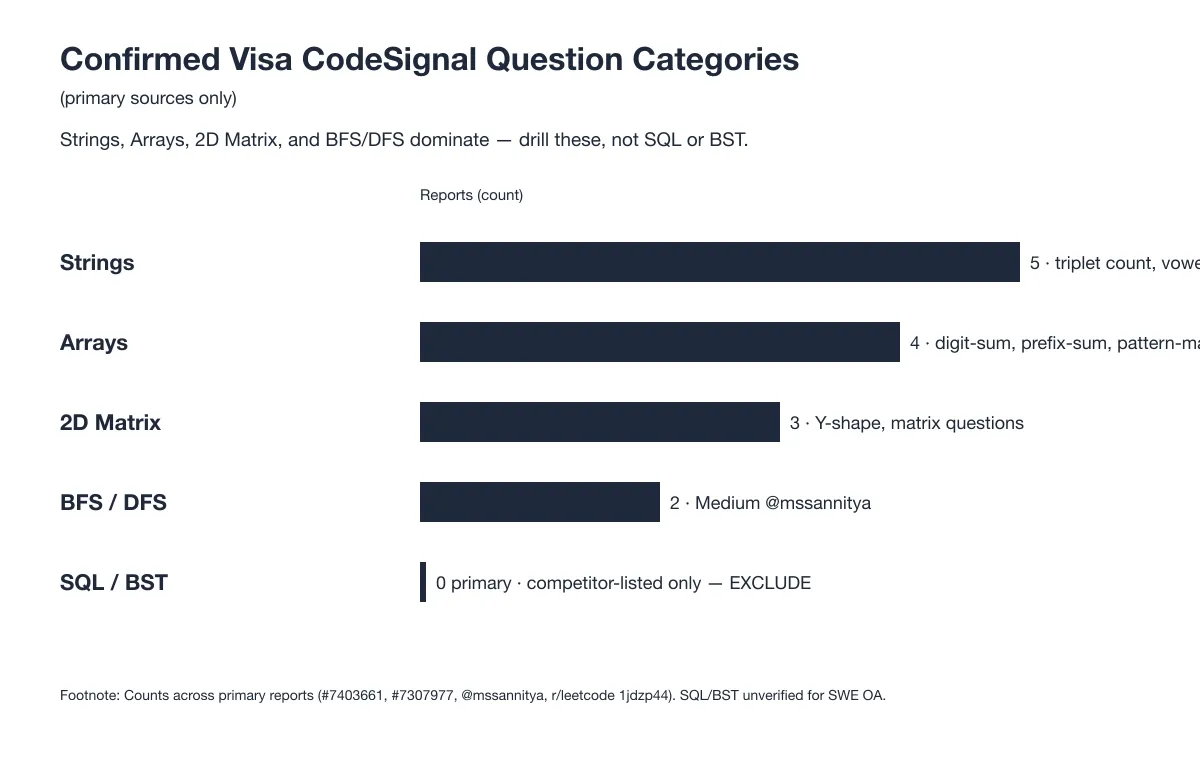
The visa codesignal assessment runs on a fixed format you can plan around, and the confirmed question categories cluster into a few drillable areas. The chart below breaks down how often each category shows up across primary reports.
70 Minutes for 4 Questions
Seventy minutes for four questions is the authoritative limit across six primary sources. A single 90-minute report exists on LinkedIn, but it is uncorroborated and should be treated as an outlier, not your planning baseline. Build your timing practice around 70 minutes.
600 Points, Proctored End to End
The test scores on CodeSignal's 600-point GCA default scale, with camera and focus monitoring active the entire time. A few comments cite a 1200 scale, but that is unverified and not the SWE norm, so track your progress against the 600 scale only.
How Visa's CodeSignal Scoring Works
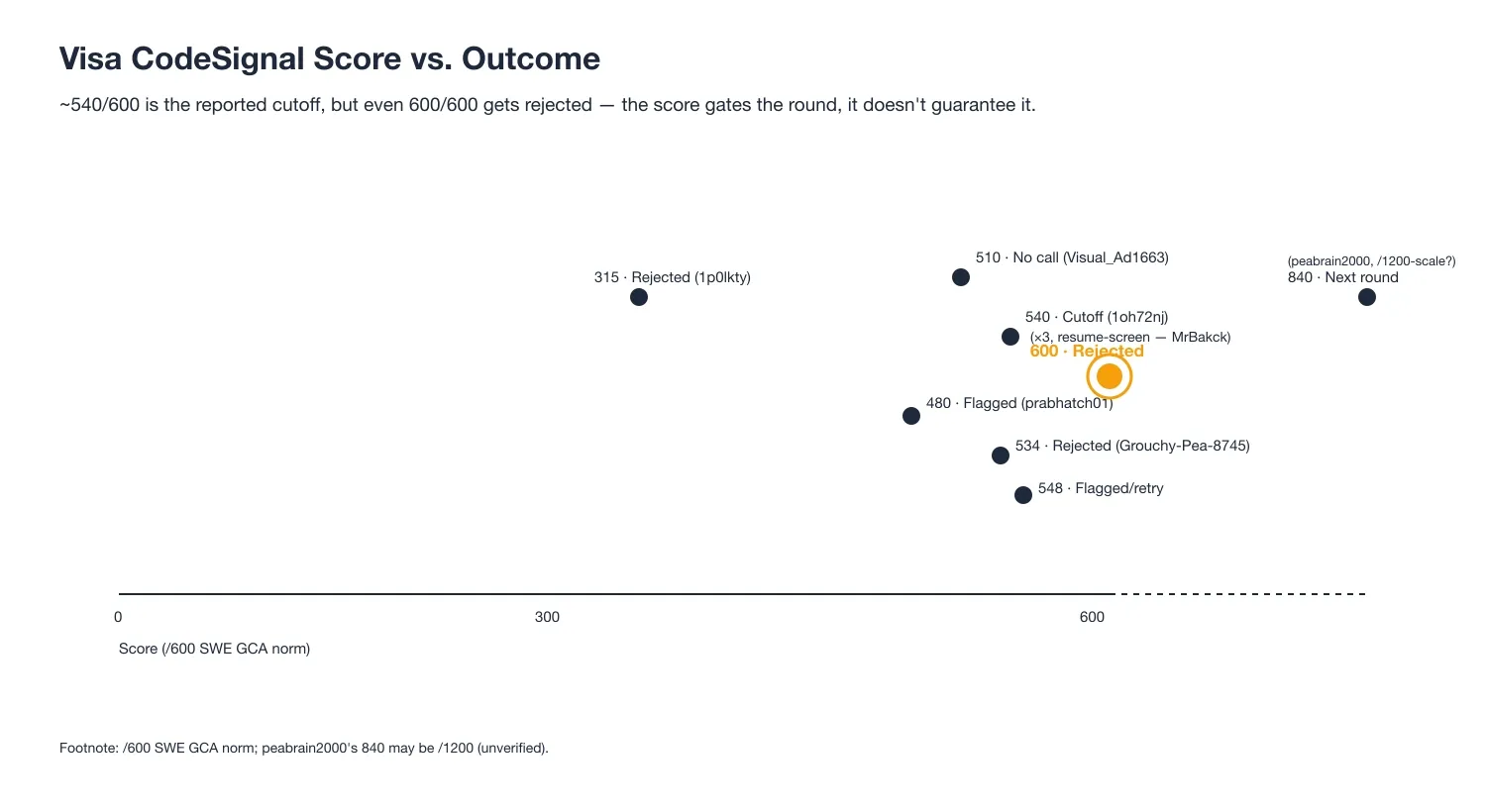
Visa's CodeSignal score gates the round without guaranteeing it, and the outcome data shows a wide spread between raw points and actual callbacks. The chart below maps reported scores to their outcomes, including a maximum score that still got rejected.
The 540/600 Cutoff Consensus
Roughly 540 out of 600 is the recruiter-stated cutoff for a next-round look, and two independent threads name that same number. Aim to clear about three and a half of the four questions to land in that band with margin.
Why 600 Isn't Automatic
A perfect 600 does not mean an automatic interview, because resume screening runs with or after the OA. Multiple candidates who scored 600 of 600 still reported rejection, and a 510 score heard nothing back at all. The code score opens the door; it does not carry you through.
Score Verification Timing
Results typically post about one week after submission, with some candidates waiting six days. Plan your follow-up timeline around that window rather than expecting an instant verdict.
Visa CodeSignal Exam-Day Strategy
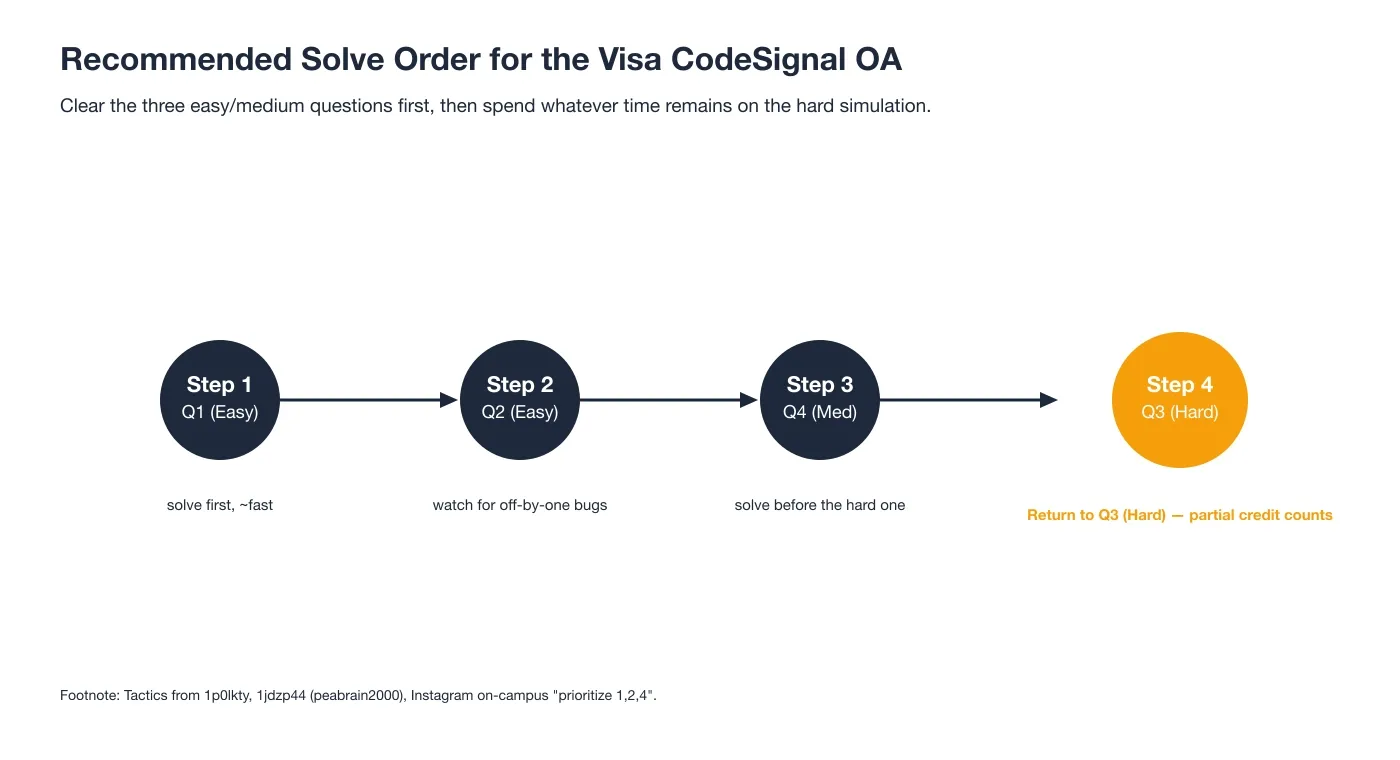
The visa codesignal reddit and LeetCode accounts agree on one thing: exam-day order matters more than raw skill. The chart below shows the solve order that protects your partial credit on the hard question.
Solve Easy First, Skip the Hardest
Do questions one, two, and four first, then return to the hard simulation. The easy and medium items are where most of your points sit, and the hard question still pays partial credit if you run out of time. Clear the safe points before the verbose one eats your clock.
Don't Thrash Between Questions
Stay inside one problem until you have squeezed it dry before moving on. Constantly switching between questions wastes the focus you need to debug, and several failed attempts trace straight back to that hopping habit. Pick, commit, and only pivot on a plan.
What Getting Stuck Costs You
One attempt ended at 315 of 600 after the candidate locked onto the hard simulation and shipped a bug on question two. That is a concrete, named-cause failure: wrong solve order plus one careless error sank an otherwise solvable test. The hard question is a trap only if you let it consume the easy points.
Why Candidates Fail the Visa CodeSignal Assessment
Most visa codesignal assessment failures come from process violations and time mistakes, not from weak algorithms. The patterns below repeat across private cases and public mechanic reports.
Desktop Overlay Gets Caught
One private case shows the risk without any public post behind it. A candidate completed the test with a Desktop Overlay, but the score was later withdrawn and the next interview canceled. The overlay rendered AI answers as a hidden layer over the exam browser, and the exposure surfaced after submission.
The structural exposure is the issue, not any one detection rule: AI interview tool puts the answer on my phone, a physically separate device no CodeSignal screenshot or screen recording can reach, so the overlay problem never arises.
Land offer with Safer AI Interview Assistant
Skip the risky invisible apps. Our dual-device mode keeps it simple and undetectable. You crush the interview, we handle the answers.
Get started. It's freeLoved by 100,000+ candidates
How CodeSignal's Suspicion Score Flags You
A hidden overlay or screen-share tool causes browser focus loss, which trips a focus-event flag and sends the session to review. A 548 score drew a flag and a retry with a warning to look only at the screen. A perfect 600 was marked unverified. A 1200 was flagged despite nothing unusual happening in the session.
Time Mismanagement and the Hardest Question
A non-AI failure mode is pure solve order, as the 315-of-600 attempt above showed when a bug on question two sank it. Flags can also arrive silently after you submit, not during the test, so a clean live session is no guarantee the score will stand.
How to Prepare for the Visa CodeSignal in 7 Days
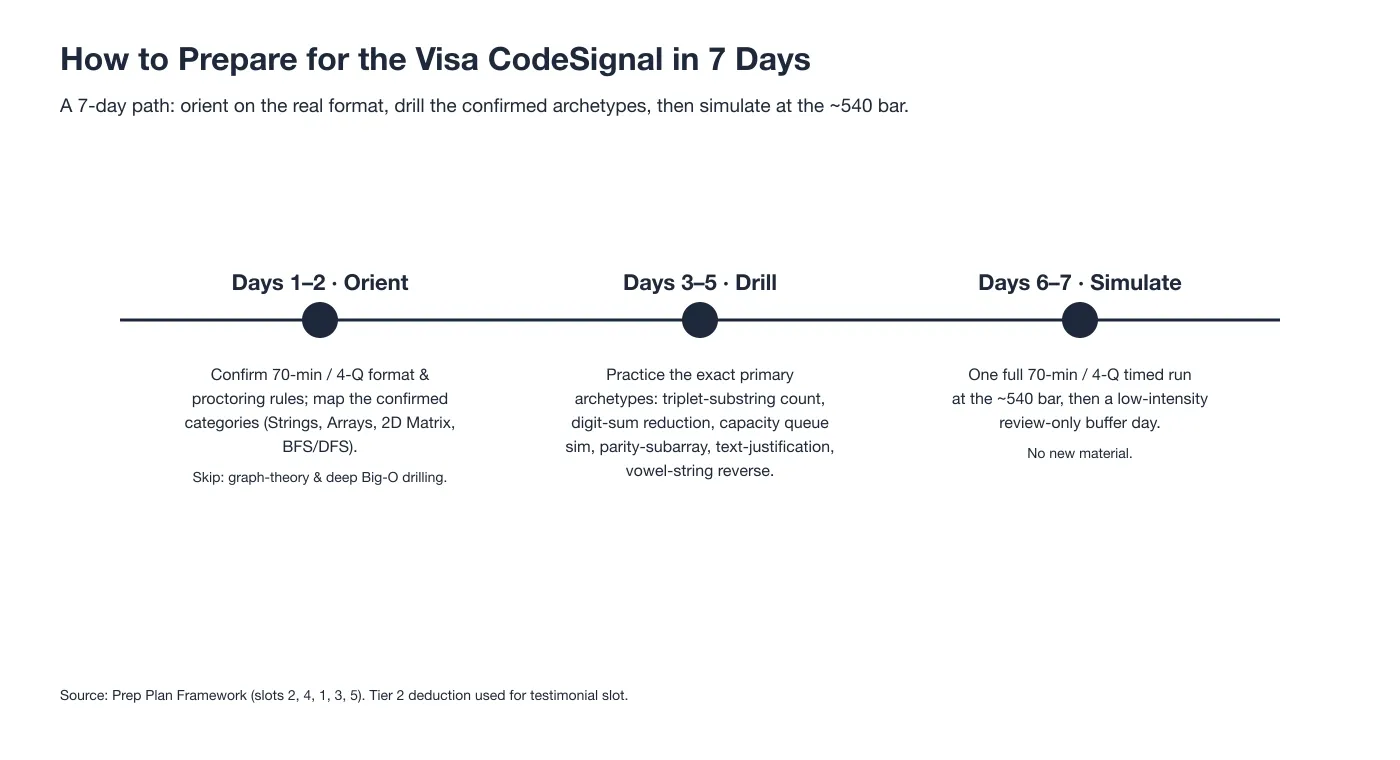
A 7-day window is enough if you orient on the real format, drill the confirmed archetypes, then simulate at the 540 bar. The chart below lays out that path day by day.
Days 1-2: Orient
I confirmed the 70-minute, four-question format and the proctoring rules before writing a single line of code. I mapped the confirmed categories: strings, arrays, 2D matrix, and BFS or DFS.
I skipped graph-theory drilling because the confirmed SWE pool has never included graph problems. I skipped deep Big-O drilling because the failure mode here is proctoring violation and time mismanagement, not weak algorithms.
Days 3-5: Drill
I practiced the exact primary archetypes the real tests use: triplet-substring count, digit-sum reduction, capacity queue simulation, parity-alternating subarray, text justification, and vowel-string reverse. Repetition on those shapes built the pattern recognition the timed test punishes you for lacking.
I also ran my drill plan through the Prep Agent on interviewfox.ai, over WhatsApp, so the practice problems arrived as spaced prompts and I could rehearse the archetypes on my phone between study blocks.
Days 6-7: Simulate + Buffer
I ran one full 70-minute, four-question timed block at the 540 bar, then spent the final day on low-intensity review only. No new material went in on the last day, because the goal was to walk in calm and rehearsed, not to learn something new under pressure.
What Happens After You Submit the OA
Submission is not the end of the loop, and the wait that follows has its own predictable shape. Knowing the timeline keeps you from misreading silence as rejection.
The Verification Wait
Results land about six days to a week after you submit. That window is normal, so do not read a quiet few days as a bad sign or flood the recruiter before it closes.
Interview Sequence After OA
A first technical interview typically follows about a week after results post. From there the loop runs technical rounds twice and HR or managerial rounds twice, then an offer or a redirect, with a background check taking three to four weeks.
When a Top Score Still Goes Nowhere
A 600 of 600 candidate reported no callback, and a 510 heard nothing back. Resume screening runs alongside the OA, so a strong code score is necessary but not sufficient. Keep your resume and the rest of the loop in shape while you wait.
Visa's Silent Benchmark: A 600 Score Isn't a Guaranteed Interview
Visa's CodeSignal has a quiet benchmark that the score alone does not capture: a maxed-out attempt can still go nowhere. This pattern surprises candidates who treat the OA as the whole gate.
The 600/600 Rejection Pattern
One candidate passed perfectly three times and was rejected each time, while another hit 510 of 600 and never heard back. The code score cleared the bar and the loop still closed, which tells you the OA is a filter, not a ticket.
Resume Screening Runs With the OA
Multiple accounts describe a benchmark plus a resume review after submission, so the score gates the round but is not enough on its own. The review runs in parallel with your code result rather than after it clears.
What This Means for Your Prep
Treat the OA as a threshold, not a trophy, and keep your resume and the rest of the loop in shape alongside the coding bar. A clean 600 means little if the surrounding packet does not hold up.
Visa's Other OA Platform: The HackerRank Route
Some Visa roles route through HackerRank instead of CodeSignal, and confusing the two will wreck your prep. Check the invite before you build a study plan.
Some Visa Roles Use HackerRank
Glassdoor reports for the Visa new-grad SWE role describe three HackerRank questions, two easy and one medium, in about 90 minutes. Graduatesfirst lists HackerRank or LeetCode as Technical Challenge alternatives, so the platform is role dependent.
Don't Confuse the Two
If your invite says CodeSignal, expect 70 minutes, four questions, and 600 points. If it says HackerRank, expect the shorter three-question set on a different clock. Verify the invite before prepping so you train for the right format.
FAQ
What questions are on the visa codesignal assessment?
The visa codesignal assessment gives four questions: two easy, one medium, and one hard. Confirmed types include triplet-substring count, digit-sum reduction, a capacity queue simulation, and a parity-alternating subarray count. Practice those exact archetypes rather than generic random problems.
Does the visa coding assessment use the same format for every role?
No. Most SWE new-grad invites use CodeSignal with 70 minutes and four questions. Some roles route through HackerRank with three questions in about 90 minutes. Read your invite and prep for the platform it names.
What does the visa codesignal reddit community say about the test?
The threads agree that solving the easy and medium questions first protects your score, and that the hard simulation eats time if you start it too early. They also warn that a high score is no guarantee of a callback because resume screening runs in parallel.
Does Visa use HackerRank instead of CodeSignal for the coding assessment?
Yes, for some roles. Glassdoor reports three HackerRank questions for the new-grad SWE role, while CodeSignal is the more common SWE OA. Confirm which platform your specific invite lists before you start studying.
Can Visa's CodeSignal detect AI tools or invisible apps?
Yes. CodeSignal records browser focus events, so a hidden overlay or screen-share tool causes focus loss and a flag. A private case saw a completed test withdrawn after a Desktop Overlay was used, and the next interview was canceled.
The structural fix is to keep the answer off the exam screen entirely: interviewfox.ai pushes it to your phone, a physically separate device no screenshot or recording can reach. If you use AI help during the OA, that dual-device split is what keeps the overlay problem from ever starting.
What score do I need to pass the visa codesignal assessment?
Roughly 540 out of 600 is the recruiter-stated cutoff for a next-round look. Aim to solve about three and a half of the four questions. A perfect 600 still does not guarantee an interview because resume screening runs alongside the OA.
Land offer with Safer AI Interview Assistant
Skip the risky invisible apps. Our dual-device mode keeps it simple and undetectable. You crush the interview, we handle the answers.
Get started. It's freeLoved by 100,000+ candidates