
How I Took Visa HackerRank in 2026: The Actual Questions and Prep Plan

Quick Facts
| Assessment | Visa HackerRank in 2026 |
| Narrator's variant | Three questions, about 90 minutes, SWE new-grad |
| Wider early-career pool | Three or four questions, with reported timings from 70 to 110 minutes |
| Question families | 3Sum-like arrays, stacks, DP/greedy, trees, graphs, and strings |
| Score | Not always visible; no public Visa threshold is verified |
| Proctoring | No universal Visa configuration is publicly verified |
I took the Visa HackerRank assessment for a 2026 SWE new-grad process. I faced three questions in 90 minutes: a 3Sum-like array task, a stack problem, and a DP/greedy problem. The third problem remained unresolved. I cover the reported format pool, scoring evidence, failure patterns, and my seven-day preparation plan.
The DP/greedy choice was still unresolved as the 90-minute clock closed. I used an AI interview assistant to compare the greedy direction with a DP-style stored-state approach. The comparison was clearer. I return to that friction in the Question 3 walkthrough below.
Before my test, I reviewed Visa HackerRank posts from the past two years. I could access reports on Reddit, LeetCode Discuss, and Teamblind. The format variations and pressure around the hardest question matched my experience.
The Real Questions on My Visa HackerRank Test
My 2026 SWE new-grad version had three questions. It moved from a 3Sum-like array task to a stack problem and then a DP/greedy problem. I kept my notes focused on that sitting.
Question 1: 3Sum-like array task
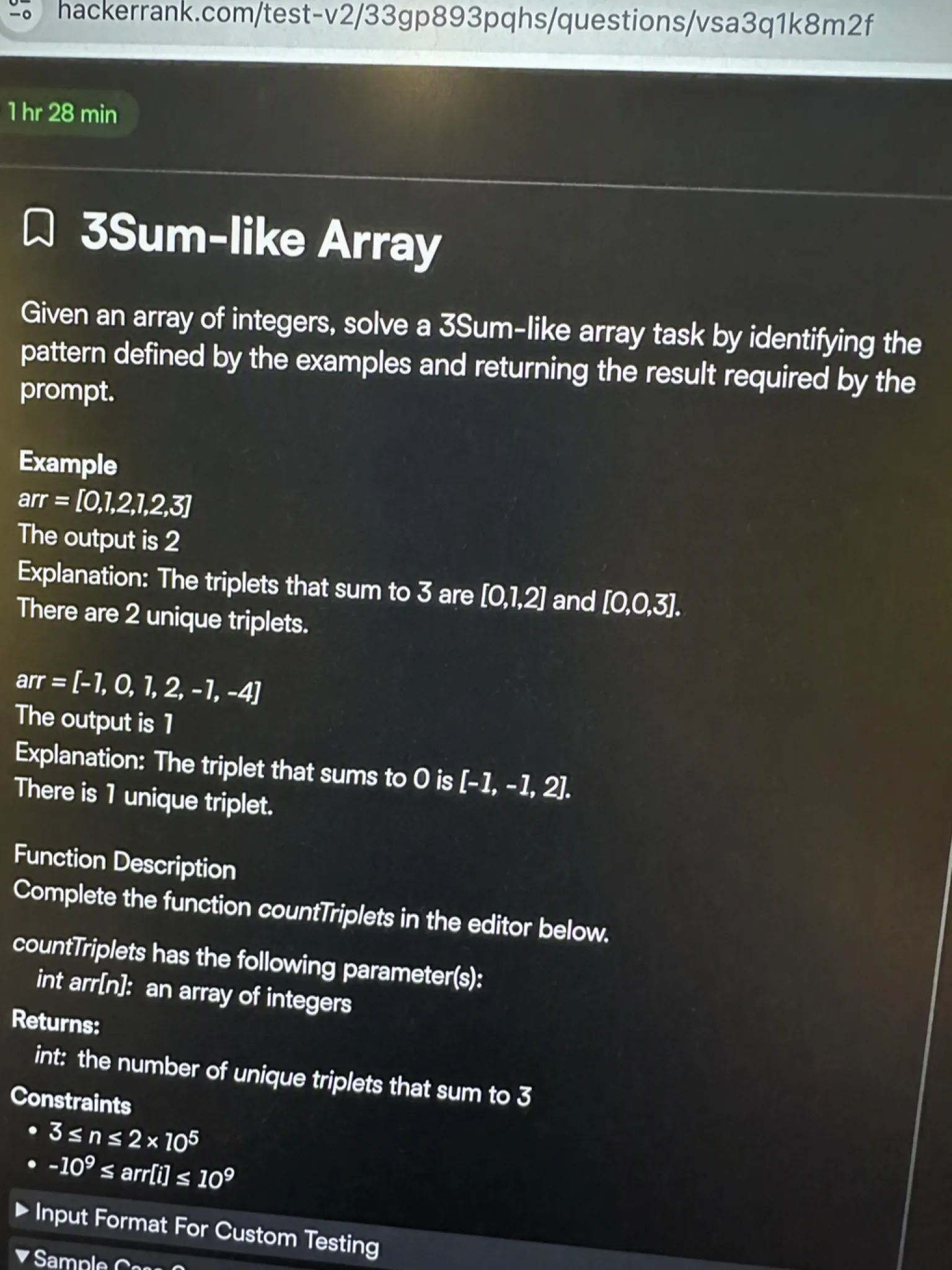
The problem I got: The first problem I got was a 3Sum-like array task. I treated it as an array problem and read through the examples before choosing a direction.
My approach: I looked for the pattern behind the examples and tried to keep the search from becoming a blind list of cases. I worked through the basic examples first, then moved on once I had a workable direction.
The first question gave me a pattern to chase, but I still checked the examples before moving on. I did not want to spend the whole sitting forcing a textbook solution onto a prompt that only looked familiar at first glance.
Question 2: Stack problem
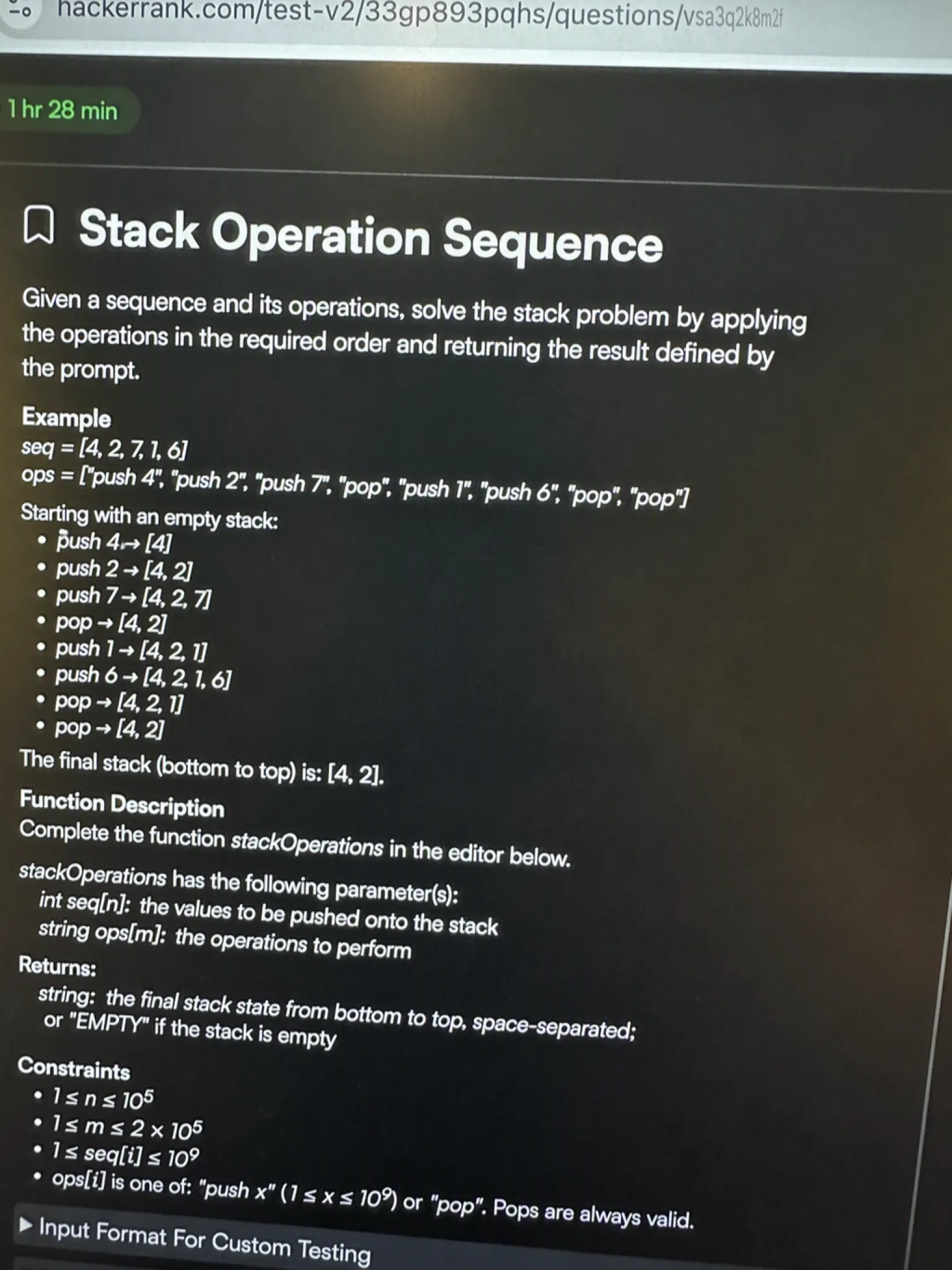
The problem I got: The second problem I got was a stack problem. I treated the sequence and the order of its operations as the main structure of the question.
My approach: I kept the stack idea simple and walked through the examples before moving on. I used those examples to check that I was applying the operations in the right order.
This question felt more mechanical than the first. I kept moving instead of spending extra time polishing it while the final problem was still waiting.
Question 3: DP/greedy problem
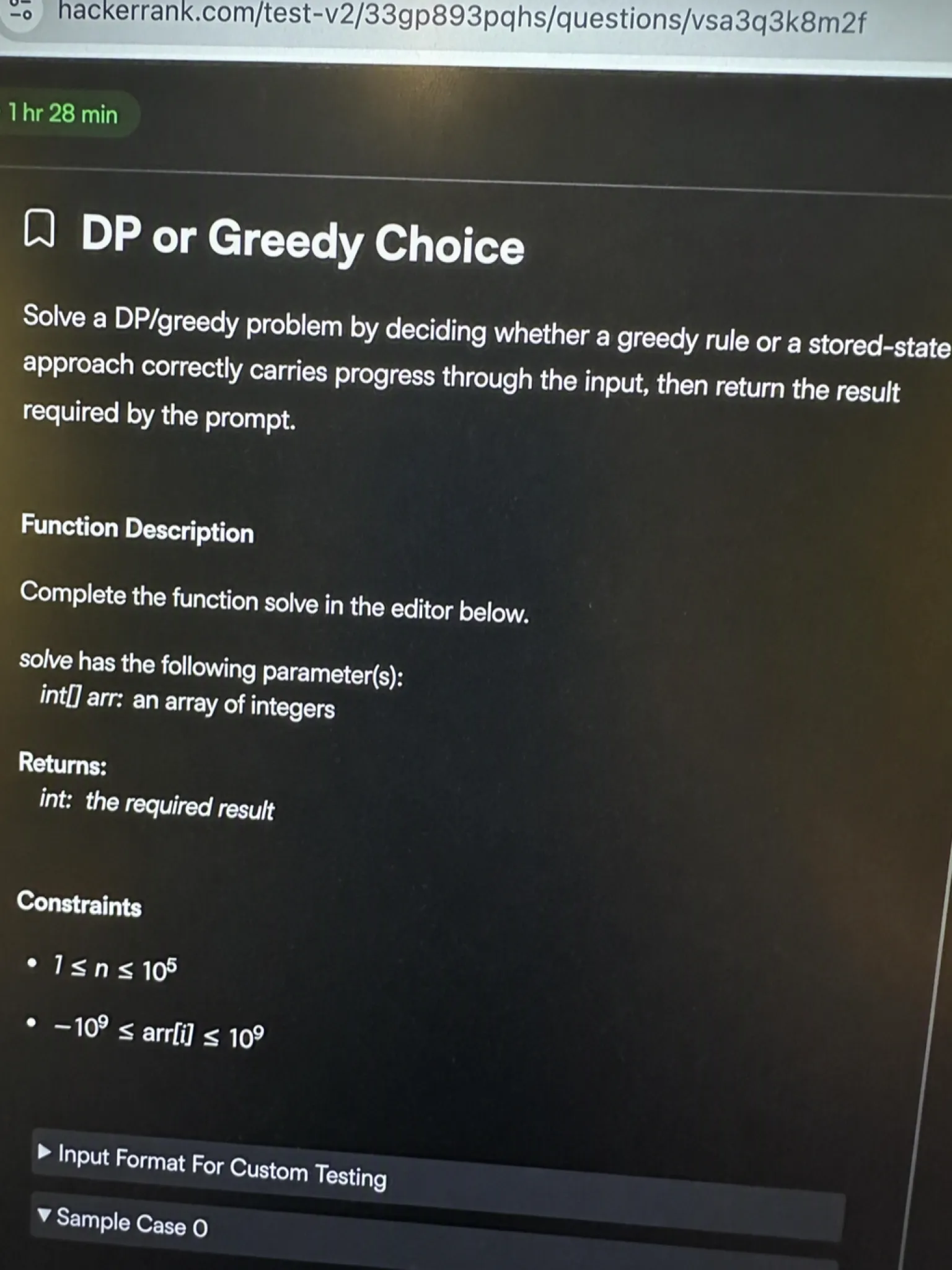
The problem I got: The third problem I got was a DP/greedy problem. It was the hardest question in my sitting because I had to choose a direction while the clock was running.
My approach: I compared a greedy direction with a DP-style way of carrying progress forward. I spent the most time deciding which line of reasoning matched the problem.
This was where the 90-minute window started to feel tight. I spent time switching between a greedy rule and a stored-state solution, and I finished the exam with that friction still unresolved.
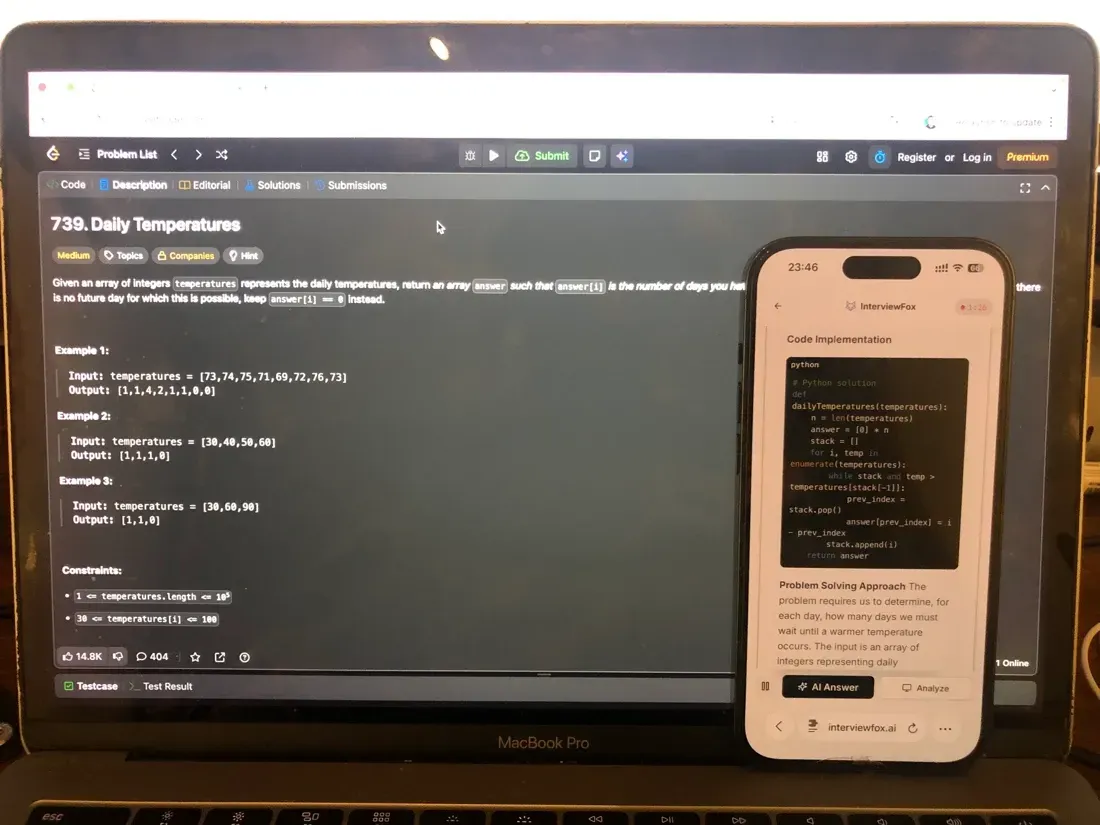
I did not want a desktop overlay. It would put the answer on the screen monitored by the proctoring system. The hidden rendering layer added uncertainty. On the DP/greedy question, I used the InterviewFox keyboard shortcut. It auto-captured the problem and pushed the answer to my phone, a separate device outside the platform’s screenshot monitoring. The greedy direction became clear. My laptop screen stayed on the exam editor unchanged.
Land offer with Safer AI Interview Assistant
Skip the risky invisible apps. Our dual-device mode keeps it simple and undetectable. You crush the interview, we handle the answers.
Get started. It's freeLoved by 100,000+ candidates
The four-question variants belong to separate role and cycle cases in the wider evidence pool. They were not extra questions from this sitting. These three descriptors stay bounded because exact prompt text, constraints, and runnable solutions were unavailable.
Visa’s Proctoring Policy for HackerRank
Visa’s exact setup is not publicly verified
I could not verify a universal Visa configuration for HackerRank in the public evidence. I found no dated, Visa-specific public AI-detection case.
The only proctored-test detail I could verify is role-specific. It does not establish a new-grad policy. The staff-level proctoring report is role-specific, not Visa-wide.
HackerRank features do not automatically become Visa settings. I could not verify which controls ran on a Visa new-grad assessment. The private October 2025 incident appears later. It is a specific withheld-score case, not proof of a universal configuration.
HackerRank controls can leave integrity signals
An invisible overlay scored 25%. AI-plagiarism flags above 0.99 appeared in HackerRank’s 2025 integrity experiment.
The test enabled tab proctoring, copy-paste detection, and AI-plagiarism detection. Image proctoring was off. I treat this as platform-level evidence, not a Visa assessment record.
That boundary leaves an open question: what could the platform inspect when an employer enables more controls? The broader HackerRank detection picture explains those layers. I do not treat them as Visa policy.
Copy-paste detection raises a narrower question. The copy-paste trail explains why pasted lines stay visible to reviewers. No Visa-specific setting is confirmed here.
The tab setting raises a different boundary. The tab-switch record distinguishes focus from destination-tab content. That is the limit I can support for this assessment.
The confirmed controls cover selected features, not every HackerRank test configuration. I treat tab activity, copy-paste activity, and AI-plagiarism signals as platform-level risks to understand. Visa’s exact setup remains unresolved.
1 Other Confirmed Visa HackerRank Questions
Question 1: String Pattern Recognition
A February 2026 internship variant included an item named “String Pattern Recognition.” It was a four-question, 90-minute assessment. I could not verify the exact statement, constraints, remaining questions, score, or outcome. I do not turn the title into a fabricated solution.
This is the only distinct current named question outside my three-question sitting that clears the evidence bar. Older on-campus examples include more problem summaries. Their experience date is ambiguous, so they do not establish a 2026 question set.
What Visa’s HackerRank Test Format Actually Looks Like
I compare early-career variants as a pool. I do not claim one Visa default. The chart keeps role, cycle, question count, and timing differences visible.
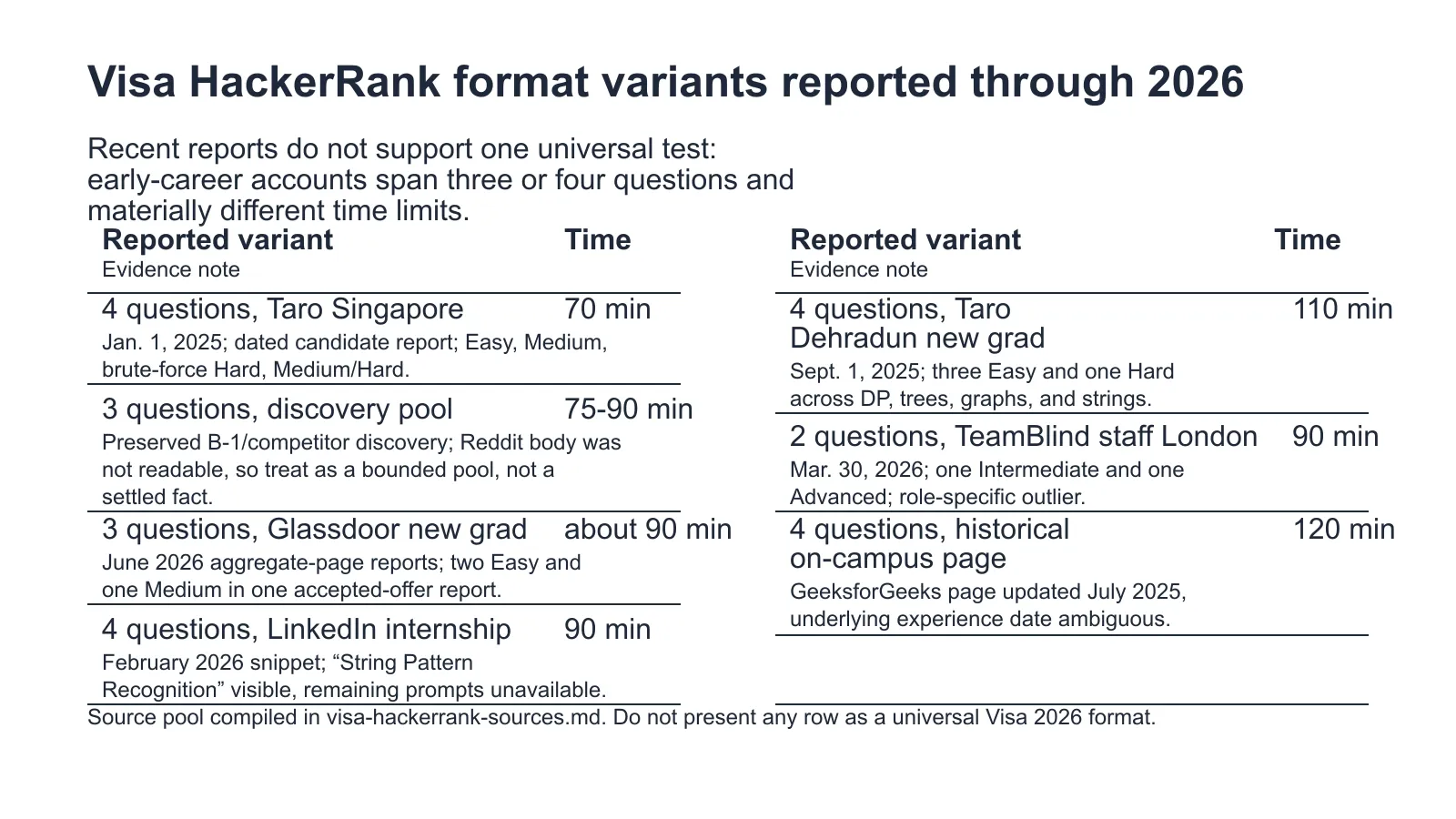
Early-career reports split between three and four questions
Recent early-career cases include three-question assessments around 90 minutes. Other cases have four questions in 90 or 110 minutes. A separate Singapore case has four questions in 70 minutes. The staff-level London case had two questions in 90 minutes. I keep it outside the new-grad default pool.
The February 2026 internship variant had four questions in 90 minutes. It showed the title “String Pattern Recognition.” The Glassdoor three-question cases stay apart from the Taro four-question cases. They are not pieces of one fixed exam.
Reported time limits span 70 to 110 minutes
The usable timing pool runs from 70 to 110 minutes. I keep a bounded 75-to-90-minute discovery range. However, I could not read the underlying Reddit body. I do not present that range as a settled Visa fact.
For early-career planning, I would prepare for a shorter four-question pace. I would also prepare for a longer three- or four-question sitting. The 120-minute on-campus case remains historical context because its experience date is ambiguous.
How Visa’s HackerRank Scoring Works
Score visibility is not guaranteed
One June 2026 new-grad variant ended without a visible score. An email for a technical interview followed. I read this as evidence that progression can occur without a numeric score. It is not evidence of a hidden cutoff.
I found no public, dated, role-matched Visa threshold. I also found no verified rule for per-question weighting, normalization, partial credit, automatic rejection, or time bonuses. The safest answer is that score mechanics remain unverified.
Passing the OA does not guarantee an offer
One October 2025 U.S. new-grad variant reached the next stage. Not every HackerRank question was correct. Later interviews covered Linux, Kubernetes, and system design. The process still ended with no offer.
I keep those outcomes separate. In one case, incomplete answers coexisted with progression past the OA. The later offer decision was a different event.
| Reported signal | What I can conclude |
|---|---|
| No visible score, then a technical-interview email | Score visibility and progression are separate |
| OA stage passed with incomplete answers, then no offer | OA passage does not establish a final hiring result |
| Four questions solved just before the time limit, then no offer | Late completion does not prove that the OA caused the outcome |
Visa HackerRank Exam-Day Strategy
Start with the Medium only in one report
I would use a Medium-first order only for an assessment like the three-question, roughly 90-minute variant. That tactic appears in one June 24, 2026 account. I treat it as one candidate’s choice, not a Visa instruction.
My rule would be simple: if the Medium reveals its pattern quickly, take the early progress. If it does not, I would return to the question with the clearest path. I would not protect a difficulty label.
Reserve a final submission window
The September 2025 Dehradun variant had a hard DP problem. All four questions were solved just before the 110-minute limit. I would reserve a final window for tests, review, and submission.
The success check is concrete. Every timed run ends with a submitted solution or a documented baseline. I do not leave an unfinished editor full of last-minute changes. That buffer matters most when the hardest question consumes the middle of the sitting.
Use a brute-force fallback when blocked
In a mock, I would solve confident questions first. Then I would return to blocked questions and write a brute-force baseline before optimizing. I keep this recovery pattern separate from current Visa policy because the experience date is ambiguous.
I would test the baseline next. Then I would isolate the exact complexity problem before changing the approach. This keeps a TLE or incomplete optimization visible. One hard question should not erase the rest of the submission.
Why Candidates Fail the Visa HackerRank Assessment
Thin pattern coverage makes mixed DSA feel unpredictable
One June 2026 three-question variant combined a 3Sum-like array task, a stack problem, and a DP/greedy problem. Limited LeetCode practice came before difficulty with that mixed set. I read this as a pattern-coverage risk, not proof of a Visa cutoff.
A narrow study plan can make each topic feel unfamiliar, even when the individual difficulty is not extreme. The mix is why I would prepare across the reported families. I would not assume one familiar pattern will carry the sitting.
A hard DP can compress the submission window
The September 2025 Dehradun variant described the DP problem as quite hard. All four questions were solved just before the 110-minute limit. I treat this as a time-compression pattern, not evidence of a hidden score threshold.
When one problem absorbs the middle of an exam, the remaining work becomes a submission problem too. I would keep the fallback and final testing window from the strategy section in view.
An AI sidebar can capture shortcuts and leave a trace
The specific private case is:
My October 2025 internship-cycle assessment started normally while a translucent AI sidebar was running. I used the overlay hotkey twice. The overlay captured the shortcut first and left its answer card visible over the prompt. I continued without the overlay. Later, I learned that the score had been withheld.
I preserve this as one private October 2025 incident with a withheld score. It has no public URL. It does not establish a universal Visa policy. I do not merge it with HackerRank’s platform-level experiment. They are separate evidence.
The avoidable failure pattern is the visible or interactive overlay path. I would take the assessment without unauthorized overlays or external assistance.
In that private October 2025 case, a translucent AI sidebar captured a shortcut. It left an answer card over the prompt. The score was withheld. InterviewFox works differently. The answer goes to my phone, a physically separate device. By design, no screenshot, screen recording, or session monitoring can reach that device.
Land offer with Safer AI Interview Assistant
Skip the risky invisible apps. Our dual-device mode keeps it simple and undetectable. You crush the interview, we handle the answers.
Get started. It's freeLoved by 100,000+ candidates
How to Prepare for the Visa HackerRank in 7 Days
Days 1-3: Mixed DSA coverage for Visa’s recurring patterns
I built the first three days around the Visa pool. The topics were 3Sum-like arrays, stacks, DP/greedy, trees, graphs, and strings. I used Striver’s DSA sheet as one report-specific reference. Then I solved one representative medium for each family.
Before the OA, I used InterviewFox’s Prep Agent over WhatsApp. I sent it the confirmed Visa HackerRank question patterns. It returned a personalized drill plan and strategy. It was one practical tool in my prep workflow, not the whole plan.
My completion test was simple: explain each pattern without notes and finish a representative medium without looking up the approach. I did not spend this OA week on system design, Linux, or Kubernetes. The October 2025 later-round case placed those topics after HackerRank. This plan stayed on DSA.
Days 4-5: Three- and four-question timed simulations
I ran one three-question simulation for about 90 minutes. I also ran one four-question simulation for 110 minutes. The conflicting counts and timings made two formats more useful than repeating only my sitting.
For each run, I left a final test-and-submit window. My completion test was a submission before the timer ended. I also noted whether the first failure came from pattern recognition, implementation, or complexity.
Days 6-7: Recovery and clean submission under pressure
During these mocks, I wrote a correct baseline before optimizing. Blocked questions could wait while I returned later. I also stated the final approach’s complexity. The mocks used no unauthorized overlays or external assistance.
My completion test was one full submission with either a working baseline or an optimized solution. I added a short complexity note. I also recorded zero tool or shortcut incidents. This combines the historical recovery pattern, the private integrity boundary, and the platform evidence. It does not claim that every Visa test uses the same controls.
What Happens After You Submit the OA
A technical interview can follow without a visible score
One June 2026 variant had no visible score. An email for a technical interview followed. I read that message as a progression signal only. It was not a disclosed score or threshold.
I found no current, role-specific basis for a standard response time after submission. The evidence supports the possibility of a technical-interview invitation, not a guaranteed schedule.
Later rounds can cover Linux, Kubernetes, and system design
One October 2025 U.S. new-grad sequence moved from HackerRank to Linux, Kubernetes, and system design. It ended with no offer. I treat it as one later-round sequence, not a guaranteed Visa path.
The OA and later interviews answer different hiring questions. I would keep preparation for those subjects separate from the seven-day HackerRank plan. I would combine them only if the invitation explicitly does so.
FAQ
Does Visa HackerRank have three or four questions?
Recent reports show both. Early-career variants include three questions in about 90 minutes. They also include four questions in 70, 90, or 110 minutes.
Can I see my Visa HackerRank score?
Not always. No visible score preceded a technical-interview email in one June 2026 case.
Is Visa HackerRank universally proctored?
I found no universal Visa setup. The only proctoring mention I found was for a staff-level case, while HackerRank controls remain test-specific.
Can I use an AI tool or invisible app during the Visa HackerRank OA?
Desktop overlay tools put the AI's answer on your computer screen. They render it as a hidden layer above the browser through a basic OS-layer trick.
Proctoring software keeps adding detection capabilities as AI tools become more common. The risk exposure is not fixed. InterviewFox pushes the answer to a phone, a physically separate device. By design, no screenshot, screen recording, or session monitoring can reach that device.
Land offer with Safer AI Interview Assistant
Skip the risky invisible apps. Our dual-device mode keeps it simple and undetectable. You crush the interview, we handle the answers.
Get started. It's freeLoved by 100,000+ candidates
What topics should I study for Visa HackerRank?
I would focus on arrays, stacks, DP/greedy, trees, graphs, and strings. The seven-day plan uses those reported families and timed simulations.