
I Passed the Walmart Karat Interview in 2026: Real Questions and a Prep Strategy

Quick Facts
| Platform | Karat |
| Time limit | 60 minutes |
| Questions | 1–2 coding problems |
| Tracks | New grad SWE |
| Domain topics | Pick 2 of 5–6 (testing, OOD, server-side debugging, etc.) |
| Proctoring | Live interviewer, video recorded |
| Redo policy | Best of 2 available |
| AI detection | Active, 6 signal categories |
I interviewed for a new grad SWE role at Walmart through Karat in early 2026. My test had two coding problems and a ten-minute domain discussion block. I solved both problems and got the next-round email the following day. What follows is the complete process and how I prepared for it.
The second problem threw me off harder than I expected. I lost five minutes untangling entry-exit ordering at the same timestamp before the logic clicked, and an AI interview assistant helped me catch the edge case I was about to miss. That one save got me to a complete solution with thirty seconds left. I will walk through both problems below.
Before my test, I went through every Walmart Karat post from the past two years on Reddit, LeetCode Discuss, and Teamblind. What I found tracks closely with what I experienced. Below I cover the exact traps that trip candidates up and the mistakes I saw others make.
The Real Questions on My Walmart Karat Test
I interviewed for a new-grad SWE role at Walmart through Karat. The format was 10 minutes of domain discussion and about 45 minutes of coding, and here is exactly what I got.
Snake Exit — A 2D Grid Traversal Problem
The problem I got: A 2D grid where + marks obstacles and 0 marks open paths. A snake enters from any edge cell. I had to return two arrays: the rows and columns the snake can exit through. A row or column qualifies only if every cell in it is 0.
My approach: The starting position does not change which exits are valid. If a whole row has no obstacles, the snake can exit there regardless of where it entered. So the solution was two independent scans: one pass over every row, one pass over every column, collecting all-zero ones.
def snake_exit_paths(grid):
    if not grid or not grid[0]:
        return [], []

    rows, cols = len(grid), len(grid[0])
    exit_rows, exit_cols = [], []

    for r in range(rows):
        if all(grid[r][c] == '0' for c in range(cols)):
            exit_rows.append(r)

    for c in range(cols):
        if all(grid[r][c] == '0' for r in range(rows)):
            exit_cols.append(c)

    return exit_rows, exit_cols
Time complexity: O(R * C) | Space complexity: O(R + C)
I finished this one in about 18 minutes. The interviewer asked about empty grids and grids with no paths, but those edge cases resolved cleanly.
Badge Access Logs — Group the Largest Cohort
The problem I got: A list of badge access logs where each entry was a name, an action (enter or exit), and a timestamp. The task was to find the largest group of people who were inside together for at least two consecutive time intervals.
My approach: I needed to track who was in the room during each time period. I grouped entries and exits by timestamp. Then I walked through the sorted timestamps, updating a present-set at each step. After that, I checked consecutive period pairs for the largest overlap.
from collections import defaultdict

def largest_cohort_two_periods(logs):
    entries = defaultdict(set)
    exits = defaultdict(set)

    for name, action, time in logs:
        if action == "enter":
            entries[time].add(name)
        else:
            exits[time].add(name)

    times = sorted(set(entries.keys()) | set(exits.keys()))
    present = set()
    present_by_time = {}

    for t in times:
        present |= entries[t]
        present -= exits[t]
        present_by_time[t] = present.copy()

    max_group = []
    for i in range(len(times) - 1):
        t1, t2 = times[i], times[i + 1]
        overlap = present_by_time[t1] & present_by_time[t2]
        if len(overlap) > len(max_group):
            max_group = list(overlap)

    return max_group
Time complexity: O(N log T) | Space complexity: O(N)
This problem took me to the wire. I got stuck on entry-exit ordering at the same timestamp and burned five minutes before the logic clicked.
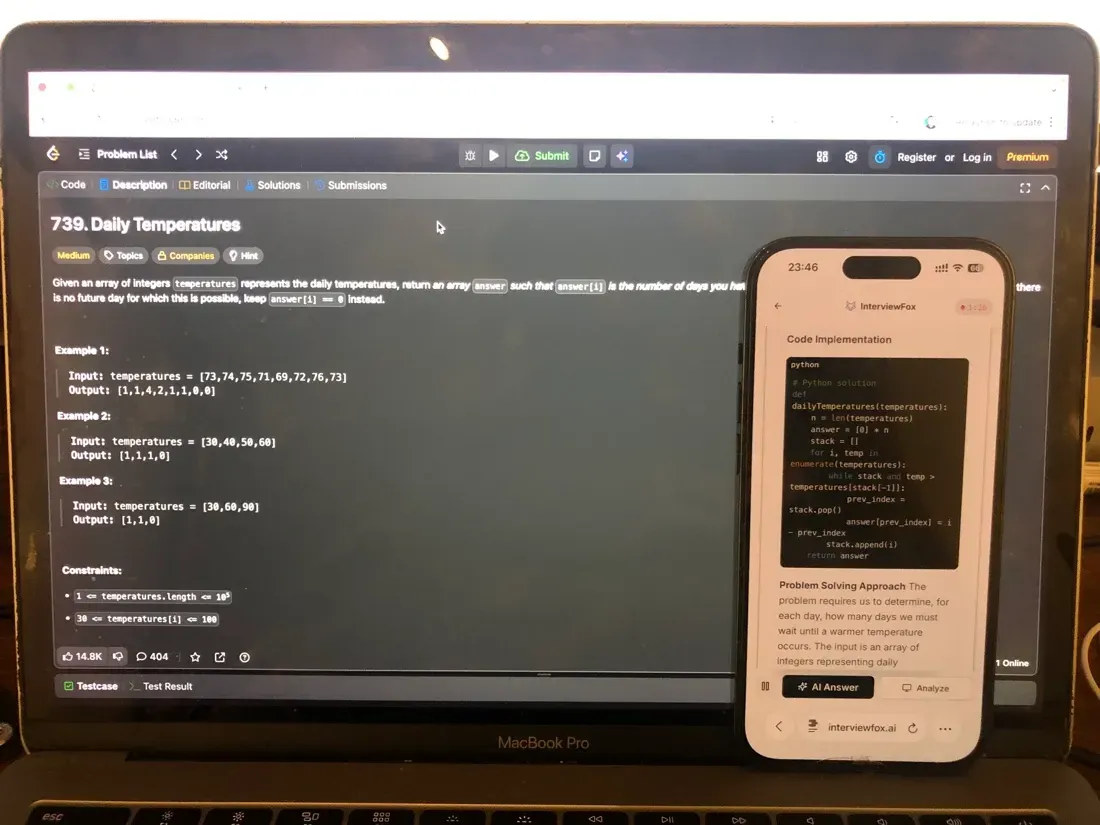
I didn't want to use a desktop overlay — the answer would have been on the same screen the proctoring system monitors, hidden by a basic rendering layer. Whether that gets flagged depends on what detection is currently running, and I didn't want that uncertainty in the background. Instead, I used a dual device AI interview tool: I set up a keyboard shortcut that auto-captures the screen and pushes the answer to my phone, completely outside the shared screen. My approach was clear, and my laptop screen stayed unchanged.
Land offer with Safer AI Interview Assistant
Skip the risky invisible apps. Our dual-device mode keeps it simple and undetectable. You crush the interview, we handle the answers.
Get started. It's freeLoved by 100,000+ candidates
Walmart's Proctoring Policy for Karat
Karat uses live human interviewers called Interview Engineers for every session. There is no automated recording and no asynchronous video review. A real person watches you code in real time.
The session is video-recorded from start to finish. Karat disables background filters and requires verification gestures like turning your head and raising your hand. These checks prevent impersonation.
Karat watches for six specific signals of AI tool usage during your interview.
Screen switching that suggests looking at another monitor tops the list. Perfect code that appears with no iteration or drafting raises a flag. Solutions that jump straight to optimal with no visible reasoning trigger scrutiny. Explanations that do not match the code block you just wrote get flagged. Large blocks of code that appear instantly suggest pasting. Zero edge-case awareness at the end of a supposedly complete solution draws attention.
A candidate used a Desktop Overlay during the recorded Karat interview; the interviewer paused the round after noticing the tool, and an integrity email later that afternoon confirmed removal from the hiring process. This is not a hypothetical. Karat has reviewed over 500,000 interviews, and its detection system is built on that scale.
What Walmart's Karat Test Format Actually Looks Like
The full session runs about 60 minutes. The official breakdown on Karat's site is a brief intro, 10 minutes of domain discussion, and 40 minutes of coding. Candidate reports from LeetCode and Reddit peg the domain block at 10 to 15 minutes and the coding block at 45 to 50 minutes. Across every account I found, the total lands at roughly one hour.
The first five to six minutes cover instructions and a 60-second self-introduction. You say who you are and which technologies you know. Keep this tight. The interviewer is timing it.
The domain discussion takes the next 10 minutes. You pick two topics from a list of five or six domains. Common ones include testing, object-oriented design, and server-side debugging. Karat sends these topics in the reminder email two to three days before your interview.
Once you pick your topics, the interviewer works through a Q-and-A list on their side. You can spend the full ten minutes on one question if you know it well. When your answer covers what they need, the interviewer interrupts and asks if you want to move to the next topic. This is normal. It means you gave a complete answer, not that you did something wrong.
The coding block runs 40 to 50 minutes. You get one or two problems. You solve them in a shared code editor while explaining every decision out loud. The expectation is two complete solutions. Solving only one and explaining the second is risky. One candidate passed with this approach, another got rejected with the same pattern. Plan to finish both.
You get a redo if things go badly. Results are the best of two attempts.
How Walmart's Karat Scoring Works
Karat does not publish a numeric rubric. The assessment is qualitative. The interviewer evaluates how successfully your code solves the problem, and the outcome is a pass or fail recommendation sent to Walmart. You never see a score breakdown.
Here is what different outcomes look like based on candidate reports:
| Performance | Outcome |
|---|---|
| Solved 2 problems cleanly | Passed - next round within 1-2 days |
| Solved 1 fully, explained approach for 2nd | Inconsistent: one candidate passed, another was rejected |
| Solved only 1 problem | Rejected |
| AI tool detected during interview | Removed from hiring process |
The must-solve-2 pattern is clear: "they will expect you to solve 2 questions. Last Time I have solved 1 but got rejected." A separate candidate solved Snake Exit fully and only explained the Closest Exit approach. They received a next-round email the next day. These two outcomes sit side by side. The safe play is completing both problems.
The redo policy is confirmed across both Reddit and LeetCode. One candidate asked: "if I give my walmart karat interview as part of redo will the results be considered best of 2?" The answer was yes. This means a bad first attempt does not sink you.
Walmart Karat Exam-Day Strategy
48 Hours Before: Read the Topic Email and Drill Those Domains
Karat sends topic questions in the reminder email two to three days before your interview. This is the single biggest prep advantage you have, and most candidates miss it.
Once the email arrives, stop practicing everything else. Drill only those two or three specific domains. The domain discussion block lets you pick which topics to answer, so you control the conversation. Two days of targeted drilling on your assigned topics puts you ahead of candidates who spread their time across all five or six domains.
In the Interview: Solve 2 Problems, Talk Nonstop, Use Your Time Budget
Budget 20 to 25 minutes per coding problem. You have roughly 45 to 50 minutes for two problems, and the Reddit failure evidence makes it clear that solving only one usually costs you the round. Start the first problem the moment you understand it. Do not over-plan. Get code on the screen within five minutes.
Talk through every decision. The Interview Engineer cannot score reasoning they cannot hear. If you go silent for thirty seconds, they lose the thread of your approach. Describe what you are about to do before you do it. Name the data structure you are choosing and why. State the edge case you see coming. When you finish, walk through your own code with a test case.
If the interviewer interrupts your domain discussion answer, do not panic. When your answer is complete, the interviewer moves on. The interruption means you covered the point. Thank them and take the next topic.
If It Goes Wrong: The Redo Safety Net
You can retake the interview. Results are best of two. Knowing this removes the all-or-nothing pressure. If you freeze on a problem or the time runs out before you finish the second solution, you get another shot. Treat the first attempt as real but not final.
Why Candidates Fail the Walmart Karat Assessment
Solved 1 Problem, Got Rejected
The clearest failure pattern in the data is completing only one problem. The data is straightforward: "they will expect you to solve 2 questions. Last Time I have solved 1 but got rejected. I don't have time to solve the second but explained the approach. Even though I got rejected."
In a similar position, another candidate passed by solving one and explaining two. The difference is not explained in either account. The only guaranteed path is finishing both.
Going Silent During the Coding Block
Multiple candidate accounts and Karat's own guidance stress continuous communication. The interviewer assesses your problem-solving process, not just the final code. When you go silent, they have nothing to evaluate. Talk through every loop condition. Say which edge case you are checking next. Name the variable you just declared and what it tracks. Silence is the fastest way to turn a solvable problem into a failed interview.
The Desktop Overlay That Ended a Candidate's Interview
As covered in the proctoring section, Karat's interviewer caught a desktop overlay during a live session, and the candidate was removed from the hiring process the same day. What makes this worth revisiting here is the detection mechanism behind that outcome.
Karat's detection system catches six categories of AI tool behavior: screen switching, perfect no-iteration code, instant optimal solutions, explanations that do not match the code, pasted code blocks, and zero edge-case awareness. If you use any assistive tool during the recording, the interviewer will see it. The outcome is removal, not a warning.
At least one candidate was flagged for using a desktop overlay tool: the tool renders the AI's answer on the same screen the proctoring system monitors, hidden by a basic OS-layer trick. The answer appears on a phone instead, a physically separate device that no screenshot or session recording can reach by design.
Land offer with Safer AI Interview Assistant
Skip the risky invisible apps. Our dual-device mode keeps it simple and undetectable. You crush the interview, we handle the answers.
Get started. It's freeLoved by 100,000+ candidates
How to Prepare for the Walmart Karat in 7 Days
Days 1–3: Lock Down Grid Traversal and Hash Map Problems
The Snake Exit problem I got is a 2D grid traversal with obstacles, and other candidates report a Badge Access Logs problem built on hash-map counting. General LeetCode practice with a focus on data structures is the most efficient path. These two patterns cover the coding problems you are most likely to see.
Solve two or three grid traversal problems each day. Snake Exit variants, Word Search, and Number of Islands all build the same muscle. Time each solution to 25 minutes or less.
Solve two or three hash-map counting problems per day. Group Anagrams and Subarray Sum Equals K target the same grouping and frequency logic as Badge Access. Your completion test: solve a 2D grid exit problem with obstacles in 25 minutes, handling empty grids, single rows, and fully blocked exits.
Days 4–6: Simulate the Full 60-Minute Format
The Karat format has three distinct blocks that you need to rehearse together. Each day, run one full mock. Start with a 60-second self-introduction that names your languages and experience. Move to two domain questions from common topics: object-oriented design principles, testing strategies, composition versus inheritance, mocking and dependency injection. Talk through each answer for four to five minutes.
Then solve two coding problems in 45 minutes with no silence gaps longer than 30 seconds. Record yourself if you can. Watch for the moments you go quiet. Those are the gaps the interviewer sees.
If your topic email has arrived by now, stop drilling all domains and focus on the exact topics it lists. This is a confirmed Walmart Karat mechanic. The last 48 hours of prep can be hyper-targeted.
Your completion test: complete one mock where you solve two problems in 45 minutes, verbalizing every decision, with no silence gaps. Skip the mock if you check the clock and find 45 minutes is not enough for two problems. Rerun the drill the next day with faster starts.
Day 7: Taper, Drill Your Assigned Topics, Rest
By now your topic email should be in your inbox. Spend two to three hours reviewing those exact domains. Answer rapid-fire questions for ten minutes: What is dependency injection and why use it? How do you test a method that calls an external API? What is the difference between composition and inheritance? If the email has not arrived, review the Snake Exit and Badge Access solutions from days 1 through 3.
Light review only. No new problems.
Your completion test: answer five domain questions in ten minutes with structured, pause-free responses. Stop studying by 6 PM. Sleep matters more than one more problem.
In the days before the interview, I also used the Prep Agent from InterviewFox: I sent it confirmed question patterns via WhatsApp and got a personalized drill plan back. It was one tool in the prep workflow, not a substitute for coding practice, but it gave me a structured set of problems targeting exactly what I would face.
What I skipped. I skipped general system design prep entirely. Karat tests CS fundamentals in the domain discussion, not architecture design. I skipped behavioral and STAR preparation. Walmart Karat does not include a behavioral round for SWE roles. I skipped memorizing Walmart trivia. The interview evaluates technical competence, not company history.
What Happens After You Submit the OA
If you pass, the next-round email typically arrives within one to two days. The timeline is fast: "In a day or two I received mail from Walmart that they have selected me for final interview." The next step is a virtual onsite or final interview.
Do not assume silence means rejection. Passing the Karat screen does not guarantee a scheduling link. Multiple candidates have waited four or more days with no slot. One account: "recently I have passed the Karat Interview for software Engineer role, It's been 4 days, But still I did not get my Interview slot."
Another waited a full week: "It's been 1 week now, mailed twice, and tried calling the recruiter like 3 to 4 times, no response or feedback." Ghosting happens even after a pass.
If you fail, the redo option is available. Your results are the best of two attempts. Wait for recruiter instructions on scheduling the retake.
Karat does not send you a performance breakdown. The recording and a summary go to the Walmart recruiter. You will not see a score, a rubric, or detailed feedback. The only signal you get is whether you advance.
The Walmart Karat Topic Email Advantage
Two to three days before your interview, Karat sends a reminder email. Inside that email are the exact domain topics you will be asked about. This detail is confirmed by candidates on both Reddit and LeetCode Discuss, and no other part of the Karat process gives you a sharper prep advantage.
Most candidates prep broadly across all five or six possible domains. They spend time on testing when they might not get tested on it. They review server-side debugging when OOD is their actual assigned topic. You do not have to spread yourself thin. Wait for the email, identify your two assigned topics, and spend the last 48 hours drilling only those.
The domain discussion block lets you pick which topics to answer. You walk in knowing exactly which two you are prepared for.
This advantage does not apply to the coding problems. Those are drawn from the interviewer's general pool and are not disclosed ahead of time. But locking down the domain discussion in advance means you enter the coding block with confidence instead of second-guessing the first ten minutes.
FAQ
Can I choose my programming language for the Walmart Karat?
Yes. Karat supports multiple languages, and you declare your preferred language during the self-introduction block. Stick with whatever you practiced in. Switching languages mid-session will slow you down.
What if I get stuck during a Walmart Karat coding problem?
Talk through what you would try next even if you are not sure it works. The interviewer may nudge you if you are close to the right approach. Do not go silent, do not delete everything, and do not give up. Narrating a stuck moment still gives the interviewer something to score.
Does the Walmart Karat test SQL or system design?
No. The domain discussion covers CS fundamentals like OOD, testing, and debugging. The coding block is data structures and algorithms. Neither SQL queries nor architecture system design appear in any confirmed Walmart Karat account.
How soon can I retake the Walmart Karat if I fail?
No primary source confirms a specific retake window for Walmart candidates. Karat generally supports redo attempts, and the "best of 2" policy is confirmed. Wait for the recruiter to send redo scheduling instructions.
Is the Walmart Karat interview different for data science roles?
Yes. Data science candidates report rapid-fire machine learning questions and behavioral components in their Karat sessions. This guide covers the SWE track only. If you are interviewing for DS, expect a materially different question set.
What LeetCode difficulty should I practice for the Walmart Karat?
Medium-level problems with a focus on data structures are the sweet spot. The Snake Exit problem is a grid traversal with no advanced algorithm. The Badge Access problem uses hash maps and set operations. Practice Mediums in arrays, hash maps, and BFS or DFS traversal. Do not waste time on Hard dynamic programming or graph theory problems that no Walmart Karat candidate has reported seeing.
Can I use an AI tool or invisible app during the Walmart Karat interview?
Desktop overlay tools put the AI answer on your computer screen: rendered as a hidden layer above the browser using a basic OS-layer trick. The answer is on-screen, the hiding is basic, and proctoring software keeps adding detection capabilities, so the risk exposure isn't fixed.
InterviewFox pushes the answer to your phone, a physically separate device that no screenshot or session recording can reach by design, so the laptop screen stays on the interview editor, unchanged. If you're going to use AI assistance during the interview, the dual-device architecture removes the answer from your screen entirely.
Land offer with Safer AI Interview Assistant
Skip the risky invisible apps. Our dual-device mode keeps it simple and undetectable. You crush the interview, we handle the answers.
Get started. It's freeLoved by 100,000+ candidates