You face a Karat interview, and the real question is whether a glance reads as cheating.
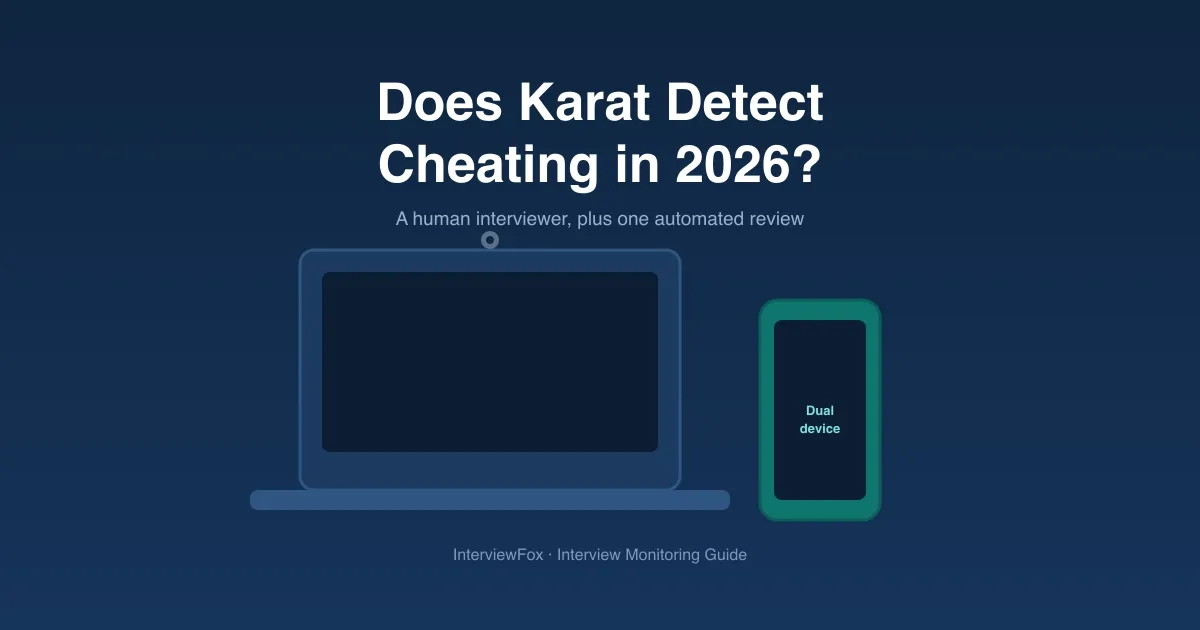
Karat does detect cheating. The model is not an always-on proctoring engine. A trained human interviewer watches your live session. One automated review re-checks the recording after the call.
That answer changes how you should read everything below. A flag is not automatic, and Karat does not notify you. The human observation is what you are really up against.
If you use any help, keep it off the interview computer's screen. An AI interview tool on a second device keeps the answer surface away from what Karat observes. Dual-device help stays on your phone, not the monitored laptop.
Quick Answer
Yes. Karat detects cheating through a live human interviewer, plus one automated review of the recording after the interview. No software silently scans your screen during the call.
The interviewer observes through the camera and microphone. They document suspicious behavior in writing. The automated pass re-analyzes the recording as a second check. Karat applies a flag when the human and the automated review agree, or after a second human quality-control watch.
Karat does not stop the interview. The platform does not auto-disqualify you. Your score stays unchanged. You are not notified. The hiring company confirms any violation and decides what happens. The flag can also appear on your Karat profile for future employers.
Karat captures video (camera optional), audio, and code playback. The platform does not capture other monitors, apps, your clipboard, or a second device. A human observer infers those things from your behavior. Prohibitions are contractual, not technically blocked. Allowed resources vary by module and employer.
Is a person or software watching you?
This is the premise most candidates get wrong. Karat is a live-interviewer service, not an automated testing platform. The detection is led by a person.
A Karat Interview Engineer (IVE) joins your session in real time. They watch how you work. Your typing outside the shared browser window draws their attention. A glance between monitors does too. Code written top-down, not built up in passes, also stands out.
None of that is a software rule firing. It is a person forming a judgment. Karat documents this model in its own Interview Integrity overview. The live IVE observation is the primary detection layer.
One automated capability exists, and it sits after the call. Karat runs a post-interview "automated integrity review." The tool independently re-analyzes the session recording as a second pass. This is separate from the live observation. It is also separate from a human quality-control re-watch.
So the honest model is mixed. A human watches live. Software reviews the recording once, afterward. A second human may review again. No screen-proctoring engine runs during the interview itself.
What Karat can see, hear, and record
You cannot size your real exposure until you know what Karat captures. Karat records three things during a session.
Video, when you enable the camera. The camera is optional, not forced. Audio, always. Karat captures your microphone whether or not the camera is on. Code playback, always. The platform records a replay of your coding session for every interview.
What is outside that surface matters as much as what is inside it. Karat does not capture your other monitors. The platform does not capture other apps or your clipboard. A second device is not captured either. A human observer infers those things from behavior, not from your screen.
That last point is where the device you use for help becomes the difference. InterviewFox's dual-device mode shows answers on a phone, not on the monitored interview computer. No answer surface and no InterviewFox process ever exists on that computer. Only on your phone.
A live interviewer on camera could still notice physical cues: looking away, a phone in hand. Dual-device removes the answer surface from the monitored computer. It is not a guarantee of invisibility, and it is not a license to break Karat's rules. It is an architectural separation: the shared-screen observation would not capture the assistance.
That is why a growing number of candidates route live help through a Dual device AI interview assistant. The tool is built around that separation from the start.

Answers On Your Phone, Not Your Shared Screen
Skip the risky invisible-overlay tricks. Our dual-device mode keeps answers on your phone, never on the screen you're sharing or recording. Nothing for a platform or interviewer to catch, because there's nothing on the shared screen to find.
Get started. It's freeLoved by 100,000+ candidates
What gets read as cheating
Now the part you check yourself against. Karat's flagged behaviors fall into clear groups. Most are human-observed. One is the automated post-interview pass.
| Behavior | How it is caught |
|---|---|
| Typing outside the shared browser window | Live IVE observation |
| Glancing between monitors | Live IVE observation |
| Writing code top-down, not iteratively | Live IVE observation |
| Using an AI tool where it is disallowed | Live IVE observation |
| Copying to an external AI tool | Automated integrity review |
The interviewer stays silent during the call. They do not interrupt. They do not warn you. Karat documents a suspicion quietly, then reviews it after the interview.
This is the error worth correcting: silence does not mean safety. An interviewer who says nothing is not necessarily seeing nothing. They watch, and they write it down.
Karat's Candidate Terms of Use prohibits outside assistance and AI-tool use in modules that restrict external resources. Those rules are contractual. Karat does not enforce them with a software block on your tabs or your clipboard.
Some candidates compare an AI interview tool by where the help appears. One stays on a separate device; the other renders on the interview computer.
Will the interviewer say anything during the call?
No. The IVE documents behavior silently. They do not flag you in real time. The conversation continues as if nothing is noted. That is by design, not by omission.
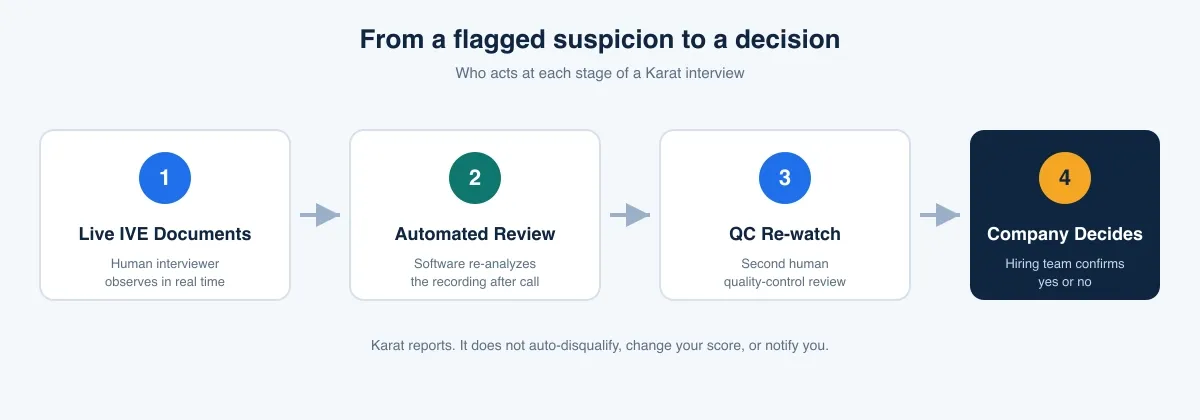
From a flagged suspicion to a decision
This is the chain most candidates actually fear. What happens after a suspicion is recorded?
The live IVE writes a report. The automated integrity review runs its second pass. A human quality-control reviewer may watch again. Karat applies a flag when the human observation and the automated review agree, or when a second human confirms.
The flag shows on the results page as a banner. It links to the exact moment in the video. The hiring team sees a status: No Flags, Integrity Risk, or Violations Confirmed. They can filter interviews by that status.
Karat does not decide your outcome. Karat reports. The hiring company confirms a violation and acts. The platform does not auto-disqualify anyone. Your score stays unchanged by the flag. Karat does not notify you.
Will you be told if you were flagged?
No. Karat never notifies the candidate. The employer may relay something, or may not. If you suspect a flag, the only channel is your recruiter or hiring manager. Karat itself stays silent on the outcome.
When Karat's rules change by module and employer
A universal statement here would mislead you. The rules vary by module and by employer. What is allowed in one Karat interview may be forbidden in another.
Some modules disallow external resources entirely. In those, any AI-tool use is a violation the IVE is trained to flag. Other modules permit non-generative help, such as syntax correction, but not full generative answers. The hiring company sets the permitted scope for the specific interview module.
You learn your own rules from the interviewer or the instructions at the start of the session. Karat tells candidates the applicable constraints before the interview begins. Read those instructions as binding. They draw the line between permitted help and a flagged violation.
How to avoid being misread as cheating
The goal here is narrow. It is avoiding the misinterpretation of honest behavior, not avoiding detection. Karat runs two human checks plus one automated pass. That structure tolerates normal work.
Build code the way you normally would: incrementally, with pauses, with a glance away to think. A brief look at a second monitor is not, by itself, a violation. The IVE judges a pattern, not a single moment. The risk is the cluster: repeated long looks away, code pasted in blocks, no iterative build-up.
If your discipline needs paper or a second screen, talk to your recruiter first. Do not hope it goes unnoticed. Honest behavior, documented plainly, is what the two human reviews are built to protect.
InterviewFox's Prep Agent works on the preparation side of this problem. Reachable over WhatsApp or SMS, it covers resume feedback, a plan scoped to the role, and mock-interview practice. All of it happens before the live interview, not during it.
Prepare Once, Walk In Ready
The durable fix isn't a cleverer hiding trick, it's going in prepared. Our Prep Agent reviews your resume, builds a study plan, and runs mock interviews with you over WhatsApp or SMS, so you rehearse the content before it counts.
Get started. It's freeLoved by 100,000+ candidates
Recording, access, and retention
A separate question from detection is privacy. What does Karat keep, and for how long?
Karat states a maximum retention of five years, or sooner on request. Storage is in the United States on AWS. Customers cannot download the raw recording themselves. Regional rules may differ; Karat does not publish a country-by-country retention table.
The camera is optional. Declining video does not stop audio capture or code-playback capture. Those two run regardless of your camera choice.
Is the camera required?
No. The camera is optional. Audio and code playback are recorded whether you enable video or not. Declining the camera reduces what is captured, but it does not make the session unrecorded.
FAQ
Do you have to turn the camera on? No. The camera is optional. Audio and code playback are recorded either way.
Can you fix a flag after it happens? A profile flag is possible, and Karat publishes no appeal path. Ask your recruiter directly.
Is Karat a proctored test? No. It is a live human interview with one automated review, not an always-on proctoring engine.