I Passed Atlassian HackerRank in 2026: Real Questions and Prep

Quick Facts
| Platform | HackerRank |
| Standard format | 3 questions in 90 minutes |
| Confirmed questions | Romanizer, parity permutations, consecutive subsequence |
| Proctoring | Proctor Mode plus Secure Mode |
| After the OA | Coding interview and values round |
| Year | 2026 |
I sat the Atlassian HackerRank online assessment for a new-grad software engineer role in 2026. I solved three coding questions in 90 minutes and moved to the next round. The test ran on HackerRank with a single 90-minute window and no separate written round. What follows is the complete process and how I prepared for it.
Q2 was where my time went. I wasted close to 20 minutes on a backtracking attempt before the counting formula clicked. That slip ate most of my buffer. With Q3 open and the clock running, I used an AI interview assistant to check parity-permutation edge cases. It surfaced the interleave pattern I break down in the walkthrough below.
Before my test, I read every Atlassian HackerRank post from the past two years. I checked Reddit, LeetCode Discuss, and Teamblind. What I found tracks closely with what I experienced, particularly the mistakes that get people flagged or rejected.
The Real Questions on My Atlassian HackerRank Test
I sat the Atlassian new-grad software engineer online assessment on HackerRank. It ran three coding questions in a single 90-minute window. Here is exactly what loaded on my screen, in the order they appeared.
Question 1: Romanizer (Integer-to-Roman Conversion)
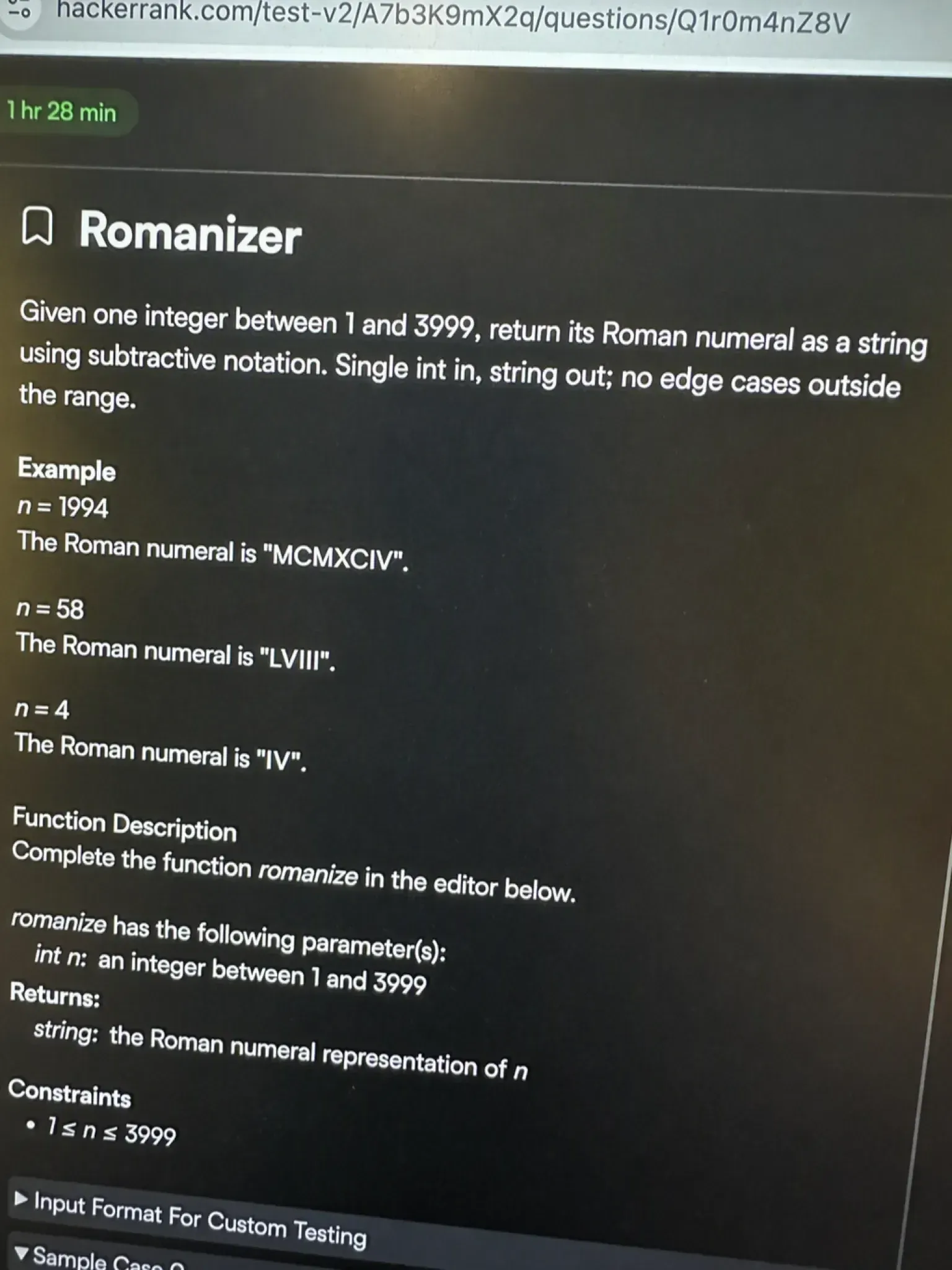
The problem I got: The first question gave me one integer between 1 and 3999 and asked me to return its Roman numeral as a string. The function took a single int and returned a string, with no edge cases outside that range.
My approach: I built a descending table of value-symbol pairs, including the subtractive pairs like 900 (CM) and 400 (CD). Walking from largest to smallest, I subtracted a value and appended its symbol whenever the number still covered it. This greedy pass always terminates because every remainder maps to a known symbol.
def int_to_roman(num):
    values = [1000, 900, 500, 400, 100, 90, 50, 40, 10, 9, 5, 4, 1]
    symbols = ["M", "CM", "D", "CD", "C", "XC", "L", "XL", "X", "IX", "V", "IV", "I"]
    result = []
    for value, symbol in zip(values, symbols):
        while num >= value:
            num -= value
            result.append(symbol)
    return "".join(result)

# HackerRank entry point
if __name__ == "__main__":
    n = int(input().strip())
    print(int_to_roman(n))
Time complexity: O(1) (fixed 13-table pass) | Space complexity: O(1)
This one came fast. I had it passing every sample case in under ten minutes and moved on with time in the bank.
Question 2: Good Permutations with Alternating Parity
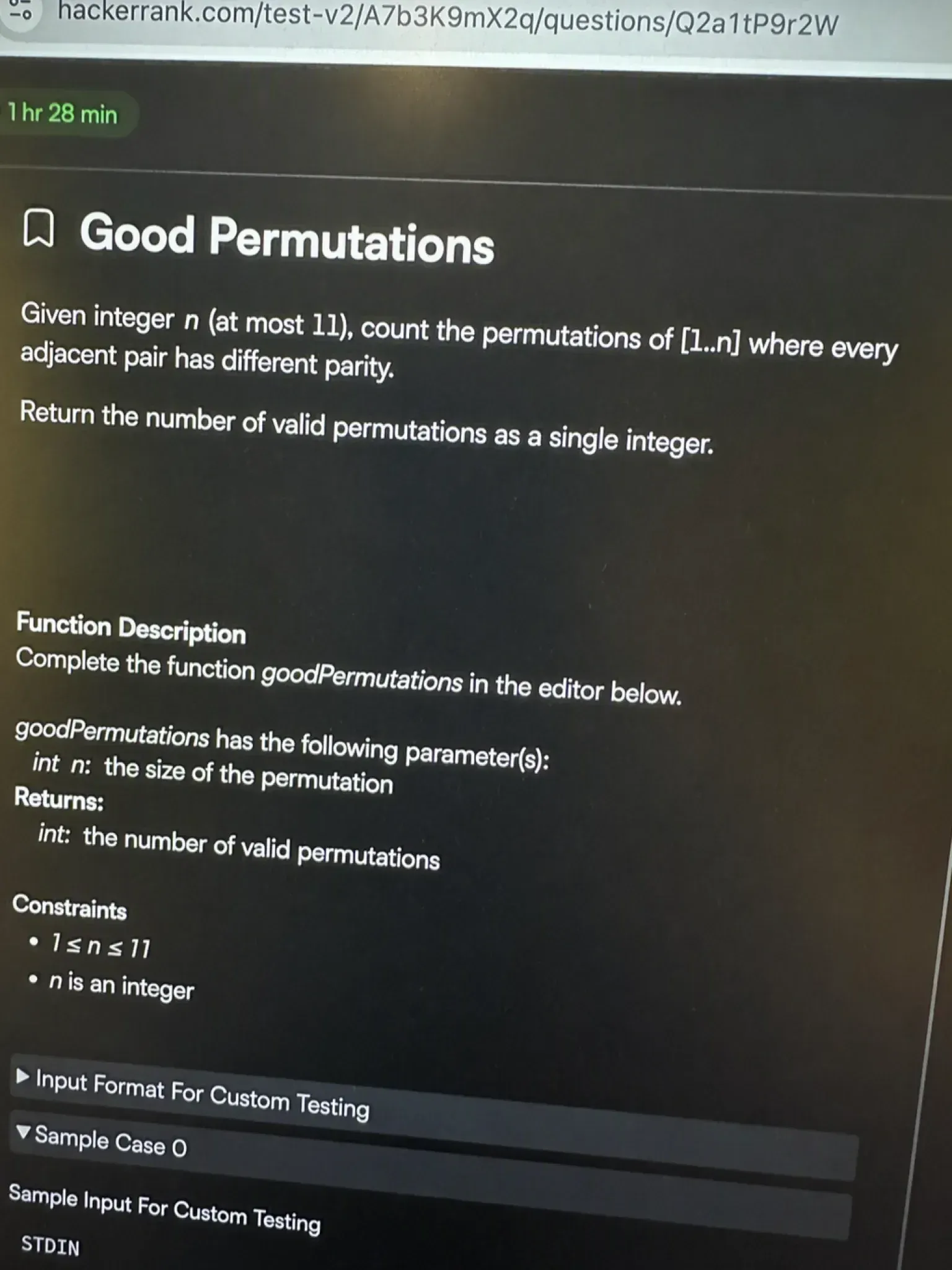
The problem I got: The second question gave me an integer n (at most 11) and asked for the number of permutations of [1..n] where every adjacent pair has different parity. I returned a single integer: the count of valid permutations.
My approach: I first reached for backtracking and generated permutations, checking parity at each step. That works for small n but the branching worried me as a general habit, so I stepped back and counted instead. The only way adjacent elements alternate in parity is to interleave odds and evens, which forces the two counts to differ by at most one. Once that clicked, the answer is just (odds)! times (evens)!, doubled when the counts are equal because the sequence can start on either parity.
import math

def count_good_permutations(n):
    odds = (n + 1) // 2
    evens = n // 2
    if abs(odds - evens) > 1:
        return 0
    ans = math.factorial(odds) * math.factorial(evens)
    if odds == evens:
        ans *= 2
    return ans

# HackerRank entry point
if __name__ == "__main__":
    n = int(input().strip())
    print(count_good_permutations(n))
Time complexity: O(n) (factorial loop, n up to 11) | Space complexity: O(1)
As I noted up top, that backtracking detour ate most of my buffer, and the shortfall is what drove the next move.
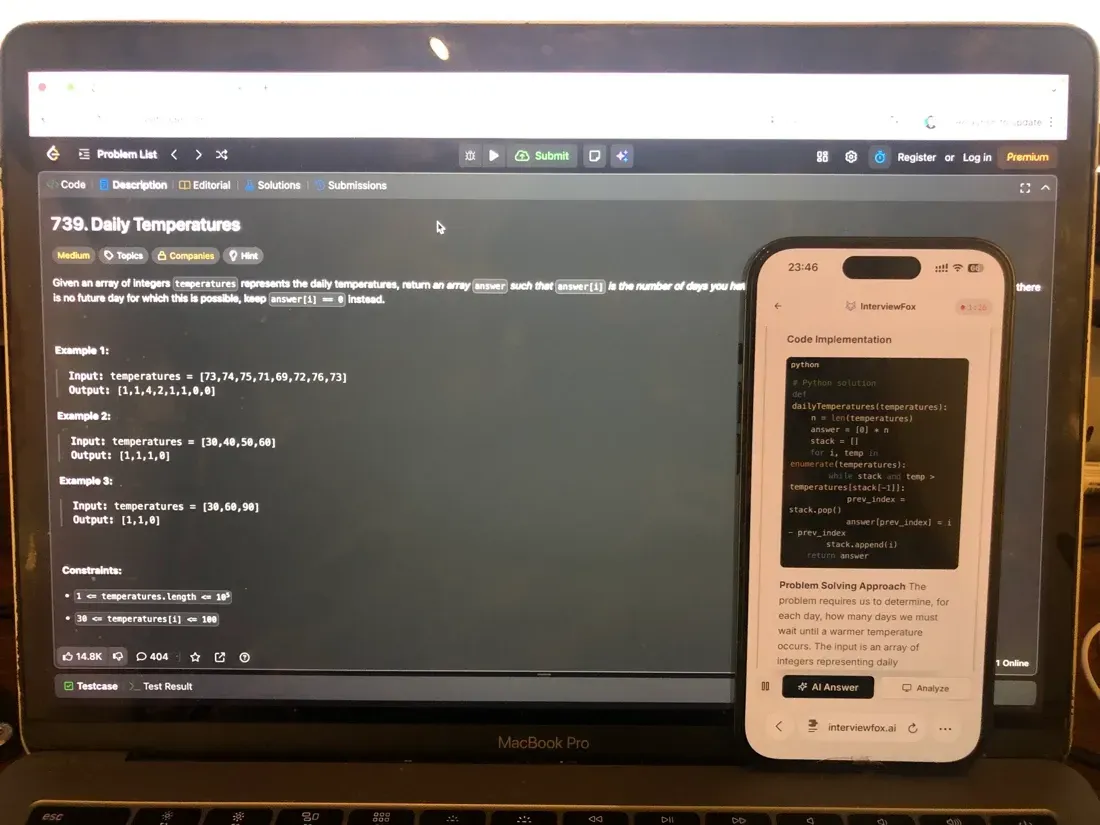
Having already decided against a desktop overlay tool (the answer would have landed on the same screen the proctoring system monitors, just hidden by a basic OS-layer trick I didn't trust), I handled the Q2 stall differently. When the counting formula wouldn't come, I hit the keyboard shortcut, the screen auto-captured, and the answer pushed straight to my phone. My laptop stayed on the HackerRank editor the whole time, unchanged.
Land offer with Safer AI Interview Assistant
Skip the risky invisible apps. Our dual-device mode keeps it simple and undetectable. You crush the interview, we handle the answers.
Get started. It's freeLoved by 100,000+ candidates
Question 3: Longest Consecutive Subsequence
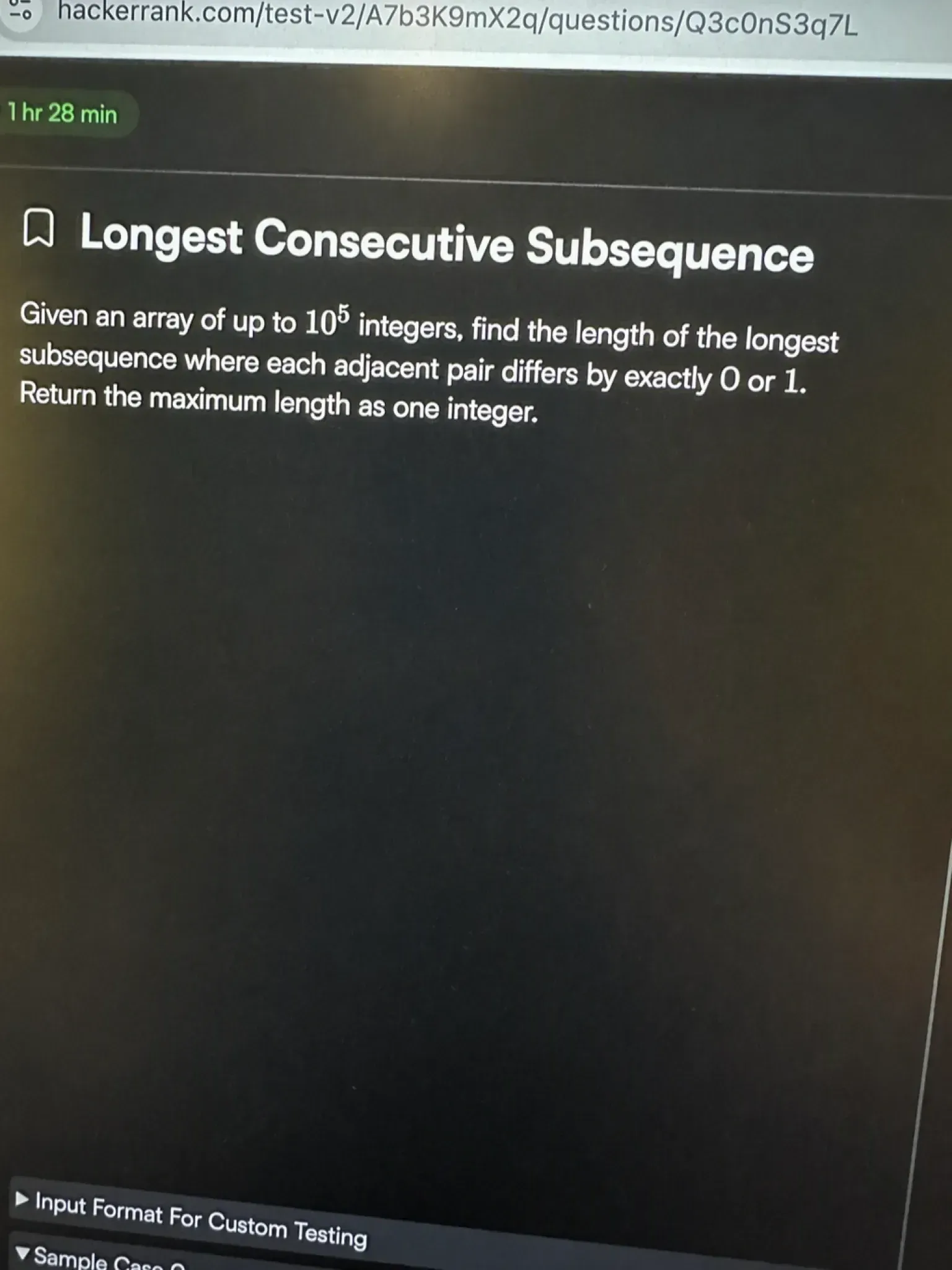
The problem I got: The third question gave me an array of up to 10^5 integers and asked for the length of the longest subsequence where each adjacent pair differs by exactly 0 or 1. I returned one integer: the maximum length found.
My approach: I treated it as a value-indexed dynamic programming pass. Reading the array left to right, I kept a map from each value to the longest valid subsequence ending at that value. For each element x, the best chain I can extend is the max of the chains ending at x minus one, x, or x plus one, plus one for x itself. Because I process in the original order, the subsequence property is preserved and the answer is the largest map entry.
def longest_consecutive_subsequence(arr):
    dp = {}
    best = 0
    for x in arr:
        prev = max(dp.get(x - 1, 0), dp.get(x, 0), dp.get(x + 1, 0))
        dp[x] = prev + 1
        if dp[x] > best:
            best = dp[x]
    return best

# HackerRank entry point
if __name__ == "__main__":
    arr = list(map(int, input().split()))
    print(longest_consecutive_subsequence(arr))
Time complexity: O(n) | Space complexity: O(n)
This slotted in cleanly once I framed it as DP over values, and I submitted the whole set with a few minutes left on the clock.
Atlassian's Proctoring Policy for HackerRank
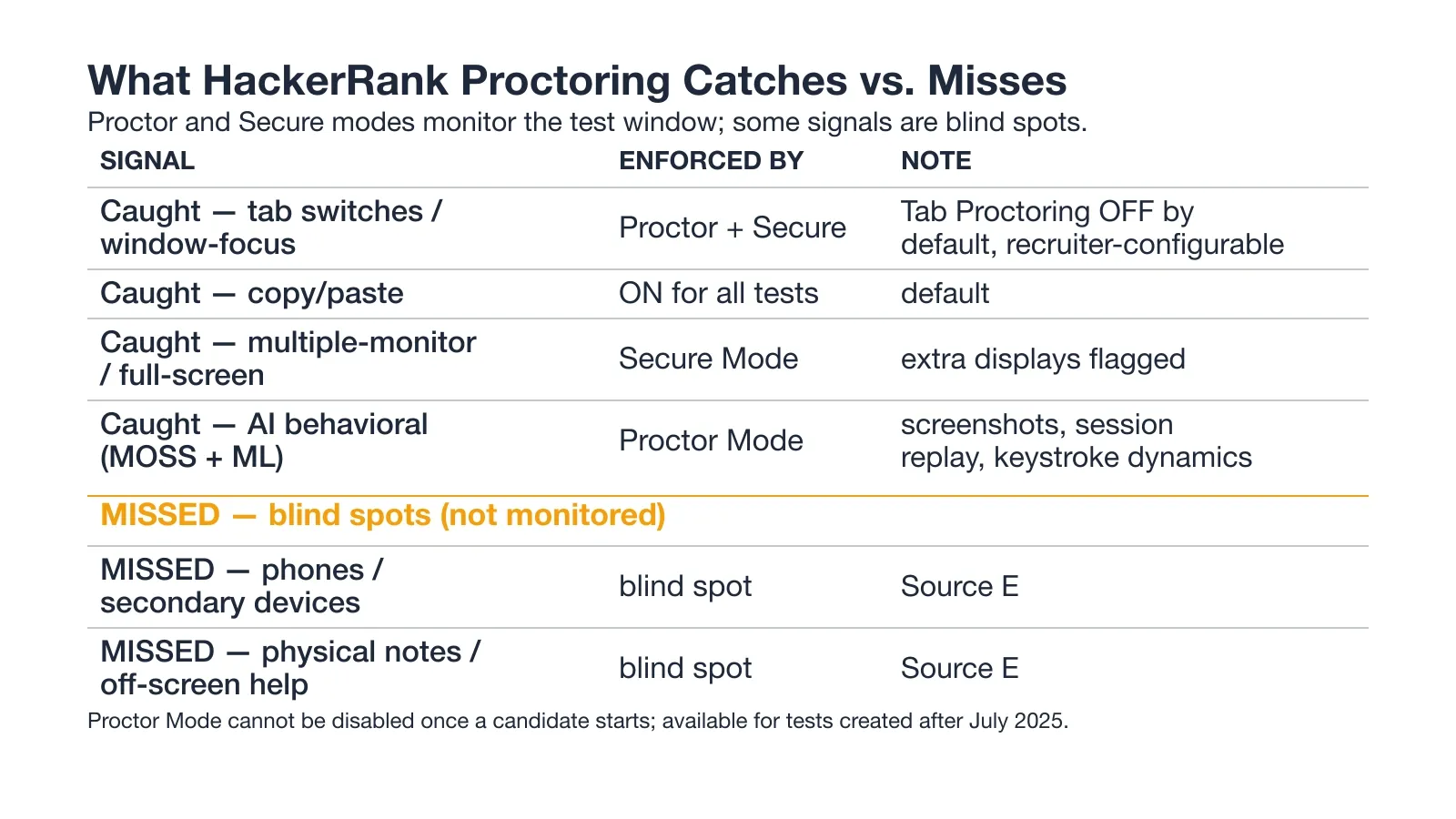
The atlassian hackerrank oa runs on HackerRank with Proctor Mode and Secure Mode watching the test window. The chart below shows the setup.
Proctor Mode vs. Secure Mode
Proctor Mode is available for tests created after July 2025 and cannot be turned off once it starts. HackerRank's Proctor Mode adds webcam checks, screenshots, and session replay.
Clipboard activity is monitored during the test. HackerRank tracks every copy and paste by default. The editor blocks pasted code unless the recruiter enables it, so type your solutions by hand.
Candidates next ask what happens if you alt-tab away from the window. Tab proctoring flags a window-focus loss when the recruiter turns it on. Keep the test window in front for the full 90 minutes.
Knowing whether the webcam turns on helps you set up your space. Proctor Mode runs webcam anomaly detection when the recruiter enables it. A plain background and good light keep that check quiet.
Secure Mode locks the screen and blocks copy paste. Proctor Mode also captures periodic screenshots and a session replay for the recruiter. Anything visible on the machine during the test is part of that record.
The dual-device blind spot
Knowing whether a second display raises a flag shapes your desk setup. Secure Mode detects multiple monitors and flags extra displays. Phones and tablets stay outside that monitored view, which is the gap most candidates miss when they plan their setup.
3 Other Confirmed Atlassian HackerRank Questions
Beyond my own exam, the circulating question bank has three confirmed families that other candidates reported on LeetCode Discuss. Each one maps to a real problem shape, and two of them showed up on my screen exactly as described.
The three circulating families beyond my exam
The Romanizer family is a straight integer to Roman numeral conversion, the same shape as LeetCode's Integer to Roman.
Parity permutations ask for valid arrangements of 1 through n where adjacent elements alternate in parity. A counting formula solves them for n up to 11. The consecutive subsequence family asks for the longest run where adjacent values differ by 0 or 1. It is a variant of Longest Consecutive Sequence at n up to 10^5.
The 3-vs-5 count conflict and the unverified-name gap
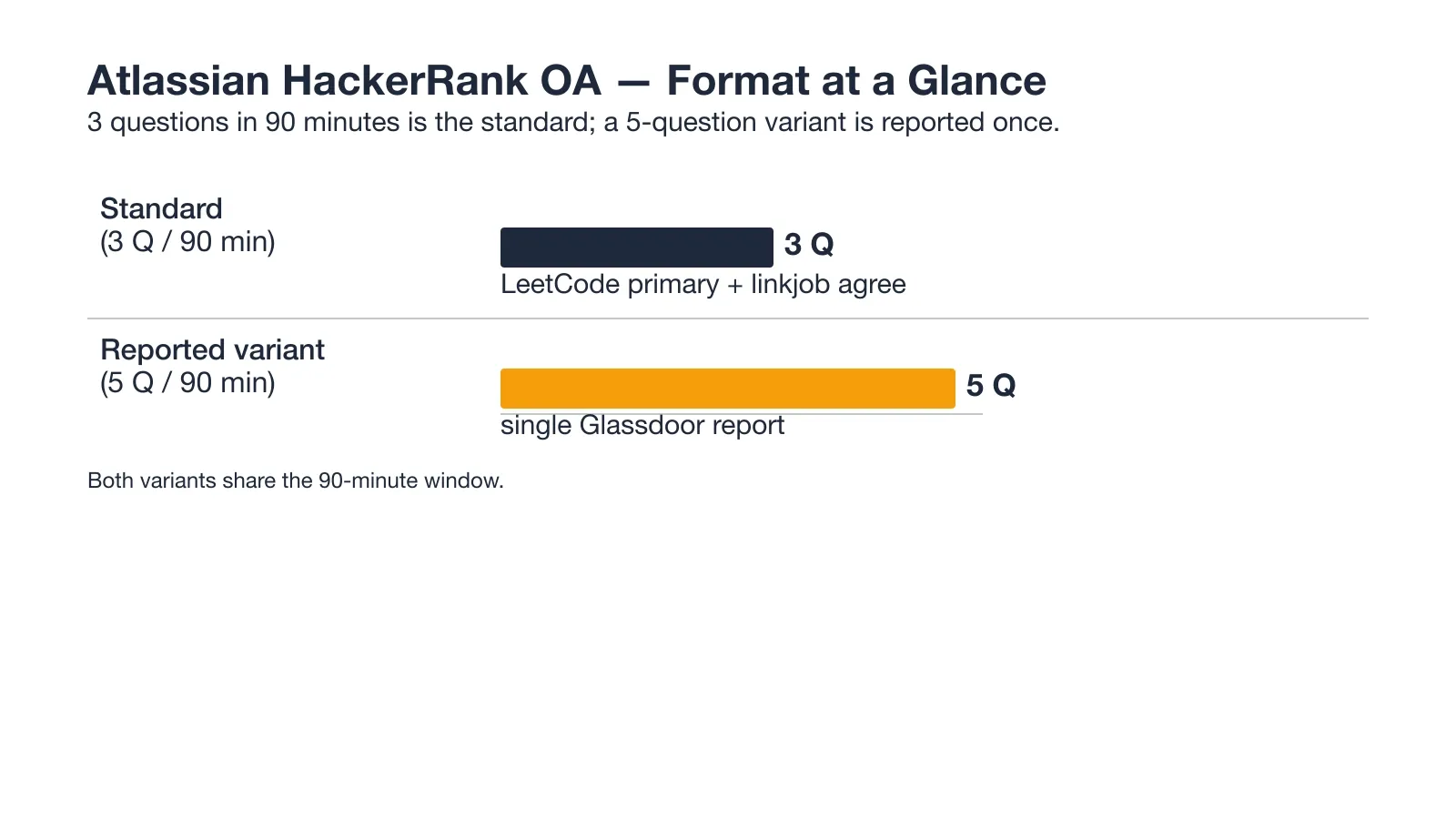
The standard report is three questions in 90 minutes. A single Glassdoor account mentions a five-question variant in the same window.
I treat both as real possibilities rather than a contradiction, since the time stays at 90 minutes either way. I did not list names like Better Compression, Flower Bouquets, or Match Substring After Replacement as confirmed. They appear only on blacklisted aggregator domains with no primary source.
What Atlassian's HackerRank Test Format Actually Looks Like
The atlassian online assessment is a three-question, 90-minute HackerRank test. The chart below shows its standard form.
Count, time, and link mechanics
Three questions in 90 minutes is the form I received. The five-question report shares the same cap. The HackerRank link arrives by email with an expiry window. Open it on a calm day, not the last hour before it lapses. The editor supports several languages, and I used Python for all three questions.
How Atlassian's HackerRank Scoring Works
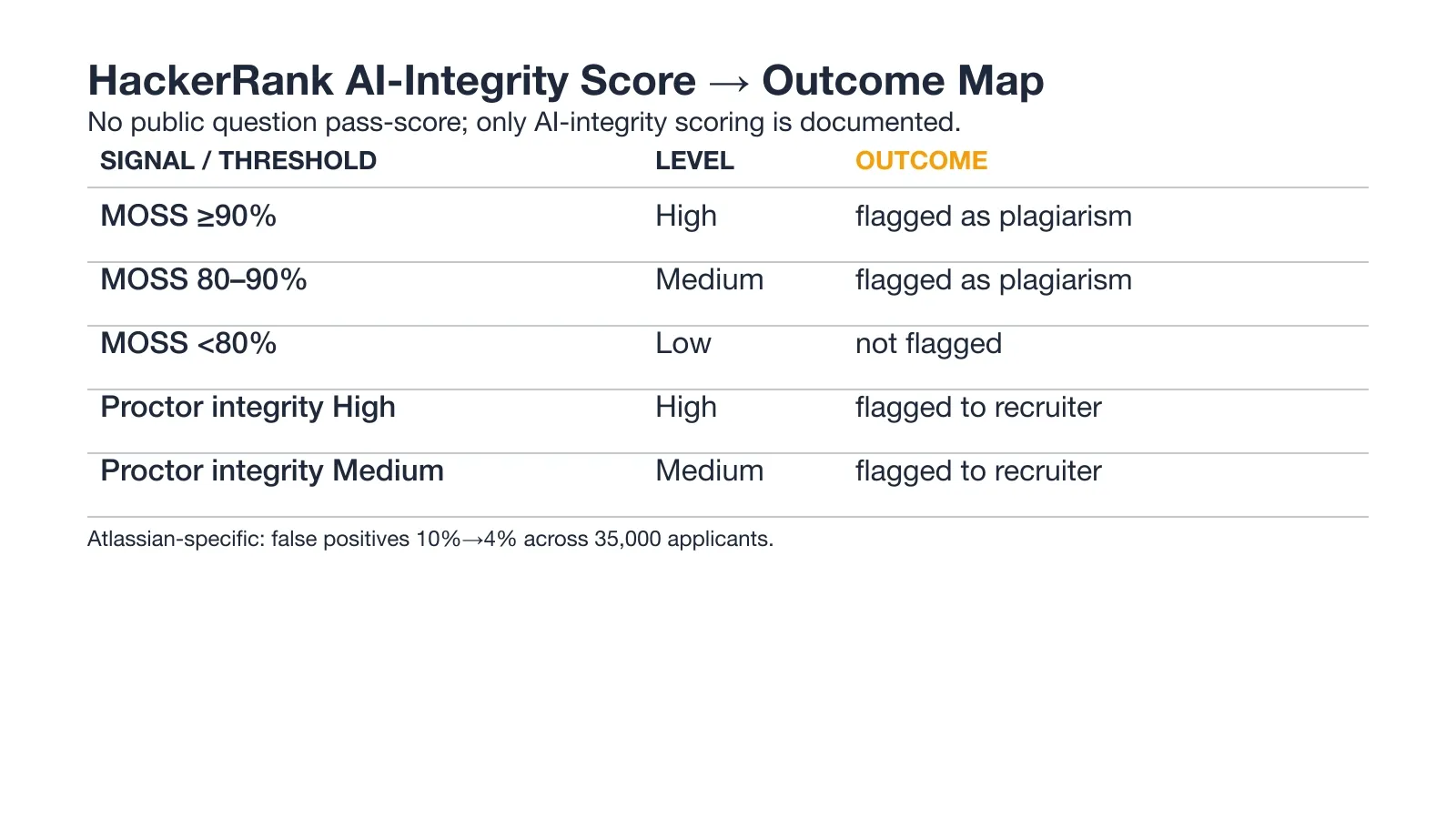
Atlassian does not publish an OA pass score. The only documented scoring is HackerRank's AI-integrity bar, shown in the chart below.
The integrity bar and what flagged means for your result
HackerRank scores integrity with two layers: MOSS structural tokenization and an ML behavioral model. A MOSS match at or above 90 percent is flagged high. Between 80 and 90 percent is medium, and below 80 percent is not flagged. A high or medium integrity result goes straight to the recruiter. Atlassian's own review cut false positives from 10 percent to 4 percent across 35,000 applicants.
Atlassian HackerRank Exam-Day Strategy
With 90 minutes and three questions, pacing matters more than any single trick. The format is moderate, not brutal, so a steady clock beats last-second heroics.
Pacing the 90-minute and 3-question window
Three questions in 90 minutes leaves about 30 minutes each, and the difficulty is moderate rather than punishing. I treated Q1 as a warm-up and pushed hard on Q2. I kept Q3 for the back half of the clock so a stall never ate my finish.
The stuck moment on Q2
On Q2 I burned nearly 20 minutes chasing a backtracking solution before the counting formula clicked. I never reached for an overlay tool on the test machine. That answer would sit on the same screen the proctoring system watches. I kept any help on a separate device, off the shared screen. The test window stayed clean, and the walkthrough above explains the path I took.
Why Candidates Fail the Atlassian HackerRank Assessment
Most rejections on this test come from integrity flags rather than wrong answers. The detection side is aggressive, and the failure patterns below are the ones that actually end attempts.
The AI-tool-detection pattern
A candidate's October 2025 internship-cycle attempt involved a floating answer widget running behind the assessment window. During the final submission check, a warning banner appeared after the overlay briefly covered the Run Code button. It ended on the spot, and the recruiter refused the appeal.
The overlay case above is one way tools get caught. The full picture of what HackerRank flags as cheating is broader than a single widget. Structurally, any answer rendered on the same machine the proctoring software monitors can be caught. A clever hiding trick does not close that gap.
InterviewFox takes the answer off the test machine entirely. It pushes the answer to my phone. No screenshot or session recording can reach that separate device by design.
Land offer with Safer AI Interview Assistant
Skip the risky invisible apps. Our dual-device mode keeps it simple and undetectable. You crush the interview, we handle the answers.
Get started. It's freeLoved by 100,000+ candidates
How HackerRank's two-layer detection catches invisible tools
This defense combines MOSS structural tokenization with an ML behavioral model that tracks typing cadence and submission patterns. It explicitly targets semi-transparent overlays and phone-based assistants. A tool that hides on screen is still exposed by how you use it. The real risk is structural, not a matter of finding the right hiding spot.
How to Prepare for the Atlassian HackerRank in 7 Days
Seven days is enough if you weight the work toward the three confirmed families. I built my plan around the questions that actually circulate rather than a generic algorithm list.
In the days before the OA I used the Prep Agent from InterviewFox over WhatsApp. I sent it the confirmed question patterns and got a personalized drill plan and strategy back.
Days 1 to 3 drill the three confirmed families
Romanizer is a greedy table walk. Parity permutations need a counting formula, not brute force. The consecutive subsequence is a value-indexed DP. I drilled each against its LeetCode counterpart: Integer to Roman, permutation drills, and Longest Consecutive Sequence. I could write them from memory by the end.
System-design and values drills I skipped because those belong to later interview rounds, not this screen. I also skipped names like Better Compression and Flower Bouquets, since no confirmed source lists them for Atlassian. Success meant a clean, memory-only write of all three in under 45 minutes.
Days 4 to 5 timed 3-question simulation
I ran a full HackerRank timed simulation with three questions inside 90 minutes to build clock discipline. The Prep Kit's warm-up problems gave me a realistic editor and a hard stop. Success meant finishing all three with time left to re-read my edge cases.
Days 6 to 7 proctoring-safe setup and buffer
I configured my desk so only the test laptop was in frame. I confirmed no overlay tools were running before I opened the link. A clean dry run with the camera and screen recording on settled the setup. Success was a calm, flag-free practice session the day before the real attempt.
What Happens After You Submit the OA
Submission is not the end of the loop. Atlassian keeps interviewing after the screen, and the next rounds test different skills than the timed coding test.
The Atlassian interview loop after the OA
Atlassian follows the OA with a coding interview. It splits into Data Structures and Code Design, plus a values and behavioral round. The team wants to see how you think, not just whether the code runs. The behavioral round weighs collaboration and the company's values as much as the technical bar.
Timelines and what to do while you wait
Most candidates hear back within a few weeks, though timelines shift by cohort and role. I used the wait to review the coding interview format and kept my prep notes handy for the next round. A calm review beat cramming, since the later rounds test explanation more than speed.
If you're weighing several HackerRank screens at once, see my Amazon HackerRank walkthrough. It shows how another big-tech OA structures its question families.
FAQ
what are the atlassian hackerrank oa questions
The atlassian hackerrank oa gave me three questions: Romanizer, parity permutations, and a consecutive subsequence. All three came from the confirmed circulating families. They were moderate in difficulty and solvable inside 90 minutes.
are atlassian hackerrank questions hard
The atlassian hackerrank questions felt moderate, not brutal, once I knew the patterns. Q2 was the time sink because the counting formula is easy to miss. Most candidates finish all three with steady pacing.
how long is the atlassian online assessment
The atlassian online assessment runs 90 minutes for the standard three-question version. One report mentions a five-question variant in the same 90 minutes. Plan for the three-question window unless your link says otherwise.
does atlassian use hackerrank for the online assessment
Yes, Atlassian delivers its software engineer online assessment on the HackerRank platform. The link arrives by email and expires after a set window. Open it on a quiet machine with a stable connection.
what happens after the atlassian hackerrank oa
After the atlassian hackerrank oa you move to a coding interview and a values round. The coding part splits into Data Structures and Code Design. Prepare to explain your reasoning out loud.
can i use an ai tool or invisible app during the atlassian hackerrank oa
Desktop overlay tools put the AI's answer on your screen as a hidden layer above the browser. Proctoring keeps adding detection as AI tools spread, so the risk isn't fixed.
InterviewFox pushes the answer to your phone. That physically separate device is out of reach of screenshots, screen recording, and session monitoring. The laptop screen stays on the exam editor, unchanged.
If you plan to use AI assistance during the OA, use the dual-device mode. It removes the answer from your screen entirely.
Land offer with Safer AI Interview Assistant
Skip the risky invisible apps. Our dual-device mode keeps it simple and undetectable. You crush the interview, we handle the answers.
Get started. It's freeLoved by 100,000+ candidates