
I Aced Barclays Codility Test Questions: Real Questions & Prep

Quick Facts
| Assessment | Barclays Technology Analyst and Quantitative Analyst Codility OA, 2026 |
| Format | Codility browser platform, single unpausable countdown timer, free task switching |
| SWE Track | 3 coding tasks in 90 minutes (automated telemetry, no mandatory webcam) |
| Quant Track | 4 to 7 math and algorithmic tasks in 240 minutes (mandatory continuous webcam) |
| Invitation Window | 5 to 7 calendar days to launch from email receipt |
| Scoring Split | 50% Task Correctness (functional tests) and 50% Performance (scalability on large $N$) |
| Passing Cutoff | Estimated $\ge 80-85\%$ for auto-advancement; 70-79% manual recruiter review |
| Proctoring Rules | Telemetry tracks window blur, tab switches, and clipboard events; background overlays cause score withholding |
| Next Stage | HireVue video interview evaluating candidate motivation and Barclays RISES core values |
I took the 2026 Technology Analyst assessment and solved the three Barclays Codility test questions cleanly with time to spare. What follows is the complete process, the exact problems from my screen, and how I prepared for them.
With 35 minutes left, my skyscraper height assignment failed duplicate limit test cases because sorting scrambled the original building indices. I used live AI interview helper on my phone to isolate why the index map drifted, which I break down in the second question below.
Before my test, I went through every Barclays Codility post from the past two years on Reddit, LeetCode Discuss, and Teamblind. What I found tracks closely with what I experienced. That research highlighted the exact proctoring tripwires and algorithmic traps that get candidate scores withheld or rejected.
The Real Questions on My Barclays Codility Test
I took the Barclays Software Engineering assessment for the Technology Analyst track. That sitting gave me exactly 90 minutes to solve three coding questions on Codility. The countdown timer ran continuously in the top corner with no per-task limits. Here is exactly what appeared on my screen.
Question 1: Player Movement Simulation on an NxN Grid
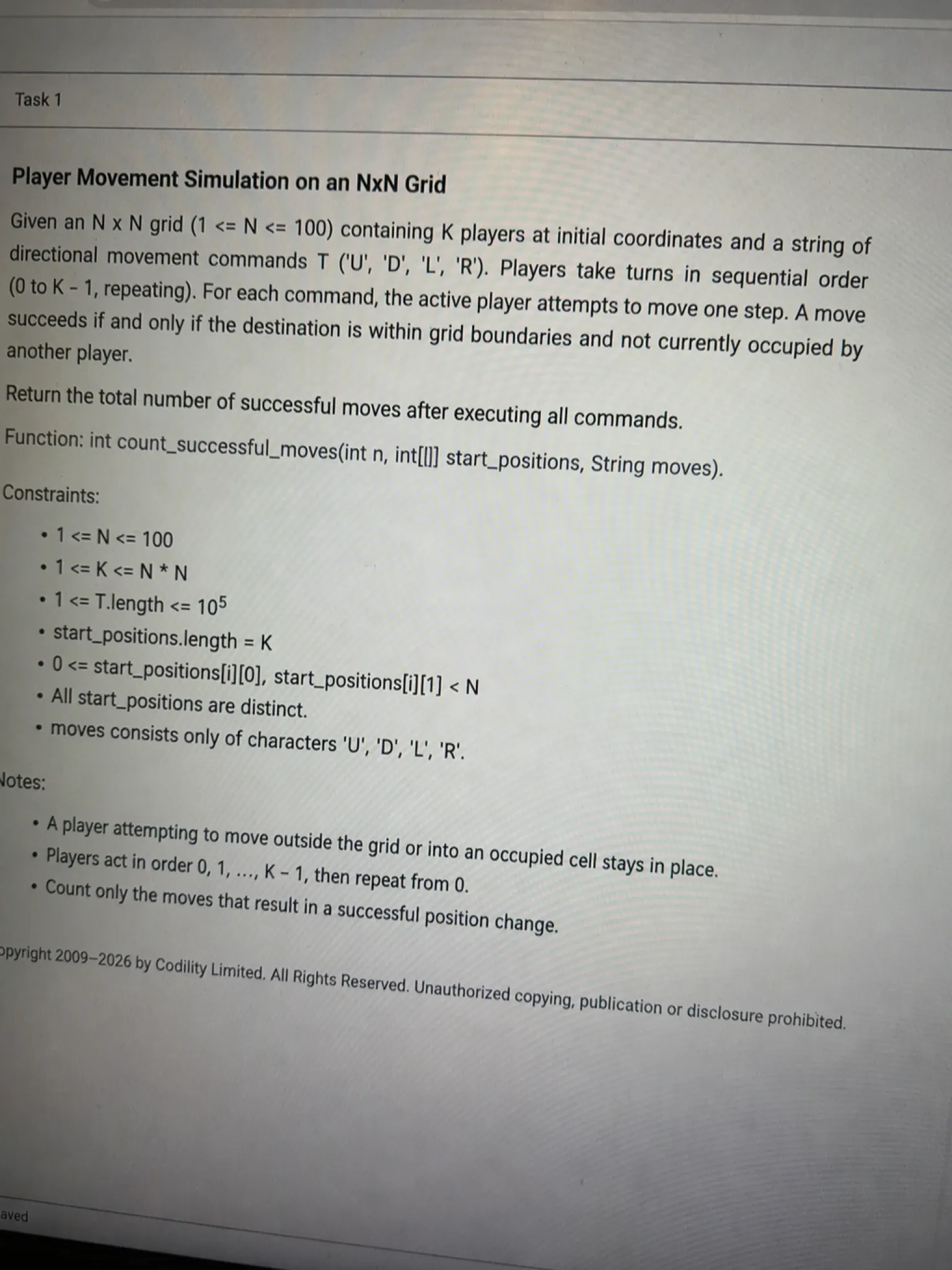
The problem I got: My test opened with a two-dimensional matrix simulation. The problem provided an $N \times N$ grid ($1 \le N \le 100$) containing $K$ players at initial coordinates and a string of directional movement commands $T$ ($1 \le |T| \le 10^5$) using 'U', 'D', 'L', and 'R'. Players took turns in sequential order ($0$ to $K-1$, repeating). For each command, the active player attempted to move one step in the specified direction. A move succeeded if and only if the destination fell inside the grid boundaries ($0 \le r < N, 0 \le c < N$) and was not currently occupied by another player. If a move was invalid, the player stayed in place. The function had to return the total number of successful moves after executing all $|T|$ commands.
My approach: Simulating each step required $O(1)$ coordinate lookups. Scanning the grid or checking all player coordinates on every move would turn the simulation into $O(|T| \times K)$, which would time out on large inputs. I maintained a list of current player coordinates to support sequential turn indexing and a separate hash set of occupied coordinates (r, c) for instant collision checks. For each command, I calculated the destination coordinates, verified boundary limits, and checked set membership. When valid, I updated the player's position, swapped the old coordinate for the new one in the occupied set, and incremented my success counter. If blocked or out of bounds, the turn still advanced without moving the player.
def count_successful_moves(
    n: int,
    start_positions: list[tuple[int, int]],
    moves: str,
) -> int:
    """Simulate sequential player movements on an N x N grid and count successful moves.

    Args:
        n: Dimension of the N x N grid (0-indexed coordinates).
        start_positions: Initial (row, col) coordinates for each player.
        moves: Sequence of directional characters ('U', 'D', 'L', 'R').

    Returns:
        The total count of successful moves executed across the sequence.
    """
    if not start_positions or not moves:
        return 0

    k = len(start_positions)
    positions = list(start_positions)
    occupied = set(positions)

    direction_deltas = {
        'U': (-1, 0),
        'D': (1, 0),
        'L': (0, -1),
        'R': (0, 1),
    }

    successful_moves = 0

    for step_idx, move_char in enumerate(moves):
        player_idx = step_idx % k
        curr_r, curr_c = positions[player_idx]
        dr, dc = direction_deltas.get(move_char, (0, 0))
        next_r, next_c = curr_r + dr, curr_c + dc

        # Check boundaries and collision
        if 0 <= next_r < n and 0 <= next_c < n:
            target_cell = (next_r, next_c)
            if target_cell not in occupied:
                occupied.remove((curr_r, curr_c))
                occupied.add(target_cell)
                positions[player_idx] = target_cell
                successful_moves += 1

    return successful_moves
Time complexity: $O(|T| + K)$ | Space complexity: $O(K)$
I finished this simulation in 14 minutes, verified the $N=1$ single-cell boundary case against sample inputs, and felt confident heading into the second problem with 76 minutes left.
Question 2: Skyscraper Height Assignment Under Limits
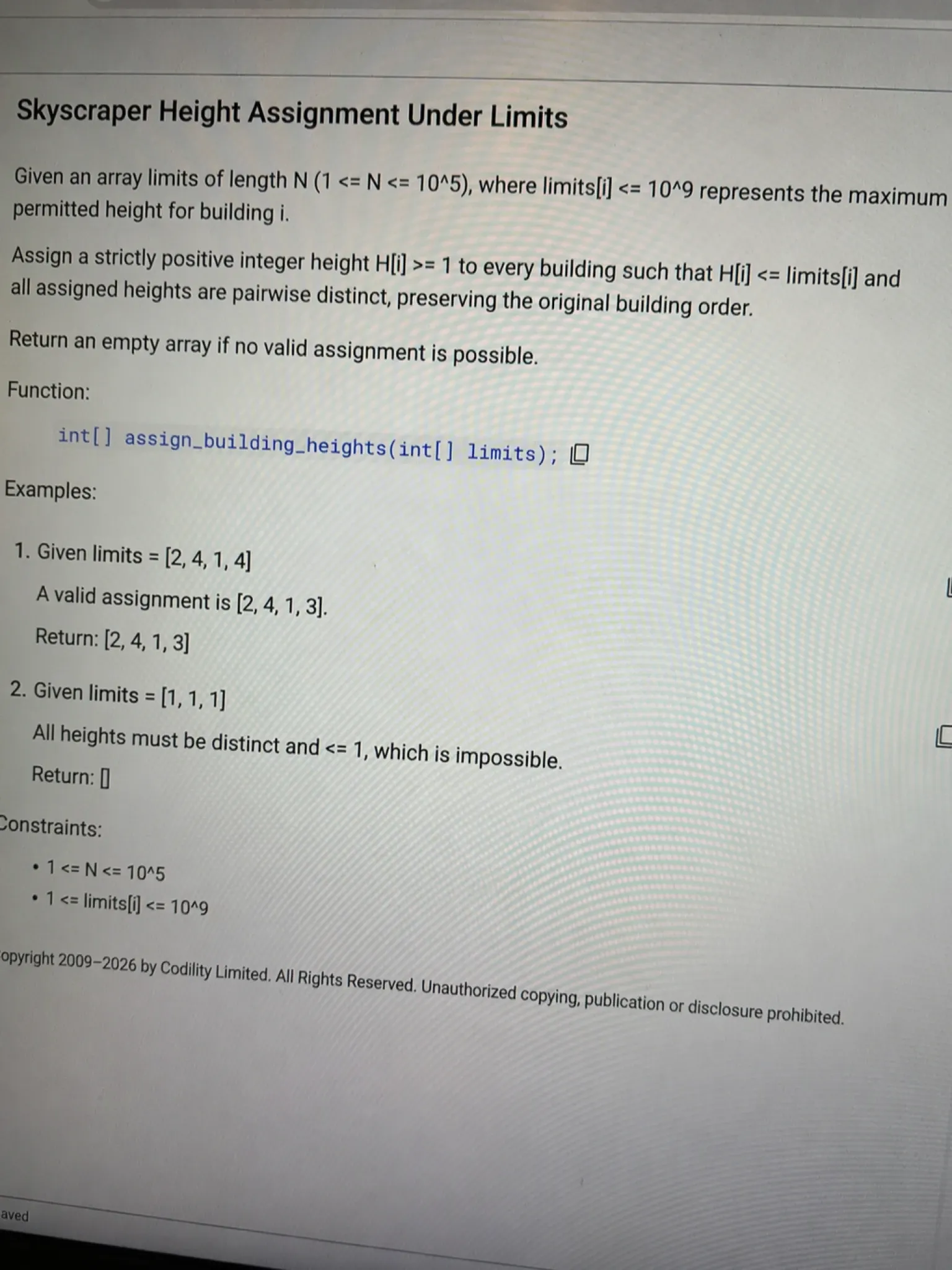
The problem I got: The second question stepped up the algorithmic difficulty. I received an array limits of length $N$ ($1 \le N \le 10^5$), where each value $\text{limits}[i] \le 10^9$ represented the maximum permitted height for building $i$. The task was to assign a strictly positive integer height $H[i] \ge 1$ to every building such that $H[i] \le \text{limits}[i]$, all assigned heights were pairwise distinct, and the returned array preserved the original building order. If no valid distinct height assignment could satisfy the limits, the function had to return an empty array.
My approach: The core constraint was assigning pairwise distinct positive integers without exceeding each building's ceiling. Buildings with smaller limits are the most constrained, so they dictate whether a valid configuration exists. I paired each limit with its original index and sorted the pairs in ascending order. In sorted order, the $k$-th building (1-indexed) requires at least height $k$. If the minimum required height $k$ ever exceeded the building's ceiling, distinct positive heights were mathematically impossible, so I returned an empty list immediately. Otherwise, I assigned height $k$ directly to the building's original index in a preallocated result array.
def assign_building_heights(limits: list[int]) -> list[int]:
    """Assign strictly positive, pairwise distinct heights satisfying building limits.

    Args:
        limits: Array of positive integers where limits[i] is the maximum
            allowed height for building i.

    Returns:
        A list of distinct positive integers where height[i] <= limits[i],
        matching the original input order. Returns [] if impossible.
    """
    if not limits:
        return []

    n = len(limits)
    # Pair each limit with its original index and sort ascending by limit
    indexed_limits = sorted((limit, idx) for idx, limit in enumerate(limits))

    assigned = [0] * n

    for assigned_height, (limit, original_idx) in enumerate(indexed_limits, start=1):
        # If minimum distinct positive integer exceeds the ceiling, impossible
        if assigned_height > limit:
            return []
        assigned[original_idx] = assigned_height

    return assigned
Time complexity: $O(N \log N)$ | Space complexity: $O(N)$
Debugging the index-mapping logic when sorting duplicate limits ate 25 minutes of my remaining clock. I stared at failing boundary tests with 35 minutes left on the timer and genuine panic setting in before I caught the issue.
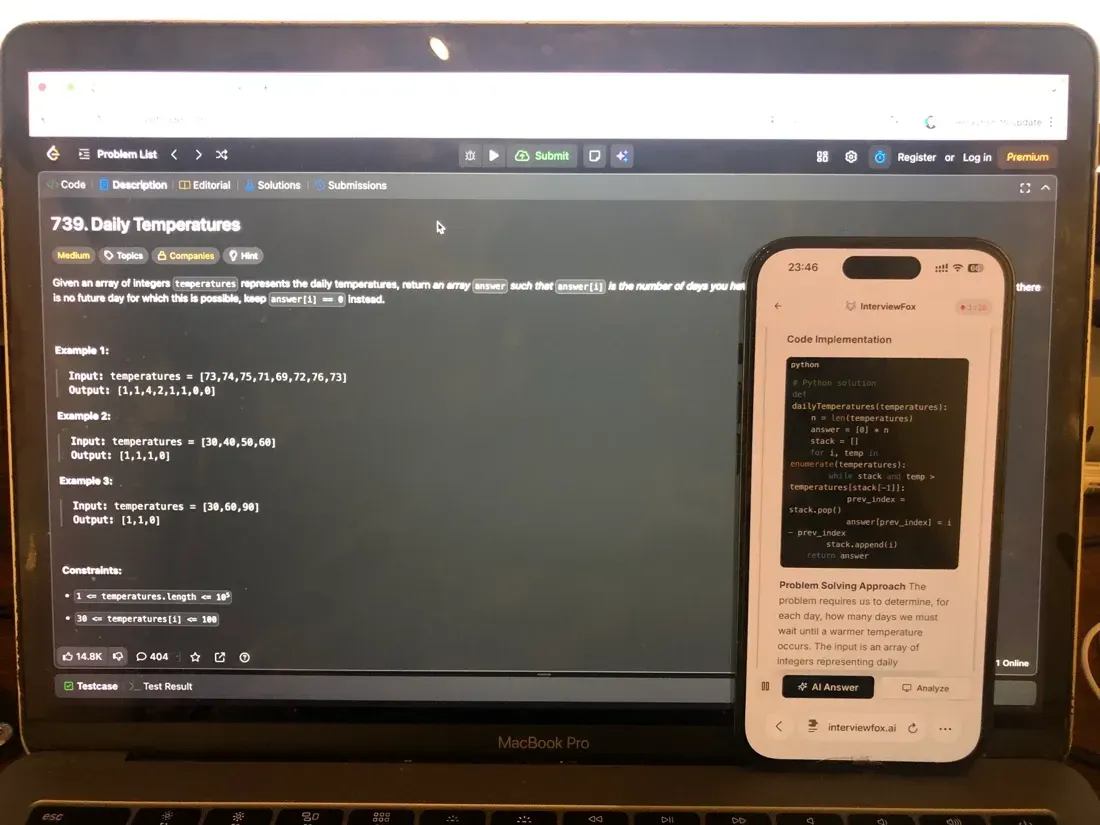
I deliberately chose not to run an on-screen desktop overlay because Codility's telemetry actively logs window blur and desktop focus switches. Instead, I pressed a single keyboard shortcut to trigger an automatic background screen capture sent directly to InterviewFox's dual device AI interview copilot on my phone.
The phone screen immediately pointed out that sorting identical limits without tracking original array indices was scrambling building positions upon reinsertion, causing the returned array to drift out of order. That phone-side insight let me tighten the sort key to (limit, idx) and pass all hidden boundary test cases in under two minutes, without a single window blur event on my assessment screen.
Land offer with Safer AI Interview Assistant
Skip the risky invisible apps. Our dual-device mode keeps it simple and undetectable. You crush the interview, we handle the answers.
Get started. It's freeLoved by 100,000+ candidates
Question 3: Poker Hand Rule Recognition and Ranking
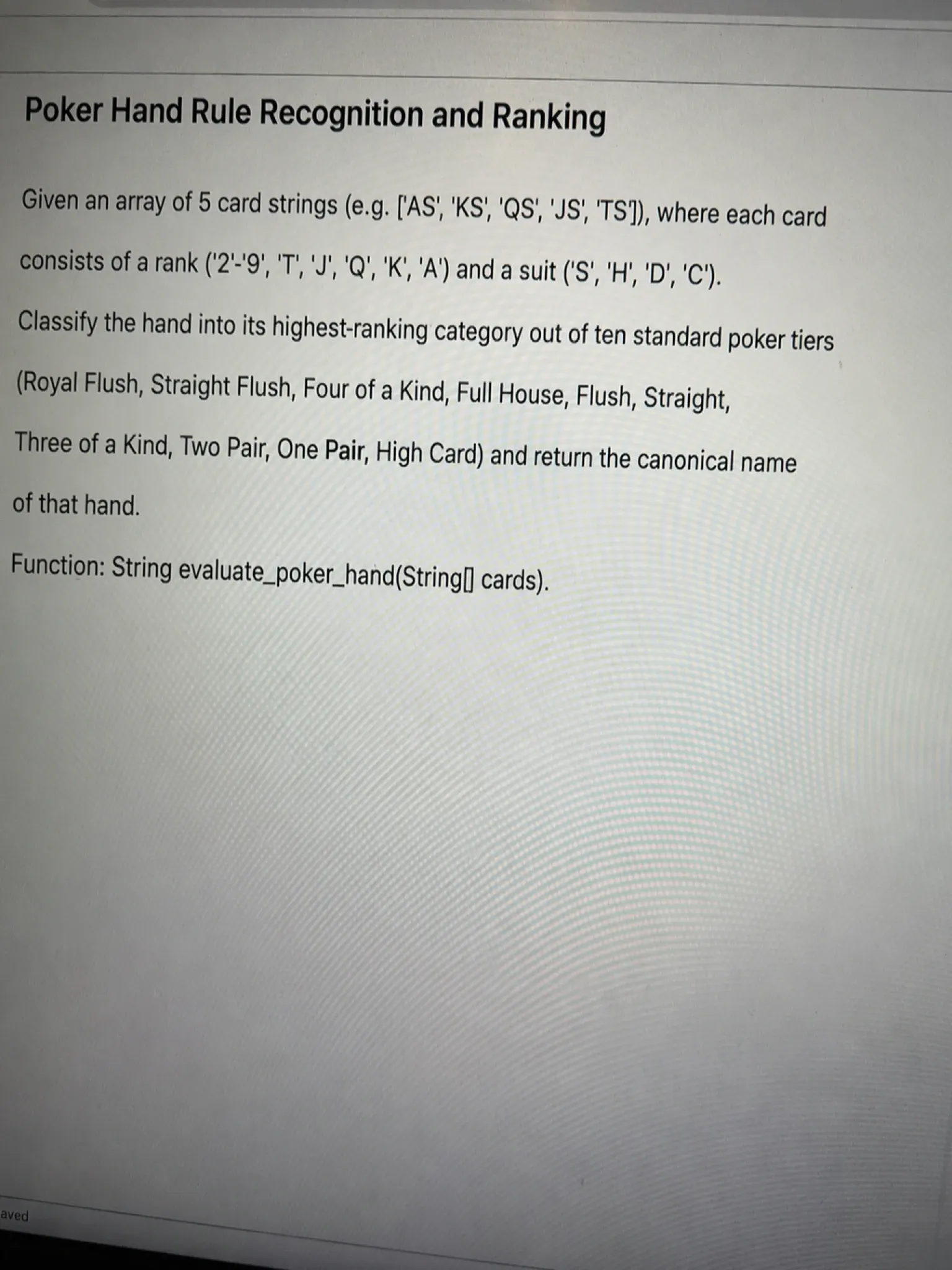
The problem I got: The final task presented a 5-card poker hand evaluator. The input was an array of five 2-character strings representing cards, such as ['AS', 'KS', 'QS', 'JS', 'TS'], where the first character indicated rank ('2' to '9', 'T', 'J', 'Q', 'K', 'A') and the second character indicated suit ('S', 'H', 'D', 'C'). I had to classify the hand into its highest-ranking category out of ten standard poker tiers, ranging from Royal Flush down to High Card, and return the canonical name of that hand.
My approach: Because the input size is fixed at five cards, the algorithmic complexity is strictly $O(1)$, but the branching logic requires complete defensive coverage. I mapped ranks to numerical values ($2$ through $14$) and built frequency maps for both ranks and suits. The evaluation order must proceed strictly top-down to avoid misclassifying combinations like a Full House as Three of a Kind. The most dangerous trap was the Ace-low Wheel Straight (A-2-3-4-5), where the Ace acts as rank $1$ rather than $14$. I evaluated straight conditions by checking both consecutive rank spans and the explicit wheel pattern before categorizing flush, count-based, and pair hierarchies.
from collections import Counter


def evaluate_poker_hand(cards: list[str]) -> str:
    """Evaluate 5 playing cards and return the highest poker hand category.

    Args:
        cards: List of 5 card strings (e.g. ['AS', 'KS', 'QS', 'JS', 'TS']).
        Each card consists of a rank ('2'-'9', 'T', 'J', 'Q', 'K', 'A')
        and a suit ('S', 'H', 'D', 'C').

    Returns:
        The canonical name of the highest-ranking poker hand.
    """
    rank_values = {
        '2': 2,
        '3': 3,
        '4': 4,
        '5': 5,
        '6': 6,
        '7': 7,
        '8': 8,
        '9': 9,
        'T': 10,
        'J': 11,
        'Q': 12,
        'K': 13,
        'A': 14,
    }

    ranks = [rank_values[card[0]] for card in cards]
    suits = [card[1] for card in cards]

    rank_counts = Counter(ranks)
    suit_counts = Counter(suits)

    is_flush = len(suit_counts) == 1

    # Check for straight (including Ace-low wheel straight: A-2-3-4-5)
    sorted_unique_ranks = sorted(set(ranks))
    is_normal_straight = (
        len(sorted_unique_ranks) == 5
        and sorted_unique_ranks[-1] - sorted_unique_ranks[0] == 4
    )
    is_wheel_straight = sorted_unique_ranks == [2, 3, 4, 5, 14]
    is_straight = is_normal_straight or is_wheel_straight

    counts_sorted = sorted(rank_counts.values(), reverse=True)

    # Hierarchical rule evaluation from highest to lowest rank
    if is_flush and sorted_unique_ranks == [10, 11, 12, 13, 14]:
        return "Royal Flush"
    if is_flush and is_straight:
        return "Straight Flush"
    if counts_sorted == [4, 1]:
        return "Four of a Kind"
    if counts_sorted == [3, 2]:
        return "Full House"
    if is_flush:
        return "Flush"
    if is_straight:
        return "Straight"
    if counts_sorted == [3, 1, 1]:
        return "Three of a Kind"
    if counts_sorted == [2, 2, 1]:
        return "Two Pair"
    if counts_sorted == [2, 1, 1, 1]:
        return "One Pair"
    return "High Card"
Time complexity: $O(1)$ | Space complexity: $O(1)$
I finished writing and validating the poker evaluator in 17 minutes, catching the Ace-low wheel straight edge case during my manual test checks. If you compare this implementation-heavy style to how other London financial institutions test on Codility, Barclays leans far more toward deterministic rule engines and coordinate grids rather than esoteric graph math.
Barclays's Proctoring Policy for Codility
Barclays sets up Codility to track candidate activity in the browser. The system logs state changes quietly without interrupting your code.
Focus-Loss Telemetry Logs Browser Window Blur Events
Codility runs background checks to track session integrity. The system logs a blur event the exact moment your cursor leaves the browser window.
Many candidates ask how separate browser events turn into a red flag. The platform combines these signals into a final risk score. To see how that scoring works, read our breakdown of how Codility detects cheating.
Codility does not lock your desktop window, but it logs every focus loss event. Recruiters review precise timers and blur thresholds after the test. For those exact limits, read our guide on whether Codility detects switching tabs.
Clipboard Tracking Flags Large Code Block Pastes
The Codility code editor monitors your clipboard interactions directly. Pasting large blocks of pre-written code instantly flags your submission for manual engineering audit.
The system tracks typing velocity and keystroke cadence alongside paste actions. Sudden text insertion speeds that exceed human typing thresholds trigger automated warnings in the recruiter dashboard.
Background Overlay Activation Triggers Score Withholding
Running hidden helper apps on your desktop machine creates a major risk. Even if an assistant window stays invisible, the system still registers focus switches when hotkeys activate.
When Codility detects background window focus shifts during the exam, the platform flags the session as high risk. As a result, recruiters review these logs and withhold assessment scores without offering a retake.
6 Other Confirmed Barclays Codility Questions
Barclays maintains a broader question pool beyond the three tasks on my assessment. Here are six additional confirmed problems drawn from verified testing reports and candidate submissions.
Question 4: Allocate Workers for a Production Ratio
An August 2026 test sitting recorded a math problem on worker allocation. The prompt gave five numbers up to $10^9$: total, firstRatio, secondRatio, firstRate, and secondRate.
Candidates had to assign workers $w_1$ and $w_2$ where $w_1 + w_2 = \text{total}$. In this setup, worker outputs produce a combined ratio. That output ratio of $w_1 \times \text{firstRate}$ to $w_2 \times \text{secondRate}$ had to match the target ratio.
Because parameters reach $10^9$, intermediate cross-multiplication products reach $10^{18}$, requiring 64-bit integer arithmetic. The approach isolates $w_1$ using exact integer arithmetic and returns the pair if allocations divide cleanly.
def allocate_workers_for_ratio(
    total: int,
    first_ratio: int,
    second_ratio: int,
    first_rate: int,
    second_rate: int,
) -> list[int]:
    """Allocate total workers across two production lines to match target output ratio.

    Args:
        total: Total count of available workers.
        first_ratio: Target ratio component for product 1.
        second_ratio: Target ratio component for product 2.
        first_rate: Production rate per worker for product 1.
        second_rate: Production rate per worker for product 2.

    Returns:
        A list [w1, w2] with worker allocations, or [] if no exact integer match.
    """
    coeff_w1 = first_rate * second_ratio + second_rate * first_ratio
    rhs = total * second_rate * first_ratio

    if coeff_w1 == 0:
        return []

    if rhs % coeff_w1 != 0:
        return []

    w1 = rhs // coeff_w1
    w2 = total - w1

    if 0 <= w1 <= total and 0 <= w2 <= total:
        return [w1, w2]
    return []
Time complexity: $O(1)$ | Space complexity: $O(1)$
Question 5: Maximum Possible GCD Under One Replacement
A verified technical sitting featured an array challenge on large inputs. The problem gave an array $A$ of size $N \le 10^5$ with integers up to $10^9$.
Candidates could replace one element with any integer $X \le R$. The goal was to find the highest possible greatest common divisor of the whole array.
Testing every replacement with an $O(N^2)$ brute-force check results in Time Limit Exceeded errors on Codility's hidden benchmark tests. Precomputing prefix and suffix GCD arrays allows evaluating the exclusion of any element $i$ in $O(\log M)$ time, yielding an optimal $O(N \log M)$ overall runtime.
import math


def find_maximum_gcd(a: list[int], r: int) -> int:
    """Find maximum achievable array GCD after replacing at most one element with X (1 <= X <= R).

    Args:
        a: Array of positive integers.
        r: Upper limit for replacement integer X.

    Returns:
        Maximum GCD achievable across the entire array.
    """
    n = len(a)
    if n == 0:
        return 0
    if n == 1:
        return r

    prefix_gcd = [0] * n
    suffix_gcd = [0] * n

    prefix_gcd[0] = a[0]
    for i in range(1, n):
        prefix_gcd[i] = math.gcd(prefix_gcd[i - 1], a[i])

    suffix_gcd[-1] = a[-1]
    for i in range(n - 2, -1, -1):
        suffix_gcd[i] = math.gcd(suffix_gcd[i + 1], a[i])

    best_gcd = prefix_gcd[-1]

    for i in range(n):
        if i == 0:
            remaining_gcd = suffix_gcd[1]
        elif i == n - 1:
            remaining_gcd = prefix_gcd[n - 2]
        else:
            remaining_gcd = math.gcd(prefix_gcd[i - 1], suffix_gcd[i + 1])

        if r >= remaining_gcd:
            achievable_gcd = remaining_gcd
        else:
            achievable_gcd = 1
            limit = int(math.isqrt(remaining_gcd))
            for d in range(1, limit + 1):
                if remaining_gcd % d == 0:
                    if d <= r:
                        achievable_gcd = max(achievable_gcd, d)
                    div2 = remaining_gcd // d
                    if div2 <= r:
                        achievable_gcd = max(achievable_gcd, div2)

        best_gcd = max(best_gcd, achievable_gcd)

    return best_gcd
Time complexity: $O(N \log M)$ | Space complexity: $O(N)$
Question 6: Minimum Steps Required for String Reversals
A candidate in a confirmed technical screening sitting solved a string transformation challenge. The task provided two equal-length binary strings str1 and str2 with length $L \le 30$. Across sequential steps $k=1, 2, \dots$, candidates could reverse any contiguous substring of length $k + 1$. The function had to return the minimum steps required to match str2.
Because the reversal length expands with each step index, the problem requires breadth-first search across reachable string states. Maintaining a visited state set of (string, step) pairs prevents cycles and identifies the shortest path.
from collections import deque


def min_steps_to_transform(str1: str, str2: str) -> int:
    """Find minimum sequential steps to transform binary string str1 into str2.

    At step k (1-indexed), any substring of length k + 1 can be reversed.

    Args:
        str1: Initial binary string.
        str2: Target binary string.

    Returns:
        Minimum number of transformation steps, or -1 if unreachable.
    """
    if str1 == str2:
        return 0

    n = len(str1)
    queue = deque([(str1, 1)])
    visited = {(str1, 1)}

    while queue:
        curr_str, step = queue.popleft()
        rev_len = step + 1

        if rev_len > n:
            continue

        for i in range(n - rev_len + 1):
            reversed_sub = curr_str[i : i + rev_len][::-1]
            next_str = curr_str[:i] + reversed_sub + curr_str[i + rev_len :]

            if next_str == str2:
                return step

            next_state = (next_str, step + 1)
            if next_state not in visited:
                visited.add(next_state)
                queue.append(next_state)

    return -1
Time complexity: $O(V + E)$ | Space complexity: $O(V)$
Question 7: Candy Store Minimum and Maximum Purchase Cost
A candidate in a confirmed technical screening sitting solved a greedy pricing challenge. That experience is discussed in an interview thread on LeetCode.
The problem provided $N$ candy prices and a store offer. Buying one candy allowed taking $K$ others for free. The task was to calculate the minimum and maximum cost to buy every candy.
The optimal strategy sorts prices ascending. To minimize total cost, candidates buy the cheapest available candy. They then claim the $K$ most expensive candies for free using two pointers. To maximize total cost, candidates buy the most expensive candy. They then claim the $K$ cheapest candies for free.
def find_min_and_max_candy_cost(prices: list[int], k: int) -> tuple[int, int]:
    """Calculate minimum and maximum total cost to purchase all candies.

    Buying 1 candy allows taking up to k candies for free.

    Args:
        prices: List of candy prices.
        k: Count of free candies granted per purchase.

    Returns:
        A tuple of (minimum_cost, maximum_cost).
    """
    if not prices:
        return (0, 0)

    sorted_prices = sorted(prices)
    n = len(sorted_prices)

    min_cost = 0
    left = 0
    right = n - 1
    while left <= right:
        min_cost += sorted_prices[left]
        left += 1
        right -= k

    max_cost = 0
    left = 0
    right = n - 1
    while left <= right:
        max_cost += sorted_prices[right]
        right -= 1
        left += k

    return (min_cost, max_cost)
Time complexity: $O(N \log N)$ | Space complexity: $O(1)$ auxiliary
Question 8: Package Delivery Weight and Cost Optimization
A candidate sitting for Barclays engineering recorded a bounded knapsack problem. The problem gave a delivery vehicle with capacity $W \le 100$ and up to 15 packages.
Each package had a decimal weight and a positive value. The goal was to maximize value, picking the lighter set if two groups tied.
Multiplying weights by 100 turns decimal values into clean integers to prevent rounding bugs. Next, standard 0/1 knapsack dynamic programming finds the best package group.
def optimize_package_delivery(
    capacity: float,
    weights: list[float],
    values: list[int],
) -> list[int]:
    """Select package indices to maximize value within capacity, minimizing weight on ties.

    Args:
        capacity: Maximum total weight capacity of vehicle.
        weights: List of floating-point package weights.
        values: List of positive integer package values.

    Returns:
        List of 0-indexed package indices selected.
    """
    n = len(weights)
    scale = 100
    int_capacity = int(round(capacity * scale))
    int_weights = [int(round(w * scale)) for w in weights]

    dp = [(0, 0, 0)] * (int_capacity + 1)

    for i in range(n):
        w = int_weights[i]
        v = values[i]
        for cap in range(int_capacity, w - 1, -1):
            prev_val, prev_wt, prev_mask = dp[cap - w]
            new_val = prev_val + v
            new_wt = prev_wt + w
            new_mask = prev_mask | (1 << i)

            curr_val, curr_wt, curr_mask = dp[cap]
            if (new_val > curr_val) or (
                new_val == curr_val and new_wt < curr_wt
            ):
                dp[cap] = (new_val, new_wt, new_mask)

    best_val, best_wt, best_mask = dp[int_capacity]
    selected_indices = [i for i in range(n) if (best_mask & (1 << i))]
    return selected_indices
Time complexity: $O(N \times W)$ | Space complexity: $O(W)$
Question 9: Quantitative Analyst Four-Hour Extended Problem Suite
Recruiting reports from London quant roles describe a longer four-hour test suite. Instead of the three coding tasks on the software track, quant applicants face four to seven math and data tasks.
The confirmed tasks include wind farm spacing, linear regression from scratch, and Fibonacci digit cycles. The test requires a live webcam for all four hours to check code style and math accuracy.
What Barclays's Codility Test Format Actually Looks Like
Barclays tests candidates using different test lengths depending on role seniority and business unit. Understanding your track setup prevents surprises on test day.
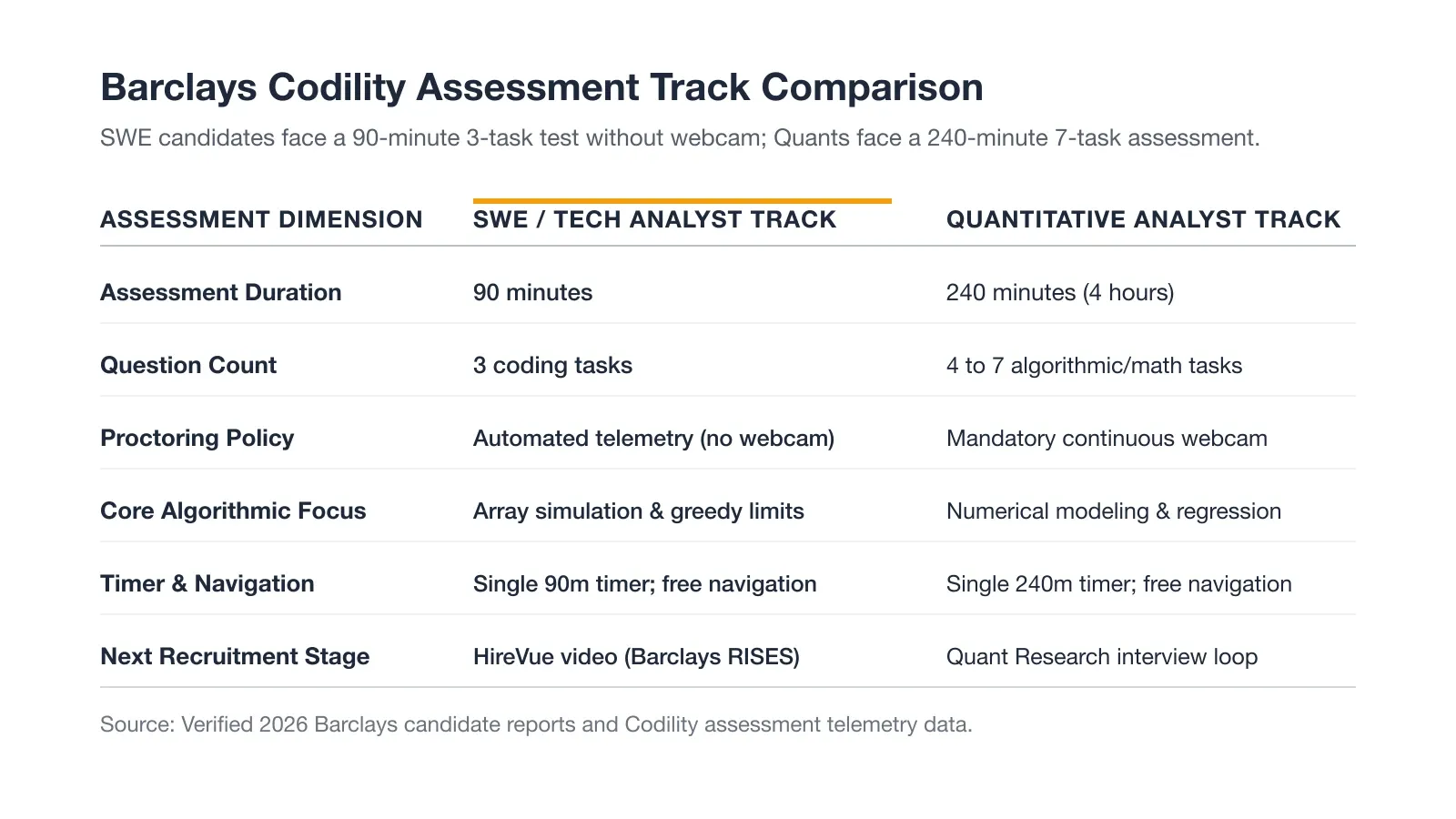
As the chart shows, software applicants take a 90-minute test with three tasks and no webcam. In contrast, quant applicants take a four-hour test with seven tasks and a live camera.
Ninety-Minute SWE Assessment Versus Four-Hour Quant Track
Barclays sets test tracks strictly by job role. Software engineering candidates get three coding tasks to solve in ninety minutes.
Applicants for different Barclays teams often hear conflicting advice about webcams. Software roles need no camera at all. In contrast, quant applicants must check what Codility captures through the camera before launching the four-hour test.
Single Countdown Clock Governs All Assessment Tasks
Codility uses a single master countdown timer for the entire test session. The clock begins ticking immediately when you start and cannot be paused for breaks.
You have complete freedom to navigate forward and backward between problems. If you get stuck on a difficult question, you can switch tasks and return later.
Five to Seven Day Window to Launch the Assessment Link
The invitation link remains active for five to seven calendar days from dispatch. That window matches candidate testing guidelines published by the platform.
Once you click the link and complete the system hardware checks, the timer begins immediately. Make sure your desktop workstation is stable before starting the session.
How Barclays's Codility Scoring Works
Codility grades code across two equal parts rather than relying only on sample cases.
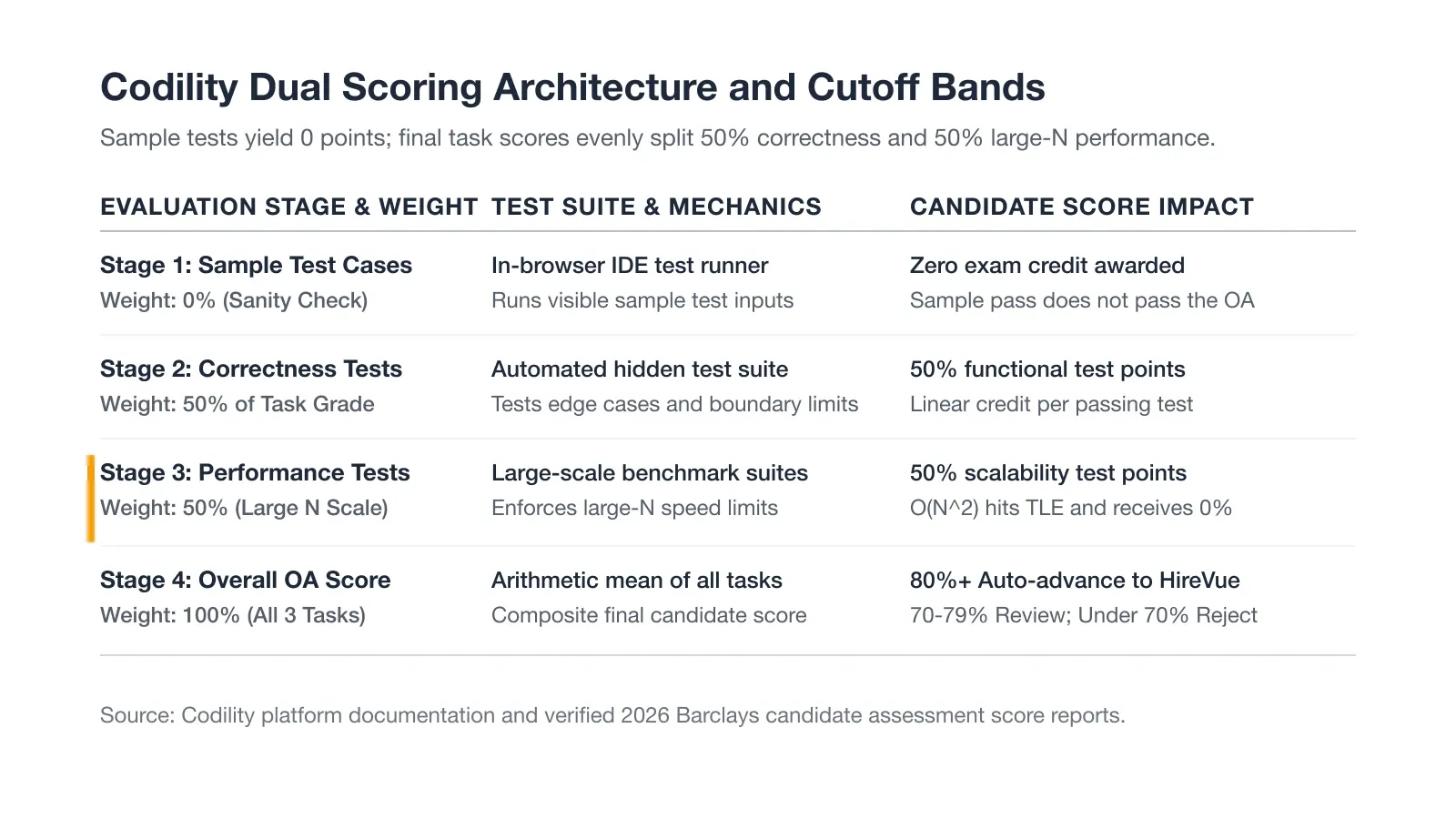
As the chart above shows, sample cases carry zero points. The final score splits evenly between basic correctness and large-input speed.
Fifty Percent Correctness and Performance Split
Codility runs two test suites on each submission. Half of your score measures basic correctness on edge cases, while the other half tests runtime speed on large inputs.
Passing the visible sample cases gives you zero points toward your final grade. However, full points require satisfying large hidden inputs within strict time limits.
Suboptimal Solutions Receive Zero Performance Points on TLE
Algorithms that exceed time limits receive an immediate Time Limit Exceeded error. On Codility, hitting TLE on benchmark tests awards zero performance points for that problem.
An unoptimized quadratic loop might pass every functional test case cleanly. That solution still scores only fifty percent because all performance test cases fail.
Eighty Percent Aggregate Score Secures Automatic Advancement
Barclays calculates your overall score as the arithmetic mean of all three tasks. Scoring eighty to eighty-five percent typically secures automatic progression to the next round.
Scores from seventy to seventy-nine percent go to recruiter review. Overall, scores below seventy percent lead to an automated rejection email.
Barclays Codility Exam-Day Strategy
Managing your ninety-minute clock effectively separates passing candidates from those who run out of time on the final problem.
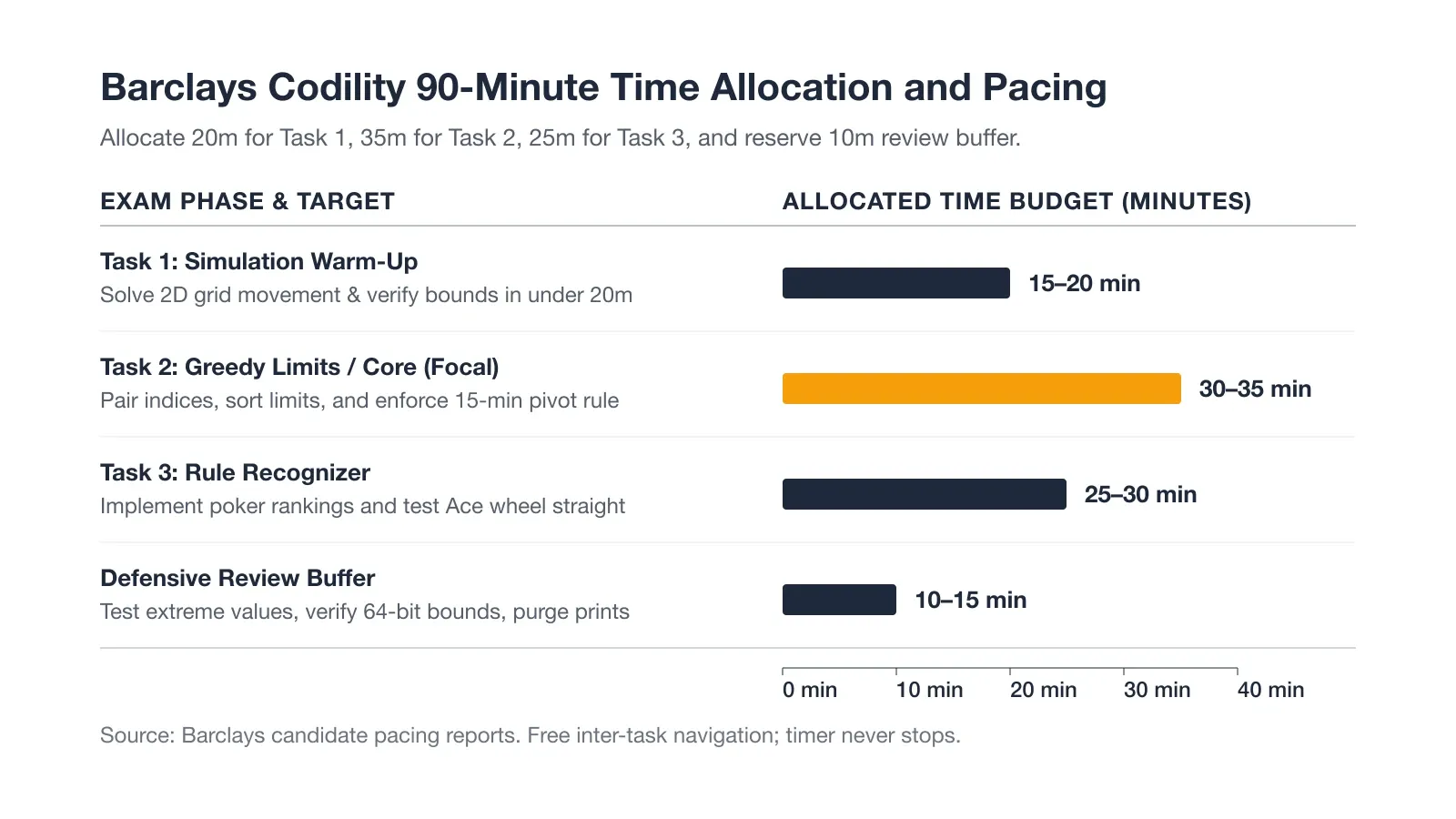
As the chart above shows, budgeting your time across distinct phases prevents deep time sinks. That pacing protects your overall assessment score.
Minute-by-Minute Ninety-Minute Clock Allocation Strategy
Pacing yourself across ninety minutes requires strict adherence to problem time limits. I budgeted twenty minutes for the opening simulation and thirty-five minutes for the greedy core.
I reserved twenty-five minutes for the final rule evaluator and kept ten minutes as a review buffer. That buffer allowed me to verify boundary edge cases without panic.
The Fifteen-Minute Pivot Rule for Unresolved Task Two Bugs
Task two often introduces greedy index constraints that swallow excessive exam time. If you cannot resolve a failing edge case after fifteen minutes, stop immediately.
Switching to task three allows you to secure straightforward points on the rule recognizer. You can return to refactor task two with banked points and remaining buffer.
Securing Brute-Force Partial Credit Before Refactoring Code
When an optimal algorithmic approach does not immediately appear, write a working brute-force implementation. A clean solution guarantees fifty points of correctness credit right away.
Banking fifty percent on a tough problem keeps your aggregate score competitive. You can then optimize for scalability only if your remaining clock allows it.
Why Candidates Fail the Barclays Codility Assessment
Most candidates who fail Barclays technical tests stumble on common coding bugs or proctoring traps.
Time Limit Exceeded on Large Benchmark Inputs
The most common failure trap is using nested loops that slow down on large inputs. Problems with arrays up to one hundred thousand items require fast linear or log-linear code.
Candidates often submit quadratic algorithms after seeing green checkmarks on sample tests. When hidden performance benchmarks run, those submissions hit timeout errors and lose half their points.
Edge Case Failures in Boundary Sorting and Straights
Subtle edge cases often break code in Barclays tests. In skyscraper limits, sorting heights without tracking original array indices corrupts the final answer.
In poker hands, missing the Ace-low wheel straight (A-2-3-4-5) fails many hidden tests. Also, worker ratio math fails when numbers exceed standard integer limits.
Disqualification From Background Overlay App Window Stealing
In an assessment sitting from May 2026, a candidate ran a hotkey-activated invisible app during the test. The assessment started normally while the background process was running. After a short network reconnect, the session paused immediately. That pause happened as soon as the hidden panel came forward. The candidate continued the exam without the overlay. Later, the candidate learned that the score had been withheld.
That failure exposes the structural danger of running transparent desktop overlays on the assessed machine. An invisible app renders floating panels on the same desktop environment that Codility's browser event listeners monitor. Focus loss becomes inevitable whenever the operating system routes keyboard input to the overlay. The same loss happens whenever the app recovers from a network interruption.
In contrast, InterviewFox relies on an air-gapped dual-device mobile push architecture. Silent hotkey captures push problem screenshots over local network relays to a physically separate mobile phone. Because of that design, all algorithmic guidance and debugging logic display on a second screen. The primary testing workstation runs no floating panes or background window hooks. This leaves Codility's browser focus listeners completely undisturbed.
Land offer with Safer AI Interview Assistant
Skip the risky invisible apps. Our dual-device mode keeps it simple and undetectable. You crush the interview, we handle the answers.
Get started. It's freeLoved by 100,000+ candidates
Lab benchmark testing: That technical vulnerability matches what our lab testing documented when evaluating desktop AI assistants. In our Cluely review, background window injection caused immediate operating system focus loss. The defocus occurred whenever the overlay gained keyboard input.
Similarly, as detailed in our Parakeet AI review, running secondary desktop floating panels on the same display risks tripping browser blur listeners. That trigger happens the moment a shortcut activates. Codility does not need to identify the software by name. The browser event loop detects window defocus instantly.
How to Prepare for Barclays Codility in 7 Days
A targeted seven-day study plan focused on confirmed Barclays problem patterns prepares you for both speed and scalability constraints.
Before beginning my practice, I used the Prep Agent from InterviewFox over WhatsApp to structure my revision. I submitted the confirmed problem types for Barclays's 90-minute Codility assessment. Those topics included two-dimensional grid simulations, index-preserving greedy assignments, and multi-tier poker rule engines. In return, I received a customized practice drill plan with daily time targets.
It functioned as an effective prep co-pilot alongside my LeetCode sessions. That tailored plan ensured I focused exclusively on high-frequency Barclays problem archetypes rather than generic algorithmic theory.
Days 1-2: Codility Console Mechanics and Two-Dimensional Grid Movement
During the first two days, I practiced in Codility's custom test console and solved grid simulations. Working through matrix navigation problems on LeetCode reinforced strict boundary checking under row and column constraints.
My success target was completing a full grid movement problem in under eighteen minutes with zero boundary errors. To prevent collisions, I maintained coordinate sets during every practice run.
For this phase, I skipped graph searches and tree algorithms because Barclays focuses on greedy arrays and matrix movement. In addition, I avoided system design topics since Barclays saves architecture interviews for the final round.
Days 3-4: Index-Preserving Greedy Limits and Prefix GCD Scalability
Days three and four targeted index-preserving sorting and prefix number theory optimization. I drilled paired-tuple array sorting to ensure assigned values mapped cleanly back to their original indices.
I also implemented prefix and suffix greatest common divisor arrays to avoid nested loops on large inputs. My success check was running prefix GCD precomputation across one hundred thousand integers in under zero point two seconds.
Days 5-7: Poker Rule Hierarchies and Ninety-Minute Mock Simulations
The final three days focused on multi-tier rule engines and timed mock exams. I built card hand evaluators using frequency maps and systematically verified the Ace-low wheel straight edge case.
I concluded with a full ninety-minute timed mock assessment enforcing my fifteen-minute pivot rule. Completing all three simulated tasks with fifteen minutes of review buffer ensured my exam-day pacing was solid.
What Happens After You Submit the OA
After finishing the online test, your code enters the Barclays review pipeline.
Three-Day Fast Track Versus Three-Week Evaluation Queue
After you submit, Codility shows a completion screen with no raw score. Response times depend closely on how well you scored.
Applicants scoring eighty-five percent or higher usually hear back in three to seven days. Scores between seventy and eighty percent sit in review for two to three weeks.
HireVue Video Interview Testing Barclays RISES Core Values
Passing the Codility test moves you to a HireVue video interview. This round has four to five recorded questions about your goals and technical interests.
Barclays tests applicants on its core RISES values: Respect, Integrity, Service, Excellence, and Stewardship. Preparing short stories that match each value helps you pass the recruiter review.
Assessment Centre Final Loop and Live Technical Coding
The final step is the Barclays Assessment Centre Superday. The loop includes three distinct components. Candidates complete a case study presentation, a fit interview, and a live coding round.
During the live technical session, engineers evaluate problem-solving process and object-oriented design in Codility. Explaining your algorithmic trade-offs aloud is essential to passing this final stage.
FAQ
Does Barclays Codility allow the use of external scratchpads or calculators?
You may use physical pen and paper at your desk during the software engineering test. External calculators and digital scratchpad applications are not permitted.
Can I re-take the Barclays Codility assessment if my internet disconnects during the test?
If your connection drops briefly, reconnect immediately to resume your session from where you left off. The countdown timer continues running during outages. In addition, Barclays only resets sessions for documented platform failures.
Does Barclays require a webcam for the 90-minute software engineering assessment?
The 90-minute software engineering test does not require a webcam. However, the four-hour Quantitative Analyst assessment enforces mandatory continuous camera recording throughout the exam.
How does Barclays calculate partial credit if I pass all correctness cases but fail performance tests?
Codility awards fifty percent of the task score for functional correctness. Your code might pass all correctness tests but time out on performance benchmarks. In that case, you receive exactly fifty points for that problem.
Can I use an AI tool or invisible app during the Barclays Codility test?
Running an on-screen AI overlay or invisible app on the test machine carries extreme risk. Codility actively monitors window blur, clipboard pastes, and focus switches. When a background application steals window focus or triggers a redraw, Codility logs the anomaly. That event typically leads to an automatic integrity flag and withheld score.
In contrast, using an AI interview assistant with dual-device phone delivery streams code assistance to an external mobile device. Edge-case checks also display on the phone screen. This keeps your testing desktop clean and leaves Codility's focus monitors completely undisturbed.
Land offer with Safer AI Interview Assistant
Skip the risky invisible apps. Our dual-device mode keeps it simple and undetectable. You crush the interview, we handle the answers.
Get started. It's freeLoved by 100,000+ candidates