
Capital One CodeSignal Questions in 2026: My Real Assessment Experience and Prep Strategy

I took the Capital One CodeSignal assessment in spring 2026 for a software engineering new-grad role. It was four coding problems on the General Coding Assessment framework, seventy minutes in one sitting, and I cleared all four. What follows is the complete process and how I prepared for it.
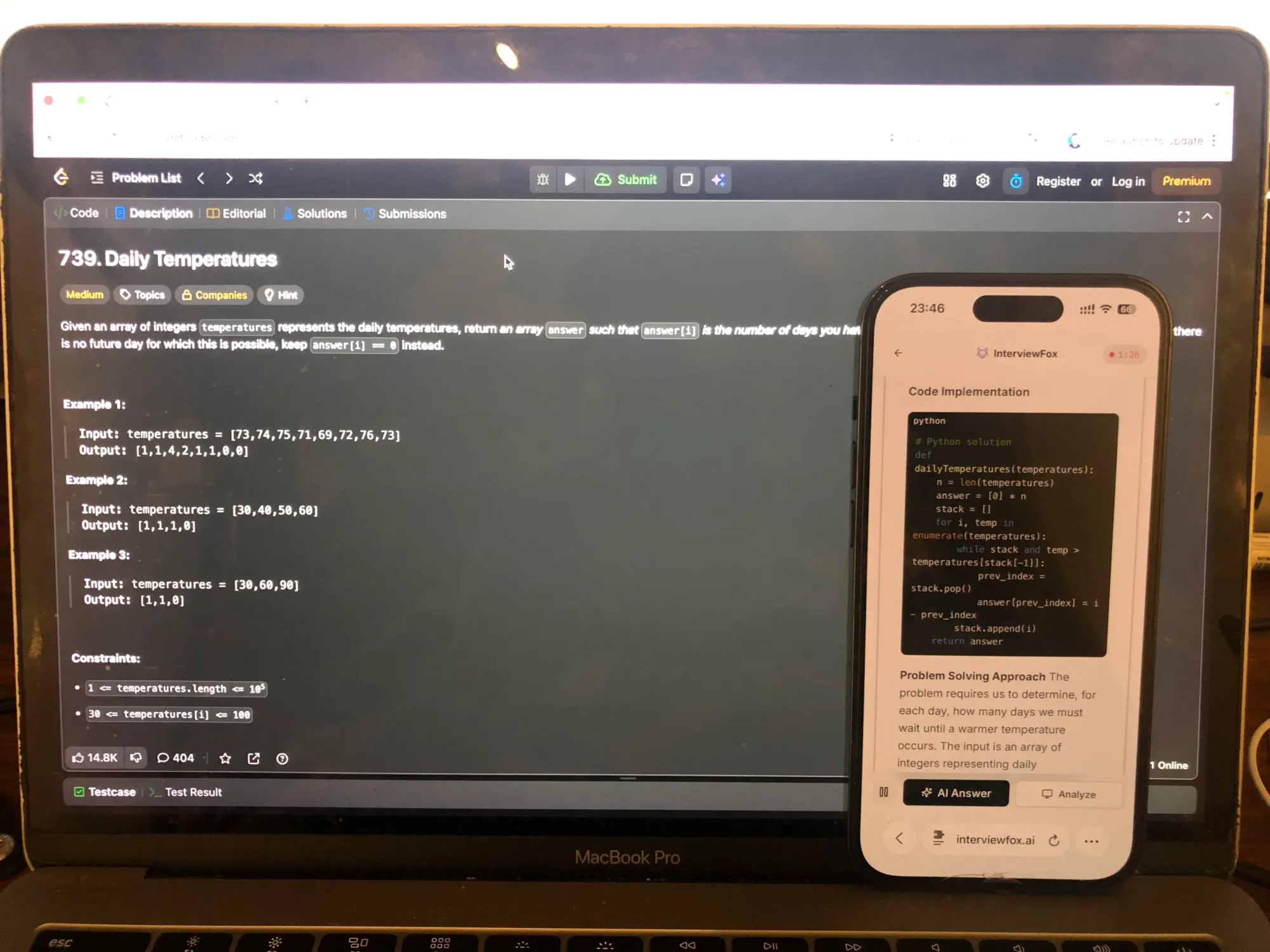
The Q4 coding question nearly broke my attempt once the clock was already past the halfway mark. With the shared screen locked to my laptop, I used real time AI interview assistant to work the solution on my phone instead, and the off-by-one in my width calc became obvious within seconds. I break that moment down in the walkthrough below.
Before my test, I went through every Capital One CodeSignal thread from the past two years on Reddit, LeetCode Discuss, and Teamblind, plus more than 20 firsthand accounts spanning 2024 through spring 2026. What I found tracks closely with what I experienced, and further down I cover the exact question order that decides your score and the mistakes that cost most candidates.
Quick Facts
| Platform | CodeSignal GCA (General Coding Assessment) |
| Time limit | 70 minutes, one sitting, no pause |
| Questions | 4 coding problems, all visible from the start |
| Proctoring | Camera + microphone + full screen sharing |
| Score range | 200–600 (updated Spring 2023) |
| Languages | Python, Java, JavaScript, C++, Go, and more |
| No DP questions | Excluded from GCA framework; no DP reported in practice |
What the Capital One CodeSignal Assessment Actually Involves
When I first received my Capital One CodeSignal invitation in spring 2026, I wanted to know exactly what I was walking into: the format, the interview questions, and the scoring risk. I spent the better part of a week going through everything I could find — online communities, recent interview reports, and conversations with people who had been through the process.
The assessment runs four coding problems on CodeSignal's General Coding Assessment framework. The proctor watches your camera, microphone, and full screen the entire time, and the score lands on the 200–600 scale.
Interview Format & Structure
The invitation arrives by email from [email protected]. The key language is worth quoting directly:
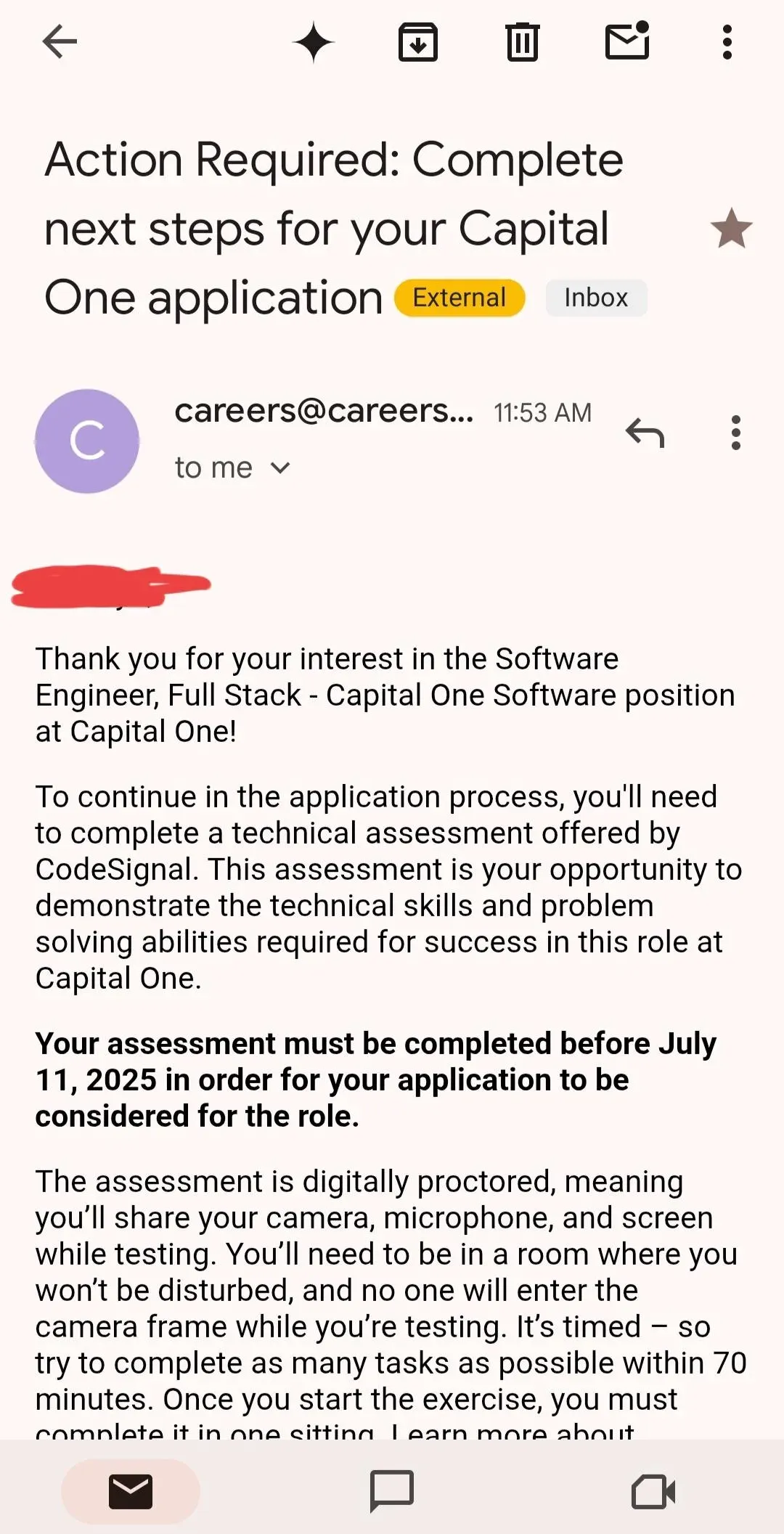
"The assessment is digitally proctored, meaning you'll share your camera, microphone, and screen while testing. It's timed — try to complete as many tasks as possible within 70 minutes. Once you start the exercise, you must complete it in one sitting."
Here is exactly what happens when you begin:
- Camera verification and ID scan (approximately 4 minutes)
- Full-screen mode is enforced — all other apps and tabs must be closed
- Environment scan: you pan your camera around the room
- Timer starts the moment you confirm you are ready
All four coding questions appear on screen simultaneously. You can view and switch between them freely. You choose your programming language — Python, Java, JavaScript, C++, Go, and others are supported — and you can switch languages between problems if needed.
One critical detail the invitation buries: once you start, there is no pause button. If your internet drops, your camera disconnects, or anything else goes wrong, the timer keeps running. Test environment preparation is not optional.
Tip: Verify your camera and microphone work before the test window opens. The proctoring setup alone takes 3–5 minutes.
What Capital One CodeSignal Questions Usually Test
The four coding questions in the Capital One CodeSignal GCA follow a consistent question pattern across 2024 through early 2026:
| Question | Topic Category | What It Tests |
|---|---|---|
| Q1 | String manipulation / Simple arrays | Speed and code clarity under time pressure |
| Q2 | Array conversion / Reading-heavy problems | Information extraction from dense problem statements |
| Q3 | 2D matrix operations / Grid traversal | Implementation fluency — translating logic to correct code |
| Q4 | Optimization — monotonic stack or hashmap | Whether you know the right data structure |
What the GCA does NOT include:
- Dynamic programming — ruled out on two independent grounds: CodeSignal's official GCA framework explicitly excludes it by design, and across all community reports collected for this article, no candidate has reported a DP question appearing in Q4. Some preparation guides circulating online list DP as a topic to study for this assessment. They are wrong. Time spent on DP is time taken away from the patterns that actually appear.
- System design questions (those appear in Power Day, not the OA)
- SQL or database queries (separate track for Data Analyst roles)
- Behavioral questions (Power Day only)
This distinction matters for preparation. Time spent on DP or system design before the OA is time not spent on the patterns that actually appear.
Capital One CodeSignal Questions During My May 2026 Test
I took the Capital One CodeSignal coding assessment on a Wednesday morning in May 2026 — 9am, early enough that the apartment was quiet, late enough that I wasn't foggy.
The sections below cover the actual Capital One CodeSignal questions I saw, the order I solved them in, and where the coding assessment became risky.
Separate room, door closed, charger plugged in, phone on the desk screen up. One monitor. Everything else closed.
The proctoring sequence took about 4 minutes: camera check, ID scan, environment pan, full-screen mode engaged. The 70-minute timer started the moment I confirmed I was ready.
All four CodeSignal questions appeared on screen at once. I scanned them first, then started with Q1.
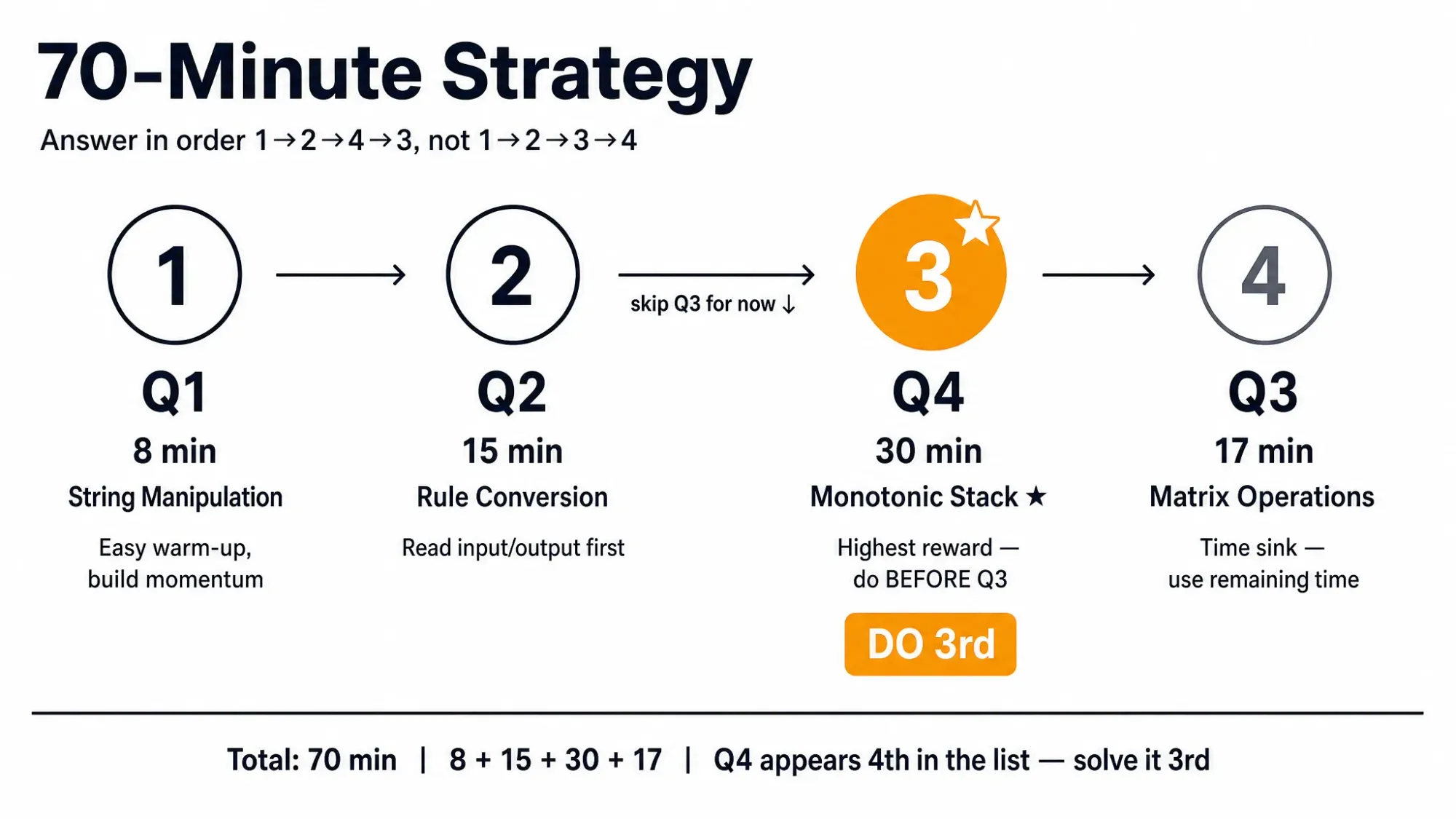
The Order That Changes Everything: 1→2→4→3
Do not do these CodeSignal questions in order. Go Q1 → Q2 → Q4 → Q3.
| Q1 | Q2 | Q4 | Q3 | |
|---|---|---|---|---|
| Difficulty | Easy | Easy–Medium | Medium | Medium |
| Suggested time | 8 min | 15 min | 30 min | Remaining |
| Do it | 1st | 2nd | 3rd | Last |
Q3 is an implementation-heavy coding question that can absorb 30–40 minutes even when you understand the approach. Q4 is an optimization coding question — once you recognize the pattern, the code is compact. Exhaust your time and energy on Q3 before getting to Q4, and the math doesn't work.
Under stress, the impulse is to go in natural order. Make the decision before you click start, so it's already settled when the pressure hits.
Q1 CodeSignal Question: String Manipulation
The question I got: Given a string, find all adjacent character pairs satisfying a frequency-based condition. Return the count.
Approach: Single pass with a frequency hashmap. No nested loops needed.
def solve(s):
    from collections import Counter
    freq = Counter(s)
    result = 0
    for i in range(len(s) - 1):
        if freq[s[i]] > freq[s[i+1]]:
            result += 1
    return result
Time complexity: O(n), single pass. Space complexity: O(1), fixed character set.
Done in 6 minutes. Moved on immediately without reviewing.
On language choice: If you use Java, Q1 and Q2 will require significantly more boilerplate — substring(), charAt(), converting between String and char[]. Python is naturally faster here. The GCA lets you switch languages between problems.
Q2 CodeSignal Question: Rule Conversion — Reading Is the Real Difficulty
The coding question I got: Given a custom calendar system (months with different day counts than the Gregorian calendar), convert a series of Gregorian dates to the custom calendar. The question statement was very long — rules written in natural language, input/output format buried at the end.
Approach: The conversion logic itself was straightforward — a lookup table and modular arithmetic. The difficulty was reading. I used a fixed extraction flow:
- Skip to the input/output format first (at the end of the question)
- Find the core conversion rule (lookup table or formula)
- Identify edge cases (end of month, year boundaries)
- Only re-read narrative sections if something is still unclear
def convert_date(year, month, day, custom_months):
    total_days = (year - 1) * 365 + sum(days_in_month[:month-1]) + day

    custom_year = 1
    remaining = total_days - 1

    days_per_custom_year = sum(custom_months)
    custom_year += remaining // days_per_custom_year
    remaining %= days_per_custom_year

    for i, m_days in enumerate(custom_months):
        if remaining < m_days:
            return custom_year, i + 1, remaining + 1
        remaining -= m_days
Time complexity: O(m), m = number of custom months.
Done in 15 minutes. 49 minutes remaining, two questions left — on schedule.
Q4 CodeSignal Question: Monotonic Stack — Where Scores Are Made or Lost
The coding question I got: A histogram variant — given an array of non-negative integers representing bar heights, find the largest rectangle that can be formed.
I recognized it immediately. I had drilled this pattern for four days straight.
Then I got the width calculation wrong.
The concept was right. But under pressure, with failing test cases and the timer in the corner, I wrote i - stack[-1] instead of i - stack[-1] - 1.
Three test cases failed. I stared at the code for three minutes before I found the difference.
At 28 minutes remaining, I picked up my phone — sitting next to the laptop, completely outside the shared screen. I reached for an AI interview helper on my phone, took a screenshot of the coding question, and the full solution breakdown appeared within seconds. The off-by-one in my width calculation was immediately obvious.
Fixed it. All test cases passed.
The shared screen showed nothing unusual the entire time. Total time on Q4: 29 minutes.
Approach: Monotonic increasing stack of indices. When you encounter a bar shorter than the stack top, pop and compute the maximum rectangle using that bar as the height.
def largestRectangleArea(heights):
    stack = []   # monotonic increasing stack of indices
    max_area = 0
    heights.append(0)  # sentinel: forces all remaining elements off the stack

    for i, h in enumerate(heights):
        while stack and heights[stack[-1]] > h:
            height = heights[stack.pop()]
            # width: distance from current index to the previous stack element, exclusive
            width = i if not stack else i - stack[-1] - 1
            max_area = max(max_area, height * width)
        stack.append(i)

    return max_area
Time complexity: O(n) — each element is pushed and popped at most once. Space complexity: O(n)
The -1 in i - stack[-1] - 1 means the element at stack[-1] is the boundary, not part of the rectangle. Verify this with a small example before the test.
Fallback if stuck — brute force for partial credit:
def largestRectangleArea_brute(heights):
    max_area = 0
    n = len(heights)
    for i in range(n):
        min_h = heights[i]
        for j in range(i, n):
            min_h = min(min_h, heights[j])
            max_area = max(max_area, min_h * (j - i + 1))
    return max_area
O(n²) will TLE on large inputs but earns partial credit. One candidate reported: "Brute force solution awarded me 140/300."
Land offer with Safer AI Interview Assistant
Skip the risky invisible apps. Our dual-device mode keeps it simple and undetectable. You crush the interview, we handle the answers.
Get started. It's freeLoved by 100,000+ candidates
Q3 CodeSignal Question: Matrix Operation Sequence
The coding question I got: Given a 2D matrix and a sequence of operation instructions — swap_row a b, swap_col c d, rotate — apply them in order and return the final matrix.
I moved to Q3 with 20 minutes remaining. This is exactly why you do Q4 first on the Capital One CodeSignal.
Approach: Implement each operation type separately. The rotation index arithmetic is the part worth slowing down on.
def apply_operations(matrix, operations):
    import copy
    mat = copy.deepcopy(matrix)

    for op in operations:
        if op[0] == 'swap_row':
            a, b = op[1], op[2]
            mat[a], mat[b] = mat[b], mat[a]
        elif op[0] == 'swap_col':
            a, b = op[1], op[2]
            for row in mat:
                row[a], row[b] = row[b], row[a]
        elif op[0] == 'rotate':
            # 90-degree clockwise rotation
            n, m = len(mat), len(mat[0])
            mat = [[mat[n-1-j][i] for j in range(n)] for i in range(m)]

    return mat
Time complexity: O(k × n²), k = number of operations, n = grid dimension.
I implemented swap_row, swap_col, and rotate in order, passed most test cases, and submitted with about 2 minutes to spare.
The algorithm is not hard. The code is just long. Each operation needs its own implementation with its own index arithmetic, and rectangular matrices add edge cases.
That is where the time goes. If you reach Q3 with less than 15 minutes, get the main logic working first — partial credit is real.
How the Questions Shifted: 2024 vs 2025
| Dimension | 2024 | 2025 |
|---|---|---|
| Q1 | Easy array traversal | Easy string manipulation |
| Q2 | Sliding window, basic string | Rule-definition conversion, reading-heavy |
| Q3 | 2D array algorithms (BFS, dual-algorithm) | Matrix operation sequences (pure implementation) |
| Q4 | Hashmap optimization / Capital One unique | LC 84 variant (monotonic stack) dominant |
| Time limit | 70 minutes | 70 minutes |
| DP questions | None | None (officially confirmed) |
The overall Capital One coding assessment difficulty ceiling stayed constant — LeetCode Medium level — but Q2 got harder to read (not harder to code), and Q4 became more pattern-recognizable. The biggest shift is not the number of questions, but what each CodeSignal question is testing. The 2026 question pattern continues this trend. If you know the monotonic stack pattern, Q4 is very winnable.
Note on difficulty variance: The GCA draws from a question pool — some sessions come in as "3 easy + 1 medium," others put Q4 closer to hard. Prepare for the harder end of the range.
How to Prepare for the Capital One CodeSignal in 10 Days
10-Day CodeSignal Study Plan
I had ten days between receiving the assessment invitation and my test date. Here is exactly how I used them for Capital One CodeSignal prep:
| Days | Focus | Reason |
|---|---|---|
| 1–2 | Arrays + hashmaps (LeetCode easy/medium) | Confirm Q1/Q2 speed — these should feel automatic |
| 3–4 | Matrix questions (LC 54, 48, 59, 566) | Q3 is the most time-consuming; fluency here saves 10 minutes |
| 5–6 | Monotonic stack (LC 84, 42, variations) | Q4 in 2025–2026 skews heavily toward this pattern |
| 7–8 | LC 2043 (Simple Bank System) + reading drills | OOP practice + Q2 extraction speed |
| 9 | Full timed simulation (70 min, 4 problems, 1→2→4→3 order) | Pressure-test the strategy before the real thing |
| 10 | Nothing new. Environment check, sleep | Don't try to learn new patterns the night before |
The Day 9 CodeSignal coding assessment simulation was the single most valuable preparation I did. Running through the full 70 minutes with a real timer — no IDE autocomplete, camera on — revealed that I could finish Q4 with 8 minutes remaining and still not have touched Q3. That is the correct outcome, but I needed to experience it once before the assessment so it didn't feel like failure when it happened again.
Tip: Practice coding questions every day, even if just one problem. Consistency matters more than intensity in the final week before the assessment.
CodeSignal Practice Tools
| Tool | What to Use It For |
|---|---|
| LeetCode (Capital One company tag) | Exact high-frequency problem list — filter by "Last 3 months" |
| GitHub: Leader-board/OA-and-Interviews | Official GCA topic breakdown + Q3 and Q4 practice lists |
| CodeSignal Practice Center | Familiarize with the IDE interface before test day |
| LeetCode Discuss (Capital One tag) | Real candidate reports with problem descriptions |
| interviewfox.ai — Prep Agent | Structured daily plan + mock Q&A over WhatsApp — useful for targeting weak spots in the final week |
High-priority Capital One CodeSignal questions to practice (from Capital One's recent tag, as of spring 2026):
For Q4 (monotonic stack track): LC 84, LC 42, LC 128, LC 1248
For Q4 (OOP variant): LC 2043 (Simple Bank System) — high-frequency Capital One coding question; implement transfer / deposit / withdraw with account validation, O(1) per operation
For Q3: LC 54, LC 48, LC 59, LC 498, LC 566, LC 1861
For Q2 (reading speed): Any rule-definition coding question — practice extraction, not memorization.
Note: CodeSignal's official documentation confirms Q4 will not be a DP coding question. Do not spend assessment prep time on DP.
Why Candidates Fail the Capital One CodeSignal (And How to Avoid It)
Six Failure Patterns
The failure patterns across Capital One CodeSignal questions are consistent — and almost none of them are "the questions were too hard."
Pattern 1: Wrong question order
Capital One CodeSignal candidates who follow the natural 1→2→3→4 sequence spend 25–35 minutes on Q3 and arrive at Q4 with no time and no energy. This is the most common and most avoidable failure.
"there are 4 questions and the first two are like gimmes and then 3 is usually the hardest and longest one so you should actually do 4 first then do 3."
Pattern 2: Language choice
Java boilerplate on Q1 and Q2 coding questions can consume 35–45 minutes — leaving almost no time for Q3 and Q4. The algorithm knowledge is there; the string parsing syntax is the bottleneck.
"I wasted too much time writing code to break down strings whereas I feel it would have been easier with other languages."
Pattern 3: Reading Q2 linearly
The 2025-style Q2 has dense coding question statements. Candidates who read them from start to finish report spending 20–30 minutes before writing code. The extraction approach (input → output → rule → edge cases) reduces this to 3 minutes.
Pattern 4: Off-by-one errors without a review pass
"I got a 418. Then about 10 minutes after the assessment, I figured out my mistake: off by one error on a condition in a for loop."
Submitting is final. Budget 2 minutes after each coding question to re-read specifically for boundary conditions.
Pattern 5: Not completing the OA at all
"I failed to complete the capital one OA for the TIP internship both for summer 2025 and now for summer 2026. I got an email today saying because I didn't complete the OA they are removing my application from consideration."
Capital One's assessment auto-removal system is real and immediate. The coding assessment window is not flexible.
Pattern 6: Using a desktop overlay AI tool
The most serious failure mode — because it ends your candidacy, not just your assessment.
A candidate I know used a desktop overlay assistant during the exam. Mid-test, the proctoring system flagged AI usage and terminated the session automatically. A violation notice followed, and their application was cancelled entirely.
Desktop overlay tools place a window on top of your shared screen — exactly the environment CodeSignal monitors. The detection risk is real, and the consequences are permanent.
The only setup that sidesteps this entirely: a phone. An AI interview tool runs on your phone — a separate device, outside the shared screen, outside everything CodeSignal monitors. You screenshot the coding question, the full solution breakdown appears on your phone in seconds.
Your laptop screen stays untouched. There is nothing for the proctoring system to flag, because nothing is happening on the monitored device.
Common Mistakes
Beyond the six patterns above, two smaller mistakes came up repeatedly:
Misreading the coding question constraints. Several candidates described spending time on an optimized solution when the constraints (small input size, explicit note that brute force is acceptable) made a simple implementation sufficient.
Ignoring partial credit. Before Spring 2023, CodeSignal's scoring was stricter. Now, a working brute-force solution on Q4 earns partial points. Submitting a working O(n²) solution with 5 minutes left is better than submitting nothing while chasing an O(n) solution.
Note: Move on if you are stuck and come back. A partial solution submitted beats a perfect solution never submitted.
The Score Myth: What Your Number Actually Means
Capital One does not see your exact score. They see pass or fail.
This assessment detail was confirmed by a candidate who communicated directly with CodeSignal:
"I had emailed the CodeSignal team to ask about something, and in the email they mentioned that the C1 team does not get the score of your assessment, they only see if you passed or failed."
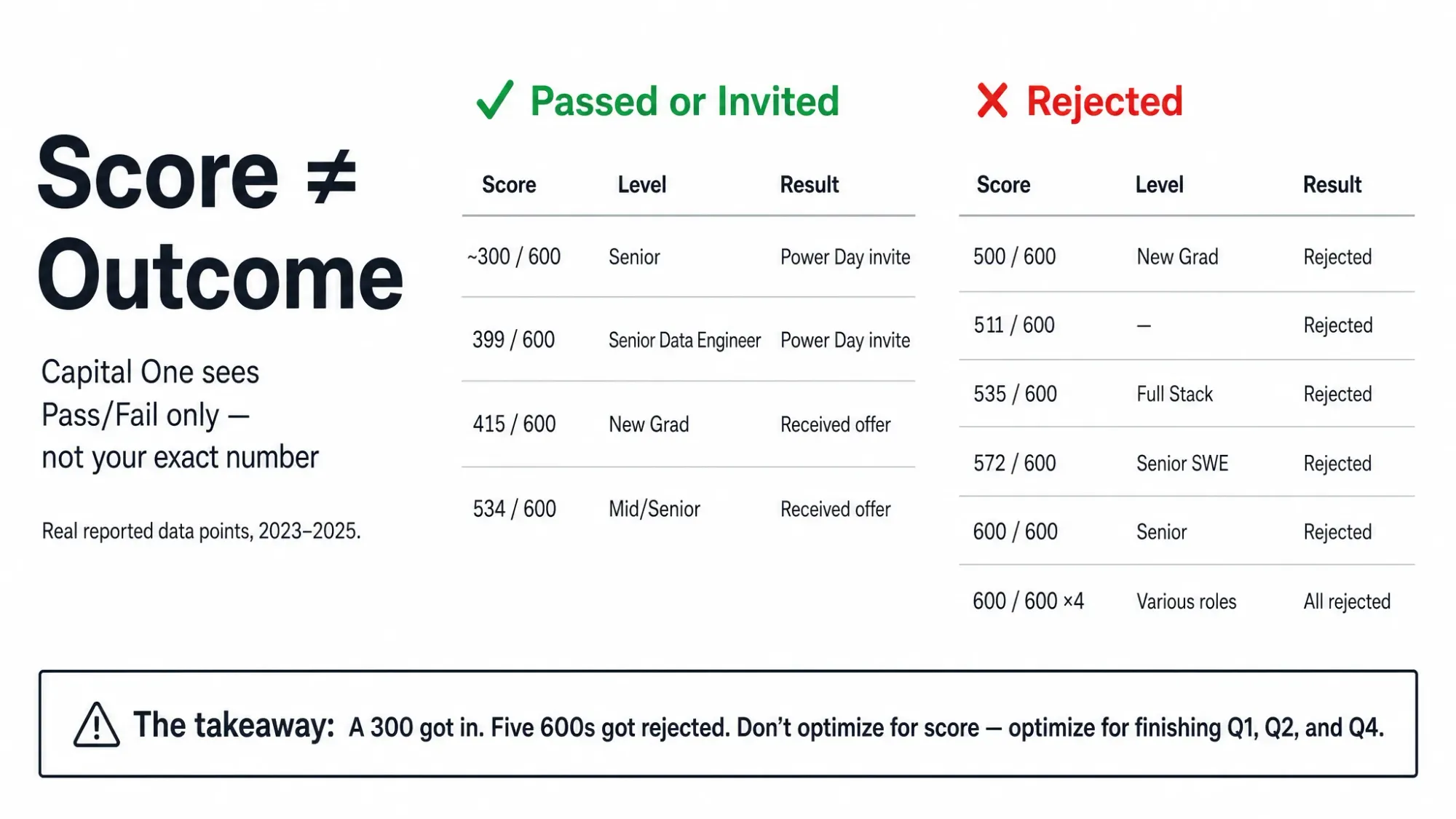
Here is what the actual data shows:
| Score | Role | Outcome | Via |
|---|---|---|---|
| ~300/600 (600/1200 raw) | Senior | Power Day invite | |
| 399/600 | Senior Data Engineer | Power Day invite | |
| 415/600 | New Grad | Received offer | |
| 500/600 | New Grad | Rejected | |
| 511/600 | Unknown | Rejected | Teamblind |
| 534/600 | Mid/Senior | Received offer | |
| 535/600 | Full Stack FT | Rejected | |
| 572/600 | Senior SWE | Rejected | Teamblind |
| 600/600 | Senior | Rejected | LeetCode Discuss |
| 600/600 (×4) | Various | All rejected | LeetCode Discuss |
Data aggregated from community reports.
There is no reliable score threshold. A ~300/600 candidate reached Power Day; four candidates with perfect 600/600 scores were rejected. The pass/fail gate is real, but what determines your outcome above it — resume, role availability, cohort competition — is outside the assessment itself.
Practical implication: Focus on completing Q1, Q2, and Q4 coding questions correctly. That appears to be sufficient to clear the Capital One assessment gate for most candidates. Chasing a higher score at the cost of strategic time allocation is the wrong trade.
Land offer with Safer AI Interview Assistant
Skip the risky invisible apps. Our dual-device mode keeps it simple and undetectable. You crush the interview, we handle the answers.
Get started. It's freeLoved by 100,000+ candidates
Suggestions for Capital One CodeSignal Candidates
Looking back at preparation, the coding assessment, and the broader interview process, here is what actually made a difference:
- Commit to 1→2→4→3 before you start. This is not natural. Make the decision before you click start, so you don't second-guess it under pressure.
- Choose your language carefully. If you use Java, practice string manipulation coding questions specifically. If you use Python, your Q1 and Q2 will be faster.
- Practice Q3 coding question patterns until the code feels automatic. Rotate, swap, transpose — these need to feel like muscle memory, not problem-solving.
- Know the monotonic stack cold for Q4. Write the LC 84 solution from memory, including the width calculation, until you can do it in under 5 minutes.
- Do one full 70-minute timed simulation. Not to measure yourself — to experience the 1→2→4→3 outcome before the real assessment.
- Budget 2 minutes per coding question for a boundary-condition review. Off-by-one errors caught after submission are the most painful failure mode in these reports.
- Set up your assessment environment the day before. Camera, microphone, room, charger. None of this should be new on test day.
What Happens After You Submit
How Long Until You Hear Back
After the Capital One CodeSignal, there is no consistent timeline. The fastest outcome is a rejection email the next morning; the slowest is two months of silence followed by a rejection.
The clearest interview process pattern: if you are going to be invited to Power Day, the invitation typically arrives within 1–2 weeks. If three weeks pass without contact, the probability skews negative — but it is not definitive.
Glassdoor's aggregate data for Capital One SWE roles shows an average of 20 days from application to offer, which implies Power Day invitations are generally going out within the first two weeks after the OA window closes.
One follow-up email to your recruiter after 7 business days is appropriate. More than that is not.
If You Pass: Power Day Interview Breakdown
Power Day is Capital One's single-day interview format after the CodeSignal assessment. All interview rounds happen on the same day — on-site or virtually — back to back.
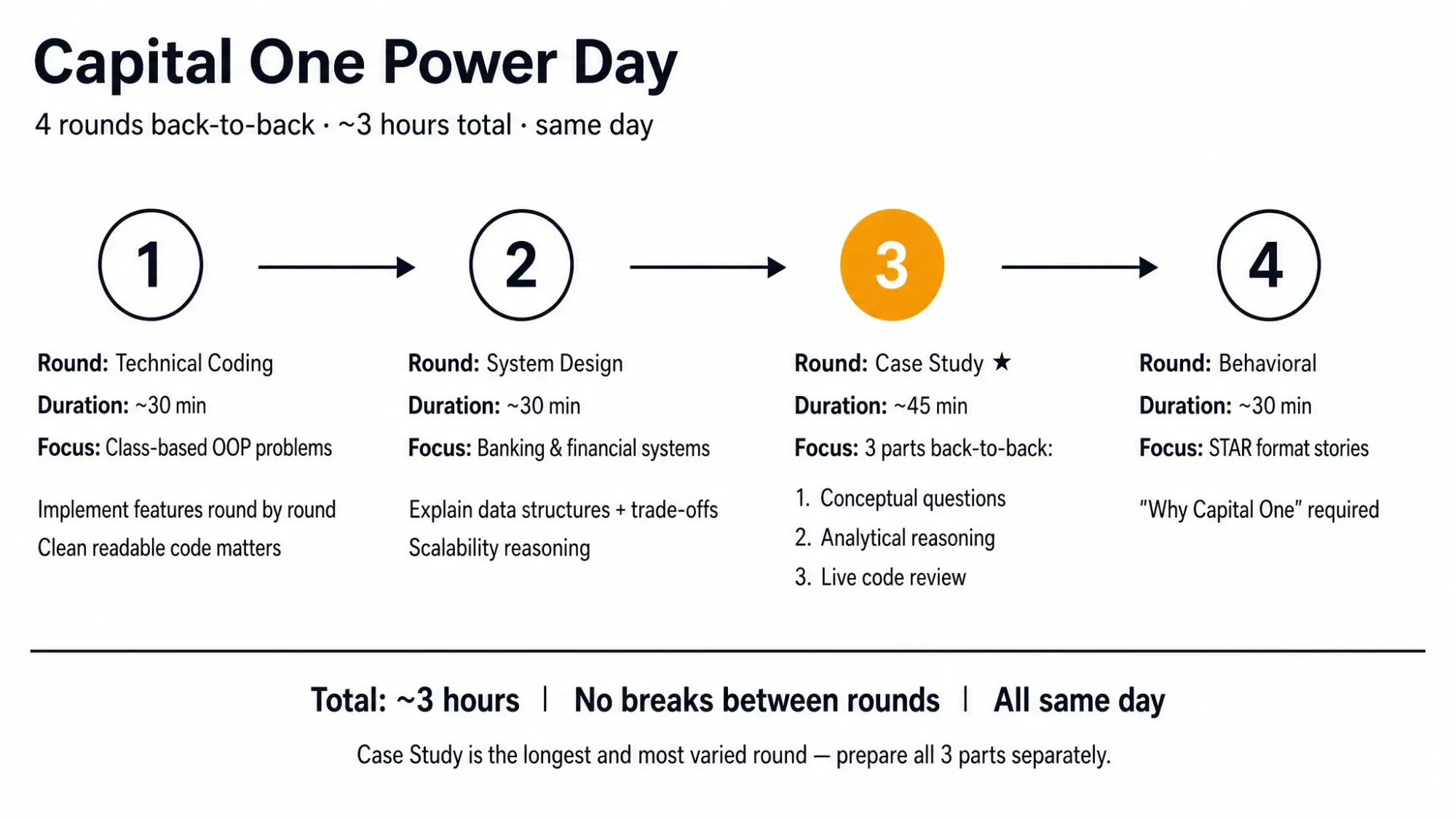
Technical Coding (~30 minutes)
Two non-LeetCode-style coding interview questions. You build on a class structure incrementally — implement features, extend them, handle edge cases. This is Low-Level Design (LLD), not algorithm optimization.
"It's very straightforward, create some class and implement simple features. They just wanna see you can write clean maintainable code."
A confirmed May 2024 coding interview example: design a bank account system with create_account, transfer, and get_top_activity. Then discuss how you'd make it production-ready.
System Design (~30 minutes)
Banking or financial system interview scenarios. Data structure choices and basic scalability — not deep distributed systems work.
Case Study (~45 minutes)
Three sequential parts sharing a common theme (credit cards, mobile payments):
- Conceptual software development questions
- Analytical reasoning with simple math
- Code review or small bug fix
"By the time I reached the last half case study interview, I was fully drained. Lesson learned to definitely ask for a break."
You can request a break between rounds. Almost no one does. You should.
Behavioral / Job Fit (~30 minutes)
STAR-format behavioral questions plus "Why Capital One" variants. Prepare 4–5 stories demonstrating: ownership without being asked, cross-team collaboration under ambiguity, pushing back on a decision with data.
After Power Day, recruiters typically commit to 5–7 business days. Real timelines run 1–2 weeks, and results release in cohort batches.
If You Don't: Retakes, Score Sharing, and What to Do Next
Retake limits:
- 2 assessments per 30 days
- 3 assessments per 6 months
- Capital One typically accepts scores from the past 6 months
Your GCA score is portable. It is attached to your CodeSignal profile, not to your Capital One application. If Ramp, TikTok, Coinbase, or another company using CodeSignal sends you an assessment invitation, you can share the same score. You do not retake the test.
"It's codesignal so they accept the same score if you did a proctored test for another company so you only gotta do it once for like 6 months."
If you need to retake:
Identify which problems you completed. If Q4 is the gap, focus on monotonic stack and OOP problems. If Q2 took too long, practice the extraction approach on reading-heavy problems.
If you completed Q1–Q3 but not Q4, the outcome may have been determined by resume and role availability more than the assessment score.
FAQ
What score do I need to pass the Capital One CodeSignal?
There is no published threshold. Candidates with scores as low as ~300/600 (completing only Q1 and Q2) have been invited to Power Day, while candidates with perfect 600/600 scores have been rejected.
The pass/fail gate appears based on completing a minimum number of problems correctly. Focus on Q1, Q2, and Q4 as your baseline target.
Does Capital One see my exact CodeSignal score?
No. According to a CodeSignal team member's email to a candidate: Capital One only sees whether you passed or failed. Your exact score is not shared with the hiring team.
Can I choose my programming language?
Yes. Python, Java, JavaScript, C++, Go, and several others are supported. You can also switch languages between problems.
Java users should specifically practice string manipulation before the CodeSignal test — the verbosity adds real time on Q1 and Q2.
What happens if I run out of time?
The Capital One CodeSignal submits whatever you have at 70 minutes. You receive partial credit for incomplete solutions. Since Spring 2023, CodeSignal's partial scoring has been more generous — a brute-force Q4 earns partial points rather than zero.
Can I reuse my CodeSignal score for other companies?
Yes. Your CodeSignal GCA score is attached to your CodeSignal profile and can be shared with any company using the GCA format — Ramp, TikTok, Coinbase, and others.
Scores are generally accepted for 6 months. Retake limits: 2 per 30 days, 3 per 6 months.
Are the Capital One CodeSignal questions the same every year?
No. The exact questions change, but the question categories are stable: string or array basics, reading-heavy conversion, matrix implementation, and one optimization question such as monotonic stack or hashmap.
What is Capital One Power Day?
Power Day is Capital One's single-day interview format for SWE roles: Technical Coding (~30 min), System Design (~30 min), Case Study (~45 min), and Behavioral (~30 min), all back to back. The coding interview round is class-based OOP, not LeetCode-style. The case study is the most unusual — three parts covering conceptual questions, analytical reasoning, and a code review.
Land offer with Safer AI Interview Assistant
Skip the risky invisible apps. Our dual-device mode keeps it simple and undetectable. You crush the interview, we handle the answers.
Get started. It's freeLoved by 100,000+ candidates