
I Aced Cognizant HackerRank in 2026: Real Questions and Prep Plan

Quick Facts
| Assessment | Cognizant HackerRank OA for the ACE technical track |
| Format | Five sections: Problem Solving (DSA), Front End Framework (React), Prompt Engineering, RAG, then an MCQ batch |
| Recallable problem sections | Four, one per coding section; the MCQ batch is a fifth section |
| MCQ batch | About 24 questions in the May 2026 ACE Team sitting, about 20 in the August 2026 sitting |
| Delivery | HackerRank Desktop App for the ACE track, not a browser tab |
| Proctoring | Top integrity tier: full-screen lock, copy and paste blocked, screenshot and webcam analysis, OS-level monitoring |
| Scoring | Per test case: Full Score, Partial Score, or No Score |
| Editor rules | Java, C#, and Scala main class must be named Solution; most tasks read STDIN and write STDOUT |
| Run vs save | Run Code is free; only Save and Proceed submits; the last compiled version auto-submits when time ends |
| Total time limit | Cognizant publishes no single figure for the campus OA; third-party pages cite 120 minutes |
| Sectional cut-off | Cognizant publishes no sectional cut-off, and no 2026 sitting reports one |
I took the Cognizant HackerRank assessment for the ACE technical track in 2026. It covered all four problem sections plus the MCQ batch. I cleared the DSA and prompt sections clean and left both React test cases red. The clock ran out before the RAG edge case. What follows is the complete process and how I prepared for it.
Both address-component test cases stayed red. That section's clock ran out before I fixed the save-then-edit transition. As that clock ran down, I captured the stuck screen with an online AI interview assistant. It surfaced the state reset the card-to-form switch had missed. I break that fix down in the walkthrough below.
Before my test, I went through every Cognizant HackerRank post from the past two years on Reddit, LeetCode Discuss, and Teamblind. What I found tracks closely with what I experienced. So the sections ahead cover the specific traps that cost me marks, especially the proctoring flags and self-inflicted errors that get candidates rejected.
The Real Questions on My Cognizant HackerRank Test
I sat the Cognizant ACE technical assessment in 2026, and the four problems below are the ones I actually worked through, in the order they appeared on my screen: a DSA problem, a React front end task, a prompt engineering task, and a RAG pipeline, with a 24-question MCQ batch waiting after them. Here is exactly what I got and how each one went.
Question 1: Duplicate Message Detection
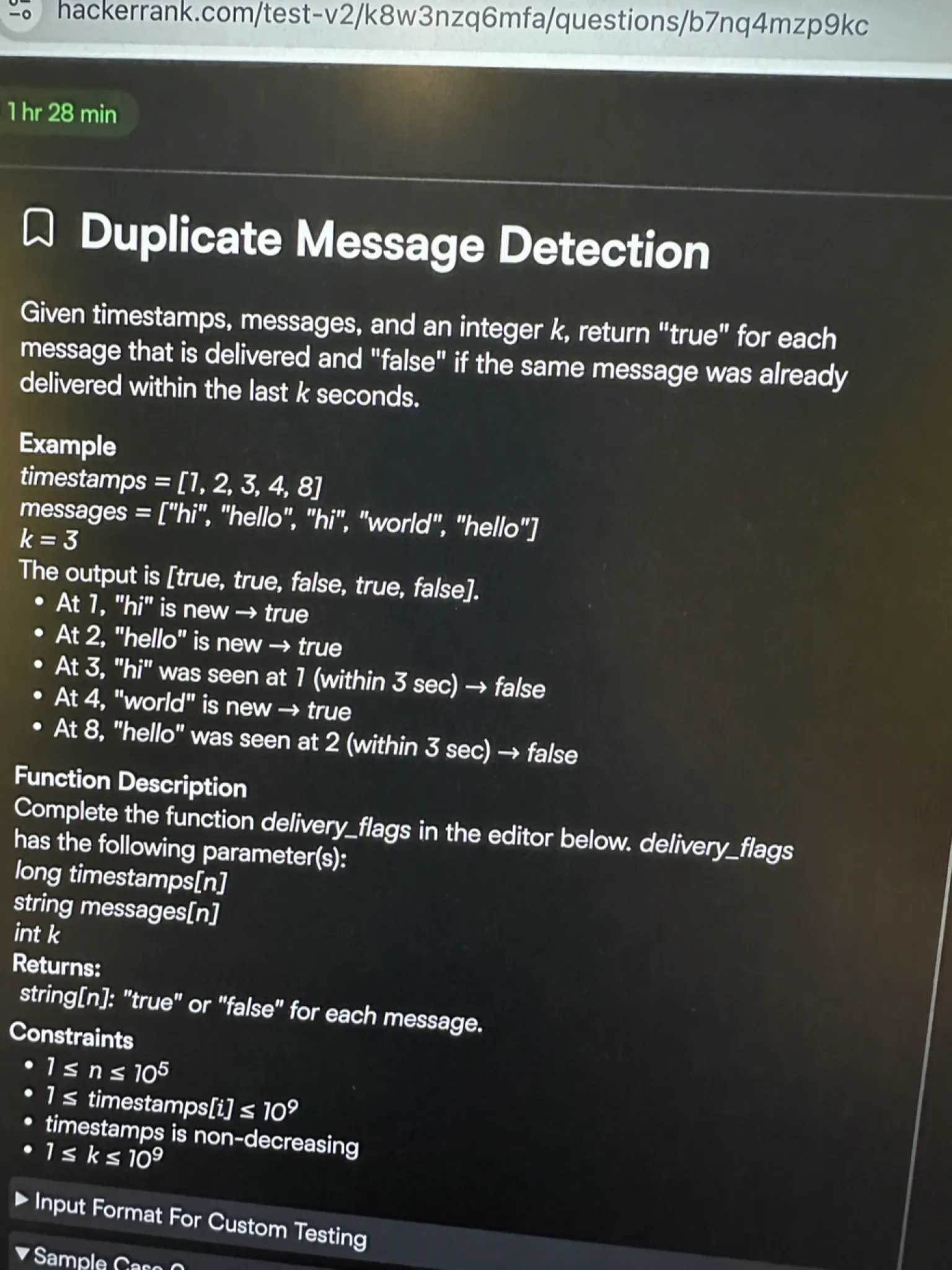
The problem I got: The first section was a single DSA problem, a message deduplication task for a messaging app. I was given an array of timestamps, an array of message strings of the same length, and an integer k, and for each message I had to return "true" if it should be delivered and "false" if the same message had already been delivered inside the last k seconds.
My approach: The k-second window is the entire problem, so I reached for a hash map keyed by the message text, storing the timestamp of its last successful delivery. For each entry I looked up whether the same text was still inside the window; if it was, I wrote "false", and if it was not, I delivered it and refreshed the stored timestamp. I skipped the idea of scanning backward through previous timestamps for every entry, because that turns one clean pass into a quadratic one the moment the test input grows.
import sys


def delivery_flags(timestamps, messages, k):
    """Return "true" if a message is delivered, "false" if it is a duplicate
    that arrived inside the last k seconds."""
    last_seen = {}
    out = []
    for t, m in zip(timestamps, messages):
        last = last_seen.get(m)
        if last is not None and t - last < k:
            out.append("false")
        else:
            out.append("true")
            last_seen[m] = t
    return out


def main():
    lines = [ln for ln in sys.stdin.read().splitlines() if ln.strip()]
    timestamps = [int(x) for x in lines[0].split()]
    messages = lines[1].split()
    k = int(lines[2])
    sys.stdout.write("\n".join(delivery_flags(timestamps, messages, k)))


if __name__ == "__main__":
    main()
Time complexity: O(n) | Space complexity: O(n)
This was the first thing on screen, so the adrenaline was still on my side. I had the function written and the visible cases green quickly, and I banked that spare time without suspecting I would need every minute of it later.
Question 2: E-Commerce Address Component
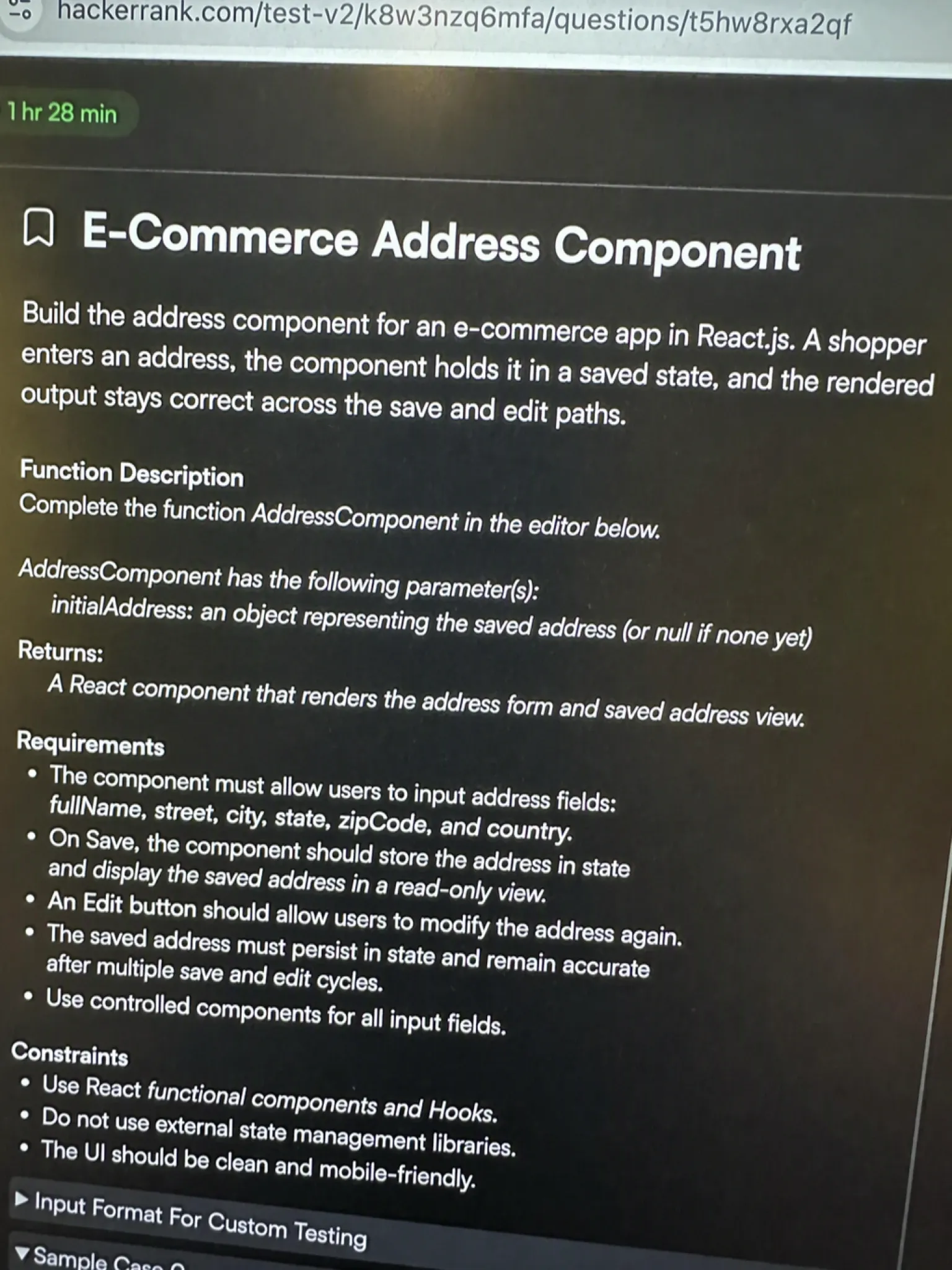
The problem I got: Section two was the front end framework section, and I was asked to build the address component functionality for an e-commerce app in React.js. I had to let a shopper enter an address, have the component hold it in a saved state, and keep the rendered output correct across the save and edit paths; the section reported two test cases.
My approach: I treated it as a controlled form: one state object for the five fields, one change handler keyed off the input's name, and a save step that swapped the editable form for a read-only card so the shopper could see what had been entered. I validated on save rather than on every keystroke, because firing an error at a half-typed field would break the empty-state case before the user had a chance to finish. The edit path mattered as much as the save path, since the test cases clearly expected a user to come back and change an address after saving it.
import React, { useState } from "react";

const EMPTY = { name: "", street: "", city: "", state: "", zip: "" };

export default function AddressComponent({ onSave }) {
  const [form, setForm] = useState(EMPTY);
  const [saved, setSaved] = useState(null);

  const handleChange = (e) => {
    const { name, value } = e.target;
    setForm((prev) => ({ ...prev, [name]: value }));
  };

  const isValid = () =>
    form.name.trim() !== "" &&
    form.street.trim() !== "" &&
    form.city.trim() !== "" &&
    form.state.trim() !== "" &&
    /^\d{5,6}$/.test(form.zip.trim());

  const handleSave = () => {
    if (!isValid()) return;
    setSaved(form);
    if (onSave) onSave(form);
  };

  if (saved) {
    return (
      <div className="address-card">
        <p>{saved.name}</p>
        <p>
          {saved.street}, {saved.city}, {saved.state} {saved.zip}
        </p>
        <button onClick={() => setSaved(null)}>Edit</button>
      </div>
    );
  }

  return (
    <form
      className="address-form"
      onSubmit={(e) => {
        e.preventDefault();
        handleSave();
      }}
    >
      <input name="name" value={form.name} onChange={handleChange} placeholder="Full name" />
      <input name="street" value={form.street} onChange={handleChange} placeholder="Street address" />
      <input name="city" value={form.city} onChange={handleChange} placeholder="City" />
      <input name="state" value={form.state} onChange={handleChange} placeholder="State" />
      <input name="zip" value={form.zip} onChange={handleChange} placeholder="ZIP code" />
      <button type="submit">Save address</button>
    </form>
  );
}
Time complexity: O(n) per render, where n is the number of address fields | Space complexity: O(n) for the state object holding the entered values
Two test cases, and I left both of them red. This was the section that ate my time: I had the markup in front of me quickly, then lost the next long stretch going back and forth on the state transition between the editable form and the saved card, and the clock on that section ran out before I got it right. I moved to section three already behind the pace I had set for myself.
With that section's clock draining, I did not want a desktop overlay, because its answer would have stayed on the screen the proctoring system was already watching. So I used a dual device AI interview tool. A keyboard shortcut captured the stuck screen, and the answer landed on my phone, a separate device outside the platform's screenshot monitoring. The missed reset on the card-to-form switch became clear in seconds, and my laptop screen never left the exam editor.
Land offer with Safer AI Interview Assistant
Skip the risky invisible apps. Our dual-device mode keeps it simple and undetectable. You crush the interview, we handle the answers.
Get started. It's freeLoved by 100,000+ candidates
Question 3: Relevance-Classification Prompt
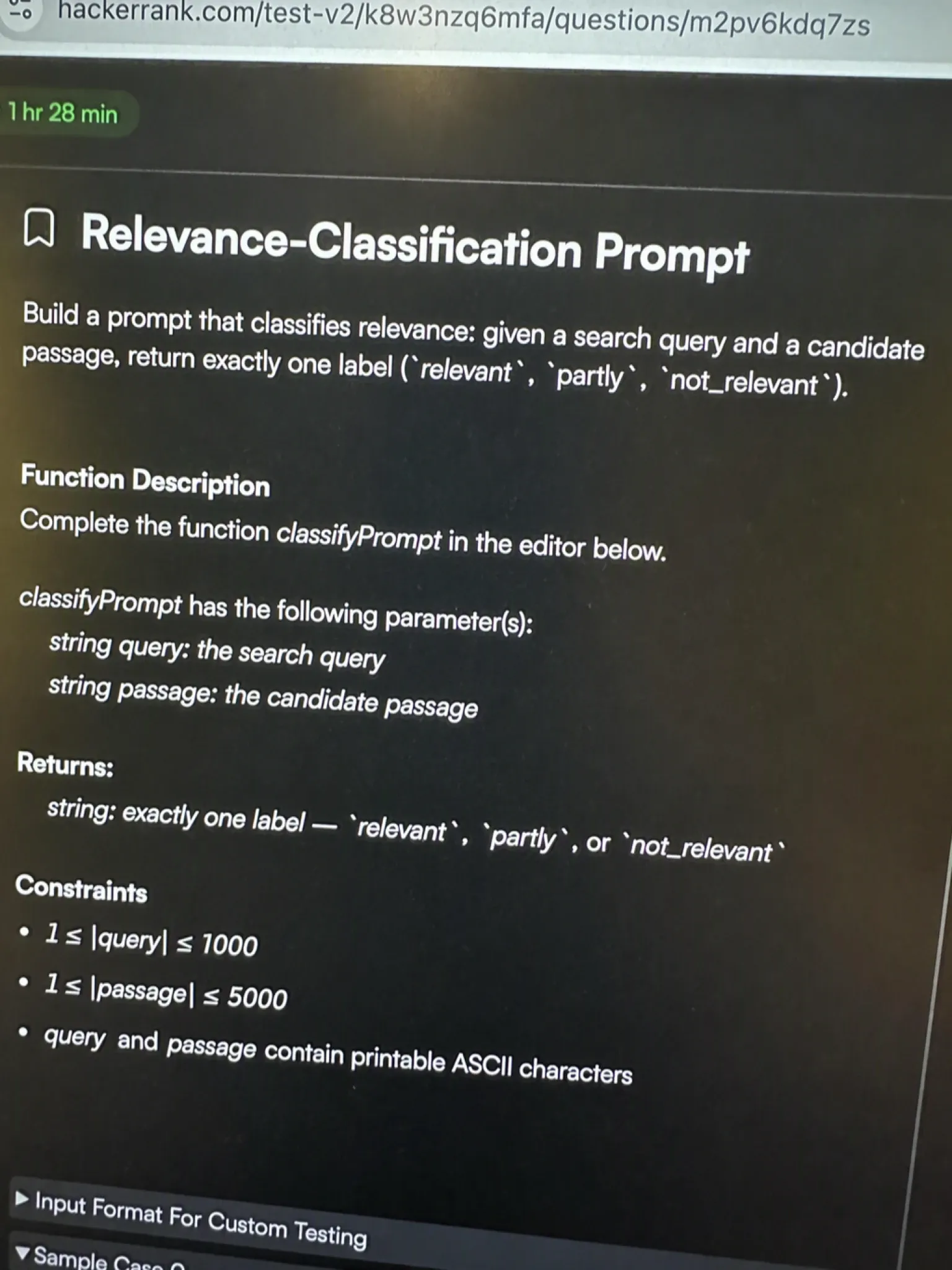
The problem I got: Section three was prompt engineering, and I was asked to build a prompt for classifying relevance. I was not writing code, I was writing the instruction itself: a prompt that takes an input and returns a relevance label, in an output format tight enough for a grader to compare against an expected answer.
My approach: I fixed the output contract before I wrote a single instruction, because a classifier prompt fails on formatting more often than on judgment. I told the model to return exactly one label from a closed set, gave it the tie-break rule for the ambiguous middle, and then wrote two short labeled examples so the boundary was shown rather than described. I kept the examples short on purpose, since long examples are where a prompt picks up the wrong pattern.
You are a relevance classifier. For each request you receive a SEARCH QUERY and a
CANDIDATE PASSAGE. Decide whether the passage answers or directly supports the query.

Return exactly one label, lowercase, with no other text:
  "relevant"      the passage answers the query or supplies the fact it asks for
  "partly"        the passage is on the same topic but does not answer the query
  "not_relevant"  the passage is off topic for the query

Rules:
1. Judge only the passage given. If the query cannot be answered from it, the label
   is not "relevant".
2. When the passage is on topic but misses the specific ask, use "partly". Do not
   upgrade it to "relevant".
3. Ignore the length of the passage and keyword overlap. A short passage that answers
   the query is "relevant"; a long passage that only mentions the topic is not.
4. If the query is empty or unreadable, return "not_relevant".

Example 1
SEARCH QUERY: how long does standard shipping take
CANDIDATE PASSAGE: Standard shipping arrives in three to five business days.
Label: relevant

Example 2
SEARCH QUERY: how long does standard shipping take
CANDIDATE PASSAGE: We ship to most countries and offer free returns.
Label: not_relevant

Now classify this request.

SEARCH QUERY: {query}
CANDIDATE PASSAGE: {passage}
Label:
This section was a relief after the React one, and I moved through it quickly. Quick did not mean early, though: I was still carrying the time I had lost on section two, and I finished the prompt knowing I was about to have to rush the last section.
Question 4: Mini RAG Pipeline
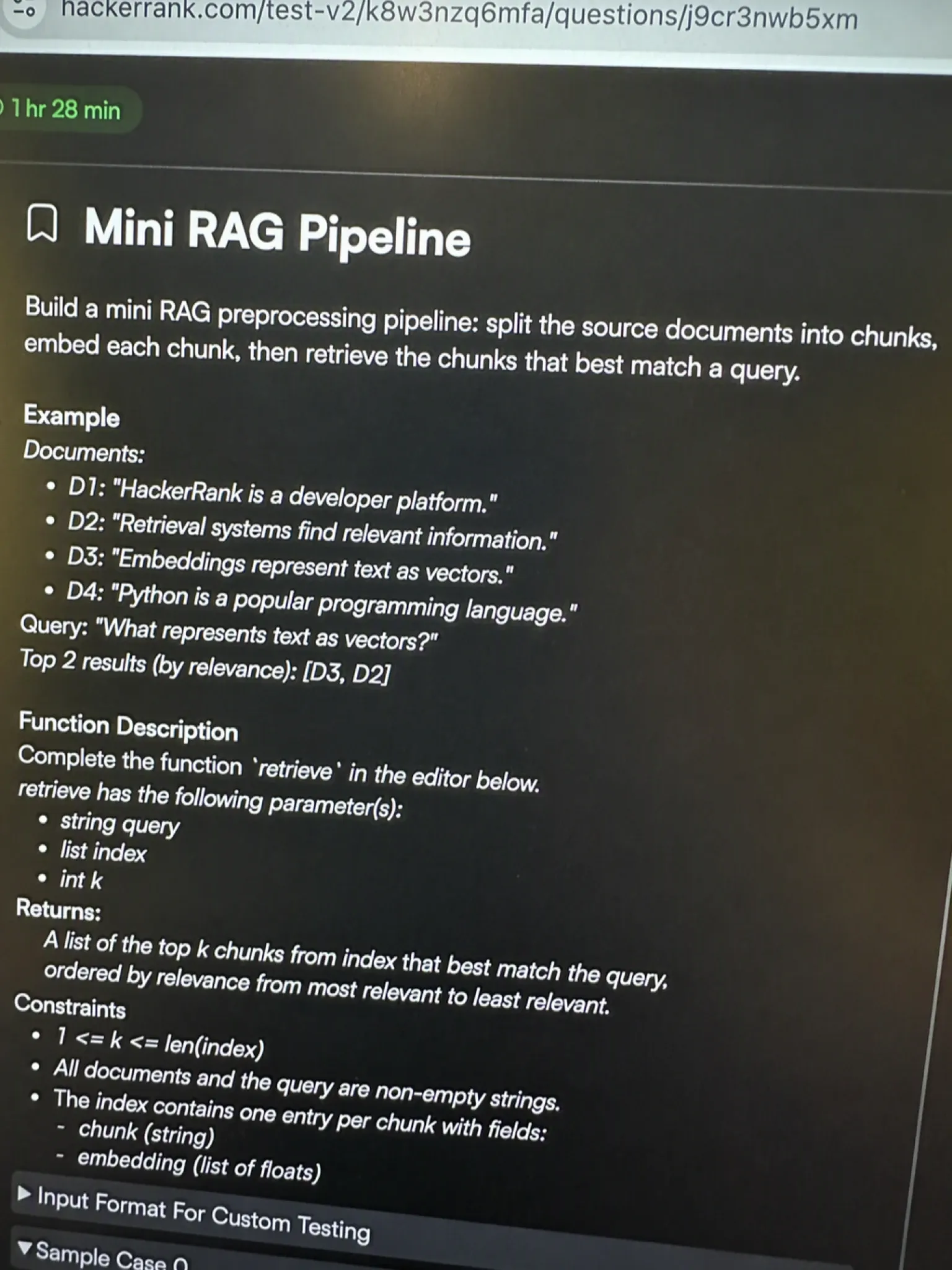
The problem I got: The last section was RAG, and I was asked to build a mini RAG preprocessing pipeline. From the title I read the three stages it wanted: break the source documents into chunks, turn each chunk into an embedding, and retrieve the chunks that best match a query.
My approach: I chunked on fixed word windows with an overlap, so a sentence sitting across a boundary still appeared whole in at least one chunk, then embedded each chunk into a fixed-length vector using a deterministic token hash, and retrieved the top matches by cosine similarity. I made the embedding deterministic on purpose: Python's built-in string hash is randomized per process, so a ranking built on it would disagree with itself between the sample run and the hidden run. Cosine similarity over the hashed vectors was close enough to rank the chunks, and it kept the whole pipeline inside the standard library.
import math
import re
import zlib


def tokenize(text):
    return re.findall(r"[a-z0-9]+", text.lower())


def chunk_text(text, size=50, overlap=10):
    words = text.split()
    step = max(1, size - overlap)
    chunks = []
    for start in range(0, len(words), step):
        piece = words[start:start + size]
        if not piece:
            break
        chunks.append(" ".join(piece))
        if start + size >= len(words):
            break
    return chunks


def embed(text, dim=256):
    vec = [0.0] * dim
    for tok in tokenize(text):
        vec[zlib.crc32(tok.encode()) % dim] += 1.0
    norm = math.sqrt(sum(v * v for v in vec))
    return [v / norm for v in vec] if norm else vec


def cosine(a, b):
    return sum(x * y for x, y in zip(a, b))


def build_index(documents, size=50, overlap=10):
    index = []
    for doc_id, doc in enumerate(documents):
        for chunk in chunk_text(doc, size, overlap):
            index.append({"doc_id": doc_id, "text": chunk, "vec": embed(chunk)})
    return index


def retrieve(query, index, k=3):
    qv = embed(query)
    scored = [(cosine(qv, item["vec"]), item) for item in index]
    scored.sort(key=lambda pair: pair[0], reverse=True)
    return [item for _, item in scored[:k]]


if __name__ == "__main__":
    documents = [
        "Standard shipping arrives in three to five business days. Express shipping is next day.",
        "Returns are accepted within thirty days of delivery. Refunds post in five days.",
        "Our support team answers email within one business day.",
    ]
    index = build_index(documents)
    for hit in retrieve("how long does delivery take", index, k=2):
        print(hit["doc_id"], hit["text"])
Time complexity: O(T * D) to build the index and O(N * D) per query, where T is total tokens, N is the number of chunks, and D is the embedding dimension | Space complexity: O(N * D)
This was the section I had prepared the hardest for, because it was Python and I am comfortable in Python, and it still ran long. I had most of the visible cases passing when I felt the clock, and the empty-document edge input is the one I never got back to.
Cognizant's Proctoring Policy for HackerRank
Cognizant's ACE technical assessment runs in the top tier of HackerRank's three-tier integrity model. Secure Mode locks the screen, blocks copy and paste, refuses multiple monitors, and raises tab-switch alerts. Proctor Mode adds screenshot analysis, plagiarism detection, and webcam anomaly detection on top of that.
The ladder stacks as the chart below shows, from a controlled browser up to full OS-level monitoring.
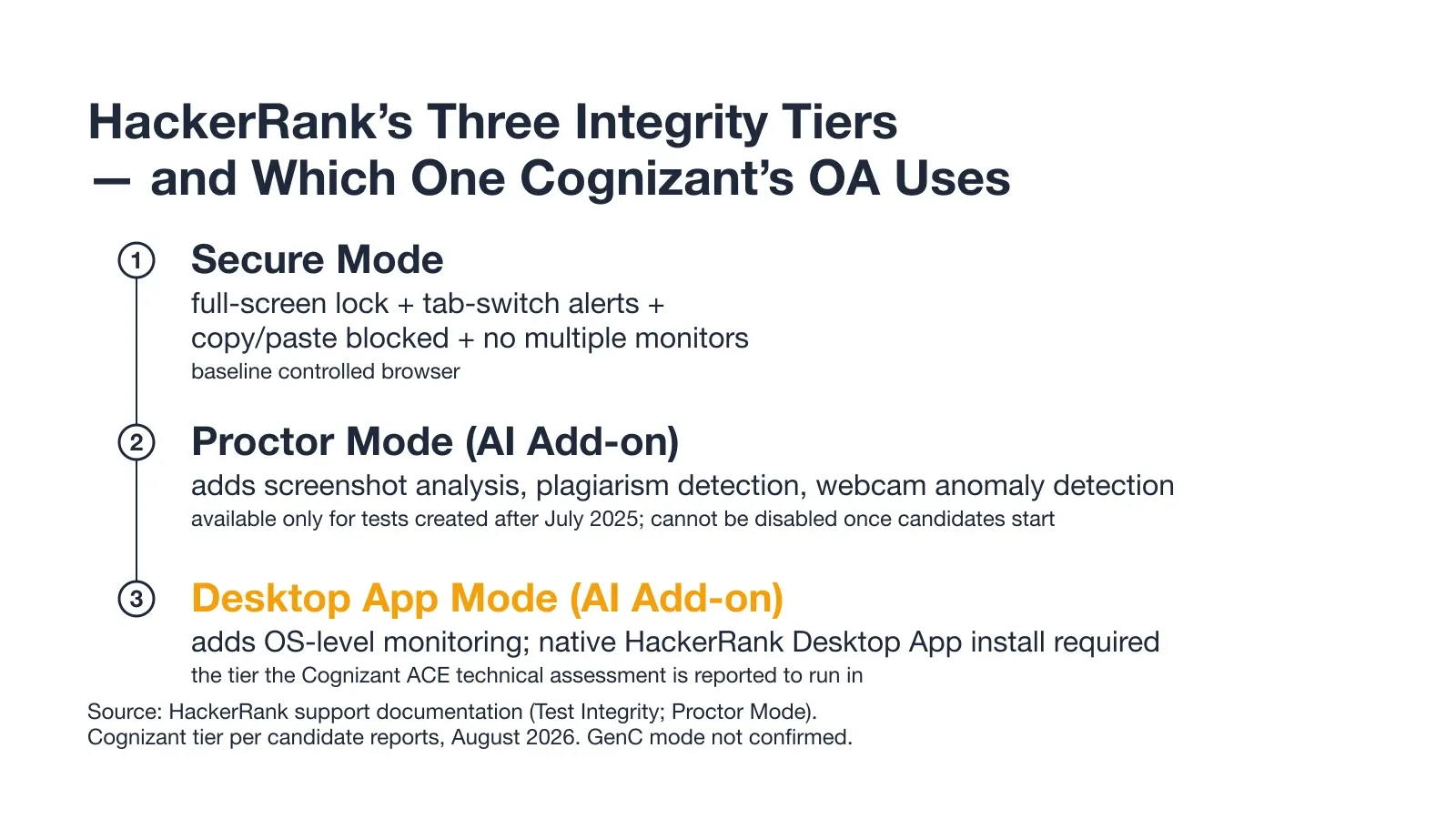
Tier placement. Which tier a sitting lands in is not a guess for the ACE track. Two candidate reports from August 2026 place it in Desktop App Mode. That tier adds OS-level monitoring and needs the native HackerRank Desktop App installed.
A single sitting ends with a final integrity result of High or Medium. The proctoring report HackerRank builds from that session is backed by a replay that samples the webcam every five seconds and the screen every fifteen.
Copy and paste tracking is on by default, and the platform's own policy stops short of the case most people actually ask about. Whether a paste is tracked even when the content is retyped by hand is spelled out on its own page.
What actually decides whether a session reads as cheating rather than as nerves? The cheating-detection logic behind HackerRank's integrity flags answers that in more depth than one policy paragraph can.
Knowing exactly what the platform captures takes the guesswork out of a shared screen. What HackerRank captures from the test screen and how often lays out the capture cadence up front.
The onboarding gate. An onboarding gate runs before the clock starts: consent to the test rules, webcam access, a single-monitor check, screen sharing, and full-screen mode. Proctor Mode exists only for tests created after July 2025, and candidates cannot switch it off once they start.
The test report captures malpractice, and it can lead to disqualification from later rounds. A proctored session also needs a webcam-enabled laptop, since the platform does not support phones or tablets.
12 Other Confirmed Cognizant HackerRank Questions
Cognizant runs several tracks on HackerRank, and each carries its own confirmed problem set. The twelve below each carry a date and a traceable source, one per report.
Distinct Palindromic Substrings
In the ACE Frontier sitting aditi wrote up on 24 August 2026, the DSA task was to count the distinct palindromic substrings in a string of up to 5,000 characters. That section ran about eleven test cases, hidden ones included.
import sys

M1, M2 = 1_000_000_007, 1_000_000_009
B = 131


def count_distinct_palindromes(s):
    n = len(s)
    seen = set()

    # odd-length palindromes, expanded around each single character
    for c in range(n):
        h1 = h2 = 0
        p1 = p2 = 1  # holds B^(2k)
        for k in range(0, min(c, n - 1 - c) + 1):
            if s[c - k] != s[c + k]:
                break
            if k == 0:
                h1 = ord(s[c]) % M1
                h2 = ord(s[c]) % M2
            else:
                h1 = (h1 * B + ord(s[c + k]) + ord(s[c - k]) * p1) % M1
                h2 = (h2 * B + ord(s[c + k]) + ord(s[c - k]) * p2) % M2
            p1 = p1 * B % M1 * B % M1
            p2 = p2 * B % M2 * B % M2
            seen.add((h1, h2))

    # even-length palindromes, expanded around each gap
    for c in range(n - 1):
        h1 = h2 = 0
        q1 = q2 = 1  # holds B^(2k-1)
        for k in range(1, min(c + 1, n - 1 - c) + 1):
            if s[c - k + 1] != s[c + k]:
                break
            h1 = (h1 * B + ord(s[c + k]) + ord(s[c - k + 1]) * q1) % M1
            h2 = (h2 * B + ord(s[c + k]) + ord(s[c - k + 1]) * q2) % M2
            q1 = q1 * B % M1 * B % M1
            q2 = q2 * B % M2 * B % M2
            seen.add((h1, h2))

    return len(seen)


def main():
    s = sys.stdin.read().strip()
    print(count_distinct_palindromes(s))


if __name__ == "__main__":
    main()
Time complexity: O(n squared) | Space complexity: O(n)
Bitmask DP
One August 2026 ACE sitting carried a single DSA question built on Bitmask DP, rated that attempt's toughest section. The public report named the topic only, with no full statement, solution, or complexity figure attached.
2D-Matrix Transformation
A 2D-matrix transformation also turned up in that August 2026 sitting, per u/Sad_Mud_541. It took a nested input like [1,2,[1,3 3,4] to an output like 4,10]. The large test cases punished edge cases hardest.
Movie Seat Booking System
A movie seat booking system covered the React work in the 24 August 2026 ACE Frontier sitting, per aditi: a 10 by 10 grid tracking selectedSeats and bookedSeats, with booking and clearing, across about six test cases.
import React, { useState } from "react";

const ROWS = 10;
const COLS = 10;

export default function SeatBooking({ onConfirm }) {
  const [selectedSeats, setSelectedSeats] = useState([]);
  const [bookedSeats, setBookedSeats] = useState([]);

  const toggleSeat = (id) => {
    if (bookedSeats.includes(id)) return;
    setSelectedSeats((prev) =>
      prev.includes(id) ? prev.filter((s) => s !== id) : [...prev, id]
    );
  };

  const clearSelection = () => setSelectedSeats([]);

  const confirmBooking = () => {
    setBookedSeats((prev) => [...prev, ...selectedSeats]);
    setSelectedSeats([]);
    if (onConfirm) onConfirm(selectedSeats);
  };

  return (
    <div className="seat-grid">
      {Array.from({ length: ROWS * COLS }, (_, i) => {
        const id = `R${Math.floor(i / COLS) + 1}C${(i % COLS) + 1}`;
        const status = bookedSeats.includes(id)
          ? "booked"
          : selectedSeats.includes(id)
          ? "selected"
          : "free";
        return (
          <button
            key={id}
            className={`seat ${status}`}
            disabled={status === "booked"}
            onClick={() => toggleSeat(id)}
          >
            {id}
          </button>
        );
      })}
      <p>{selectedSeats.length} seats selected</p>
      <button onClick={clearSelection}>Clear</button>
      <button onClick={confirmBooking}>Book</button>
    </div>
  );
}
Time complexity: O(n) per render, where n is the number of seats | Space complexity: O(n) for the two seat arrays
Product Sort/Filter Component
An August 2026 ACE sitting asked for a sort-and-filter component, per u/Key-Importance-6309. It was built like Amazon or Flipkart behind a function name the test supplied. The test never shared the function signature, so the shape is all I can describe rather than a full solution.
Income Calculator
The same August 2026 sitting put an income calculator in the React section, per u/Sad_Mud_541. It was logic only, with heavy use of hooks. The report listed no input or output format alongside it.
Answer Rewriter
The 24 August 2026 ACE Frontier RAG section used an Answer Rewriter, per aditi. It was a class with __init__(model_name), a build_prompt(answer, style_instructions) method, and a rewrite(...) -> str method that returns a string. That section reported about 23 test cases. The report did not specify the model call, so I would not invent its internals.
Chunk / Embed / Retrieve Top-K
An August 2026 ACE sitting also carried a chunk-embed-retrieve RAG task, per u/Sad_Mud_541: take the given documents, chunk them, embed each chunk, and retrieve the top-k matches for a query.
import math
import re
import zlib


def tokenize(text):
    return re.findall(r"[a-z0-9]+", text.lower())


def chunk(text, size=60, overlap=10):
    words = text.split()
    step = max(1, size - overlap)
    chunks = []
    for i in range(0, len(words), step):
        piece = words[i:i + size]
        if not piece:
            break
        chunks.append(" ".join(piece))
    return chunks


def embed(text, dim=128):
    vec = [0.0] * dim
    for tok in tokenize(text):
        vec[zlib.crc32(tok.encode()) % dim] += 1.0
    norm = math.sqrt(sum(v * v for v in vec))
    return [v / norm for v in vec] if norm else vec


def build_index(documents):
    index = []
    for doc_id, doc in enumerate(documents):
        for piece in chunk(doc):
            index.append({"doc_id": doc_id, "text": piece, "vec": embed(piece)})
    return index


def retrieve(query, index, k=3):
    qv = embed(query)
    scored = [(sum(a * b for a, b in zip(qv, item["vec"])), item) for item in index]
    scored.sort(key=lambda pair: pair[0], reverse=True)
    return [item for _, item in scored[:k]]


if __name__ == "__main__":
    docs = [
        "Standard shipping arrives in three to five business days.",
        "Returns are accepted within thirty days of delivery.",
    ]
    for hit in retrieve("how long does delivery take", build_index(docs), k=1):
        print(hit["doc_id"], hit["text"])
Time complexity: O(N * D) per query, where N is the chunk count and D the embedding dimension | Space complexity: O(N * D)
Customer-Complaint Classifier Prompt
The 24 August 2026 ACE Frontier prompt section asked for a customer-complaint classifier, per aditi. It sorted complaints into roughly five priority-ordered categories, returned the first match, and defaulted to changed_mind. The report named none of the five categories.
GenC Cluster 1 SQL + Java + Web Set
GenC cluster 1 is a structurally different assessment on the same platform. It holds two SQL questions, two Java questions, and one HTML/CSS/JS question. It has no DSA section at all, per a report from around October 2025.
GenC Cluster 2 C# + SQL Set
GenC cluster 2 shifts the stack to C#. It holds C# MCQs, two C# coding problems, and two SQL questions, per a December 2025 report from u/SakethBharathula.
Kafka(ipm)
The Java FSE lateral track ran a 52-minute assessment with a question titled Kafka(ipm), reported around February 2026. The report carried the title only, with no statement or section detail.
Known Variants
Three of the React problems above are faces of one section-level task. Movie Seat Booking System, Product Sort/Filter Component, and Income Calculator all test React state manipulation. That is the section I met as the address component.
Chunk / Embed / Retrieve Top-K and Answer Rewriter are two mechanics from the same RAG section. Customer-Complaint Classifier Prompt is the priority-routing cousin of the relevance-classification prompt in section three of my test.
What Cognizant's HackerRank Test Format Actually Looks Like
Cognizant runs more than one assessment on HackerRank, and the section list changes with the track. The ACE technical assessment is the one I sat, and its five-section shape holds across three independent 2026 sittings.
| Track | Sections | Notes |
|---|---|---|
| ACE Team, 2nd round 2026 | Problem Solving → Front End Framework → Prompt Engineering → RAG → MCQ | The sitting I took, with a 24-question MCQ batch |
| ACE OA, August 2026 | Same five-section shape | A 20-question MCQ batch |
| ACE Frontier Engineer | DSA → Prompt Writing → React → RAG → MCQ | About three hours |
| GenC cluster 1 | 2 SQL → 2 Java → 1 HTML/CSS/JS | No DSA section |
| Java FSE lateral | 52 minutes | A question titled Kafka(ipm) |
The core ACE list has not shifted all year. The ACE Team round's full section list from 13 May 2026 named all five sections plus its MCQ batch.
One rule surprises people first: the recruiter sets the invitation link's expiry, and HackerRank cannot reset it. There is no reschedule button on the candidate side.
Once a section's timer ends, the section locks and the attempt cannot return to it. That lock holds even when another section still has time on the clock.
Run Code only tests a solution against the samples, and it does not affect the score. Save and Proceed is the only action that submits a section.
If the test ends before a submission, the last compiled version goes in automatically. The timer also keeps running while the connection is down.
Name the main class Solution for Java, C#, and Scala, with no package declarations. Most tasks read from STDIN and write to STDOUT.
Cognizant publishes no total time limit covering the whole company. The 120-minute figure on some third-party pages comes from neither Cognizant nor HackerRank.
How Cognizant's HackerRank Scoring Works
Cognizant's HackerRank scoring is per test case, not per question. Every problem carries a set of cases, and the score reflects how many of them pass.
Full Score means every case passes. Partial Scores means credit is given for the cases that pass. No Score means none pass. Output has to match the expected format exactly, since a formatting slip fails an otherwise passing case.
The test-case denominators are the least stable number in the section. The chart below shows how far the reported counts drift from one ACE sitting to the next.
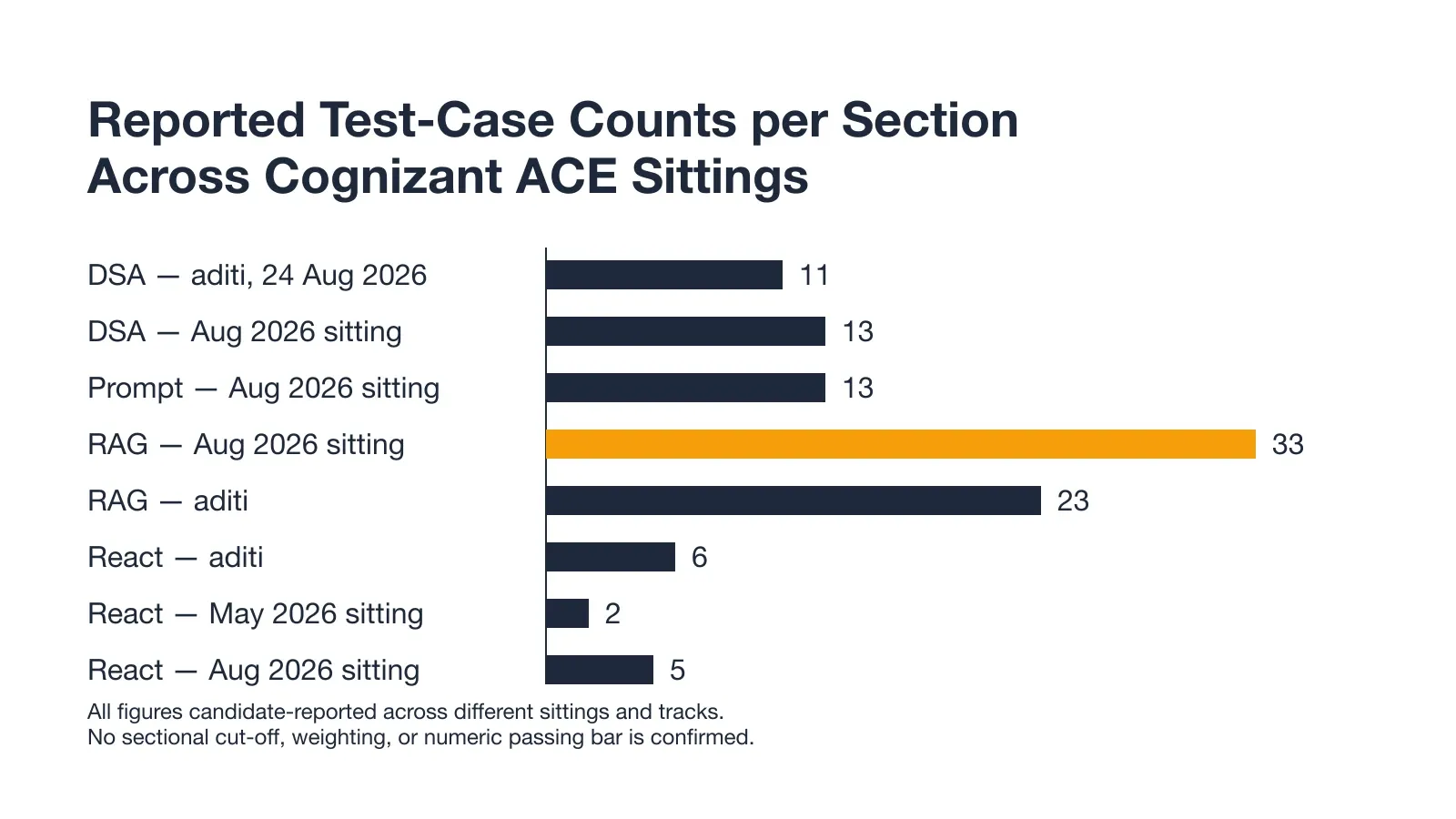
Hidden cases sit behind the samples, and per-language time limits apply. The status line reads Terminated due to timeout when a solution runs past its language limit.
The score and the outcome do not line up the way most people assume.
| Solved or scored | Track | Outcome |
|---|---|---|
| Only 2 SQL questions and the MCQs, no coding | GenC cluster 1 | Shortlisted for the interview |
| 13/13 DSA, 13/13 prompt, 7/33 RAG, 0/5 React | ACE | Eligibility and sectional cut-off questions went unanswered |
| Some RAG test cases cleared | ACE | Interview calls concentrated among the candidates who cleared RAG cases |
| "Depends on your slot" | ACE and cluster 1 | No fixed threshold, slot decides |
| About a 3-hour OA | ACE Frontier Engineer | Only 14 candidates shortlisted for the final interview |
Cognizant publishes no sectional cut-off or weighting. One candidate's 13/13 DSA, 13/13 prompt, 7/33 RAG, and 0/5 React profile is the case that usually triggers the cut-off question.
The outcome table also shows the spread. Across two 2025 GenC cluster-1 cases, the candidate who solved only two SQL questions and the MCQs got shortlisted. Yet the one who solved more did not.
Cognizant HackerRank Exam-Day Strategy
The pacing that worked in one August 2026 ACE sitting put the MCQs and the prompt first. That sitting finished both inside about 40 minutes. Afterward, it took about an hour on RAG in Python and left DSA for last.
RAG was the section worth the time when Python is comfortable, and React was worth skipping without expert-level React. That came from the same August 2026 account.
Two platform rules shape the plan. Re-running code is free, and only Save and Proceed submits, so testing costs nothing but the clock. And once a section's timer ends, it is gone for good.
This split belongs to one candidate in one sitting. It is one data point rather than a Cognizant-recommended order. The MCQs plus prompt budget is the part worth copying.
Why Candidates Fail the Cognizant HackerRank Assessment
Failures in this assessment cluster into a handful of causes. Most come from setup or a fumbled second rather than from skill.
The integrity-review interruption. A candidate mapped a borderless desktop answer window to a shortcut during a summer 2026 Cognizant assessment. After a brief network reconnect, the session moved to an integrity-review screen instead of returning to the question. The assessment was marked invalid, and an interview that had already been scheduled was withdrawn.
That candidate was flagged for a structural reason, not bad luck. The tool renders its answer on the same screen the proctoring system already watches. It hides the window with a basic OS-layer trick, so it stays on-screen but out of visible view.
InterviewFox works differently. It is a dual device AI interview assistant that puts the answer on my phone. No screenshot, screen recording, or session monitoring can reach that physically separate device by design.
Land offer with Safer AI Interview Assistant
Skip the risky invisible apps. Our dual-device mode keeps it simple and undetectable. You crush the interview, we handle the answers.
Get started. It's freeLoved by 100,000+ candidates
Exiting full-screen or switching tabs. HackerRank flags and logs attempts to leave full-screen or switch browser tabs automatically. The report carries Out-of-Window Duration and Window Exits columns.
Does one quick window switch really matter? What a window exit records in your integrity report shows what the log actually keeps.
Editor "conversation" patterns. Typing and deleting content in the editor can read as external assistance. The platform flags it for review, including regional languages written in English. Secure and Proctor Mode disable copy and paste. Every paste reaches the report even when a candidate retypes it by hand.
Webcam and second-screen signals. A warning fires for a missing candidate or a second face in the frame. The platform records the event. It also detects new monitor connections.
Clearing the second-screen question before test day saves a mid-exam scramble. How HackerRank treats an extra monitor covers the single-monitor check and the connections it notices.
The self-inflicted editor error. A GenC cluster-1 candidate hit a JavaScript editor error. It kept reading a declared variable as an invalid identifier. Still, it survived resetting the code, per u/PatientDapper in a report from around October 2025. That candidate abandoned the question and did not get the interview mail.
How to Prepare for the Cognizant HackerRank in 7 Days
Seven days is enough when the hours go to the two sections that break most attempts. Cognizant publishes no link-expiry window for the campus OA, so this is a flat seven-day plan with no buffer subtracted.
Before the test I also sent the confirmed question patterns for this company to the InterviewFox Prep Agent over SMS. It came back with a drill plan weighted toward the RAG pipeline and the React state work. That is where the time actually went.
Days 1-2: Chunk-Embed-Retrieve Until the RAG Test Cases Pass
RAG, a fixed ACE section, is the one worth winning first. A candidate in an August 2026 sitting cleared its test cases in about an hour with Python. Interview calls clustered among the people who cleared RAG cases.
I spent the first two days building the pipeline end to end: chunk the documents, embed each chunk, retrieve the top-k. I built the build_prompt and rewrite flow separately. My success check was every visible test case passing on both, with empty-document and duplicate-chunk inputs handled.
I skipped broad LeetCode-tag grinding and all system-design prep. The DSA section is a single question, so tag breadth does not pay, and no ACE section is system design. The MCQ batch covers Generative AI, LLMs, RAG, and prompt engineering, so those hours went to RAG and React instead.
Days 3-4: React State Manipulation Under Hidden Test Cases
React, the other fixed ACE section, broke my sitting, with both address-component test cases left red. A booking-style component and a filter-and-sort component cover the shapes that show up.
I built one of each, handling selectedSeats and bookedSeats state with conditional class names. My success check was every test case passing on both, including the book-then-unbook transition.
Days 5-7: Timed Section Simulation and DSA Edge Cases
Pacing is the last thing to train. One August 2026 candidate finished the MCQs and prompt inside about 40 minutes and took about an hour on RAG. I ran one full timed mock in ACE section order under that same 40-minute MCQ-and-prompt budget. I also drilled DP, string, and array edge cases.
My success check was finishing MCQ and prompt inside 40 minutes. I also needed a self-drafted large-input DSA case to pass without a timeout. On the platform side, name the main class Solution for Java, C#, and Scala. The input and output run through STDIN and STDOUT.
The plan stays inside these two sections on purpose, because extra breadth elsewhere did not move my score.
What Happens After You Submit the OA
Submitting is quiet. Answers auto-save as the test runs. The test submits on Submit or when the timer hits zero. So the result goes straight to the hiring team with no confirmation step. Rescheduling is not a HackerRank feature, and an expired link can only be reset through the recruiter.
After that, the sequence runs OA, shortlist, interviews, and the interviews move to Superset. The wait is where the variance lives.
Shortlist sizes swing by college, cluster, and slot. One ACE post counted 400 candidates reduced to 180 for the technical assessment. An ACE Frontier OA produced 14 interview calls. A GenC cluster-1 candidate got shortlisted after solving only two SQL questions and the MCQs.
Cognizant publishes no campus-OA cooldown or retake rule, and no 2026 sitting reports one being enforced.
HackerRank for the OA, Superset for the Interview
A reader holding an invite usually wants to know which platform is about to appear on screen. The answer changes by stage.
| Stage | Platform | What to expect |
|---|---|---|
| Online assessment | HackerRank | For the ACE technical assessment, the HackerRank Desktop App with OS-level monitoring |
| Interview | Superset | A Superset code editor for short coding tasks; some candidates apply through Superset from the start |
That split matters before the link expires. The OA needs the Desktop App installed and expects OS-level monitoring. Meanwhile, the interview runs in a browser editor on a different platform.
FAQ
How many sections does the Cognizant HackerRank assessment have?
The ACE assessment has five sections: Problem Solving (DSA), Front End Framework (React), Prompt Engineering, RAG, and an MCQ batch. Four of those hold a recallable problem each. Other tracks, like GenC cluster 1, use a different section list entirely.
Is the Cognizant HackerRank assessment proctored?
Yes. The ACE technical assessment runs in HackerRank's Desktop App Mode, the top integrity tier. That adds OS-level monitoring on top of full-screen lock, copy and paste blocking, screenshot analysis, and webcam checks.
Can I use an AI tool or invisible app during the Cognizant HackerRank OA?
Desktop overlay tools put the AI's answer on your computer screen. A basic OS-layer trick renders it as a hidden layer above the browser. The answer stays on-screen, and the hiding is basic. Proctoring software keeps adding detection capabilities, so the risk exposure isn't fixed.
InterviewFox pushes the answer to your phone, a physically separate device no screenshot, screen recording, or session monitoring can reach. So the laptop screen stays on the exam editor. If you use AI assistance during the OA, the dual-device architecture removes the answer from your screen entirely.
Land offer with Safer AI Interview Assistant
Skip the risky invisible apps. Our dual-device mode keeps it simple and undetectable. You crush the interview, we handle the answers.
Get started. It's freeLoved by 100,000+ candidates
Can HackerRank detect copy and paste during the Cognizant test?
Secure and Proctor Mode block copy and paste, and paste tracking is on by default. Every paste lands in the report, even when a candidate retypes the same content by hand.
What is the Cognizant HackerRank sectional cut-off?
Cognizant publishes no sectional cut-off. Any figure circulating online comes from neither Cognizant nor HackerRank.
How long is the Cognizant HackerRank assessment?
Cognizant publishes no single company-wide time limit. Known durations are per track: about three hours for ACE Frontier and 52 minutes for the Java FSE lateral.
Does Cognizant run the interview on HackerRank?
No. The OA runs on HackerRank, but the interview round moves to Superset. Some candidates apply through Superset from the start.