I Passed the HackerRank MongoDB OA in 2026: Real Questions

Quick Facts
| Assessment | HackerRank MongoDB OA, backend SWE, 2026 |
| Format | 25 multiple-choice questions plus 2 coding questions |
| Coding questions | Union iterator on two sorted iterators; bounded concurrent web crawler |
| Language | Not published for the OA; C++ confirmed on an adjacent MongoDB screen |
| Time limit | Not published for the 2026 OA |
| Proctoring | Webcam-enabled PC or laptop; Proctor Mode monitors invisible tools and extra monitors |
| Score | No candidate-facing numeric score and no published cutoff |
| Outcome | Advanced past the OA stage |
I took the HackerRank MongoDB online assessment for a backend software engineering role in early 2026. The invitation arrived by email after a shortlisting step, and the test held 25 multiple-choice questions plus 2 coding questions. I cleared both coding problems, and what follows is the complete process and how I prepared for it.
On the concurrent crawler, my first version let a worker exit whenever the queue looked empty. The crawl stalled on a page whose links were still loading, so the grader reported a missing URL. I turned to a live AI interview helper with minutes left. It surfaced the in-flight counter fix I walk through below.
Before my test, I read every HackerRank MongoDB post from the past two years on Reddit, LeetCode Discuss, and Teamblind. What I found tracks closely with what I experienced. The later sections cover the traps that end real OA runs.
The Real Questions on My MongoDB HackerRank Test
I took the MongoDB HackerRank assessment for a backend Software Engineer role, and the test link arrived by email after my resume was shortlisted. The format held 25 multiple-choice questions and 2 coding questions, and here is exactly what I got.
Question 1: Union Iterator on Two Sorted Iterators
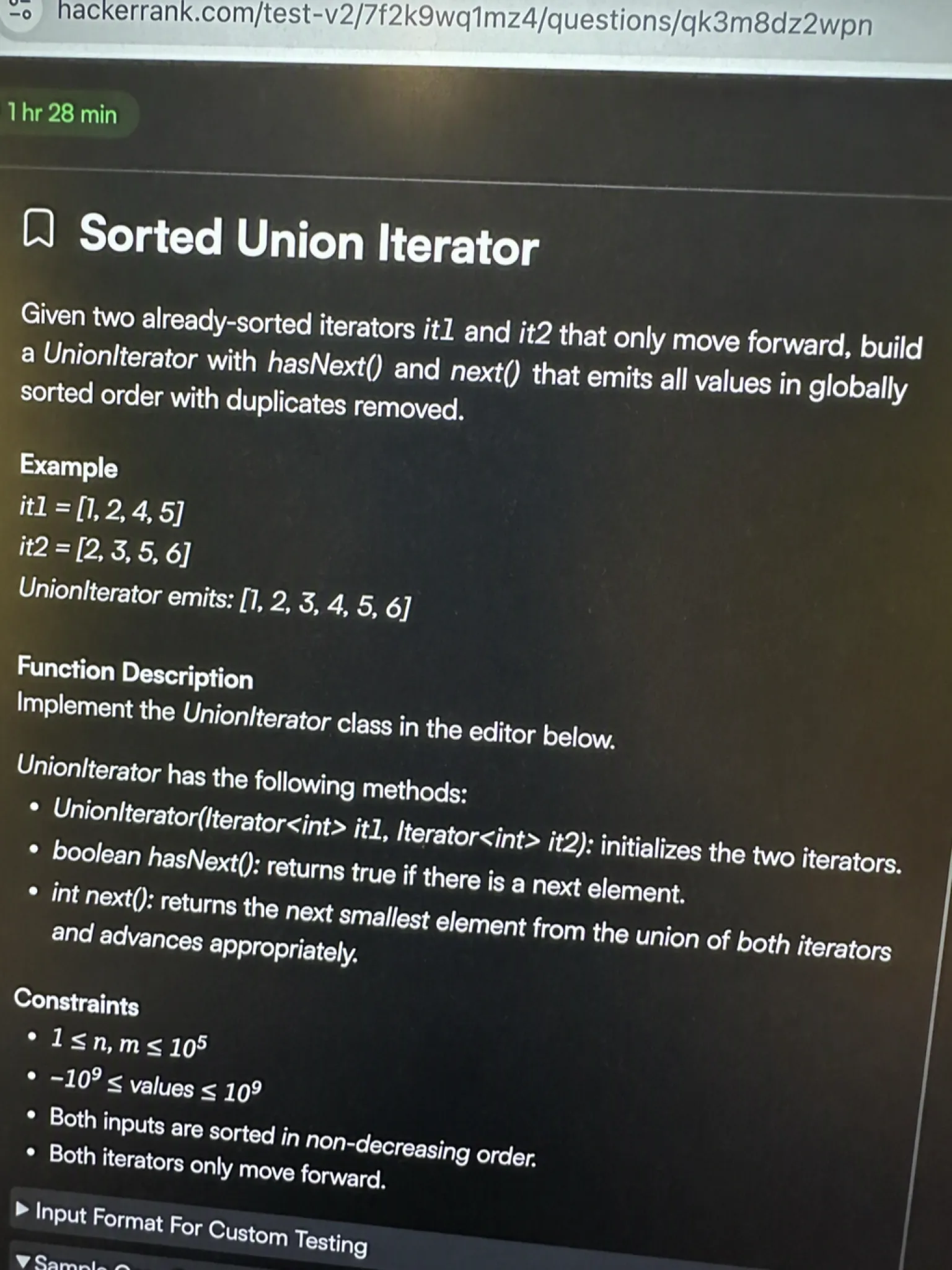
The problem I got: I was handed two iterators, it1 and it2, each already producing values in ascending order, and I could only step forward through them, with no rewind and no random access. I had to build a UnionIterator class exposing hasNext() and next() where the output stayed globally sorted and dropped duplicates, even when the same value appeared in both iterators or repeated inside one of them. My prompt example was it1 = [1, 2, 4] and it2 = [2, 3, 4, 5], which had to come out as 1, 2, 3, 4, 5, and the follow-up was how I would change the code for n iterators.
My approach: Because both inputs are sorted, I only needed to peek at the head of each iterator and always emit the smaller one, which is the same merge step I already knew from merging two sorted lists. The part that needed care was the deduplication. The head I peeked at is the value I am about to emit, so after emitting it I had to advance that iterator past every copy of that value, and I also had to advance the other iterator if its head matched. I kept one lookahead value per iterator and nothing else, so memory stayed flat. I wrote a first version that only stripped duplicates inside each iterator and forgot the cross-iterator case, and the sample it1 = [1, 2, 4], it2 = [2, 3, 4, 5] exposed it. For the n-iterator follow-up I said I would push the head of each iterator into a min-heap and pop the smallest, which keeps the merge order but adds a log k step per element.
class UnionIterator:
    def __init__(self, it1, it2):
        self.it1 = it1
        self.it2 = it2
        # one lookahead value per iterator, each pulled once
        self.h1 = it1.next() if it1.hasNext() else None
        self.h2 = it2.next() if it2.hasNext() else None

    def _advance(self, it, value):
        # move `it` forward until its head differs from `value`
        while it.hasNext():
            nxt = it.next()
            if nxt != value:
                return nxt
        return None

    def hasNext(self):
        return self.h1 is not None or self.h2 is not None

    def next(self):
        if not self.hasNext():
            raise StopIteration("union iterator exhausted")

        if self.h1 is None:
            value = self.h2
        elif self.h2 is None:
            value = self.h1
        else:
            value = min(self.h1, self.h2)

        # drop the emitted value and any duplicates of it on both sides
        if self.h1 == value:
            self.h1 = self._advance(self.it1, value)
        if self.h2 == value:
            self.h2 = self._advance(self.it2, value)
        return value
Time complexity: O(1) amortized per call, O(n + m) across a full pass | Space complexity: O(1)
This was the first coding question and I cleared it, but the cross-iterator dedup bug cost me close to ten minutes of the clock before the sample case caught it. I started the second question with less time than I had planned for.
Question 2: Bounded Concurrent Web Crawler
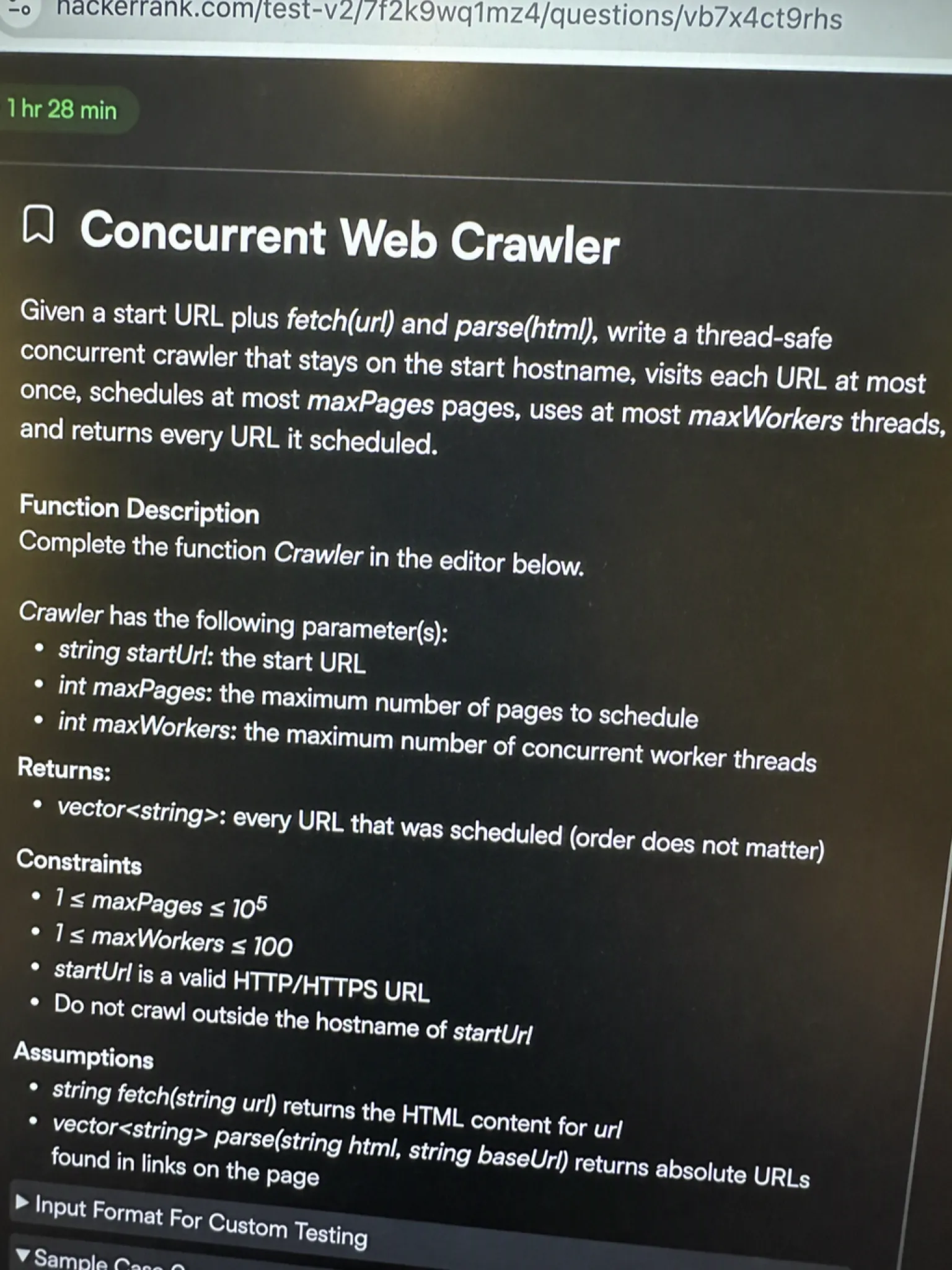
The problem I got: I was given a start URL and two functions I could call, fetch(url) for the page content and parse(html) for the links on that page, and I had to write a thread-safe concurrent crawler. It had to stay on the same hostname as the start URL, visit each URL at most once, and schedule no more than maxPages pages. I could use at most maxWorkers threads, a slow page could not block the other workers, and the crawler had to finish correctly with no deadlock and no early exit, returning every URL it had scheduled.
My approach: The shared state was the visited set and the queue of pending URLs, so both of them lived behind one lock and a condition variable. A URL counted as claimed the moment it entered the visited set, which is what stopped two workers from fetching the same link discovered from different pages. The subtle part was termination. A worker that sees an empty queue cannot quit, because another worker can be mid-fetch and about to push new links. I tracked an in-flight counter that rose every time a URL was scheduled and fell when its worker finished, so workers only stop when the queue is empty and nothing is in flight. I built it as a pool of worker threads that wait on the condition and wake whenever work or a status change arrives.
import threading
from collections import deque
from urllib.parse import urlparse


class Crawler:
    def __init__(self, fetch, parse, max_workers=64):
        self.fetch = fetch
        self.parse = parse
        self.max_workers = max_workers

    def crawl(self, start_url, max_pages):
        host = urlparse(start_url).netloc
        cond = threading.Condition()
        queue = deque()
        visited = set()
        result = []
        in_flight = 0

        def schedule(url):
            nonlocal in_flight
            with cond:
                if url in visited or len(visited) >= max_pages:
                    return
                visited.add(url)
                queue.append(url)
                in_flight += 1
                cond.notify()

        def worker():
            nonlocal in_flight
            while True:
                with cond:
                    while not queue and in_flight > 0:
                        cond.wait()
                    if not queue:
                        cond.notify_all()
                        return
                    url = queue.popleft()

                html = self.fetch(url)
                links = self.parse(html)

                with cond:
                    result.append(url)

                for link in links:
                    if urlparse(link).netloc == host:
                        schedule(link)

                with cond:
                    in_flight -= 1
                    cond.notify_all()

        schedule(start_url)
        threads = [threading.Thread(target=worker)
                   for _ in range(self.max_workers)]
        for t in threads:
            t.start()
        for t in threads:
            t.join()
        return sorted(result)
Time complexity: O(V + E) across the whole crawl, with the slow fetch and parse calls overlapping across up to maxWorkers threads | Space complexity: O(V)
I finished it, but I burned almost fifteen minutes on a termination bug. My first version let a worker exit the moment the queue looked empty, so the crawl stopped early on a page whose links were still being fetched. I rebuilt it around the in-flight counter after the grader showed a missing URL, and I submitted with far less slack than I had planned.
I did not want a desktop overlay running during a proctored test. The answer would sit on the same screen the platform was already watching. So instead, with the crawler still failing and only a few minutes left, I hit a keyboard shortcut. That auto-captured the problem, sent it to my phone through a live AI interview helper, and returned the in-flight counter fix. The answer stayed on a separate device outside the platform's screenshot monitoring, and my laptop screen never changed.
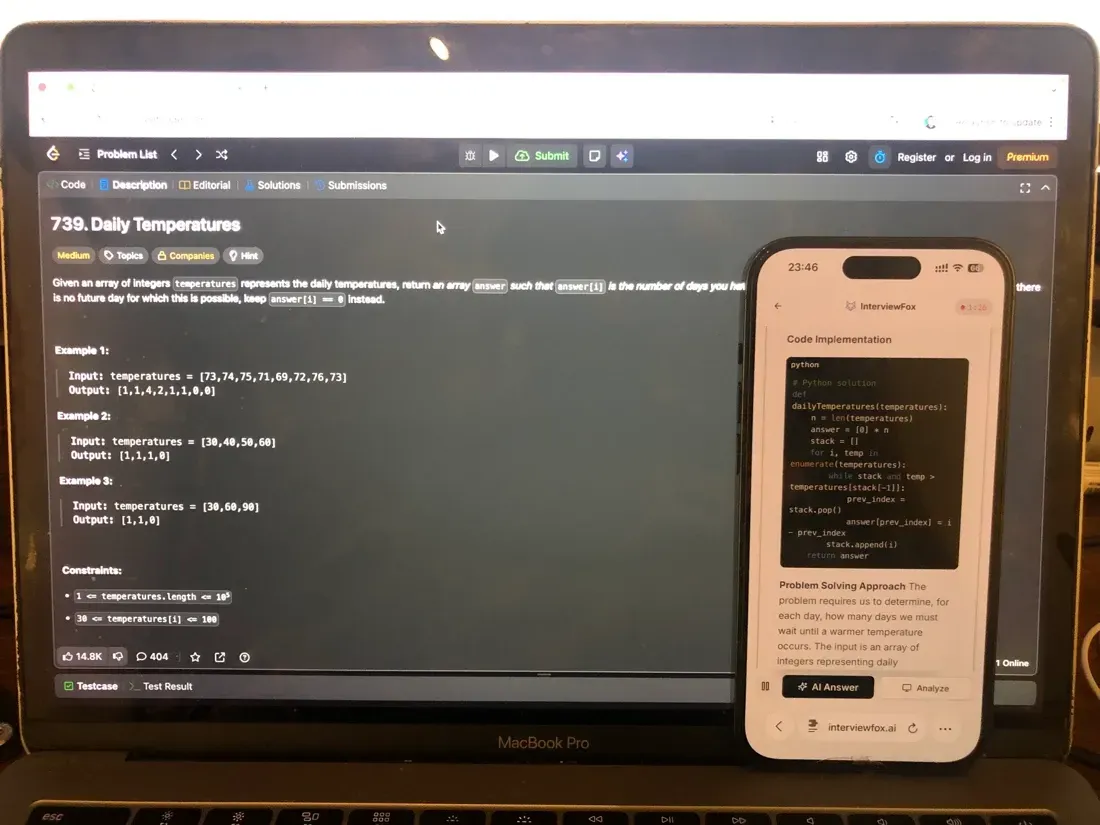
Land offer with Safer AI Interview Assistant
Skip the risky invisible apps. Our dual-device mode keeps it simple and undetectable. You crush the interview, we handle the answers.
Get started. It's freeLoved by 100,000+ candidates
MongoDB's Proctoring Policy for HackerRank
Proctoring Is Enforced Whether or Not MongoDB Sets a Mode
HackerRank does not publish which Security or Proctor settings MongoDB turns on. I prepared as if every safeguard was live, and that turned out to be the right call.
Proctored tests require a computer with a working webcam. They also run only on a PC or laptop, because HackerRank does not support mobile or tablet devices. Chrome, Edge, Safari, and Firefox are the supported browsers.
Proctor Mode flags suspicious activity and detects invisible tools. It also images the candidate's environment throughout the session and detects multiple monitors.
One thing I wanted confirmed was whether my webcam stayed on for the whole session. The webcam and camera monitoring rules for HackerRank answered that directly.
A second display is its own risk, and the platform detects multiple monitors. Rather than guess what that flag means for a laptop plus an external screen, I checked the multiple-monitor detection behavior. I unplugged the second display before I started.
A Malpractice Flag Reaches Your Recruiter
The consequence is the part most people underestimate. HackerRank records malpractice in the candidate's test report, and that record can lead to disqualification from later rounds. The HackerRank before-the-test requirements spell out that rule directly.
So a flagged session is not just a low score. It travels to the recruiter attached to your name, and it can close doors you have not reached yet.
What MongoDB's HackerRank Test Format Actually Looks Like
25 Multiple-Choice Questions Plus 2 Coding
The one publicly recorded MongoDB HackerRank OA held 25 multiple-choice questions plus 2 easy coding questions. That link arrived by email after resume shortlisting. Its author noted android and kotlin topics on a backend posting, which signals a much larger generalist bank.
That 2022 report is the only source describing the actual OA format. Every other question below came from a MongoDB screen that ran separately. Only this one source confirms the OA attribution.
MongoDB Publishes No 2026 Time Limit or Language Policy
MongoDB publishes no 2026 question count, time limit, or language policy for the HackerRank OA. Language-specific asks, like a required C++, sit on phone screens instead. So I planned around the 2022 shape and treated the clock as unknown.
How MongoDB's HackerRank Scoring Works
No Numeric Score and a Pass Can Still Advance
No candidate sees a numeric score for a MongoDB OA, and MongoDB publishes no cutoff. The platform grades each question against hidden test cases, so partial credit never reaches you. A weak result is not automatically fatal, though. One 2022 candidate expected to fail the screening, yet still got shortlisted.
No published cutoff. Nothing marks the bar, so a low-confidence run is not fatal.
The adjacent screen bar is cleaner. MongoDB phone screens expect code that lands clean on the first pass. That is a higher bar than eventual correctness.
15 Other Confirmed MongoDB HackerRank Questions
These are the confirmed MongoDB programming asks I collected on top of my own two. They come from MongoDB's wider programming question pool, so read them as the pool the OA draws from rather than a guaranteed OA set.
Most of them come from MongoDB phone screens and virtual onsite rounds run through Karat. The set skews toward database-flavored problems, which is the pattern I map at the end.
Lazy Union Iterator (Keeps Duplicates, K Follow-Up)
The lazy-merge version of my union-iterator question surfaced in a January 2026 report. It keeps duplicates instead of dropping them. The interface matches mine with an idempotent has_next() and a next() that raises StopIteration.
The ask: keep both matching heads and emit the value for K iterators.
Time complexity: O(k) per call for k iterators, O(1) for two iterators | Space complexity: O(k)
Merge K Sorted Lists / Streams
Merging K sorted streams with a priority queue appeared in a 2023 report. A director-round variant asked for the same merge on linked lists.
The ask: push each stream's head into a min-heap, pop the smallest, then push that stream's next element back.
Time complexity: O(N log k) for N elements and k streams | Space complexity: O(k)
Simplified BSON / Binary Parser
A hex-to-JSON BSON decoder appeared in the local MongoDB problem records. Integers are little-endian, and the type set covers eight tags like 0x01 and 0x10.
The ask: decode within a 1e5 size limit and depth 100 while preserving field order and numeric array order.
Time complexity: O(n) over the byte length | Space complexity: O(n) for the decoded tree
Find a Value by Key in Nested JSON
One MongoDB problem record gives a nested JSON document and a key that appears exactly once. The key can sit at any depth.
The ask: walk the structure and return the value while preserving the nested shape around it.
Time complexity: O(n) over every node | Space complexity: O(d) for the recursion depth
Thread-Safe DB Connection Pool
A connection pool with acquire, release, and close over an open and close lifecycle appeared in two reports. Thread safety comes from a lock around the free list.
The ask: manage the pool lifecycle cleanly. The available writeups stop at the interface, so there is no code block for this one.
Time complexity: O(1) per acquire or release | Space complexity: O(pool size)
Inverted Index With Delete
An inverted-index problem with add and delete operations is the most-asked MongoDB screen question, per a May 2024 report.
The ask: build a map from token to a set of document ids, support search and add, then handle a delete follow-up that removes an id from every set it appears in.
Time complexity: O(1) average per search and O(k) per delete | Space complexity: O(total postings)
The remaining confirmed asks repeat these same engine shapes at lower frequency. Each is named here with its headline cost.
- Resolve a JSON path (C++ required). Resolve a list of path strings into a list of values, with nested arrays in scope. O(p) per path and O(total document size) space.
- JSON delta update. Recurse over an original object and a delta object to add or overwrite keys. O(delta size) time and space.
- Predicate and expression tree evaluator. Evaluate an
EQ,GT,AND, orORtree against a document with up to 1e5 nodes. O(n) time and O(d) recursion space. - Minimum XOR sum of two arrays. Permute the second array to minimize the sum of pairwise XORs, with
nup to 14. O(2^n * n) time and O(2^n) space. - Sliding-window class (sum, product, average). Advance one step per call, returning the running sum, then the product with zero handling, then the average. O(1) per step and O(window size) space.
- Billing and plan-cost accounting. Compute a month-to-date total as
Max(MinimumPlanCost, usage * percentage)across plan ranges. O(d) over d days and O(1) space. - Implement a HashMap (put / get). Build a hash map from scratch with your own tests, then make it thread-safe by synchronizing both methods. O(1) average per operation and O(n) space.
- Implement a Trie (plus a leak and immutability). Build a Trie in 45 minutes, find a memory leak in a stack, and make a class immutable. O(m) per word of length m and O(total characters) space.
- Top-50 scorers (dedup, keep max). Return the fifty highest scores with a per-person dedup that keeps each person's best. O(n log 50) with a heap and O(50) space.
Why Candidates Fail the MongoDB HackerRank Assessment
The Bug-Free One-Shot Bar Sinks Correct-but-Hacky Code
A May 2024 MongoDB phone-screen candidate finished the inverted-index problem and fixed every bug, then still got rejected. The interviewer expected the solution to land clean on the first attempt. A missing query-validation case surfaced only late.
So the bar in a 30 to 45 minute screen is a clean first pass. A working solution that needed three rounds of fixes reads as a failure.
Wrong-Language Prep Burns a 30-Minute Clock
One 2023 screen required C++ for the JSON-path problem. A candidate who had prepared other languages froze and wrote messy code against a 30-minute clock. That candidate later noted how hard it is to write solid code that fast without a matching prep pass.
Domain mismatch loses the round. One 2024 candidate failed on fit rather than code. The team wanted database internals and code-analysis depth, not generic distributed-systems answers.
A thin project story costs you too. One intern candidate with a shallow MongoDB story got rejected. The coding held up, but the conversation had nothing specific to anchor on.
A Covert AI Overlay Ended the Pipeline
At least one candidate was flagged for mapping a transparent AI answer overlay to a keyboard shortcut. During an early February 2026 MongoDB assessment, a notification stole focus. Then the supposedly hidden panel flashed over the code editor, and the assessment came back invalid. The company withdrew an interview that had already been scheduled.
That exposure is structural. The overlay renders the AI's answer on the screen the proctoring software is watching. A basic OS-layer trick hides it, and Proctor Mode detects invisible tools by design. I went through the breakdown of how HackerRank detects cheating to see what the platform treats as cheating.
That is why I stayed away from a desktop overlay. InterviewFox works differently: it is a dual device AI interview assistant that puts the answer on my phone, a physically separate device that no screenshot, screen recording, or session monitoring can reach by design. So my laptop screen never carries the AI's output at all.
Land offer with Safer AI Interview Assistant
Skip the risky invisible apps. Our dual-device mode keeps it simple and undetectable. You crush the interview, we handle the answers.
Get started. It's freeLoved by 100,000+ candidates
How to Prepare for the MongoDB HackerRank in 7 Days
Seven days is enough if the time goes into the right shapes. My plan weighted three days to the Mongo-flavored coding. Two days went to the generalist MCQ bank, and two to a full proctored simulation.
In the days before the OA, I used the Prep Agent from InterviewFox over SMS. I sent it the confirmed MongoDB question patterns and got back a personalized drill plan. It also returned a strategy for the two coding shapes, which I folded into the day split below.
Days 1-3: Drill the Mongo-Flavored Question Shapes
The Mongo questions are engine-flavored, so I worked through LeetCode's MongoDB high-frequency list instead of a generic array-and-DP set. Mongo's own engineering-interview prep guidance names concurrency, distributed systems, algorithms, and language-specific coding as fair game.
The training action was to implement each shape from scratch. I built a streaming union iterator, a lazy K-way merge, a thread-safe bounded crawler, and a simplified BSON parser. Each one had to run bug-free in a single 30-minute sitting, which was the whole success check.
Skip deep system design. None appears in the OA, since the 2022 format was 25 MCQs plus 2 coding questions. That is a later-loop topic.
Skip hard DP grinding. Only one DP problem exists in the whole pool. The bank skews to implementation and document handling instead.
Days 4-5: Cover the Generalist MCQ Bank and Java Trivia
I drilled mixed CS and database concept MCQs. Then I enumerated Java checked and unchecked exceptions, collections, and concurrency basics with GPT's help. The MCQ bank is large and generalist, so a coding-only prep pass leaves a real gap.
The success check was an 80 percent score on a 25-question mixed concept set. Once I cleared that twice in a row, I stopped adding trivia.
Days 6-7: Simulate Under Proctoring Rules
Both final days went to one full timed simulation in the real environment. The camera stayed on, with no overlays and no extra monitors. I pre-loaded my language templates, because the HackerRank setup runs only on a PC or laptop. I wanted to rehearse on the exact machine I would test on.
The success check was one complete simulation with zero environment warnings. Anything less meant my setup, not my code, was the risk.
What Happens After You Submit the OA
The Wait and the Next Rounds Stay Loose
No MongoDB OA submission produces a clean, published timeline, and the feedback window in the reports is genuinely loose. One candidate heard back in about three or four days. Another heard back roughly two days after a later round.
The funnel beyond the OA varies, and no report gives an OA-specific timeline. So I treated the wait itself as the only reliable part.
MongoDB Questions Follow a Database-Engine Pattern
Looking across every confirmed MongoDB ask in the pool, the questions are not a random LeetCode sample. They cluster into four database-engine shapes, and the chart below shows how the set splits.
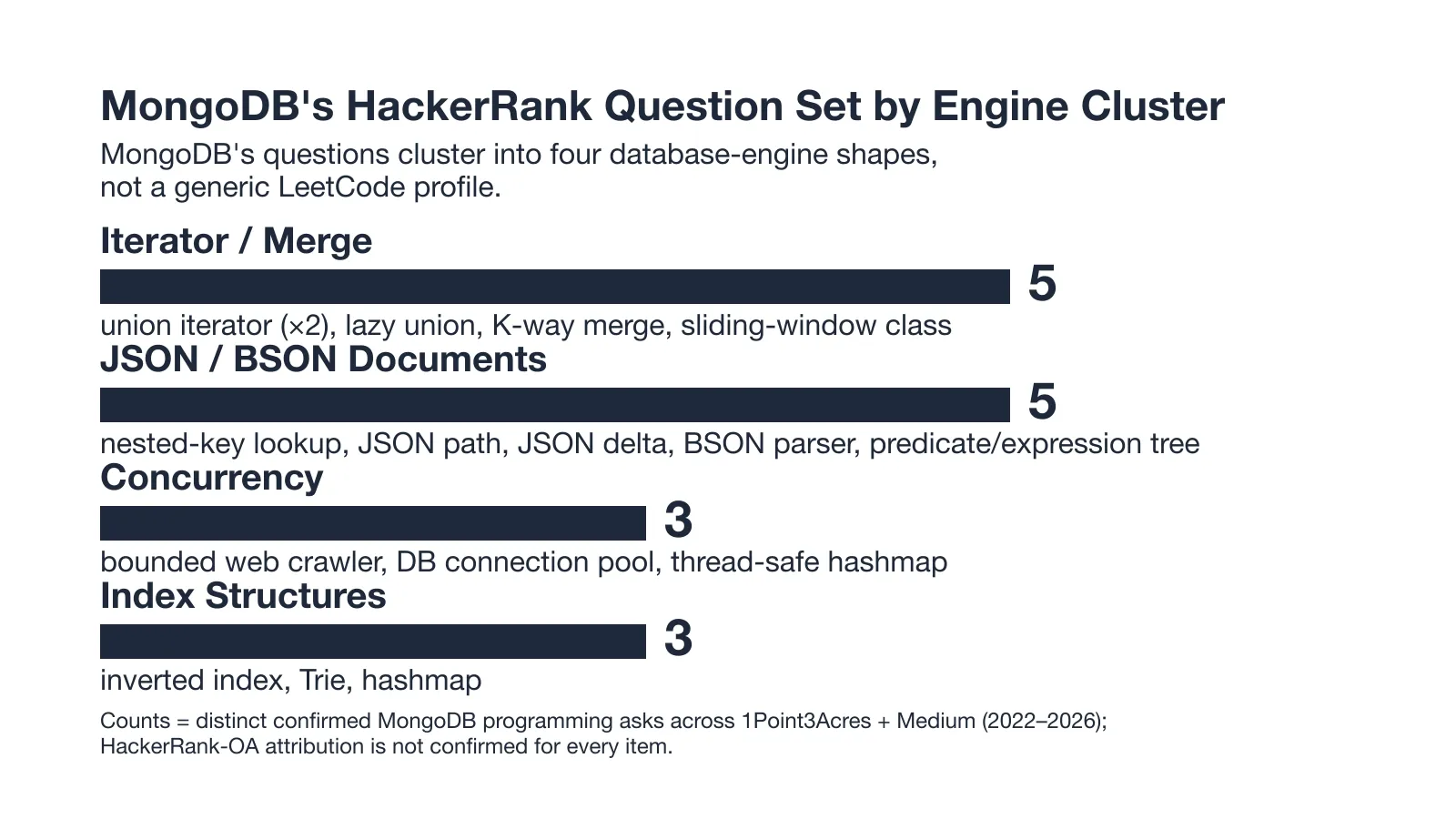
Iterator and merge problems lead the set, followed closely by JSON and BSON document handling. Concurrency and index structures fill out the remaining pairs, so a generic DP grind misses the real test shape.
Counts come from distinct confirmed MongoDB asks across 1Point3Acres and Medium between 2022 and 2026. Some of them come from phone screens rather than the HackerRank OA.
FAQ
How many questions are on the MongoDB HackerRank OA?
The only recorded MongoDB HackerRank format had 25 multiple-choice questions plus 2 coding questions. MongoDB publishes no 2026 count, so that shape is the safest assumption.
Does the MongoDB HackerRank OA use a webcam?
Proctored HackerRank tests require a webcam-enabled computer. HackerRank does not support mobile or tablet devices, so the test runs on a PC or laptop.
Can I use an AI tool or invisible app during the MongoDB HackerRank OA?
Desktop overlay tools put the AI's answer on your computer screen, rendered as a hidden layer above the browser with a basic OS-layer trick, so the answer stays on-screen and the hiding is basic while proctoring software keeps adding detection capabilities.
InterviewFox instead pushes the answer to your phone, a physically separate device that no screenshot, screen recording, or session monitoring can reach by design, so the laptop screen stays on the exam editor, unchanged. If you're going to use AI assistance during the OA, a dual device AI interview tool removes the answer from your screen entirely.
Land offer with Safer AI Interview Assistant
Skip the risky invisible apps. Our dual-device mode keeps it simple and undetectable. You crush the interview, we handle the answers.
Get started. It's freeLoved by 100,000+ candidates
Is there a time limit on the MongoDB HackerRank OA?
MongoDB publishes no time limit for the OA, and the 2022 record listed none. The clock is the biggest unknown going in.
What else is on the MongoDB HackerRank test besides coding?
The recorded format pairs coding with multiple-choice concept questions that can lean to generalist topics. A backend posting once showed android and kotlin items, so the MCQ bank is wide.