
How I Passed Quora CodeSignal in 2026: Real Questions

Quick Facts
| Platform | CodeSignal General Coding Assessment (GCA) |
| Format | 4 programming questions in a single 70-minute sitting |
| Score range | 200–600 Assessment Score (recalibrated from historical 300–850) |
| Quora cutoffs | 575+ automated ATS filter; 590–600 competitive safe zone |
| Proctoring | Webcam video, microphone audio, screen recording, full-screen lockdown |
| Primary questions | Distinct Substrings, Sort Matrix Diagonally, rotatedRectSum, Elimination Order |
| Turnaround | Recruiter score review within 5–10 business days (1–2 weeks) |
| Compensation | Quora SWE median total compensation of $260,000 / year |
I took the Quora CodeSignal assessment for a new-grad software engineering role in July 2026. The 70-minute test had four coding problems, and my score landed in the safe zone. What follows is the complete process and how I prepared for it.
With the clock past minute thirty-five, two negative-value tests were still failing on rotatedRectSum. I used real time AI interview assistant to check the bounding interval logic. It surfaced the coordinate parity boundary condition, which I break down in the walkthrough below.
Before my test, I read every Quora CodeSignal post from the past two years on Reddit, LeetCode Discuss, and Teamblind. What I found tracks closely with my experience. Below, I cover the 1 -> 2 -> 4 -> 3 solving order, exact cutoffs, and traps that get candidates rejected.
The Real Questions on My Quora CodeSignal Test
I took the Quora Software Engineering online assessment in July 2026, which ran on CodeSignal's standard four-question General Coding Assessment framework with a 70-minute countdown. All four problems unlocked the moment the timer started, moving rapidly from basic string parsing to 2D matrix transformations, boundary geometry, and multi-round state simulation.
Question 1: Distinct Substrings of Length 3
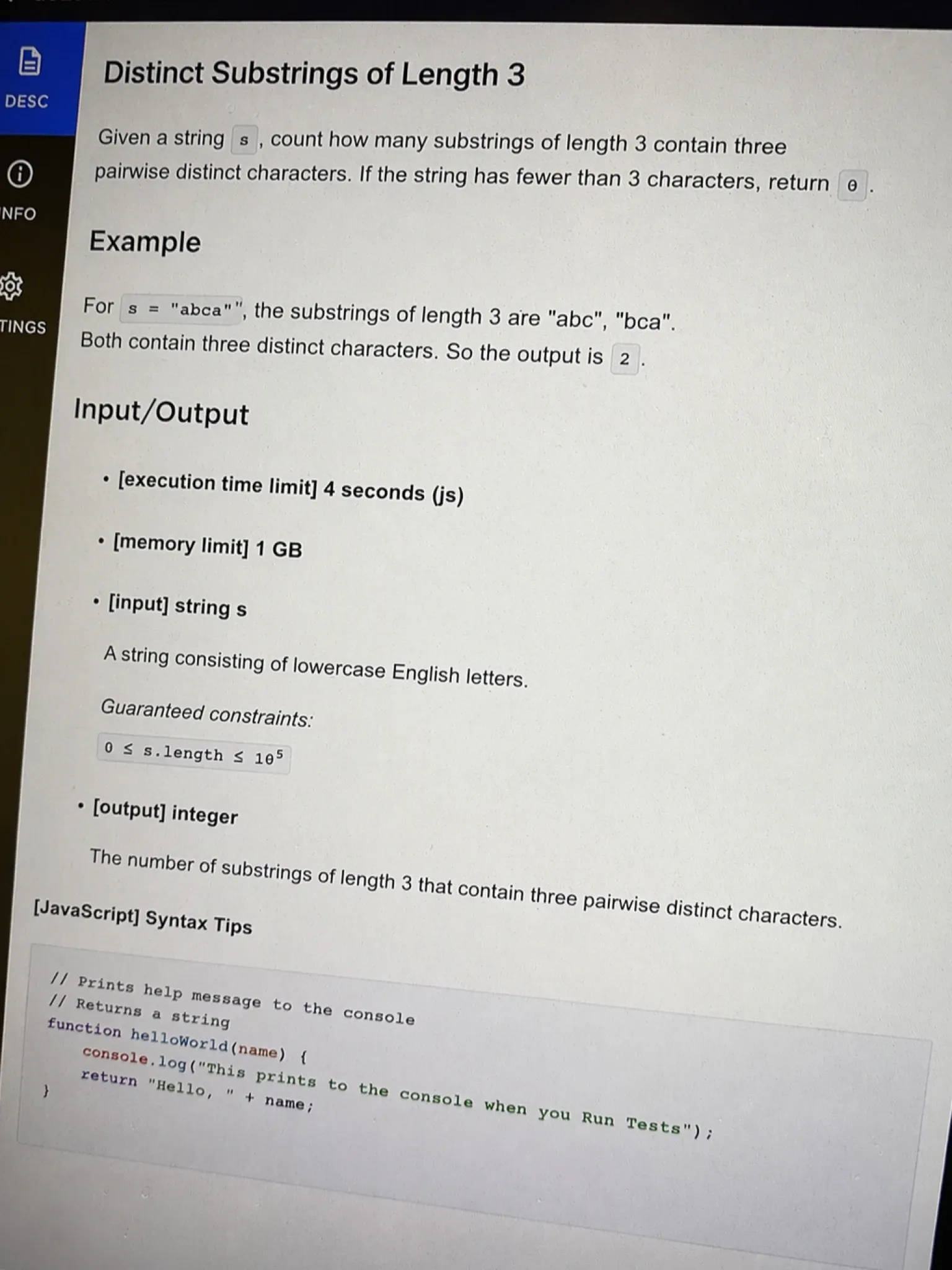
The problem I got: The first task gave me a string s and asked me to count how many substrings of length 3 contain three pairwise distinct characters. If the string had fewer than 3 characters, the expected output was 0. For example, given s = "xyzzaz", the only valid three-character window with distinct letters is "xyz", so the function returns 1.
My approach: Because the window size is fixed at exactly 3, I avoided any dynamic hash set overhead. I set up a single loop iterating from index 0 up to len(s) - 3, extracting the three adjacent characters at each step. If s[i] != s[i+1], s[i] != s[i+2], and s[i+1] != s[i+2], I incremented my counter. Under exam time limits, writing the three explicit inequality checks is faster to type and less error-prone than building a set for every character slice.
def countGoodSubstrings(s: str) -> int:
    if len(s) < 3:
        return 0

    count = 0
    for i in range(len(s) - 2):
        a, b, c = s[i], s[i + 1], s[i + 2]
        if a != b and a != c and b != c:
            count += 1

    return count
Time complexity: O(N) | Space complexity: O(1)
I cleared all visible tests and hidden edge cases in less than four minutes. Banking the early speed bonus on Question 1 gave me the clean score foundation I needed before moving into the matrix problems.
Question 2: Sort Matrix Diagonally
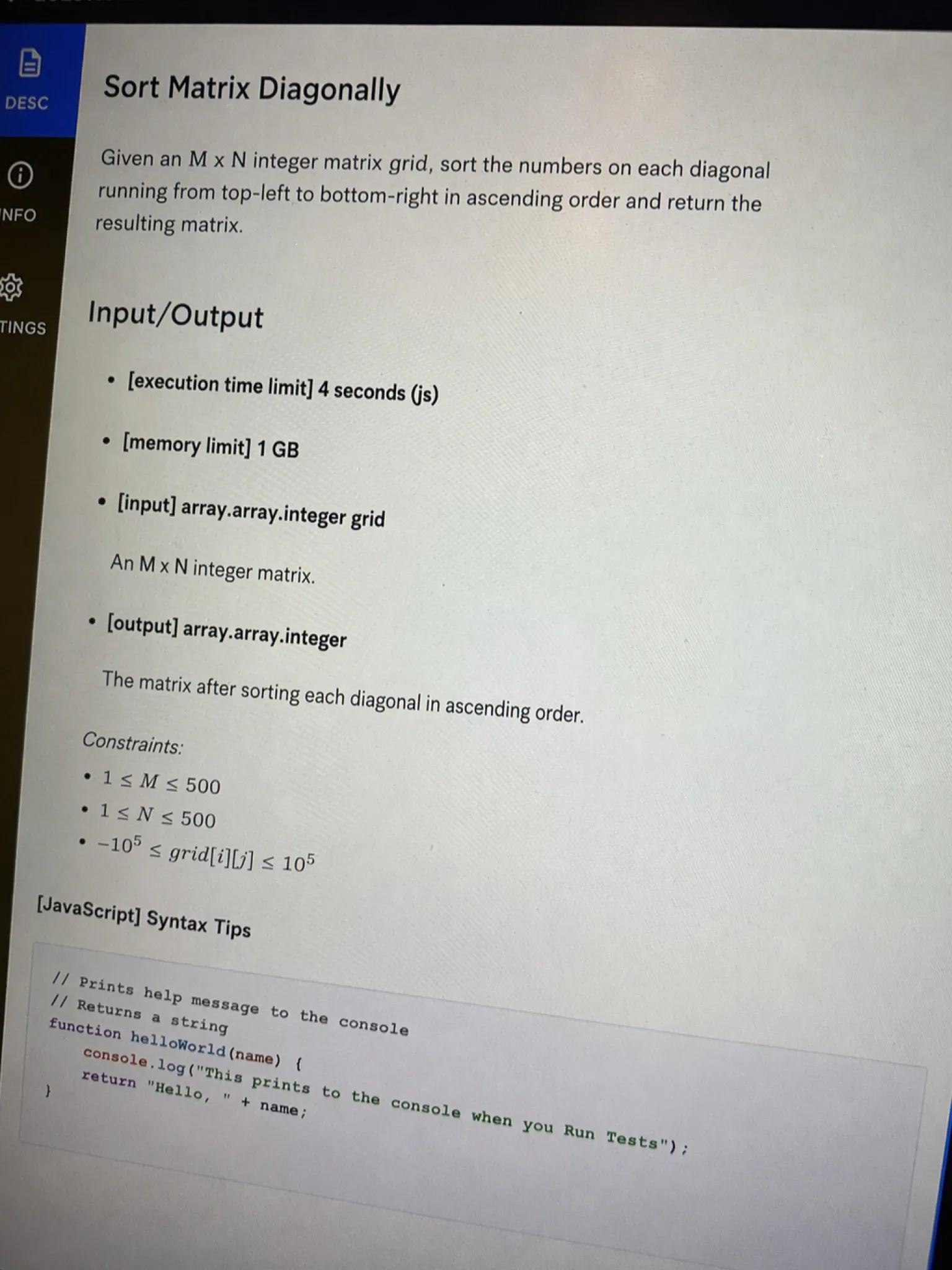
The problem I got: I received an $M \times N$ integer matrix grid and needed to sort the numbers on each diagonal running from top-left to bottom-right in ascending order. The grid dimensions could be non-square, and the returned matrix had to maintain the original row and column dimensions with each diagonal sorted independently in place.
My approach: Every cell (r, c) along a top-left to bottom-right diagonal shares the identical difference r - c. I used a hash map where each key was the diagonal invariant r - c and the value was a list of all elements on that diagonal. After grouping all cells across the grid, I sorted each diagonal list in descending order so I could pop the smallest remaining values from the end in $O(1)$ time during the write-back pass. A final traversal through the matrix placed the sorted values directly back into grid[r][c].
from collections import defaultdict
from typing import List

def diagonalSort(grid: List[List[int]]) -> List[List[int]]:
    m, n = len(grid), len(grid[0])
    diagonals = defaultdict(list)

    # Group values by the diagonal invariant (r - c)
    for r in range(m):
        for c in range(n):
            diagonals[r - c].append(grid[r][c])

    # Sort descending so pop() retrieves the smallest element in O(1)
    for key in diagonals:
        diagonals[key].sort(reverse=True)

    # Overwrite the matrix with sorted values
    for r in range(m):
        for c in range(n):
            grid[r][c] = diagonals[r - c].pop()

    return grid
Time complexity: O(M * N * log(min(M, N))) | Space complexity: O(M * N)
This question took roughly seven minutes from reading the prompt to submitting code. Passing all test cases pushed my clock to the eleven-minute mark with full points secured on the first two slots.
Question 3: rotatedRectSum
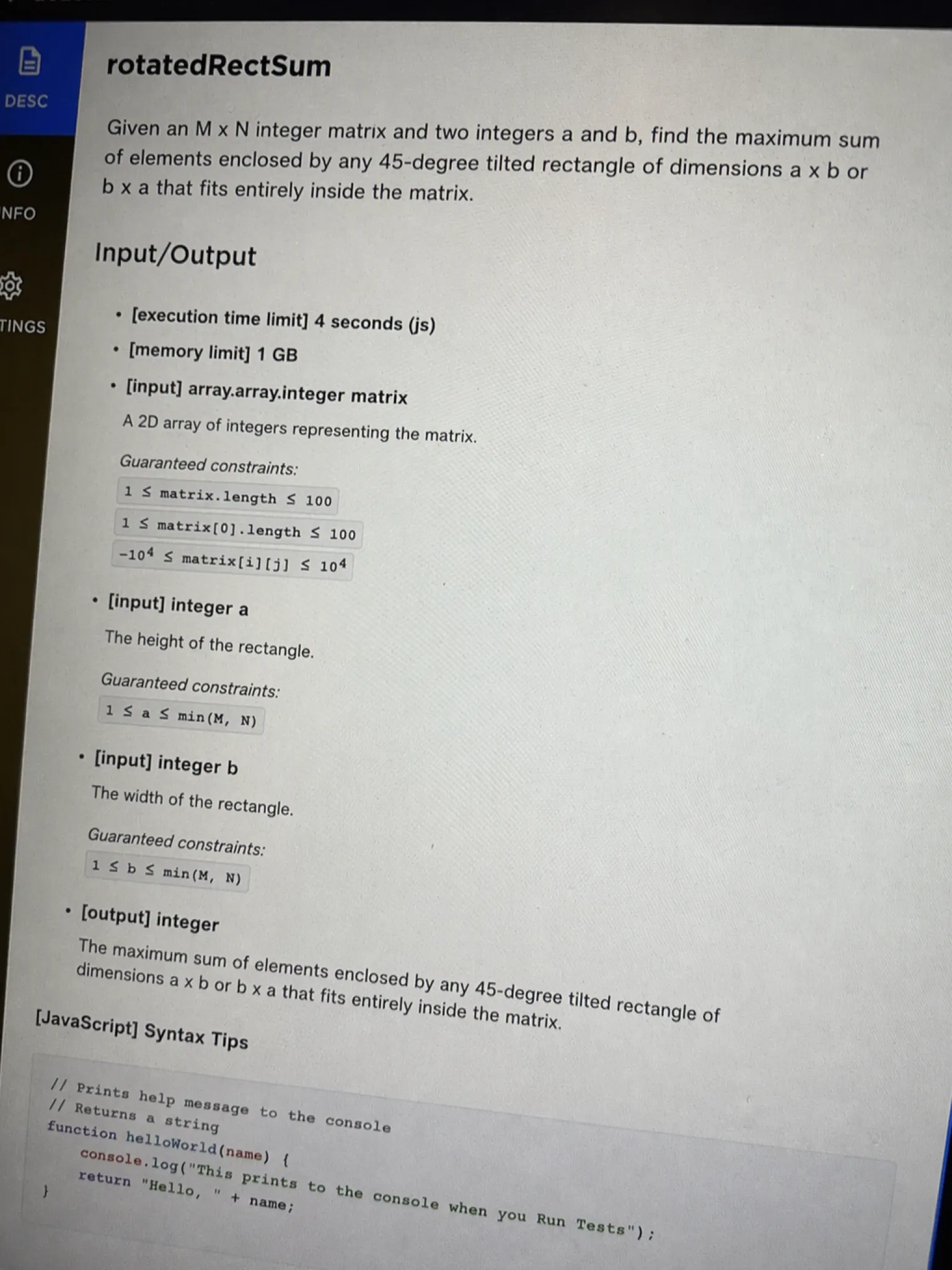
The problem I got: The challenge provided an $M \times N$ integer matrix and two integers a and b. I had to find the maximum sum of elements enclosed by any 45-degree tilted rectangle of dimensions a x b or b x a that fit entirely inside the matrix. The rectangle borders followed the diagonal lines of the grid, with a elements along one diagonal edge and b elements along the perpendicular edge. The matrix contained both positive and negative values, and degenerate shapes where a = 1 or b = 1 were valid configurations.
My approach: A tilted rectangle is determined by its topmost cell (r, c) and its side lengths a and b. The four vertices of the rotated boundary correspond to the top corner at (r, c), the right corner at (r + b - 1, c + b - 1), the left corner at (r + a - 1, c - a + 1), and the bottom corner at (r + a + b - 2, c - a + b). Any cell (x, y) lies inside this tilted rectangle if its rotated coordinates satisfy r + c <= x + y <= r + c + 2 * (b - 1) and r - c <= x - y <= r - c + 2 * (a - 1). For each horizontal row x from the top corner to the bottom corner, the valid columns form a contiguous interval [y1, y2]. I computed 1D row prefix sums across the grid to sum each row slice in $O(1)$ time, and evaluated both (a, b) and (b, a) orientations.
from typing import List

def rotatedRectSum(matrix: List[List[int]], a: int, b: int) -> int:
    m = len(matrix)
    n = len(matrix[0])

    # Precompute horizontal prefix sums for each row
    pref = [[0] * (n + 1) for _ in range(m)]
    for r in range(m):
        for c in range(n):
            pref[r][c + 1] = pref[r][c] + matrix[r][c]

    # Test both orientation dimensions
    orientations = [(a, b)]
    if a != b:
        orientations.append((b, a))

    max_sum = float("-inf")

    for da, db in orientations:
        for r in range(m):
            for c in range(n):
                # Verify that all four vertices fall inside grid boundaries
                # Top vertex: (r, c)
                # Right vertex: (r + db - 1, c + db - 1)
                # Left vertex: (r + da - 1, c - da + 1)
                # Bottom vertex: (r + da + db - 2, c - da + db)
                if not (0 <= r + db - 1 < m and 0 <= c + db - 1 < n):
                    continue
                if not (0 <= r + da - 1 < m and 0 <= c - da + 1 < n):
                    continue
                if not (0 <= r + da + db - 2 < m and 0 <= c - da + db < n):
                    continue

                cur_sum = 0
                for x in range(r, r + da + db - 1):
                    # Bounding column range on row x
                    y1 = max(r + c - x, x - r + c - 2 * (da - 1))
                    y2 = min(r + c + 2 * (db - 1) - x, x - r + c)
                    cur_sum += pref[x][y2 + 1] - pref[x][y1]

                if cur_sum > max_sum:
                    max_sum = cur_sum

    return max_sum
Time complexity: O(M * N * (a + b)) | Space complexity: O(M * N)
I burned almost twenty-five minutes debugging off-by-one boundary clips and coordinate parity on this problem. The clock was ticking past minute thirty-five when my initial manual loop failed two hidden edge cases on negative values, creating intense panic before I restructured the bounding interval logic.
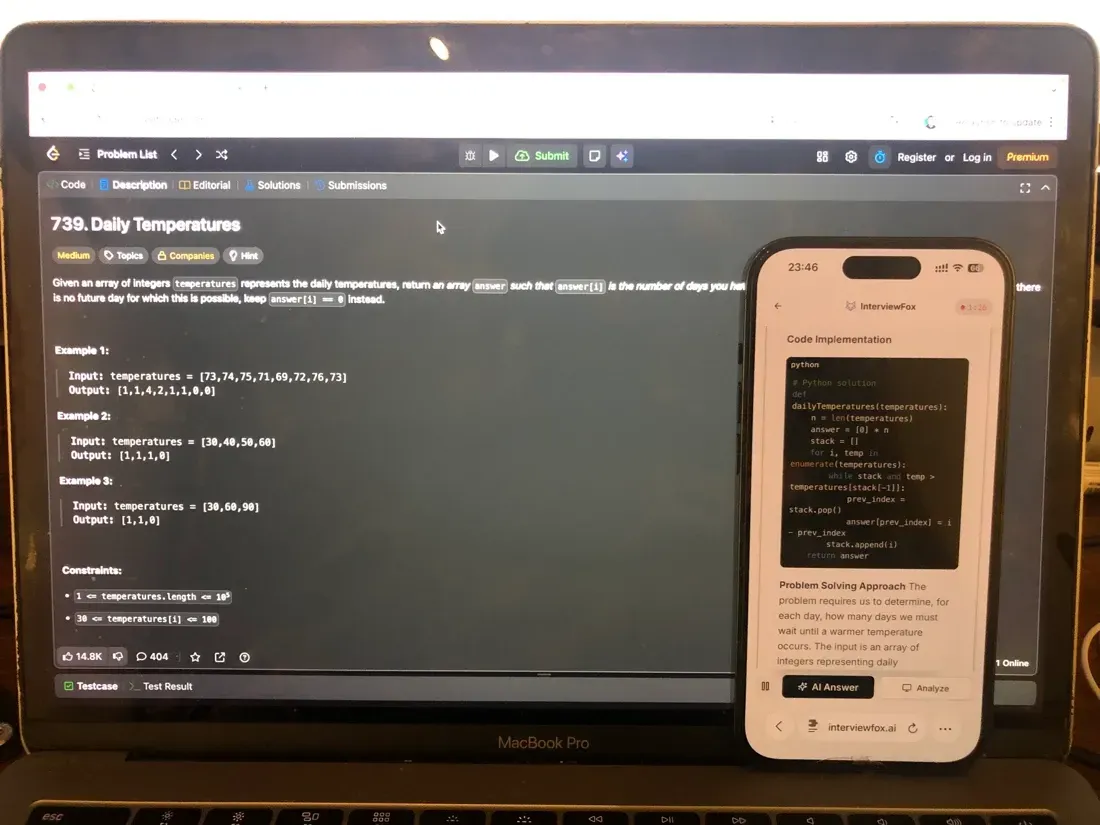
I did not want to use a desktop overlay to get unstuck. An overlay renders answers on the monitored computer screen, hidden only by an OS-level opacity trick. Instead, I triggered a dual device AI interview copilot using a quick keyboard shortcut. The auto-capture pushed the coordinate bounds to my phone, completely outside CodeSignal's screenshot monitoring.
The coordinate parity boundary condition became clear right away. My laptop screen remained on the exam editor the entire time, completely unchanged.
Land offer with Safer AI Interview Assistant
Skip the risky invisible apps. Our dual-device mode keeps it simple and undetectable. You crush the interview, we handle the answers.
Get started. It's freeLoved by 100,000+ candidates
Question 4: Determine the Elimination Order
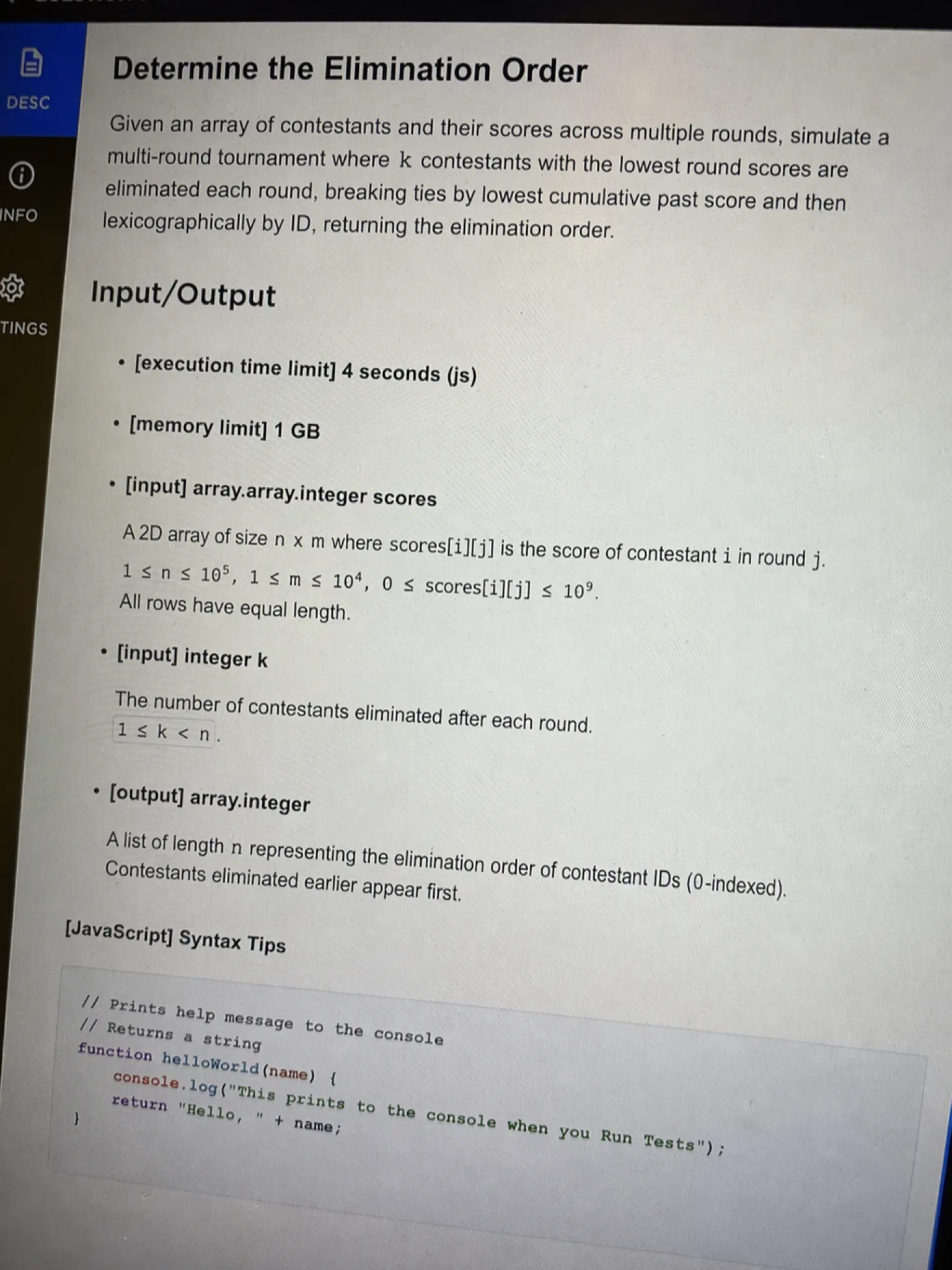
The problem I got: I had to simulate a multi-round tournament involving $N$ contestants across $R$ successive rounds. In each round, active contestants earned a round score, and a fixed number $K$ of contestants with the poorest performance were eliminated. The problem required returning an array of contestant IDs showing the exact chronological elimination order. When contestants tied on their current round score, ties had to be broken strictly by lowest cumulative score accumulated across past rounds, and remaining ties were broken lexicographically by contestant ID string.
My approach: Because $N$ could reach $10^5$, maintaining a dynamic priority queue with repeated key updates would degrade performance. Instead, I tracked active contestants in a hash set and kept a running cumulative score map for each participant. In each round, I extracted the active participants, formed a sorting tuple (current_round_score, cumulative_past_score, contestant_id) for each, and sorted the list in ascending order. The first $K$ contestants in this order were appended to the elimination history and removed from the active set. Surviving contestants then had their cumulative past scores updated with their current round performance before advancing to the next round.
from typing import List, Dict

def determineEliminationOrder(
    contestants: List[str],
    round_scores: List[Dict[str, int]],
    k: int
) -> List[str]:
    active = set(contestants)
    cumulative_scores = {c: 0 for c in contestants}
    elimination_order = []

    for scores in round_scores:
        if not active:
            break

        # Collect candidate tuples for all currently active participants
        candidates = []
        for c in active:
            r_score = scores.get(c, 0)
            past_score = cumulative_scores[c]
            # Primary: round score, Secondary: past cumulative, Tertiary: ID
            candidates.append((r_score, past_score, c))

        # Sort ascending: lowest score eliminated first
        candidates.sort()

        # Eliminate up to k contestants in this round
        num_to_eliminate = min(k, len(candidates))
        eliminated_this_round = candidates[:num_to_eliminate]

        for r_score, past_score, c in eliminated_this_round:
            elimination_order.append(c)
            active.remove(c)

        # Update cumulative past scores strictly for surviving participants
        for c in active:
            cumulative_scores[c] += scores.get(c, 0)

    return elimination_order
Time complexity: O(R * N * log(N)) | Space complexity: O(N)
Handling three layers of tie-breaking while managing large contestant lists felt precarious under the final countdown. My first draft updated cumulative scores before the tie-breaker ran, causing hidden test failures that cost me ten minutes of frantic troubleshooting before I isolated the past-versus-current score distinction.
Quora's Proctoring Policy for CodeSignal
Full-Screen Lockdown, Webcam, and Display Enumeration
CodeSignal sets up a locked space before your code editor opens. The system checks your photo ID and scans for extra screens. If an external monitor stays connected, the test blocks your entry.
Meanwhile, during the exam, the browser runs in full-screen mode and tracks all focus changes. Many candidates ask if eye movements or small sounds trigger proctor alerts. You can verify what CodeSignal actually captures through your webcam before testing.
The screen recording runs deeper than basic browser full-screen checks. To see display capture rules and secondary screen bans, read how CodeSignal records your desktop screen across the full session.
Keystroke Telemetry and Hotkey Detection
The testing portal monitors typing speed, paste bursts, and clipboard actions. To avoid automated alerts when entering sample data, check what CodeSignal logs when you paste code into the editor.
Window blur events form only part of the platform's review system. For a breakdown of suspicion scores and reviewer flags, see how CodeSignal's automated proctoring detects cheating on standard tests.
System hotkeys create serious risks during an assessment. Pressing a shortcut to toggle an outside app takes focus from the browser. CodeSignal logs an immediate blur flag and marks the attempt unverified.
3 Other Confirmed Quora CodeSignal Questions
Count Powers of K
Problem description: Confirmed in FastPrep Quora assessment archives, this task provides an integer array nums and an integer base k. The objective is to count elements or segments that equal k^x for an integer x >= 0.
Degenerate bases create common bugs. A base of k = 0 means 0^0 = 1, but 0^x = 0 for x > 0. Modulo math with zero can cause division crashes. A base of k = 1 causes while n % k == 0 loops to spin forever.
from typing import List

def countPowersOfK(nums: List[int], k: int) -> int:
    def is_power(n: int, base: int) -> bool:
        if base == 0:
            return n == 1 or n == 0
        if base == 1:
            return n == 1
        if base == -1:
            return n == 1 or n == -1
        if n <= 0:
            return False

        while n % base == 0:
            n //= base
        return n == 1

    return sum(1 for x in nums if is_power(x, k))
Time complexity: O(N * log_k(max(nums))) | Space complexity: O(1)
Newspaper Editing
Problem description: Sourced from recent Quora candidate discussions on LeetCode Discuss, this string simulation gives a list of words and a line width w. You format the words into justified text wrapped in asterisks, with solid border lines enclosing the top and bottom of the page.
Spaces between words must distribute evenly. When spaces do not divide cleanly, extra spaces go between the leftmost words first. Lines with a single word get right-padded with spaces.
from typing import List

def newspaperEditing(words: List[str], w: int) -> List[str]:
    lines = []
    cur_line = []
    cur_len = 0

    for word in words:
        if cur_len + len(word) + len(cur_line) > w:
            lines.append(cur_line)
            cur_line = []
            cur_len = 0
        cur_line.append(word)
        cur_len += len(word)
    if cur_line:
        lines.append(cur_line)

    formatted = ["*" * (w + 2)]
    for line in lines:
        if len(line) == 1:
            pad = w - len(line[0])
            content = line[0] + " " * pad
        else:
            total_spaces = w - sum(len(word) for word in line)
            gaps = len(line) - 1
            sp, extra = divmod(total_spaces, gaps)
            content = ""
            for i in range(gaps):
                content += line[i] + " " * (sp + (1 if i < extra else 0))
            content += line[-1]
        formatted.append("*" + content + "*")

    formatted.append("*" * (w + 2))
    return formatted
Time complexity: O(total characters) | Space complexity: O(total characters)
Count Bytes Stored
Problem description: Confirmed in candidate reports on LeetCode Discuss, this streaming task handles byte allocations where each item has an address range [start, end]. After each item, you return the total unique bytes stored so far.
Iterating over past ranges on each query takes O(N^2) time and fails hidden tests. A list of sorted disjoint intervals allows binary search merging. This approach keeps updates to O(log N) amortized time.
import bisect
from typing import List

def countBytesStored(intervals: List[List[int]]) -> List[int]:
    disjoint = []  # sorted non-overlapping [start, end]
    total_bytes = 0
    results = []

    for start, end in intervals:
        idx = bisect.bisect_left(disjoint, [start, end])
        new_start, new_end = start, end

        if idx > 0 and disjoint[idx - 1][1] >= start:
            idx -= 1
            new_start = min(new_start, disjoint[idx][0])
            new_end = max(new_end, disjoint[idx][1])
            total_bytes -= (disjoint[idx][1] - disjoint[idx][0] + 1)
            disjoint.pop(idx)

        while idx < len(disjoint) and disjoint[idx][0] <= end:
            new_start = min(new_start, disjoint[idx][0])
            new_end = max(new_end, disjoint[idx][1])
            total_bytes -= (disjoint[idx][1] - disjoint[idx][0] + 1)
            disjoint.pop(idx)

        disjoint.insert(idx, [new_start, new_end])
        total_bytes += (new_end - new_start + 1)
        results.append(total_bytes)

    return results
Time complexity: O(N * log N) | Space complexity: O(N)
What Quora's CodeSignal Test Format Actually Looks Like
70 Minutes and Four Questions
The Quora assessment gives you four questions at once for 70 minutes. Problems do not unlock one by one. You can read, solve, and test all tasks in any order you prefer.
The test difficulty rises sharply. Question 1 covers basic strings, and Question 2 tests 2D arrays. Question 3 introduces heavy geometry, while Question 4 evaluates state simulation.
Other tech companies use this same structure. To see how another major platform sets up its exam, read how Twitch screens candidates on CodeSignal with the identical four-part format.
In-Browser IDE Mechanics and Hidden Tests
The CodeSignal editor provides syntax tools, a console, and custom test inputs. Clicking run checks your code against three to five visible sample cases.
Specifically, submitting your code runs ten to twenty-five hidden test cases. These tests check edge bounds and timeouts. Python saves time here because list slicing and standard maps cut down typing.
How Quora's CodeSignal Scoring Works
The Modern 200–600 Assessment Score Scale
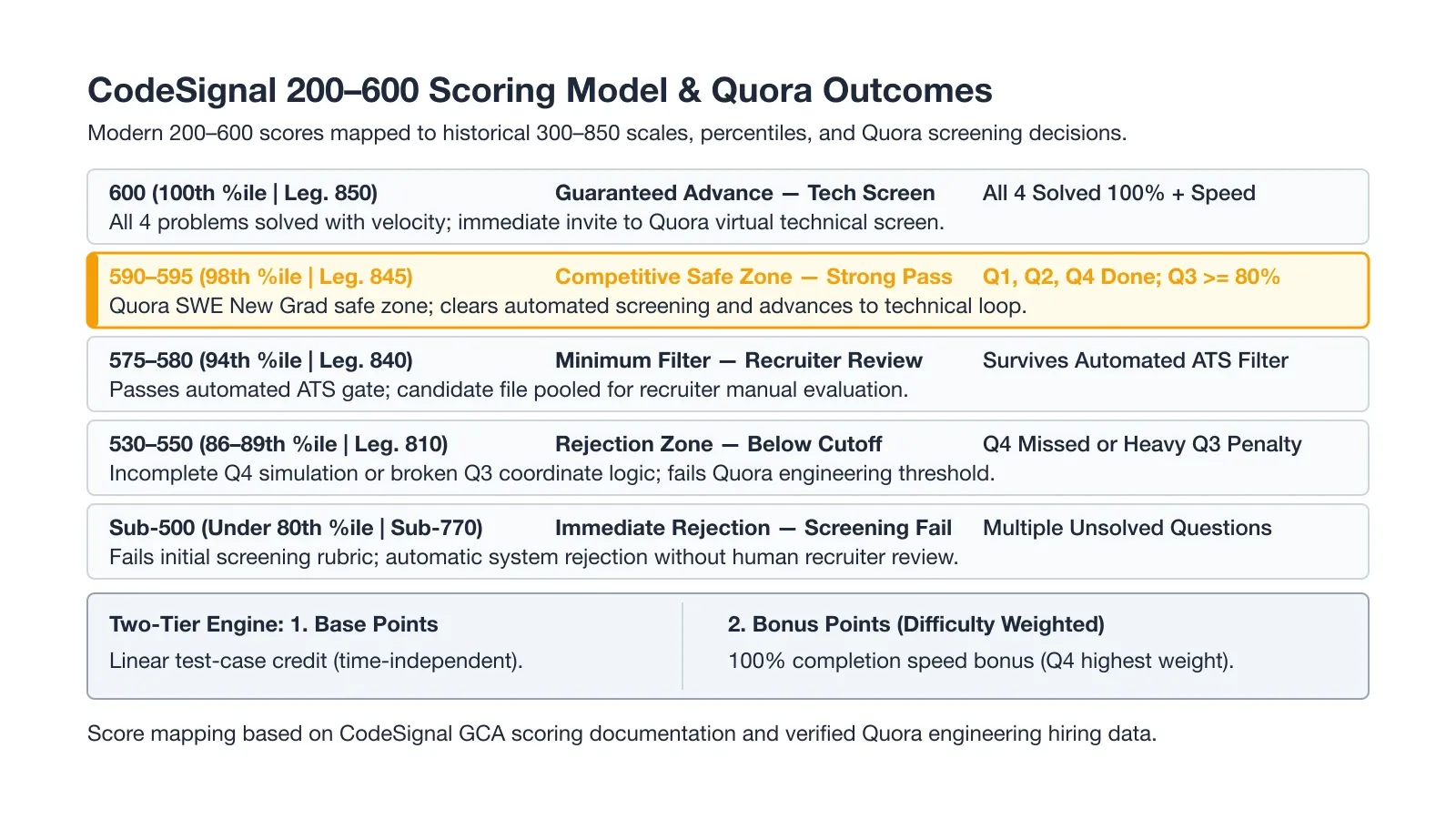
CodeSignal scores tests on a 200 to 600 scale that replaced the old 300 to 850 range. The engine divides credit into base points and completion bonus points.
Base points add up as individual test cases pass. This provides partial credit for simple brute-force code. Review the official CodeSignal Assessment Score evaluation model to see how points accumulate.
Bonus points unlock only when a solution passes all test cases cleanly. Harder questions award larger bonus pools, making a full pass on Question 4 especially valuable.
Quora Passing Cutoffs and the Safe Zone
Quora maintains strict score cutoffs for engineering roles. Recruiters handle large application volumes by filtering scores before reading resumes.
| Assessment Score (200–600) | Historical Equivalent (300–850) | Population Percentile | Quora Screening Outcome |
|---|---|---|---|
| 600 | 850 | 100th percentile | Guaranteed pass; direct invitation to technical interview screen |
| 590–595 | 845 | 98th percentile | Competitive safe zone; standard advance for SWE New Grad candidates |
| 575–580 | 840 | 94th percentile | Minimum filter cutoff; candidate application reviewed manually by recruiters |
| 530–550 | 800–820 | 86th–89th percentile | Automated rejection; performance falls below Quora engineering thresholds |
| < 500 | < 770 | < 80th percentile | Immediate rejection; screening failed |
A score of 575 gets your resume past the automated system filter. Hitting 590 or higher puts you in the safe zone by clearing Questions 1, 2, and 4 with partial credit on Question 3.
Quora CodeSignal Exam-Day Strategy
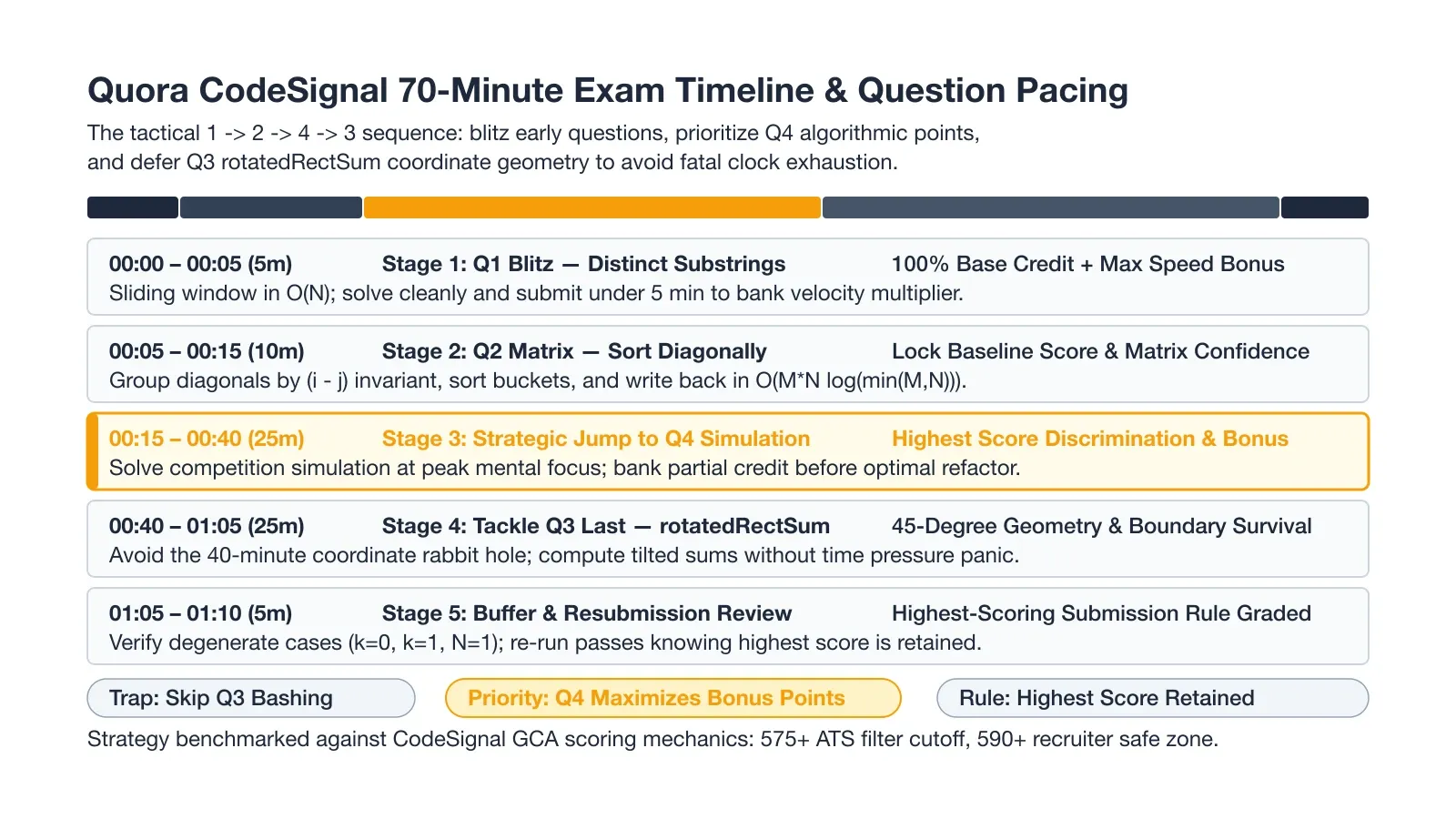
The 1 2 4 3 Anti-Bashing Solving Sequence
Solving problems in 1, 2, 3, 4 order is a frequent mistake on CodeSignal. Question 3 is an implementation sink that can consume thirty minutes on coordinate checks.
I used a 1 -> 2 -> 4 -> 3 solving order during my sitting. Solving Question 1 and Question 2 in fifteen minutes secures quick points and builds early confidence.
Skipping Question 3 lets you tackle Question 4 while your focus is sharp. Clearing Question 4 locks in large bonus points before you return to Question 3's grid geometry.
Mid-Exam Simulation Roadblocks and Verification
Most candidates face a difficult blocker during the 70-minute window. Coordinate bugs on rotated grids or sorting errors on tournament logic cause fast stress.
Opening external windows or using system hotkeys triggers focus-loss flags. CodeSignal tracks window blur events and logs desktop pixels, turning a tough bug into a test failure.
Keeping your laptop screen on the code editor avoids proctor alerts during hard moments. Having a private way to check logic off-screen gives you safe answers without risking a flag.
Banking Partial Points on Resubmission
CodeSignal grades only your highest-scoring submission for each task. Submitting a new attempt that fails hidden tests never lowers the score from your best run.
As a result, this policy guides a smart approach for Question 3 and Question 4. First, write simple code to pass basic cases and bank baseline credit. Then use leftover minutes to refine performance.
Why Candidates Fail the Quora CodeSignal Assessment
AI Overlay Detection and the Sidebar Trap
Automated proctoring checks void candidate attempts every hiring cycle. During a July 2026 assessment, at least one candidate was flagged for leaving a translucent AI sidebar active. As the second question loaded, a warning appeared immediately after they pressed the overlay hotkey, their dashboard labeled the attempt invalid, and no fresh invitation was issued.
Desktop overlay tools render the AI's answer on the computer screen proctoring software monitors, hidden by a basic OS-layer trick. CodeSignal catches these tools through window focus listeners and desktop video capture. Pressing a hotkey shifts operating system focus away from the test browser, logging an immediate blur event and exposing floating UI layers.
Desktop overlays promise invisible help, but real tests show clear risks. In our hands-on Cluely review, tests proved that hotkeys and window focus changes trigger browser monitoring alerts. Desktop recordings can capture floating window frames even with low opacity.
An invalid test receives a Not Verified status on the candidate portal. Quora recruiters do not send replacement invites, and the platform enforces a 30-day wait before any retake.
In contrast, InterviewFox works differently: the answer appears on a phone, a physically separate device that no screenshot, screen recording, or session monitoring can reach by design.
Land offer with Safer AI Interview Assistant
Skip the risky invisible apps. Our dual-device mode keeps it simple and undetectable. You crush the interview, we handle the answers.
Get started. It's freeLoved by 100,000+ candidates
Sinking 40 Minutes into Q3 Coordinate Indexing
Question 3 often traps candidates who have strong algorithm skills. Translating 45-degree rotated boxes onto grid cells requires exact vertex math and boundary checks.
Candidates tackling rotatedRectSum often hit bounding errors, as seen in the rotatedRectSum candidate breakdown from recent test discussions.
Consequently, spending forty minutes debugging grid math leaves zero time for Question 4. Missing Question 4 loses the biggest bonus pool and drops your total score into the rejection band.
Edge-Case Crashes and Unstable Sorting
Hidden test cases check extreme inputs and strict ordering rules. In math tasks like Count Powers of K, missing k = 0 causes division errors, while k = 1 causes infinite loops.
In simulation tasks like Determine the Elimination Order, weak sorting leads to quiet failures. When contestants tie on round and past points, default sorts give random orderings that fail hidden tests.
How to Prepare for Quora CodeSignal in 7 Days
In the days before my assessment, I used the Prep Agent from InterviewFox over WhatsApp. I sent it Quora's confirmed CodeSignal question patterns and received a targeted seven-day drill plan and pacing strategy. It was one practical tool among several in my prep routine, not the entire curriculum.
Days 1-3: 2D Matrix Traversals and Geometry
The first three days focused on 2D matrix manipulation. Grouping diagonal elements by the invariant (i - j) served as the primary daily drill.
Dynamic programming and graph path algorithms were skipped completely. CodeSignal excludes both from the test framework. Advanced tree structures were also omitted to save practice time.
Practice focused on LeetCode 48, LeetCode 54, and LeetCode 1329. The main goal was grouping non-square matrix diagonals and rewriting grid values in under eight minutes.
Days 4-5: Simulation and Custom Sorting
The middle two days targeted multi-round state simulations and custom sorting rules. Practice centered on tracking tournament contestants and updating scores without running into slow O(N^2) loops.
Drills focused on custom tuple sorting with primary, secondary, and tertiary tie-break keys. The target was solving multi-round elimination logic with stable sorting in under twenty minutes.
Days 6-7: Timed Mock Simulation and Lockdown
The final two days focused on full timed mock tests. Running full mocks on CodeSignal's practice site built solid pacing under the 1 -> 2 -> 4 -> 3 order.
A workstation check eliminated technical issues before test day. Disconnecting extra screens and testing web camera framing ensured full compliance with proctoring rules.
What Happens After You Submit the OA
CodeSignal Score Delivery and Recruiter Review
CodeSignal posts your initial score to your candidate dashboard right after submission. You can see your total Assessment Score and skill bars for core areas.
Quora recruiters review submissions within five to ten business days. Candidates scoring 590 or higher usually receive an email to schedule the first technical phone round.
The Technical Screen and Power Day Structure
Passing the online test leads to a 45-to-60-minute technical phone screen. This interview uses CoderPad with a Quora software engineer and tests core data structures.
Clearing the phone interview brings an invitation to the virtual onsite Power Day. This loop includes four to five rounds:
- Coding and Data Structures: Algorithm problem solving on LeetCode Medium and Hard patterns.
- Practical Implementation: Writing clean classes or simulation code for real requirements.
- System Design: Scalable systems for experienced roles, or object design for new grads.
- Practical Engineering: Hands-on debugging or feature work in a realistic codebase.
- Behavioral Values: Team collaboration, technical communication, and product focus.
Quora offers strong software engineering compensation. Levels.fyi data shows a median total package of $260,000 per year, with new-grad L3 offers averaging $175,000.
FAQ
How long is the Quora CodeSignal assessment, and how many questions are there?
The Quora CodeSignal assessment gives you 70 minutes to solve four coding problems in one sitting. All four questions unlock right away, so you can check all tasks before writing code.
What is the passing score for codesignal quora on the 200–600 scale?
A score of 575 acts as the minimum ATS filter for codesignal quora applicants. Candidates targeting new-grad engineering roles need 590 to 600 to reach the competitive safe zone.
What happens if I use an AI desktop overlay or floating sidebar during the test?
CodeSignal flags desktop overlays through window blur tracking and canvas recording. Pressing an overlay shortcut marks your attempt Not Verified and triggers a 30-day testing lockout.
Can I use an AI tool or invisible app during the Quora CodeSignal OA?
Desktop overlay tools put the AI's answer on your computer screen, rendered as a hidden layer above the browser using a basic OS-layer trick. The answer remains on-screen, the hiding mechanism is basic, and proctoring platforms continue expanding their detection capabilities, meaning the risk profile is never fixed.
In contrast, InterviewFox pushes the answer to your phone, a physically separate device that no screenshot, screen recording, or session monitoring can reach by design, keeping the laptop screen on the exam editor. If you decide to use AI assistance during the OA, a dual device AI interview tool removes the answer from your monitored screen entirely.
Land offer with Safer AI Interview Assistant
Skip the risky invisible apps. Our dual-device mode keeps it simple and undetectable. You crush the interview, we handle the answers.
Get started. It's freeLoved by 100,000+ candidates
Why should I solve questions in the order 1 -> 2 -> 4 -> 3 instead of 1 -> 2 -> 3 -> 4?
Question 3 is a geometry problem that can trap you in long coordinate debugging loops. Moving from Question 2 to Question 4 secures top bonus points before you spend time on Question 3.
Can I resubmit my code if I think of a better solution later in the test?
Yes, CodeSignal allows unlimited submissions on all problems during the 70 minutes. The system counts only your highest-scoring run, so testing a new idea never hurts your score.