
I Passed the Twitch CodeSignal in 2026: Real Questions and Prep
Quick Facts
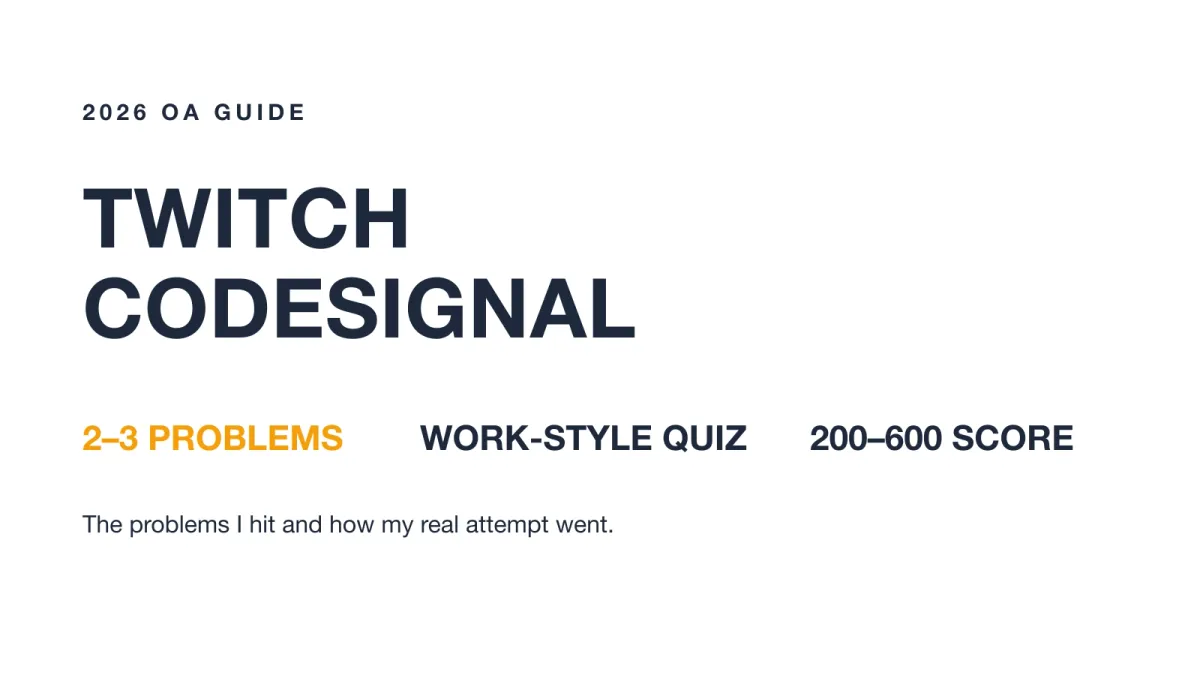
| Format | Twitch CodeSignal OA: 2–3 coding problems plus a work-style questionnaire |
| Time limit | Strict timed window; Twitch's exact minutes not published (stock GCA baseline is 70 minutes) |
| Proctoring | Camera, microphone, screen, and government ID; AI and human review |
| Suspicion Score | 35% of proctored assessments flagged; 40% of entry-level attempts (2025) |
| Score range | CodeSignal Coding Score, 200–600 |
| Year | 2026 |
I took the Twitch CodeSignal online assessment for a new-grad backend role in 2026. I chose Python and solved the JSON-and-API problem clean. What follows is the complete process and how I prepared for it.
My five-page API loop was still failing and my buffer was nearly gone. I used real time AI interview assistant to check the dedupe-and-sort logic. It surfaced the empty-page early-exit case, and I break that down in the walkthrough below.
Before my test, I scanned two years of Twitch CodeSignal posts on Reddit, LeetCode Discuss, and Teamblind. What I found tracks closely with what I experienced. I cover the mistakes that get people flagged or rejected, including a real integrity-review case from early 2026.
The Real Questions on My Twitch CodeSignal Test
I applied to Twitch as a new-grad backend candidate. The screen was a CodeSignal OA with two or three coding problems plus a short work-style questionnaire. Here is the one problem I can still walk through in full.
Question 1: Combine Lists from JSON and API
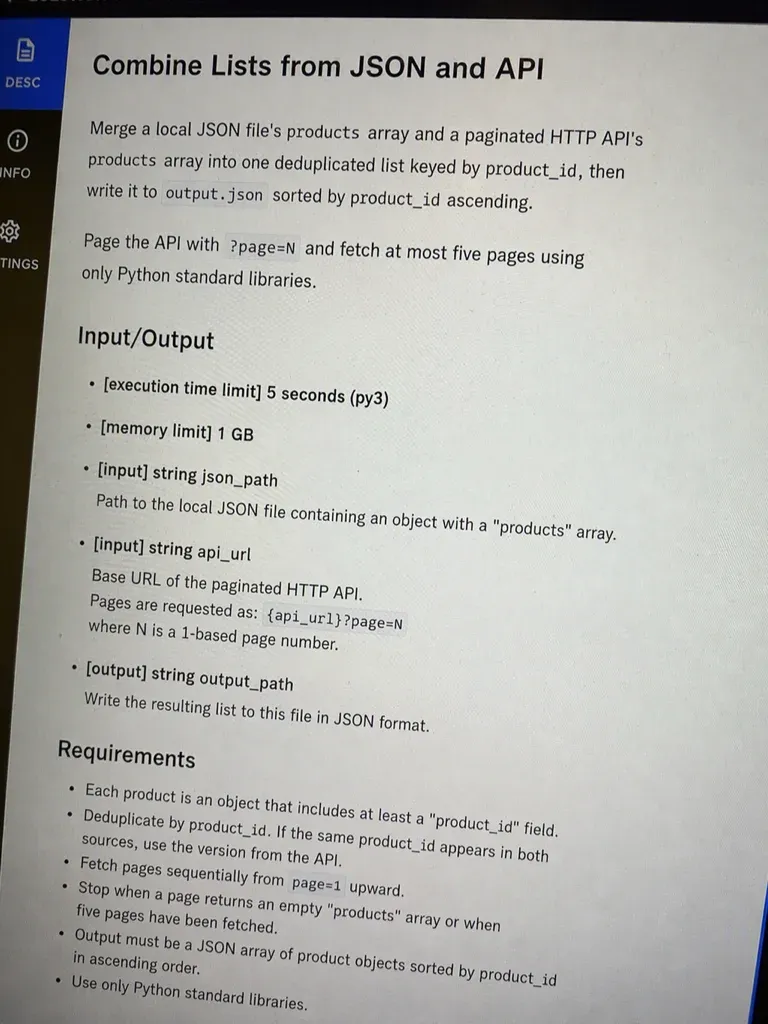
Recreated CodeSignal question panel (not a real candidate screenshot).
The problem I got: The task handed me a local JSON file holding a products array and a paginated HTTP API that also returned products. Both sides could hold duplicates, even inside a single source. I had to merge everything into one deduplicated list keyed by product_id, then write it to output.json sorted by product_id ascending. The API was paged through a ?page=N parameter, and I was told never to fetch more than five pages. Only Python standard libraries were allowed.
My approach: The clean path is a single dictionary keyed by product_id, because that key both deduplicates and hands me a sort order for free. I loaded the local file first, then walked the API page by page up to the five-page ceiling, stopping early if a page came back empty. After the merge I sorted the surviving keys and dumped the list. The one trap was the page cap: without it the loop could run into a timeout, so I hard-bounded it at five.
import json
import urllib.request
from urllib.parse import urlencode


def combine_lists(local_path, api_base):
    merged = {}

    with open(local_path, "r") as fh:
        local = json.load(fh)
    for product in local.get("products", []):
        merged[product["product_id"]] = product

    page = 1
    while page <= 5:
        separator = "&" if "?" in api_base else "?"
        url = api_base + separator + urlencode({"page": page})
        try:
            with urllib.request.urlopen(url, timeout=10) as resp:
                payload = json.load(resp)
        except Exception:
            break
        page_products = payload.get("products", [])
        if not page_products:
            break
        for product in page_products:
            merged.setdefault(product["product_id"], product)
        page += 1

    result = [merged[key] for key in sorted(merged.keys())]
    with open("output.json", "w") as fh:
        json.dump(result, fh, indent=2)
    return result
Time complexity: O(n + m log m) where n is the total product count and m is the number of unique ids | Space complexity: O(n)
The sample case fed local ids 1 and 2 plus API page 1 ids 2 and 3, and the output came back as 1, 2, 3. I lost more time than I planned here because I first wrote the API loop without the page cap, then caught the five-page limit and rewrote it. By the time output.json passed, my time buffer was thin.
Twitch's CodeSignal battery runs two or three coding problems plus the work-style questionnaire. The JSON and API task is the one I can reproduce end to end. The other problem on my screen I did not keep a clean record of, so I won't dress up a guess as fact.
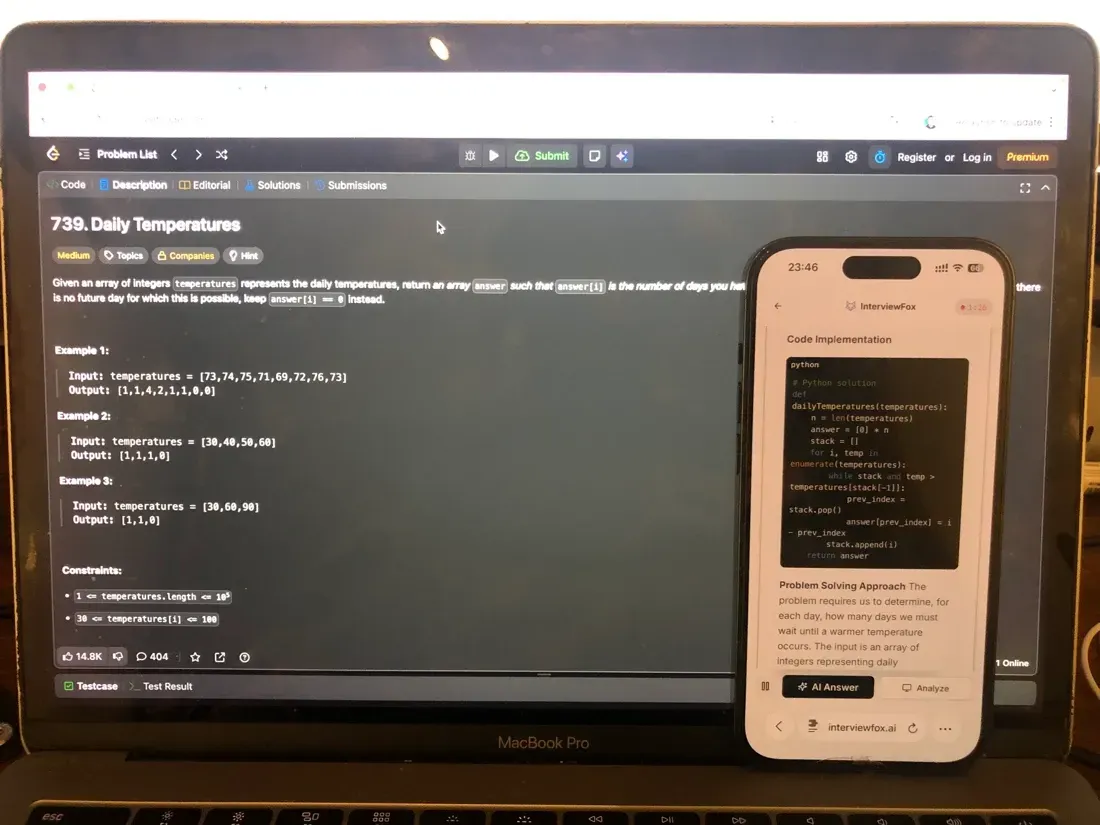
When my buffer got thin on the JSON-and-API merge, I didn't want to reach for a desktop overlay: the answer would have been on the same screen the proctoring system was monitoring, hidden by a basic rendering layer. Whether that gets flagged depends on what detection is currently running, and I didn't want that uncertainty in the background. I hit the InterviewFox shortcut, it auto-captured the question panel, and the dual device AI interview assistant pushed the answer to my phone, a separate device outside the platform's screenshot monitoring. My approach cleared and the laptop screen stayed on the exam editor, unchanged.
Land offer with Safer AI Interview Assistant
Skip the risky invisible apps. Our dual-device mode keeps it simple and undetectable. You crush the interview, we handle the answers.
Get started. It's freeLoved by 100,000+ candidates
Twitch's Proctoring Policy for CodeSignal
Twitch runs its CodeSignal OA on CodeSignal's own integrity stack. The platform records the session and scores it for cheating signals, so I read the policy before I clicked start.
What CodeSignal Records (camera, mic, screen, ID)
I shared my camera, microphone, and screen, and uploaded a government ID before the session began. CodeSignal captures the full session as video, audio, and screen recording, then runs both AI and human review on it.
Before you start, learn what CodeSignal actually saves from your webcam. The clip-retention window matters too. Screen capture follows its own rules. how CodeSignal records your screen during the test lays out the exact boundaries the recorder watches.
The Suspicion Score and How It Catches Help
The Suspicion Score studies four signals: solution similarity, pattern detection, telemetry, and paste events. CodeSignal's recruiting guide explains how each signal feeds the score. See CodeSignal's guide to preventing and detecting cheating in recruiting for the full breakdown.
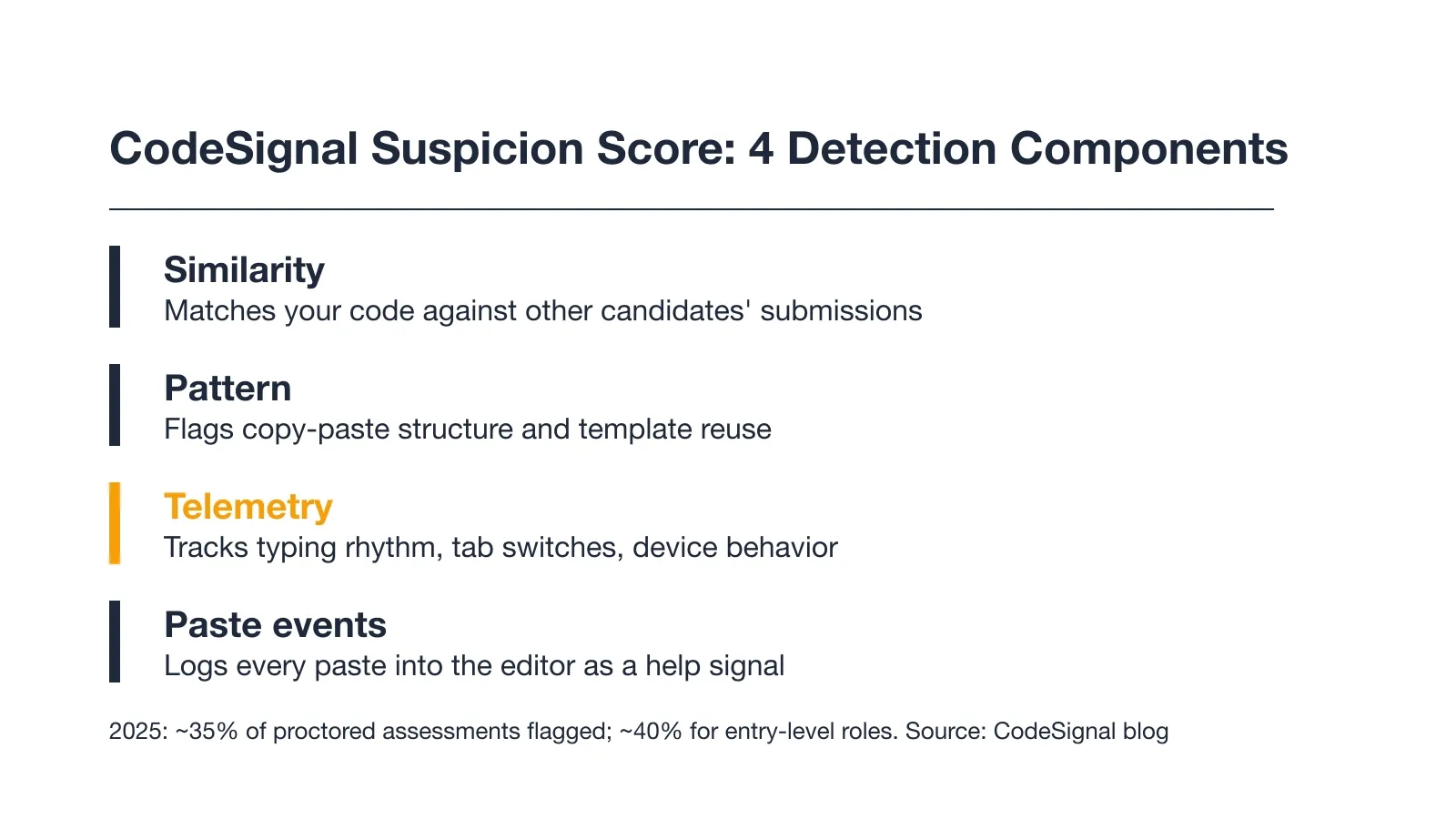
The four signals CodeSignal feeds into the Suspicion Score (recreated visual).
I read how CodeSignal's cheating detection actually works. It shows which behaviors trip the score live. The telemetry branch flags unusual typing or speaking patterns. That is exactly the signal an outside tool leaves behind.
A Real Integrity-Review Case (Jan 2026)
One exam-day risk is worth naming directly. A friend who also sat the Twitch CodeSignal OA in January 2026 described what happened on his run.
A click-through desktop overlay was running behind the assessment window. Less than ten minutes before the deadline, the session kept going, but the result page changed to pending integrity review. The recruiter later said the completed assessment would not count, and the process ended there.
4 Other Confirmed Twitch CodeSignal Questions
Beyond my own screen, Twitch's recurring bank holds several more confirmed problems. These come from candidate reports and competitor writeups, not from my sitting. I attribute each to its source and never call them my questions.
Merge Intervals
techprep lists Merge Intervals as a representative Twitch OA coding problem, reported by candidates who sat the round. The task merges overlapping [start, end] ranges into a minimal set of non-overlapping intervals.
def merge_intervals(intervals):
    intervals.sort(key=lambda x: x[0])
    merged = []
    for start, end in intervals:
        if merged and start <= merged[-1][1]:
            merged[-1][1] = max(merged[-1][1], end)
        else:
            merged.append([start, end])
    return merged
Time complexity: O(n log n) to sort, then O(n) to scan | Space complexity: O(n) for the merged output
Trapping Rain Water
techprep also names Trapping Rain Water among the Twitch battery. The task computes how much water is trapped between vertical bars given their heights.
def trap(height):
    left, right = 0, len(height) - 1
    left_max, right_max = 0, 0
    water = 0
    while left < right:
        if height[left] < height[right]:
            left_max = max(left_max, height[left])
            water += left_max - height[left]
            left += 1
        else:
            right_max = max(right_max, height[right])
            water += right_max - height[right]
            right -= 1
    return water
Time complexity: O(n) | Space complexity: O(1)
Toss Strange Coins
jointaro records Toss Strange Coins from a Twitch SWE experience. The problem gives n coins, each with its own probability of landing heads, and asks for the chance of exactly k heads after one toss of all n.
def probability_k_heads(probs, k):
    n = len(probs)
    dp = [0.0] * (n + 1)
    dp[0] = 1.0
    for p in probs:
        for j in range(n, 0, -1):
            dp[j] = dp[j] * (1 - p) + dp[j - 1] * p
        dp[0] *= (1 - p)
    return dp[k]
Time complexity: O(n * k) where k is the target head count | Space complexity: O(n)
Design a File Sharing System
jointaro lists Design a File Sharing System as a later-round design prompt, not an OA coding question. No first-hand spec or single function exists, so this stays a design outline, not a coded solution. I would scope it as authenticated upload, chunked storage, a metadata table, and time-limited share links with revoke. The grading angle is access control and concurrency, not one specific algorithm.
What Twitch's CodeSignal Test Format Actually Looks Like
Twitch's OA is a custom battery, not the stock General Coding Assessment. The shape below is what the sources and my own sitting agree on.
Problem Count and the Work-Style Questionnaire
Twitch sends two or three coding problems plus a short work-style questionnaire, on a strict time limit. The work-style part is CodeSignal's Behavioral and Work Style assessment. It measures how you work and fit, not coding skill.
Time Limit (and Why Twitch ≠ the Stock GCA)
Twitch's window is strict, though the exact minute count is not published. Do not confuse it with the stock CodeSignal General Coding Assessment, which packs four questions into about 70 minutes. Twitch's custom battery is two or three problems, a different shape entirely.
Link Mechanics and Expiry
One CodeSignal link is tied to your email, so a fresh invite means a fresh address match. Twitch's exact link-expiry window in days was not found in the sources, so I will not invent one.
How Twitch's CodeSignal Scoring Works
CodeSignal scores every submission, and the OA feeds that score into the advance decision. The platform model is what I can describe with confidence.
The 200–600 CodeSignal Score Model
CodeSignal scores every submission on a 200 to 600 scale through a two-tier model. The model adds base points plus a 100 percent module-completion bonus. The skill areas are Basic Coding, Data Manipulation, Ease of Implementation, and Problem-Solving.
CodeSignal's assessment score guide explains how the two tiers combine into the final number. See CodeSignal's Assessment Score guide for details.
Twitch's Pass Bar
Twitch publishes no specific pass bar or cutoff, and the sources found none. I treat the 200 to 600 range as the only usable baseline and do not guess a Twitch-specific threshold.
Why Candidates Fail the Twitch CodeSignal Assessment
The failures split into one invisible risk and one loud platform stat. Both are worth knowing before you start.
The Invisible AI-Tool Detection Risk
The January 2026 integrity-review case above shows a desktop overlay behind the assessment window. It voided a friend's attempt.
The exposure is structural, not a one-off. An overlay renders the AI's answer on the same screen the proctoring stack watches. Telemetry and paste tracking keep improving. A basic rendering trick does not make that invisible.
InterviewFox works differently. The answer goes to my phone, a separate device no screenshot, recording, or monitoring can reach by design.
Land offer with Safer AI Interview Assistant
Skip the risky invisible apps. Our dual-device mode keeps it simple and undetectable. You crush the interview, we handle the answers.
Get started. It's freeLoved by 100,000+ candidates
Suspicion Score Flag Rates (35% / 40%)
CodeSignal flagged 35 percent of proctored assessments platform-wide in 2025, and entry-level attempts hit 40 percent. The named causes are telemetry that flags unusual typing or speaking patterns and paste events from other windows.
Paste events are a named trigger. what the reviewer sees when you paste code from another window shows why that signal alone sinks a session.
Didn't Make It Past the OA
A few candidates who missed the OA surface in a thin Glassdoor thread. No specific cause is listed. It supports the pattern without adding detail, so I treat it as a weak signal, not evidence.
How to Prepare for the Twitch CodeSignal in 7 Days
Twitch reuses a small set of problem shapes, so a focused week beats a vague month. My plan follows the categories that actually appear in the sources.
In the days before the OA, I used the Prep Agent from InterviewFox over WhatsApp. It returned a personalized drill plan and strategy for each day.
Days 1-2: JSON+API Drill Under the 5-Page Cap
My first two days went to the JSON-and-API style, the one fully specified problem Twitch indexed. The drill trained me to dedupe by product_id with a dictionary and to hard-bound pagination at five pages. The success check was solving a fresh merged-output variant from scratch inside the time buffer.
Days 3-4: Merge Intervals and BFS/DFS for the Reported Set
My drills covered the four problems candidates reported for Twitch. They were Merge Intervals, Trapping Rain Water, Toss Strange Coins, and Design a File Sharing System. The completion test was three of the four under a timed block. That design prompt does not code in one sitting. The probability DP for Toss Strange Coins stayed a timed written drill.
Days 5-7: Timed Simulate + Skip System Design
A full timed simulation of two or three problems matched Twitch's battery shape. System design and low-level design were skipped entirely, because techprep lists those as later interview stages, not the OA. Memorizing a Twitch pass threshold was also skipped, since none exists in the sources.
What Happens After You Submit the OA
The OA is one gate in a longer loop. What comes next is what the sources and candidate reports describe.
The Interview Sequence
After the OA, a candidate I read waited a few days, then got a 45-minute hiring-manager technical interview. Techprep lists the pipeline as recruiter screen, OA, hiring-manager chat, a technical phone screen, then onsite.
Wait Time and Selectivity
Twitch's loop runs two to eight weeks from OA to onsite. Jointaro reports an 18 percent pass rate from one experience, a single-source figure I flag as soft. The pipeline shape looks like this:
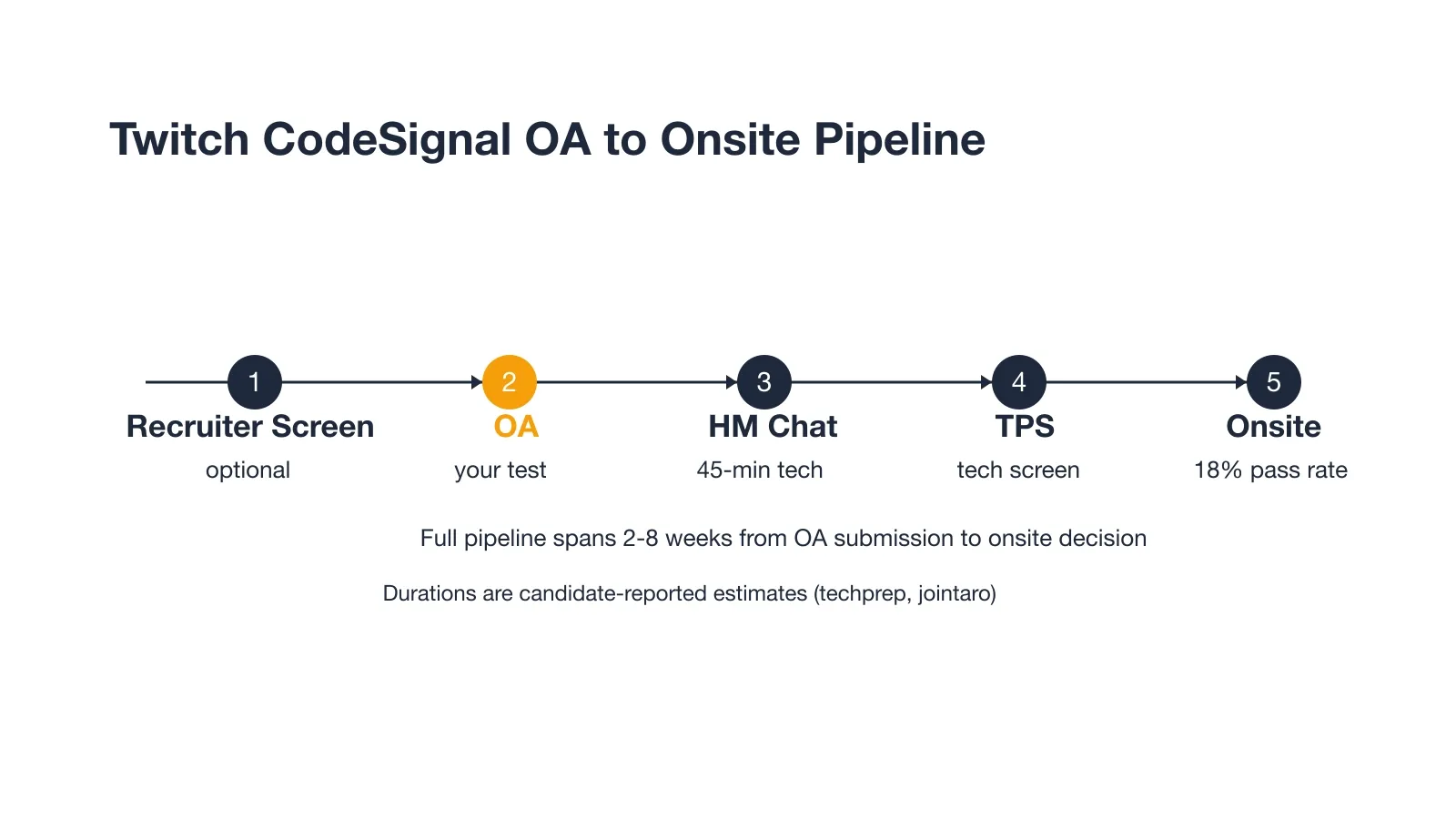
Twitch's reported pipeline from OA to onsite, with the two-to-eight-week window (recreated visual).
FAQ
Is the Twitch CodeSignal OA the stock GCA?
No. Twitch uses a custom battery of two or three coding problems plus a work-style questionnaire. It is not the stock GCA's four questions in 70 minutes.
How many questions are on the Twitch CodeSignal OA?
Two or three coding problems, plus a short work-style questionnaire. The coding count is smaller than the stock GCA's four.
Is the Twitch CodeSignal OA proctored?
Yes. CodeSignal records your camera, microphone, screen, and government ID, then runs AI and human review on the full session.
Can I use an AI tool or invisible app during the Twitch CodeSignal OA?
Desktop overlay tools put the AI's answer on your computer screen. It renders as a hidden layer above the browser, using a basic OS-layer trick. I won't claim it gets caught in every case. The answer stays on-screen, and the hiding is basic. Proctoring software keeps adding detection as AI tools spread, so the risk isn't fixed.
InterviewFox pushes the answer to your phone. It's a physically separate device that no screenshot, screen recording, or session monitoring can reach by design. The laptop screen stays on the exam editor, unchanged.
If you use AI help during the OA, the dual-device setup keeps the answer off your screen.
Land offer with Safer AI Interview Assistant
Skip the risky invisible apps. Our dual-device mode keeps it simple and undetectable. You crush the interview, we handle the answers.
Get started. It's freeLoved by 100,000+ candidates
What CodeSignal score do I need to pass the Twitch OA?
Twitch publishes no pass bar, and none was found in the sources. The only usable baseline is CodeSignal's 200 to 600 range. I aim for a clean run rather than a guessed cutoff.