
How I Cracked Virtu Financial HackerRank in 2026: Real Questions

Quick Facts
| Platform | HackerRank, named on the internship tracks and one full-time req |
| Invitation | Emailed after an initial resume screening |
| My sitting | May 2026, `general hiring test v2`, four coding problems |
| Older set | Five coding problems, posted August 2024, unchanged in August 2025 |
| Time limit | None published for any Virtu HackerRank sitting |
| Cutoff | None published in any source I reached |
| Scoring | Per test case, pass or fail, no partial credit |
| Verdict at submit | None shown to the candidate |
| Proctoring | HackerRank Secure Mode capability, Virtu settings unpublished |
| Prep window | 7 days, the default I used |
I took the Virtu Financial HackerRank test for a new-grad software engineering role in May 2026. The set was the four-question general hiring test v2, and I solved all four. No pass or fail verdict ever arrived at submission. What follows is the complete process and how I prepared for it.
Question 4 asked for the longest array, and I had spent close to twenty minutes coding the shortest one. My fix for the maximum still failed on [5, -2, 3] against [3, 3]. I checked the boundary rule with AI interview helper and rebuilt the prefix-sum map. Question 4 below has the full walkthrough.
Before my test, I read every Virtu Financial HackerRank post from the past two years. The sources were Reddit, LeetCode Discuss, and Teamblind. That reading matched my own sitting, down to the conduct that ends an attempt before a score is issued.
The Real Questions on My Virtu Financial HackerRank Test
My Virtu Financial HackerRank test was the four-question set titled general hiring test v2. I sat it in May 2026 for a new-grad software engineering role. All four were coding problems, and here is exactly what I got, in the order they appeared.
Question 1: Valid Bracket Sequences
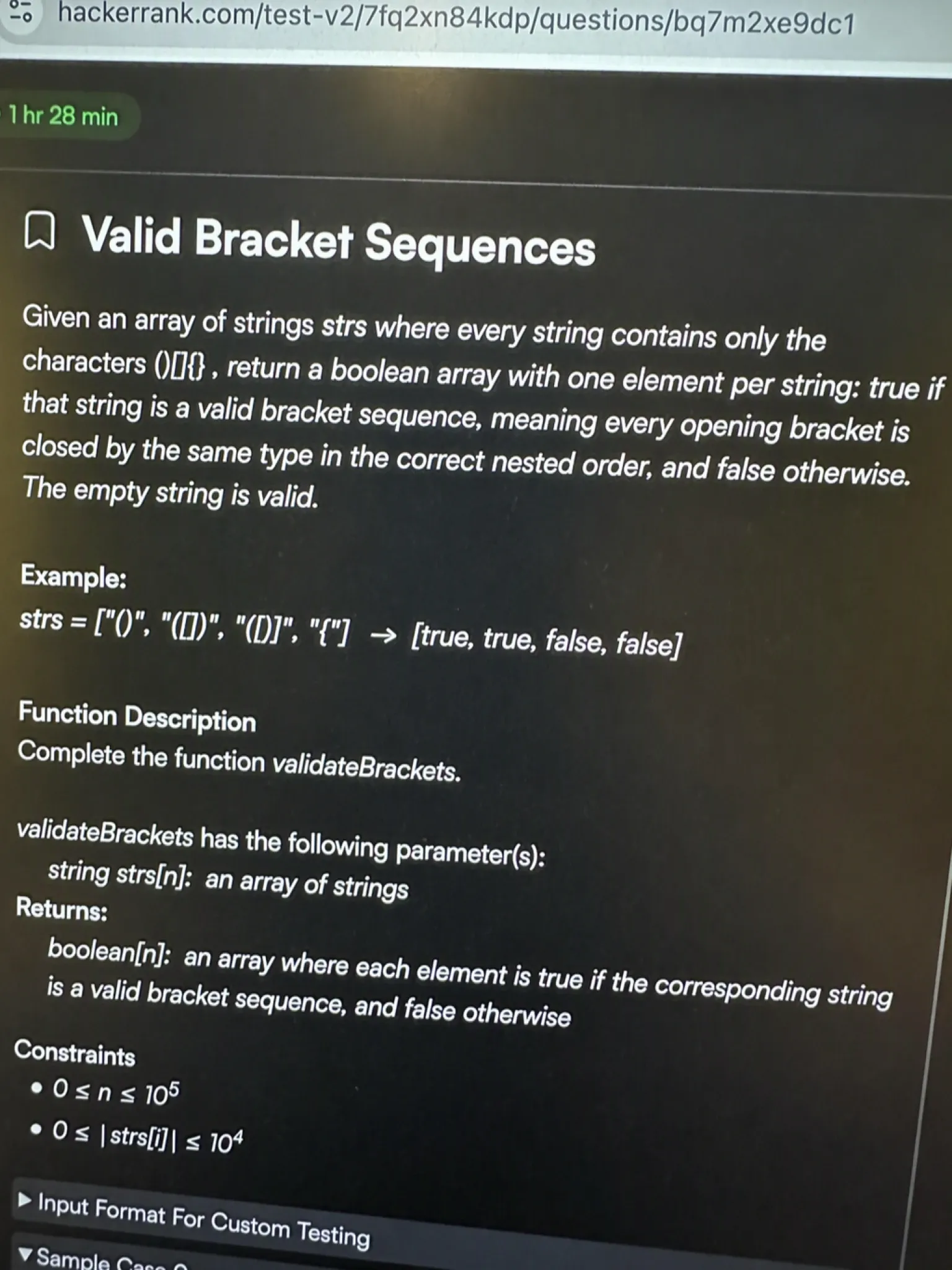
The problem I got: I was handed an array of strings, and every string was built only from the six bracket characters. For each one I had to decide whether it was a valid sequence, meaning every opening bracket closed by its own type in the right nested order. The return value was a boolean array with one answer per string.
The bounds were the part I checked twice. Up to 2·10⁵ strings could arrive in the outer array, and a single string could reach 2·10⁵ characters. Total length across all strings stayed at or below 2·10⁵.
My approach: I had solved the single-string version many times, and the batch wrapper changed the shape more than I expected. A stack still works, one per string. I push openings, and on a closing character I pop and compare types. Three details decided the hidden cases. The empty string counts as valid, so an empty stack at the end is a pass. The total-length bound rules out copying or slicing strings, so a straight scan with one stack at a time is the right cost. And a mismatch lets me stop that string immediately, because its answer is already false.
def validate_brackets(strs):
    close_to_open = {")": "(", "]": "[", "}": "{"}
    answer = []
    for text in strs:
        stack = []
        valid = True
        for ch in text:
            if ch in close_to_open:
                if not stack or stack.pop() != close_to_open[ch]:
                    valid = False
                    break
            else:
                stack.append(ch)
        answer.append(valid and not stack)
    return answer


if __name__ == "__main__":
    print(validate_brackets(["()", "([])", "([)]", "{"]))
Time complexity: O(total characters across all strings) | Space complexity: O(longest string)
That prints [True, True, False, False], and the other printed cases come back as [True], [True, False], [False] and [False]. This one took me under ten minutes, and it was the only question where my first draft passed every case I could see.
Question 2: Bit Flips to Equalize
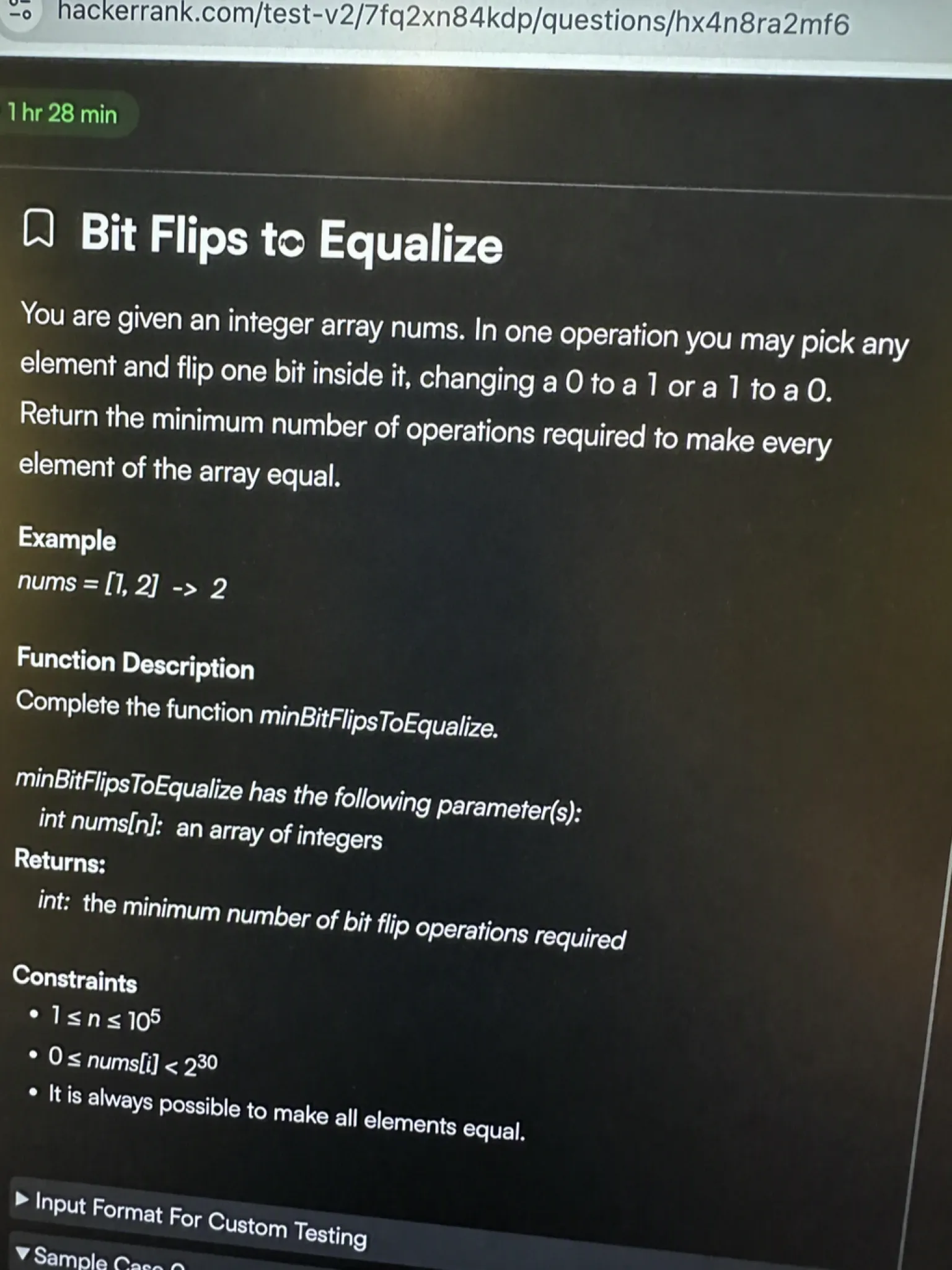
The problem I got: I got an integer array, and one operation let me pick any element and flip one bit inside it, either 0 to 1 or 1 to 0. I had to return the smallest number of operations that made every element equal.
The bounds were up to 2·10⁵ elements, with every value between 0 and 10⁹.
My approach: My first instinct was to pick a target value from the array and count how many bits differed across all elements. Then I looked at the smallest printed case, [1, 2] with an answer of 2. In binary that is 01 against 10, and no target value I tried beat two flips. The better frame is that each bit position stands alone. For one position, suppose ones elements carry a 1 there. Making that column all ones costs n - ones flips, and making it all zeros costs ones. I take the smaller side and add it up across 31 positions, which covers every value up to 10⁹. The target value falls out of those choices, and it never has to appear in the input.
def minBitFlipsToEqualize(nums):
    n = len(nums)
    total = 0
    for bit in range(31):
        ones = 0
        for x in nums:
            ones += (x >> bit) & 1
        total += min(ones, n - ones)
    return total


if __name__ == "__main__":
    print(minBitFlipsToEqualize([1, 2]), minBitFlipsToEqualize([2, 4, 8]))
Time complexity: O(31n), which is O(n) | Space complexity: O(1)
That prints 2 3, and the remaining printed cases give 0, 0 and 2. This one took me about six minutes, and the [1, 2] example did most of the thinking for me.
Question 3: No m Consecutive Zeros
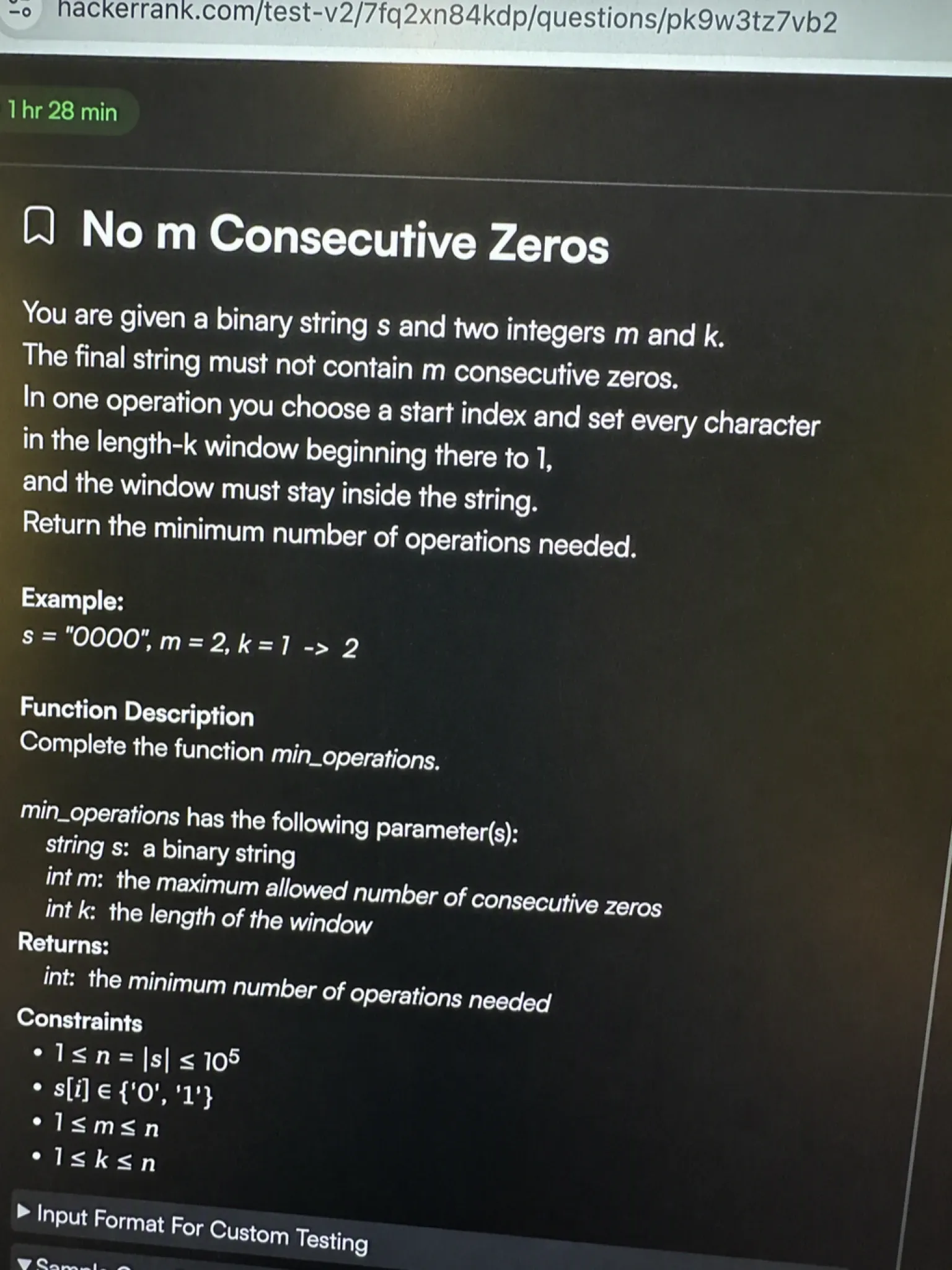
The problem I got: I got a binary string and two integers, m and k. The final string could not contain m zeros in a row. One operation picked a start index and set the whole length-k window from there to ones, and the window had to stay inside the string. I had to return the minimum number of operations.
The string could reach 2·10⁵ characters, with 1 ≤ m ≤ len(s) and 1 ≤ k ≤ len(s).
My approach: I read "set to 1" on my second pass, and that word decides the whole problem. These are not toggles. A position that is already 1 stays 1, so the order of operations never matters and a left-to-right greedy scan is safe. I walk the string and count the current run of zeros. When the count reaches m, one window has to cover the zero I am standing on, and starting the window at that index also covers the most zeros ahead. I do not rewrite the string on every placement. Instead I keep the right edge of the last window and treat every index up to it as a 1, which keeps the scan linear. When a window would run past the end, I right-align it at n - k.
def min_operations(s, m, k):
    n = len(s)
    ops = 0
    run = 0
    covered_until = -1
    for i, ch in enumerate(s):
        if i <= covered_until or ch == "1":
            run = 0
            continue
        run += 1
        if run == m:
            ops += 1
            start = i if i + k <= n else n - k
            covered_until = start + k - 1
            run = 0
    return ops


if __name__ == "__main__":
    print(min_operations("0000", 2, 1), min_operations("01000010", 4, 2))
Time complexity: O(n) | Space complexity: O(1)
That prints 2 1, and the all-ones string returns 0. In the end this took ten minutes, most of it spent convincing myself that the operation was not a toggle.
Question 4: Subarray Sum Equalization
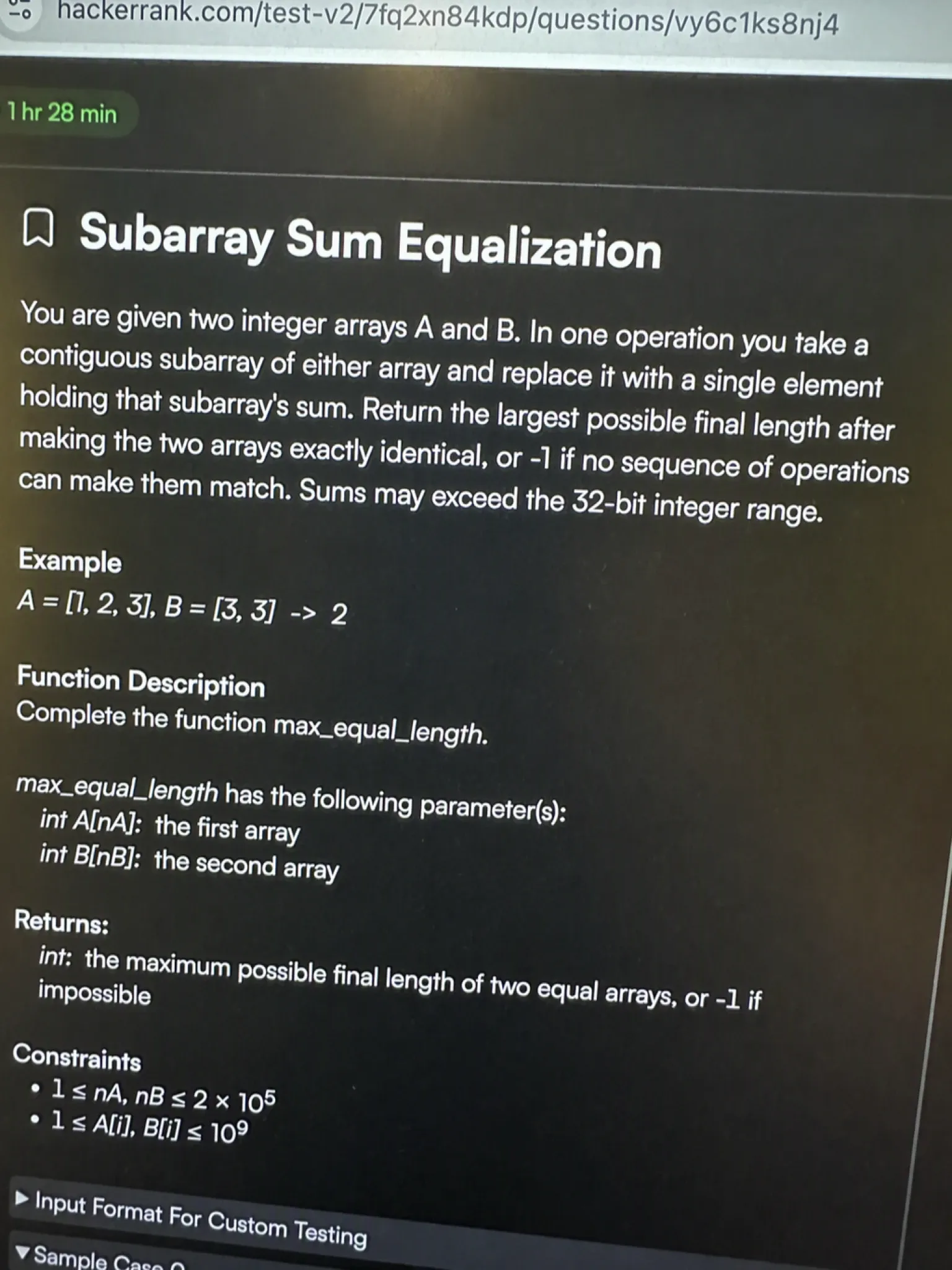
The problem I got: I got two integer arrays. One operation took a contiguous subarray of either array and replaced it with a single element holding that subarray's sum. I had to make the two arrays exactly identical and return the largest possible final length, or -1 when no sequence of operations could make them match.
Both arrays could hold up to 2·10⁵ elements, values ran from -10⁹ to 10⁹, and the statement carried a note that the sums may exceed the 32-bit range.
My approach: I coded the minimum-length version first, because that was the version I had written down while revising. That version is simple: merge everything into one element per side, then compare the two sums. The first printed case answered 2 while my function answered 1, so I re-read the sentence and it said maximum. That misread cost me close to twenty minutes, and the corrected objective changed the method completely.
Under the maximum reading, every final element is the sum of one contiguous block, so a solution is a shared set of block boundaries. Two boundaries line up when the running sums agree. My first attempt advanced whichever side had the smaller running sum, which is the usual move and is wrong here, because the values can be negative. I checked it on [5, -2, 3] and [3, 3]: the pair answers 2, and the smaller-sum walk answers 1. So I stored the prefix sums of B in a map from value to the sorted list of positions, then walked the prefix sums of A in order. Each one takes the earliest unused position in B with the same value, and every match is one shared boundary. The answer is the count of matches plus one. Python integers are arbitrary precision, so the 32-bit note only affected how I read the bounds.
def max_equal_length(A, B):
    if sum(A) != sum(B):
        return -1

    positions = {}
    running = 0
    for j in range(len(B) - 1):
        running += B[j]
        positions.setdefault(running, []).append(j + 1)

    matched = 0
    last = 0
    running = 0
    for i in range(len(A) - 1):
        running += A[i]
        spots = positions.get(running)
        if spots is None:
            continue
        lo, hi = 0, len(spots)
        while lo < hi:
            mid = (lo + hi) // 2
            if spots[mid] > last:
                hi = mid
            else:
                lo = mid + 1
        if lo < len(spots):
            matched += 1
            last = spots[lo]
    return matched + 1


if __name__ == "__main__":
    print(max_equal_length([1, 2, 3], [3, 3]), max_equal_length([5, -2, 3], [3, 3]))
Time complexity: O(m + n log m) | Space complexity: O(m)
That prints 2 2. The unequal-total case returns -1, and [0, 0, 0] against [0] returns 1, because zero-valued elements are allowed to merge. This one took longer than any other question in the sitting, and almost all of that time went into one wrong word in my own notes.
Twenty minutes in, with the smaller-sum walk still answering 1 on [5, -2, 3] against [3, 3], I stopped trying to reason it out against the clock. A desktop overlay was never an option for me: the answer would sit on the same screen the platform captures, hidden by a basic rendering layer, and whether that gets caught depends on whatever monitoring happens to be running that day.
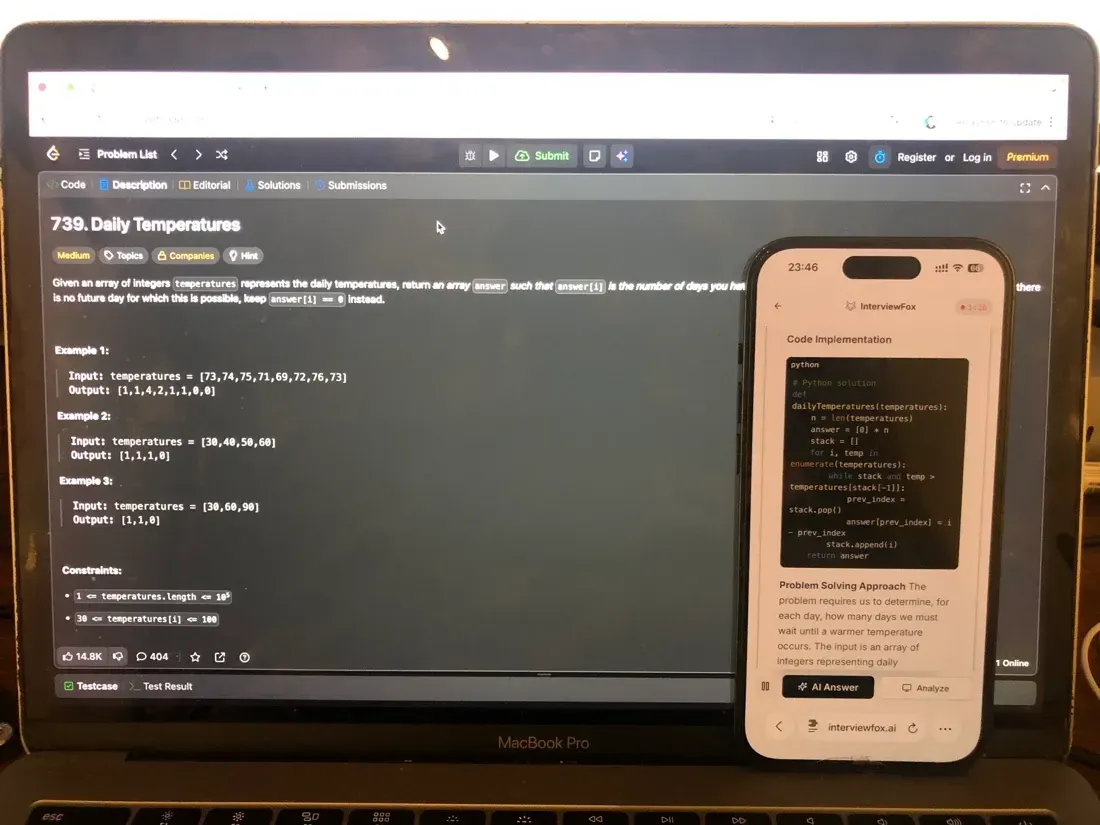
So I hit the keyboard shortcut instead, and the screen was captured automatically and pushed to my phone, a separate device outside the platform's screenshot monitoring. The boundary rule came back spelled out, the prefix-sum map followed from it, and my laptop screen never left the editor.
Land offer with Safer AI Interview Assistant
Skip the risky invisible apps. Our dual-device mode keeps it simple and undetectable. You crush the interview, we handle the answers.
Get started. It's freeLoved by 100,000+ candidates
Virtu Financial's Proctoring Policy for HackerRank
What HackerRank Secure Mode Logs
Secure Mode runs the test inside a controlled browser window and starts in full-screen. Minimizing or resizing the window is blocked, and leaving full-screen still raises a warning.
That warning is the visible half of full-screen enforcement and tab-switch alerts. The invisible half is the log. Every exit lands in your report as a window exit, with a duration.
The exit count and the time-away column get a full explanation in how HackerRank logs a tab switch.
Secure Mode blocks external copy and paste outright. Does a paste from your own notes count against you? The answer sits in what clipboard activity it records.
Unplugging a second display the night before is the cheap fix. That is where the practical advice ends. What the check makes of a docked laptop sits in the monitor check at launch.
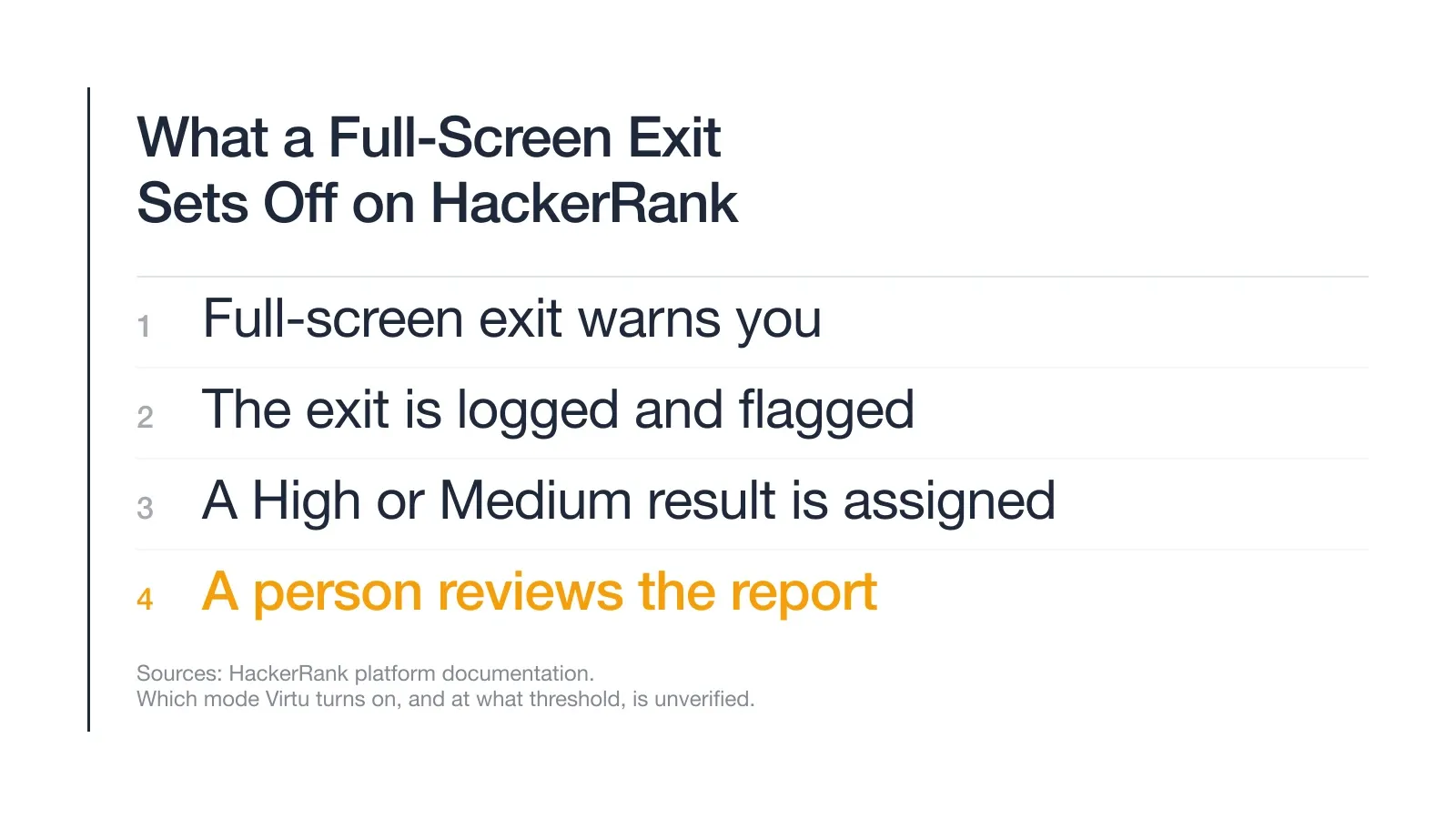
Exiting full-screen past a threshold flags the session. Secure Mode then assigns a final integrity result of High or Medium by severity. Proctor Mode adds screenshots and webcam images about every 15 seconds, plus session replay and a human review.
The sequence below follows one exit to the reviewer.
What Virtu Enables Stays Unstated
I scanned all 48 live Virtu postings for webcam, proctor, integrity, lockdown, and screen-share wording. Not one of them mentions any of it. The eight candidate threads I read carry no integrity screen, no webcam, and no full-screen requirement either.
So the section above describes what the platform can do, not what this employer switched on. No source I could reach states which settings Virtu enables, or at what thresholds. I treated the strictest reading as the one in force.
What Virtu Financial's HackerRank Test Format Looks Like
Question Count Varies by Sitting
Invitation follows resume screening, and Virtu's own posting says the test arrives by email only after that screen. No posting states a deadline, a link-expiry window, or a retake policy.
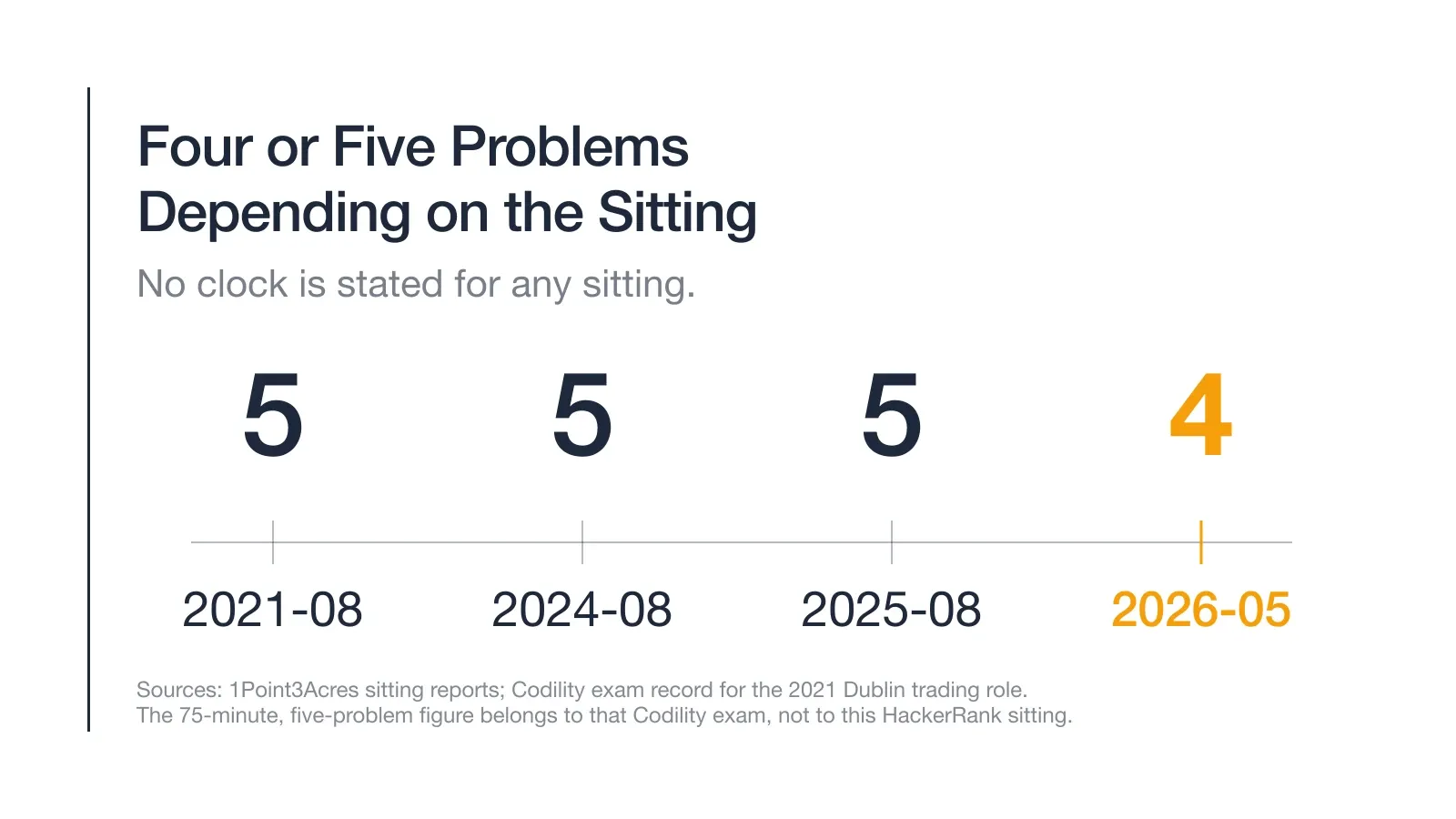
The count itself moves between sittings. My May 2026 test carried four problems under the title general hiring test v2. The earlier set carried five, posted in August 2024 and reported unchanged in August 2025.
Both sets still circulate, and the two share no problems at all. A reader who drills one of them has not seen the other.
The timeline below puts those sittings side by side, with the clock column as empty as the sources leave it.
No Timer Is Documented for the HackerRank Sitting
I looked for a duration in eight candidate threads and in all 48 postings. None states one. Six years of sittings, and nobody has written down how long the test ran.
The figure that does circulate is 75 minutes for five questions. It comes from a 2021 Codility exam for a Dublin trading analyst role. That is a different platform, a different role, and a different year. Attaching it to this OA is the most common error in the write-ups I read.
HackerRank Is Named Only on Some Postings
Virtu's 2027 software engineering internship posting spells out the mechanic. After a resume screen, the test arrives by email via HackerRank. The 2027 quantitative research internship and one full-time trading-engineering req name the same platform.
Other full-time SWE reqs say only that an online programming test comes next, with no vendor attached. That covers the front-end, full-stack, and C# roles. Codility and CodeSignal appear in none of the 48 postings I checked.
So the vendor is confirmed for the internships and that one engineering req, and unstated for the rest. That is the whole claim these postings support, and I have not stretched it further.
5 Other Confirmed Virtu Financial HackerRank Questions
These five come from a different sitting, posted in August 2024 with the author's own JavaScript attached. They are not variants of the four above. Yet the two sets share no problems, and both drew fresh reports years apart.
Question 1: Apples in a 5000 g Box
This one opened the August 2024 set, and the posted code for it fails its own example. A box holds 5000 g, the first array element is the weight already inside, and the rest are apple weights.
Return the largest number of apples that fit without going over 5000. For [4650, 150, 150, 150] the box has 350 g free, so two apples fit and the third does not.
Sorting decides it. The posted version compares the whole array against the remaining capacity and stops at the first apple that does not fit, so one heavy apple ends the pass early. A 2025 counter-example, [4000, 2000, 100, 100], settles it: an unsorted greedy takes nothing and the sorted version takes two.
BOX_CAPACITY = 5000


def max_apples_in_box(A):
    remaining = BOX_CAPACITY - A[0]
    count = 0
    for weight in sorted(A[1:]):
        if weight > remaining:
            break
        remaining -= weight
        count += 1
    return count


if __name__ == "__main__":
    print(max_apples_in_box([4650, 150, 150, 150]))
Time complexity: O(n log n) for the sort | Space complexity: O(n) for the sorted copy
That prints 2, and the counter-example prints 2 as well, which is the case the unsorted greedy gets wrong.
Question 2: Identical-Character Substrings
This is the gentler half of the 2024 set, and the posted code for it has no bug. Count the non-empty substrings whose characters are all identical.
Every maximal run of one repeated character contributes L * (L + 1) / 2 substrings, where L is the run length. The string zzzyz breaks into runs of 3, 1, and 1, which gives 6 + 1 + 1 = 8.
So one scan adds the running length at each position and produces the same total. The input stays at 100 characters or below, so a quadratic version would also pass, but the linear one is shorter to write.
def count_identical_substrings(s):
    total = 0
    run = 0
    prev = None
    for ch in s:
        run = run + 1 if ch == prev else 1
        prev = ch
        total += run
    return total


if __name__ == "__main__":
    print(count_identical_substrings("zzzyz"), count_identical_substrings("k"))
Time complexity: O(n) | Space complexity: O(1)
That prints 8 1, and the single-character case confirms the base count.
Question 3: HexSpeak Conversion
This is the problem from the 2024 set with the best hidden-case lesson. Convert a decimal string to uppercase hex, then swap 0 for O and 1 for I.
Return the word only if every character sits in the allowed set. That set is A, B, C, D, F, I, and O, so E is out and A is in.
The input runs up to 10¹², and the posted code calls parseInt(S, 10) before doing anything. A JavaScript number stops being exact well below that bound, which is the overflow a 2025 reply pointed at. Dividing the decimal string by 16 as text sidesteps the whole problem.
ALLOWED = set("ABCDFIO")
HEX_DIGITS = "0123456789ABCDEF"


def to_hex_speak(S):
    n = S.lstrip("0") or "0"
    chars = []
    while n != "0":
        remainder = 0
        quotient = []
        for ch in n:
            current = remainder * 10 + int(ch)
            quotient.append(str(current // 16))
            remainder = current % 16
        chars.append(HEX_DIGITS[remainder])
        n = "".join(quotient).lstrip("0") or "0"
    word = "".join(reversed(chars)) or "0"
    word = word.replace("0", "O").replace("1", "I")
    for ch in word:
        if ch not in ALLOWED:
            return "ERROR"
    return word


if __name__ == "__main__":
    print(to_hex_speak("257"), to_hex_speak("3"))
Time complexity: O(d²) where d is the decimal digit count, 13 at this bound | Space complexity: O(d)
That prints IOI ERROR, since 257 is 0x101 and 3 has no valid letter form.
Question 4: Nearest Fibonacci Steps
The wording is the trap here, and it is a single word. It asks for the distance to the nearest Fibonacci number, not to the next one up.
The value 15 sits between 13 and 21. That gives 2 against the lower neighbour and 6 against the upper one. Both 13 and 1 are Fibonacci already, so both cost 0.
A reader who takes "next" literally and walks upward gets 6 on the first case, then passes only the exact hits.
def min_steps_to_fibonacci(x):
    a, b = 0, 1
    while b < x:
        a, b = b, a + b
    return min(x - a, b - x)


if __name__ == "__main__":
    print(min_steps_to_fibonacci(15), min_steps_to_fibonacci(13), min_steps_to_fibonacci(1))
Time complexity: O(log X), the count of Fibonacci numbers up to X | Space complexity: O(1)
That prints 2 0 0, and the two exact hits need no steps at all.
Question 5: Student Score Stabilization
This closed the 2024 set, and the posted code carries a type bug worth naming. Each day, a student with both neighbours scoring higher rises by one. A student with both neighbours lower falls by one. The two ends never move.
It repeats while anything changes. The array [1, 6, 3, 4, 3, 5] settles at [1, 4, 4, 4, 4, 5] after two days.
A posted line reads newScores = scores + 1, which appends a number to an array in JavaScript instead of updating a copy. The fix is a separate array each day, compared against the previous one for the stop condition.
def update_scores(scores):
    current = list(scores)
    while True:
        nxt = current[:]
        changed = False
        for i in range(1, len(current) - 1):
            if current[i] > current[i - 1] and current[i] > current[i + 1]:
                nxt[i] = current[i] - 1
                changed = True
            elif current[i] < current[i - 1] and current[i] < current[i + 1]:
                nxt[i] = current[i] + 1
                changed = True
        current = nxt
        if not changed:
            return current


if __name__ == "__main__":
    print(update_scores([1, 6, 3, 4, 3, 5]))
Time complexity: O(n · V), with V the largest possible score drift, capped at 1000 | Space complexity: O(n)
That prints [1, 4, 4, 4, 4, 5], which is the stated sample.
How Virtu Financial's HackerRank Scoring Works
Nothing Tells You Pass or Fail at Submission
The submit screen stays silent in the one account I have from a 2024 quantitative-strategist intern. Few test cases were visible, and no verdict arrived when the code went in. Nothing in the postings contradicts that.
What happens next is human. Virtu's posting says the team reviews the test and reaches out to arrange next steps. The code does not decide alone.
Sample Cases Can Be Worth Zero Points
HackerRank scores every test case as pass or fail, with no partial credit inside a case. A case either pays its full predefined score or pays nothing.
Sample cases are visible and can carry a score of zero. The hidden ones stay locked behind an icon. Passing every case you can see can therefore leave that question at zero.
No Cutoff or Percentile Exists in Any Source
Nothing I read states a cutoff, a threshold, a percentile, or a target score. Eight candidate threads, 48 postings, and every platform page I opened came back empty on that question.
HackerRank's own documentation walks through a worked example of 65 out of 95 across 11 cases. That example illustrates per-case scoring, and it is not a Virtu bar. I did not treat it as one.
Why Candidates Fail the Virtu Financial HackerRank OA
Passed the OA Then Cut at the First Human Round
A 2021 Dublin quantitative trading candidate cleared the coding exam. The next interviewer opened by praising that result, then declined to say what the score was.
The rejection arrived the next day with no feedback attached. Strong coding still did not carry the loop, and the email closed off any route to finding out why.
Attempts Can End Before a Score Is Issued
A candidate I know sat the assessment in late April 2026 with a floating answer widget open. When the editor returned to full-screen, the test moved to an integrity-review screen instead of the question. The attempt ended before submission, and no score was issued.
That ending fits the documented mechanics. Leaving full-screen past a threshold counts as a violation. The session then picks up an integrity result, and a person reads the report. Correctness never gets a vote once that chain starts.
More steps sit below a flagged session than this OA description can carry. I read them end to end in the full integrity chain.
That integrity screen was structural rather than unlucky. The widget drew the answer on the same screen HackerRank's session monitoring watches, hidden by a basic operating-system trick, and that exposure sits in the architecture rather than in how careful the user is.
InterviewFox works differently in exactly that respect: a dual device AI interview assistant puts the answer on my phone, a physically separate device that no screenshot, screen recording, or session monitor can reach by design.
Land offer with Safer AI Interview Assistant
Skip the risky invisible apps. Our dual-device mode keeps it simple and undetectable. You crush the interview, we handle the answers.
Get started. It's freeLoved by 100,000+ candidates
A Final-Round Fail Is Not an OA Fail
A 2023 quantitative research candidate cleared the OA easily, cleared the technical round, and then had the third round cancelled. The stated reason was a skill-set mismatch, which is a final-stage judgment about fit.
The first round went badly for at least one 2022 trading-operations candidate, with no detail on which round that meant. I have not counted it as an OA rejection, because nothing in the account names the OA.
How to Prepare for the Virtu Financial HackerRank in 7 Days
Seven days is the default I used, because no Virtu source states how long the link stays live. The plan below spends all seven and assumes nothing about a deadline.
Before day one I messaged the Prep Agent from InterviewFox on WhatsApp with the question patterns confirmed for Virtu, and it came back with a personalized drill plan and a strategy note. I kept my own shape list as the spine and used its plan to order the days.
Days 1-2: Four Shapes at the 2·10⁵ Bound
Three of my four questions bounded input at 2·10⁵. That bound kills an O(n²) solution while every printed sample still passes. Behind them sit four shapes: a stack over batched strings, a per-bit greedy, and a prefix-sum partition. The window question adds a greedy pass over zero runs.
I spent the first two days implementing one shape per sitting from the statement alone, with the editorial closed. Each run had to finish inside a second at 2·10⁵ generated input, with no nested scan anywhere.
I skipped timed simulation entirely. No clock is documented for a Virtu HackerRank sitting, so a timer would rehearse a constraint nobody verified. I also skipped DP, graph, and tree drilling, since neither confirmed set contains one.
The check at the end of day two was both corrected objectives restated in a single sentence. That meant maximum final length for the partition problem, and set-to-1 rather than toggle for the window problem.
Days 3-4: Write the Cases the Scorer Will Not Show You
Per-case scoring left edge coverage as my only lever, so I wrote the case list before the solution. Four edges carried most of the value. The empty string counts as valid, and both window parameters can equal the length. Sums can pass 32 bits, and the HexSpeak input can reach 10¹².
The success check was a written list per problem that a stranger could run without asking me anything. Each list also held one case where a wrong reading of the objective still passes the printed samples.
Days 5-7: Drill the Five-Problem Set Still Served
The older five were still identical in August 2025, a year after posting, so they stayed in the plan. I solved all five with the corrected approaches. That meant sort before the greedy, long division on the decimal string, and a simultaneous update on a copy.
The check here was blunt. Every implementation had to match its own examples. I also had to name the two traps out loud: the apples sort and the HexSpeak overflow.
What Happens After You Submit the OA
About a Week to a Thirty-Minute HR Screen
The one dated timeline I have comes from a 2024 quantitative-strategist intern, not from a 2026 SWE candidate. About a week after the OA, a 30-minute HR screen followed, mostly conversation.
That screen carried a few easy brain teasers, one mental-arithmetic word problem, and one simple card-probability question. After it came one technical round and three video rounds, all from that same 2024 timeline.
The 2026 SWE Interval Is Still Unreported
No 2026 SWE candidate has posted an OA-to-response interval that I could find. Silence after submission is therefore unreported, not evidence of ghosting.
An older 2017 ladder ran OA, HR screen, video technical, a four-round onsite, and a CEO round. Nine years on, only the shape is worth keeping.
FAQ
Does Virtu Financial proctor the HackerRank OA?
HackerRank can enforce full-screen, log tab switches, and block external copy and paste. It can also check for a second display and assign an integrity result. Virtu does not publish which of those settings it turns on.
Does a second monitor get flagged on the Virtu test?
Secure Mode runs a single-monitor check before the test starts. A candidate continues only with one display active. That setup, a docked laptop plus an external screen, is worth changing before the sitting rather than during it.
Can I use an AI tool or invisible app during the Virtu Financial HackerRank OA?
A desktop overlay draws the answer on the same screen the test already watches, and the hiding happens at a basic operating-system layer: one late-April 2026 attempt ended at an integrity-review screen the moment full-screen returned.
InterviewFox sends the answer to your phone instead, a physically separate device that no screenshot, screen recording, or session monitoring can reach by design. If you use AI assistance during the OA, the dual-device architecture takes the answer off your screen rather than hiding it on top of one.
Land offer with Safer AI Interview Assistant
Skip the risky invisible apps. Our dual-device mode keeps it simple and undetectable. You crush the interview, we handle the answers.
Get started. It's freeLoved by 100,000+ candidates
How many questions are on the Virtu Financial OA?
Four in my May 2026 sitting, and five in the set posted in August 2024. Virtu states no fixed count in any posting.
What is the Virtu Financial general hiring test?
It is the title HackerRank shows for the four-problem 2026 software engineering sitting. The April to June 2026 new-grad cycle is the one it belongs to.
How long until Virtu responds after the HackerRank test?
About one week, on the only dated account available. That account is a 2024 intern, not a 2026 SWE candidate. No 2026 interval has been posted.