I Aced C3.ai HackerRank in 2026: Real Questions and a Study Plan
Quick Facts
| Assessment | C3.ai HackerRank online assessment, 2026 |
| Question format | 3 coding questions, 90 minutes (dominant SWE/Applications/FDE format) |
| Question types | Stack/strings, greedy with a heap, nested string decode, DFS/graph |
| Time limit | 90 minutes, one sitting |
| Proctoring | Proctor Mode: full screen, webcam, single monitor, copy/paste blocked, screenshots |
| Scoring | No public pass bar; partial credit per test case |
I took the C3.ai HackerRank online assessment for a Software Engineer role in 2026. I solved the valid-parentheses question and the schedule-decode question clean, and lost the halving problem to the clock. What follows is the complete process and how I prepared for it.
The halving problem ate my clock. I came back to it with maybe twenty minutes left, stuck on whether the greedy choice was really optimal. I used a dual device online AI interview assistant to check the reasoning. It surfaced the exact failing case. I break down that moment in the walkthrough below.
Before my test, I went through every C3.ai HackerRank post from the past two years on Reddit, LeetCode Discuss, and Teamblind. What I found tracks closely with what I experienced. What follows also covers the mistakes that get attempts flagged or rejected, including a desktop copilot that invalidated one attempt and a greedy problem that ate the clock.
The Real Questions on My C3.ai HackerRank Test
The C3.ai HackerRank test I sat for in 2026 had one theme: the same problems keep coming back.
My C3.ai online assessment ran on HackerRank, three questions in ninety minutes for the Software Engineer role I had applied to. Here is exactly what I got.
Question 1: Valid Parentheses
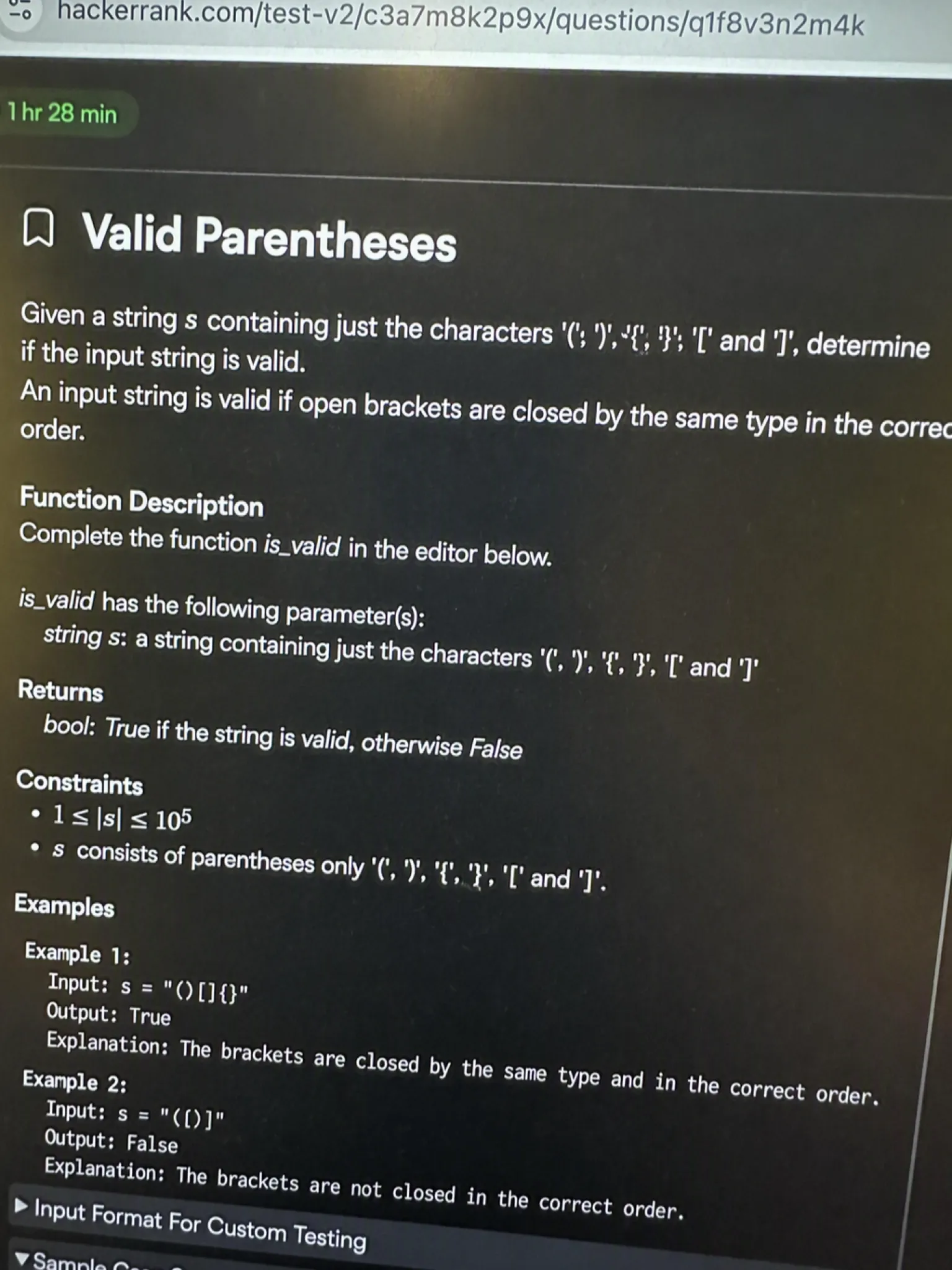
The problem I got: I had to check whether a string made of parentheses, brackets, and braces was valid. Every opening bracket had to close with the matching type, and the closes had to come in the right nesting order. Empty string counted as valid.
My approach: I walked the string with a stack, pushing every opening bracket. On a closing bracket I popped the top and checked it matched, and if the stack was empty or the pair was wrong, I returned false. After the loop, true only if the stack was empty.
def is_valid(s):
    stack = []
    pairs = {')': '(', ']': '[', '}': '{'}
    for c in s:
        if c in '([{':
            stack.append(c)
        else:
            if not stack or stack[-1] != pairs[c]:
                return False
            stack.pop()
    return not stack

if __name__ == "__main__":
    s = input().strip()
    print(str(is_valid(s)).lower())
Time complexity: O(n) | Space complexity: O(n)
This was the warm-up. Clean pass in about fifteen minutes, and it set the pace for the rest of the clock.
Question 2: Minimize the Sum by Halving
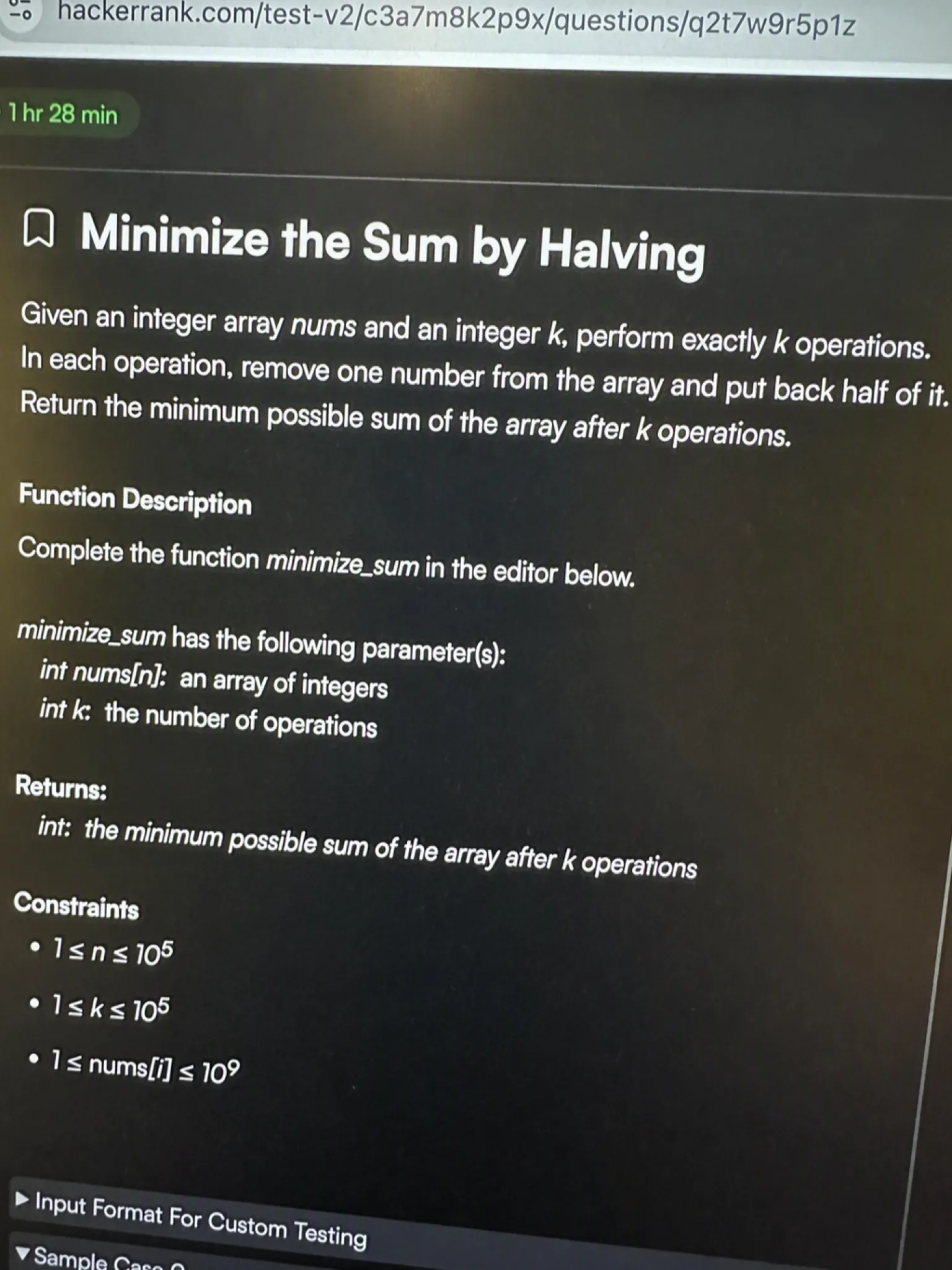
The problem I got: I got an array of integers and a number k. Each step I had to take one number out of the array, put half of it back, and after exactly k steps make the sum of the array as small as possible.
My approach: The greedy insight was that halving a bigger number always shrinks the sum more than halving a smaller one, so every step I took the current largest value, halved it with integer division, and put it back. A max-heap kept the largest value at the top so each step was cheap.
import heapq

def minimize_sum(nums, k):
    heap = [-x for x in nums]
    heapq.heapify(heap)
    for _ in range(k):
        largest = -heapq.heappop(heap)
        heapq.heappush(heap, -(largest // 2))
    return -sum(heap)

if __name__ == "__main__":
    n, k = map(int, input().split())
    nums = list(map(int, input().split()))
    print(minimize_sum(nums, k))
Time complexity: O((n + k) log n) | Space complexity: O(n)
This one ate my clock. I banked Q1 first, then came back here with maybe twenty minutes left and second-guessed whether taking the largest was really optimal when a smaller number was close to the largest. Re-deriving the greedy instead of trusting it burned the time, and the last two test cases did not pass before the timer hit zero.
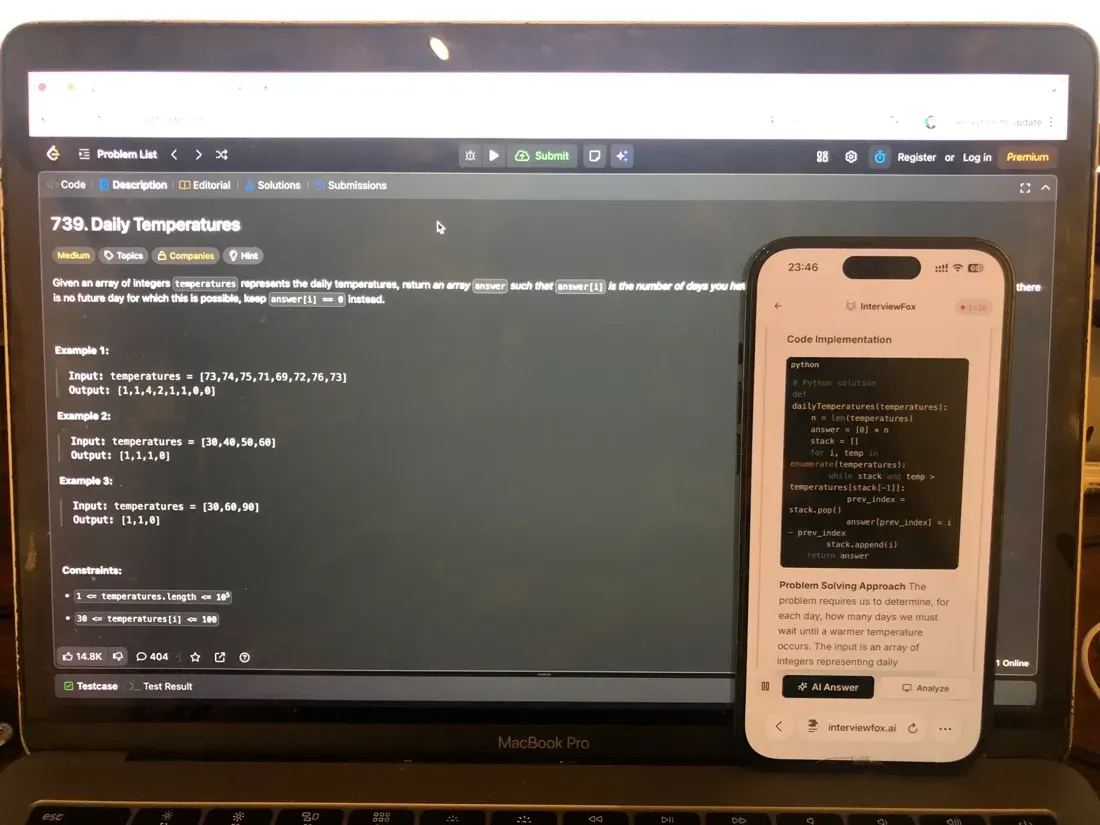
A desktop overlay was not something I wanted near this run, for the reason I break down later. Instead, a keyboard shortcut auto-captured the problem and pushed the answer to my phone, so the laptop screen stayed on the exam editor, unchanged. The greedy case surfaced fast enough that I stopped second-guessing.
Land offer with Safer AI Interview Assistant
Skip the risky invisible apps. Our dual-device mode keeps it simple and undetectable. You crush the interview, we handle the answers.
Get started. It's freeLoved by 100,000+ candidates
Question 3: Decompress the Schedule
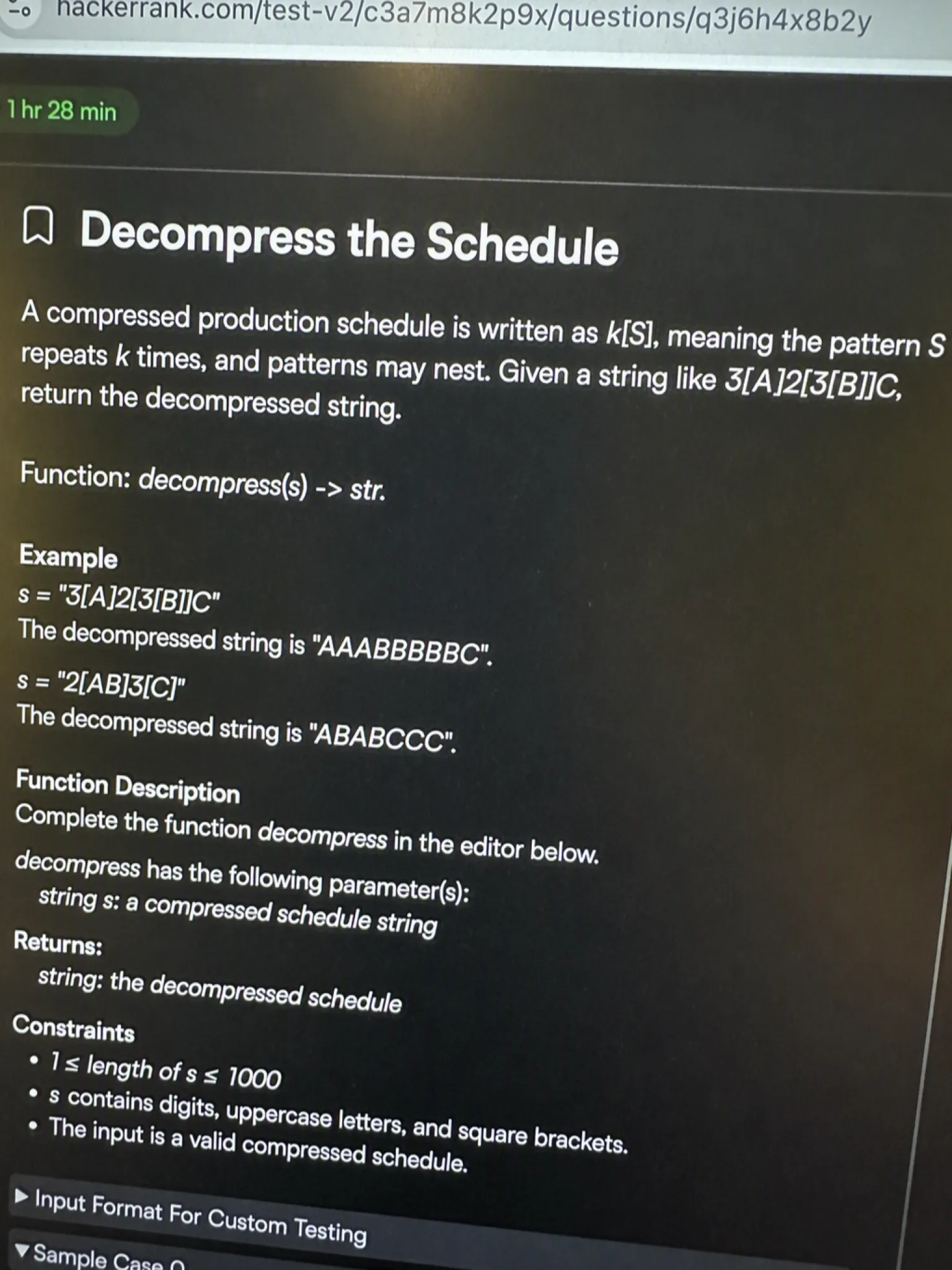
The problem I got: I got a compressed production schedule like 3[A]2[3[B]]C and had to expand it. The rule was that k[S] repeats the pattern S inside the brackets k times, and patterns could nest inside each other. 3[A]2[3[B]]C expanded to AAABBBBBBC, and a bare letter with no repeat stood on its own.
My approach: I ran a stack with one frame per open bracket. Each frame remembered the text built before the bracket and the repeat count. When I hit ] I popped the frame and appended the current text repeated that many times to the frame's prefix. That handled the nesting without recursion.
def decompress(s):
    stack = []
    cur = ""
    num = 0
    for c in s:
        if c.isdigit():
            num = num * 10 + int(c)
        elif c == '[':
            stack.append((cur, num))
            cur, num = "", 0
        elif c == ']':
            prev, n = stack.pop()
            cur = prev + cur * n
        else:
            cur += c
    return cur

if __name__ == "__main__":
    print(decompress(input().strip()))
Time complexity: O(length of output) | Space complexity: O(depth + length of output)
I did this one last, because the nesting looked like the kind of thing that eats time if you overthink the frame bookkeeping. The stack version fell out clean once I kept the prefix and count in one tuple per level.
C3.ai's Proctoring Policy for HackerRank
C3.ai runs its HackerRank tests with the platform's proctoring active. The AI layer, Proctor Mode, only ships on tests created after July 2025.
The Three Proctoring Modes HackerRank Runs
HackerRank runs three layers: Secure Mode, Proctor Mode, and Desktop App Mode.
Secure Mode locks the test to full screen, blocks copy and paste, and prevents multiple monitors. Proctor Mode stacks AI on top, and Desktop App Mode adds OS-level monitoring.
Copy/Paste Tracking is on by default, and Tab Proctoring is off by default.
What trips a paste flag is the question worth answering before exam day. How HackerRank detects copy paste breaks down every trigger.
Secure Mode requires a single monitor, and Proctor Mode onboarding checks for extras. The benefit of understanding how HackerRank detects multiple monitors is knowing what a second display triggers in the system.
Tab Proctoring runs only when a recruiter turns it on, and full-screen exits are logged either way. That covers the basics; how HackerRank handles tab switches goes deeper into the thresholds and who sees the record.
What HackerRank Flags During the Test
In Proctor Mode, the webcam captures a frame every five seconds and the screen is screenshotted every fifteen seconds. Near a suspected violation, the screenshot cadence drops to every five seconds.
What those captures actually contain is the natural next question. What HackerRank records of your screen separates screenshots from video and names who can see them.
Screenshot analysis explicitly targets external AI coding assistants and invisible overlay applications, not just the editor. Object detection also watches for phones and tablets, and conversation detection runs inside the editor.
Code similarity runs through MOSS, and the platform cites 85 to 93 percent detection precision on AI-assisted code. The practical takeaway is how HackerRank detects cheating, which maps each detection layer to what it can prove.
Webcam images also feed gaze detection, though the scope is limited. That only sketches the boundary; how much gaze data HackerRank reads from the webcam is the fuller answer.
An Unapproved Process Ended an Attempt
This detection scope is not theoretical: a September 2025 campus-cycle attempt was invalidated because of it, and I break that down in the failure-patterns section.
4 Other Confirmed C3.ai HackerRank Questions
Beyond my own exam, several confirmed sets round out the question bank. I skipped code for the two problems where the source did not specify enough detail.
Question 4: Group the People
Group the People ran in that same 2020 set. It asks for numbered people split into groups of a declared size.
The greedy answer walks people one at a time and fills groups to their declared size.
def group_the_people(group_sizes):
    buckets = {}
    result = []
    for person, size in enumerate(group_sizes):
        buckets.setdefault(size, []).append(person)
        if len(buckets[size]) == size:
            result.append(buckets.pop(size))
    return result

if __name__ == "__main__":
    group_sizes = list(map(int, input().split()))
    print(group_the_people(group_sizes))
Time complexity: O(n) | Space complexity: O(n)
Question 5: Top K Frequent Words
Top K Frequent Words rounded out that 2020 set.
Count every word, then rank by frequency and break ties alphabetically.
from collections import Counter

def top_k_frequent(words, k):
    counts = Counter(words)
    return sorted(counts, key=lambda w: (-counts[w], w))[:k]

if __name__ == "__main__":
    k = int(input())
    words = input().split()
    print(top_k_frequent(words, k))
Time complexity: O(n log n) | Space complexity: O(n)
Question 6: DFS Grid Traversal
An October 2025 C3.ai SWE Intern assessment, two problems in 75 minutes, led with a DFS grid solution.
The problem read straightforward until a confusing factor near the end. The IDE also showed C++ code even though Python was the selected language. Since the exact grid layout is not public, I did not reconstruct a full solution here.
Question 7: Board Path Moves
Around 2024, a C3.ai HackerRank question asked for a path across a board. The start and end positions were given, and only certain moves were allowed.
The exact move set is not public, so I did not write a solution for this one. A BFS over the board fits the shape, the same template used for grid shortest paths.
What C3.ai's HackerRank Test Format Actually Looks Like
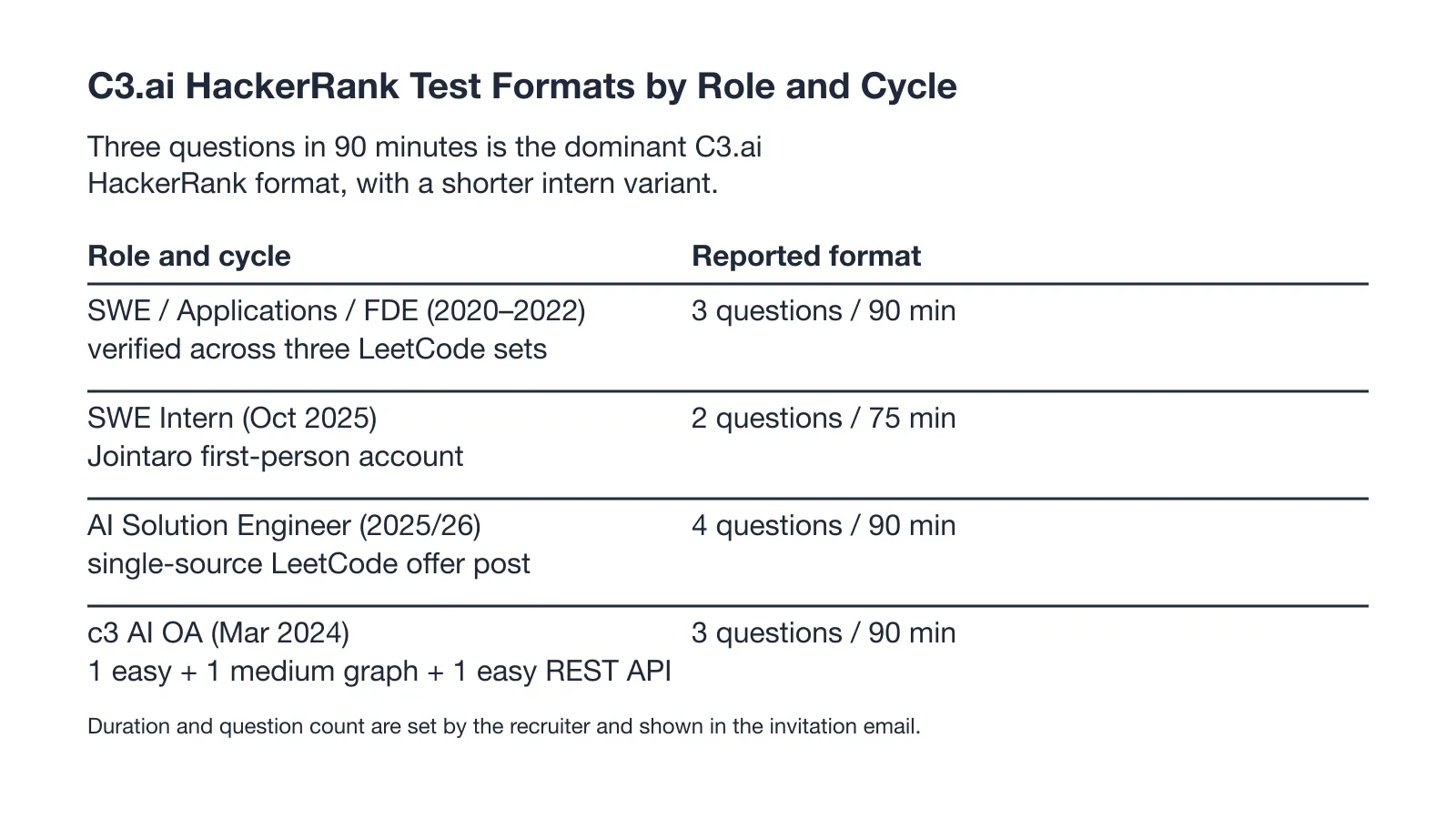
The format varies by role and cycle, but the confirmed attempts line up into a clear pattern. The breakdown across roles and years is in the chart below.
Three Questions in 90 Minutes Is the Dominant Format
Three questions in ninety minutes is the dominant format for SWE, Applications, and Forward Deployed Engineer roles. It held across every confirmed set from 2020 to 2022.
The intern and solution-engineer variants in the chart above are real. They do not change the core shape: timed coding against a fixed clock.
The Test Window, Link Expiry, and Rescheduling Rules
The recruiter sets the duration and schedule, and both show up in the invitation email and the test login page. The count is per-test, not a fixed global rule.
An expired link returns "Test is No Longer Available," and reopening it needs recruiter communication. One 2022 candidate waited about a week and a half to start and still passed. So the window has some give.
How C3.ai's HackerRank Scoring Works
Scoring decides the outcome, and the mechanics are not what most candidates expect. The outcome pattern across confirmed attempts is in the chart below.
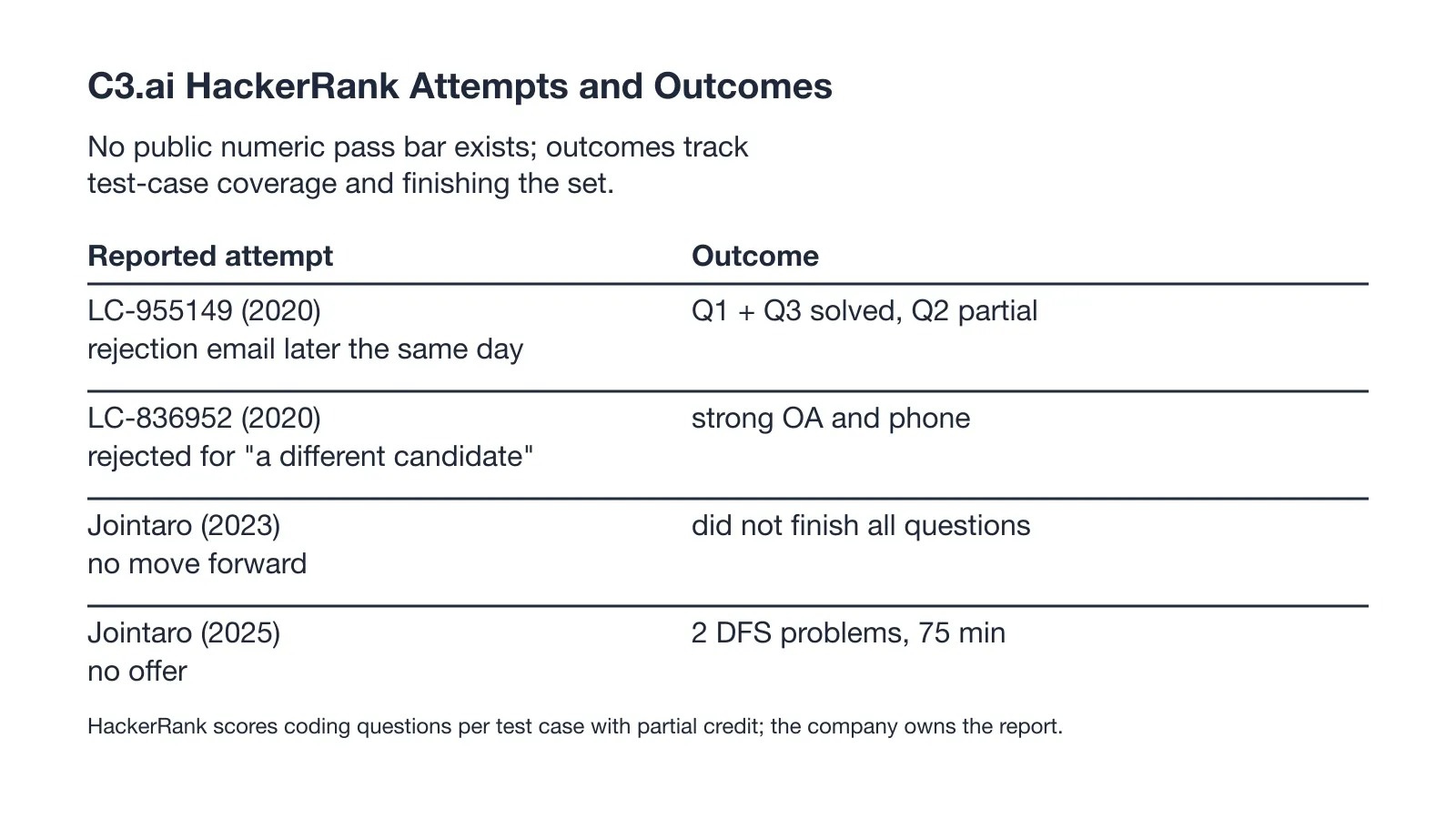
Partial Credit Is Per Test Case, Not Per Question
HackerRank grades each coding question test case by test case, and the total is the sum of the passed cases. Partial credit is real, so every solved case moves the number.
The company owns the report and shares it at its discretion, so the number may never reach you. HackerRank's documented evaluation methods confirm the per-test-case rule.
No Public Score Threshold Exists for C3.ai
C3.ai does not publish a numeric pass bar, so coverage was my only real target. The honest claim is partial credit per test case on a timed set.
What does exist is a plagiarism scale. MOSS flags run High at or above 90 percent match, Medium from 80 to 90, and Low below 80.
C3.ai HackerRank Exam-Day Strategy
Solving Q1 and Q3 First Cost Me Q2
I solved the parentheses warm-up and the schedule decode first and left the halving problem for last. The order banked the surest points but gave the greedy question the least clock.
A 2020 attempt that ran the same order missed Question 2 and drew a rejection email the same day. Against partial credit, ordering changes the total, because every passed test case scores.
Recovering a Hard Problem in the Last Ten Minutes
The nested schedule decode is the classic last-ten-minutes problem in the confirmed pool: candidates report leaving it to the end because the nesting looks heavier than it is. The stack version falls out clean once the frame bookkeeping is right.
I did not pull that off on my run; my greedy second-guess stayed stuck at zero. The habit I kept was to trust the exchange argument early and leave the cleanup for the end.
The IDE Showed C++ Even Though the Test Was Set to Python
Check the language first. The IDE showed C++ code even though the test was set to Python. The mismatch ate time on the 75-minute, two-problem intern clock. Confirming the language selector on the first screen, before the timer matters, prevents the same stall.
Why Candidates Fail the C3.ai HackerRank Assessment
A Leftover Copilot Window Invalidated an Attempt
A desktop copilot left active is the single clearest failure pattern in the pool. The most concrete example I have is a private one, shared with me directly rather than posted publicly. The person involved described it this way. They entered a September 2025 campus-cycle assessment with a desktop copilot window set to low opacity active.
About 12 minutes into Question 1, the editor froze and a proctoring message named an unapproved desktop process. The dashboard labeled the attempt invalid, and no fresh invitation was issued.
I treat that as the rule for every test after it: nothing open except the browser, one monitor, full screen. The platform's screenshot analysis names external copilots and invisible overlays as explicit targets, so the flag was structural, not random.
At least one candidate was flagged for using a desktop overlay tool. The tool renders the AI's answer on the same computer screen the proctoring software is monitoring, hidden by a basic OS-layer trick.
InterviewFox works differently: it is a dual device AI interview assistant that puts the answer on my phone, a physically separate device that no screenshot, screen recording, or session monitoring can reach by design.
Land offer with Safer AI Interview Assistant
Skip the risky invisible apps. Our dual-device mode keeps it simple and undetectable. You crush the interview, we handle the answers.
Get started. It's freeLoved by 100,000+ candidates
A Strong OA Still Ended in Rejection
Strong results do not guarantee a move forward. One attempt passed both the OA and the phone screen. It still ended with C3.ai moving forward with a different candidate.
Running Out of Time on the Last Question
Running out of time is the most common named cause in the pool. A 2020 attempt that failed Question 2's test cases drew a same-day rejection. A 2023 attempt that did not finish all questions stopped the process.
Tabs and paste are logged. Full-screen exits and copy-paste events are recorded, and the screenshot cadence tightens around a violation. The clock pressure shows up in the report as well.
How to Prepare for the C3.ai HackerRank in 7 Days
My plan ran seven days and was built entirely around the confirmed questions, the dominant format, and the proctoring rules. It is a plan for this specific test, not a generic grind.
Before the clock started, I sent the confirmed question patterns for this test to the Prep Agent from InterviewFox over WhatsApp and got back a personalized drill plan with a pacing strategy. The seven days below are that plan, expanded with the timings I kept.
Days 1-2: Valid Parentheses and the Halving Greedy in Under 15 Minutes
I opened with the two problems that show up in the confirmed sets. They were the bracket-matching stack and the halving greedy. Day 1 was timed reps on the bracket match, nested, unmatched, and empty cases included.
My success check was a clean pass in under fifteen minutes from cold. Day 2 covered the halving greedy with a max-heap, including k equal to zero and all-equal arrays, with the same fifteen-minute bar.
I skipped SQL and data-manipulation prep. No verified C3.ai SWE or Applications set contains a SQL question.
I also skipped system design. The verified OA sets are pure algorithmic coding. System design only shows up later in the onsite, outside the OA.
Days 3-5: The Schedule Decode and the DFS/Graph Shift
Day 3 was the nested schedule decode, the problem that eats the clock if the frame bookkeeping goes wrong. I derived the stack version from scratch, then coded it under a timer with no hints.
My bar was the decode from an empty file in under twenty-five minutes, and I stayed until the nesting and the multi-digit repeat counts were automatic.
Days 4 and 5 split between the overflow family and the graph shift. I ran timed reps on Group the People and Top K Frequent Words, each under fifteen minutes.
The 2024 and 2025 attempts both point at graph and grid work. I drilled BFS and DFS grid traversal, plus connected components. A grid path and a graph component each had to land in under twenty minutes.
Days 6-7: A Proctoring-Clean 3-Question Timed Run
Day 6 was the environment, built from the invalidation I described above. My pre-test checklist was single monitor, full screen, webcam ready, and every overlay, copilot, chat, and remote-desktop process closed.
Day 7 was the full three-question, ninety-minute simulation in the real HackerRank IDE. A valid submission with all three questions attempted, from a clean run, was the success check.
The plan is not portable. The confirmed set, the ninety-minute pacing, and the proctoring rules are C3.ai and HackerRank specific. It would not transfer to another company's OA unchanged.
What Happens After You Submit the OA
The path after the OA splits into a short rejection and a long offer loop. The full sequence, stage by stage, is in the chart below.
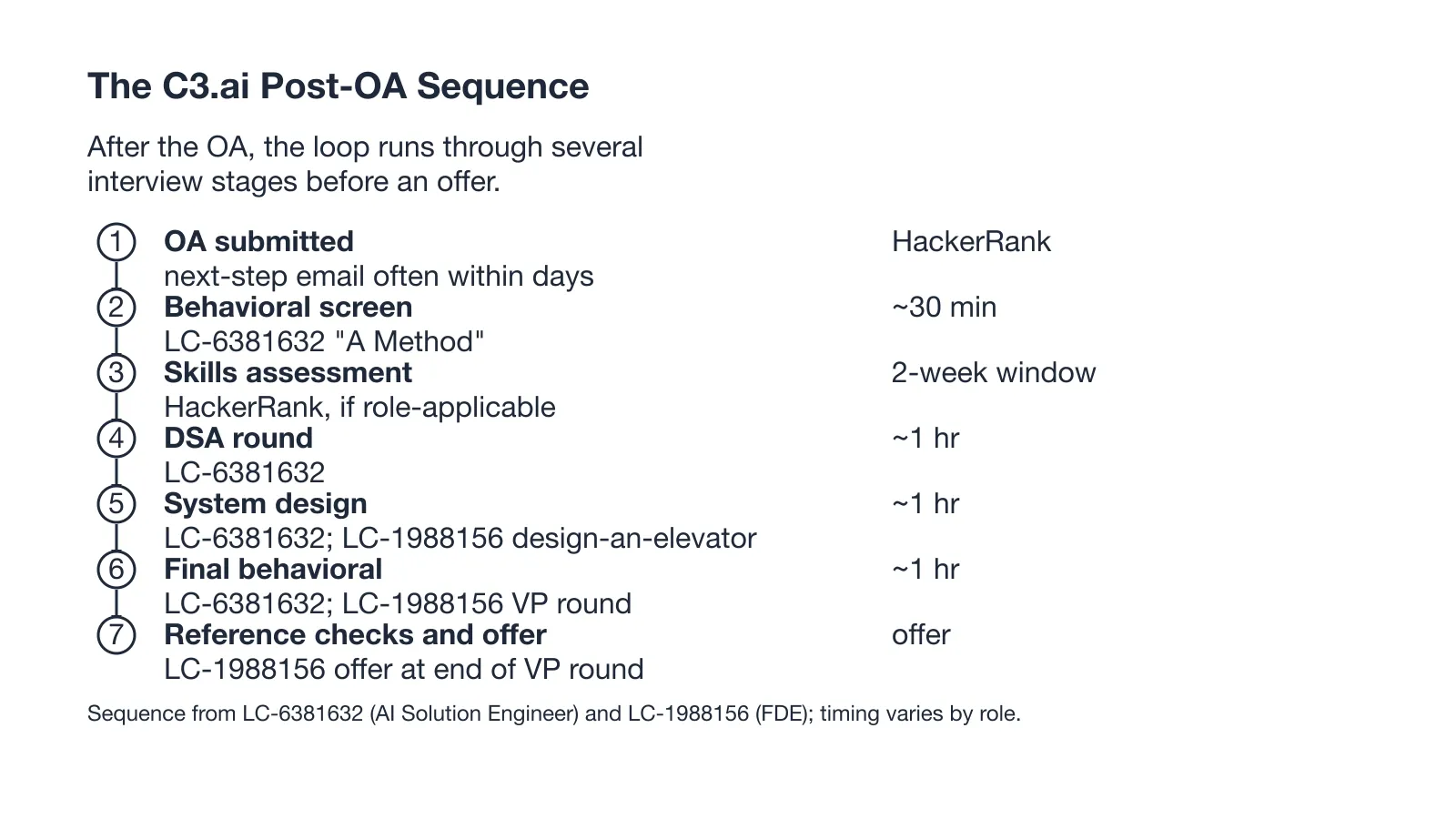
Same-Day Rejection vs the Three-Week Offer Path
The wait can end either way. A 2020 attempt that missed Question 2 drew a rejection email the same day. A 2022 FDE attempt moved to a next-day GPA and location check.
The 2022 path ran a one-hour tech screen and an onsite with system design. The offer landed at the end of the VP round.
A 2025 and 2026 AI Solution Engineer path ran longer. It added a behavioral screen, a two-week skills assessment, a DSA round, system design, and a final behavioral. Reference checks came before the offer.
Retakes and Link Expiry Are the Company's Call
Retakes sit with the company, and HackerRank cannot reset a test on its own. The link-expiry rule from the format section above is exactly what the invalidated attempt I described ran into.
Intern roles sit in Platform or Forward Deployed teams.
C3.ai Reuses One Rotating OA Question Bank
The Same Problems Reappear Across Roles
The strongest signal in the research is reuse. The bracket-matching stack question, the array-halving greedy, and the nested schedule decode each trace to a different confirmed cycle, and older sets repeated a frequency sort, a vowel-counting DP, and a photo-album insert across 2020 to 2022. Those sets carried Applications, Forward Deployed, and FDE role titles.
The older trio repeats in the Glassdoor question titles across that window. I treated this as an observed pattern, not official policy.
The 2025 Intern Cycle Broke the Pattern
The 2025 intern cycle diverged: two problems in 75 minutes, DFS-based, with no stack or greedy question in sight. So the rotating bank is real but not universal.
I prepped for both. The confirmed stack, greedy, and decode questions cover the dominant format, and the DFS and graph templates cover the recent cycle.
FAQ
How hard is the C3.ai HackerRank assessment?
Most of the set sits at easy to medium, with one greedy or stack problem that can eat the clock if you overthink it. The bracket match is the easy win. The halving greedy is the one that cost me the most time.
How many questions are on the C3.ai HackerRank test?
Three coding questions in ninety minutes is the dominant format for SWE, Applications, and Forward Deployed Engineer roles. The 2025 intern variant used two problems in 75 minutes, and the AI Solution Engineer variant used four in 90.
Does the C3.ai HackerRank test use proctoring?
Yes. Tests run under HackerRank proctoring with full screen, webcam, single monitor, and screenshots. Proctor Mode is AI-based and available for tests created after July 2025.
Can I use an AI tool or invisible app during the C3.ai HackerRank OA?
A desktop copilot left active ended the attempt I described above. Screenshot analysis explicitly targets external AI coding assistants and invisible overlays, so the answer is to keep the machine clean.
Desktop overlay tools put the AI's answer on your computer screen, rendered as a hidden layer above the browser using a basic OS-layer trick, and proctoring software keeps adding detection capabilities as AI tools become more common, so the risk exposure is not fixed.
InterviewFox pushes the answer to your phone, a physically separate device that no screenshot, screen recording, or session monitoring can reach by design, so the laptop screen stays on the exam editor, unchanged.
If you are going to use AI assistance during the OA, the dual-device architecture removes the answer from your screen entirely.
Land offer with Safer AI Interview Assistant
Skip the risky invisible apps. Our dual-device mode keeps it simple and undetectable. You crush the interview, we handle the answers.
Get started. It's freeLoved by 100,000+ candidates
What happens after the C3.ai HackerRank assessment?
Outcomes split between a same-day rejection after a partial submission and a multi-stage loop through a tech screen and onsite. Retakes and rescheduling sit with the company, not the platform.
Does C3.ai reuse the same HackerRank questions?
The bank is reused but rotated: the same three-question set ran 2020-2022, and the 2025 intern cycle switched to a DFS set.