
I Took the Citadel HackerRank OA in 2026: Real Questions and Prep Plan

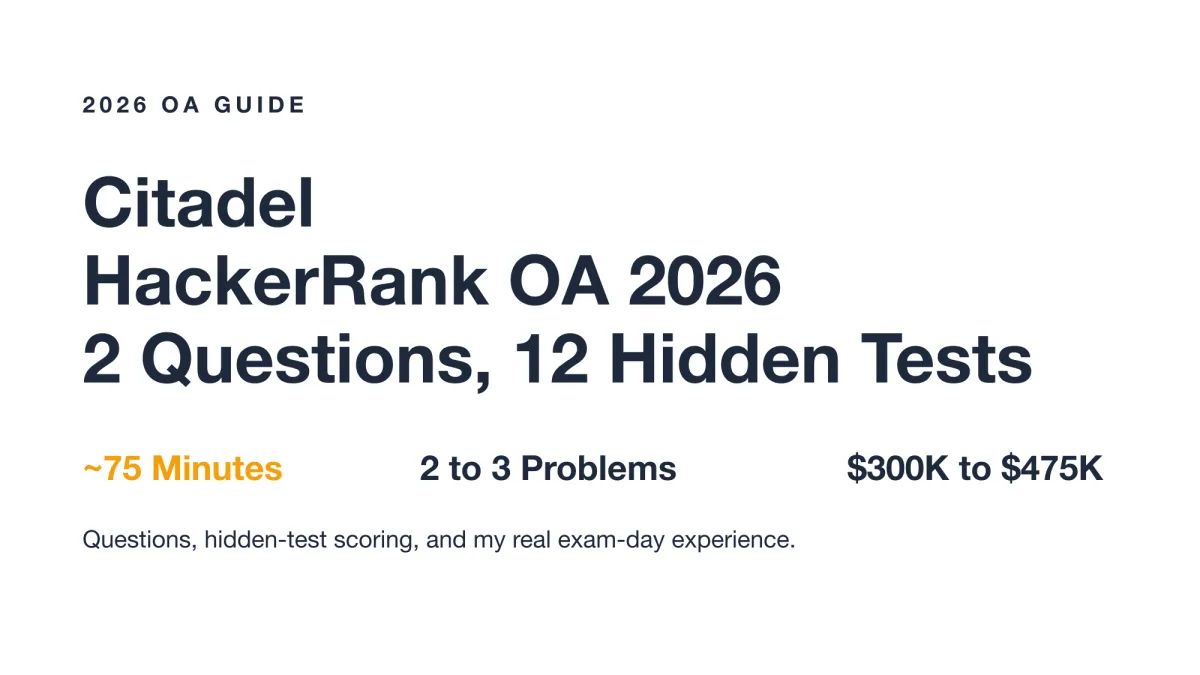
Quick Facts
| Platform | HackerRank (SWE new-grad track) |
| Questions | 2 to 3 coding problems (this sitting: 2) |
| Time limit | 60 to 90 minutes, most reports ~75 |
| Hidden tests | About 12 per problem; efficiency gates passage |
| Proctoring | HackerRank Proctor Mode optional per team; webcam and screen capture possible |
| Scoring | Auto-graded by test cases; near-perfect needed to advance |
| Invite window | About 7 days from the email |
| New grad SWE comp | $300,000 to $475,000 total (US, 2026) |
The Citadel Securities HackerRank OA is the online coding test used to screen software engineering applicants. It is separate from the Citadel Securities Datathon used for data and quant tracks. The standard version runs two or three coding problems in sixty to ninety minutes. HackerRank auto-grades the test by cases passed.
I took the Citadel HackerRank OA for a software engineering new-grad role in 2026. I solved both coding problems. The second needed a full rewrite after my first solution timed out on the hidden tests. A dual device AI interview assistant on my phone would have steered me faster.
The second problem — counting valid process schedules — didn't click on the first read. For a few minutes I thought I might not get through it. How it resolved comes later, in the question walkthrough. My research across Reddit, LeetCode Discuss, and Teamblind matched what I experienced, especially the mistakes that get people flagged or rejected.
Citadel HackerRank OA Questions I Got
Before my Citadel HackerRank OA, I reviewed posts from the past two years. I checked Reddit, LeetCode Discuss, and Teamblind. What I found tracks closely with what I experienced on the two questions below.
I sat the Citadel HackerRank online assessment for a software engineering new-grad role in 2026. I was applying to several trading and tech firms and had completed a little over a hundred LeetCode problems.
Below is exactly what the two questions looked like from my side of the screen, in the order they appeared.
Question 1: Request Throttling (Sliding Window)
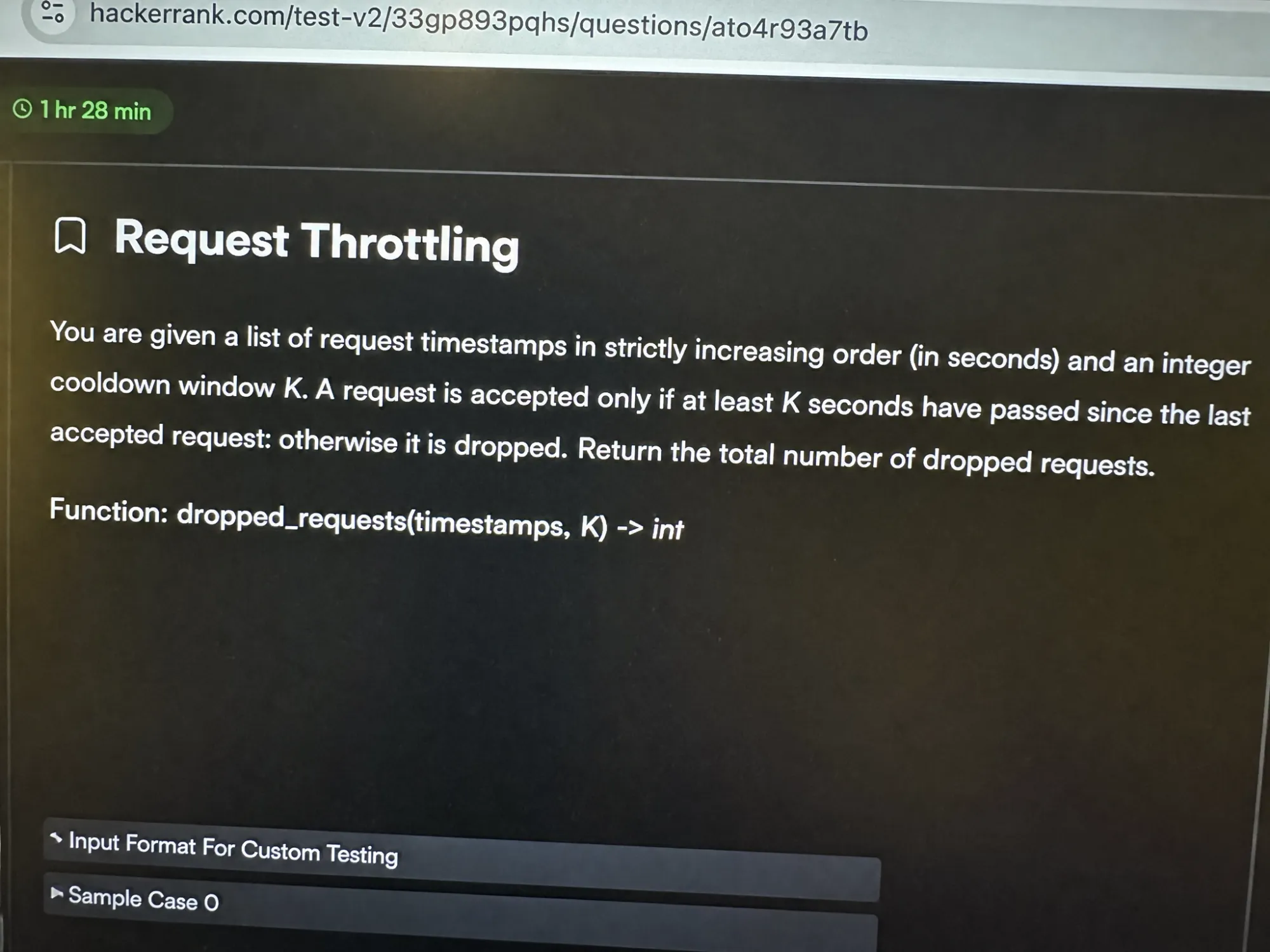
The problem I got: The first task described a rate limiter. I was given a list of request timestamps in strictly increasing order (in seconds) and a cooldown window K. A request is accepted only if at least K seconds have passed since the last accepted request; otherwise it gets dropped. I had to return the total number of dropped requests.
My approach: This is a greedy single pass. I track the timestamp of the last accepted request and walk the list once.
If the gap to the current request is smaller than K, I drop it and leave the last-accepted marker alone; otherwise I accept it and move the marker forward. No window buffer is needed because only the most recent accepted time matters, so the whole scan stays linear. I wrote it in Python since it reads cleanly under time pressure.
def dropped_requests(timestamps, K):
    dropped = 0
    last_accepted = -10**18
    for t in timestamps:
        if t - last_accepted < K:
            dropped += 1
        else:
            last_accepted = t
    return dropped
Time complexity: O(n) | Space complexity: O(1)
This one felt like a warm up, which I expected from the format. The samples were small and the logic was obvious, so I finished it in a few minutes and moved on with some confidence.
Question 2: Process Scheduling (Combinatorics)
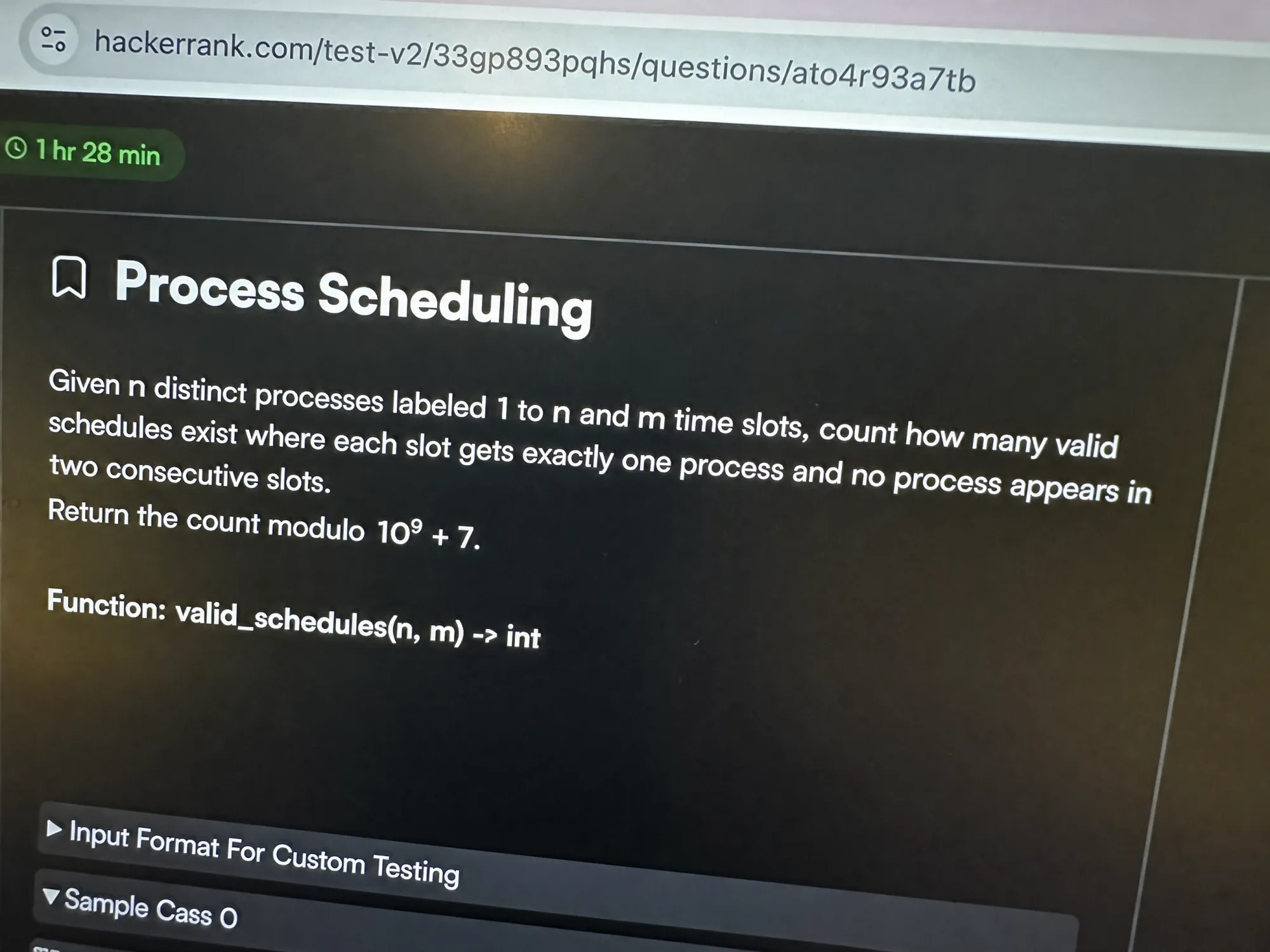
The problem I got: The second task gave me n distinct processes (labeled 1 to n) and m time slots. I had to count how many valid schedules exist where each slot gets exactly one process and no process appears in two consecutive slots.
The answer could be large, so I had to return it modulo 10^9 + 7. The constraints were n up to 20 and m up to 50.
My approach: My first instinct was to enumerate. I would build every length-m sequence over the n processes, reject repeats, and count the rest. That was simple and it cleared the tiny samples.
On the largest hidden test it failed with a timeout. Enumerating n^m sequences is hopeless once m hits 50. The clock was already deep in the red. I had burned minutes watching the solution time out without knowing why a "working" approach kept getting rejected.
Desktop overlay tools put the AI's answer on the same screen the proctoring system is monitoring, hidden by a basic OS rendering trick. That is exactly the surface HackerRank's prohibited-tool detection is built to catch — a candidate I came across was caught using one, and the proctor ended the session on the spot.
InterviewFox works differently: the answer goes to my phone, a physically separate device that no screenshot or session recording can reach by design.
I didn't want to use a desktop overlay during the test. The answer would have sat on the same screen the proctoring system was monitoring, hidden by a basic rendering layer, and now I knew a session could end the moment one was detected. I didn't want that ending.
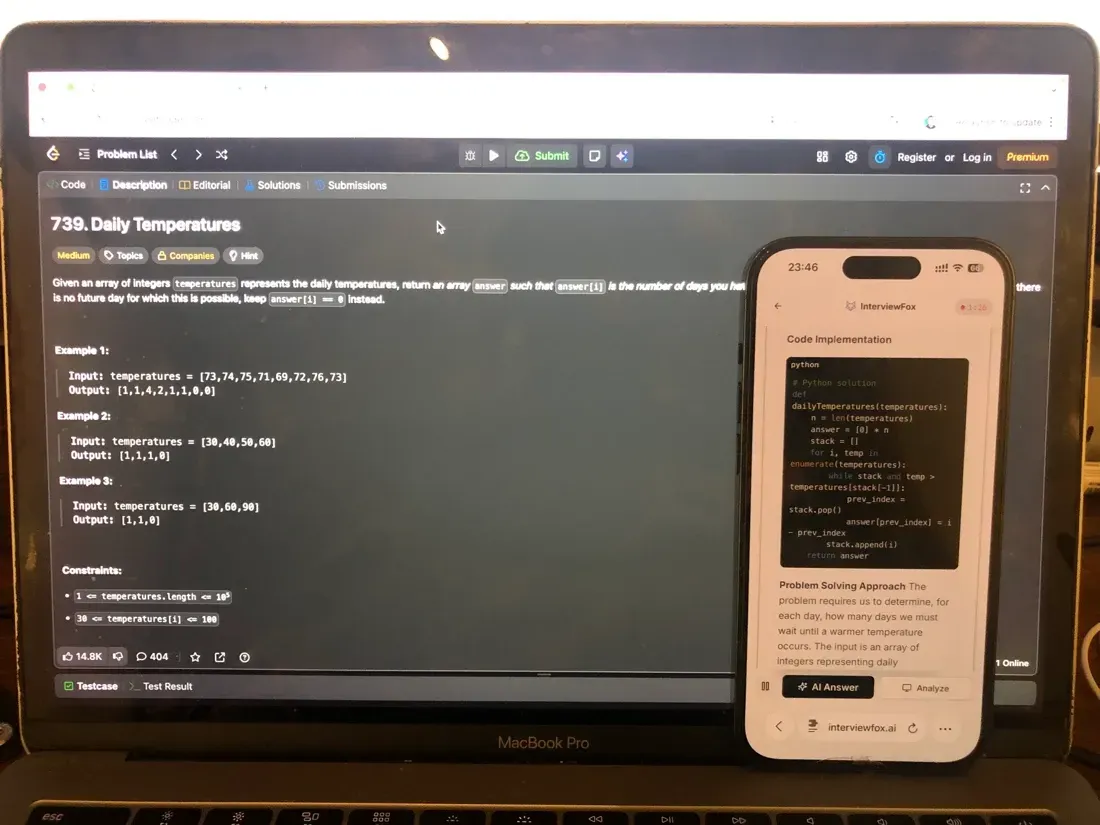
So I hit the keyboard shortcut, the screen auto-captured, and the answer pushed to my phone through the dual-device Coding Assistant from InterviewFox, an AI interview tool. The approach cleared up, the laptop screen stayed on the exam editor, and I rewrote the solution on the clock instead of guessing.
Land offer with Safer AI Interview Assistant
Skip the risky invisible apps. Our dual-device mode keeps it simple and undetectable. You crush the interview, we handle the answers.
Get started. It's freeLoved by 100,000+ candidates
The Formula That Passed
I had to stop and think about the structure instead of the brute force. The first slot has n choices. Every later slot has exactly (n - 1) choices because it only must differ from the one before it. That collapses to n multiplied by (n - 1) raised to (m - 1). I compute it with fast modular exponentiation.
MOD = 10**9 + 7

def valid_schedules(n, m):
    if m == 0:
        return 0
    return (n * pow(n - 1, m - 1, MOD)) % MOD
Time complexity: O(log m) | Space complexity: O(1)
That question was the low point of the whole test, the moment I nearly walked away with nothing on the harder problem. I got it in, but only after the panic of a dead end and a full rewrite under pressure.
Citadel's Proctoring Policy for HackerRank
What HackerRank Monitors
The HackerRank platform supports several test-integrity controls, and the top tier is Proctor Mode. It tracks tab and window focus, logs copy and paste activity, and detects a second monitor.
Its machine learning layer also compares submissions for code similarity and flags pasted or generated code. These controls are part of the platform toolkit, not something Citadel adds on its own.
Webcam and Screen Recording
When Proctor Mode is on, the system requests webcam access and captures periodic snapshots during the test. It captures more around flagged events. It can also record the screen at a regular interval to build a session replay.
A lighter mode called Secure Mode exists for tests that do not need full video. Not every Citadel sitting looks the same.
For the camera rules, see HackerRank webcam monitoring. For screen capture, see HackerRank screen recording.
When Proctoring Can Reject You
A session can be flagged for a blocked webcam, a detected second monitor, lost test-window focus, or a prohibited tool. These checks can end the round regardless of how the code runs.
Citadel SWE sittings use different monitoring levels. Some run without webcam capture; others use full Proctor Mode. Check the invite settings for the rules attached to your test.
Citadel Securities Online Assessment (OA) Format
Citadel OA Questions and Time Limit
The Citadel HackerRank test for software engineering new grads most often arrives as two coding problems in roughly seventy five minutes. Some reports describe three problems in up to ninety minutes.
The invite email gives about a seven day window to start. The clock begins when you open the link, not when it lands in your inbox.
Pick Your Language
Candidates pick their own language and keep it per problem. Python, Java, C++, and JavaScript are all supported, and most people default to Python for clean syntax under time pressure. The choice does not change the grading, only the speed at which you can write correct code.
Hidden Tests Punish Slow Code
The platform grades against visible tests and a much larger hidden set. It often runs around twelve hidden tests per problem. A brute force that passes the samples can still fail once the input grows. Optimal time complexity is graded, not optional, so a slow but correct solution is treated as wrong.
How Citadel's HackerRank Scoring Works
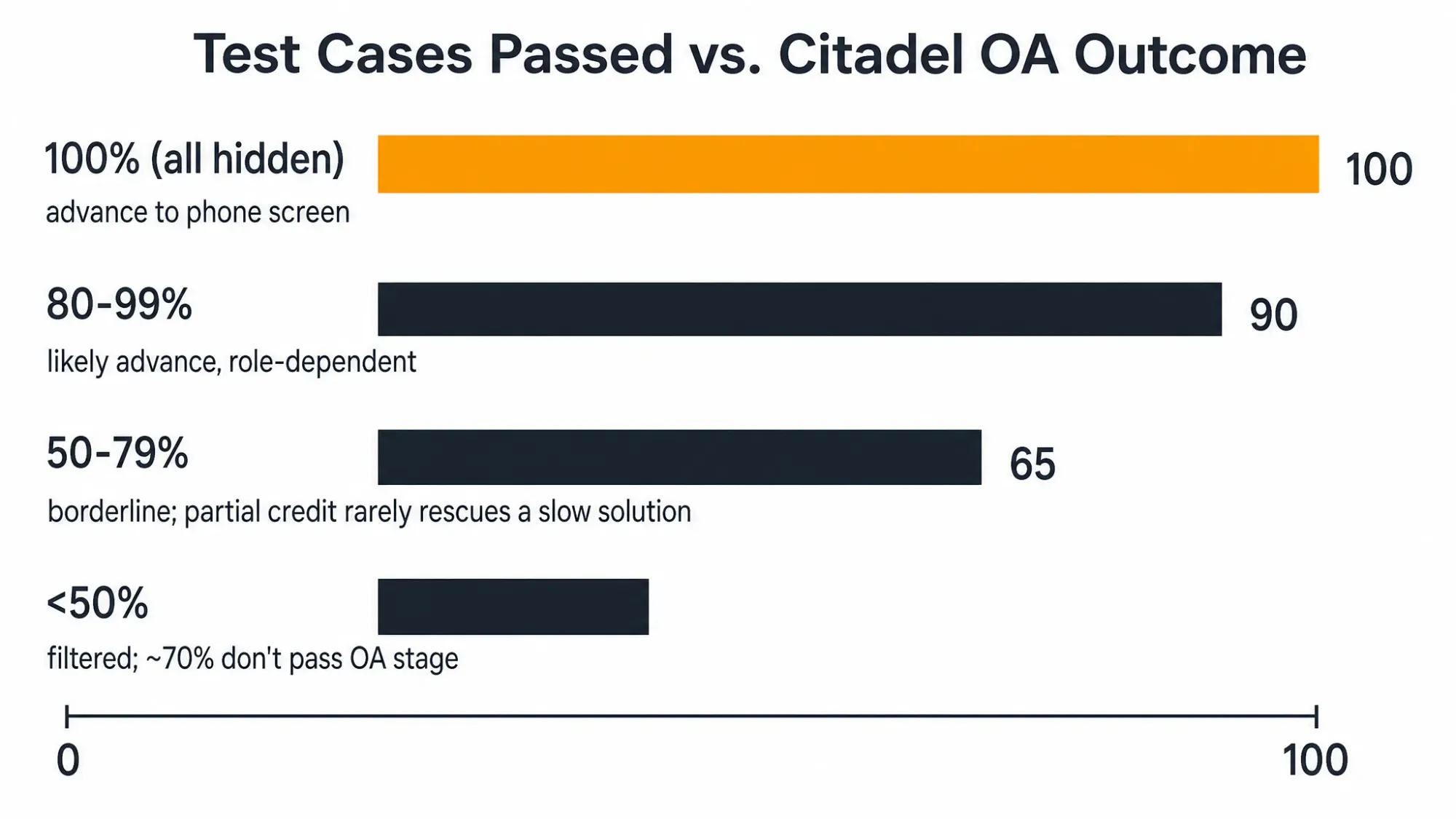
The chart below shows how far a result travels. It uses the share of visible and hidden test cases passed.
HackerRank Auto-Grades by Test Cases
HackerRank scores each problem by the test cases it passes. The platform reports the final result automatically. A partial pass on a hard problem still earns credit. Points are awarded per case, not as an all-or-nothing mark.
Efficiency Gates the Hidden Tests
A Glassdoor candidate reported an October 2025 OA with two questions, three easy tests, and twelve hidden tests. The account also noted that inefficient algorithms fail the hidden set. The pattern is consistent: hidden tests expose slow code. Advancing or filtering can come down to one complexity class.
The Automatic Shortlist
Citadel's shortlist is score-driven and automatic. A near-perfect result gives you the strongest chance to advance because efficiency matters alongside correctness. One candidate described an easy-to-medium OA that still ended in rejection about a week later.
Citadel HackerRank Exam-Day Strategy
Start With the Easier Problem
My sitting taught me to open with the problem I could finish fastest. The questions rise in difficulty. A clean win on question one builds a buffer and steadies the nerves before the harder one. I treated the first problem as a speed round, and it paid off when question two arrived.
Time-Box Each Question
Spending more than an hour on a single problem throws the whole attempt off balance. Use forty to sixty minutes per problem. Set a hard stop if the path is not clear. I keep a visible clock and force a decision once the buffer runs low.
Don't Over-Optimize at the Cost of Finishing
The clearest mistake candidates report is polishing question one past the point of diminishing returns and then rushing question two. A real account described this pattern. The candidate optimized the first solution too long, then rushed the second problem. I now ship a correct first pass and only optimize if time remains.
Why Candidates Fail the Citadel HackerRank Assessment
A Slow Solution Fails the Hidden Tests
The most named failure on this exam is an inefficient algorithm. The October 2025 Glassdoor account spells it out: twelve hidden tests. A slow solution fails them even when the logic is right.
Another candidate's combinatorics problem was flagged as too slow at O(n squared). I hit the same wall on my second question until I changed the approach.
Running Out of Time
Time mismanagement is the second pattern. Candidates who over-invest in one problem run out of room. The harder question is where the clock usually wins. A per-problem budget can turn a partial attempt into a finished one.
A Desktop Overlay Ended Another Candidate's Session
The most concrete case I found for Citadel's HackerRank did not come from my own sitting. A candidate was caught using a Desktop Overlay during the assessment, and the proctor ended the session immediately. No score was recorded and the round closed on the spot.
What matters is that the platform is built to catch exactly this. HackerRank's prohibited-tool detection watches for AI assistants, invisible overlays, and remote desktop tools. Its code-similarity layer also flags generated solutions. A Desktop Overlay is the highest-risk move here because the system explicitly watches for it.
InterviewFox works the other way. The answer goes to my phone, a separate device that no screenshot or session recording can reach by design.
Land offer with Safer AI Interview Assistant
Skip the risky invisible apps. Our dual-device mode keeps it simple and undetectable. You crush the interview, we handle the answers.
Get started. It's freeLoved by 100,000+ candidates
How to Prepare for the Citadel HackerRank in 7 Days
Drill the Citadel Question Patterns
A focused seven day plan targets the patterns this exam actually uses. The confirmed set leans on several patterns. These include sliding window, two pointers, combinatorics, dynamic programming with modular arithmetic, graph traversal, binary search, and hash map design. Practicing those shapes beats broad random grinding because the topics repeat across sittings.
Run a 75-Minute Timed Mock
The best preparation mirrors the real clock. A seventy five minute mock with two problems trains the question one speed burst. It leaves an honest block for question two. Treat the second problem as the one that needs a rewrite, not a first try. Check complexity before submitting.
Rehearse the Proctoring Setup
Proctoring rehearsal prevents avoidable flags. Use a quiet room and a working webcam if Proctor Mode is on. Keep one monitor active and close background apps. Running one dry session removes the environment surprises that end otherwise strong attempts.
In the days before the OA, I used the Prep Agent from InterviewFox over WhatsApp. I sent it the confirmed Citadel question patterns. It returned a personalized drill plan and a strategy for the timed mock. It was one practical tool among the rest of my prep workflow, not a pitch.
What Happens After You Submit the OA
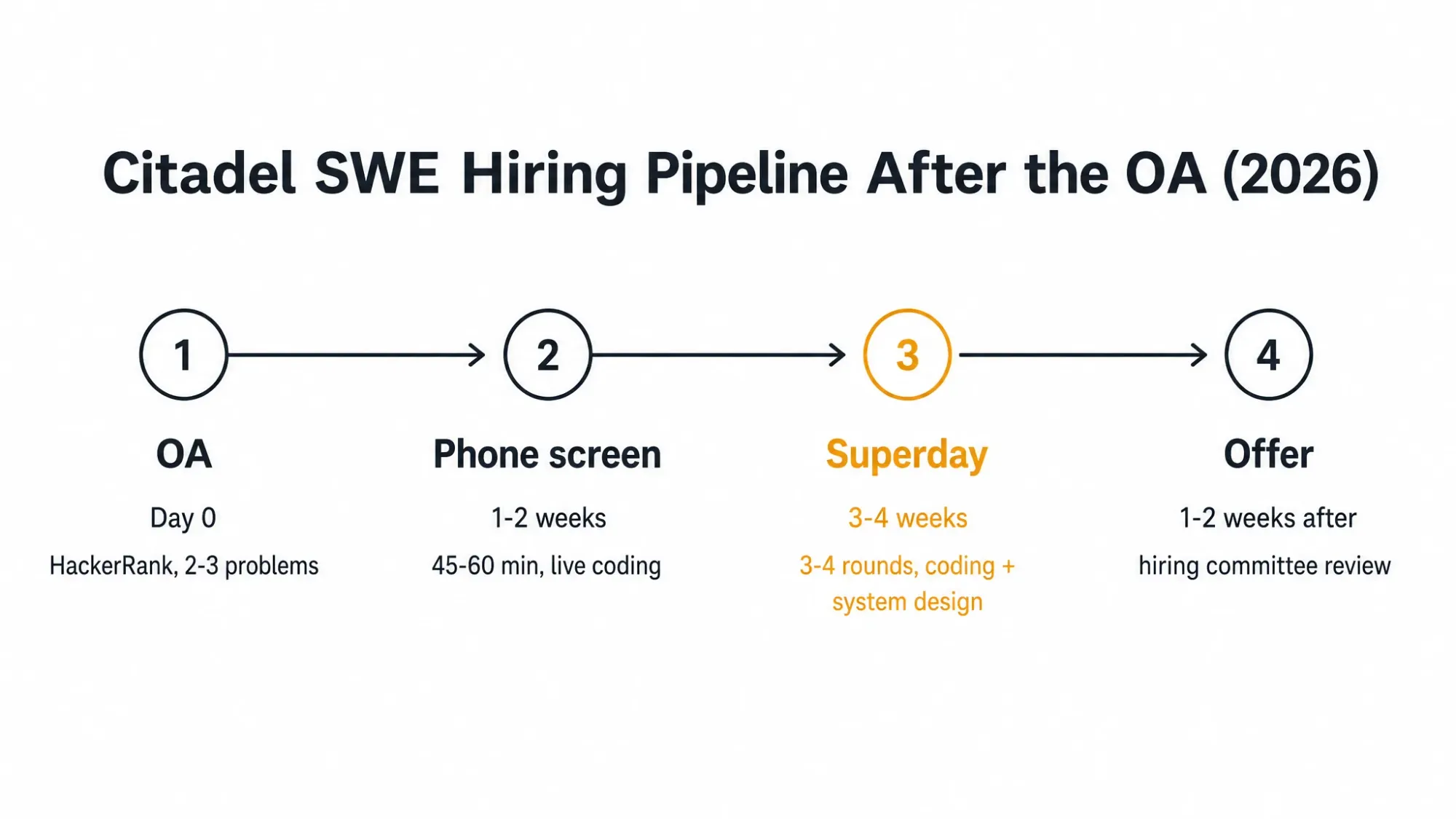
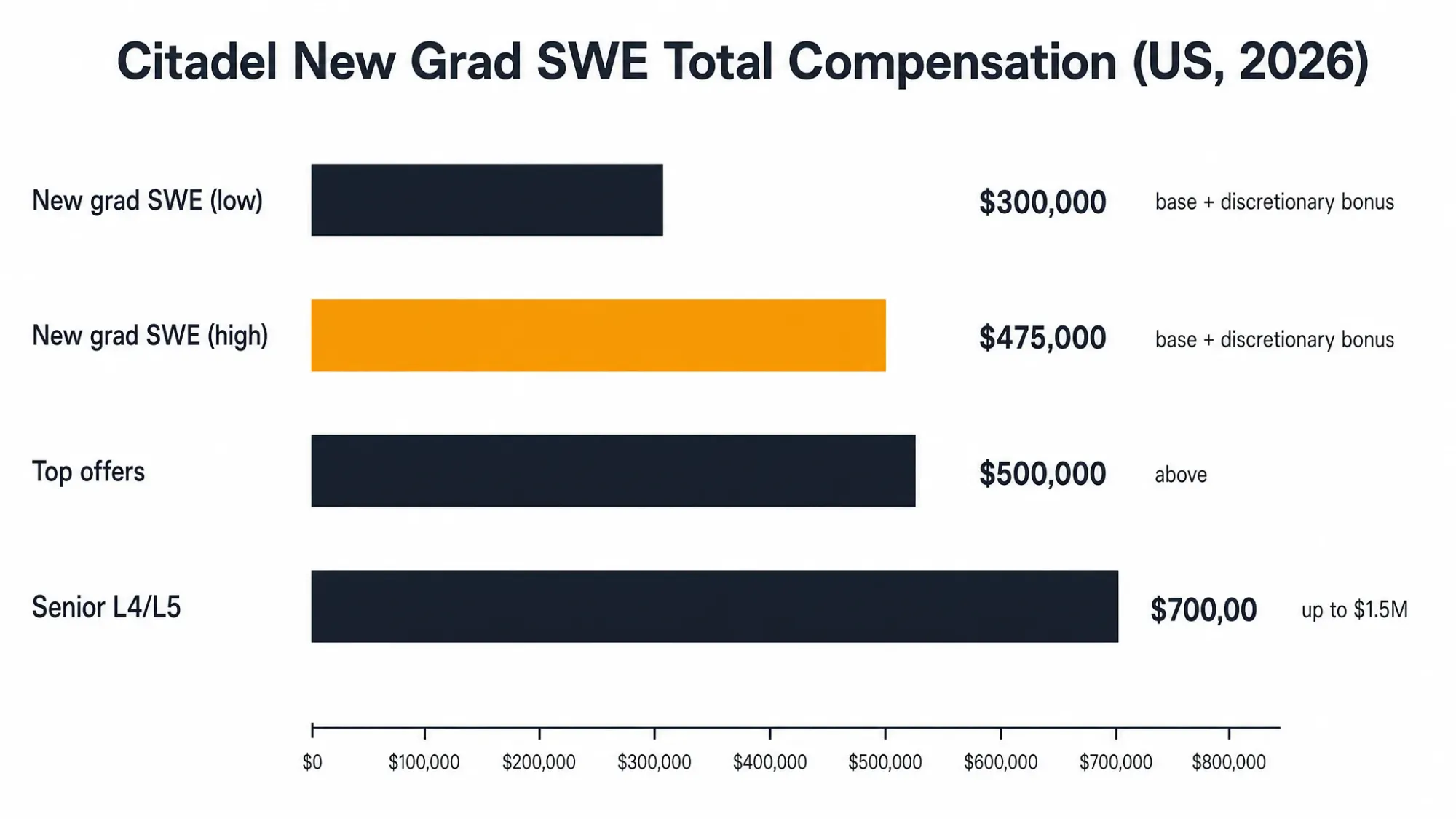
After the HackerRank submit, the Citadel software engineering pipeline moves to a phone screen and then a longer coding round. The charts below lay out the timeline and the US compensation that follows a pass, drawn from 2026 data.
The Technical Phone Screen
The next step is one or two forty five to sixty minute calls, often on CoderPad, with live coding. Expect a single hard algorithmic problem plus, for experienced tracks, systems questions on memory, concurrency, and networking. Candidates who clear it move to the full loop.
The Superday Loop
The main round is three or four back-to-back interviews of about forty five minutes each. It mixes two coding rounds at or above phone-screen difficulty with a system-design round. The design prompt can cover low-latency finance problems, such as an order book or a market-data pipeline. Behavioral fit runs through the day as well.
What the Role Pays
In 2026, median US Citadel new-grad SWE compensation was about $300,000 to $475,000. The strongest offers clear $500,000. The package is base salary plus a discretionary cash bonus, not stock, because both entities are private.
Citadel's Datathon Is a Separate Pipeline
How the Datathon Works
Citadel Securities runs Datathons through Correlation One several times a year. Candidates first take a sixty-minute assessment quiz through the Citadel Securities Datathon application page.
Accepted candidates then form teams to work a large dataset and present findings to judges. The challenges cover real-world problems in areas such as urban traffic, renewable energy, and education.
Why It's Separate From the OA
The Datathon is a different funnel from the HackerRank SWE OA. It is a team data-science competition with cash prizes near fifteen thousand dollars and exclusive recruiting access. It is not an individual timed coding test. Treating the two as one process hides a second way into the company.
Who Should Consider It
Data- and quant-leaning students should weigh the Datathon alongside the OA. It favors dataset work and presentation over algorithmic coding. A strong builder who dislikes timed contests may do better there. The SWE HackerRank route stays the path for pure software roles.
Citadel OA Automatic Invite and Scoring
The Invite Is Near-Automatic
For software engineering, the HackerRank invite often arrives automatically. One candidate reported receiving it about two days after applying. The screening step is the score, not the invite.
Grading and Shortlist Are Automated
HackerRank grades every submission by test cases. Citadel shortlists from that score without a human in the first pass. Results land a few days after completion. The decision starts as a number. This is why a slow solution that "works" still fails.
What That Means for You
Getting the Citadel OA is not a win. It is the starting line. The invite is only the entry point; your leverage is how many hidden tests you pass. Prepare for efficiency, not just correctness, and the automatic gate works in your favor.
FAQ
What questions show up on the Citadel OA?
The Citadel HackerRank test leans on sliding window and two-pointer problems, combinatorics with modular arithmetic, graph traversal, binary search, and hash map design. My 2026 sitting had a request throttler and a process scheduling count. Both were medium to hard, with a hidden-test bar that punishes slow code.
Does Citadel send the OA to everyone who applies?
For software engineering, the HackerRank invite often arrives within a couple of days. The platform handles the invitation automatically. The real filter is the score-based shortlist, so the OA itself is the gate, not the invitation.
Is the Citadel OA automatic?
Grading is automatic. HackerRank runs your code against visible and hidden tests and reports a numeric result. Citadel shortlists from that score without a human in the first pass. The outcome is decided by test cases passed, which is why efficiency matters as much as a working solution.
What is the Citadel Datathon assessment, and is it the same as the HackerRank OA?
The Citadel Datathon assessment is a separate Citadel Securities pipeline run through Correlation One, not the SWE HackerRank OA. It is a team data-science competition with a sixty-minute qualifying quiz, real-world datasets, and cash prizes. The OA is an individual timed coding test. They are different funnels into the company.
What Is the Citadel Online Assessment?
The Citadel online assessment is the HackerRank coding screen for software engineering applicants. In the sitting described here, it meant two algorithmic problems in about 75 minutes, with visible and hidden tests and an automated score.
How Long Is the Citadel OA Link Valid?
The invite email gives about a seven day window to start the test. The campus assessment is the same HackerRank coding round: two or three algorithmic problems in sixty to ninety minutes. Candidates who advance continue to a phone screen and then a superday.
What Does the Citadel Campus Assessment Involve?
The campus assessment refers to the same early coding stage described here. It is a HackerRank test with two or three algorithmic problems in sixty to ninety minutes. Candidates who advance continue to a phone screen and then a superday.
Where do I find Citadel HackerRank reddit threads, and can I trust them?
Citadel OA Reddit and Citadel HackerRank Reddit threads can provide anecdotal context. They are not a substitute for a dated writeup with full problem text. Use the documented 2025 to 2026 sittings in this guide as the factual baseline.
Can I use an AI tool or invisible app during the Citadel HackerRank OA?
Desktop overlay tools put the AI's answer on your computer screen. They render a hidden layer above the browser with an OS-level technique. Proctoring software keeps adding detection capabilities, so on-screen assistance remains exposed to monitoring.
InterviewFox pushes the answer to your phone, a separate device that no screenshot, screen recording, or session monitoring can reach by design. The laptop screen stays on the exam editor. If you use AI assistance during the OA, the dual-device architecture keeps the answer off that screen entirely.
Land offer with Safer AI Interview Assistant
Skip the risky invisible apps. Our dual-device mode keeps it simple and undetectable. You crush the interview, we handle the answers.
Get started. It's freeLoved by 100,000+ candidates