
How I Passed the Plaid CodeSignal OA in 2026

Quick Facts
| Company and role | Plaid, 2026 new-grad software engineer hiring |
| Platform | CodeSignal General Coding Assessment, the plaid oa platform |
| Time limit | 70 minutes, one sitting, no pause |
| Questions | 4 total (Q1-Q2 warm-ups, Q3 matrix, Q4 hashmap) |
| Score range | 200 to 600 scaled |
| Proctoring | Screen-share, webcam, ID check, automated integrity flags |
I took the plaid oa on CodeSignal for a new-grad software engineer role in 2026 and worked through all four questions in the 70-minute window. The test was a fully proctored General Coding Assessment scored on the 200 to 600 scale. What follows is the complete process and how I prepared for it.
Question 4, the longest consecutive sequence hashmap problem, did not click on the first read. For about fifteen minutes I doubted my solution would clear the largest hidden test cases, and that uncertainty is the hard moment I come back to below. Through those fifteen doubting minutes on the hashmap problem, a phone-side real time AI interview assistant kept me straight without ever showing up in the screen-share.
Before my test, I went through every plaid oa post from the past two years on Reddit, LeetCode Discuss, and Teamblind. What I found tracks closely with what I experienced, particularly the mistakes that get people flagged or blocked before they reach the interview.
The Real Questions on My Plaid CodeSignal Test
For the Plaid new-grad SWE loop the screening step was a fully proctored CodeSignal General Coding Assessment, four questions in seventy minutes on the 200 to 600 scale. Below is the exact set I was served, in the order they appeared on my screen.
Question 1: Warm-up Gimme
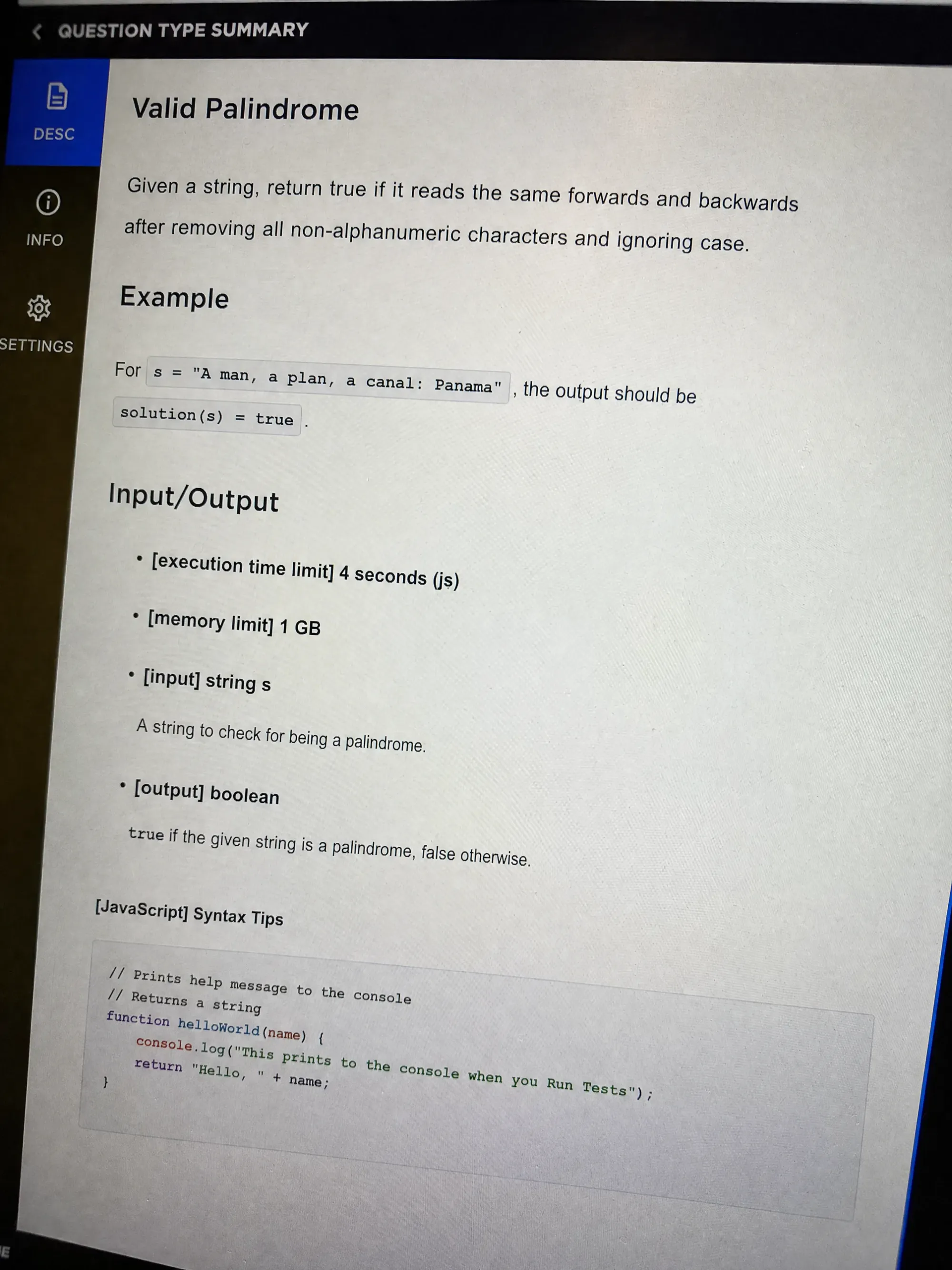
The problem I got: The first prompt handed me a string and asked me to return true if it read the same forwards and backwards once I stripped out everything except letters and numbers and ignored capitalization. Input was a single string like "A man, a plan, a canal: Panama", output was a boolean.
My approach: This was a freebie, so I just cleaned the string first by walking it once and keeping only the alphanumeric characters lowercased, then compared the result against its own reverse. Two pointers would also work, but reversing a small filtered list is easier to get right under pressure and the cost is identical.
def is_palindrome(s: str) -> bool:
    cleaned = [c.lower() for c in s if c.isalnum()]
    left, right = 0, len(cleaned) - 1
    while left < right:
        if cleaned[left] != cleaned[right]:
            return False
        left += 1
        right -= 1
    return True
Time complexity: O(n) | Space complexity: O(n)
I typed it, ran the sample, and moved on in under three minutes. That is exactly what this slot is for, bank the easy points and do not overthink.
Question 2: Simple String Parse
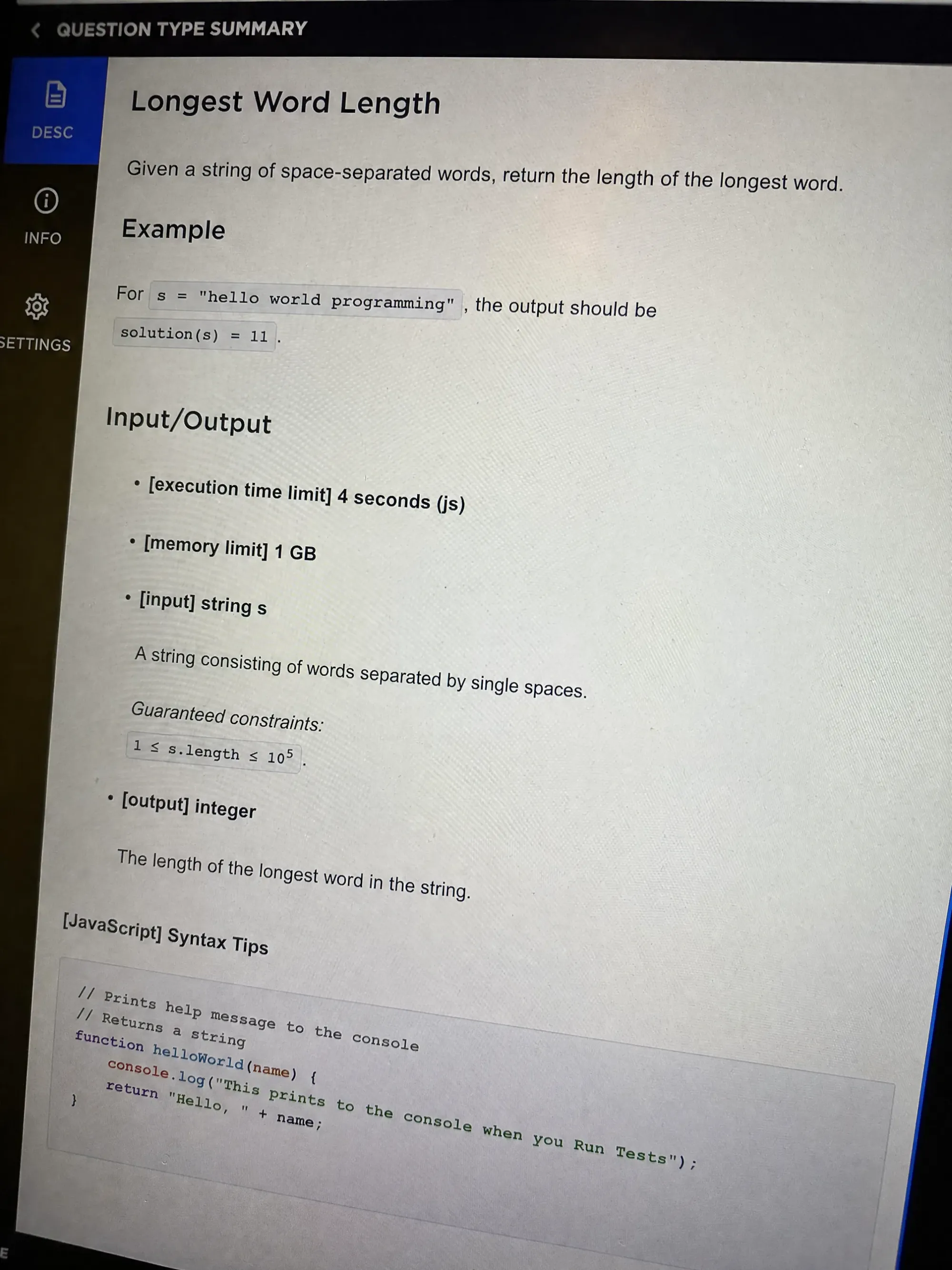
The problem I got: The second question gave me a single line of space separated words and asked for the length of the longest word. Input was a string such as "plaid builds fintech infrastructure", output was an integer, in this case 14.
My approach: I split on whitespace and tracked the largest length as I walked the resulting list. The only thing to watch was empty input, but the test description guaranteed at least one word, so I kept it straightforward and skipped any defensive branching that would just eat time.
def longest_word_length(s: str) -> int:
    words = s.split()
    longest = 0
    for w in words:
        if len(w) > longest:
            longest = len(w)
    return longest
Time complexity: O(n) | Space complexity: O(n)
This one took maybe four minutes including reading the prompt. Two gimmes down, and I was already feeling good about the clock.
Question 3: 2-D Matrix Implementation
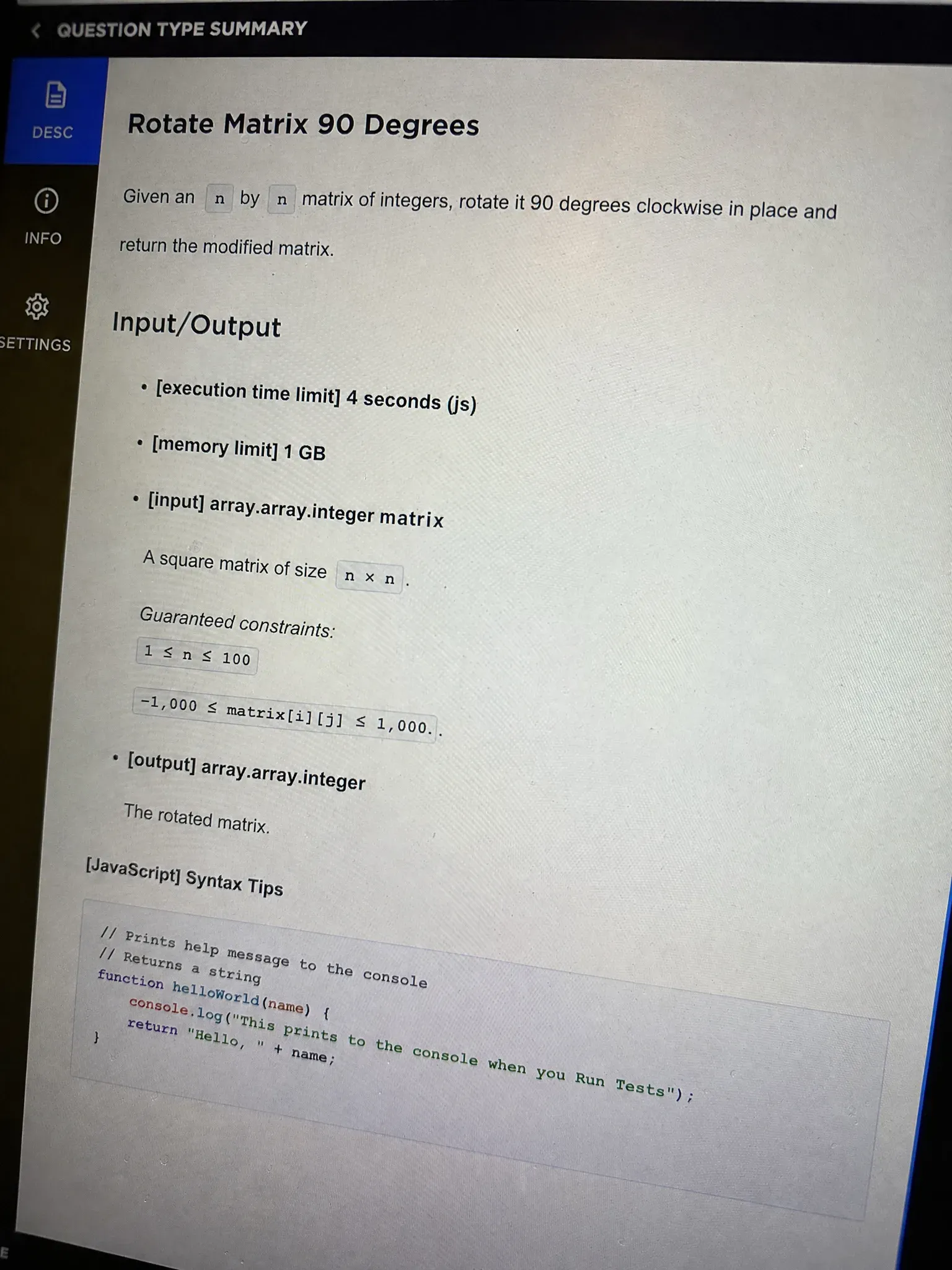
The problem I got: Question three gave me an n by n matrix of integers and told me to rotate it 90 degrees clockwise, in place, and return the modified matrix. Input was something like [[1,2,3],[4,5,6],[7,8,9]], output was [[7,4,1],[8,5,2],[9,6,3]].
My approach: The clean way to do this in place is a two step trick: first transpose the matrix by swapping matrix[i][j] with matrix[j][i] for every pair above the diagonal, then reverse each row. I noticed I could also rotate layer by layer from the outside in, but that meant more index arithmetic and more places to be off by one, so I set it aside and went with transpose plus reverse because it is shorter to write and easier to verify by eye.
def rotate(matrix):
    n = len(matrix)
    for i in range(n):
        for j in range(i + 1, n):
            matrix[i][j], matrix[j][i] = matrix[j][i], matrix[i][j]
    for i in range(n):
        matrix[i].reverse()
    return matrix
Time complexity: O(n^2) | Space complexity: O(1)
The code itself was quick, but I spent a few minutes hand tracing a 4 by 4 example to be sure the in place swaps were not clobbering values. All in, call it eighteen minutes, which matched what people said about this slot being the first real time sink.
Question 4: Hashmap Algorithmic Medium
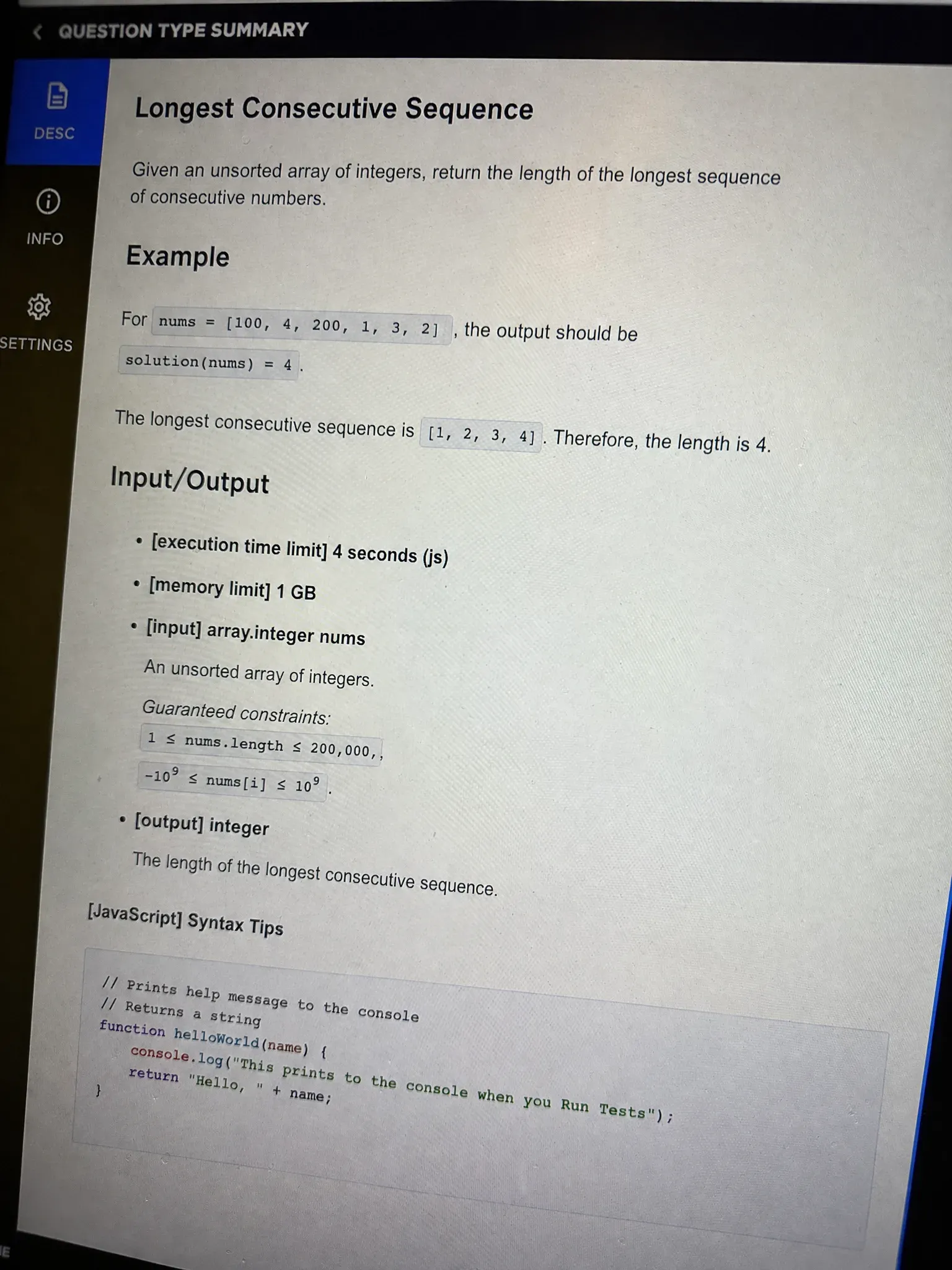
The problem I got: The last question gave me an unsorted array of integers and asked for the length of the longest sequence of consecutive numbers. Input was [100, 4, 200, 1, 3, 2], output was 4 because 1, 2, 3, 4 appear in the array. Order did not matter.
My approach: The brute idea of sorting then scanning is tempting, but sorting is O(n log n) and I was not sure it would clear the largest hidden cases on a big array. Instead I dropped every number into a set so lookups are constant time, then for each number I only started counting a sequence if the number one below it was absent, which guarantees I begin at each run's true start. From there I just walked upward while the next integer stayed in the set and tracked the longest run I found.
def longest_consecutive(nums):
    if not nums:
        return 0
    num_set = set(nums)
    best = 0
    for num in num_set:
        if num - 1 not in num_set:
            current = num
            length = 1
            while current + 1 in num_set:
                current += 1
                length += 1
            best = max(best, length)
    return best
Time complexity: O(n) | Space complexity: O(n)
I had spent the better part of fifteen minutes before I fully trusted the hashset version, and with the clock nearing the end I was still second guessing whether the largest hidden cases would actually pass. That uncertainty is what ate the back half of my time on this question.
I didn't want to reach for a desktop overlay during that stretch: the answer would have landed on the same screen the platform was monitoring, hidden by a basic OS-layer trick, and I didn't want that uncertainty riding along in the background. Instead I used AI interview helper: a keyboard shortcut auto-captured the problem, and the worked answer was pushed to my phone, a separate device outside the platform's screenshot monitoring. My laptop screen never changed: the CodeSignal editor stayed exactly as the proctoring system expected to see it, and my approach was clear.
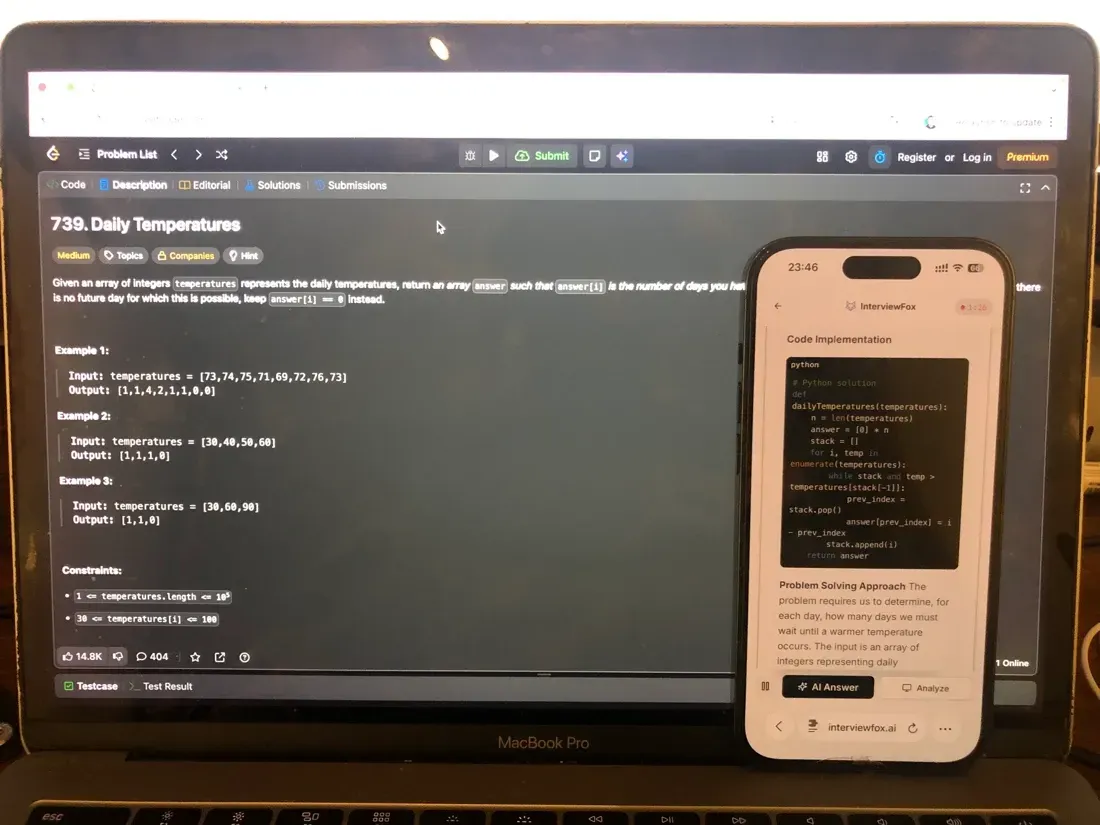
Land offer with Safer AI Interview Assistant
Skip the risky invisible apps. Our dual-device mode keeps it simple and undetectable. You crush the interview, we handle the answers.
Get started. It's freeLoved by 100,000+ candidates
Plaid's Proctoring Policy for CodeSignal
Only Your Primary Monitor Gets Captured
CodeSignal's screen-share captures only the primary monitor, so I prepared on the display I planned to share and kept every other window on a second screen out of frame. The proctoring data exists only to confirm you did not cheat, which makes a clean single-monitor setup the safe path. I learned the layout by rehearsing the share flow before the real attempt.
Webcam and ID Verification Are Mandatory
Plaid runs the fully proctored GCA variant, so a working webcam and a valid ID are required before the clock starts. The CodeSignal proctoring setup and review rules explain the platform-level mechanics. I had my ID ready and the camera angled straight at my face from the first minute. Fumbling this step is its own failure mode, separate from the coding score, and it can block progression on its own. For the platform-level answer to what CodeSignal records from your camera, the separate guide explains continuous video, ID capture, review, and retention.
Automated Flags Catch Copy-Paste and Overlays
Copy-paste is detected, and automated integrity flags are the real enforcement layer on the test. The broader CodeSignal detection stack beyond the video layer breaks down how Suspicion Score, paste activity, solution similarity, and AI proctoring review fit together. If no flag trips, nothing usually comes of it, but the moment a flag fires the score can be voided regardless of how well you coded. I kept every action on the shared screen plain and above board.
What Plaid's CodeSignal Test Format Actually Looks Like
70 Minutes Across 4 Questions
The Plaid OA is the standardized 70-minute, 4-question GCA, the same shape CodeSignal ships to many employers. I treated it like a timed exam where every minute is spoken for, not a casual practice round. Plan the whole block as one uninterrupted sitting with no breaks.
The Proctored Variant, Not Practice Mode
Plaid uses the proctored GCA build, not the unproctored practice mode. The four-question shape holds across 2026 new-grad accounts: the first three come quick and the last one runs long. I went in expecting that exact curve and banked time accordingly.
Retake Limits and Score Sharing
You get two attempts per rolling 30 days and three per rolling six months, so an attempt is not free to waste. A single GCA score is shareable to multiple companies, which means one strong result helps at Plaid and at peers like Coinbase or Robinhood. I did not spend an attempt on a casual run.
How Plaid's CodeSignal Scoring Works
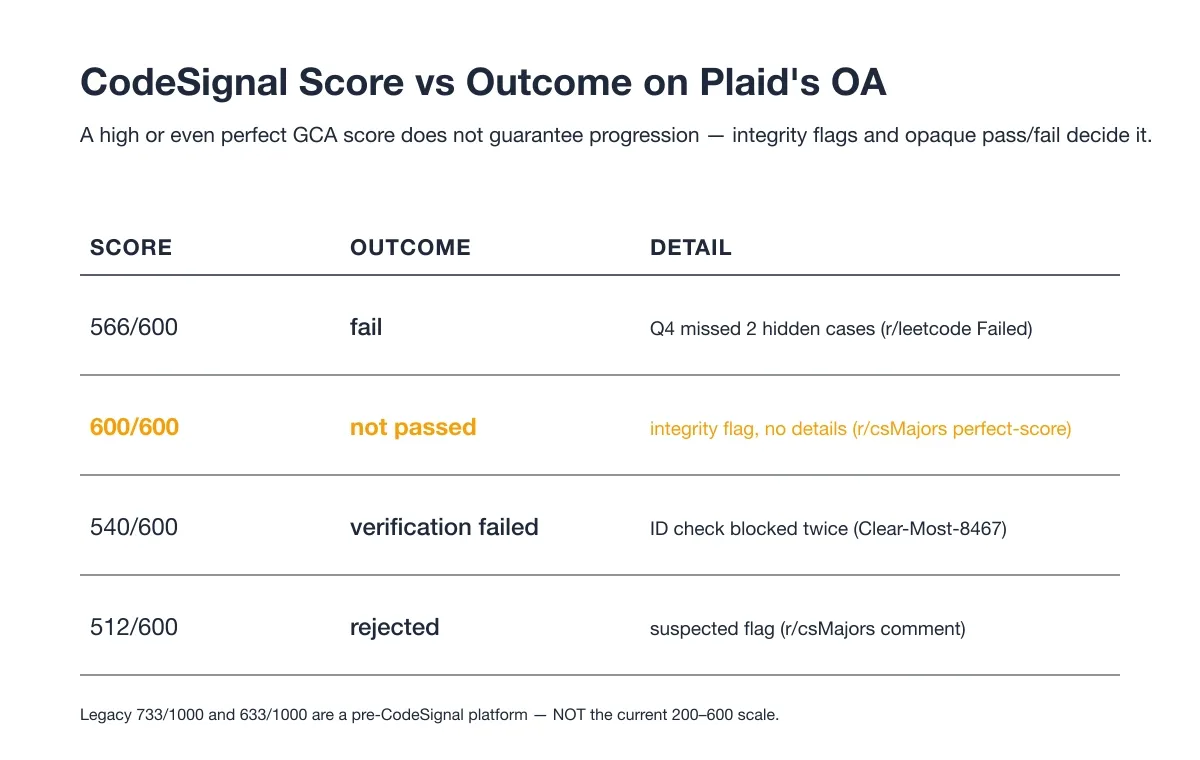
The score band looks reassuring until you see how often a high or even perfect result still fails. The chart below lays out what actually happened to real candidates at each score point.
The 200 to 600 Scale Replaced 850
CodeSignal moved the GCA scale from 300 to 850 down to 200 to 600 in spring 2023. The scaled score out of 600 is what Plaid sees, and that is the only number the recruiter talks about. I aimed for the top of the band and still treated the cutoff as unknown.
Partial Credit Rewards a Brute-Force Q4
Partial marking has been in place since spring 2023, so a brute-force Q4 earns half points instead of zero. I always shipped a working solution even when the optimal pass felt out of reach, because a blank answer is the only true failure on that question. The partial path protects your total more than people expect.
Opaque Pass/Fail and a Dynamic Cutoff
Candidates see only pass or fail, never a breakdown of where they fell short. The minimum threshold is dynamic, and a recruiter reviews the resume after the score clears it, so a top number is necessary but not sufficient. I treated the OA as a gate to clear rather than a rank to top.
You will still see old Plaid OA threads scored out of 1000 on Reddit. Those come from a pre-CodeSignal platform Plaid used in 2023 and 2024, not the current 200 to 600 CodeSignal scale, so I ignored them as stale legacy posts.
Plaid CodeSignal Exam-Day Strategy
Crush Q1 to Q3 Fast, Bank Time for Q4
I finished Q1 and Q2 in under ten minutes combined and spent the early buffer on Q3. The first three questions take ten to twenty minutes and the last one runs much longer, the same curve I saw in my own run. Banking that time is the whole game on this test.
Time-Box at 5 Minutes Easy, 25 Minutes Medium
I capped easy questions at five minutes and mediums at twenty-five, then mocked the full test at 70 minutes before the real run. The 600/600 scorers use that same box, and it kept me from spiraling on any single prompt. The clock discipline mattered more than raw skill.
Ship a Brute-Force Q4 for Partial Credit
When Q4 stalled, I wrote the brute-force version and submitted it for partial credit rather than chase the optimal pass. One candidate who missed two hidden Q4 cases still scored 566/600, which shows how much the partial path protects you. I never left that slot blank.
Why Candidates Fail the Plaid CodeSignal Assessment
Desktop Overlay Blocked the Assessment
A private account from a Plaid candidate describes a desktop overlay being detected partway through the assessment; the candidate was blocked from completing it. That case is the clearest example in this article of an integrity flag ending a Plaid OA before the score ever mattered. An automated flag killed the attempt, and no public writeup exists for it.
The pattern is not isolated, though: one candidate earned a perfect 600/600 and the recruiter was still told the assessment failed with no further detail.
Strong coding did not protect either of them once a flag fired.
The reason that overlay failed is structural: a desktop overlay tool renders its answer on the same computer screen the proctoring system monitors, hidden by a basic OS-layer trick: the window stays out of visible view but is still on-screen. AI interview tool works differently: the answer goes to my phone, a physically separate device that no screenshot, screen recording, or session monitoring can reach by design.
Land offer with Safer AI Interview Assistant
Skip the risky invisible apps. Our dual-device mode keeps it simple and undetectable. You crush the interview, we handle the answers.
Get started. It's freeLoved by 100,000+ candidates
Perfect 600/600 but Flagged as Failed
One candidate earned a perfect 600/600 and the recruiter still reported a fail with no breakdown. Others at 600, 580, and 512 report the same outcome, and the common read is an integrity flag, not a weak answer. A top score is not a safe score on this test.
Opaque Fail After Solving 3 of 4
A candidate passed Q1 through Q3 clean and still got a fail at 566/600 because Q4 missed two hidden cases. The result screen showed pass or fail only, with no hint of which cases broke. I read that as a warning to protect Q4 instead of chasing a perfect front three.
ID Verification Failure Blocks You
Another candidate scored 540/600, then got a verification-failed notice the next day, and the same failure repeated on a second 600/600 attempt. The ID step can block progression on its own, apart from the coding result. I rehearsed the ID check so it would not become my own trap.
Dynamic Cutoff Plus Resume Filter
The score only needs to clear a moving minimum, after which the recruiter reads the resume properly. A high number helps, but the bar shifts and the resume still decides the next round. I treated the OA as a gate to clear, not a contest to win.
How to Prepare for the Plaid CodeSignal in 7 Days
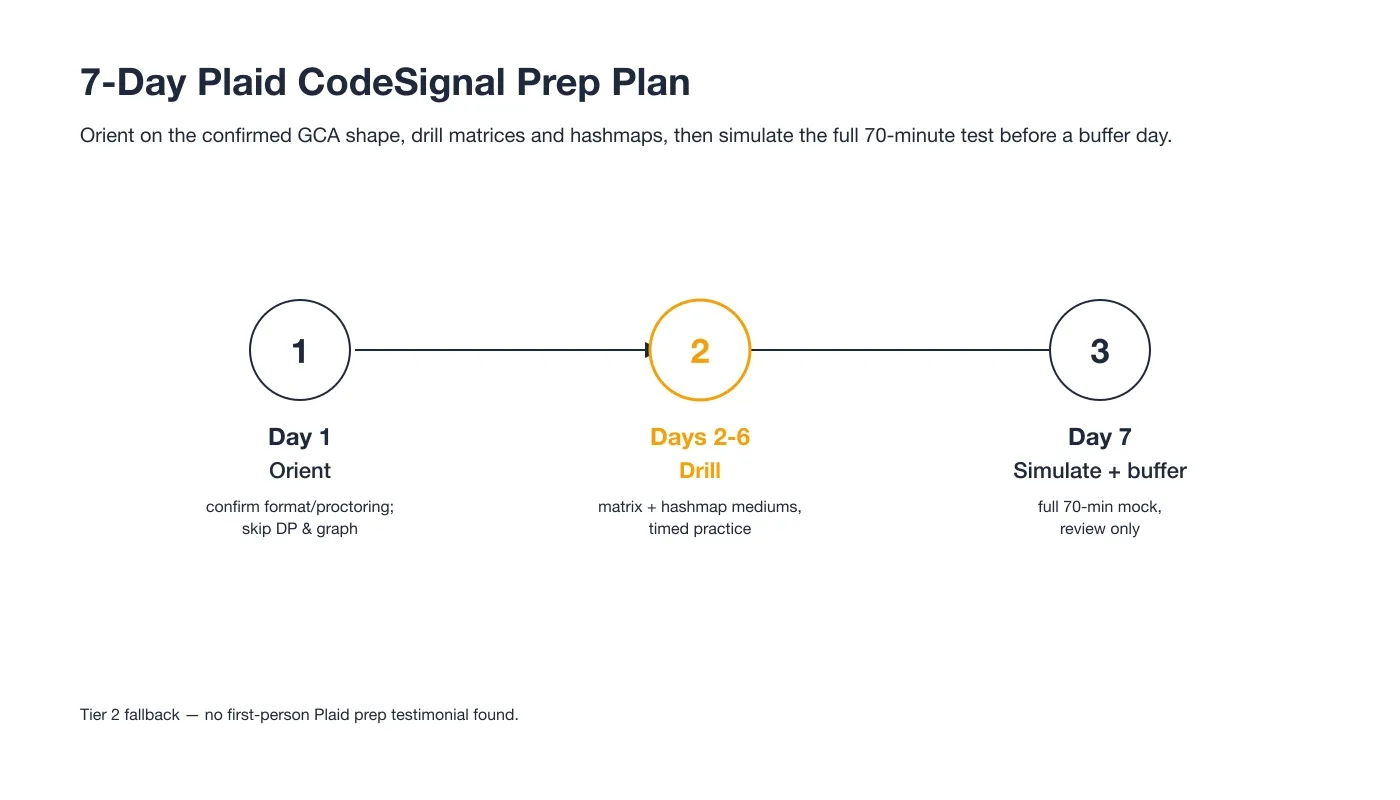
My plan front-loads orientation, then drills the two question families that actually show up, then simulates the full test. The timeline below maps the week.
Before the test, I also ran the Prep Agent from interviewfox.ai over WhatsApp: I sent it the confirmed question patterns for this company and got back a personalized drill plan and strategy. It was one practical tool among several in my prep workflow, not the whole plan.
Day 1: Orient
I spent day one confirming the format, the proctoring, and the 70-minute clock, then set a skip list. I skipped DP and graph-theory drilling because the GCA never tests DP and only confirms matrix and hashmap questions. I also skipped heavy Big-O theory drilling because the failure cause is proctoring or an integrity slip, not weak algorithm analysis.
Days 2 to 6: Drill
I drilled matrix problems every day, using one candidate's 120-problem matrix streak as my volume anchor for Q3. I paired that with hashmap Medium practice, especially longest consecutive sequence, and ran timed mocks inside the 25-minute medium box. The repetition is what made Q4's pattern land fast on test day.
Day 7: Simulate and Buffer
I ran one full 70-minute mock at the real bar, then spent the rest of the day on light review only. The simulation taught me the proctoring flow and the IDE before the stakes were real. I walked into the actual OA calm because nothing about the format surprised me.
What Happens After You Submit the OA
OA Leads to a Phone Screen and Live Coding
A pass moves you to a phone screen, then a 60-minute live coding round, then a virtual technical interview, then an onsite. Later rounds are live and screen-share your local environment, not a platform test. I prepared for a different format the moment the OA score posted.
The Full Interview Sequence and 23-Day Timeline
Plaid's hiring runs about 23 days on average from first contact to offer, with new-grad loops sometimes closing in roughly a week. The OA sits at the front, so a clean score buys momentum for everything after. I treated the wait after submission as prep time for the live rounds, not a rest.
Plaid's $320K Median Pay Is the Payoff
Plaid's median software engineer total comp sits near $320,000, with E4 around $325,000 and E5 near $463,000. That range is the reason the OA gate feels tight and the prep weeks feel long. I kept the payoff in view during the drill blocks.
Why Plaid Guards Its OA So Tightly
Fintech Data Sensitivity Drives Strict Proctoring
This next point is my own read, not a confirmed policy: Plaid handles financial data, and that posture is consistent with strict proctoring on the OA. I would not state it as fact, only as a reasonable fit with how locked-down the test is. The proctoring itself is confirmed; the motive is inference.
Community Belief That Plaid Loves CodeSignal Scores
A common community view holds that Plaid weights the CodeSignal score heavily in early screening. I treat that as belief, not a published rule, but it matches the energy around the test. The safer play is to assume the score opens the door and the resume walks through it.
FAQ
What is the plaid oa swe process like?
The plaid oa swe screen is a 70-minute, four-question CodeSignal GCA with full proctoring. A pass leads to a phone screen, live coding, and an onsite loop.
Is the plaid codesignal test proctored?
Yes. Plaid runs the fully proctored CodeSignal GCA with screen-share, webcam, ID check, and automated integrity flags. The practice build is not what you get.
What does the plaid oa reddit community say about scoring?
A high or perfect score can still fail with no breakdown, usually from an integrity flag. The old /1000 posts come from a pre-CodeSignal platform and are stale.
What score do I need to pass the Plaid CodeSignal OA?
Plaid does not publish a fixed cutoff, and the minimum is dynamic. Clear the bar, then the recruiter reviews your resume, so aim for the top of the 200 to 600 range.
How should I prep for the Plaid OA in a week?
Spend day one on format and a skip list. Days two through six drill matrix and hashmap problems with timed mocks. Day seven is a full 70-minute simulation.
Can a desktop overlay tool get me blocked on the Plaid OA?
Yes. An overlay assistant can trip an automated flag and end the attempt before the score matters. One private case was blocked mid-test after an overlay was detected.
Can I use an AI tool or invisible app during the Plaid CodeSignal OA?
Desktop overlay tools put the AI's answer on your computer screen: rendered as a hidden layer above the browser using a basic OS-layer trick; the answer is on-screen, the hiding is basic, and proctoring software keeps adding detection capabilities as AI tools become more common, so the risk exposure isn't fixed.
interviewfox.ai pushes the answer to your phone: a physically separate device that no screenshot, screen recording, or session monitoring can reach by design. So the laptop screen stays on the exam editor, unchanged. If you're going to use AI assistance during the OA, the dual-device architecture removes the answer from your screen entirely.
Land offer with Safer AI Interview Assistant
Skip the risky invisible apps. Our dual-device mode keeps it simple and undetectable. You crush the interview, we handle the answers.
Get started. It's freeLoved by 100,000+ candidates