
I Took the Point72 HackerRank in 2026: Real Questions and Prep Plan

Quick Facts
| Platform | HackerRank Screen, browser-based code editor |
| My sitting (2026) | Software Engineer build, 3 algorithmic questions, 90 minutes |
| Format in 2026 | Varies by role: 3 to 4 questions, coding and SQL |
| Time limits reported | 60, 90, 150, and 180 minutes depending on the build |
| Languages | Python, Java, SQL, or PySpark depending on the track |
| Scoring | Percentage of hidden test cases passed |
| Pass bar | Not published by Point72 |
| Proctoring | Tab proctoring, copy and paste tracking, Secure Mode, monitor detection |
| AI tools | Flagged as suspicious activity when the assessment does not permit them |
| Position in pipeline | Not always round one; step 6 of 10 in one quant analyst process |
| Typical wait | About 17 days for software engineer candidates |
I took the Point72 HackerRank assessment for a software engineer role in 2026, the 90 minute build with three questions. I solved all three and submitted the last one with only a few minutes left. What follows is the complete process and how I prepared for it.
Question three hid a greedy problem inside an app upgrade scenario. Twelve minutes into a DP table, under thirty minutes left, I used an AI interview assistant to check my model. The 2^i effect was the reason that DP was pointless, and I walk through the rewrite below.
Before my test, I went through every Point72 HackerRank post from the past two years on Reddit, LeetCode Discuss, and Teamblind. What I found tracks closely with my own sitting, especially the variant trap and the mistakes that get sessions invalidated.
The Real Questions on My Point72 HackerRank Test
I sat the Software Engineer build, the 90 minute HackerRank with three algorithmic questions. Here is exactly what I got on my screen.
Question 1: Element Swapping
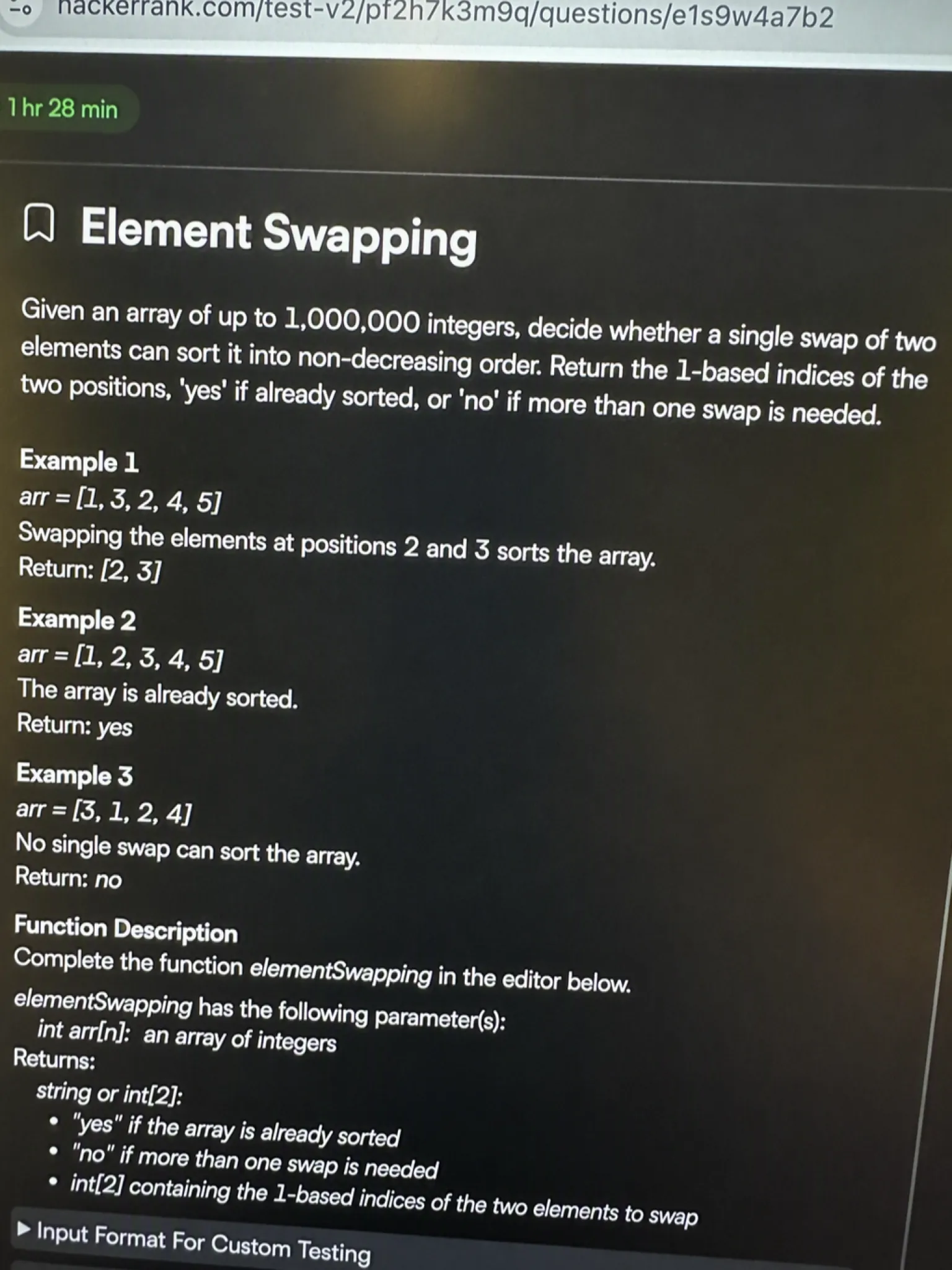
The problem I got: HackerRank handed me an array of up to 1,000,000 integers. I had to decide whether a single swap of two elements could sort it into non-decreasing order. If a single swap worked, I returned the 1-based indices of the two positions. An array that was already sorted, I flagged as such. Anything needing more than one swap came back as impossible.
My approach: I scanned once for the first place the array stopped being sorted, a left to right descent, and once for the last such place. When neither existed the array was already sorted. When descents existed, the only swap worth trying swapped the element at the first descent with the element just past the last descent. I made that swap on the array and checked the whole thing was now sorted. That is O(n) with no sort step, which matters at a million elements.
def element_swap(arr):
    n = len(arr)
    left = -1
    right = -1
    for i in range(n - 1):
        if arr[i] > arr[i + 1]:
            if left == -1:
                left = i
            right = i
    if left == -1:
        return "yes", None  # already sorted
    # try the single swap that could fix a one-descent run
    arr[left], arr[right + 1] = arr[right + 1], arr[left]
    for i in range(n - 1):
        if arr[i] > arr[i + 1]:
            return "no", None
    return "yes", (left + 1, right + 1)  # 1-based indices
Time complexity: O(n) | Space complexity: O(1)
I finished this one in about eighteen minutes and felt steady. It was a fair warm up and I moved on with time in hand.
Question 2: Modulo Arithmetic Equation
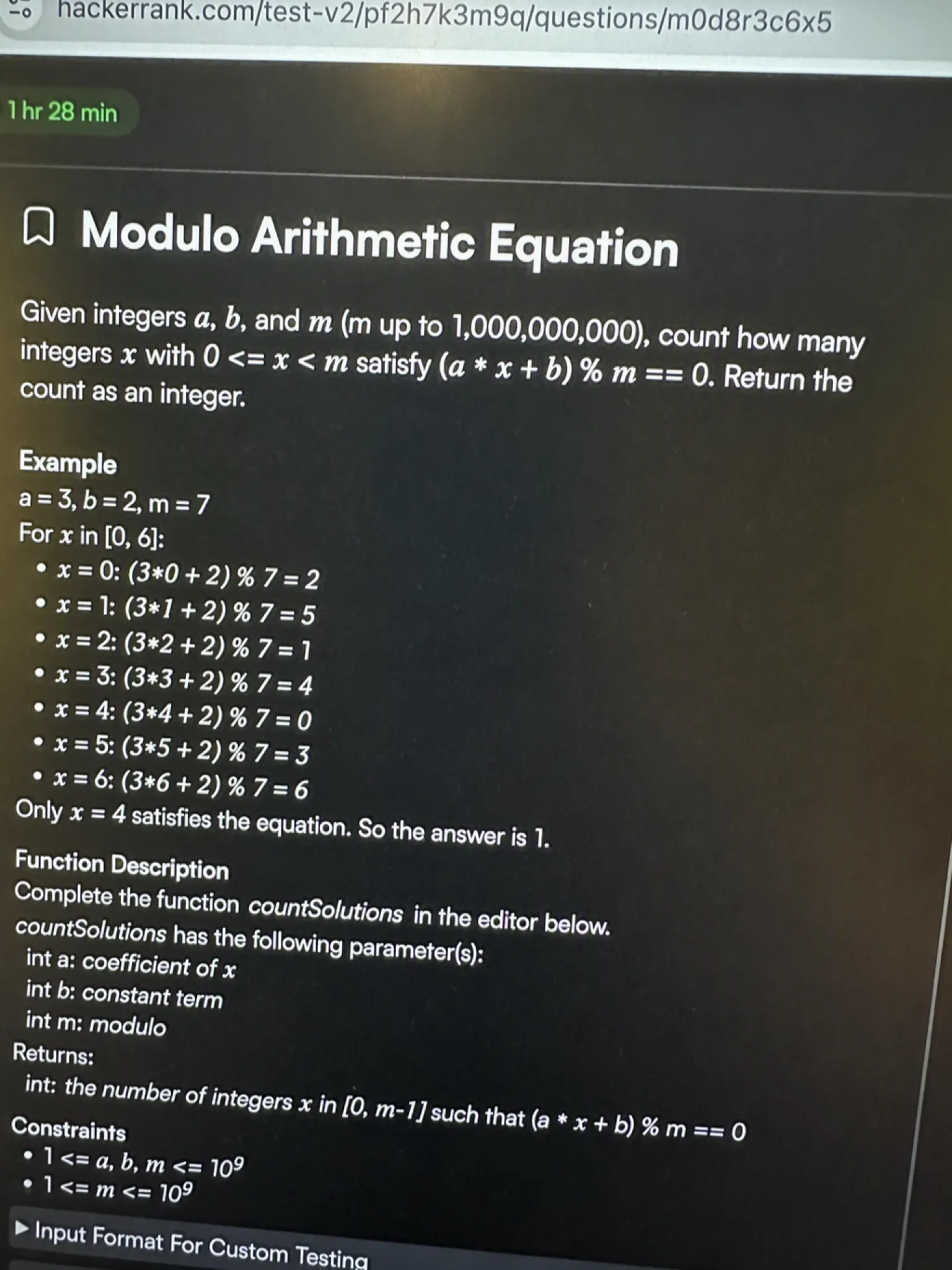
The problem I got: I was given three integers, a, b, and m, with m up to 1,000,000,000. I had to count how many integers x with 0 <= x < m satisfy (a * x + b) % m == 0. The answer could be large so I returned it as an integer.
My approach: The equation a*x + b = 0 (mod m) is a linear congruence. The number of solutions depends on the greatest common divisor g of a and m. If g does not divide b there is no solution at all. When g does divide b, the congruence collapses to one solution in each block of size m/g, so exactly g values of x work in the range. I used the Euclidean gcd and a divisibility check. No prime factorization was needed because the gcd already captures the shared factors that create the repeated solutions.
import math

def count_mod_solutions(a, b, m):
    g = math.gcd(a, m)
    if b % g != 0:
        return 0
    return g
Time complexity: O(log m) | Space complexity: O(1)
This one was quick once the congruence clicked. I had about forty minutes left for the last question and felt confident.
Question 3: Android In-App Upgrades
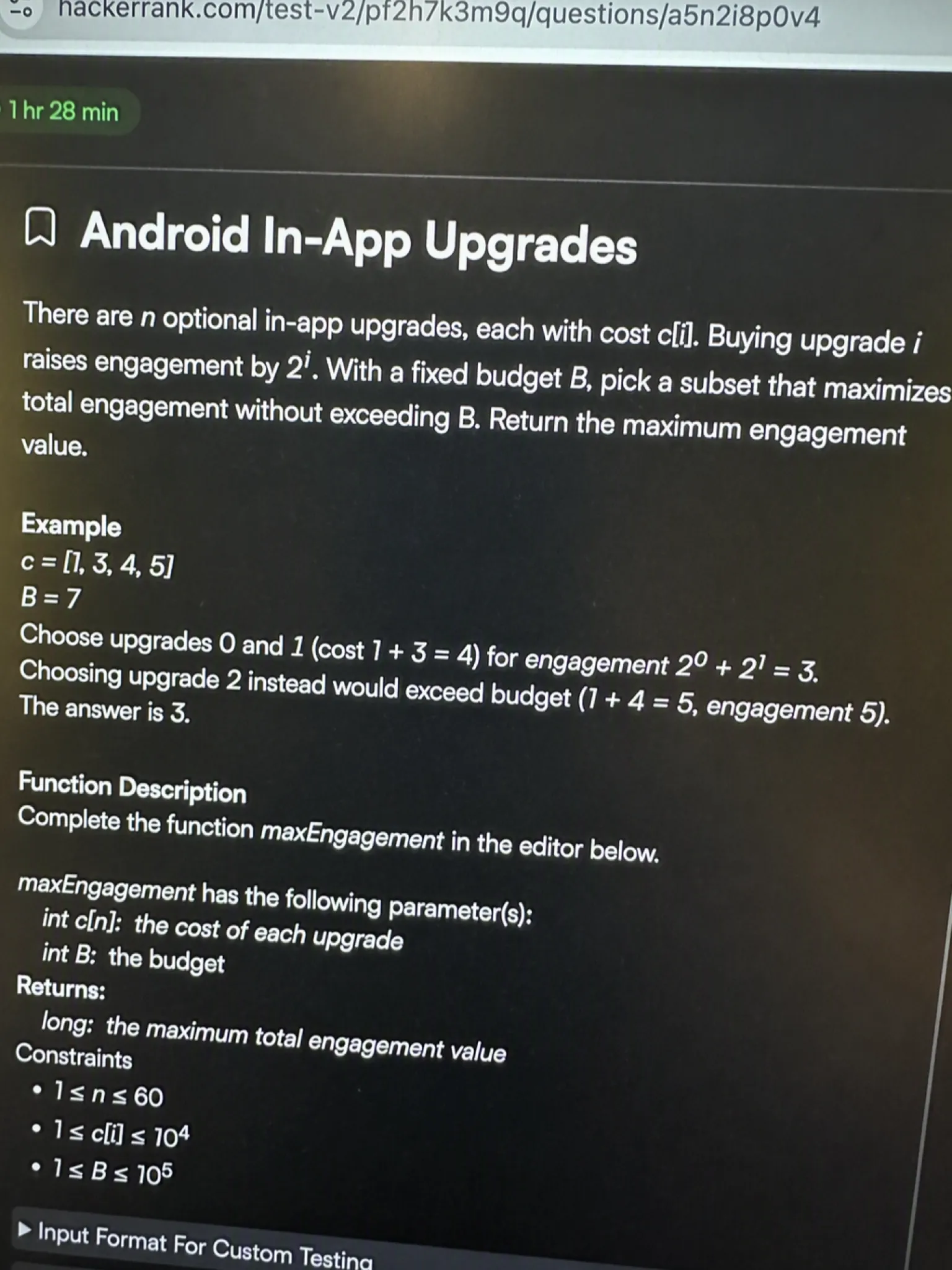
The problem I got: I got a mobile product scenario. There were n optional in-app upgrades, each with a cost c[i]. Buying upgrade i (0-based) raised engagement by an effect of 2^i. I had a fixed budget B and had to pick a subset of upgrades that maximized total engagement without going over budget. I returned the maximum engagement value.
My approach: The effect 2^i grows so fast that upgrade i is worth more than every lower upgrade combined (2^i > 2^0 + ... + 2^{i-1}). That meant the greedy choice is always correct. I walked the upgrades from the highest index down and bought each one I could still afford. There was no need for a knapsack DP because the exponential weighting removes every tradeoff. The loop runs once and uses constant space.
def max_engagement(costs, budget):
    remaining = budget
    engagement = 0
    for i in range(len(costs) - 1, -1, -1):
        if costs[i] <= remaining:
            remaining -= costs[i]
            engagement += (1 << i)  # 2 ** i
    return engagement
Time complexity: O(n) | Space complexity: O(1)
I lost about twelve minutes building a DP table before I noticed the 2^i effect made the highest index always worth more. Tearing it down and rewriting cost the rest of my buffer, and I submitted the greedy version with only a few minutes left.
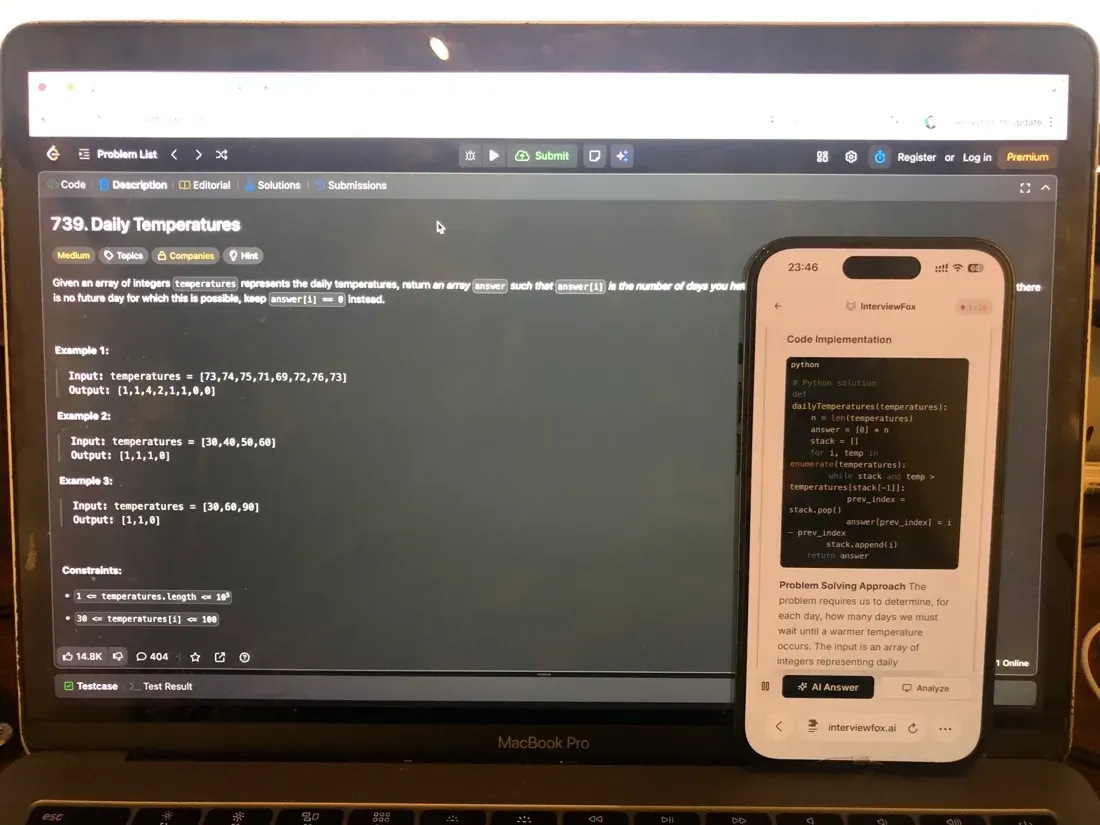
Rather than draw anything on the screen the test was recording, I hit a keyboard shortcut that captured the problem panel to my phone. A real time AI interview assistant on that separate device kept the help off my laptop, and the 2^i greedy finally clicked.
Land offer with Safer AI Interview Assistant
Skip the risky invisible apps. Our dual-device mode keeps it simple and undetectable. You crush the interview, we handle the answers.
Get started. It's freeLoved by 100,000+ candidates
Your Version May Not Match
The three problems above are the Software Engineer and generalist build. Other Point72 tracks run different question types. The Data Scientist, Data Engineer, and Quant Analyst builds lean on SQL, PySpark, and Python rather than the greedy puzzles I got. The exact mix depends on your role, so check the Format section before you assume your test will look like mine.
Point72's Proctoring Policy for HackerRank
Point72 runs this test inside HackerRank Screen. The rules while the window is open are the platform's rules, with Point72 picking the toggles. In 2026 that signal set is documented, and it is wider than most candidates expect.
What HackerRank Logs During the Session
The chart below maps what a Screen session can record from the moment the test opens.
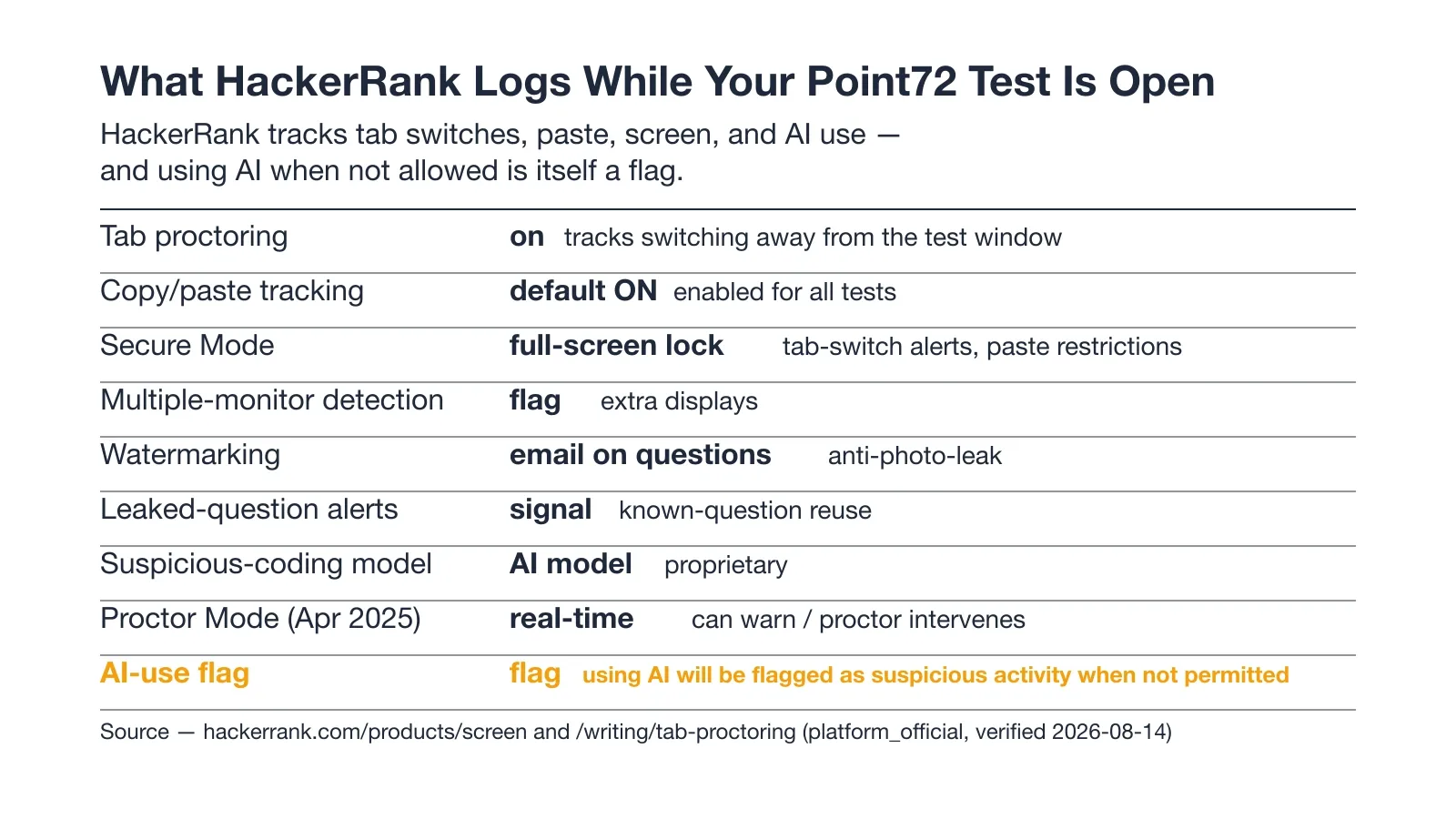
Almost every row is an employer-side toggle. From the candidate side I could not tell which ones Point72 had switched on.
Two need no switching. Copy and paste tracking runs by default, and tab proctoring is standard on employer tests. The toggle label is only the start, though, and what HackerRank records on every paste is more specific than the on/off switch suggests.
Once you are in the test, the question that matters is whether leaving the window gets logged and what counts as switching, and how HackerRank records a tab exit breaks down the focus-loss signal and the two numbers it stores.
Multiple-monitor detection is part of that same flagged signal set, and the payoff of understanding it is concrete: when HackerRank actually flags a second display depends on the proctored mode your test runs, which is the detail that lets you keep any reference on a phone the monitor check never reaches.
Proctor Mode arrived in April 2025 and watches in real time rather than after the fact. A proctor can warn mid-session instead of leaving a report for a recruiter to read later.
Using AI When It Isn't Allowed Is a Flag
The platform rule is written down without hedging. When an assessment says no AI, using it registers as suspicious activity. Point72 does not have to build that detection, because it ships with the platform.
For the full picture of what the platform's detection covers beyond the AI flag, HackerRank's three-layer cheating-detection model shows which signals run by default and which your employer has to switch on.
The consequence is not a warning that fades. In one spring 2026 sitting an AI overlay left its answer card visible over the prompt. The session was flagged and later invalidated, and I break that case down in the failure section below.
What Proctoring Does Not Catch
Tab proctoring watches the browser and the machine, not the room. A phone, a tablet, a printed page, or a second person off camera sits outside what the browser can see.
Virtual machines land in that same gap on paper, and I would not treat that as safe either way. The open question is whether the platform can detect a virtual machine at all, and how HackerRank actually treats a VM keeps that open rather than a confirmed yes or no.
The line that held up in practice is simpler. Anything rendered on the screen the test runs on is inside the recorded picture.
What Point72's HackerRank Test Format Actually Looks Like
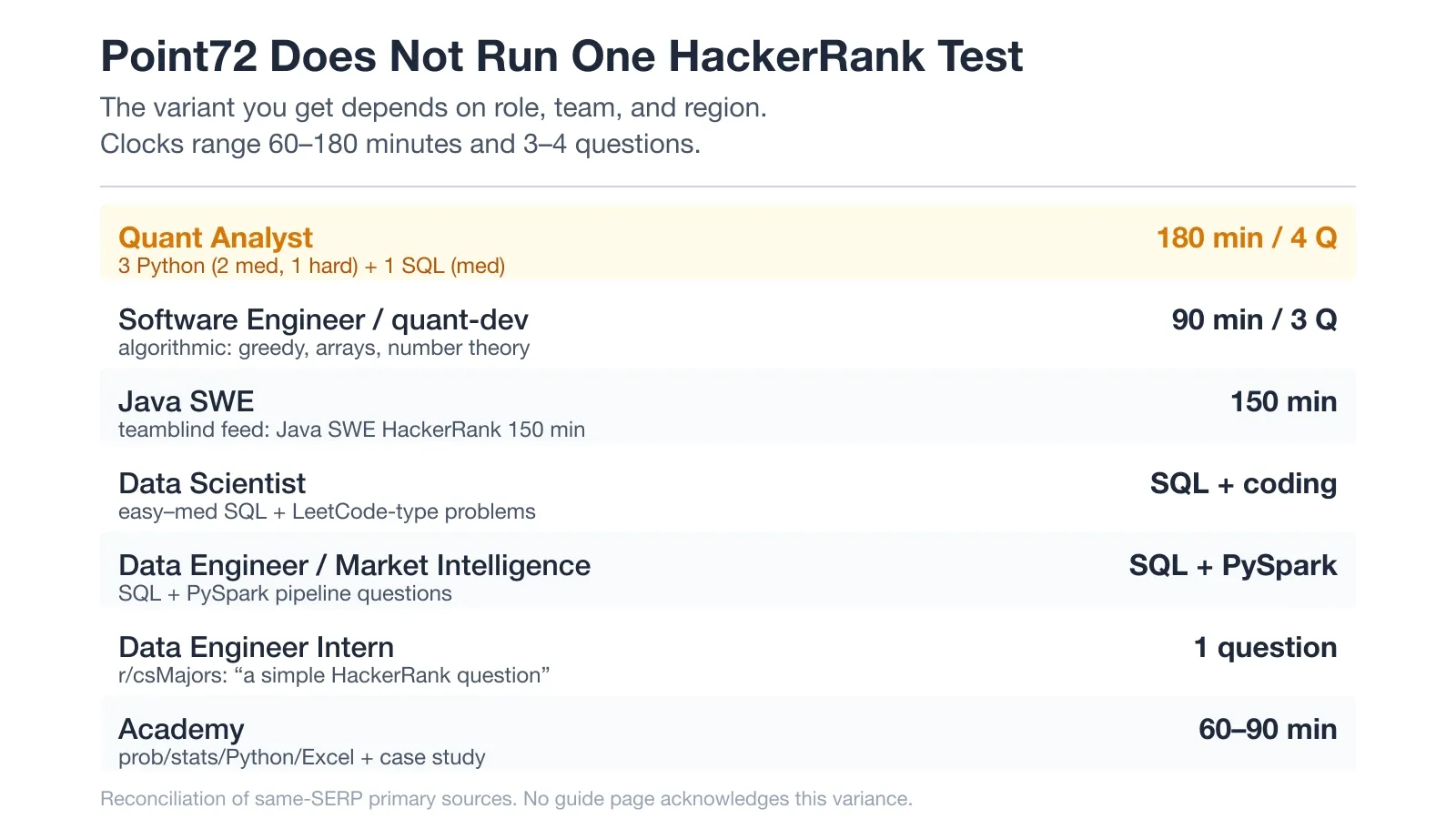
Point72 does not run one HackerRank test. The clock, the question count, and the language mix change with the role, the team, and the region.
The matrix below is what the reported configurations add up to once you stop assuming a single exam.
The Quant Analyst Build at 180 Minutes and 4 Questions
A quant analyst asked whether this test was 90 minutes and got a correction. The real figure was 180 minutes and four questions. Three were Python and one was SQL, with two mediums, one hard Python, and a medium SQL.
That is double the clock the popular guides quote, and one question more than they list. It also works out to roughly 45 minutes per question, a different exam from the one I sat.
The 90-Minute Engineer Build and the 150-Minute Java Test
My build was the common one: three algorithmic questions in 90 minutes, weighted toward greedy, arrays, and number theory. That is 30 minutes per question, with no slack for a wrong model. That is exactly where my third question went sideways.
A Java software engineer sitting has gone out at 150 minutes. Another candidate got four relatively easy questions inside one hour total, the tightest clock in the set.
The SQL and PySpark Builds for Data Roles
The data tracks do not get my three problems at all. A data scientist sitting ran easy to medium SQL plus LeetCode-type coding. A Market Intelligence data engineer in India got a SQL and PySpark test in March 2026.
Meanwhile, a data engineer intern got a single simple HackerRank question. The Academy track runs 60 to 90 minutes of probability, statistics, Python, and Excel with a case study attached. Same company, same platform, nothing shared but the login screen.
How Point72's HackerRank Scoring Works
Point72 publishes nothing about its grading bar. The mechanics underneath the score are platform standard, and knowing them changes what is worth submitting when the clock is nearly gone.
How HackerRank Grades Your Code
A HackerRank algorithmic question scores as the percentage of test cases the code passes. No human reads my code at this stage. A clever approach that dies on a large input scores below a plain one that passes.
Partial Credit and Hidden Tests
Every test case that passes earns points, which is why a partial submission beats an empty editor. HackerRank also runs a dynamic scoring beta. A question's value there moves with how difficult it turns out to be.
The hidden tests are where my first question had to hold. One swap on an array of a million integers rules out anything with a sort inside it. A solution that clears the samples and times out on the big case is a low score, not a near miss.
The Point72 Pass Bar Remains Unknown
Point72 does not publish a cutoff score, and I found no candidate who named one. Any specific percentage quoted for this test is a guess.
I planned around that by treating full test-case coverage as the target instead of a number. On a three question build, one question left half-passing is a visible hole in the report.
Point72 HackerRank Exam-Day Strategy
Every pacing recipe I read before my test assumed 90 minutes and three questions. That recipe is actively wrong if the invite says 60, 150, or 180 minutes.
Pace to Your Actual Variant Clock
The first thing I did was divide my clock by my question count. That number sets the whole plan.
My 90 minute build gave 30 minutes per question. The quant analyst build gives about 45, and the four question hour gives 15.
Fifteen minutes per question is a reading and typing problem, not an algorithm problem. Forty five minutes leaves room to model carefully before writing, which is room I did not have.
What to Do When You Get Stuck
Getting stuck on my third question cost twelve minutes before I changed anything about how I was working. The move that finally helped was re-reading the constraint I had skimmed, the 2^i effect. Debugging the model I had already committed to was the wrong instinct.
During mock rounds I trained myself to set a hard checkpoint. If a question has no working submission by the halfway mark, I stop building. Then I read the prompt again from the top.
Re-reading a constraint costs a minute. Rewriting a data structure with the clock running costs ten.
Software to Keep Off the Shared Screen
Whatever runs during the test has to stay off the screen the test is on. Anything drawn on the test window sits inside the recorded picture, which is the gap most candidates skip, and how the platform watches the screen you share is where the real risk sits.
Keep any reference on a device that never touches the screen, the one side of the line worth relying on. The failure section below shows what happens when that rule is ignored.
Why Candidates Fail the Point72 HackerRank Assessment
Misreading a prompt and missing an edge case cost points. Three failures on this test cost the whole attempt, and only one of them is about code quality.
The AI-Tool Trap Ends in an Invalidated Session
One candidate ran a translucent AI sidebar through a spring 2026 assessment and saw no issue at first. When the editor returned to full screen, the overlay captured the shortcut first and left its answer card visible over the prompt.
Closing the app was allowed. The session was still flagged, and it was invalidated later, so every question solved that day counted for nothing.
I would not trust the word undetectable for anything that draws on top of the test window. The mechanism that failed here was not exotic. A translucent layer is still a layer on the screen being recorded.
That candidate was flagged because the tool drew the AI's answer on the same screen the proctoring system is monitoring, hidden only by a basic OS-layer trick. The window stays out of visible view but is still on-screen.
InterviewFox works differently, and the answer goes to my phone, a physically separate device that no screenshot, screen recording, or session monitoring can reach by design, which is what a dual device AI interview tool does.
Land offer with Safer AI Interview Assistant
Skip the risky invisible apps. Our dual-device mode keeps it simple and undetectable. You crush the interview, we handle the answers.
Get started. It's freeLoved by 100,000+ candidates
Showing Up Unprepared for the Question Mix
The second failure is preparing for the wrong exam. One candidate asked publicly what question types to expect on this test and got nothing usable back. They sat it anyway, and afterwards said flatly that they had blown the technical interview.
Drilling greedy and number theory is right for the engineer build. It is the wrong call for a SQL and PySpark data build. Settling which variant is coming is the first prep decision, ahead of any topic list.
Misreading the Business Logic
The third failure is a modeling error dressed up as a coding error. My third question wrapped a greedy rule inside a product scenario. I built a knapsack DP because I read the scenario and skimmed the effect formula.
The swap question worked the same way. The one-swap constraint is what makes an O(n) scan correct and a sort wasteful. Writing the model down before coding is what stopped me repeating the mistake.
How to Prepare for the Point72 HackerRank in 7 Days
No confirmed link expiry window turned up for this invite, so I planned on a flat seven days. The plan below is built from the question categories and clocks above, not from a generic topic list.
In the days before the test I used a prep agent tool over WhatsApp and SMS: I sent it the confirmed question patterns for this company and it returned a personalized drill plan and strategy that shaped the plan below.
Days 1 to 3 Lock Greedy, Arrays, Number Theory, and SQL
My three questions were a single-swap sort check, a linear congruence count, and an exponential-weight budget problem. That is greedy, arrays, and number theory. The first three days went to timed medium problems in exactly those categories.
I set the check at three medium problems inside 90 minutes, with every test case passing on the first submit. A practice run below that meant the pattern was not automatic yet.
SQL shows up in the quant and data builds, so I gave part of day three to JOINs and aggregation. My own build was pure algorithms, and I still wanted the coverage.
I skipped system design entirely, and I did not revisit amortized complexity proofs. Neither reported mix asks for them. The engineer build is greedy and number theory, and the data builds are SQL and PySpark.
Days 4 to 5 Business Logic and PySpark SQL Drills
The upgrades question and the swap question both wrapped a rule inside a scenario. Both punish anyone who starts coding before modeling.
Days four and five went to translation practice. I read a written rule, wrote the model in one line, then wrote code. The check was two scenario problems modeled correctly before a single line of code went down.
For the data side I wrote window function and JOIN queries against a sample schema, plus one PySpark transform. That is the actual content of the data scientist and Market Intelligence builds.
Days 6 to 7 Timed Simulation and the Integrity Rules
I ran one full length mock at my own clock, 90 minutes and three questions, no pausing and no lookups. The check was finishing with time in hand, which I failed on the first attempt and cleared on the second.
The last block was the rules, because an invalidated session scores zero no matter how good the code is. I made myself able to state cold which signals run by default. I also learned what happens when AI is used on a test that forbids it.
What Happens After You Submit the OA
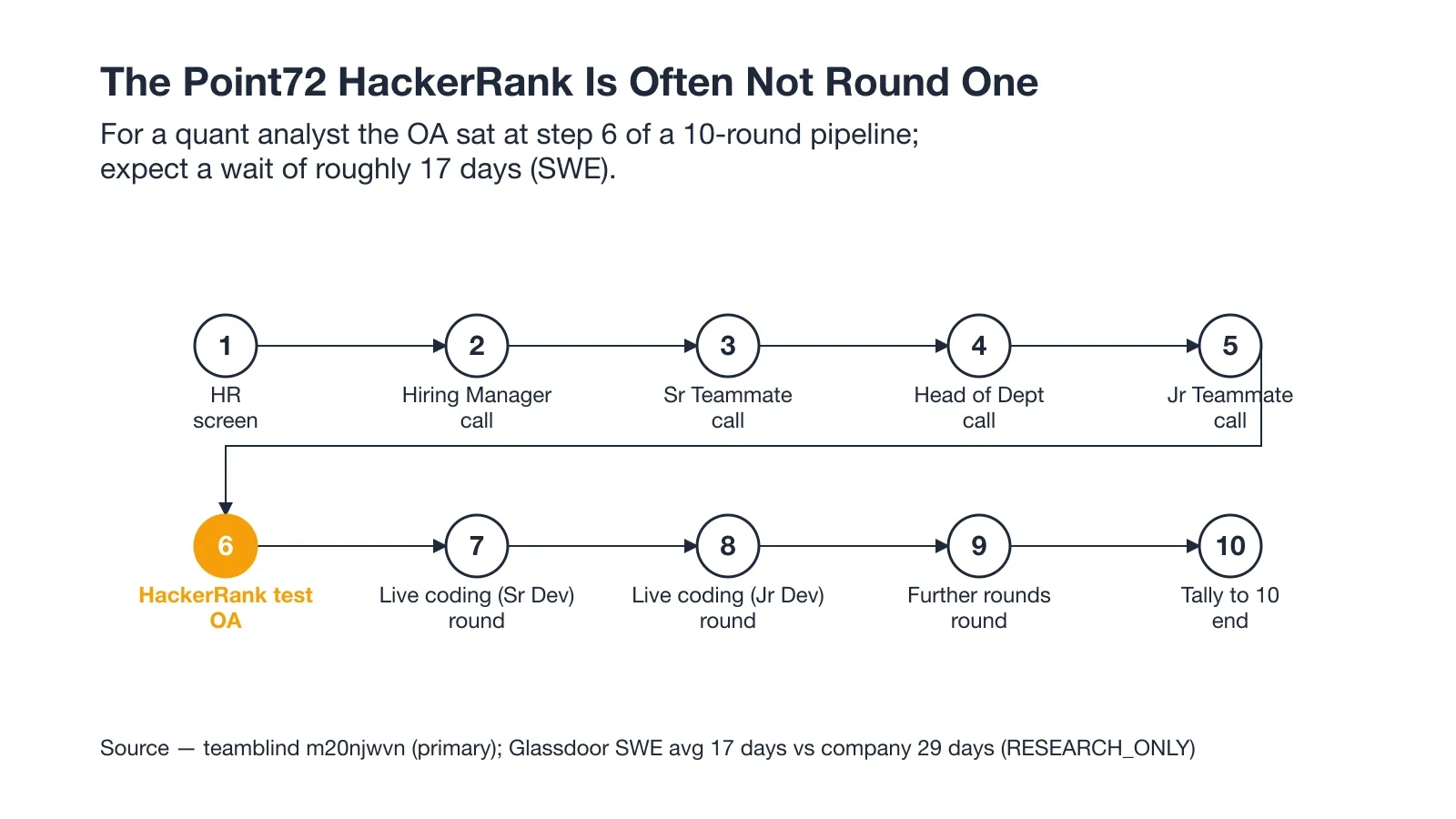
Submitting does not tell you where you stand. This test does not sit at a fixed point in the process. For some candidates it is the first thing that happens, and for others it arrives after five conversations.
The sequence below is one real quant analyst pipeline, with the HackerRank landing at step six.
Your OA May Not Be Round One
One quant analyst went through five conversations before the HackerRank arrived. An HR screen, a hiring manager call, a senior teammate, a head of department, and a junior teammate all came first. Two live coding rounds followed the test, with the process running toward ten touchpoints.
That changes what a submission means. A test at step six is a confirmation step, not a filter at the front door. The process is already invested in the candidate by then.
The Typical Wait After Submitting
Software engineer candidates average about 17 days through the Point72 process, against 29 days company-wide. The wait after a submission runs in days, not months.
I treated three weeks of silence as the outer edge of normal for the engineer track. Past that I stopped refreshing and kept applying elsewhere, which is what a 17 day average implies anyway.
What Usually Follows
A phone or video technical screen is the normal next step, then the onsite loop Point72 runs as a Superday. The engineering loops also cover object-oriented design and system design, which this test does not touch.
Point72's Question Fingerprint Is pandas, SQL, PySpark
There is a contradiction sitting inside every guide on this test, including the parts of mine that agree with them. The three worked problems everyone shows, mine included, are not finance problems.
Why the Guides' Examples Don't Match the Fund
An element swap, a modular equation, and an app upgrade budget are generic algorithm puzzles. Nothing in them touches a time series, a position, a return, or a table of trades. That is what the work at a hedge fund actually looks like.
I got those three problems, so I am not calling them fake. They are one build's content, and treating them as the fund's fingerprint is what leaves data candidates unprepared.
The Data-Heavy Questions Point72 Actually Sends
The data-side evidence points somewhere else: SQL, pandas, and PySpark. The data scientist sitting was SQL plus coding, easy to medium. In March 2026, the Market Intelligence data engineer OA was SQL and PySpark work.
One candidate summarized this test five years ago with the same mix. Some pandas, some SQL, and one LeetCode style algorithm question.
An SQL problem about top travellers circulates attributed to this company. So does an April 2026 problem about IPO allocation. Neither is confirmed by a first-party account, so I treat both as indicative rather than as questions to expect.
FAQ
How many questions are on the Point72 HackerRank and how long is it?
It depends on the build. The engineer version is three questions in 90 minutes. A quant analyst version runs 180 minutes and four questions, three Python and one SQL. Reported sittings also include a 150 minute Java test and four easier questions in one hour.
Is the Point72 HackerRank proctored?
Yes, through HackerRank's own proctoring features. Copy and paste tracking is on by default, and tab proctoring is standard on employer tests. Point72 picks which extra signals to enable, so the exact set is not visible from the candidate side. Full-screen Secure Mode and monitor detection are both possible.
Can you use AI on the Point72 HackerRank?
Not when the assessment instructs candidates not to, because the platform then treats AI use as suspicious activity. One spring 2026 sitting was flagged over an on-screen AI overlay and later invalidated, so every solved question in that session counted for nothing.
Desktop overlay tools put the answer on your computer screen as a hidden layer above the browser. Proctoring software keeps adding detection as AI tools get more common, so that on-screen exposure is a risk that is not fixed.
InterviewFox instead pushes the answer to your phone, a separate device that no screenshot, screen recording, or session monitoring can reach by design. The dual-device architecture removes the answer from your screen entirely.
Land offer with Safer AI Interview Assistant
Skip the risky invisible apps. Our dual-device mode keeps it simple and undetectable. You crush the interview, we handle the answers.
Get started. It's freeLoved by 100,000+ candidates
What is a passing score on the Point72 HackerRank?
Point72 publishes no cutoff, and no candidate has named one. The score itself is the percentage of hidden test cases passed. I aimed at full coverage on every question rather than at a number. A half-passing question shows up plainly in the report.
How long does Point72 take to respond after the HackerRank?
Days, not months, at least on the engineer track. Software engineer candidates average about 17 days through the whole process, against 29 days company-wide. Three weeks of silence is the outer edge of normal.
Do data engineer and data scientist roles get the same Point72 HackerRank test?
No. Those builds lean on SQL, pandas, and PySpark. The greedy and number theory problems belong to the engineer build. A Market Intelligence data engineer OA in March 2026 was SQL and PySpark. An intern data engineer got a single simple question.