
I Passed Vanguard HackerRank in 2026: Real Questions and Prep
Quick Facts
| Company | Vanguard |
| Platform | HackerRank |
| Role | Entry-level software engineer (new-grad track) |
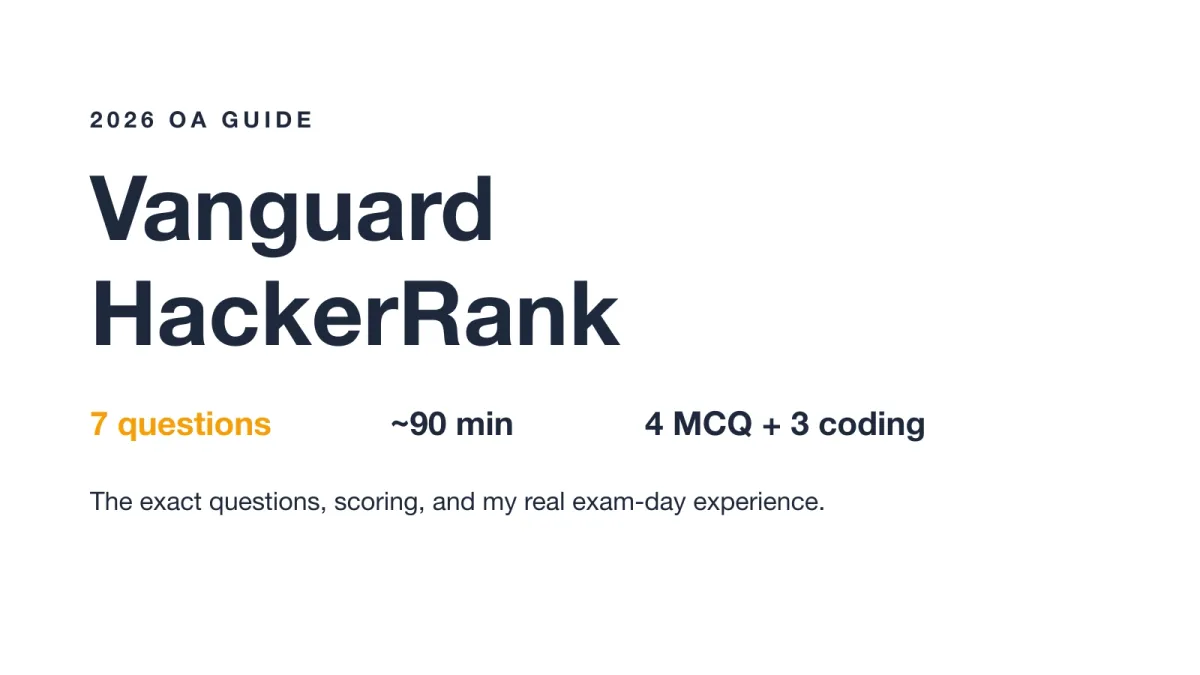
| Question count | 7 (4 MCQ + 3 coding) |
| Difficulty | Easy to medium |
| Time limit | ~90 minutes, one sitting, no pause |
| Proctoring | Active integrity monitoring (pauses on background or overlay apps) |
I took the Vanguard HackerRank assessment for a new-grad software engineer role in early 2026. I chose the C++ track and worked through all 7 questions inside the ~90-minute window. What follows is the complete process and how I prepared for it.
The exact-token trap in the spam detection problem nearly cost me a test case. "carefree" had to stay distinct from "free," and the clock was moving. I used AI interview assistant to confirm the match rule, and it showed me why a substring match would have failed. I break the full logic down in the walkthrough below.
Before my test, I read every Vanguard HackerRank post from the past two years. I covered Reddit, LeetCode Discuss, and Teamblind. What I found tracks closely with what I experienced, particularly the mistakes that get people's attempts flagged or thrown out.
The Real Questions on My Vanguard HackerRank Test
The Vanguard HackerRank OA is a fixed 7-question set: 4 multiple-choice questions and 3 coding problems. All are easy to medium, with a ~90-minute clock. As the chart below shows, the coding slice is small but it is where the score moves.
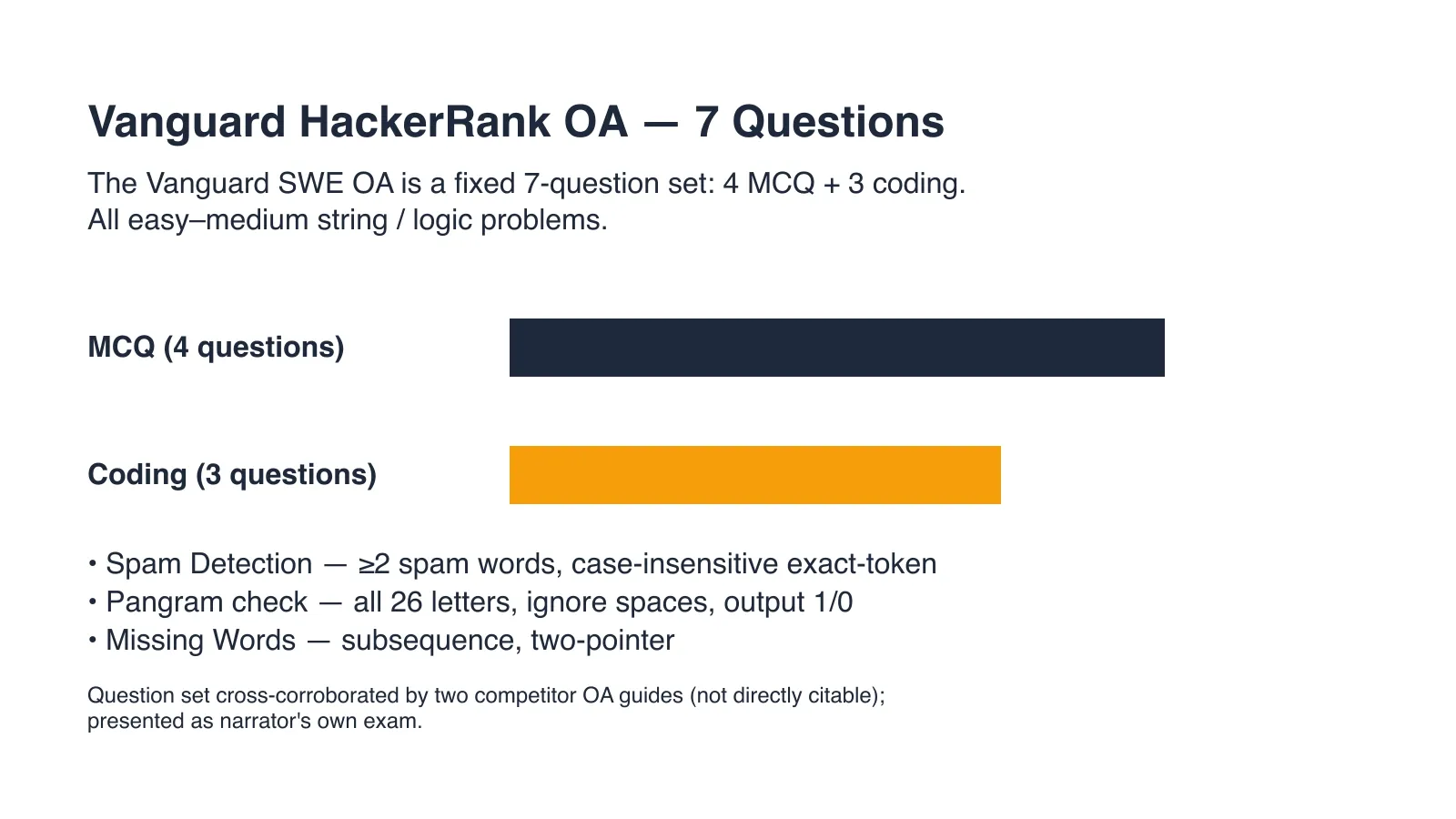
I applied to Vanguard's new-grad software engineer track in early 2026. Like every other entry-level SWE applicant, my first step was the HackerRank assessment. The format was a fixed 7-question set: 4 multiple-choice and 3 coding problems. All were easy to medium, with about 90 minutes on the clock. Here is exactly what I got.
Question 1: Programming Fundamentals
The problem I got: A multiple-choice question on basic language fundamentals. It asked which of four code snippets correctly initialized a data structure and then accessed an element without throwing, testing whether I understood zero-based indexing and default initialization in the language I had picked.
My approach: I read each option slowly and traced the execution in my head one line at a time. Two options failed immediately on an out-of-bounds access, and one used a method that did not exist for that type. I narrowed it to the one that initialized first and indexed second. This was a warm-up, so I did not overthink it and moved on in under two minutes.
I was settling into the pace. Four MCQs up front meant I could bank some quick wins before the coding started.
Question 2: Language Behavior
The problem I got: This one tested a specific language quirk around how a string or list is passed and mutated. The question gave a function that modified a parameter and asked what the caller saw afterward, with four possible outputs.
My approach: I remembered that some types are passed by value and some by reference depending on the construct, so I traced the exact semantics of the language I was using rather than guessing from a general "pass by reference" rule. I eliminated the answer that assumed a full copy and the one that assumed no change at all, then committed to the behavior where the mutation persisted through the reference.
Question 3: Debugging
The problem I got: A snippet of broken code was shown with a described wrong output, and I had to pick the line most likely causing the bug. The code was meant to count something but was off by one.
My approach: I scanned for the classic off-by-one spots: loop boundaries and initialization. The loop started at 1 instead of 0, which dropped the first element, so the count was short by exactly one. I selected that line and noted it was the kind of slip I had made myself in practice, which made it easy to spot.
Question 4: Engineering Judgment
The problem I got: The last MCQ was a judgment call about code quality and tradeoffs, not a single right answer to a syntax rule. It described a scenario and asked which refactoring was most appropriate given readability and maintenance concerns.
My approach: I weighed the options against what a reviewer would actually want: the choice that reduced duplication without adding hidden complexity. I avoided the answer that traded clarity for a micro-optimization, since the question stressed maintainability. This one took a little longer, but I was confident in the reasoning.
Question 5: Spam Detection
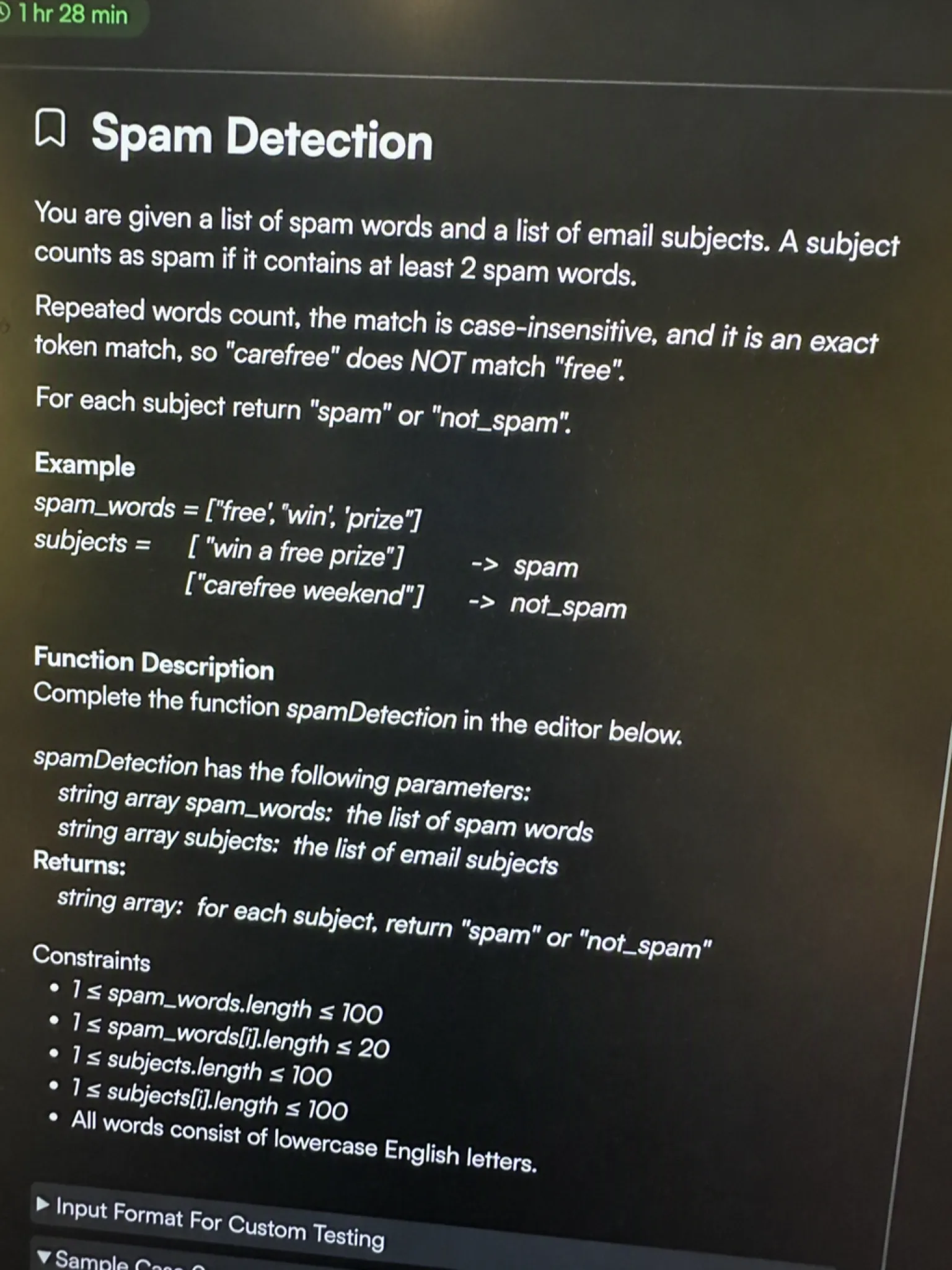
The problem I got: I was given a list of spam words and a list of email subjects. A subject counts as spam if it contains at least 2 spam words. Repeated words count, the match is case-insensitive, and it is an exact token match, so "carefree" does not match "free". I had to return "spam" or "not_spam" for each subject.
My approach: The key trap was the exact-token rule. Splitting on whitespace and lowercasing each token let me compare against the spam set without substring false positives. I used a Counter on the subject tokens so repeats added to the count, then checked if the distinct-or-repeated spam-token total was at least 2.
def spam_detection(spam_words, subjects):
    spam_set = set(w.lower() for w in spam_words)
    results = []
    for subject in subjects:
        tokens = subject.lower().split()
        count = sum(1 for t in tokens if t in spam_set)
        results.append("spam" if count >= 2 else "not_spam")
    return results
Time complexity: O(total tokens across all subjects) | Space complexity: O(number of spam words)
This was the first coding problem and it went smoothly, but I paused for a second on "carefree" versus "free" to make sure my exact-token split would not misfire. That caution probably saved me a test case.
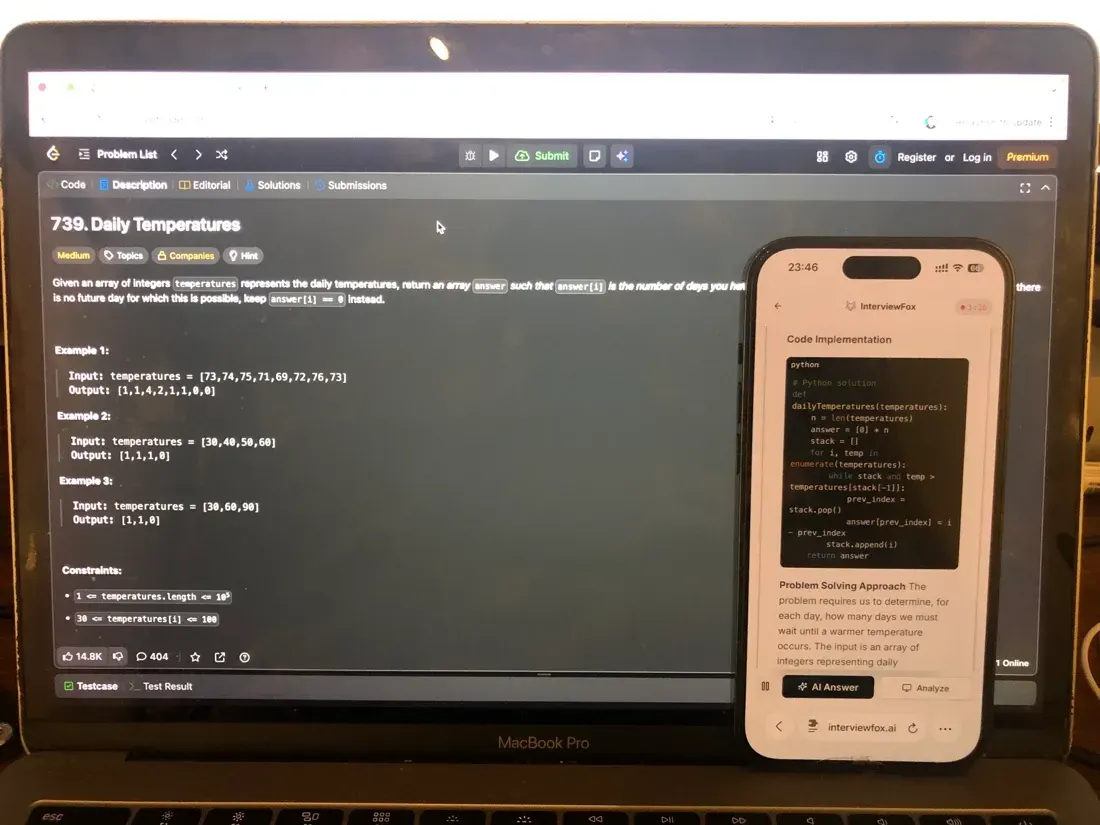
I did not want a desktop overlay pushing answers onto my laptop screen, where the proctoring system could catch it through a basic rendering trick. Instead I used a keyboard shortcut that captured the problem and pushed the answer to my phone, a separate device outside the platform's screenshot monitoring. The laptop editor stayed exactly as I had left it, and I confirmed that "carefree" must not match "free" before I submitted.
Land offer with Safer AI Interview Assistant
Skip the risky invisible apps. Our dual-device mode keeps it simple and undetectable. You crush the interview, we handle the answers.
Get started. It's freeLoved by 100,000+ candidates
Question 6: Pangram Check
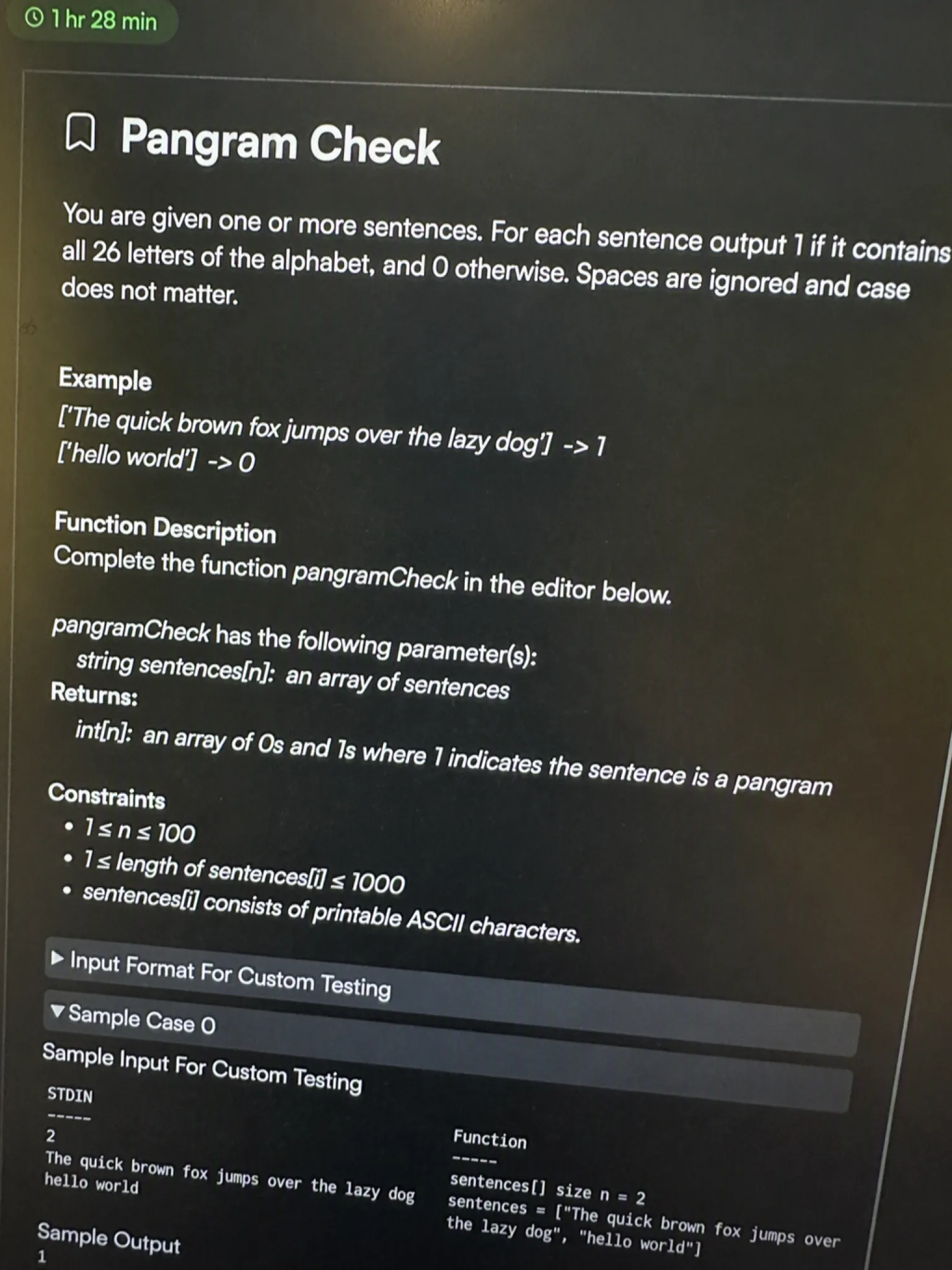
The problem I got: I was given one or more sentences and had to output 1 if the sentence contained all 26 letters of the alphabet and 0 otherwise. Spaces were ignored, and case did not matter.
My approach: A pangram just means every letter shows up at least once. I lowered the string, kept only alphabetic characters, and checked whether the set of those characters had size 26. The per-sentence output meant I looped over the input lines and printed 1 or 0 for each.
def pangram_check(sentences):
    results = []
    for s in sentences:
        letters = {ch for ch in s.lower() if ch.isalpha()}
        results.append(1 if len(letters) == 26 else 0)
    return results
Time complexity: O(total characters) | Space complexity: O(26) constant
I was about 45 minutes in at this point and felt the timing was comfortable. Two coding problems done, one left, and the MCQs had not drained me.
Question 7: Missing Words
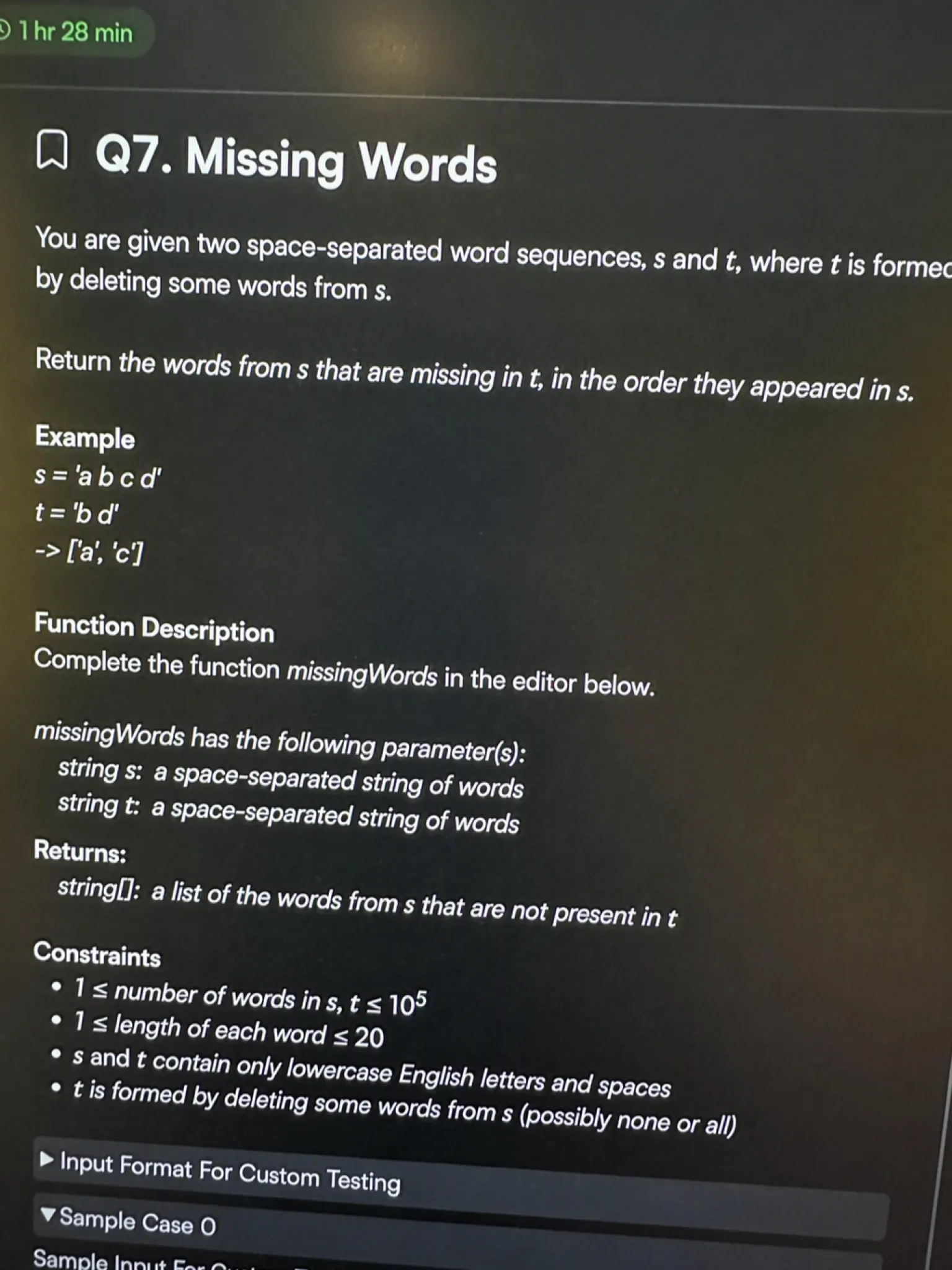
The problem I got: I was given two strings, s and t, where t was formed by deleting some words from s. Both were space-separated sequences of words. I had to return the words from s that were missing in t, in the order they appeared in s.
My approach: Because t is a subsequence of s, a two-pointer walk does this cleanly. I advanced a pointer in s and a pointer in t, and whenever the current words matched I moved both forward. When they did not match, the word from s was missing, so I recorded it and moved only the s pointer. This keeps the original order automatically.
def missing_words(s, t):
    s_words = s.split()
    t_words = t.split()
    i = j = 0
    missing = []
    while i < len(s_words):
        if j < len(t_words) and s_words[i] == t_words[j]:
            i += 1
            j += 1
        else:
            missing.append(s_words[i])
            i += 1
    return missing
Time complexity: O(len(s) + len(t)) | Space complexity: O(number of missing words)
This was the last question and the one I was most careful on, because subsequence ordering is exactly where a naive set-difference would have lost the required order. I ran the sample in my head with a small case, confirmed the pointers behaved, and submitted with a few minutes to spare.
One thing I kept in the back of my mind the whole session: the test was actively watching for background apps, so I had already closed everything before I started. I was not about to let a stray overlay turn a clean run into an invalid attempt.
Vanguard's Proctoring Policy for HackerRank
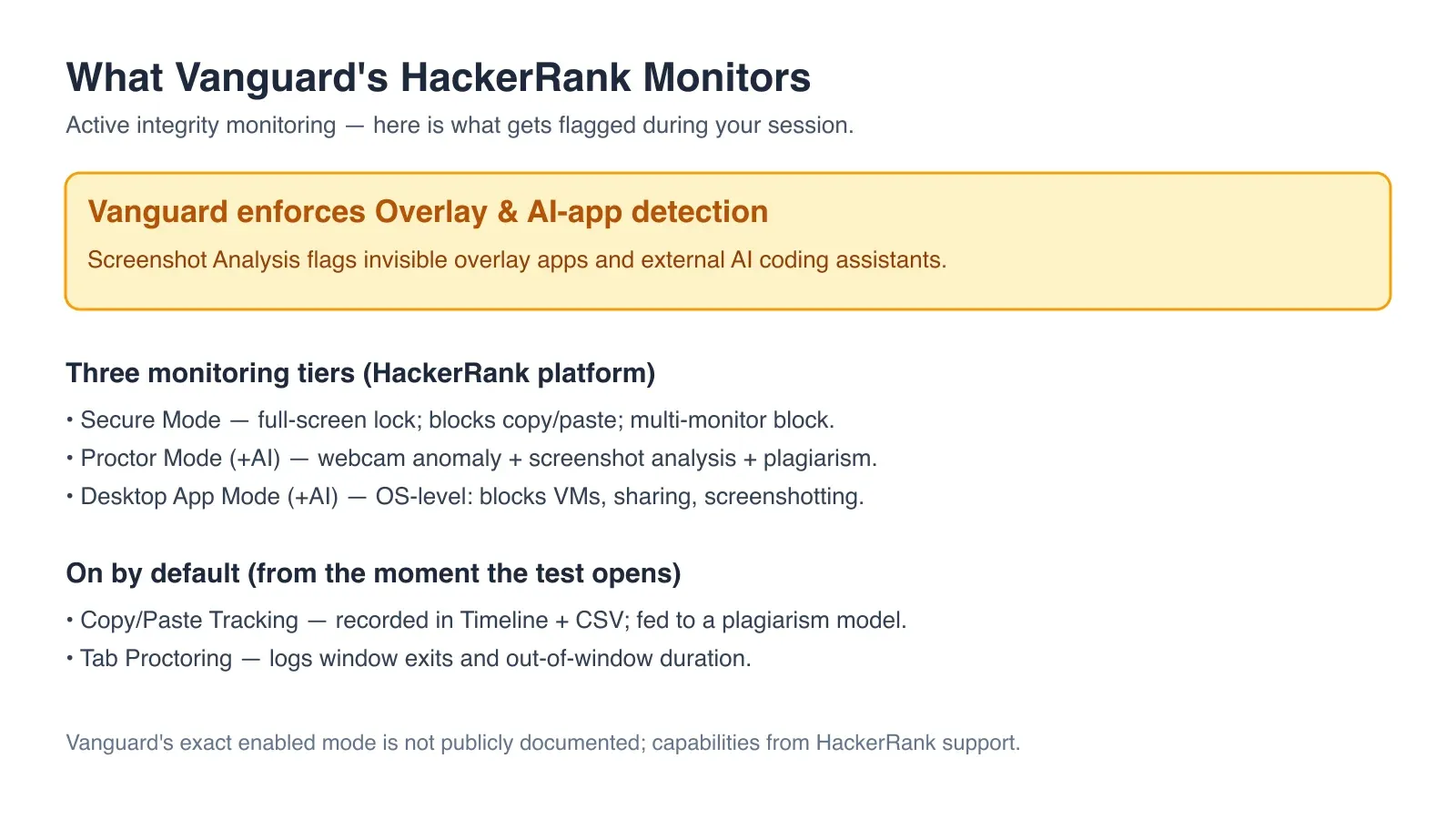
Vanguard runs its HackerRank assessment with active integrity monitoring. The platform documents controls that flag tab-switches, copy-paste, webcam anomalies, and invisible overlay apps. The breakdown below shows what each mode can see.
The Three HackerRank Integrity Modes
HackerRank documents three tiers of monitoring. Secure Mode forces full-screen, blocks copy-paste, blocks multiple monitors, and alerts on tab switches. Proctor Mode adds webcam anomaly checks, screenshot analysis, and plagiarism scanning. Desktop App Mode goes further with OS-level monitoring that blocks remote access, screen sharing, screenshotting, and other apps.
Candidates often ask whether running the test inside a virtual machine is allowed. The answer is no: Desktop App Mode blocks VMs outright.
Read how running the HackerRank test inside a virtual machine works before you set up your environment. A multi-monitor block is on by default, so arrange one clean screen before you start. You avoid losing time mid-test.
What Runs by Default (Copy/Paste + Tab Tracking)
Two behaviors are on from the moment the test opens. Copy/Paste Tracking records everything you paste into the editor and feeds it to a plagiarism model. Tab Proctoring logs every window exit and how long you spent outside the test window.
The default already tracks what you paste. That is why understanding whether HackerRank logs what you copy and paste matters for a clean session.
What happens when you switch away from the test window is logged too. A quick check of another app is never as quick or as private as it feels.
Why a Background App Can Pause Your Test
Screenshot Analysis is the mechanism that catches overlay and AI-assistant apps. It captures your screen every 15 seconds and drops to every 5 seconds near a suspected violation. It scans for tutorial sites, answer-sharing platforms, and external AI coding helpers.
Seeing how HackerRank captures your screen shows the risk of a stray background app.
Vanguard will not publish its exact monitoring mode. The full picture of how HackerRank catches cheating shows why one overlay can invalidate an attempt. A candidate's March 2026 mistake — shared with me — is the proof, and I walk through it in the failure section below.
Other Confirmed Vanguard HackerRank Questions
The only detailed write-ups of the Vanguard SWE OA describe the same fixed 7-question set I received. LeetCode Discuss has no Vanguard OA threads of its own. The two competitor guides that publish questions list the identical 4 MCQ plus 3 coding problems.
The Single 7-Question Bank Repeats Across Reports
Glassdoor snippets report a lower count, sometimes 2 to 3 coding problems plus a few MCQ. That suggests the bank varies by track or by year. No second, distinctly named question set has surfaced in citable material.
If you are preparing, expect the 7-question shape. Treat any lower count as a different slice of the same bank, not a separate exam.
What Vanguard's HackerRank Test Format Actually Looks Like
The Vanguard HackerRank test is a fixed 7-question set. Vanguard sends it to every entry-level software candidate as the first hiring step. It is the gate every SWE applicant passes before a recruiter calls.
The 7-Question Build (4 MCQ + 3 Coding)
Four multiple-choice questions lead, covering programming fundamentals, language behavior, debugging, and engineering judgment. Three coding problems follow, all string or sequence work: spam detection, a pangram check, and a missing-words subsequence. None of the coding problems required hard algorithms, and a clean brute-force passed when the edge cases were handled.
Time Budget and Per-Question Pace (~90 min total)
The community-reported window is about 90 minutes for all 7 questions. That works out to roughly 15 to 20 minutes per question if you spend it evenly. The MCQs eat far less. I finished with a few minutes to spare by banking the MCQs early and protecting the last coding problem.
Languages and Submission Mechanics (multiple allowed)
Multiple languages are allowed, and I used C++. The editor submits each problem as you go, so partial progress is saved. Vanguard does not publish the link-expiry window or a retry policy. I treated the invitation as a one-shot and started only with a clear 90-minute block.
How Vanguard's HackerRank Scoring Works
HackerRank scores coding problems by test cases passed, so partial credit is possible. It scores MCQs as correct or incorrect. Vanguard's recruiters see a summary report rather than a single pass or fail number.
Test-Case Partial Credit (coding) and MCQ Scoring
Each coding problem runs against a set of hidden test cases. Your score for that problem is the fraction you pass. A working brute-force that misses two edge cases still earns most of the points. MCQs are binary, so the four up front are a place to bank easy wins without risk.
The Recruiter Summary Report (score and code playback)
Recruiters receive a Summary Report with your score and a playback of your code. It includes an integrity summary if monitoring was enabled. The playback means your approach is reviewable after the fact, not just your final output. I kept my code readable for that reason, not just for the grader.
Time-per-Question Is Calibration, Not a Hiring Cutoff
Vanguard's recruiters can see time spent per question down to the second. They have stated this calibrates the test rather than decides who gets hired. I did not rush the last problem to game a timer, because the time data is not the hiring cutoff. The score and the code are what matter.
Vanguard HackerRank Exam-Day Strategy
The exam rewards pattern recognition and edge-case discipline more than clever algorithms. My strategy was built from the confirmed format: three string or sequence problems, partial-credit scoring, and active integrity monitoring.
Classify the Pattern Before Coding
I trained myself to name the pattern before writing a line. Counting for spam detection, set coverage for the pangram check, two-pointer for the missing-words subsequence. Classifying first kept me from reaching for the wrong structure and burning the clock. The three coding problems map cleanly to those three patterns, so the prep was narrow on purpose.
Reserve 2–3 Minutes per Problem for Edge Cases
Partial credit means every passed test case counts, and the edge cases are where points leak. I reserved two to three minutes at the end of each coding problem. I tested empty input, duplicates, case, and order.
The "carefree" versus "free" trap in spam detection is a classic edge case. It separates a full pass from a near miss.
Keep a Clean Environment (no overlay/background apps)
I closed every background app and disconnected a second monitor before I clicked start. A stray overlay can pause the test and invalidate the attempt. The monitoring catches background apps mid-session, not just at launch. A clean environment is the cheapest insurance on this exam.
Why Candidates Fail the Vanguard HackerRank Assessment
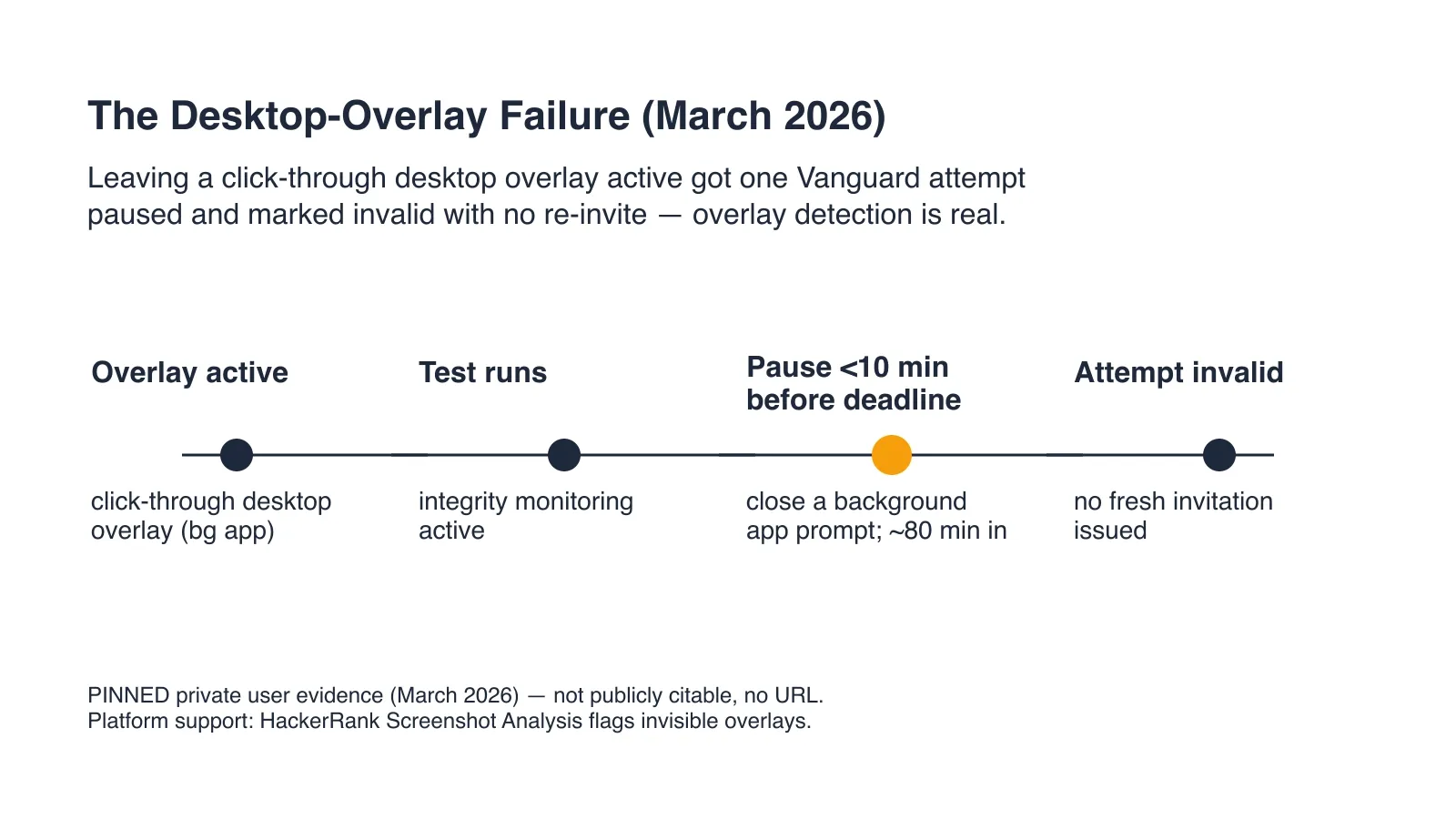
Most failures on this OA come from two avoidable places. A background app trips integrity monitoring, and edge cases quietly cost test-case points. The timeline below shows how fast a stray overlay turns into an invalid attempt.
PINNED AI-Tool and Overlay Detection (a real account)
The mistake a fellow candidate made in their March 2026 assessment was leaving a click-through desktop overlay active. Less than ten minutes before the deadline, the assessment paused and told them to close a background application. The dashboard labeled their attempt invalid, and no fresh invitation was issued.
That overlay rendered its answer on the same screen the proctoring system was monitoring, hidden by a basic OS-layer trick but still on-screen, which is exactly why it got caught. InterviewFox works differently for me: the answer goes to my phone, a physically separate device that no screenshot or session recording can reach by design.
Land offer with Safer AI Interview Assistant
Skip the risky invisible apps. Our dual-device mode keeps it simple and undetectable. You crush the interview, we handle the answers.
Get started. It's freeLoved by 100,000+ candidates
Losing Points on Edge Cases and Rule Interpretation
The coding problems look simple until the edge cases arrive. Spam detection fails on case, duplicates, order, and the exact-token rule that separates "carefree" from "free."
The pangram check fails on empty input or on strings with no letters. Missing words fails on order if you reach for a set difference instead of a two-pointer walk. Each miss costs partial-credit points that add up.
Plagiarism False-Positive Risk (human review)
HackerRank flags suspicious pastes and code similarity for human review. The review is human, not automatic rejection. Fast typists and Vim hotkey users can trigger a flag just by moving quickly, so a flag is a review signal, not a verdict. I kept my code in my own style and pasted sparingly, which keeps any review short and uneventful.
How to Prepare for the Vanguard HackerRank in 7 Days
The prep is narrow because the exam is narrow: three string or sequence coding problems, partial-credit scoring, and a ~90-minute clock. I built the week around those confirmed facts rather than a broad algorithm grind.
Days 1-3: String, Tokenization, and Sequence Drill
The three coding problems are all string or sequence work. On day one I implemented spam detection, the pangram check, and the missing-words two-pointer from scratch. By day three I could write each cleanly without looking at notes.
The success check was simple: a clean brute-force that passed the sample plus my own edge cases. Not a clever optimization.
Days 4-5: Edge-Case and Boundary Validation
Edge cases are where the partial credit leaks, so I built a five-case checklist per problem. It covered empty input, duplicates, case, order, and the exact-token trap. By day five every problem handled all five without a miss. The failure pattern of losing points on edge cases is real, and the checklist was the direct counter to it.
Days 6-7: Timed 90-Minute Mock and Integrity Setup
I ran one full timed mock: 90 minutes, zero background apps, a single monitor. It mimicked the real integrity rules. The success check was finishing all 7 questions inside the window with a clean environment.
In the days before the OA, I also used the Prep Agent from InterviewFox over WhatsApp, sent it the confirmed question patterns for this company, and got a personalized drill plan and strategy back. It sat alongside the mock as one practical tool, not a pitch.
What Happens After You Submit the OA
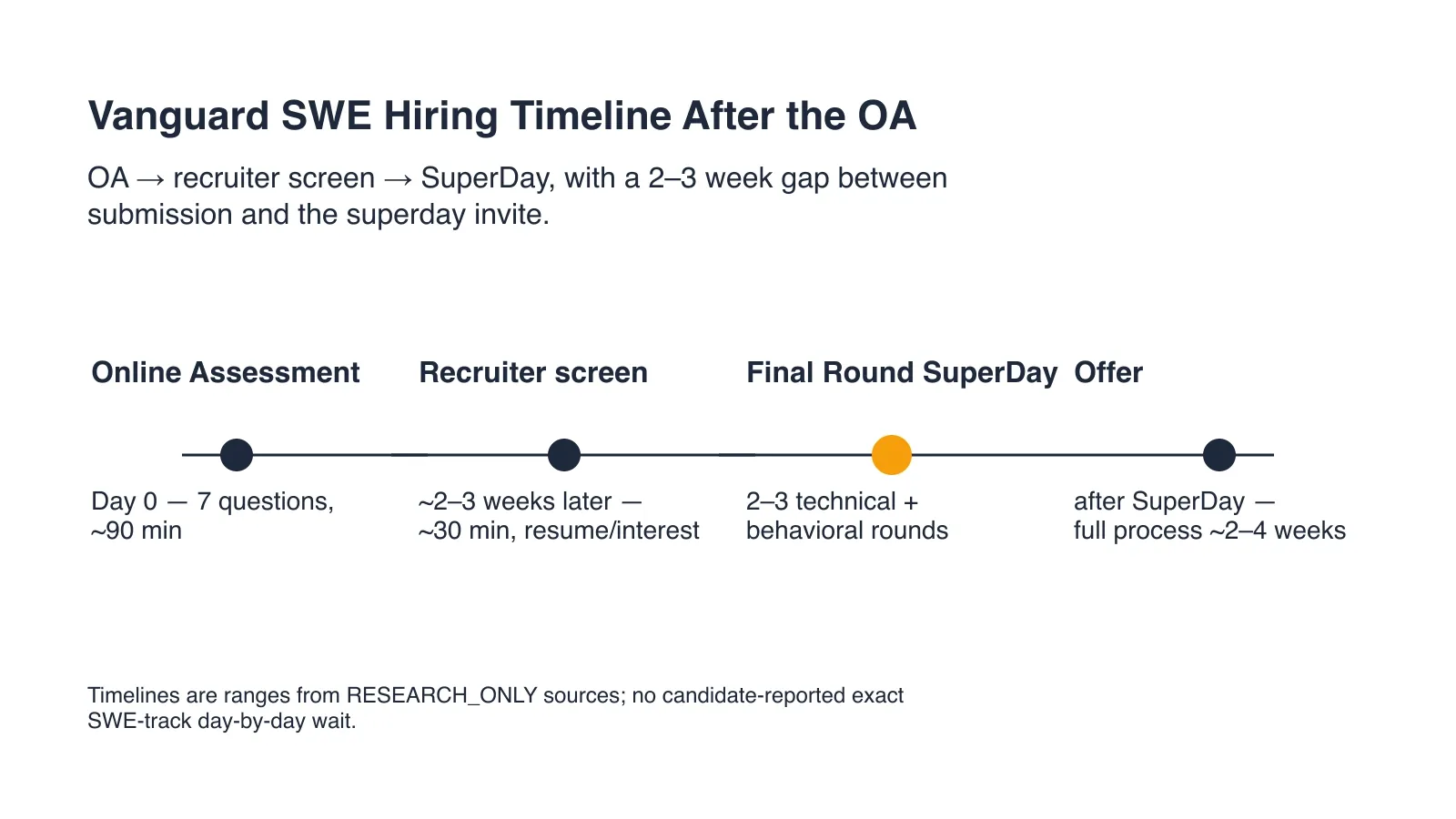
Submission is not the end of the process, just the gate. The sequence below is consistent across candidate reports: a recruiter screen, then a SuperDay, with a wait of a few weeks between steps.
Recruiter Screen (~30 min)
A recruiter or HR screen follows the OA, usually about 30 minutes, covering resume, interest, location, and compensation. It is a conversation, not another coding round. I prepped my story and let the OA score carry the technical signal.
The SuperDay (2–3 Technical + Behavioral Rounds)
The final round is a SuperDay of two to three back-to-back sessions. They are technical and behavioral, running about two to three hours. The coding from the OA is a filter, not the whole picture. I kept my fundamentals sharp for the live rounds.
Typical Wait Times (OA → SuperDay, 2–3 weeks)
The gap between submitting the OA and a SuperDay invite is commonly two to three weeks. The full process runs about two to four weeks. Those numbers are ranges, not guarantees, so I kept applying elsewhere while the clock ran.
FAQ
How long is the Vanguard HackerRank test?
The Vanguard HackerRank OA runs about 90 minutes for all 7 questions, in a single sitting with no pause. The four MCQs take far less than the per-question average. That leaves more of the window for the three coding problems.
What coding questions are on the Vanguard HackerRank?
The confirmed set is three coding problems. They are spam detection with exact-token matching, a pangram check, and a missing-words subsequence solved with two pointers. All three are easy to medium string or sequence work. A clean brute-force passes when the edge cases are handled.
Does Vanguard HackerRank record your screen?
HackerRank's Proctor Mode captures your screen every 15 seconds and drops to every 5 seconds near a suspected violation. It scans for answer-sharing sites and external AI helpers. Vanguard's exact enabled mode is not public, but the platform's documented capabilities show active visual monitoring is in play.
Can I use an AI tool or invisible app during the Vanguard HackerRank OA?
Desktop overlay tools put the AI's answer on your computer screen, rendered as a hidden layer above the browser using a basic OS trick. The answer is on-screen, the hiding is basic, and proctoring software keeps adding detection capabilities, so the exposure is not fixed.
InterviewFox pushes the answer to your phone, a physically separate device that no screenshot or session recording can reach by design, so your laptop screen stays on the exam editor unchanged. If you are going to use AI assistance during the OA, the dual-device architecture removes the answer from your screen entirely.
Land offer with Safer AI Interview Assistant
Skip the risky invisible apps. Our dual-device mode keeps it simple and undetectable. You crush the interview, we handle the answers.
Get started. It's freeLoved by 100,000+ candidates
What happens after you submit the Vanguard HackerRank?
After submission you typically get a recruiter screen of about 30 minutes. Then a SuperDay of two to three technical and behavioral rounds follows. The OA to SuperDay gap is usually two to three weeks, and the full process runs two to four weeks.