
I Nailed HackerRank VMware in 2026: Real Questions and Prep

Quick Facts
| Assessment Platform | HackerRank |
| Duration | 90 minutes, one sitting, no pause |
| Question Count | 2 to 3 coding problems plus optional CS MCQs |
| Proctoring Environment | HackerRank Secure Mode with fullscreen enforcement |
| Invitation Window | 7 calendar days from receipt |
| Allowed Languages | C++, Java, Python, Go, and standard HackerRank runtimes |
| Passing Cutoff | ~80% to 85% of total points (full marks on Q1 and Q2) |
I took the hackerrank vmware assessment for an early-career systems role in late 2025 for the 2026 cycle. I solved all three coding problems in C++ within the 90-minute limit. What follows is the full technical guide and how I prepared for it.
With twenty minutes left on the base conversion question, I hit a bug. My code failed hidden test cases due to an integer overflow. Using a dual device AI interview copilot outside the test computer showed me the 64-bit limit right away. I walk through that fix in the Question 3 section below.
Before my test, I went through every VMware HackerRank post from the past two years on Reddit, LeetCode Discuss, and Teamblind. What I found tracks closely with what I experienced. Below, I break down the exact problem constraints, the scoring thresholds, and the proctoring traps that disqualify candidates.
The Real Questions on My VMware HackerRank Test
I took VMware's software engineering online assessment through HackerRank for an early-career systems track. The test allocated 90 minutes for three coding problems, advancing in difficulty from bit-manipulation sorting to multi-query range processing and arbitrary-base algorithmic simulation.
Question 1: Cardinality Sorting — Bit Count Custom Sort
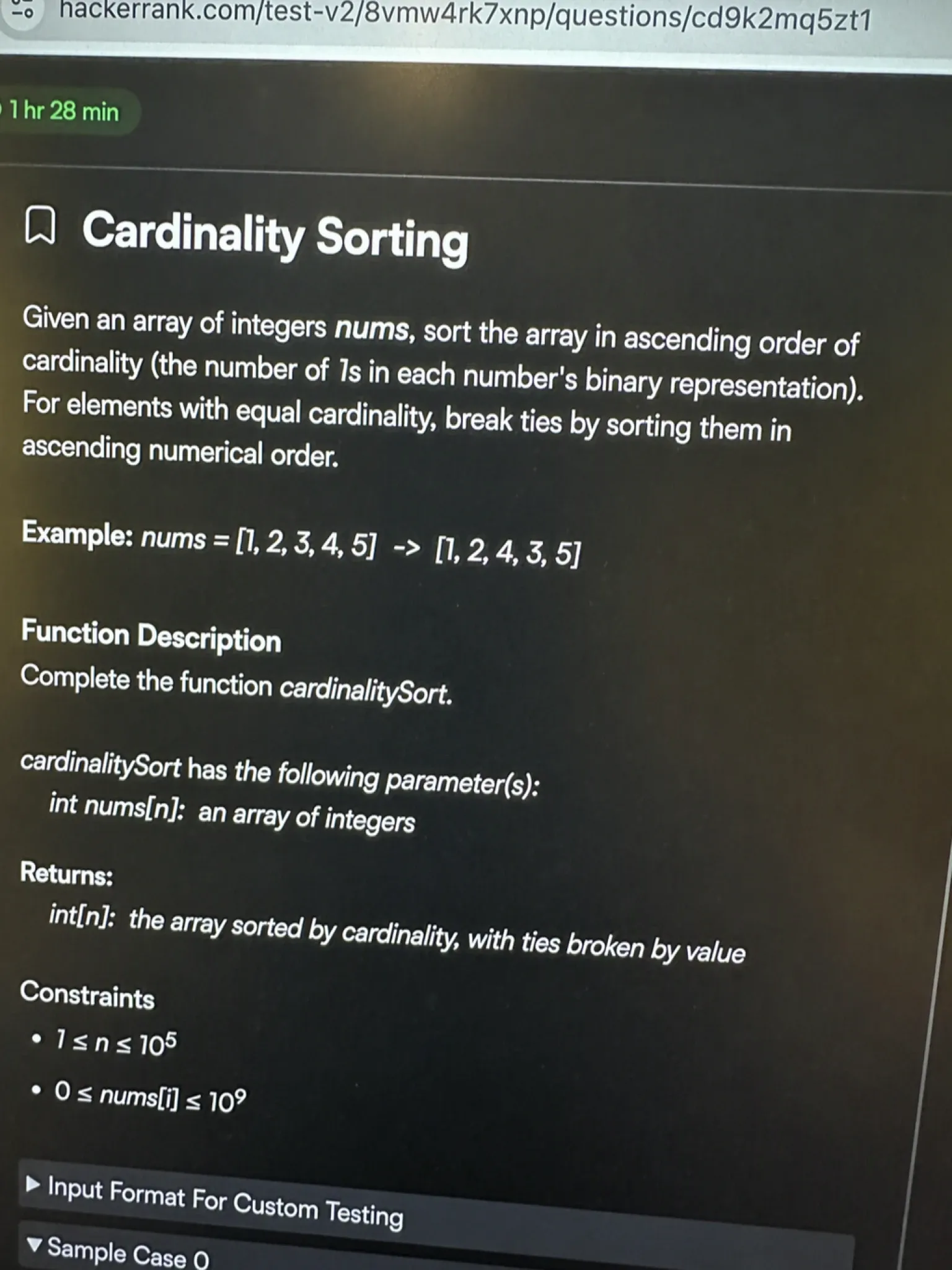
The problem I got: I received an array of $N$ positive integers and had to sort them according to two strict criteria. The primary sort key was each number's cardinality, defined as the number of set bits (binary 1s) in its binary representation, ordered from fewest to most set bits. For any numbers sharing the same cardinality, the tiebreaker required sorting them in ascending decimal order.
My approach: Because $N$ could scale up to $10^5$ with integer values up to $10^9$, computing bit counts naively inside a custom comparator using repeated division by 2 would trigger significant runtime overhead and risk timeout on larger test suites. In C++, __builtin_popcount executes via dedicated CPU hardware instructions (such as POPCNT on x86 architectures) in $O(1)$ constant time. I implemented a lambda comparator that evaluates bit counts first and defaults to standard numeric comparison whenever cardinalities match.
#include <vector>
#include <algorithm>

std::vector<int> cardinalitySort(std::vector<int> nums) {
    std::sort(nums.begin(), nums.end(), [](int a, int b) {
        int countA = __builtin_popcount(a);
        int countB = __builtin_popcount(b);
        if (countA != countB) {
            return countA < countB;
        }
        return a < b;
    });
    return nums;
}
Time complexity: $O(N \log N)$ | Space complexity: $O(1)$ auxiliary space
I spent approximately 15 minutes parsing the input format, implementing the comparator, and verifying all sample test cases. Passing all initial tests gave me an immediate baseline of points before moving to the longer algorithmic questions.
Question 2: Distinct Digit Range Queries — Frequency Counting at Scale
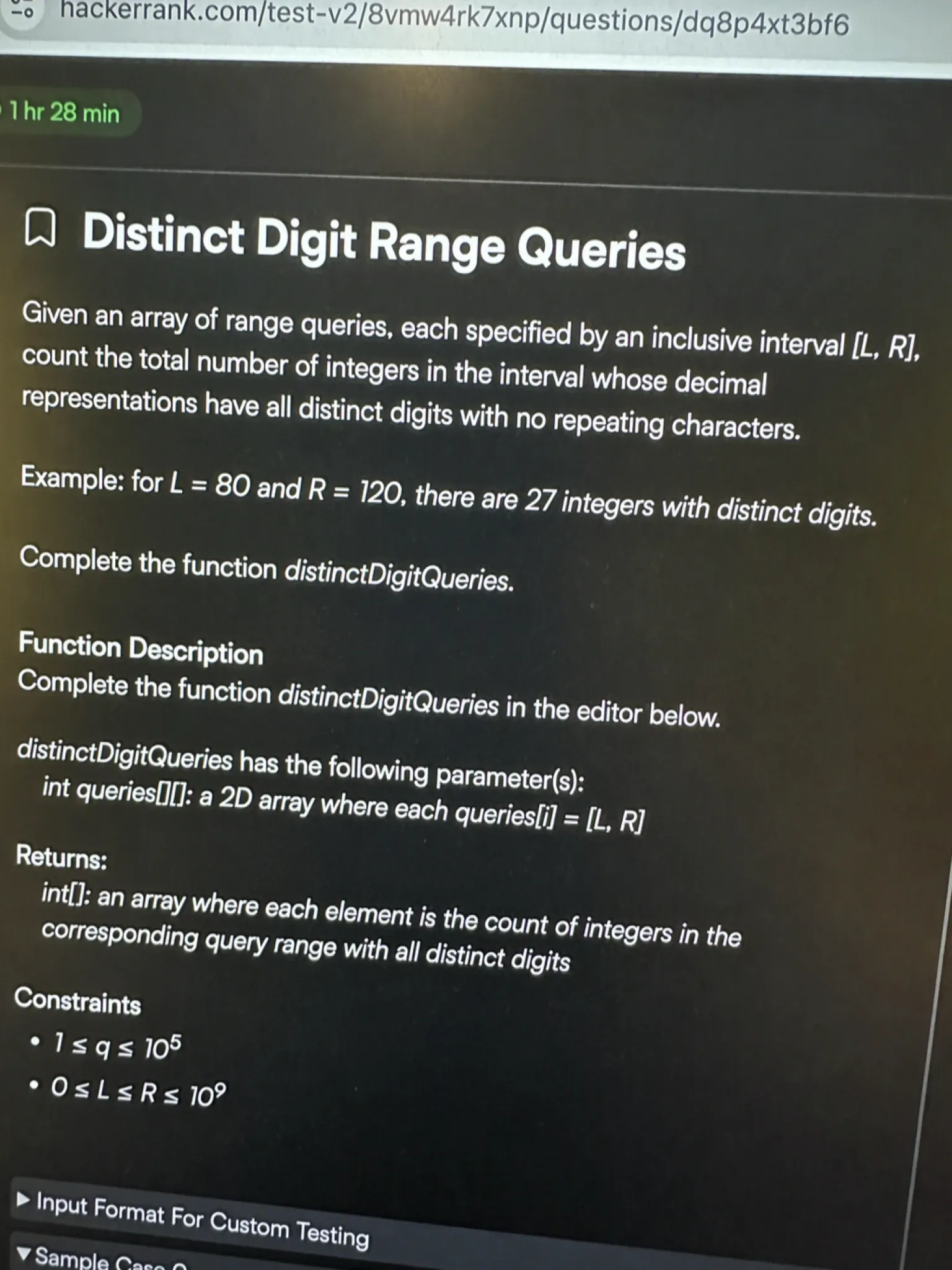
The problem I got: The second question presented $Q$ independent range queries. Each query supplied two integers, $L$ and $R$, defining an inclusive interval $[L, R]$. For each query, I had to return the count of integers in that range whose decimal representations consist of completely distinct digits with zero repetitions.
My approach: The upper bounds were $Q \le 10^5$ and $R \le 10^5$. A naive brute-force loop iterating through every integer in each query interval and extracting its digits would require roughly $O(Q \times (R - L) \times \log_{10} R)$ operations, which on $10^5$ queries can reach up to $10^{10}$ operations and guarantee a Time Limit Exceeded (TLE) verdict. Because the maximum possible value of $R$ was fixed at $10^5$, I used an offline precomputation strategy with a prefix sum array. I precomputed whether each integer from 1 to $10^5$ has unique digits using a boolean helper and accumulated the counts into a running prefix sum array. Each incoming query $[L, R]$ was then answered in $O(1)$ time by evaluating prefix[R] - prefix[L - 1].
#include <vector>

bool hasDistinctDigits(int n) {
    int mask = 0;
    while (n > 0) {
        int digit = n % 10;
        if (mask & (1 << digit)) {
            return false;
        }
        mask |= (1 << digit);
        n /= 10;
    }
    return true;
}

std::vector<int> distinctDigitQueries(const std::vector<std::pair<int, int>>& queries) {
    const int MAX_VAL = 100000;
    std::vector<int> prefix(MAX_VAL + 1, 0);

    for (int i = 1; i <= MAX_VAL; ++i) {
        prefix[i] = prefix[i - 1] + (hasDistinctDigits(i) ? 1 : 0);
    }

    std::vector<int> results;
    results.reserve(queries.size());
    for (const auto& q : queries) {
        int L = q.first;
        int R = q.second;
        results.push_back(prefix[R] - prefix[L - 1]);
    }
    return results;
}
Time complexity: $O(M \log_{10} M + Q)$ where $M = 10^5$ | Space complexity: $O(M)$ auxiliary array
The precomputation resolved in less than 15 milliseconds locally, and running the query set cleared all visible test cases within 25 minutes of total work.
Question 3: Digitally Balanced Numbers in a Base — Frequency Uniformity
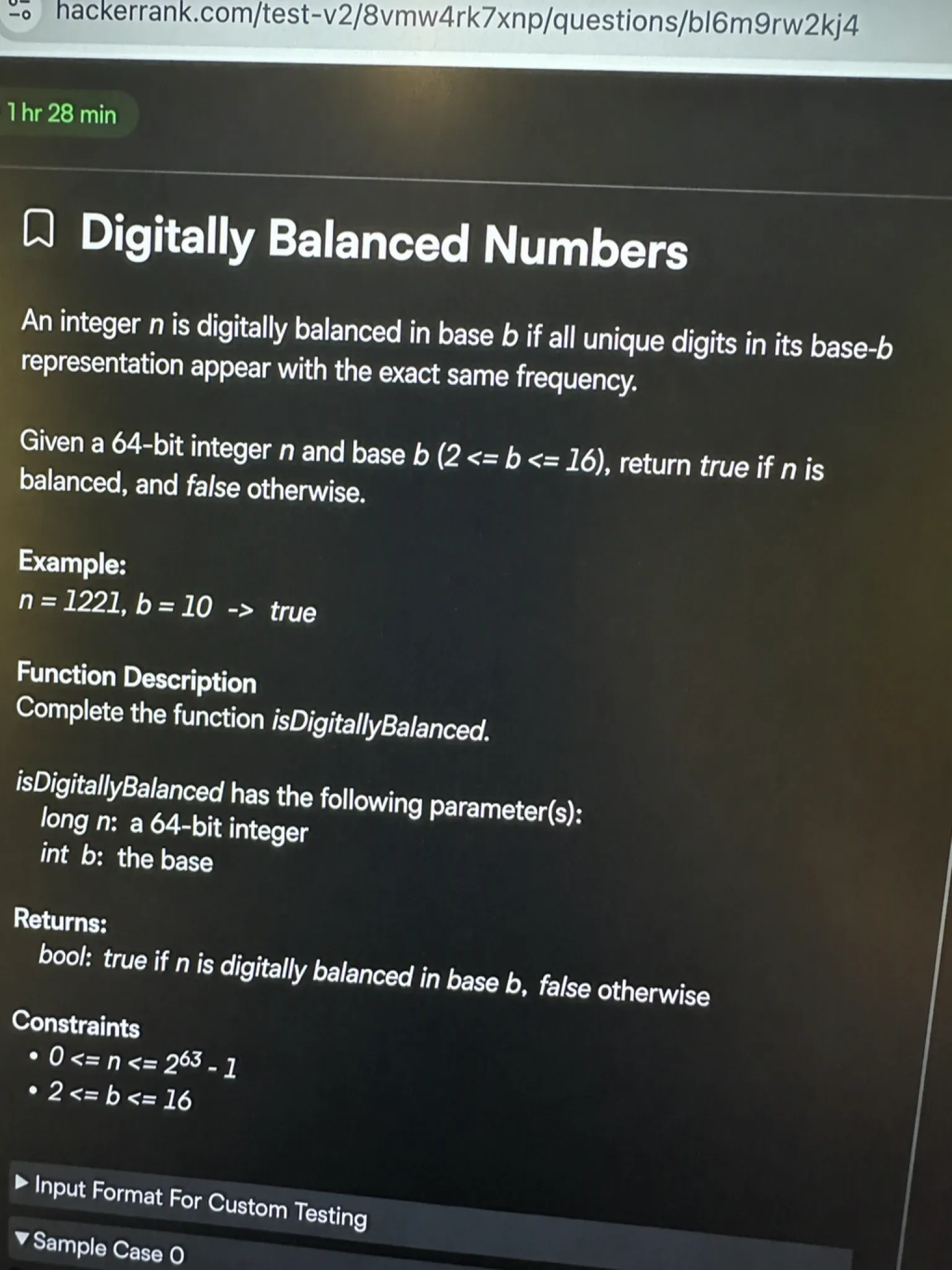
The problem I got: An integer $N$ is defined as "digitally balanced" in base $B$ if every distinct digit that appears at least once in its base-$B$ representation occurs with the exact same frequency. Given a 64-bit integer $N$ and a base $B$ ranging from 2 to 16, I had to determine whether $N$ is balanced, returning true if all appearing digits share an identical count and false otherwise.
My approach: Because $N$ could reach $10^{14}$, the input exceeded standard 32-bit signed integer limits, requiring 64-bit data types (long long in C++). I handled the edge case where $N = 0$ directly, then converted $N$ to base $B$ using successive modulo operations while tallying digit frequencies in a frequency table of size $B$. Once all digits were extracted, I inspected the frequency table to ensure all non-zero counts matched the frequency of the first observed digit.
#include <vector>

bool isDigitallyBalanced(long long n, int b) {
    if (n == 0) {
        return true;
    }

    std::vector<int> freq(b, 0);
    while (n > 0) {
        int remainder = n % b;
        freq[remainder]++;
        n /= b;
    }

    int targetFreq = -1;
    for (int count : freq) {
        if (count > 0) {
            if (targetFreq == -1) {
                targetFreq = count;
            } else if (count != targetFreq) {
                return false;
            }
        }
    }
    return true;
}
Time complexity: $O(\log_B N)$ | Space complexity: $O(B)$ frequency table
With under 25 minutes remaining, I initially overlooked the 64-bit integer overflow requirement and failed two hidden boundary test cases on the maximum input range.
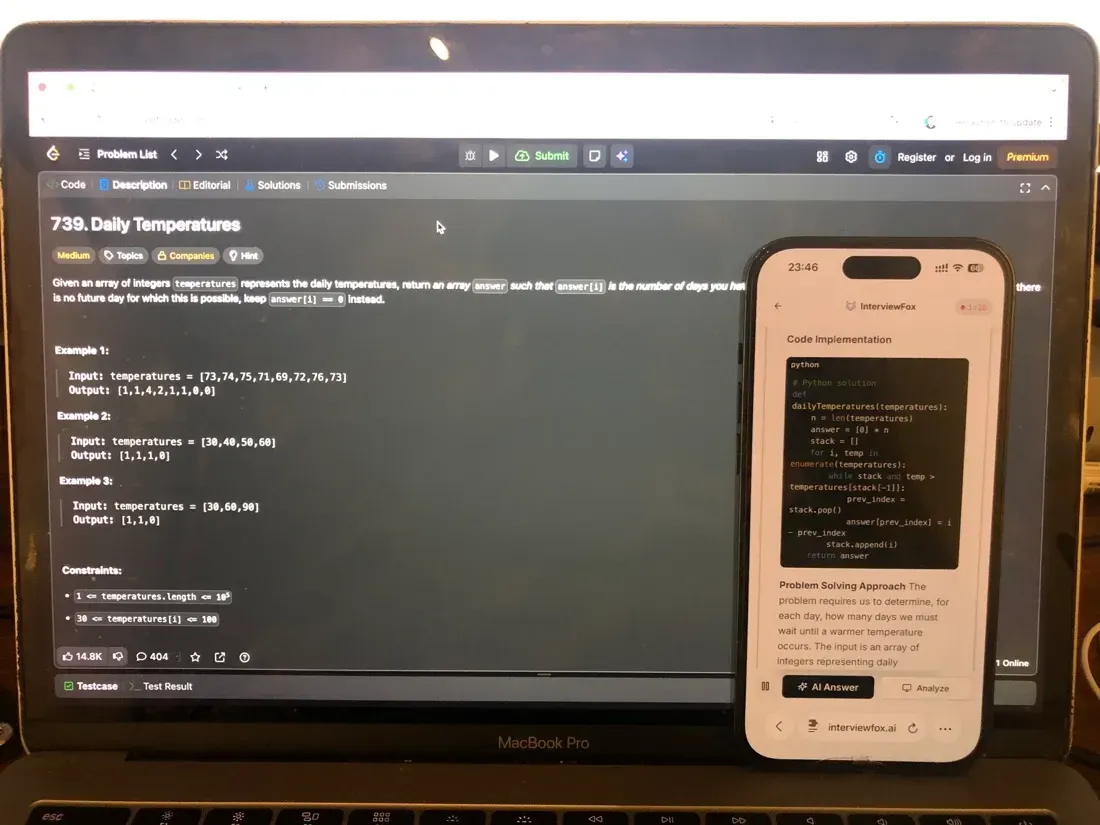
I didn't want to use a desktop overlay: the answer would have been on the same screen the proctoring system was monitoring, hidden by a basic rendering layer. Whether that gets flagged depends on what detection is currently running, and I didn't want that uncertainty in the background. With the clock ticking on Question 3, I pressed my keyboard shortcut to capture the problem statement. The clean approach pushed straight to my phone outside HackerRank's screenshot monitoring, leaving my laptop screen locked on the editor.
Land offer with Safer AI Interview Assistant
Skip the risky invisible apps. Our dual-device mode keeps it simple and undetectable. You crush the interview, we handle the answers.
Get started. It's freeLoved by 100,000+ candidates
VMware's Proctoring Policy for HackerRank
VMware uses HackerRank Secure Mode to protect test integrity. As the sequence diagram below shows, the system records candidate focus throughout the 90 minutes.
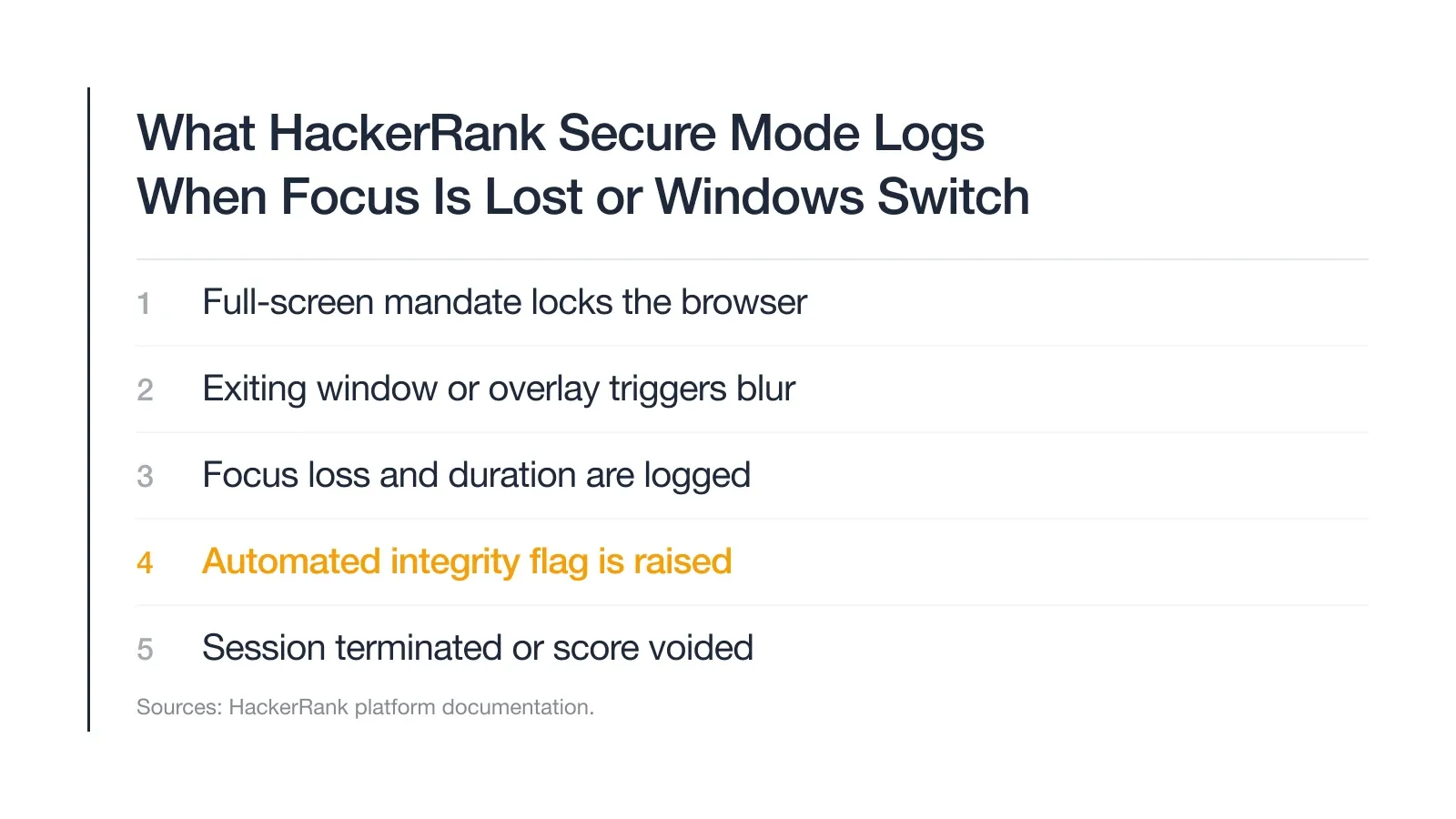
What HackerRank Secure Mode Actually Logs
Before the test starts, the interface forces the browser into fullscreen mode. HackerRank details these technical environment controls in their official Secure Mode documentation .
Leaving fullscreen triggers an instant focus-loss alert in the candidate log. To see which timestamps recruiters review after submission, read our analysis on how HackerRank tracks tab switching.
Clipboard actions face the same tracking inside the code editor. Candidates who want to avoid integrity flags should review how HackerRank monitors copy and paste during timed tests.
Can candidates connect a second display for extra space? In fact, the proctoring system blocks extra screens at launch, as explained in our guide to HackerRank multiple monitor restrictions.
Why Background Overlays Risk an Immediate Voided Session
Some applicants run transparent desktop overlays to display notes or code hints. However, these tools rely on desktop graphics layers that conflict directly with browser fullscreen hooks.
When an operating system renders an overlay window, the browser loses active focus. Even a brief window flicker creates an automated blur event in HackerRank audit logs.
While Secure Mode logs focus loss, many wonder whether the platform records screen video. To clarify what the testing engine actually records, see our analysis on whether HackerRank records your screen.
As a result, repeated focus-loss events flag the session for manual integrity audit. In severe cases, the proctoring engine ends the test before the candidate can submit code.
What VMware's HackerRank Test Format Actually Looks Like
VMware gives candidates 90 minutes for the entire test without breaks. The infographic below outlines how the platform structures the test sections and countdown timer.
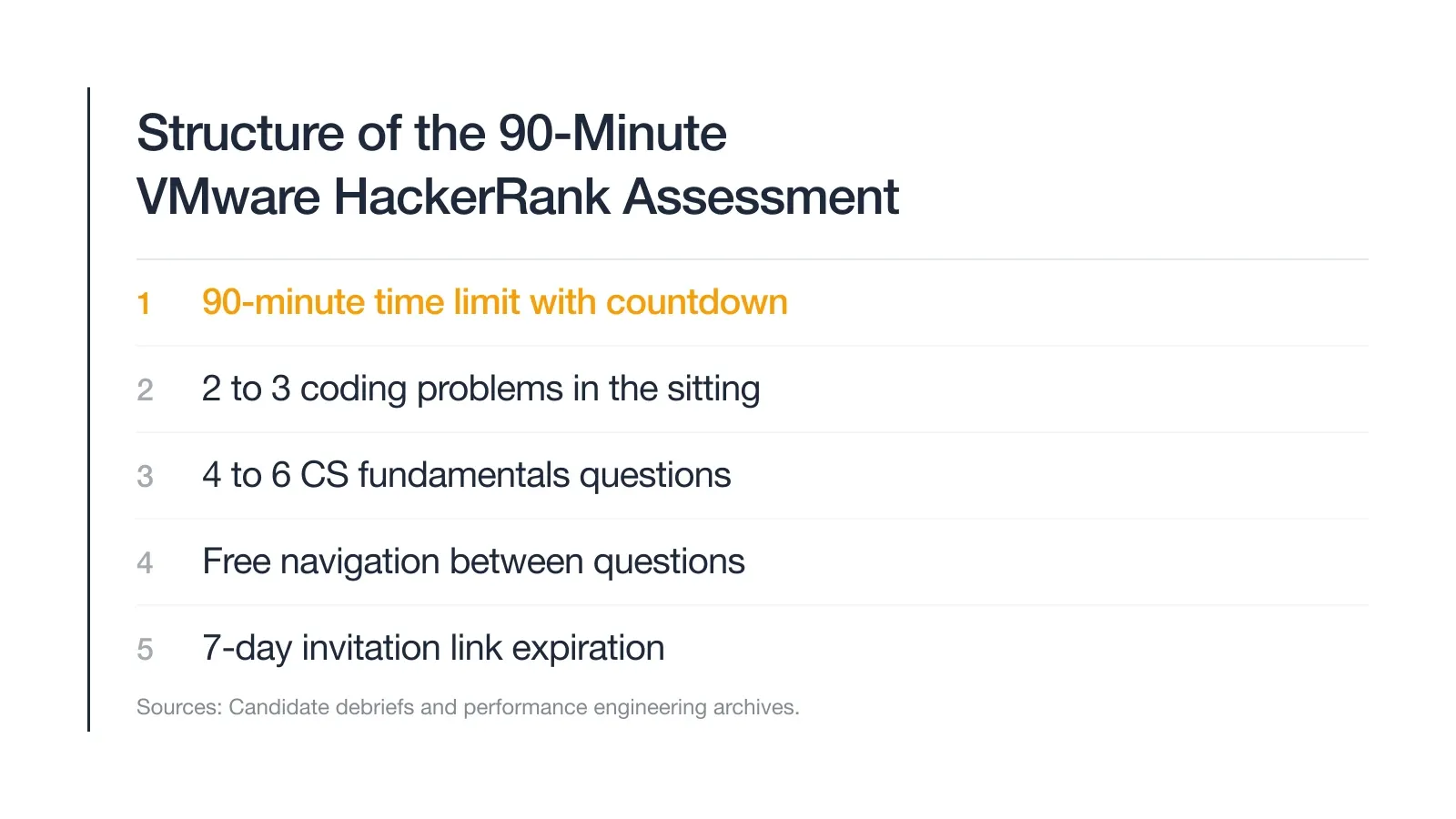
The 90-Minute Time Limit and Section Breakdown
The standard test presents two to three coding problems. In addition, systems tracks often include four to six multiple-choice questions on operating systems, networking, and object-oriented design.
The 90-minute countdown timer runs continuously once you click start. When the clock hits zero, the platform submits your code and answers automatically.
Navigation Flexibility and Platform Rules
HackerRank allows free movement between all test sections. As a result, you can solve questions in any order and run visible test cases as often as needed.
The test link remains valid for seven calendar days from receipt. Therefore, I recommend starting the test during a quiet window to avoid network disruptions.
2 Other Confirmed VMware HackerRank Questions
Beyond the questions on my exam, candidate notes confirm two other common problems in VMware's HackerRank pool. Below are their full problem specifications, optimal algorithms, and complete C++ implementations.
Maximum K x K Submatrix Sum
A candidate debrief from an on-campus VMware software drive documented this 2D grid problem. Given an $M \times N$ matrix of integers and an integer $K$, you must find the maximum sum of any contiguous $K \times K$ submatrix.
A naive approach computes the sum of each $K \times K$ submatrix by looping over all its elements. That takes $O(M \times N \times K^2)$ time, which times out when $M, N = 1000$ and $K = 500$.
The optimal approach precomputes a 2D prefix sum array in $O(M \times N)$ time. Any $K \times K$ submatrix sum evaluates in $O(1)$ constant time using 2D range sum queries.
#include <vector>
#include <algorithm>
#include <climits>

int maxSubmatrixSum(const std::vector<std::vector<int>>& grid, int K) {
    if (grid.empty() || grid[0].empty() || K <= 0) {
        return 0;
    }

    int M = grid.size();
    int N = grid[0].size();
    if (K > M || K > N) {
        return 0;
    }

    std::vector<std::vector<long long>> pref(M + 1, std::vector<long long>(N + 1, 0));
    for (int i = 0; i < M; ++i) {
        for (int j = 0; j < N; ++j) {
            pref[i + 1][j + 1] = grid[i][j] + pref[i][j + 1] + pref[i + 1][j] - pref[i][j];
        }
    }

    long long maxSum = LLONG_MIN;
    for (int i = K; i <= M; ++i) {
        for (int j = K; j <= N; ++j) {
            long long currentSum = pref[i][j] - pref[i - K][j] - pref[i][j - K] + pref[i - K][j - K];
            maxSum = std::max(maxSum, currentSum);
        }
    }

    return static_cast<int>(maxSum);
}
Time complexity: $O(M \times N)$ | Space complexity: $O(M \times N)$ auxiliary prefix table
Disk Space Analysis
Candidate archives from VMware HackerRank hiring rounds recorded this sliding window challenge. Given an array of $N$ integers representing hard drive capacities and an integer $k$, find the minimum space in each contiguous segment of size $k$. The problem requires returning the maximum among all segment minimums.
A brute-force solution checks all $N - k + 1$ segments one by one. That requires $O(N \times k)$ operations and times out when $N = 10^5$.
The optimal solution uses a monotonic deque storing array indices. Elements remain in increasing order so the front index always points to the minimum value in the current window.
#include <vector>
#include <deque>
#include <algorithm>
#include <climits>

int diskSpaceAnalysis(int k, const std::vector<int>& space) {
    int n = space.size();
    if (n == 0 || k <= 0 || k > n) {
        return 0;
    }

    std::deque<int> dq;
    int maxOfMins = INT_MIN;

    for (int i = 0; i < n; ++i) {
        while (!dq.empty() && dq.front() <= i - k) {
            dq.pop_front();
        }

        while (!dq.empty() && space[dq.back()] >= space[i]) {
            dq.pop_back();
        }

        dq.push_back(i);

        if (i >= k - 1) {
            maxOfMins = std::max(maxOfMins, space[dq.front()]);
        }
    }

    return maxOfMins;
}
Time complexity: $O(N)$ amortized | Space complexity: $O(k)$ for the deque
How VMware's HackerRank Scoring Works
HackerRank grades your code through automated test suites. Understanding how the platform scores visible and hidden tests helps you prioritize test coverage during the exam.
Automated Hidden Test Cases and Scale Evaluation
Each coding problem includes two to three visible test cases. Passing visible tests proves basic syntax, but accounts for only a minor fraction of the total score.
The remaining points come from ten to fifteen hidden test cases. Specifically, these hidden suites test edge cases, large arrays ($N = 10^5$), and strict 2.0-second time limits.
Score Cutoffs and Shortlisting Thresholds
VMware uses an automated cutoff to pick candidates. Successful applicants generally pass all test cases on Question 1 and Question 2, along with partial credit on Question 3.
Candidate records show consistent selection patterns across tracks. For example, a systems applicant in Bangalore passed all cases on the first two questions. They secured partial credit on the third and advanced to onsite rounds. In contrast, an applicant with an $O(N^2)$ solution on Question 2 failed eight hidden scale tests and was rejected.
VMware HackerRank Exam-Day Strategy
Managing your time and avoiding platform pitfalls makes a significant difference in your final score. I followed a strict execution plan during my 90-minute testing session.
Scanning Constraints in the First 5 Minutes
I spent the first five minutes reading all three problem descriptions before writing code. Examining the input constraints immediately clarified which code speed was required.
For instance, seeing $N = 10^5$ on Question 2 ruled out brute-force loops before I wrote any code. That early scan saved me twenty minutes of debugging failing scale tests.
Pacing Across 90 Minutes and Managing Hidden Failures
I budgeted twenty minutes for Question 1, thirty-five minutes for Question 2, and thirty minutes for Question 3. Overall, that schedule left a five-minute buffer to review all final submissions.
One platform quirk requires caution: changing the programming language in HackerRank resets the editor. Switching languages clears all custom code, so pick your language before writing your solution.
Why Candidates Fail the VMware HackerRank Assessment
Most candidates who fail the VMware assessment make common technical or setup mistakes. Reviewing these failure patterns helps you protect your test score.
Algorithmic Inefficiency and Hidden Scale Tests
The most frequent failure cause is using slow $O(N^2)$ code when the test requires $O(N \log N)$. Solutions that pass visible sample tests often trigger Time Limit Exceeded errors on hidden scale cases.
When $N$ reaches $10^5$, an $O(N^2)$ solution takes ten billion steps. Therefore, writing prefix arrays or monotonic deques is essential to clear VMware's hidden test suites.
Overlooking Systems and OS Fundamentals
Candidates who focus only on LeetCode often stumble on the systems multiple-choice questions. VMware engineering teams place heavy weight on core operating systems knowledge.
Reviewing process synchronization, memory paging, and threads is critical for systems tracks. In fact, dropping points on fundamental CS questions can pull your score below the passing bar.
Desktop Overlay Window Flashes and Session Termination
Desktop overlays create severe risks during browser-monitored exams. In a November 2025 new-grad-cycle assessment, a candidate kept a transparent AI answer overlay open during the test. During the final failing test case, the supposedly hidden panel flashed over the code editor. The test attempt ended immediately before submission, and the platform issued no score.
At least one candidate was flagged for using a transparent desktop overlay during their session. The tool renders the AI's answer on the same screen the proctoring system is monitoring, hidden by a basic OS-layer rendering trick.
InterviewFox works differently: the answer goes to my phone, a physically separate device that no screenshot, screen recording, or session monitoring can reach by design.
Land offer with Safer AI Interview Assistant
Skip the risky invisible apps. Our dual-device mode keeps it simple and undetectable. You crush the interview, we handle the answers.
Get started. It's freeLoved by 100,000+ candidates
Desktop overlay tools advertised as undetectable frequently fail during live browser interactions. To see how overlay hooks trigger detection flags during testing, review our independent Cluely review.
Similar flaws emerge across other desktop AI tools. For detailed tests on window lag and detection risks, check our Parakeet AI review.
How to Prepare for the VMware HackerRank in 5 Days
With a seven-day link window, a focused five-day prep plan gives you the best return. I built my study plan around the exact problem types and systems topics that VMware tests.
Days 1-2: Bit Manipulation and Prefix Sums
During the first two days, I drilled custom sort logic and prefix sum arrays. Bit count tricks with compiler tools like __builtin_popcount required repeated practice to write without syntax errors.
In the days before the OA, I used the Prep Agent from InterviewFox via WhatsApp with confirmed question patterns to generate a targeted drill schedule. It surfaced the exact custom comparator edge cases that saved time during the live assessment.
Heavy digit dynamic programming and complex graph algorithms were easy cuts. VMware's question pool tests arrays, bit operations, and sliding windows rather than advanced graph theory. My success target was coding a 2D prefix sum query solution in under twenty minutes with zero compiler warnings.
Days 3-4: Monotonic Deques and OS Concurrency
The next two days focused on sliding window tools and systems basics. I drilled monotonic deque setups to find sliding window minimums and maximums in linear time.
Meanwhile, I revised core operating systems concepts, focusing on semaphores, mutexes, virtual memory paging, and cache consistency. My target was solving sliding window questions cleanly and scoring ninety percent on systems mock quizzes.
Day 5: HackerRank Mock Simulation and Edge Case Drills
On the final day, I ran a full 90-minute timed mock test under real conditions. I practiced parsing standard input and output streams directly in the HackerRank interface without an external IDE.
Finally, I focused on testing edge cases like empty arrays, single-item inputs, and 64-bit integer values. Finishing all three practice problems within seventy-five minutes confirmed I had enough time for the real test.
What Happens After You Submit the OA
Submitting your online assessment initiates the automated grading and recruiter review workflow. Knowing what comes next helps you prepare for the live rounds.
Recruiter Timelines and Score Review
VMware recruiters typically send test results within three to seven business days. Candidates whose total scores clear the cutoff receive an invite for technical round one.
If you do not hear back after seven business days, send a short follow-up note to your recruiter. Review timelines can shift depending on how many applicants apply in that hiring cycle.
Technical Interview 1 on HackerRank CodePair
Candidates who pass the assessment move to a 60-minute live technical screen on HackerRank CodePair. In this round, you pair directly with a VMware engineer in a shared code editor with video turned on.
The engineer typically gives you a medium coding problem and asks you to optimize your solution live. For systems roles, expect deep questions about multithreading, memory management, and virtual machine internals.
FAQ
What types of questions appear on the VMware HackerRank test?
The test features two to three coding problems covering bit operations, prefix sums, and sliding windows. Systems roles also include four to six multiple-choice questions on operating systems and networking basics.
How hard is the VMware online assessment?
The coding difficulty ranges from LeetCode Easy to Medium-Hard. Question 1 is usually simple. However, Question 2 and Question 3 require optimal code speed to pass strict hidden test suites.
What is the passing score for VMware HackerRank?
VMware does not share an official cutoff score. Candidate debriefs show that passing requires roughly eighty to eighty-five percent of total points. Specifically, this means solving Question 1 and Question 2 clean with partial credit on Question 3.
Does VMware use webcam proctoring on HackerRank?
The standard 90-minute test uses HackerRank Secure Mode rather than live webcam proctoring. The system enforces fullscreen browser locking, logs window blur events, and monitors clipboard pasting.
Can I use an AI tool or invisible app during the VMware HackerRank OA?
Desktop overlay tools put the AI's answer on your computer screen, rendered as a hidden layer above the browser using a basic OS-layer trick. Because the answer is on-screen and proctoring software regularly updates its detection heuristics, the risk of session termination remains high.
InterviewFox pushes the answer to your phone, a physically separate device outside screenshot and session monitoring, keeping your assessment screen completely untouched. If you plan to use AI assistance, a dual-device architecture removes the answer from your screen entirely.
Land offer with Safer AI Interview Assistant
Skip the risky invisible apps. Our dual-device mode keeps it simple and undetectable. You crush the interview, we handle the answers.
Get started. It's freeLoved by 100,000+ candidates
What programming languages can I use on the VMware OA?
HackerRank supports C++, Java, Python, Go, and most modern languages. Systems tracks often test your grasp of low-level memory handling, making C++ or Java a strong pick.