
I Nailed PayPay CodeSignal in 2026: Real Questions and Prep Plan

Quick Facts
| Assessment | PayPay CodeSignal online assessment, 2026 |
| Platform | CodeSignal; the OA is PayPay's first hiring gate |
| Questions | 4 (current Japan SWE and India Backend default) |
| Time limit | 70 minutes, time split freely across the four questions |
| Rival reading | 3 questions / 90 minutes, one Japan Frontend report |
| Legacy and other tracks | 2 Q / 70 min (Jun 2025) · 2 Q / 40+60 min (2021) · 2 coding + MCQ (QA / SDET) |
| Pass bar | 3 of 4 (widely repeated) vs all 4 correct (one India report); no PayPay-published cutoff |
| Proctoring | camera, microphone, and shared screen; government photo ID; reviewed by CodeSignal, never shared with PayPay, deleted within 15 days |
| Detection | Suspicion Score from similarity, GenAI pattern detection, telemetry, and paste events; dynamic question rotation; Leak Sweep |
| After you submit | result verified in 1 to 3 business days; invitation valid 14 days |
I took the PayPay CodeSignal online assessment for a software engineering role in 2026. The format was four coding questions in seventy minutes, and I finished all four before time ran out. Here is the complete process, the real questions, and how I prepared.
My Calculate Change hidden tests kept failing on the sub-dollar bills. I had burned twenty minutes and printed the raw remainders twice. I used a dual device AI interview assistant to check the arithmetic. It pinned the error on binary floating point, which I break down below.
Before my test, I read two years of PayPay CodeSignal posts on Reddit, LeetCode Discuss, and Teamblind. What I found tracks closely with what I experienced. The article also covers the mistakes that get a submission flagged or rejected.
The Real Questions on My PayPay CodeSignal Test
I took PayPay's CodeSignal online assessment for a software engineering opening in spring 2026. The format was four coding questions in seventy minutes, all inside the CodeSignal editor with no external IDE, and here is exactly what I got.
Question 1: Calculate Change
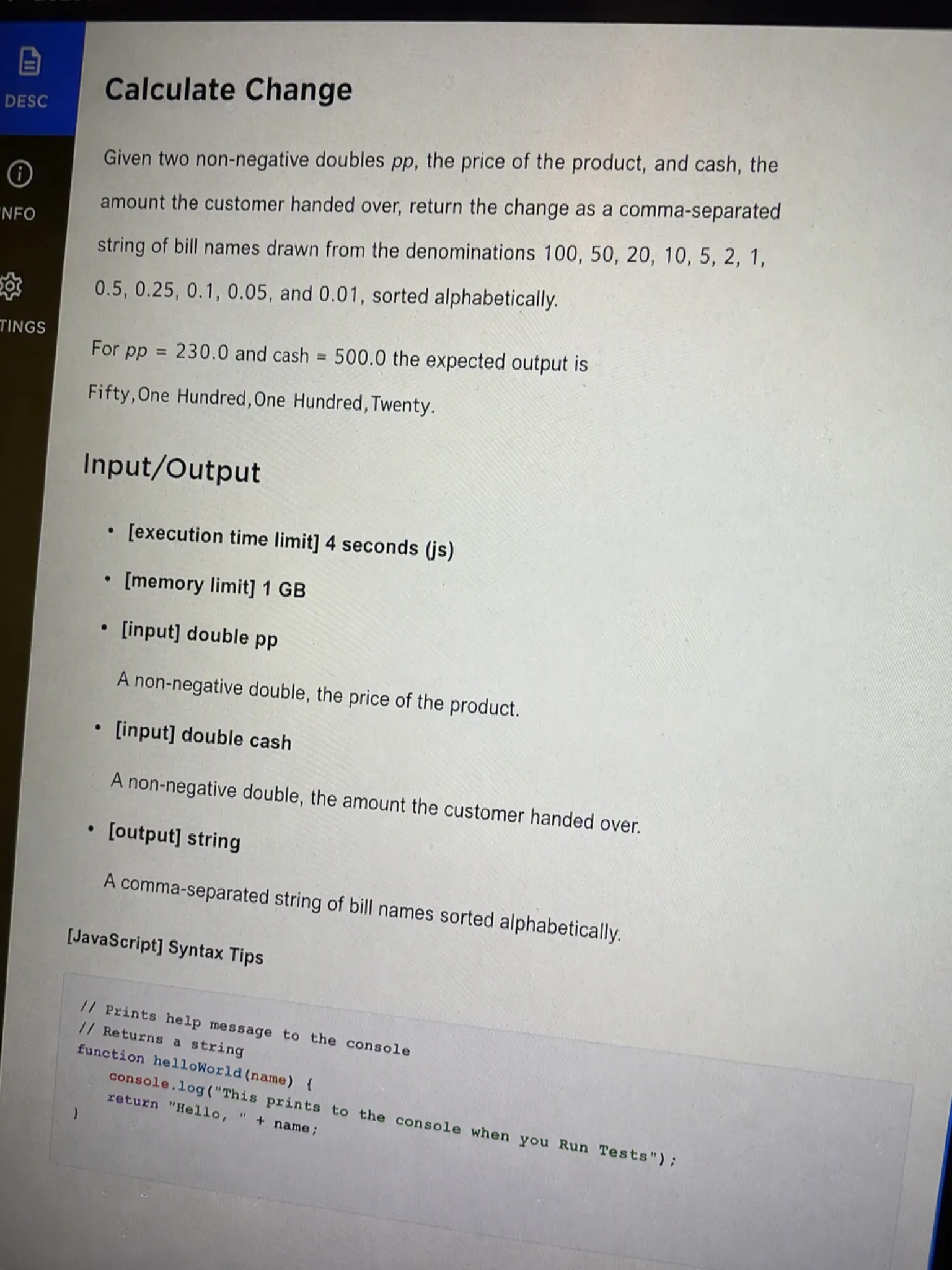
The problem I got: I was handed a cashier's change problem. Two non-negative doubles came in: pp, the price of the product, and cash, the amount the customer handed over. The register carried twelve denominations: 100, 50, 20, 10, 5, 2, 1, 0.5, 0.25, 0.1, 0.05, and 0.01. I had to return the change as a comma-separated string of bill names, sorted alphabetically. The sample was pp = 230.0 and cash = 500.0, and the expected output was "Fifty,One Hundred,One Hundred,Twenty".
My approach: Change owed is cash minus pp, and greedy is the right rule here because every denomination in the list divides evenly into the ones below it. My first pass worked directly on the doubles: subtract, then walk the denominations from largest to smallest and take as many of each as fit. It passed the sample, then the hidden set started failing, always on the sub-dollar bills. The cause was floating-point arithmetic. Subtracting two doubles and then dividing by 0.1, 0.05, and 0.01 leaves a remainder that is not exactly zero in binary, so a small coin appeared or vanished at the final step. I moved the whole computation to integer cents: convert both inputs with round(x * 100) before any math, keep every value an int, and format the bill names only at the end. The sample only pinned the whole-dollar labels, so I filled in the smaller bills in the same style: Fifty Cents, Quarter, Ten Cents, Five Cents, and Penny.
DENOMINATIONS = [
    (10000, "One Hundred"),
    (5000, "Fifty"),
    (2000, "Twenty"),
    (1000, "Ten"),
    (500, "Five"),
    (200, "Two"),
    (100, "One"),
    (50, "Fifty Cents"),
    (25, "Quarter"),
    (10, "Ten Cents"),
    (5, "Five Cents"),
    (1, "Penny"),
]


def calculate_change(pp, cash):
    cents = int(round((cash - pp) * 100))
    if cents <= 0:
        return ""
    bills = []
    for value, name in DENOMINATIONS:
        count = cents // value
        if count:
            bills.extend([name] * count)
            cents -= count * value
    bills.sort()
    return ",".join(bills)
Time complexity: O(k log k), where k is the number of bills returned, since the alphabetical sort dominates | Space complexity: O(k) for the returned list
This was the question that cost me the most time. I burned close to twenty minutes watching the sample pass while the hidden set kept failing, and I stopped trusting the double comparison only after printing the raw remainders. That is the point where I stopped grinding alone. More on how I broke the loop below.
Question 2: Palindromic Array Transformation
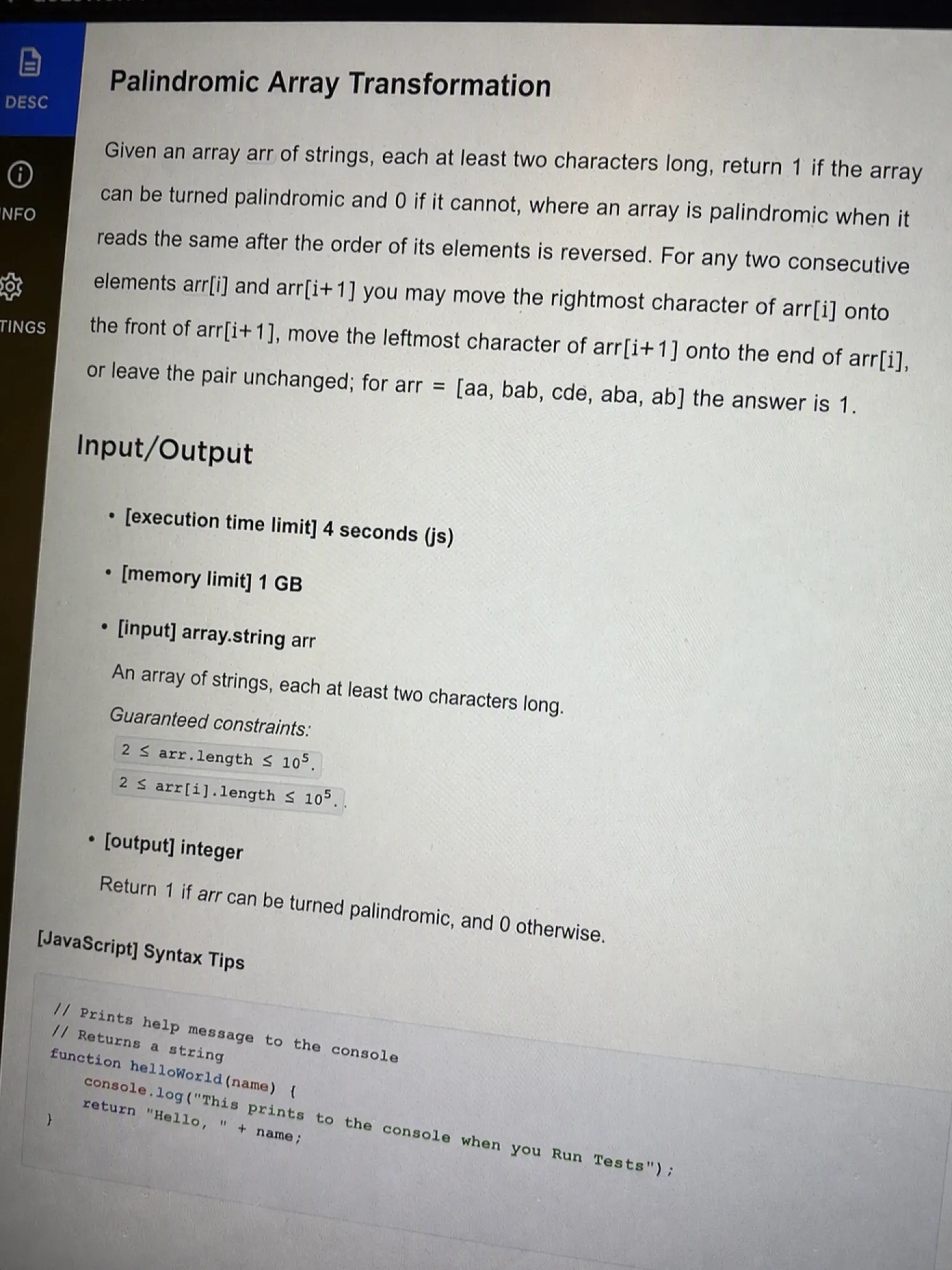
The problem I got: The second one was about reshaping an array of strings into a palindrome. The input was arr, and every string in it had at least two characters. An array counts as palindromic when it reads the same after the order of its elements is reversed. For any two consecutive elements arr[i] and arr[i+1], three moves were allowed: move the rightmost character of arr[i] onto the front of arr[i+1], move the leftmost character of arr[i+1] onto the end of arr[i], or leave the pair unchanged. I had to return 1 if the array could be turned palindromic and 0 if it could not. The visible example was ["aa", "bab", "cde", "aba", "ab"], which returns 1.
My approach: My first read was wrong. I treated each mirrored pair, arr[i] against arr[n-1-i], as independent and checked whether one move could make them equal. That breaks as soon as you see the move as a transfer across a boundary, because one move rewrites two neighbouring elements, and the neighbour is part of the next pair inward. The version that worked treats every boundary between arr[i] and arr[i+1] as a switch with three settings. I walk the switches from both ends toward the middle. At each layer I only need the switch just outside the left element and the switch just outside the right element. I try the two switches for this layer, rebuild the two elements, and keep the combination only if they match. That leaves at most nine states alive per layer, and if a layer kills every state, the answer is 0.
def can_be_palindrome(arr):
    n = len(arr)
    if n <= 1:
        return 1

    OPS = ("none", "right", "left")

    def rebuild(i, left_switch, right_switch):
        s = arr[i]
        if left_switch == "left":
            s = s[1:]
        if right_switch == "right":
            s = s[:-1]
        if left_switch == "right":
            s = arr[i - 1][-1] + s
        if right_switch == "left":
            s = s + arr[i + 1][0]
        return s

    states = {("none", "none")}
    for i in range(n // 2):
        j = n - 1 - i
        nxt = set()
        for left_outer, right_outer in states:
            for oi in OPS:
                for oj in OPS:
                    if j - 1 == i and oi != oj:
                        continue
                    if rebuild(i, left_outer, oi) == rebuild(j, oj, right_outer):
                        nxt.add((oi, oj))
        states = nxt
        if not states:
            return 0
    return 1
Time complexity: O(n * L), where L is the longest string rebuilt at each layer and n is the array length | Space complexity: O(1) for the state table, at most nine switch pairs
The code is short; the reading is what took the minutes. I rewrote it once after the independent-pair version fell apart, and I checked the rewrite against the two edge inputs I always test: a one-element array and a two-element pair that cannot be equalized.
Question 3: Maximum Two-Digit Fragment
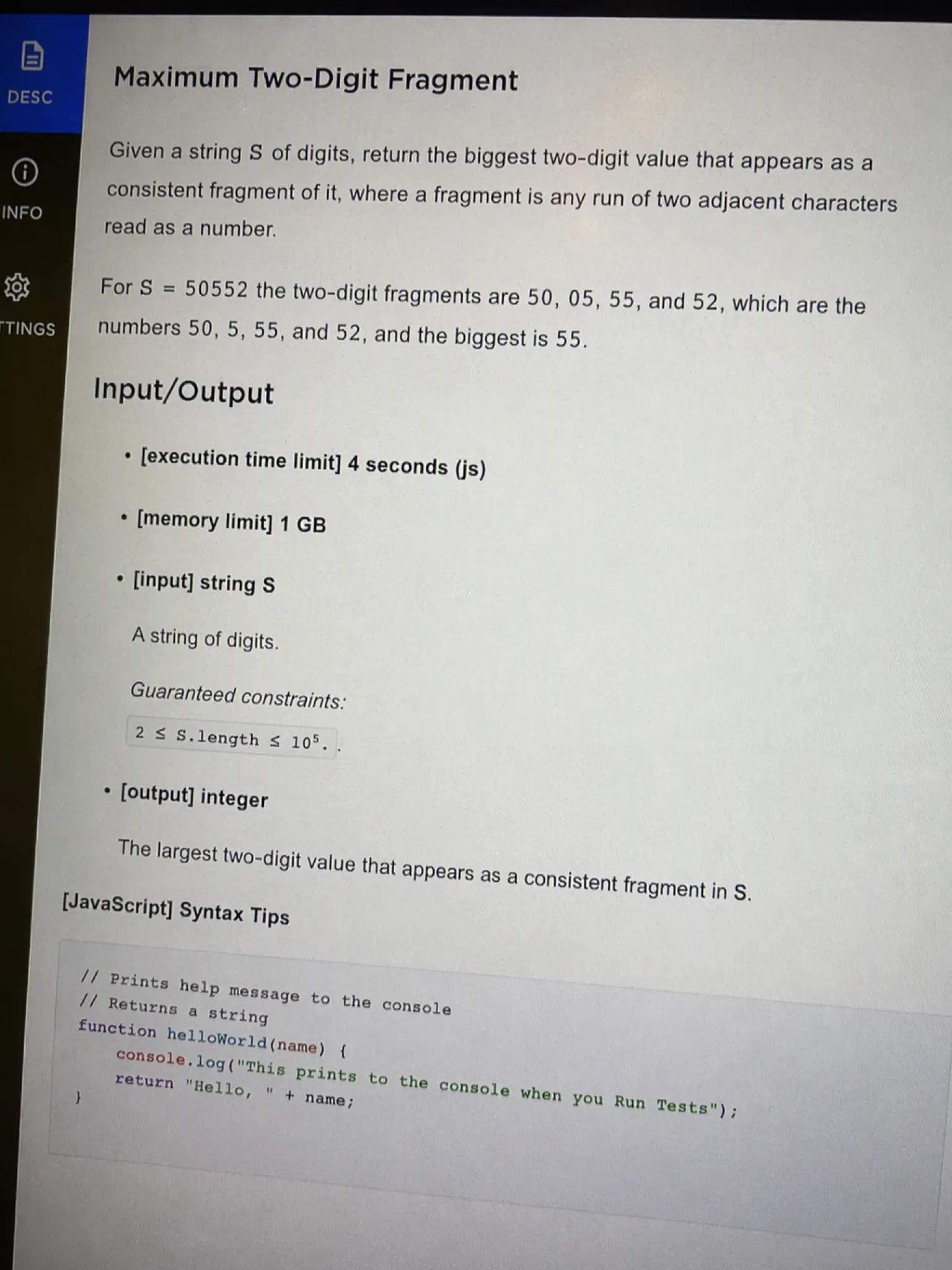
The problem I got: The third was the shortest prompt of the four. I was given a string S of digits and had to return the biggest two-digit value that appears as a consistent fragment of it. A fragment is just a run of two adjacent characters, so every window of length two counts. The prompt worked it out on "50552": the two-digit fragments are "50", "05", "55", and "52", which are the numbers 50, 5, 55, and 52, and the biggest is 55. The editor handed me the standard solution skeleton, class Solution { public int solution(String S); }.
My approach: The whole problem is the numeric reading. "05" in that list is the number 5, not a two-digit string, so a window that starts with a zero cannot win on length alone. Once I saw that, it is one pass: cast every adjacent pair to an int and keep the maximum. No sorting, no string comparison. I wrote it in Python, so the skeleton became def solution(S).
def solution(S):
    best = -1
    for i in range(len(S) - 1):
        best = max(best, int(S[i:i + 2]))
    return best
Time complexity: O(n), one pass over the string | Space complexity: O(1)
This one took under five minutes, and it was the point where I started to think the set had been ordered hard first.
Question 4: Consecutive Identical Digit Sum
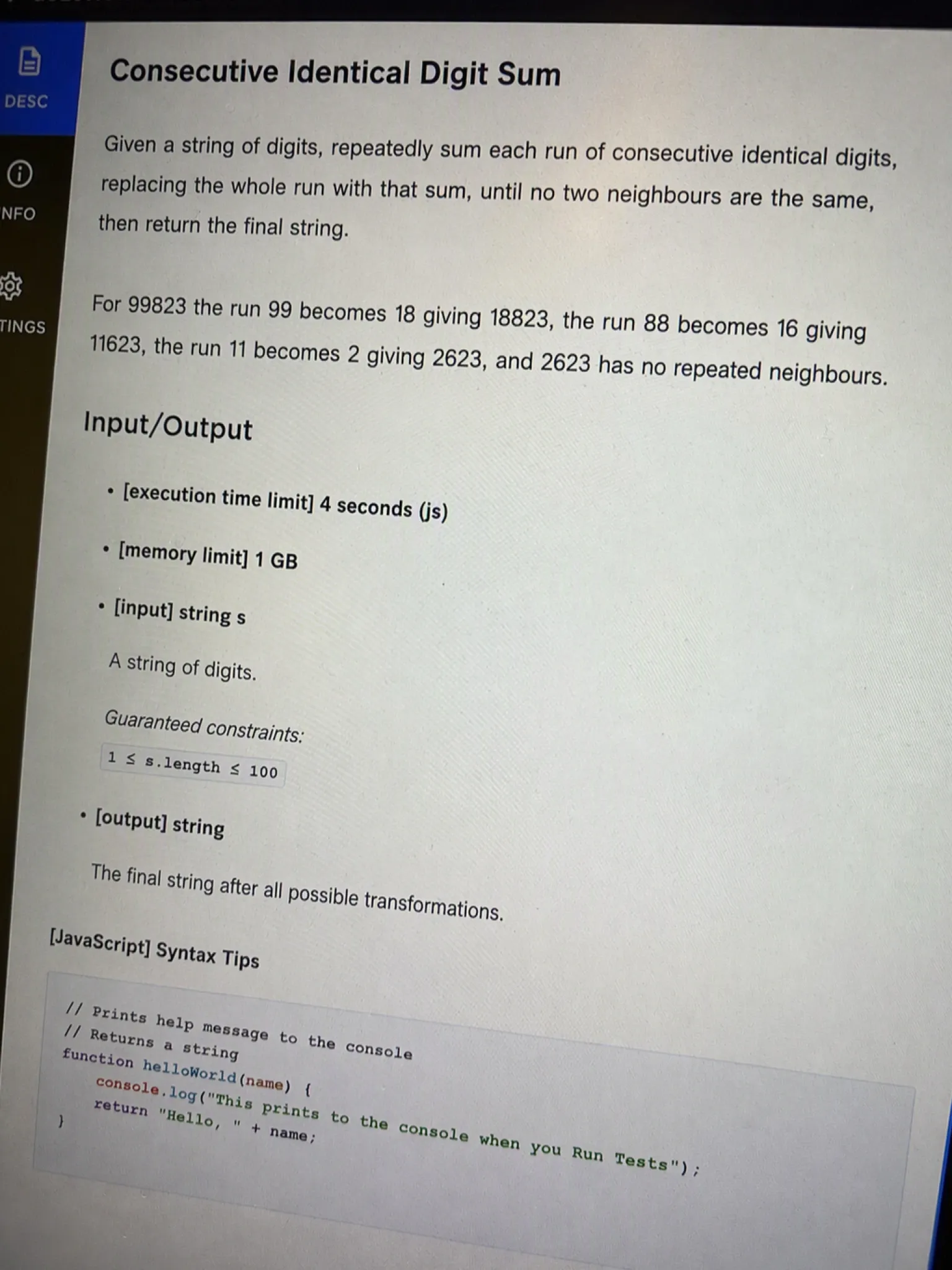
The problem I got: The last one was a repeated-summation string problem. I was given a string of digits and had to keep summing runs of consecutive identical digits until no two neighbours were the same, then return the final string. The prompt walked through 99823: the two 9s become 18, giving 18823, the two 8s become 16, giving 11623, the two 1s become 2, giving 2623, and 2623 has no repeated neighbours. The function was sumConsecutiveIdenticalDigits(String digits), and it returned the final string.
My approach: The trap is that a sum can seed a new pair. 99 collapses to 18, and that 8 lands next to the 8 that was already there, which is what turns 18823 into 11623. A single scan over the original string cannot catch that. I ran it in passes instead. Each pass collapses every maximal run at once, writing the run's sum when the run is longer than one character and the digit itself when it is not, then loops until a pass changes nothing. A stack is the usual shape for this kind of problem, but the run length matters here and the two-digit sums keep re-seeding new runs, so the loop was the version I could keep correct under the clock.
def sumConsecutiveIdenticalDigits(digits):
    current = digits
    while True:
        merged = []
        changed = False
        i = 0
        while i < len(current):
            j = i
            while j < len(current) and current[j] == current[i]:
                j += 1
            run = j - i
            if run > 1:
                merged.append(str(run * int(current[i])))
                changed = True
            else:
                merged.append(current[i])
            i = j
        current = "".join(merged)
        if not changed:
            return current
Time complexity: O(n^2) worst case, since each O(n) pass can shrink the string by only a little | Space complexity: O(n)
This was the last question and I had under ten minutes left. It is not the fastest version of the answer, but it passed the example on the first run, and first-run correctness was worth more than a cleverer loop at that point.
The final submission check. I finished all four questions and went back through the submissions. I submitted each one before the clock ran out, and the platform accepted the full set. That was the end of my assessment.
PayPay's Proctoring Policy for CodeSignal
Proctoring is the layer most candidates underestimate. CodeSignal records the camera, the microphone, and the shared screen for the whole session. It also checks a government photo ID before the test starts.
CodeSignal deletes the recording within 15 days and never shares it with PayPay. Two rules matter here.
Proctoring has no impact on the score, and the score and the integrity flag stay separate. Both sit in CodeSignal's official proctoring documentation.
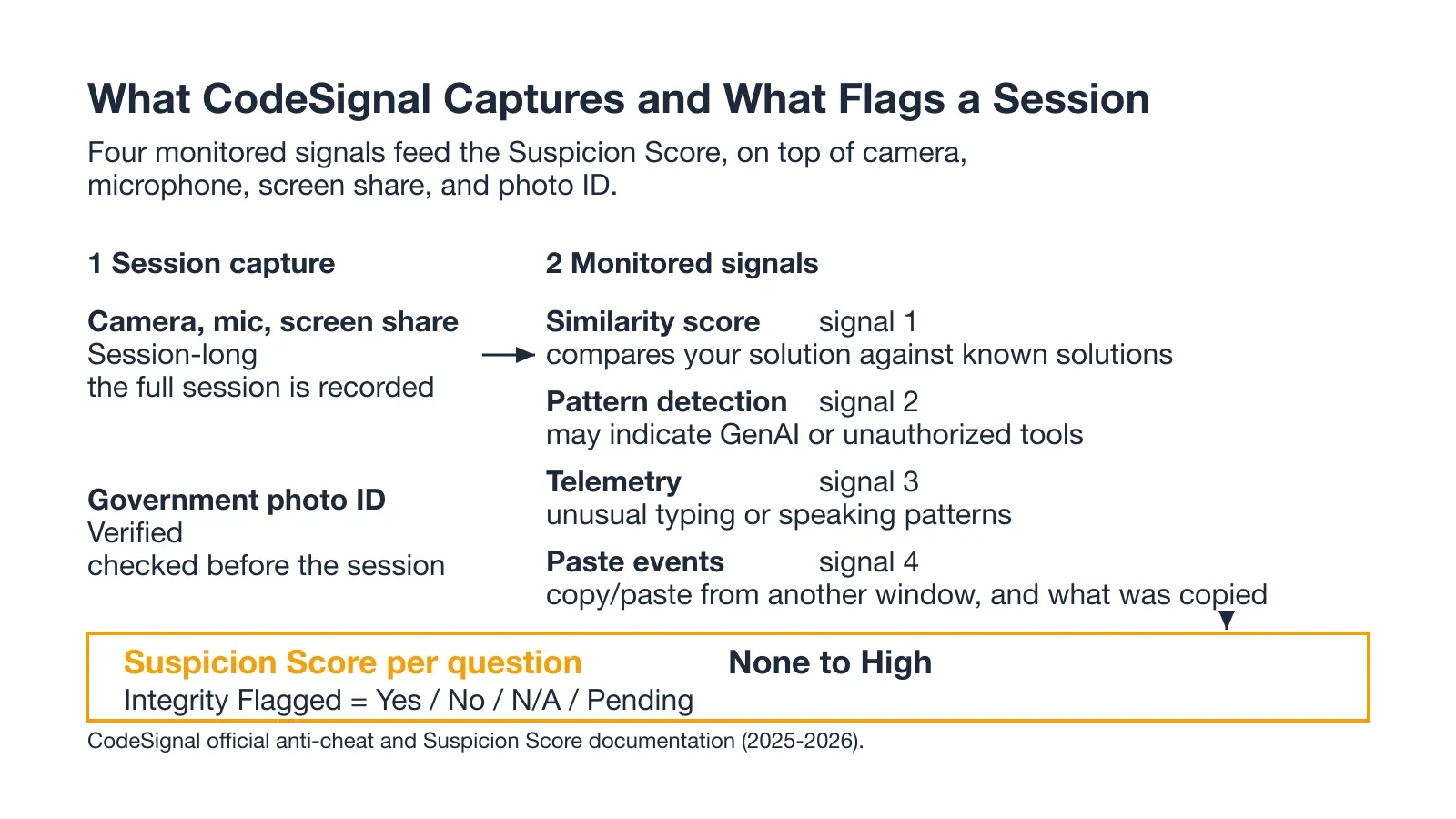
Four monitored signals sit on top of that capture set. The chart below shows how they feed one score.
CodeSignal Keeps the Footage From PayPay
CodeSignal keeps the recording, and PayPay never sees it. The 15-day deletion clock covers the identification and proctoring data together. Footage review also has no impact on the score.
What the recording actually contains is the next question. Its full capture window is in what CodeSignal's webcam proctoring records.
Suspicion Score Builds From Four Monitored Signals
The Suspicion Score is the integrity layer. The footage is not what drives it. Four signals feed the score.
One is a similarity check against known solutions. Another is pattern detection for GenAI and other unauthorized resources. A third is telemetry, such as odd typing or speaking patterns. The last is paste events, which record what was copied from another window.
A flagged question carries an Integrity Flag of Yes, No, N/A, or Pending. The flags name description-copy events, retyping after a copy, and language switches.
Paste events are the signal candidates misread most often. Pasting your own notes is still a paste. Paste tracking is the part to check. Whether CodeSignal flags copy-paste covers what its paste events capture.
CodeSignal also rotates questions and runs a Leak Sweep on published solutions. The rules are blunt: AI is not allowed, including syntax search.
A session can also fail verification for leaving the seat or exiting camera view. Other reasons include using another device, using an external IDE, or searching online beyond syntax. CodeSignal reports that 35 percent of proctored assessments were flagged in 2025.
5 Other Confirmed PayPay CodeSignal Questions
Beyond my own set, five more questions appear in dated PayPay reports and local records. I kept the code where the source gives enough detail. I say so plainly where it does not.
Question 5: Board Coloring With Directional Queries
This is the most detailed overflow question in the pool. It is also the only one whose intended solution needs an ordered structure. The board is h by w and starts white.
Each query is one of five types. The x a b form colors the cell at row a, column b. The >, <, v, and ^ forms return the nearest white cell that way. When nothing is white in that direction, the answer is [-1,-1]. Every non-color query stores its answer in order.
h = 3, w = 5
queries = ["v 1 2", "x 2 2", "v 1 2", "> 2 1", "x 2 3", "> 2 1", "< 2 0"]
answers = [[2,2], [-1,-1], [2,3], [2,4], [-1,-1]]
A flat scan of a row or column costs O(h + w) per lookup. That will not survive a large board. Keeping the white cells of each row and column sorted turns every lookup into a binary search.
import bisect


def process_board(h, w, queries):
    rows = [list(range(w)) for _ in range(h)]
    cols = [list(range(h)) for _ in range(w)]
    answers = []

    for query in queries:
        kind, a, b = query.split()
        a, b = int(a), int(b)

        if kind == "x":
            row = rows[a]
            i = bisect.bisect_left(row, b)
            if i < len(row) and row[i] == b:
                row.pop(i)
            col = cols[b]
            j = bisect.bisect_left(col, a)
            if j < len(col) and col[j] == a:
                col.pop(j)
            continue

        if kind == ">":
            row = rows[a]
            i = bisect.bisect_right(row, b)
            answers.append([a, row[i]] if i < len(row) else [-1, -1])
        elif kind == "<":
            row = rows[a]
            i = bisect.bisect_left(row, b) - 1
            answers.append([a, row[i]] if i >= 0 else [-1, -1])
        elif kind == "v":
            col = cols[b]
            i = bisect.bisect_right(col, a)
            answers.append([col[i], b] if i < len(col) else [-1, -1])
        elif kind == "^":
            col = cols[b]
            i = bisect.bisect_left(col, a) - 1
            answers.append([col[i], b] if i >= 0 else [-1, -1])

    return answers
Time complexity: O(q log(h * w)) for the lookups, plus O(h + w) per removal from a plain list | Space complexity: O(h * w) for the two index structures
An ordered set, a Fenwick tree, or a disjoint-set pointer makes removal logarithmic too. This question alone breaks the implementation-only pattern of the rest of the bank.
Question 6: Stack-Based String Manipulation
The June 2025 Japan backend set opened with an easy string manipulation. It was solved with a stack. Only the topic and the difficulty are on record. No statement is public, so I did not reconstruct a solution.
A single left-to-right pass with a stack is the shape that fits. Push what you cannot resolve yet, and pop when the current character closes it. That is the same implementation muscle the other confirmed questions test.
Question 7: Adjacent Same-Color Elements
The second June 2025 question was a LeetCode 2672 re-run with different constraints. The base problem starts n cells with no color. Each query sets one cell to a color and reports how many adjacent pairs share a color.
The clean answer keeps a running count and touches only the changed cell. Before the new color is written, the two neighbours are checked against the old color and the new one. The count moves by at most two.
def color_the_array(n, queries):
    color = [0] * n
    count = 0
    result = []
    for index, new_color in queries:
        old = color[index]
        if old == new_color:
            result.append(count)
            continue
        for neighbor in (index - 1, index + 1):
            if 0 <= neighbor < n:
                if old != 0 and color[neighbor] == old:
                    count -= 1
                if color[neighbor] == new_color:
                    count += 1
        color[index] = new_color
        result.append(count)
    return result
Time complexity: O(n + q), one pass over the queries | Space complexity: O(n) for the color array
The PayPay re-run changed the constraints rather than the shape. The exact change is not public.
Question 8: Even and Odd Digit Sums
A July 2026 Japan frontend set led with a digit problem. The task is the sum of the even digits minus the sum of the odd digits. One pass, two accumulators, and a subtraction.
def difference_of_even_odd_digit_sums(number):
    even = 0
    odd = 0
    for digit in str(number):
        value = int(digit)
        if value % 2 == 0:
            even += value
        else:
            odd += value
    return even - odd
Time complexity: O(d) for d digits | Space complexity: O(1)
The remaining questions in that frontend set sit behind a member wall. This is the only one from that set I could confirm.
Question 9: Binary String Addition
A September 2021 Japan backend set asked for the sum of two binary strings. Leading zeros were discarded. Walk both strings from the right with a carry, then trim the leading zeros at the end.
def add_binary(a, b):
    i, j, carry = len(a) - 1, len(b) - 1, 0
    result = []
    while i >= 0 or j >= 0 or carry:
        total = carry
        if i >= 0:
            total += int(a[i])
            i -= 1
        if j >= 0:
            total += int(b[j])
            j -= 1
        result.append(str(total % 2))
        carry = total // 2
    return "".join(reversed(result)).lstrip("0") or "0"
Time complexity: O(max(len(a), len(b))) | Space complexity: O(max(len(a), len(b)))
The change-making statement from my Question 1 appears word for word in that same 2021 set. That makes it the strongest cross-check in the pool.
What PayPay's CodeSignal Test Format Actually Looks Like
The question count is not one number across every PayPay posting. The chart below separates the reports by track and year. Four questions in seventy minutes is the current default for Japan SWE and India Backend.
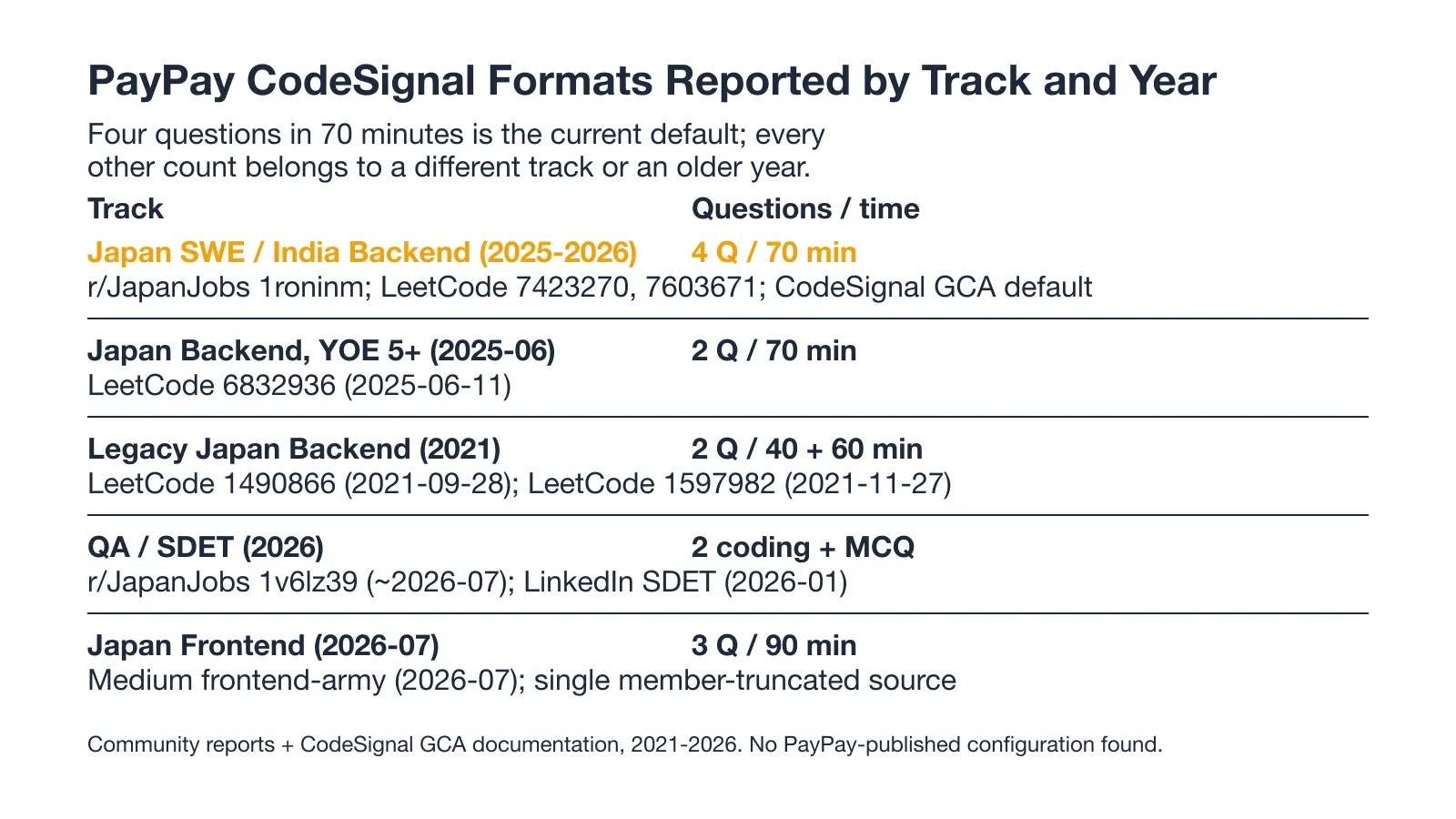
That count matches the CodeSignal general assessment default. The other counts in the chart belong to different tracks or older cycles. They are not a change in the format.
4 Questions in 70 Minutes Is the Current Default
This is the format I sat. It was four coding questions on a single seventy-minute clock, and every question was open from the start. The order and the time split were mine. CodeSignal scores on correctness, speed, implementation, and problem solving. It documents the same four-question default for its general assessment.
Older and QA Tracks Report Fewer Questions
The smaller counts are real. Each one belongs to a specific track or year. QA and SDET postings mix coding with multiple choice, and the 2021 reports describe a two-question layout.
CodeSignal's own rules explain the spread. The duration and the count are whatever the company configures, and seventy minutes is only the default. Three questions in ninety minutes is the one Japan frontend reading, and it stands alone against every other report.
How PayPay's CodeSignal Scoring Works
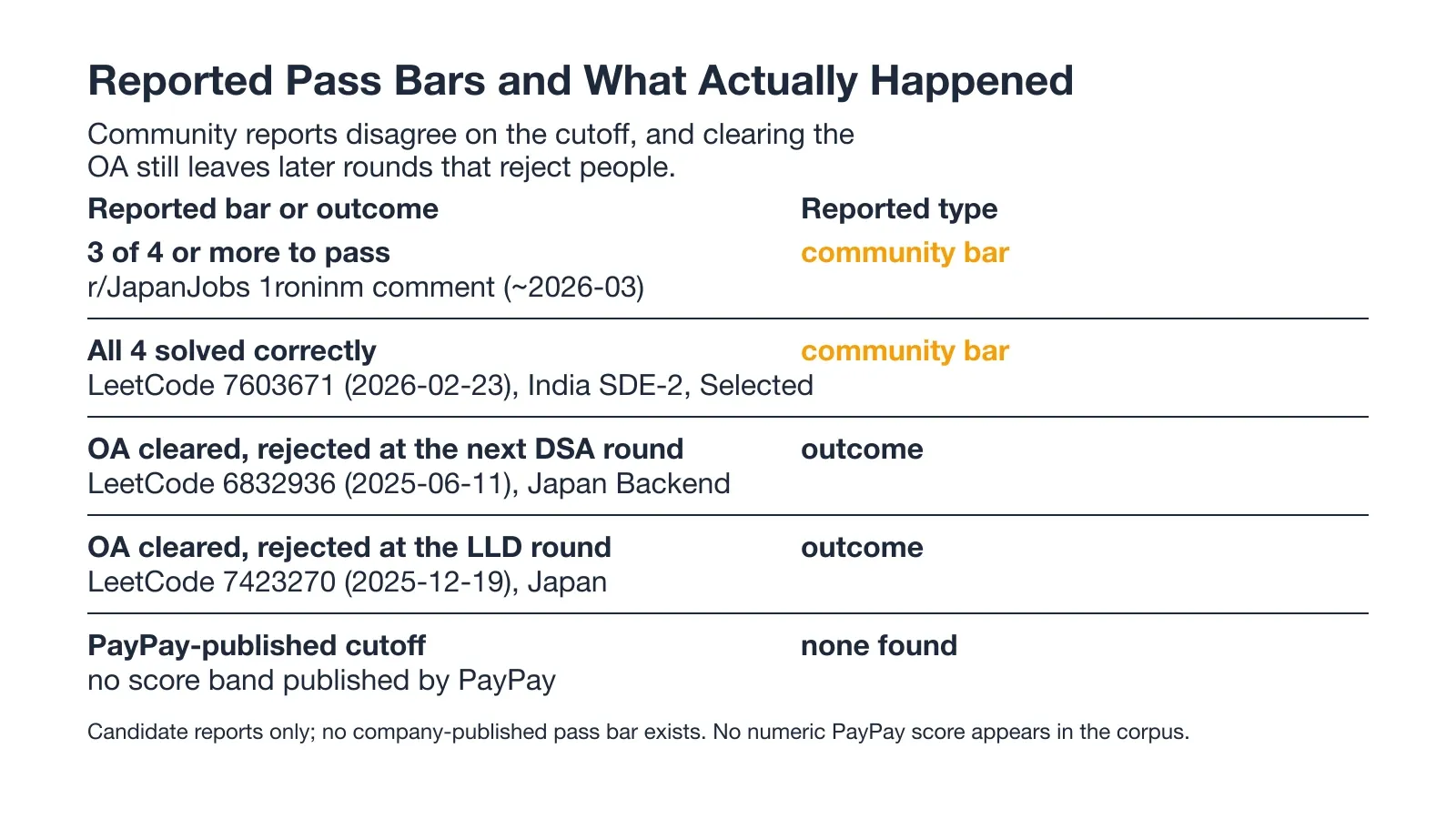
Scoring is where the platform's model and PayPay's cutoff come apart. The chart below pairs the reported bars with the outcomes behind them.
CodeSignal Scores Correctness, Speed, and Implementation
Each submission is scored on correctness, speed, implementation, and problem solving. CodeSignal certifies the result only when review finds nothing unusual.
CodeSignal allows resubmissions on every task, and the highest-scoring submission is the one that gets graded. That means a late improvement still counts. The output is a Coding Report, which is what PayPay reads.
The Pass Bar PayPay Has Never Published
PayPay publishes no cutoff, so the only bar anyone can quote is a candidate bar. Three of four is the version that circulates most widely.
A candidate who sat the same CodeSignal test twice logged both runs at three medium and one hard in 70 minutes.
The India SDE-2 bar is harder: all four correct. That candidate was selected. Both are candidate reports, not a company rule. Three is the floor and four is the safe target.
PayPay CodeSignal Exam-Day Strategy
Spend the 70 Minutes Where the Points Are
Every question is open from the first second, and the order is yours. I banked the two implementation problems I could finish quickly. I gave the money problem a full block, because a submitted solution beats a clever one still in progress.
CodeSignal's mechanics reward the same habit. You have to submit before you leave a task, or the code is not saved. No external IDE is permitted, so every line goes into the browser editor.
Three medium questions and one hard one inside seventy minutes is the pacing I planned around.
Floating-Point and Boundary Traps Cost Points
Two in-exam traps cost points without ever failing a visible test. Both showed up in mine. My Calculate Change implementation passed the sample and then failed the hidden set on the sub-dollar bills. Subtracting doubles leaves a remainder that is not exactly zero in binary.
That same pair shows up in a 2021 report for this assessment. The two traps are double comparison and boundary conditions. The fix is to convert money to integer cents before any arithmetic. Then test exact payment, zero change, and rounding edges.
The 2025 Japan set sat two DSA questions inside the same seventy minutes. Clock pressure compounds the trap rather than replacing it.
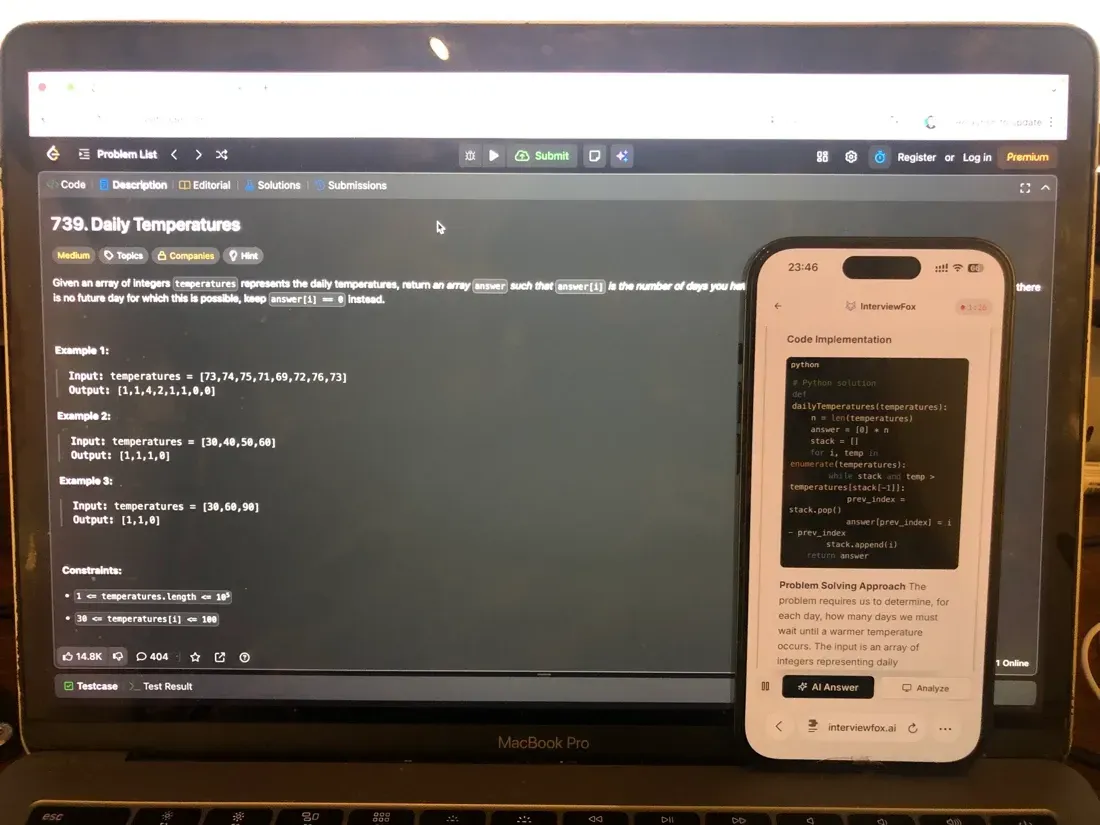
When I got stuck on exactly that trap mid-exam, I did not want to reach for a desktop overlay: the answer would have lived on the same screen CodeSignal's monitoring captures, hidden by a basic rendering-layer trick, and whether that gets flagged depends on what detection is currently running, uncertainty I did not want in the background.
Instead, I triggered a keyboard shortcut that handed the screen to a real time AI interview assistant, which pushed the answer to my phone, a separate device outside the platform's screenshot monitoring.
It pinned the failure on binary floating point instantly, and my laptop screen stayed on the CodeSignal editor the whole time, unchanged.
Land offer with Safer AI Interview Assistant
Skip the risky invisible apps. Our dual-device mode keeps it simple and undetectable. You crush the interview, we handle the answers.
Get started. It's freeLoved by 100,000+ candidates
Why Candidates Fail the PayPay CodeSignal Assessment
Missing the Pass Bar Is the Most Common Failure
The cutoff itself is the failure theory that dominates, and it is not published. Three of four is the widely repeated bar. In one India SDE-2 case, all four had to be correct.
Against a bar that high, one lost question decides the outcome. The money problem is never the place to gamble time.
Clearing the OA Does Not Mean Clearing PayPay
The assessment is the first gate, not the offer. A June 2025 Japan backend candidate cleared it and got rejected one day after the DSA round. The rejection mail carried no feedback.
Listing out-of-practice languages backfired on that same application. A December 2025 Japan candidate cleared the OA and lost the next LLD round. That round ended with the logic unfinished.
The AI-Overlay Case That Ended a Candidate's Session
In a spring 2026 assessment, another candidate left a transparent AI answer overlay active. During the final submission check, the overlay briefly appeared in the captured desktop view. The session was suspended, and the invitation link would not reopen it.
That single frame was enough. The integrity layer does not have to prove intent. The Suspicion Score reads similarity, telemetry, paste events, and GenAI patterns together. A session can also fail verification for leaving the seat or opening another device.
That candidate's suspension turned on how the platform reads the whole session, not on one frame. How CodeSignal decides a session is not verifiable is the fuller picture.
The overlay was caught for a structural reason: it renders the answer on the same screen the proctoring system is monitoring, hidden by a basic OS-layer trick that keeps the window out of visible view but still on-screen.
InterviewFox works differently: it is a dual device AI interview tool that puts the answer on my phone, a physically separate device no screenshot or session recording can reach by design.
Land offer with Safer AI Interview Assistant
Skip the risky invisible apps. Our dual-device mode keeps it simple and undetectable. You crush the interview, we handle the answers.
Get started. It's freeLoved by 100,000+ candidates
How to Prepare for the PayPay CodeSignal in 12 Days
The invitation is valid for fourteen days, and I kept two days of buffer. That gave me a twelve-day plan. It is built around the confirmed question families, the seventy-minute clock, and the submission mechanics, not a generic grind.
In the days before the OA, I used the Prep Agent from InterviewFox over WhatsApp: I sent it the confirmed question patterns for PayPay's CodeSignal plus my target role, and it returned a personalized twelve-day drill plan and strategy.
The same profile it built carries into the live session, so the real-time assistant answers from my background and target role instead of a generic bank. It was one practical tool among several in my prep workflow, not the whole plan.
Days 1-4: Timed Implementation Speed on Arrays and Strings
I opened with speed. Four questions in seventy minutes leaves about seventeen minutes each, and the bar is three of four. The confirmed families are array, string, HashMap, and Stack. The December 2025 Japan set was implementation only, with no DSA pattern to spot.
Days 1 through 4 were array and string implementation problems. I wrote them directly in a browser editor with a timer running. My success check was three mid-level implementation problems inside fifty minutes, without leaving the editor once.
I skipped the advanced-DSA ladder. Graphs, trees, and dynamic programming do not appear in any confirmed question family. A full pattern grind is not what this test measures.
I also skipped system design for this window. The OA is a coding assessment, and design rounds arrive only after it clears.
Days 5-9: Float and Boundary Correctness on Money Problems
Denomination and floating-point work got the largest block, five days. It is the trap that passes visible tests and fails hidden ones. I drilled change-making with epsilon comparisons instead of equality. I also covered exact payment, zero change, and large-cash inputs where a rounding error compounds.
My success check was a Calculate Change implementation that passed zero-change, exact-denomination, and rounding-boundary cases. I kept every drill in integer cents from the first line. That single move removed the failure I hit in the real assessment.
Days 10-12: A Full 4-Question Timed CodeSignal Simulation
The last three days were about the environment, not the algorithms. CodeSignal hands you a function skeleton and keeps every task open in any order. Nothing is saved unless you submit before leaving a task, so I rehearsed exactly that. Skipping external IDEs was deliberate, since CodeSignal does not permit them.
One full four-question, seventy-minute simulation ran in the browser editor. The standard solution-style skeleton held, and I resubmitted as I went. My success check was all four tasks attempted, each submitted before I moved on.
What Happens After You Submit the OA
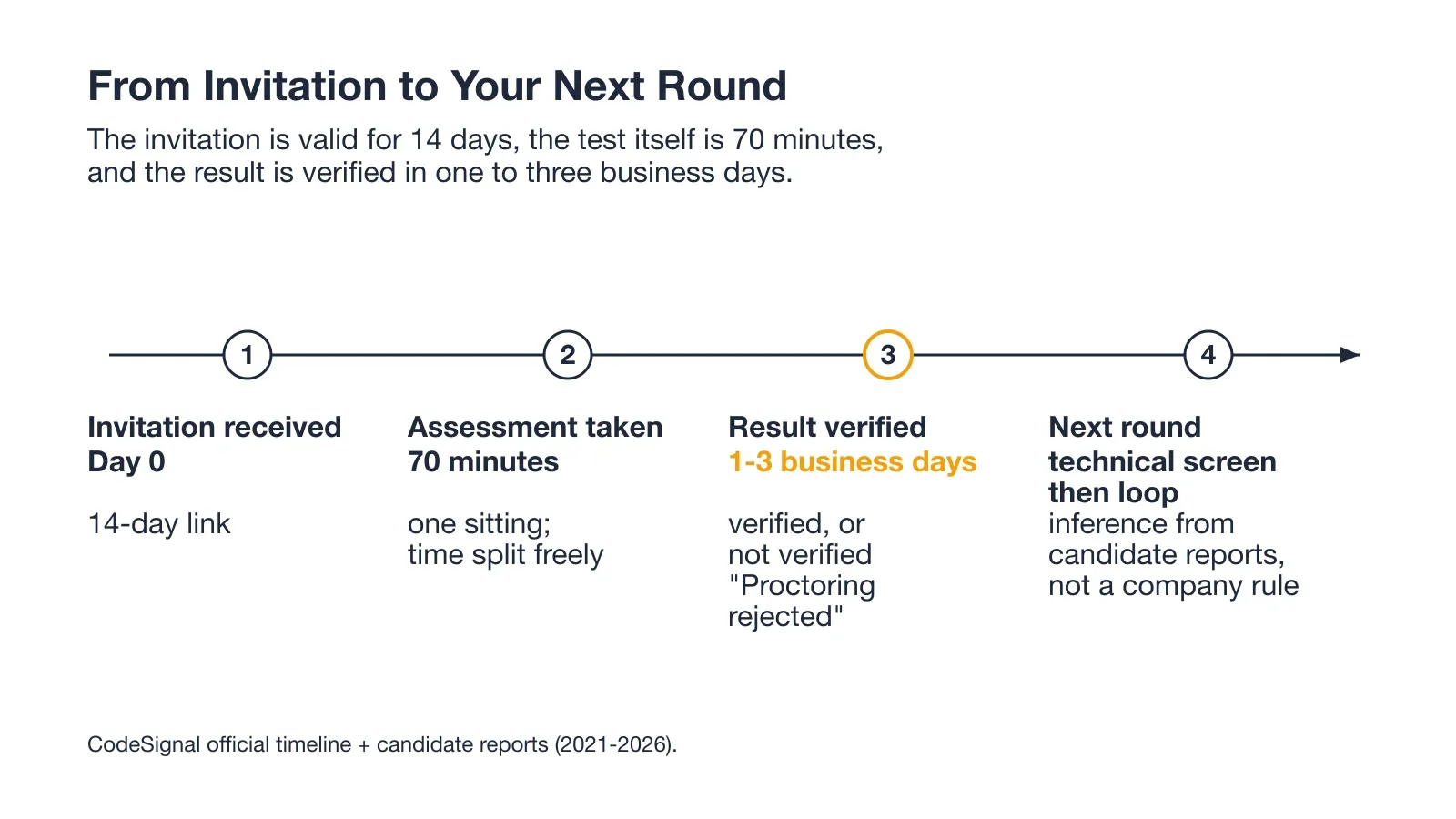
The stretch after submission is short and mechanical. The chart below puts the dates in order.
Result Verification Takes 1 to 3 Business Days
CodeSignal reviews the session and marks it verified. A failed session comes back as not verified, under a "Proctoring rejected" label. The invitation is valid for fourteen days from the day it arrives.
Verification lands within one to three business days of the submission. A failed session ends the process there. That is the path the suspended candidate from the failure section took.
Next round, in one line. Clearing the OA leads to a technical screen first, then a multi-round loop.
The shape varies by region. Japan reports a heavier design component, and India a longer loop through HR and a techno-managerial stage. The assessment is the gate, and everything past it is a different job.
PayPay's CodeSignal OA Is Implementation-Heavy
Across every confirmed PayPay CodeSignal set, one pattern holds. The questions test implementation, not algorithmic patterns. Array, string, HashMap, and Stack cover the whole confirmed surface.
The December 2025 Japan attempt reads as easy-medium and implementation only. A June 2025 set even re-ran a known LeetCode problem with different constraints, rather than switching topics.
The one outlier is a board-coloring question with directional queries. Its intended solution needs an ordered structure, such as a sorted set, a Fenwick tree, or a disjoint-set pointer. That question alone breaks the pattern.
It is also why I kept one data-structure template in the plan. Clean implementation speed and float-boundary care covered every other confirmed question in the pool.
FAQ
Does the PayPay CodeSignal test use a camera?
Yes. The whole session runs on camera, microphone, and shared screen. CodeSignal checks a government photo ID before the test starts. It reviews the recording itself and never passes the footage to PayPay.
Can I use an AI tool or invisible app during the PayPay CodeSignal OA?
No. AI use is not allowed, including syntax search. Desktop overlay tools put the AI's answer on your computer screen, rendered as a hidden layer above the browser using a basic OS-layer trick. The answer is on-screen, the hiding is basic, and proctoring software keeps adding detection capabilities as AI tools become more common, so the risk exposure isn't fixed.
InterviewFox pushes the answer to your phone, a physically separate device that no screenshot, screen recording, or session monitoring can reach by design, so the laptop screen stays on the exam editor, unchanged. If you're going to use AI assistance during the OA, the dual-device architecture removes the answer from your screen entirely.
Land offer with Safer AI Interview Assistant
Skip the risky invisible apps. Our dual-device mode keeps it simple and undetectable. You crush the interview, we handle the answers.
Get started. It's freeLoved by 100,000+ candidates
Is 3 out of 4 enough to pass the PayPay CodeSignal?
Three of four is the bar that circulates most widely. The stricter India SDE-2 bar is all four correct. PayPay publishes no cutoff, so treat three as the floor and four as the safe target.
How long do I have to take the OA after the invitation arrives?
The invitation is valid for fourteen days from the day it arrives. CodeSignal verifies the finished session within one to three business days. The result comes back as verified or not verified.
What are the later PayPay interview rounds like?
A cleared OA leads to a technical screen first, then a multi-round loop. Japan reports a heavier design component. India reports a longer loop through HR and a techno-managerial stage.
What questions does PayPay actually ask on CodeSignal?
The current set is four implementation-style coding questions. It includes change-making with floating-point traps, string-array palindromes, two-digit fragments, and repeated digit-run sums. Stack-based string manipulation and binary-string addition also show up in older or other-track reports.