
How I Aced Pinterest CodeSignal in 2026: Real Questions and Prep

Quick Facts
| Platform | CodeSignal General Coding Assessment (GCA) |
| Questions | 4, varying difficulty |
| Time limit | 70 minutes, one sitting, no pause |
| Score range | 200 to 600, certified after integrity review |
| Proctoring | Session monitored and ID-verified |
| Pipeline | CodeSignal OA, then recruiter screen and technical interviews |
I took the pinterest codesignal assessment for a new-grad software engineer role in 2026. I solved three of four questions cleanly and moved on to the recruiter screen. What follows is the complete process and how I prepared for it.
Question 3 — the Escape Room prompt — had me stuck on the per-room linked-list trap with twelve minutes left. I used the dual device real time AI interview assistant to check the game-state. It surfaced the shared-class-variable bug. I break that down in the walkthrough below.
Before my test, I went through every Pinterest CodeSignal writeup from the past two years — the 1Point3Acres interview board, which holds the deepest run of Pinterest OA reports, plus Reddit, LeetCode Discuss, and Teamblind. What the community reports tracks closely with what I experienced, especially the mistakes that get people flagged or rejected.
The Real Questions on My Pinterest CodeSignal Test
I sat for the Pinterest CodeSignal General Coding Assessment in 2026 for a new-grad software engineer role. The test gave me four questions and seventy minutes, and I could work through them in any order. Here is exactly what showed up on my screen.
Question 1: Trie Autocomplete
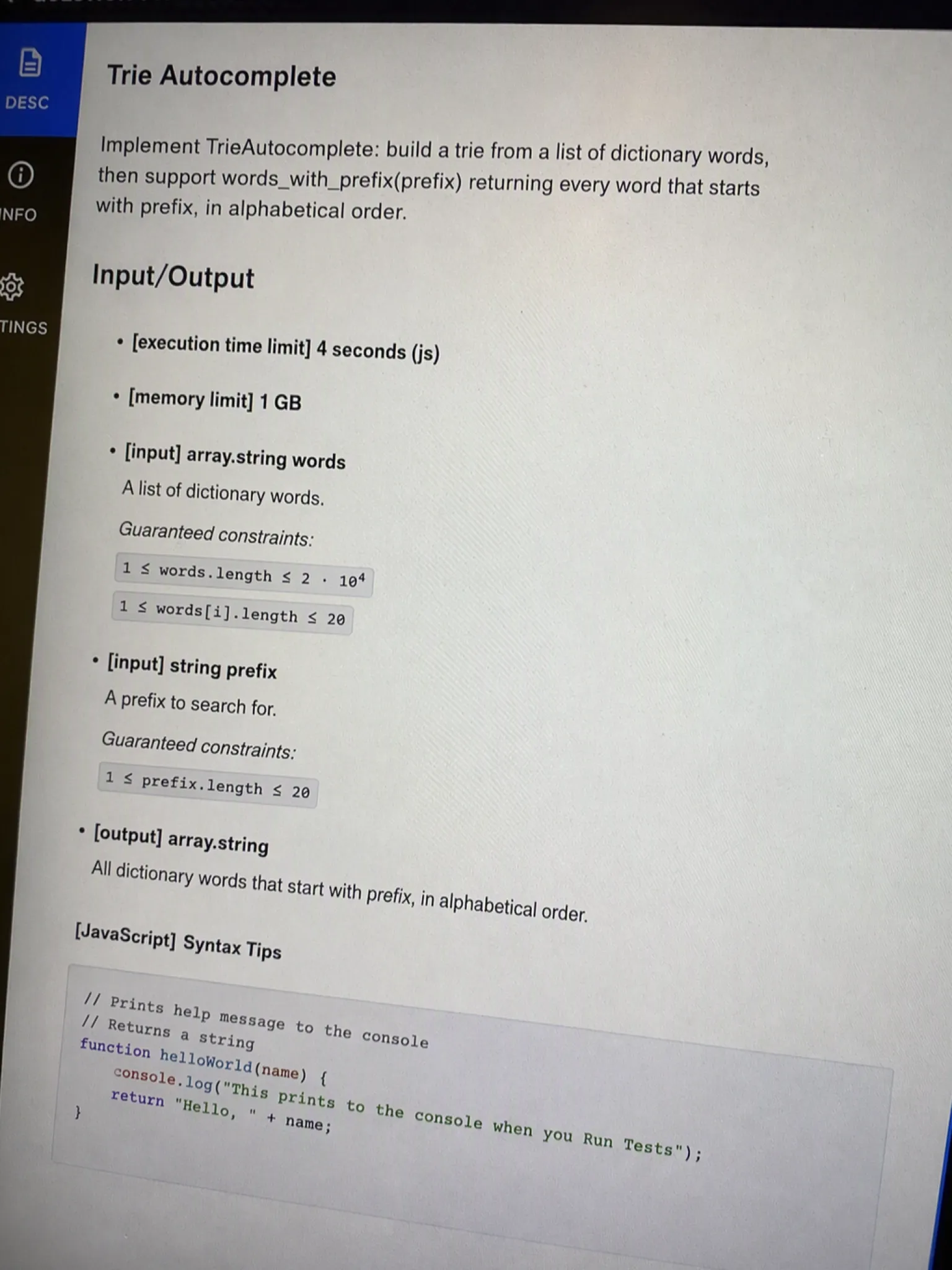
The problem I got: Pinterest asked me to build an autocomplete service over a dictionary of pin titles. I had to support two operations. Insert a word, then return every word that starts with a given prefix, in alphabetical order. It is the classic trie variant 1Point3Acres lists for Pinterest onsite coding rounds, and the most-reported trie prompt on the board.
My approach: I built a standard trie. Each node holds its children and a flag marking a complete word. For prefix search I walked down to the prefix node, then collected every word below it with a depth-first pass.
class TrieNode:
    def __init__(self):
        self.children = {}
        self.is_word = False

class Trie:
    def __init__(self):
        self.root = TrieNode()

    def insert(self, word):
        node = self.root
        for ch in word:
            node = node.children.setdefault(ch, TrieNode())
        node.is_word = True

    def words_with_prefix(self, prefix):
        node = self.root
        for ch in prefix:
            if ch not in node.children:
                return []
            node = node.children[ch]
        results = []
        self._collect(node, prefix, results)
        return sorted(results)

    def _collect(self, node, path, results):
        if node.is_word:
            results.append(path)
        for ch, child in node.children.items():
            self._collect(child, path + ch, results)
Complexity is O(L) per insert and O(L + k) per prefix query. Here L is the word length and k is the number of matches. I finished it inside ten minutes and moved on.
Question 2: Splitwise Balance Settlement
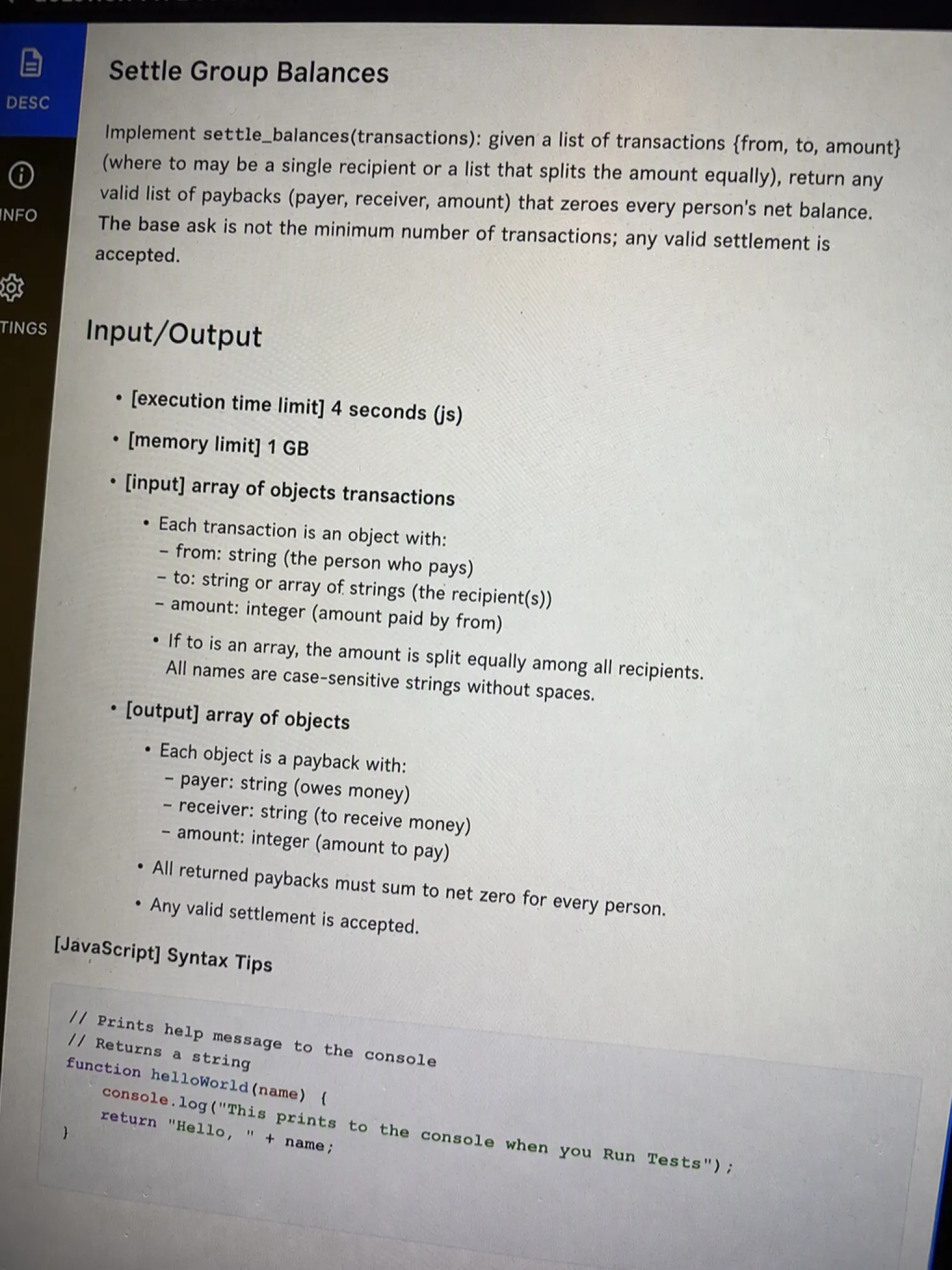
The problem I got: I was given a list of transactions between friends — each entry was {from, to, amount}, where to could be a single recipient or a list that splits the bill equally. I had to output any valid sequence of paybacks (payer, receiver, amount) that zeroed every person's net balance. Pinterest framed it as settling a group-trip bill. The base ask is not "minimum number of payments" — 1Point3Acres' problem record for this prompt is explicit that the minimum-count variant is an NP-hard follow-up and that you should not volunteer it unless the interviewer asks.
My approach: First I computed each person's net balance. For each transaction, the payer is credited the full amount and each recipient is debited their equal share. I then kept two max-heaps — one for creditors (people owed money) and one for debtors (people who owe). On each step I pulled the largest creditor and the largest debtor, settled min(credit, debt), and pushed any remainder back. The output is the list of paybacks.
import heapq

def settle_balances(transactions):
    bal = {}
    for frm, to, amount in transactions:
        recipients = to if isinstance(to, list) else [to]
        share = amount / len(recipients)
        bal[frm] = bal.get(frm, 0) + amount
        for r in recipients:
            bal[r] = bal.get(r, 0) - share
    creditors, debtors = [], []
    for p, b in bal.items():
        if b > 1e-9:
            heapq.heappush(creditors, (-b, p))
        elif b < -1e-9:
            heapq.heappush(debtors, (b, p))
    paybacks = []
    while creditors and debtors:
        _, payer = heapq.heappop(creditors)
        debit, receiver = heapq.heappop(debtors)
        pay = min(bal[payer], -debit)
        paybacks.append((payer, receiver, round(pay, 2)))
        bal[payer] -= pay
        bal[receiver] += pay
        if bal[payer] > 1e-9:
            heapq.heappush(creditors, (-bal[payer], payer))
        if bal[receiver] < -1e-9:
            heapq.heappush(debtors, (bal[receiver], receiver))
    return paybacks
Complexity: O(n log n) for the heap work, where n is the number of people. The output is a valid settlement, not a minimum one.
The follow-up I did not volunteer: If the interviewer pushes for the minimum number of transactions, the right move is to name-drop the equivalence to subset partition and signal that the implementation is NP-hard in general. That is enough to show awareness without burning time on a hard variant.
Question 3: The Escape Room Prompt
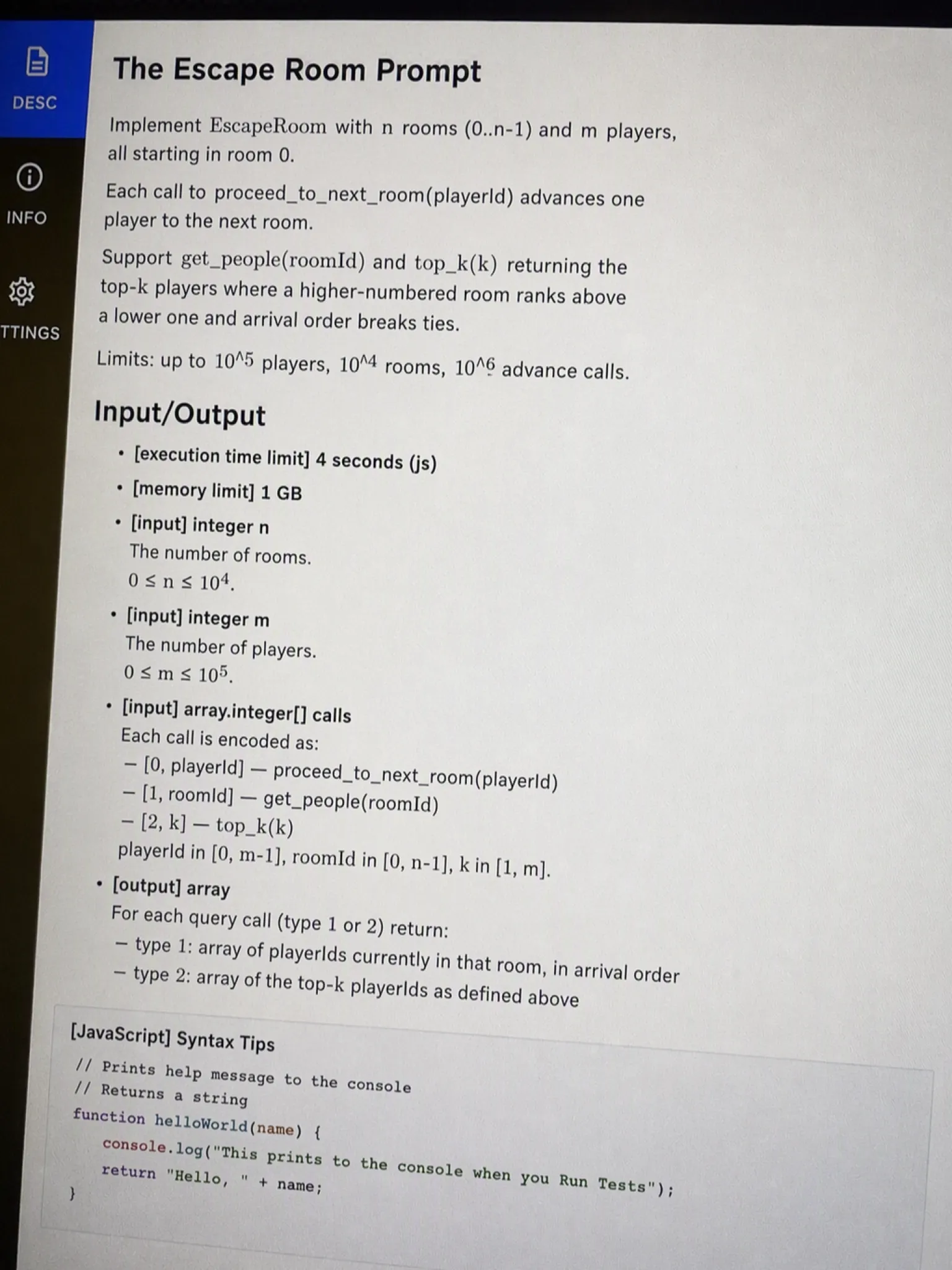
The problem I got: This was the custom interface that actually stressed me out. 1Point3Acres calls it the most-recurring custom Pinterest coding prompt in the current rotation, asked at both phone and onsite. Pinterest gave me n rooms and m players all starting in room 0. Each call advanced one player to the next room. I had to support O(1) per-room headcount and O(1) per-player move, and a top-K leaderboard where a higher-numbered room ranks above a lower one, with arrival order breaking ties within the same room. The stated limits were up to 10^5 players, 10^4 rooms, and 10^6 advance calls — which is exactly why O(1) per move is non-negotiable.
My approach: I kept a per-room doubly-linked list of player IDs plus a playerId → (roomId, dllNode) map, so a move was an unlink from the current room and an append to the next room, both O(1). I also tracked each player's arrival tick in their current room for the tiebreaker. The top-K leaderboard iterated rooms from n-1 down to 0, walking each room's list head-to-tail and emitting until I had k players. The known trap — and the one that has cost candidates passing rounds — is storing the list node as a class variable instead of per-room state. Each room's list must be independent, including its own sentinel.
class _Node:
    __slots__ = ('pid', 'prev', 'next')
    def __init__(self, pid):
        self.pid = pid
        self.prev = None
        self.next = None

def _sentinel():
    s = _Node(None)
    s.prev = s.next = s
    return s

class EscapeRoom:
    def __init__(self, n_rooms, n_players):
        self.n = n_rooms
        self.head = [_sentinel() for _ in range(n_rooms)]
        self.tail = list(self.head)
        self.loc = [0] * n_players
        self.node = [None] * n_players
        self.arrival = [0] * n_players
        self.tick = 0
        for p in range(n_players):
            nd = _Node(p)
            self._append(0, nd)
            self.node[p] = nd

    def _append(self, room, nd):
        t = self.tail[room]
        nd.prev = t
        nd.next = t.next
        t.next.prev = nd
        t.next = nd
        self.tail[room] = nd

    def proceed_to_next_room(self, player):
        r = self.loc[player]
        nd = self.node[player]
        if self.tail[r] is nd:
            self.tail[r] = nd.prev
        nd.prev.next = nd.next
        nd.next.prev = nd.prev
        self.loc[player] = r + 1
        self.arrival[player] = self.tick
        self.tick += 1
        self._append(r + 1, nd)

    def get_people(self, room):
        out = []
        nd = self.head[room].next
        while nd is not self.head[room]:
            out.append(nd.pid)
            nd = nd.next
        return out

    def top_k(self, k):
        out = []
        for r in range(self.n - 1, -1, -1):
            nd = self.head[r].next
            while nd is not self.head[r] and len(out) < k:
                out.append(nd.pid)
                nd = nd.next
            if len(out) >= k:
                break
        return out
Complexity: proceed_to_next_room is O(1) amortized, get_people is linear in the headcount, and top_k is O(rooms + k) in the worst case. At 10^6 advance calls on 10^5 players, the O(1) move is what keeps this from melting.
I did not want to reach for a desktop overlay. The answer would have landed on the same screen CodeSignal's monitoring was watching, hidden by a basic rendering layer. I did not want that uncertainty running in the background.
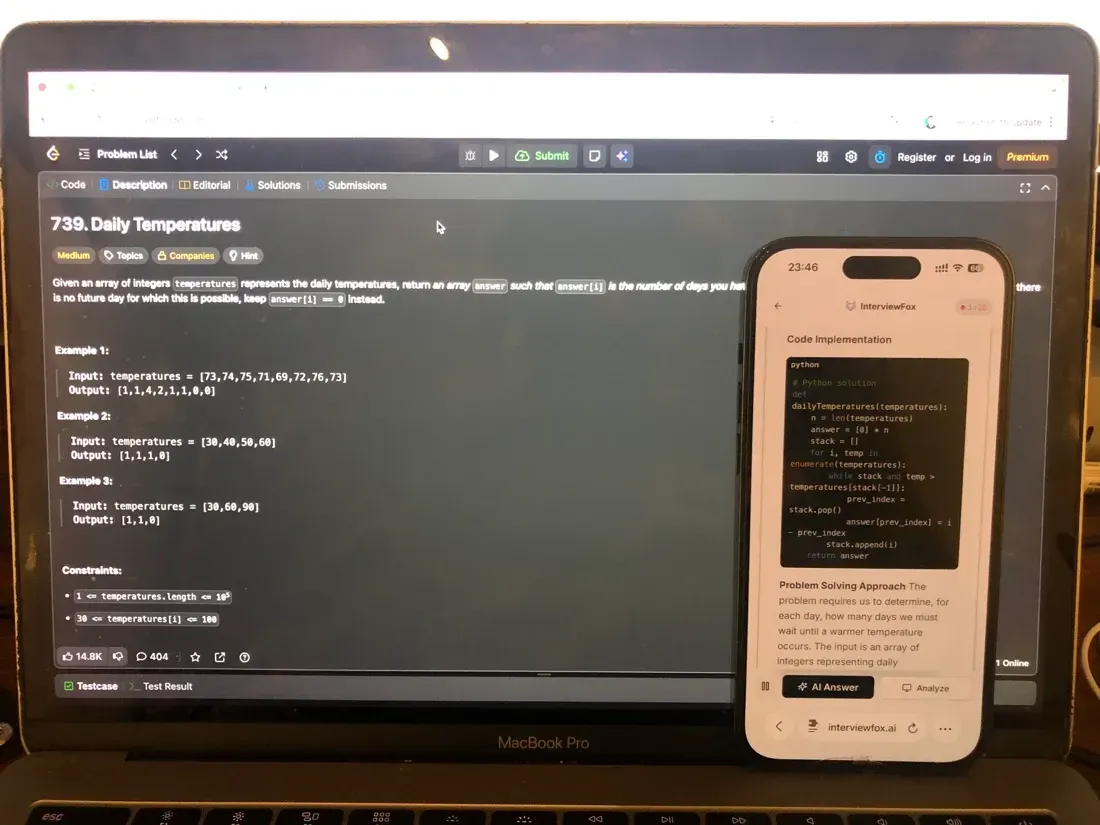
Instead I hit the InterviewFox shortcut: it auto-captured the room-state and pushed the walkthrough to my phone. My laptop screen stayed on the exam editor the entire time. The per-room DLL-node trap clicked into place.
Land offer with Safer AI Interview Assistant
Skip the risky invisible apps. Our dual-device mode keeps it simple and undetectable. You crush the interview, we handle the answers.
Get started. It's freeLoved by 100,000+ candidates
Question 4: Reconstruct Itinerary
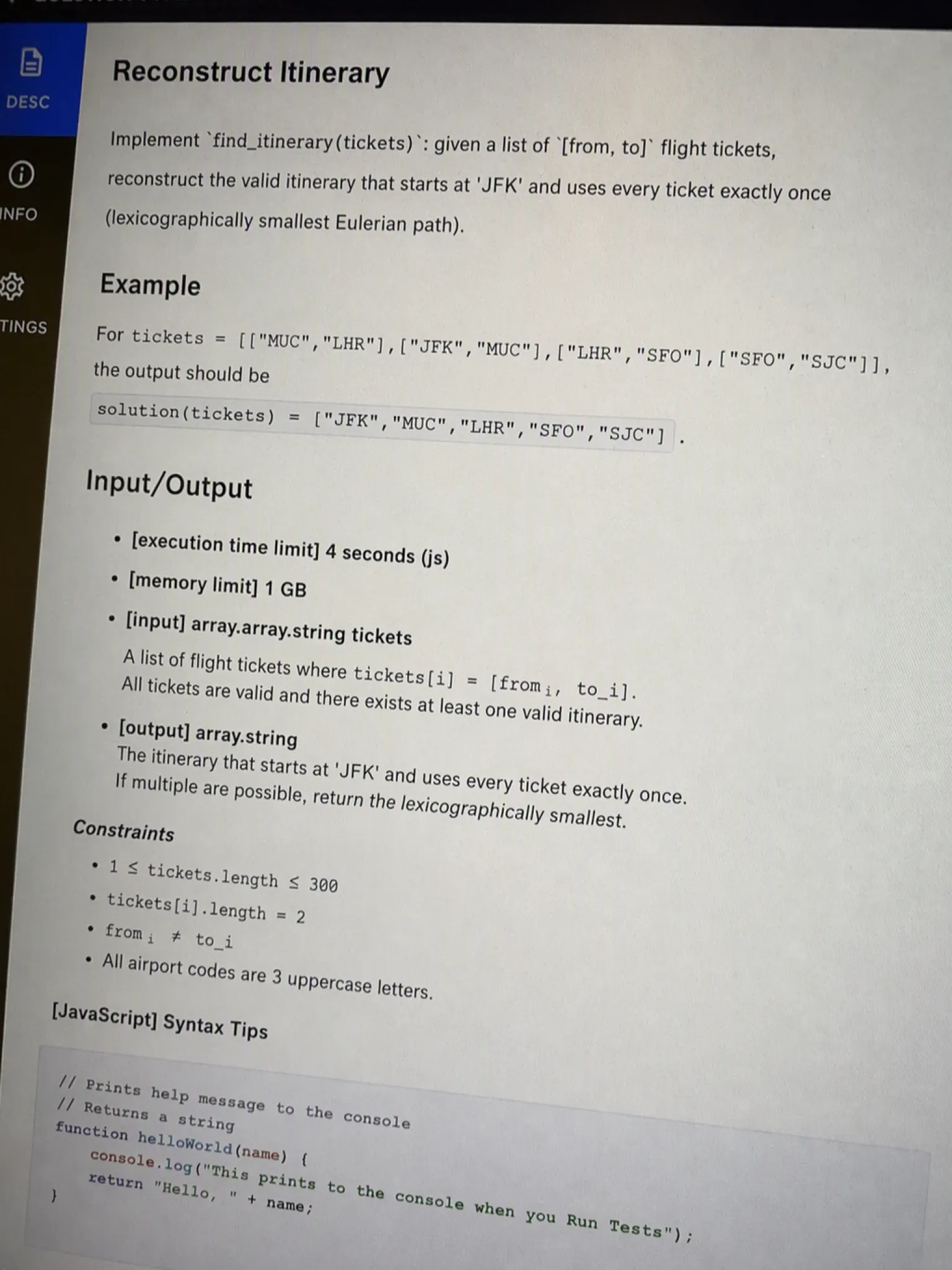
The problem I got: Given a list of airline tickets as [from, to] pairs, I had to return the itinerary that uses every ticket exactly once. It started at "JFK" and had to be ordered lexicographically when ties existed. It is LeetCode 332 verbatim, and 1Point3Acres confirms Pinterest reuses it as both a phone-screen warmup and an onsite round.
My approach: This is an Eulerian path, not a backtracking problem. I built an adjacency list with a min-heap at each node for the lexicographic order. Then I ran a post-order Hierholzer's algorithm so the deepest edge resolved first.
import heapq

def find_itinerary(tickets):
    graph = {}
    for frm, to in tickets:
        heapq.heappush(graph.setdefault(frm, []), to)
    route = []
    def visit(airport):
        while graph.get(airport):
            visit(heapq.heappop(graph[airport]))
        route.append(airport)
    visit("JFK")
    return route[::-1]
Complexity: O(E log E) where E is the number of tickets. I finished it with a small buffer. Then I went back to clean up Question 3, the moment I describe in the walkthrough above.
The cycle follow-up is where most candidates stall. The base problem is small enough that a naive greedy "pick the lex-smallest next ticket" passes the visible tests. But on a graph that contains a cycle, that greedy walks into a dead end with no way to back out, and the code looks fine until the hidden tests run. Hierholzer handles cycles natively because the post-order append unwinds the recursion, which is exactly the "fix" the interviewer is pushing for. If you shipped the no-backtrack version, the cycle follow-up is what flushes it out.
Pinterest's Proctoring Policy for CodeSignal
Pinterest sends the standard CodeSignal GCA, and CodeSignal proctors the session. The score is certified only after a review confirms no unusual activity took place, which means the platform watches for integrity problems during the test. CodeSignal's monitoring goes well beyond the camera, and I broke down exactly how CodeSignal detects cheating in 2026 if you want the full picture.
The community writeups are specific about what gets watched. The harness records both your webcam and your screen activity — I broke down how CodeSignal uses your camera and how CodeSignal records your screen in separate guides — and it flags anything that pulls an answer onto the testing machine.
For the ML-heavy version, the webcam stays on for the whole sitting. Physical books and a second monitor are forbidden. A plain notebook for arithmetic is allowed — and you want it ready, because one section asks you to hand-compute a small neural-network forward pass with a sigmoid. Have that notebook open before you start.
The practical takeaway is simple: the assessment is not a casual take-home. Treat the environment like a real interview, keep your workspace clean, and do not run anything that puts an answer on the same machine you are testing on.
Other Confirmed Pinterest CodeSignal Questions
Beyond the four on my own test, the 1Point3Acres interview board aggregates the wider pool Pinterest actually sends. These are community-compiled, not official, and the board's coverage shows which ones recur.
Pin / Board Graph Distance
Pinterest leans on its own product surface, and 1Point3Acres lists it as a recurring prompt. It models boards and pins as a bipartite graph. It asks for connectivity and shortest pin-to-pin or board-to-board distance — ordinary BFS on the pin projection.
Robot Vacuum Grid
An eight-direction grid traversal that 1Point3Acres also tracks. The forms go from an open grid, to a blocker, to two cooperating vacuums. A clean neighbor table and a visited set carry it.
Binary Search Log by Date
A warm-up-slot question that 1Point3Acres tracks. It uses bisect on a sorted timestamp array, with a violation-log counting follow-up.
Lower-frequency warm-ups
A few LeetCode staples show up less often but are confirmed. BST to Doubly Linked List is LeetCode 426, with an insert follow-up. Put Boxes Into the Warehouse is LeetCode 1564. Lighthouse 2D Matrix is a light-propagation simulation. These tend to land in the first two warm-up slots.
What Pinterest's CodeSignal Test Format Actually Looks Like
The format is settled. CodeSignal's own assessment guide states the test is four questions in seventy minutes. It scores from 200 to 600 and certifies after an integrity review.
You see all four questions at once and may answer them in any order. Each question is a single function or small program. It is scored on correctness, speed, implementation, and problem solving.
CodeSignal's IDE lets you switch languages mid-test, which matters because the questions escalate. Q1 is a warm-up, Q2 is medium, and Q3 or Q4 is where the difficulty jumps. Your link arrives by email as a one-shot timed sitting, so there is no pausing once the timer starts.
The ML Intern CodeSignal OA Is a Different Build
If you are applying for an ML or data internship, do not assume the four-question coding build. The ML-flavored CodeSignal OA that candidates report is a different mix. The proctoring note above covers its book and screen rules.
It starts with a block of ML multiple-choice questions: confusion-matrix reading, overfitting diagnosis, cross-entropy loss, and L1 regularization. Then comes a hand-computed neural-network forward pass with a sigmoid, plus one LeetCode-style coding problem.
One reported coding variant asks whether a sliding window is "monotonic from the center." The last two parts are ML implementations: a bootstrap decision tree with NumPy disabled, and a naive Bayes classifier from the standard formulas. The NumPy ban is the distinctive constraint — you resample with pure-Python random and reduce predictions to a majority vote without numpy.bincount.
How Pinterest's CodeSignal Scoring Works
The GCA score runs from 200 to 600. A 600 is CodeSignal's top band: excellent algorithmic, problem-solving, and implementation performance. One CodeSignal candidate's score breakdown on Teamblind shows the solve order matters more than finishing everything.
That candidate finished Q1, Q2, and Q4 but not Q3 and still scored in the high band on the older 850 scale. Another finished Q1 through Q3 plus half of Q4 and scored lower despite solving more questions, because hidden tests on Q4 failed.
The lesson is direct: partial credit on the hard question beats a frantic attempt at full coverage. CodeSignal also re-runs hidden tests that punish slow code. An O(n log n) solution that passed the visible cases can still lose points on large inputs.
A perfect 600 does not guarantee an interview on its own. Pinterest still re-screens the resume and compares you against other passing candidates.
Pinterest CodeSignal Exam-Day Strategy
The questions feel manageable until the hidden tests run. The candidates who do well plan for that from the first minute.
Spend Your First 40 Minutes on Q1 and Q2
I treated Q1 and Q2 as must-clears and budgeted them first. They are the two mid-weight questions — a trie and a greedy balance settlement — that most candidates clear if they stay calm. Q3 and Q4 are the custom-interface questions where the hidden tests bite. I wanted the two bankable ones locked before the clock got tight.
Treat Hidden Tests as the Real Bar, Not the Visible Ones
I wrote the simplest correct solution first, then asked whether it would survive a large input. When the pattern called for a hash map or two pointers instead of brute force, I switched before submitting. Visible green is not the same as graded green.
Recover From the Q3 Stall Before Time Runs Out
When Q3 stalled, I stopped rebuilding the whole approach and instead tested the state I thought I understood. The missing piece was almost always the per-room linked list stored as a class variable. It shared state across rooms, not the traversal itself. I kept Q1 and Q2 finished so a stall on Q3 or Q4 could not sink the whole score.
Why Candidates Fail the Pinterest CodeSignal Assessment
Most failures are not about not knowing algorithms. They are about code that is not both clean and efficient under pressure.
Invisible-App Results Get Voided
At least one candidate was flagged for using a hotkey-activated invisible app during a Pinterest CodeSignal assessment in late April 2026. The tool rendered an answer window that took focus during a hidden-test debugging pass, the assessment locked, and the already-scheduled interview was withdrawn with the score marked invalid.
Desktop overlay tools put the AI's answer on the same screen the proctoring system watches, hidden by a basic OS-layer trick. InterviewFox works differently: the answer goes to my phone, a physically separate device that no screenshot or session recording can reach by design.
Land offer with Safer AI Interview Assistant
Skip the risky invisible apps. Our dual-device mode keeps it simple and undetectable. You crush the interview, we handle the answers.
Get started. It's freeLoved by 100,000+ candidates
Passing Visible Tests While Failing Hidden Ones
The most common killer is a correct algorithm that times out on large hidden inputs. A brute-force pass on Q3 or Q4 looks green on the sample cases and then loses the performance points. I made a habit of checking the worst-case input size before I submitted anything.
Running Out of Time on the Hardest Question
People who open Q3 first and grind it burn the clock that Q1 and Q2 would have banked. The assessment rewards three solid solves over one perfect and three abandoned. I kept the order disciplined so a single hard question could not take the whole sitting.
How to Prepare for the Pinterest CodeSignal in 7 Days
With no confirmed link-expiry window for this assessment, I planned a flat seven-day cycle built from the facts above: four questions in seventy minutes, a hidden-test efficiency bar, and a Q3 that is the real filter.
Days 1-2: Pattern Library for the Four Question Types
Before the OA, I sent my confirmed question patterns to InterviewFox's Prep Agent over WhatsApp. It returned a personalized drill plan, which I used to focus the four families below. My set covered the exact shapes Pinterest uses. The families were trie and prefix search, greedy balance settlement, O(1) game-state with a top-K leaderboard, and graph path reconstruction.
I skipped broad LeetCode tag farming. The repeatable value was in these four families, not in 200 random problems.
Days 3-5: Timed Blocks Under the 70-Minute Cap
I ran four-question blocks on a visible clock, forcing myself to submit Q1 and Q2 inside twenty minutes combined. The goal was pace, not novelty. Every block ended with a manual edge-case pass on empty input, duplicates, and maximum constraints.
Day 6-7: Edge-Case Forcing and One Full Simulation
I drilled the exact failure I hit on Q3. A game-state class stored the per-room linked list as a class variable, sharing state across every room. One full seventy-minute simulation, then a review of the two questions I weakest on. I did not add new topics in the final two days, because nothing new sticks that close to the test.
What Happens After You Submit the OA
The score feeds the resume review, not an automatic offer. New-grad software engineers move from the CodeSignal OA to a recruiter screen, then a one-hour technical interview, then a hiring committee. Interns follow a leaner path with a single live round.
A strong score gets you the look. The live rounds decide it, and they weigh communication as much as correctness. Prepare to talk through your code out loud, because the assessment is only the first filter.
FAQ
Is the Pinterest CodeSignal OA the same for every candidate?
No. New-grad and intern software engineers get the four-question General Coding Assessment described above.
ML and data interns report a different build. It mixes ML multiple-choice questions, a hand-computed neural-network forward pass, one coding problem, and two ML implementation problems (bootstrap tree without NumPy, naive Bayes). The structure is fixed per role, but the question themes shift by level and team. Treat them as probable, not guaranteed.
How many questions are on the Pinterest CodeSignal test?
Four questions in seventy minutes. They appear together and can be answered in any order, so plan your own sequence instead of working top to bottom.
What score do I need on the Pinterest CodeSignal to get an interview?
CodeSignal scores run 200 to 600, and a high score clears the technical screen. Pinterest still re-screens the resume and compares candidates, so there is no single passing number that guarantees an interview on its own.
Can a perfect Pinterest CodeSignal score still lead to rejection?
Yes. Candidates with a perfect 600 have been rejected after the live rounds, because communication and resume fit matter as much as the coding score. The OA gets you the look, not the offer.
Does Pinterest use CodeSignal or HackerRank?
New-grad and intern software engineers get CodeSignal. Some other roles or experienced hires use CoderPad or a live screen instead, so confirm the platform with your recruiter.
Can I use an AI tool or invisible app during the Pinterest CodeSignal OA?
Desktop overlay tools put the AI's answer on your computer screen, rendered as a hidden layer above the browser with a basic OS trick. The answer is on-screen, the hiding is crude, and proctoring software keeps adding detection as these tools spread.
InterviewFox pushes the answer to your phone, a physically separate device that no screenshot or session recording can reach by design. The laptop screen stays on the exam editor unchanged. If you're going to use AI assistance during the OA, the dual-device architecture removes the answer from your screen entirely.
Land offer with Safer AI Interview Assistant
Skip the risky invisible apps. Our dual-device mode keeps it simple and undetectable. You crush the interview, we handle the answers.
Get started. It's freeLoved by 100,000+ candidates