
Walmart HackerRank OA: Real Questions and What It Takes to Pass

Quick Facts
| Platform | HackerRank (2026) |
| Questions (2026 sitting) | 3, two LeetCode-Medium DSA plus one Java and Spring task |
| Time limit (2026 sitting) | 80 minutes |
| Proctoring | HackerRank per-test toggle: Secure, Proctor, or Desktop App |
| AI-tool detection | Real invalidation reported (desktop copilot led to a marked-invalid session) |
| Score cutoff | Not published by Walmart |
I sat the Walmart HackerRank OA for a software engineering role in early 2026. The format was three questions in eighty minutes. So, I walk through the full process and how I prepared below.
Question 1 buried a DP twist in its constraints. I had burned far more of the eighty minutes than I planned. I turned to my AI interview assistant to pressure-test the recurrence window. It surfaced the off-by-one gap in my state. Finally, I break the full walkthrough down below.
Before my test, I read every Walmart HackerRank post from the past two years. I checked Reddit, LeetCode Discuss, and Teamblind. In fact, what I found tracks closely with what I experienced, particularly the mistakes that get people flagged or rejected.
The Real Questions on My Walmart HackerRank Test
My late-February 2026 Walmart OA ran on HackerRank. The format was fixed at three questions in eighty minutes. Two were LeetCode-Medium DSA problems and one was a Java plus Spring task in an integrated editor. So here is exactly what I faced on screen.
Question 1, LeetCode-Medium DSA
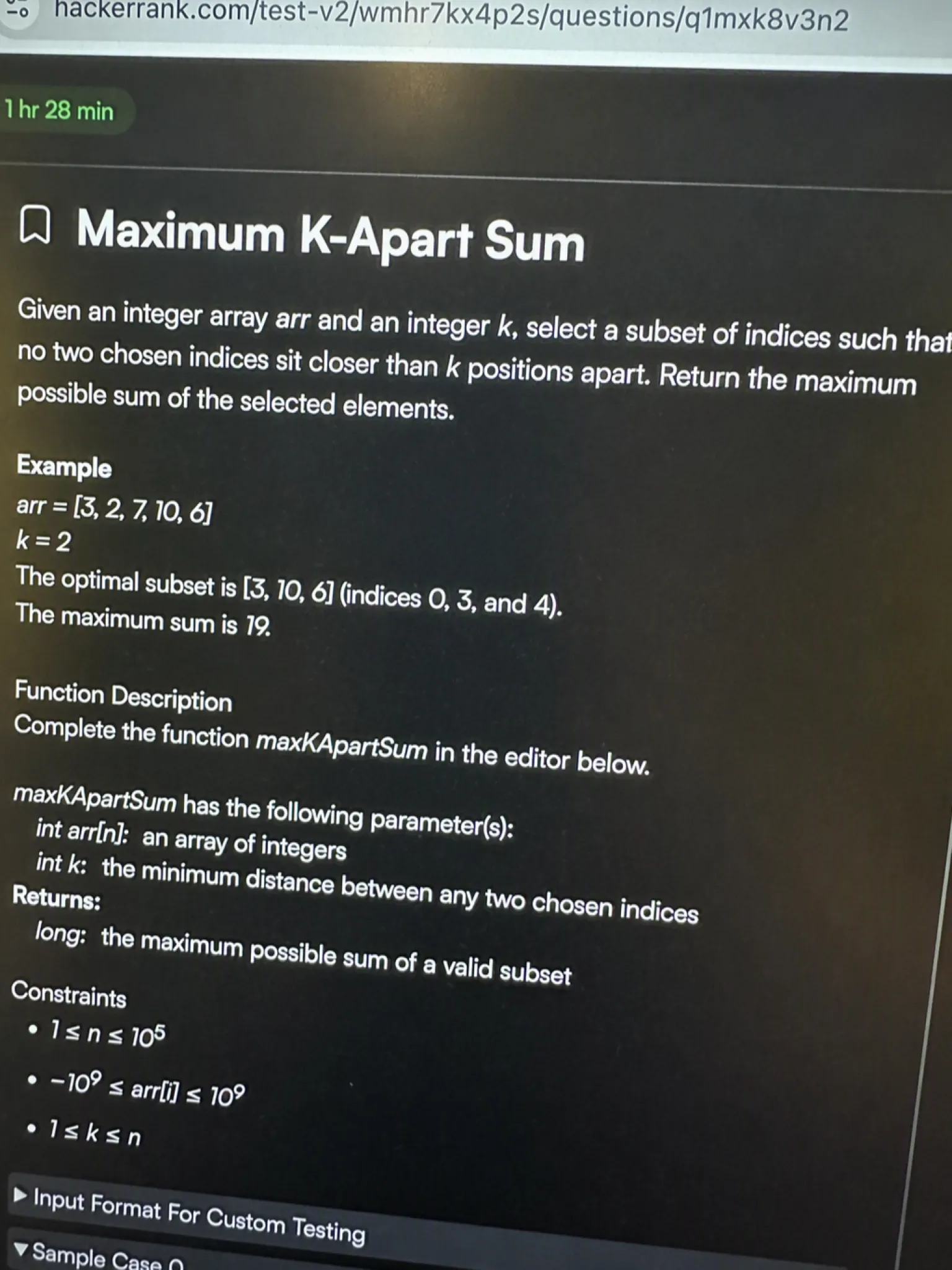
The problem I got: a medium array problem. I was handed an integer array and asked to pick a valid subset that maximized the total sum, under a constraint that no two picked positions could sit closer than a fixed distance k. It read like a classic DP once I saw the shape of it.
My approach: I built a DP where dp[i] is the best sum from a valid selection ending at index i, and I transitioned by either skipping i or taking it and looking back at most k positions for the best prior choice. The catch was the recurrence window. Question 1's DP twist had me re-reading the constraints three times before I was sure the gap was k, not k minus one. I kept a rolling max of the last k entries so each step stayed cheap instead of rescanning.
def max_sum(arr, k):
    n = len(arr)
    if n == 0:
        return 0
    dp = [0] * n
    dp[0] = max(0, arr[0])
    for i in range(1, n):
        best = 0
        for j in range(max(0, i - k), i):
            best = max(best, dp[j])
        dp[i] = max(dp[i - 1], arr[i] + best)
    return dp[-1]
Time complexity: O(n * k) | Space complexity: O(n)
I got a working submission compiled with a minute to spare, but Question 1's DP twist had me re-reading the constraints three times, and I had burned far more of the eighty minutes than I planned.
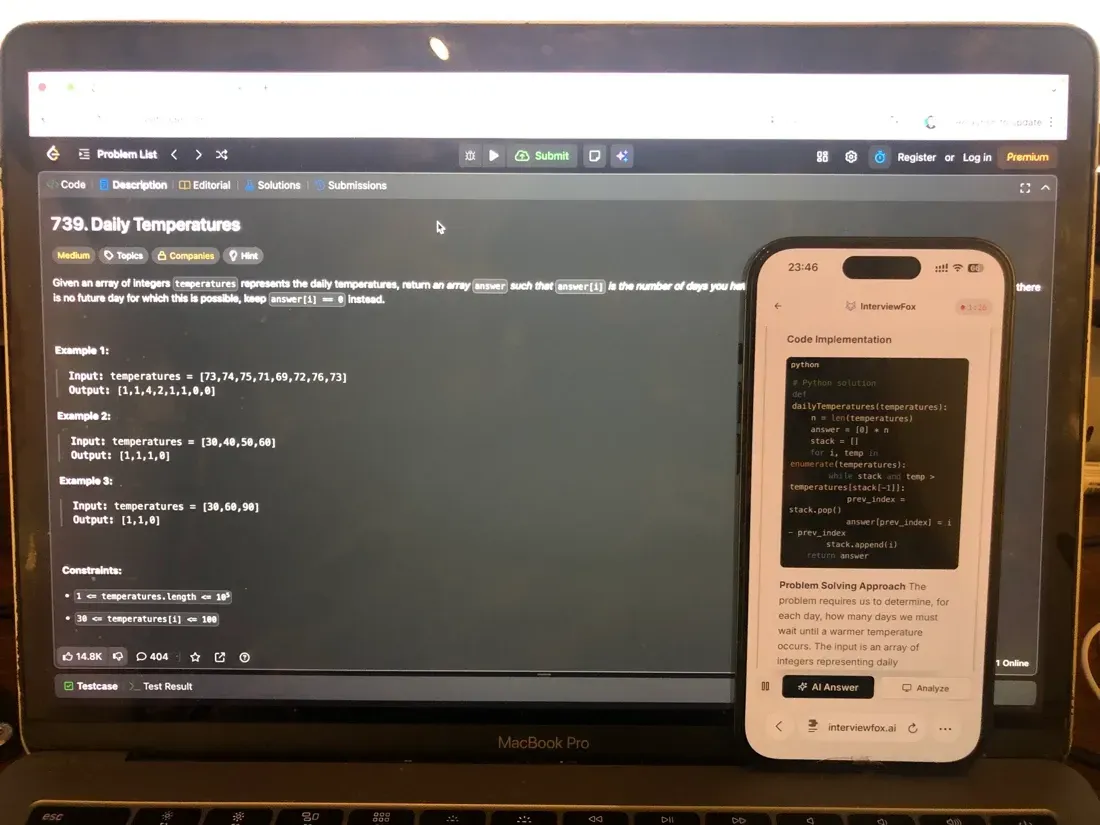
I did not want to use a desktop overlay. The answer would have sat on the same screen the proctoring system was monitoring, hidden by a basic rendering layer. I pressed the keyboard shortcut instead, the tool auto-captured the screen, and the answer landed on my phone. Meanwhile, my laptop screen stayed on the exam editor, unchanged.
Land offer with Safer AI Interview Assistant
Skip the risky invisible apps. Our dual-device mode keeps it simple and undetectable. You crush the interview, we handle the answers.
Get started. It's freeLoved by 100,000+ candidates
Question 2, LeetCode-Medium DSA
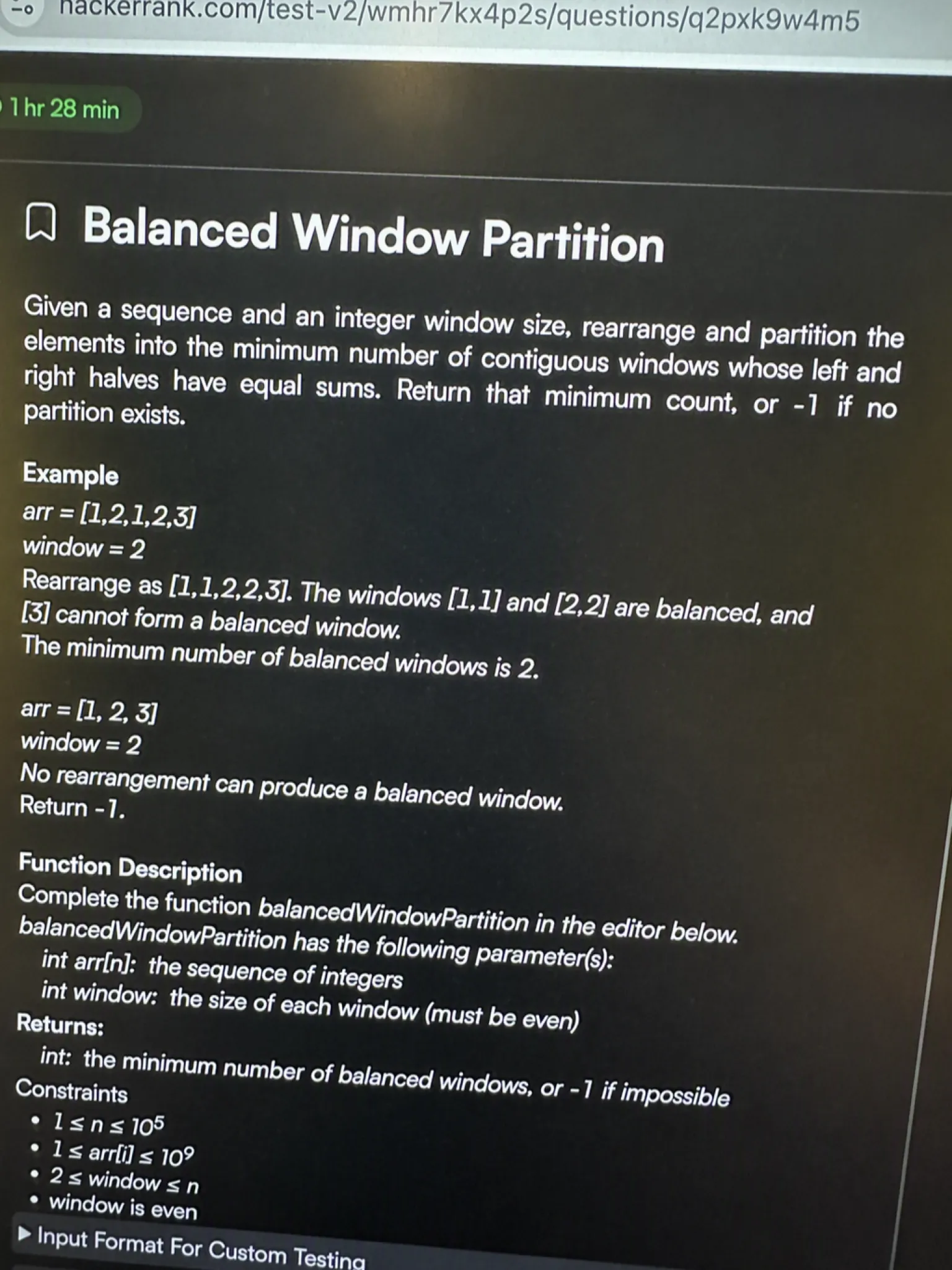
The problem I got: a second medium, this one with a greedy or two-pointer angle on a string or array. The prompt asked me to partition or rearrange elements so a balanced-window condition held. I had only just opened it when everything stopped.
My approach: my first read said a sorted greedy or a two-pointer scan from both ends, growing a valid window and committing the cheapest partition, would fit. I never got to write a line. The moment I clicked Save and Proceed to leave Question 1 and open Question 2, the editor froze. A proctoring message appeared on screen naming an unapproved desktop process. That was the last action the assessment let me take.
Time complexity: not reached | Space complexity: not reached
I was stuck at the threshold of Question 2, the approach still unformed, when the environment locked.
Question 3, Java and Spring integrated task
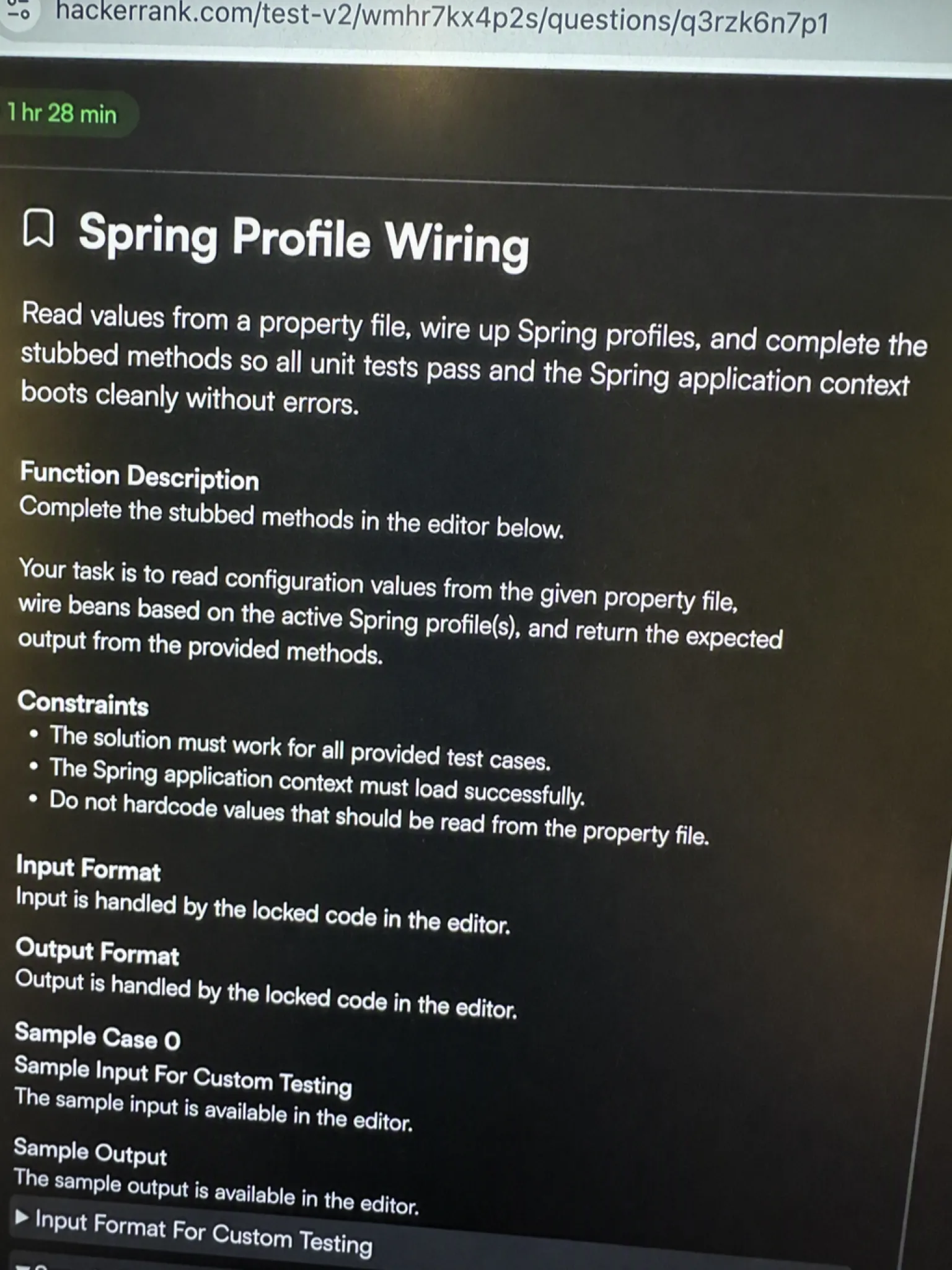
The problem I got: the third item was a Java and Spring task inside the integrated editor. The brief asked me to read values from a property file, wire up Spring profiles, and complete several stubbed methods so that all tests passed and the app ran error-free.
My approach: I would have loaded the values through @ConfigurationProperties, activated a dev profile with @ActiveProfiles, and filled the stub methods to return the configured values. The grading was "all tests green, app boots clean," not a DSA score, so the work was wiring, not algorithm design.
@Configuration
@ConfigurationProperties(prefix = "app")
public class AppConfig {
    private String mode;
    private int limit;
    // getters and setters
}

@Service
@ActiveProfiles("dev")
public class ReportService {
    private final AppConfig config;
    public ReportService(AppConfig config) { this.config = config; }
    public int compute(String input) {
        // completed stub: returns the configured limit for valid input
        return config.getLimit();
    }
}
Time complexity: framework task, not measured | Space complexity: framework task, not measured
However, I never reached it. After the freeze and the unapproved-process message, the assessment was marked invalid and an already scheduled interview was withdrawn.
Walmart's Proctoring Policy for HackerRank
HackerRank offers three integrity modes as a per-test employer toggle. the platform's proctoring support page documents them. Walmart does not publish which mode it enables. I describe the platform mechanics, not a claimed Walmart setting.
Specifically, the three integrity tiers and the always-on tracking break down as the chart below shows.
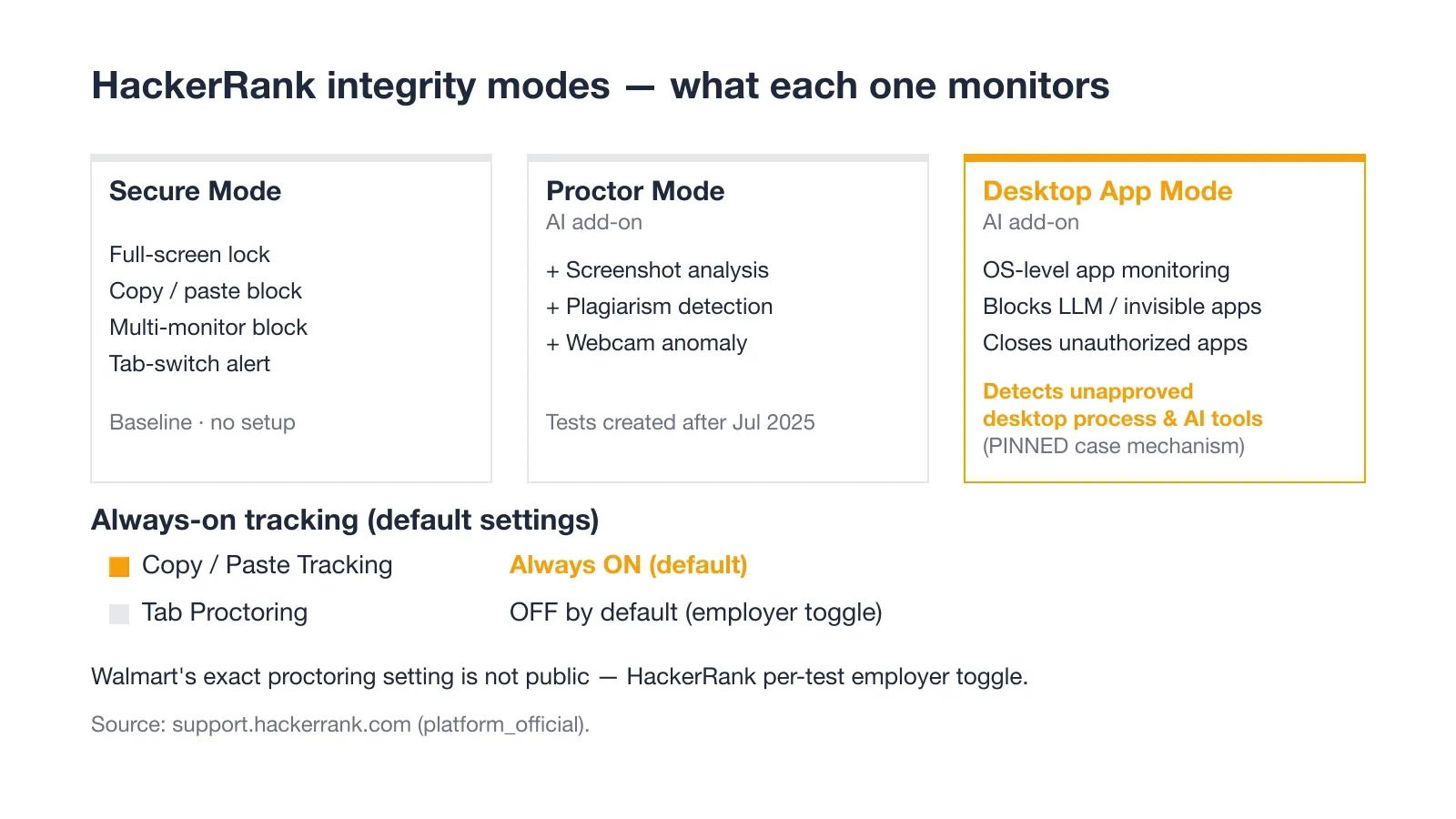
The three integrity modes
First, Secure Mode locks the full screen, blocks copy and paste, blocks extra monitors, and alerts on a tab switch. Proctor Mode adds AI screenshot analysis, plagiarism detection, and webcam anomaly checks, but only for tests created after July 2025.
Second, Desktop App Mode goes deeper. It monitors at the OS level and blocks LLM and invisible apps. You must close unauthorized programs before you start.
What's always on
Third, copy-paste tracking stays on by default for every test. Recruiters see a Copy-Paste Frequency column in the report. Tab Proctoring, by contrast, is off by default, so its visibility depends on the employer's configuration.
I never fully mapped the exact line where pasting becomes a flag. how HackerRank detects copy paste covers what the recorder captures.
What the candidate experiences
Question switching is a normal action inside the test, done through the Save and Proceed button. The timer keeps running even if your connection drops, and the last compiled code auto-submits at timeout. Timed sections move one way only, so you cannot return to an earlier block.
So which switches reach the recruiter, and which stay invisible? whether HackerRank sees you switch tabs shows the boundary. It sits between a normal question switch and a logged one.
Other Confirmed Walmart HackerRank Questions
Instead, these are distinct real questions reported across roles and years, not the contents of one sitting. I label them that way because no single source lists more questions than the sitting it describes.
Coding questions beyond the 2026 sitting
Other candidates reported problems like reversing a number and counting factors. They printed string permutations that start with a digit, and reversed a binary tree from scratch. One SWE-III panel round asked for rapid-fire Spring Boot, Kafka, JWT, and SQL work. It also included small Java 8 and SQL coding tasks.
I was not in those rooms, so I report them as separate accounts rather than my own.
The MCQ bank
Several reports describe a multiple-choice block covering data structures, algorithms, operating systems, object-oriented design, databases, and system design. Similarly, a campus report lists 15 to 20 core computer-science and aptitude questions before the coding round. These are supporting patterns, not a guarantee of what your test will contain.
The framework-shaped task repeats
The Java and Spring property-file and profiles task I faced is not a one-off. Another report describes a Spring-Boot, Kafka, JWT, and SQL rapid-fire round. It shows Walmart tests framework engineering, not just algorithm design. Otherwise, if you only drill LeetCode, you will miss a real slice of the assessment.
What Walmart's HackerRank Test Format Actually Looks Like
The 2026 sitting I took ran three questions in eighty minutes. this Walmart OA report matches it. Older reports describe different shapes. I treat the 2026 profile as current and the rest as historical range.
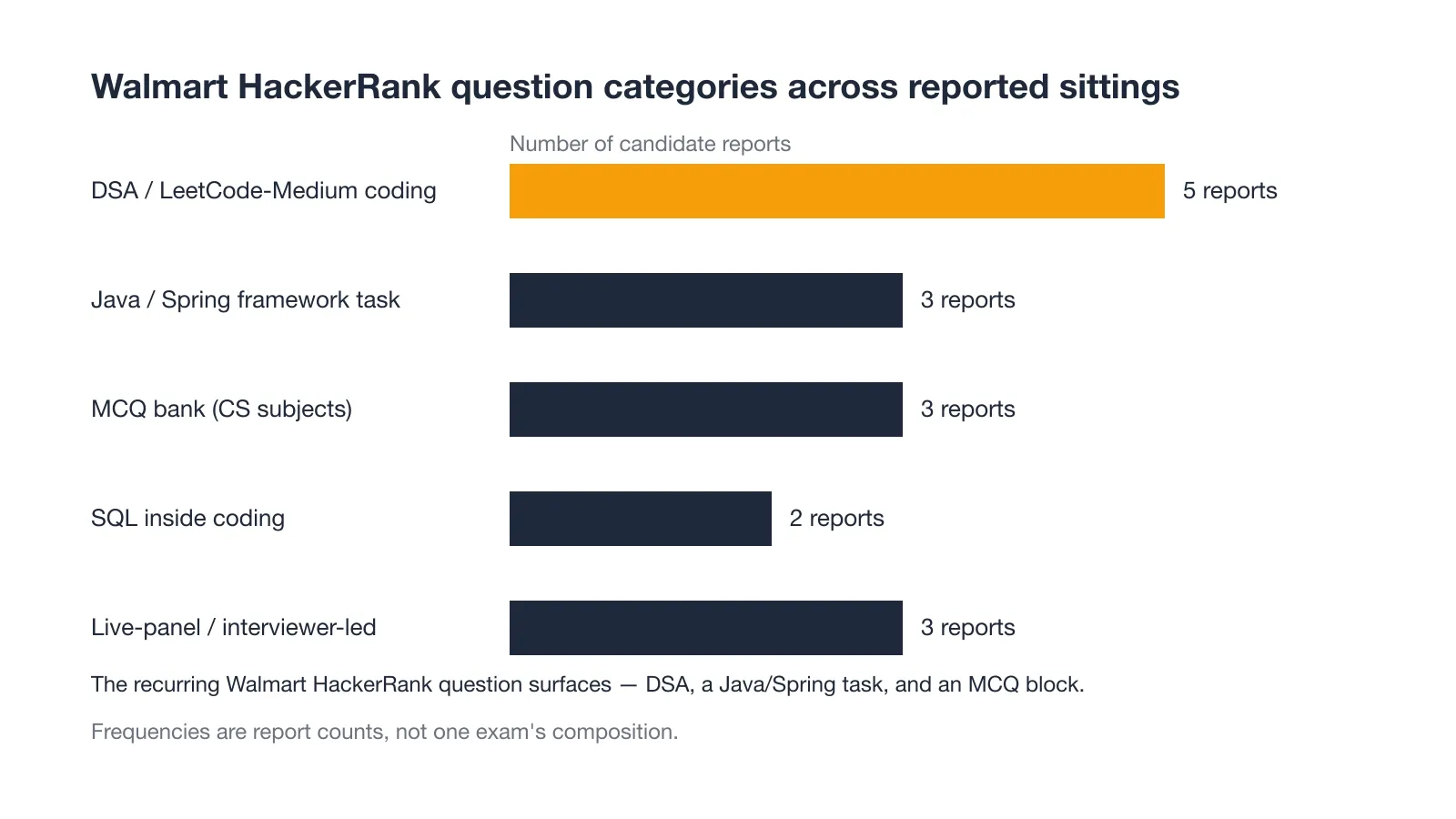
Overall, the recurring question categories across reported sittings look like this.
Time limits and question counts
Time limits vary by year and role. My 2026 sitting was 80 minutes for 3 questions. A 2022 report shows 60 minutes for 6. One interviewer-led round ran 45 minutes for 1, and a live coding round ran 90 minutes. That 2026 figure is the one I can vouch for personally.
The two-section shape
Some reports describe a two-section test: a multiple-choice block followed by a coding block. A 2024 report and a 2020 campus report both show this split. It suggests a recurring Walmart format, not a one-time setup.
Platform mechanics
Invites arrive by email with no candidate-side reschedule. The test runs on a PC or laptop only, not a phone or tablet. More than 35 languages are available, and the last compiled code auto-submits at the timeout. Timed sections are one-way, so plan the order before you start.
The debunked 90-minute figure
You will see a claim of 90 minutes with 10 multiple-choice questions and 3 coding tasks. That figure traces to a HackerEarth campus test from 2015 to 2018, not to Walmart HackerRank. Only the HackerRank-attested limits of 80, 60, 45, and 90 minutes are real Walmart numbers.
How Walmart's HackerRank Scoring Works
Walmart publishes no cutoff score for its HackerRank OA, and I found no candidate-reported passing bar anywhere. Therefore, the platform mechanics below explain why that number stays hidden from candidates.
Why there's no public Walmart cutoff
Cutoff scores are configured by the recruiter and never shown to the candidate. The bar can shift between cohorts without any public signal. Treat any passing score you see online as unverified.
How coding questions are scored
Each coding question is auto-evaluated per predefined test case. Additionally, every case carries its own score, and a case is either full credit or zero, with no partial scoring. A clean run on all visible cases is the only way to bank the points.
Framework tasks score differently
The Java and Spring task I faced is graded on all tests green. Your app must boot clean, not on a DSA score curve. The platform recommends manual review for this item. Your work is judged on whether it runs, not on cleverness.
The recruiter sees behavior
The recruiter report carries behavior signals beyond pass counts. Specifically, they include Copy-Paste Frequency, Out-of-Window Duration, Number of Window Exits, and a plagiarism verdict. These feed the disqualification decision, so how you interact with the editor matters as much as your answers.
Why Candidates Fail the Walmart HackerRank Assessment
The failure stories split into integrity violations and self-inflicted mistakes. The most instructive one is a private case where an assistive tool turned a passing attempt into a voided session.
Invisible-App Results Get Voided
For my late February 2026 assessment, I mapped a desktop copilot window set to low opacity to a shortcut. I switched from Question 1 to Question 2. The editor froze and a proctoring message named an unapproved desktop process. An already scheduled interview was withdrawn after the assessment was marked invalid.
This freeze matches a documented platform behavior. Desktop App Mode detects and closes unapproved processes. It blocks invisible cheating tools and LLM apps. A proctoring message naming an unapproved desktop process is exactly that detection firing.
My window stayed on the same screen the proctoring system was monitoring, hidden by a basic OS-layer trick. InterviewFox works differently. The answer goes to my phone, a physically separate device that no screenshot or session recording can reach by design.
Land offer with Safer AI Interview Assistant
Skip the risky invisible apps. Our dual-device mode keeps it simple and undetectable. You crush the interview, we handle the answers.
Get started. It's freeLoved by 100,000+ candidates
Platform penalty pathways
Knowing the full set of triggers HackerRank uses to invalidate a session helped me. I stopped guessing after my own freeze. how HackerRank catches cheating in 2026 lays out that family.
AI Plagiarism Detection flags High or Medium sessions at 85 percent precision, with human oversight required. Tab Proctoring is off by default, and confirmed malpractice can disqualify you from later rounds.
Self-inflicted failures
Some failures have nothing to do with integrity. Running out of time with zero tests passing is a real auto-fail pattern. Unstable internet mid-round has sunk otherwise-strong attempts. Neither is a Walmart-specific rule, but both end the same way.
How to Prepare for the Walmart HackerRank in 7 Days
No one published a Walmart-specific prep timeline. I built this plan from the confirmed question shapes and platform constraints. The seven days are a default window, not a confirmed notice-to-deadline span.
Days 1-2, Java and Spring drill
The single Java and Spring property-file task carried real weight. I treat it as the highest-relevance item. I stood up a small Spring Boot project, read values through @ConfigurationProperties, and activated a dev profile with @ActiveProfiles.
My success check was an app that runs error-free with every test green, mirroring how that question is graded.
Days 3-5, LeetCode-Medium DSA and MCQ breadth
The two LeetCode-Medium problems ate most of my eighty minutes. I drilled timed medium sets and reviewed the multiple-choice subjects. I used flashcards for data structures, algorithms, operating systems, object-oriented design, databases, and system design. My success check was solving two mediums under pressure and recalling the MCQ subjects without lookup.
Days 6-7, timed simulation and AI-off rehearsal
I ran one full eighty-minute mock in a HackerRank-like shell and practiced the environment with every assistant disabled. The direct tie to my failure was confirming no invisible desktop copilot was mapped to a shortcut. My success check was finishing a three-question mock inside eighty minutes with a clean process list.
In the days before the OA, I used the Prep Agent from InterviewFox over WhatsApp and SMS. I sent it the confirmed Walmart question patterns and got back a personalized drill plan and strategy.
What Happens After You Submit the OA
Submission is rarely the end of the loop. The sequence below reflects reported turnarounds and the platform's usual screening role.
The follow-on DSA round rule
A follow-on DSA round allows any IDE with AI tools disabled. It grades working code and passing tests, not a discussion of time and space complexity. That tells you the later round rewards a running solution more than a clever explanation.
The typical next step
HackerRank Tests usually act as the first screening step. Those who clear qualify for an online coding interview on HackerRank Interviews. One 2025 report describes three rounds, two virtual and one final face-to-face, after the OA.
Scheduling slippage is real
Interviewers can no-show or reschedule, and that slippage shows up in candidate reports. In one account, the recruiter called the next working day after a clear. A later panel round slipped without warning.
The framework fingerprint continues
The framework angle does not stop at the OA. One report describes a solved DSA problem turned into a working Spring endpoint. That matches the property-file task I faced. Expect wiring questions to follow you into later rounds.
The possible second assessment
Some older reports describe a second assessment: the HackerRank OA plus a separate Modern Hire behavioral test. This pair is not re-confirmed for 2025 or 2026, so I flag it as historical rather than current.
FAQ
Can I use an AI tool or invisible app during the Walmart HackerRank OA?
Desktop overlay tools put the AI's answer on your screen. It renders as a hidden layer above the browser through a basic OS trick. Proctoring software keeps adding detection, so the exposure is never fully fixed.
InterviewFox pushes the answer to your phone instead. It is a physically separate device that no screenshot or recording can reach by design. Your laptop screen stays exactly as the editor left it. If you use AI help during the OA, the dual-device setup removes the answer from your screen entirely.
Land offer with Safer AI Interview Assistant
Skip the risky invisible apps. Our dual-device mode keeps it simple and undetectable. You crush the interview, we handle the answers.
Get started. It's freeLoved by 100,000+ candidates
How many questions and how long is the Walmart HackerRank OA?
The 2026 sitting had three questions in eighty minutes, two LeetCode-Medium problems and one Java and Spring task. Historical reports range from sixty minutes for six questions to a forty-five minute round. The exact count depends on the role and year.
Does Walmart publish a passing score for the HackerRank OA?
No. Walmart sets no public cutoff, and HackerRank cutoff scores are configured by the recruiter and hidden from candidates. Treat any specific passing number you see online as unverified.
What happens after I submit the Walmart HackerRank OA?
Clearing the OA usually leads to an online coding interview. Some candidates report a three-round sequence and scheduling slippage. A few older reports mention a separate behavioral assessment, but that pairing is not confirmed for recent years.
Is the Walmart HackerRank OA pure DSA?
No. The 2026 sitting embedded a Java and Spring task, and other reports describe a multiple-choice block alongside coding. Prepare for framework engineering and CS fundamentals, not only algorithm problems.