
How I Took the D. E. Shaw CodeSignal OA in 2026: Prep Plan
Quick Facts
| Platform | CodeSignal, on the recruiter-sent SWE intern and full-time SDE path |
| Questions | 4 medium-hard questions, coding only |
| Time limit | 90 minutes, one sitting, no pause |
| Other live shapes | HackerRank 3 DSA questions (India on-campus) and a HackerRank front-end OA |
| Invitation window | 14 days by default; the timer starts only after proctoring setup |
| Score | CodeSignal 200-600, two-tier; bonus points only at 100% module completion |
| Pass bar | No D. E. Shaw cut-off is published anywhere |
| Proctoring | Camera, microphone, screen share, government photo ID |
| Detection signals | Similarity score, pattern detection, telemetry, paste events |
| If you are flagged | Session reviewed in 1-3 business days, then verified or Proctoring rejected |
| After you submit | Score verification, then interviews, which have run as a same-day series |
I took the D. E. Shaw CodeSignal assessment in October 2025 for a software engineering internship. It ran on the recruiter-sent path: four questions in 90 minutes, coding only. My attempt finished without a certified score, and what follows is the complete process plus how I prepared for it.
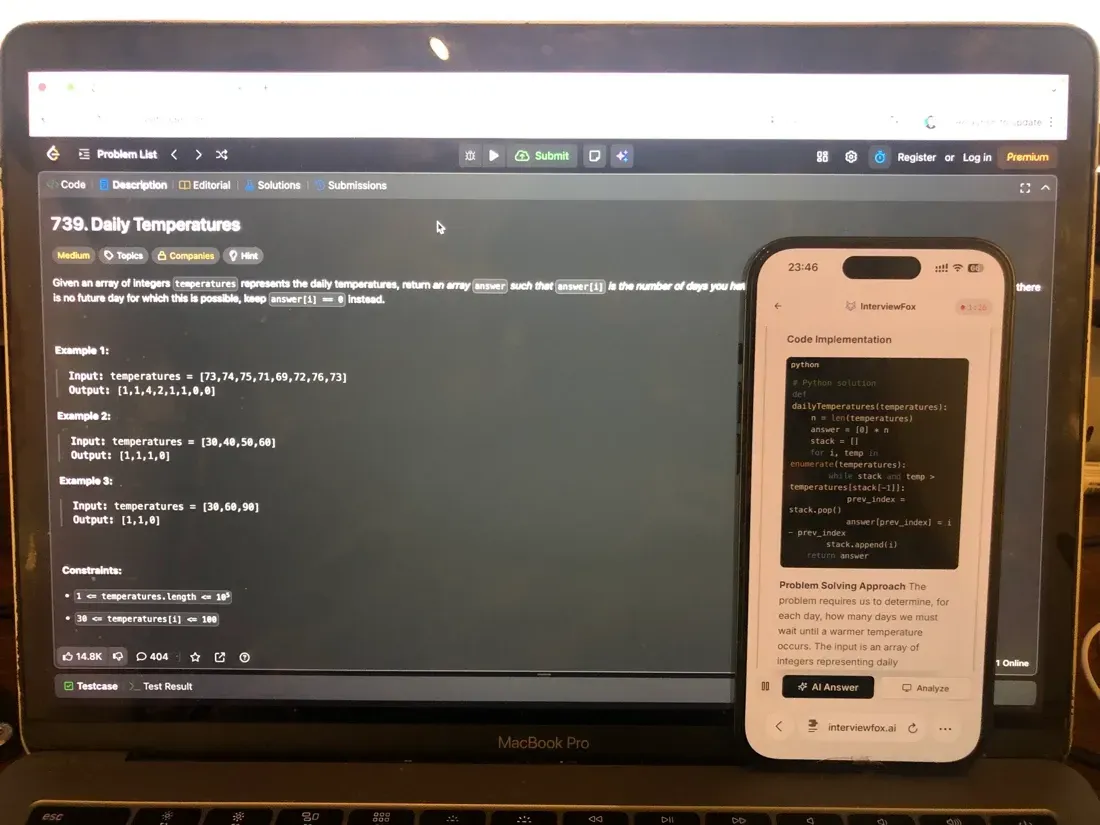
At the 72-minute mark, I was stuck during the assessment. I used dual device AI interview copilot to recheck the walkthrough. It shows the answer on a phone instead of the recorded desktop.
Before my test, I went through every D. E. Shaw CodeSignal post from the past two years on Reddit, LeetCode Discuss, and Teamblind. What I found tracks closely with what I experienced. I cover the mistakes that end an attempt without a certified score further down. They run from paste events to a second window on the shared display.
My D. E. Shaw CodeSignal Experience
The recruiter-sent D. E. Shaw CodeSignal OA is four questions on a single 90-minute clock, coding only, with no aptitude section and no break.
I had already decided against relying on a desktop overlay: the answer would have sat on the same screen the proctoring system was recording, hidden or not, and whether that gets flagged depends on what detection happens to be running, which is uncertainty I did not want riding on a timed sitting. So at the 72-minute mark I pressed one keyboard shortcut, and the real time AI interview assistant auto-captured the problem and pushed it to my phone, a device outside the platform's screenshot monitoring. The rebuild came back in under a minute and gave me another way to think through the implementation. My laptop screen never changed; it still showed the checker I had been debugging while I read through the revised reasoning on my phone.
D. E. Shaw's Proctoring Policy for CodeSignal
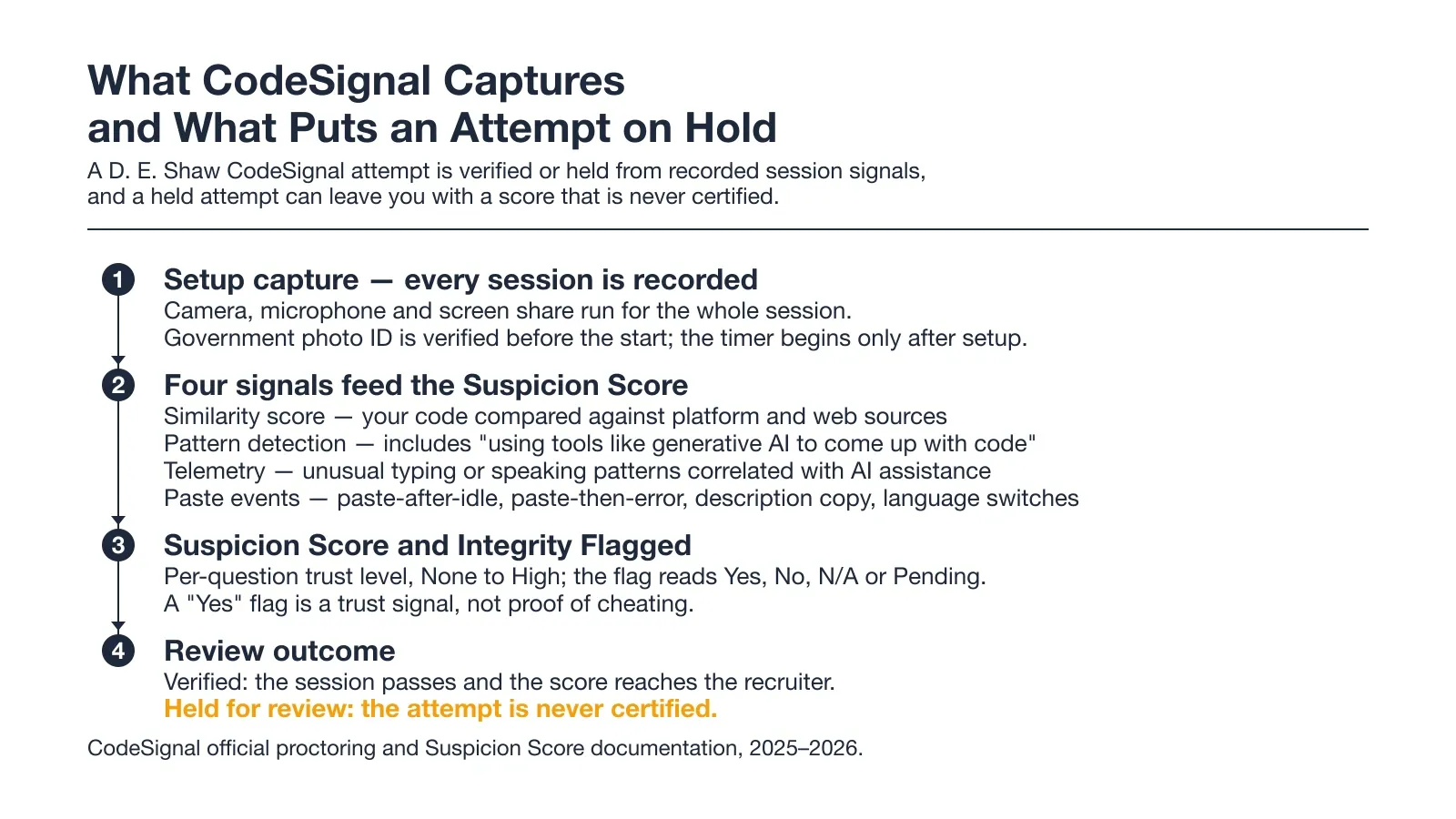
Every D. E. Shaw CodeSignal attempt runs under the same recording setup, and the same signals decide whether the sitting counts. The chart below maps what CodeSignal captures and what puts an attempt on hold.
CodeSignal Records Your Camera, Mic, Screen and Photo ID
Setup requires four things before the first question appears. I need a working camera, a live microphone, full screen share, and a government photo ID. The third step asks me to close every unrelated tab, window, and application. Still, most candidates treat that step as optional.
None of that touches the clock. The timer begins only after every setup step is complete. The ID check, the camera test, and the sweep of open windows all happen before the 90 minutes start.
CodeSignal applies the same requirements across its proctored assessments. Compare a different setup screen against what CodeSignal's proctoring setup captures.
Whether the camera records for the whole session was the one thing I wanted stated plainly. Leaving the frame is the one item on that list that feels accidental. For what that costs, see what CodeSignal's webcam recording captures and stores.
The Four Signals That Feed the Suspicion Score
CodeSignal gives each question a Suspicion Score running from None to High. Each question also carries an integrity flag set to Yes, No, N/A, or Pending. The flag is a trust level rather than a verdict. Yet a Yes does not mean the platform concluded the test-taker cheated.
Four signal families feed those values. CodeSignal compares your solution against other submissions and web sources for similarity. It scans code patterns for signs of generative-AI assistance. It logs typing and speaking patterns as telemetry, and it records every paste event.
Generative AI appears explicitly in the platform's own material as a flagged pattern. The scale shows in the rates. In 2025, 35% of proctored assessments carried a flag, against a 40% attempt rate at entry level.
How CodeSignal flags copy-paste during a proctored assessment lists event types. Paste timing is the signal candidates ask about most. Knowing which paste events register is the difference between a clean attempt and a held one.
Verified or Proctoring Rejected
After submission the session goes to review rather than straight to a recruiter. A result comes back within one to three business days. Two outcomes exist: verified, or not verified and logged as Proctoring rejected.
The named reasons for a failed review are specific. Specifically, they include not being alone in the room, leaving the camera frame, and using other devices. They also cover an external IDE and searching online beyond syntax.
6 Other Confirmed D. E. Shaw CodeSignal Questions
Six further D. E. Shaw OA questions come from dated candidate reports in the last two years. Each one below carries the track it came from. None of these were on my own sitting.
Question 5: Max Subarray Score Minus MEX
On the 2026 on-campus intern track, the task was subarray work inside a 30-minute slot. Candidates had to maximize the subarray sum minus the mex of that subarray across all subarrays.
In other words, the mex is the smallest non-negative integer missing from the subarray. Long dense intervals score best, so the search runs over subarray boundaries rather than individual elements.
Question 6: Minimum Time Visiting Required Tree Nodes
The same track includes an undirected tree with a start node, an end node, and a required set of nodes. The walk has to visit every required node, and the goal is the shortest route with revisits allowed.
One example runs in full. Take a chain 1-2-3-4 with start 1, end 3, and node 4 required. That walk takes 4 moves, because it has to pass back through 3.
Question 7: Count Subsequences Equal to K
The 2026 SDE-intern set adds a counting task, and the report leaves the platform unnamed. The question asks how many subsequences of a binary string have a value equal to k. Leading zeros count, and n goes up to 2e5. That bound rules out enumeration entirely and points at a two-dimensional DP over position and running value.
Question 8: Python OOP Stock Generator
The on-campus set also carries a Python-only task. Given a price series, buy at a valley and sell at a peak.
Write a generator that yields buy_price, buy_day, sell_price, and sell_day. The generator needs input validation, and the slot is 15 minutes. The check there is object design and edge cases rather than dynamic programming.
Question 9: K-Product Bitwise-OR Discount
A 2024 internship OA asks for the maximum combined value. The t-th pick of product i yields products[i] multiplied by 2 to the power of t minus 1. So all picks combine by bitwise OR.
The doubling on each pick makes the order matter. The DP has to track which products are used and how many times each one is taken.
Question 10: Clear Image Minimum Decrements
Also from 2024: an array counts as clear when zeros pad both sides. The non-zero middle rises by one to a peak, then falls back to one. That task takes the fewest single-pixel decrements to reach a clear shape.
The cost of each pixel is the gap between its value and the value the shape requires at that position.
What D. E. Shaw's CodeSignal Test Format Actually Looks Like
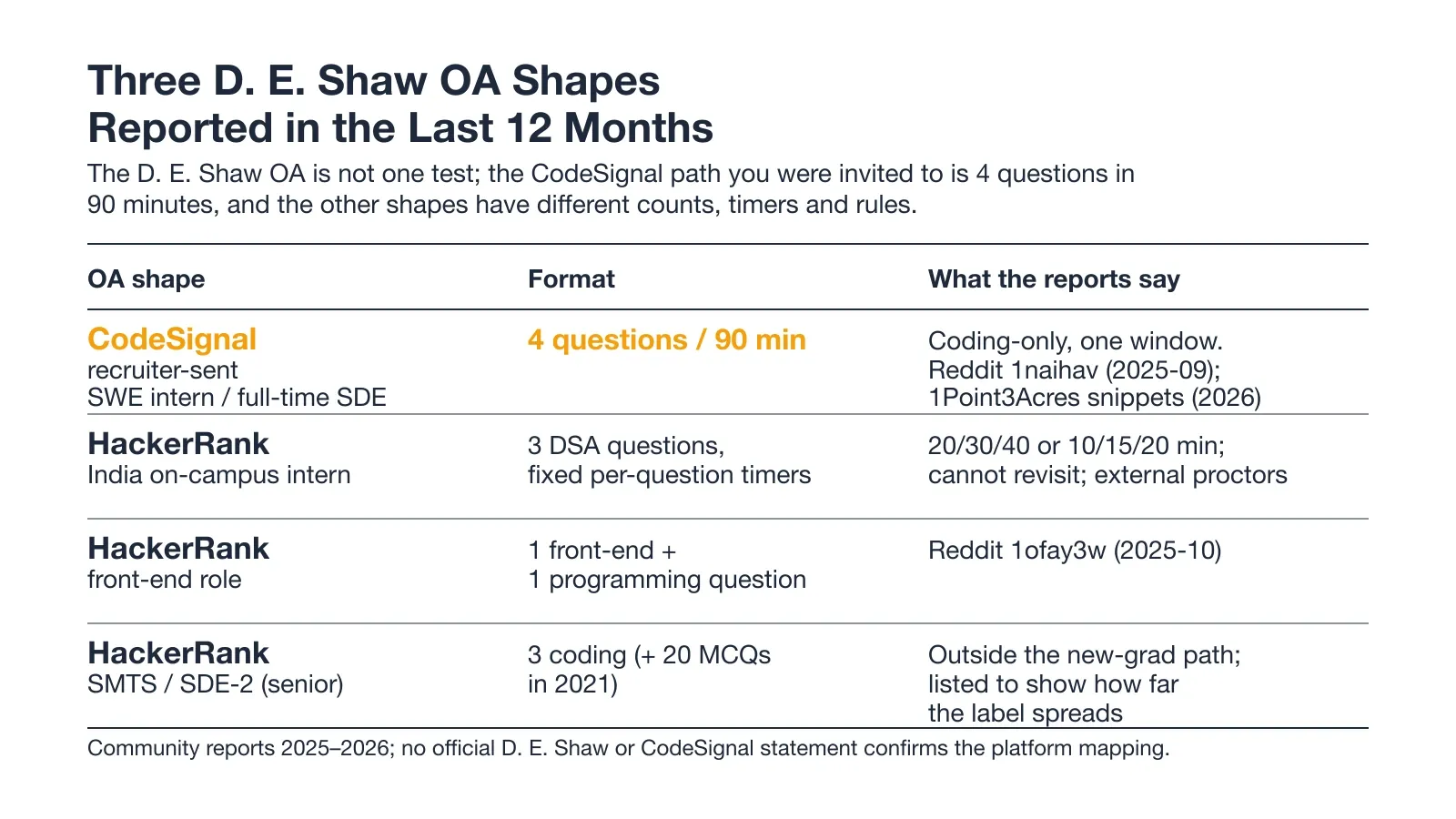
The D. E. Shaw OA is not one test with one format. Three shapes show up across the last 12 months of reports. They differ in question count, total time, and how the clock splits; the chart below separates them.
The CodeSignal Path Is 4 Questions in 90 Minutes
On the recruiter-sent path the sitting is four questions in 90 minutes. It is coding only, in a single window with no per-question split. That is what my invitation said, and the full-time SDE sitting matches it: 90 minutes, four medium-hard problems.
Yet the platform itself is not a 2026 arrival. CodeSignal was already the D. E. Shaw screen back in 2023, which is the one piece of history worth knowing before the current format.
On-Campus HackerRank Path Runs on Fixed Per-Question Timers
The 2026 on-campus shape is three DSA questions on HackerRank. Each question runs on a fixed timer, and the reported splits run 20/30/40, 10/15/20, and 20/25/35 minutes. Once a question's timer expires there is no return to it, and those sittings run in labs with external proctors.
A separate front-end OA asks one front-end question and one programming question. That is a different role path, and it is not the four-question coding screen.
Check Your Own Invitation Before You Prepare
Nothing on either official domain says which platform the OA runs on. I went through the firm's own material. It names no platform: published interviewing guide.
The two tracks differ in question count, total time, and timer layout. The first move is opening the invitation and checking the sender and the URL before any prep happens. So preparing for the wrong shape wastes the whole window.
How D. E. Shaw's CodeSignal Scoring Works
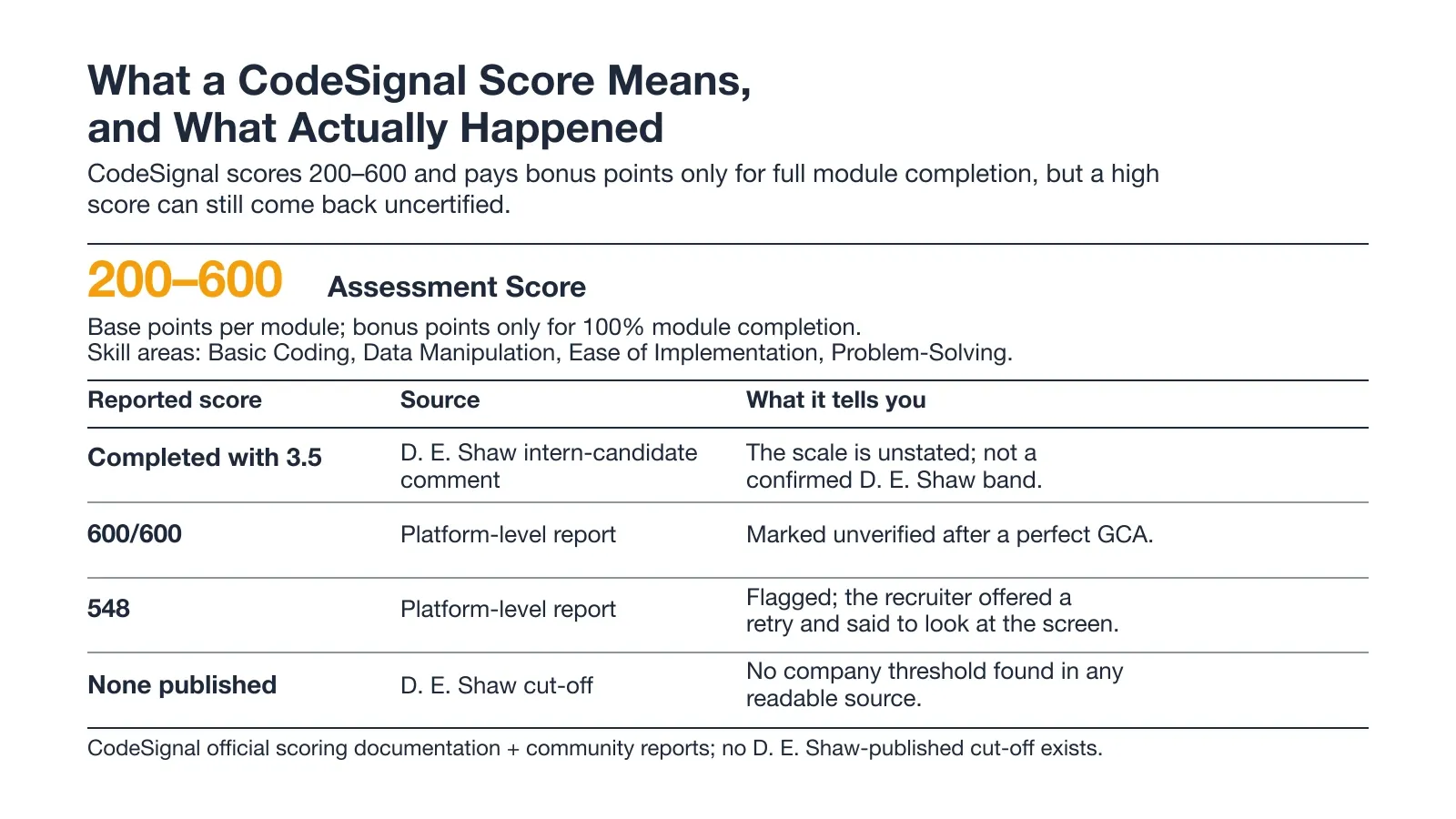
CodeSignal scores on a 200-600 scale. So the two-tier bonus mechanic changes how I should play a single sitting. The chart below holds the scale next to the outcomes that actually came back.
The 200-600 Score Scale and Two-Tier Bonus Points
The Assessment Score runs from 200 to 600. It builds from base points per module plus bonus points that pay out only at 100% module completion. The scored skill areas are Basic Coding, Data Manipulation, Ease of Implementation, and Problem-Solving.
That mechanic is the reason to finish a task instead of perfecting it. A submitted working solution that completes a module can outscore a cleaner solution that never finishes. So the losing variable is the clock.
D. E. Shaw Has Never Published a Cut-Off
No score band, threshold, score-report artifact, or retake policy tied to D. E. Shaw exists anywhere. The only D. E. Shaw-adjacent number in public is an intern's "Completed with 3.5 last sunday," with no scale attached. That is not a company bar.
CodeSignal itself allows retakes in some circumstances under a two-attempts-in-six-months rule. A candidate quoted that rule in a different company's process, so it is not D. E. Shaw policy. A quoted D. E. Shaw cut-off with no source behind it carries no weight.
A Score You Can See Is Not Always a Score That Counts
A strong score screen is not the end of the process. One GCA reported at 600/600 came back marked unverified. A 548 came back flagged, with a retry offered and a note to look into the screen.
What CodeSignal's screen recording captures during a session covers capture and review. How much of the display a reviewer sees sits outside what that retry note explains. Specifically, that includes anything rendering on top of the display.
D. E. Shaw CodeSignal Exam-Day Strategy
The CodeSignal path is a single window, so I make pacing decisions once and cannot revisit them. Three things changed how I spent the 90 minutes.
The Clock Starts After Setup, Not Before
Every minute before the timer starts is free, and every minute after it is not. So I had my photo ID out and my camera and microphone confirmed before the clock existed.
A slow ID check costs nothing. A slow first question costs the whole sitting. The 90 minutes do not pause, and there is no per-question timer to absorb the loss.
Bank the Easiest Question First and Submit Before You Leave
Candidates on the per-question-timer track bank the lightest slot first. They save time for the harder problems. The same order helps on a single window. Bonus points exist only for a fully completed module, and a submitted partial beats an unfinished elegant solution.
I opened with the lightest question to bank points early and leave time for anything harder.
Where Legitimate Help Goes When You Freeze
I was still stuck on the assessment and needed another way to think it through.
That is the moment where anything rendering on top of the shared display ends the attempt. The platform records the display for the entire session. Help that arrives off the recorded desktop leaves the screen clean. That is the only version of that moment I would repeat.
Why Candidates Fail the D. E. Shaw CodeSignal Assessment
Most failures on this screen are not about recognizing the pattern. Instead, they split into a held attempt, a refused score, and a clock that runs out. Each has a named cause.
The AI-Tool Case That Left a Candidate's Score Uncertified
At least one candidate was flagged during an October 2025 internship-cycle assessment. In fact, the flag cited a desktop copilot window left at low opacity. Less than ten minutes before the deadline, that candidate's final score screen never appeared, and the attempt went to review. The candidate closed the tool and finished the sitting, yet the score never came back certified.
Nothing about that window looked visible from the candidate's side. That is the whole point of the failure mode: the recording captures the display the entire time. The four signal families include pattern detection for generative-AI code and telemetry around typing and speaking. A held attempt resolves as verified or not verified rather than getting an explanation.
CodeSignal's cheating-detection system is the platform's own account of that pipeline. The open question a held-for-review screen leaves behind is how a session becomes not verifiable at all.
That outcome is structural rather than a matter of luck. An overlay tool draws its answer on the same computer screen the proctoring system monitors. A basic OS-layer trick keeps it out of view, so the answer and the monitoring share one surface.
InterviewFox works differently. The dual device AI interview tool puts the answer on my phone, a physically separate device. No screenshot, screen recording, or session monitoring can reach that by design.
Land offer with Safer AI Interview Assistant
Skip the risky invisible apps. Our dual-device mode keeps it simple and undetectable. You crush the interview, we handle the answers.
Get started. It's freeLoved by 100,000+ candidates
When a Verified-Looking Score Comes Back Unverified
The recruiter only ever receives a non-verified result. The specific reason never reaches the candidate. For example, one candidate passed a near-perfect GCA and got rejected four times anyway. The test came back unverified, and nobody told the team what the candidate did or did not do.
That gap is what makes a held attempt so hard to respond to. Without a stated cause, there is nothing to appeal, and the sitting is simply gone.
Pasting Your Own Code From Your Own Desktop Voided a Result
Paste events register even when the web had nothing to do with it. For example, one candidate pasted a Swift heap class from their own desktop into the editor. There was no tab switch and no browser use. The submission came back unverified and the platform denied the appeal. The stated grounds were that a paste event had occurred at all.
Intent behind a paste is not part of the signal. The event itself is the trigger, which is why the event types matter more than where the code came from.
Speed Is the Named Failure, Not Insight
The failure is easier to state than to fix. On a fixed clock the losing variable is typing complete solutions fast, not recognizing the pattern. "I literally ran out of time while writing the codes, it wasn't even hard I just suck at writing code fast."
My own stuck moment showed the same cost from the other direction. The clock does not care whether the time goes to the wrong approach or to slow typing.
The OA Is a Hard Filter and the Advice to Cheat Is a Trap
On the 2026 on-campus track, a single person got selected from one candidate's entire college. The questions from an earlier senior run were not findable online either. The normalized advice around this OA is "everyone cheats in OA" and "keep your phone out of camera view."
That advice points straight at the acts the platform names as non-verification reasons. They include other devices, external IDEs, and searching beyond syntax. The same acts end in a held attempt or a refused score. That is the opposite of the shortcut they look like.
How to Prepare for the D. E. Shaw CodeSignal in 12 Days
A CodeSignal invitation is valid for 14 days by default. Verification takes one to three business days. D. E. Shaw publishes no window of its own. I planned 12 days with a two-day buffer. I split the time 5 / 4 / 3 by risk weight rather than evenly.
Before the clock started, I sent the Prep Agent in InterviewFox my target role and prep window. I used WhatsApp for that. It came back with a personalized timed-drill plan and a strategy for where to spend each day.
That plan is one practical input among others into the split below, not a replacement for the timed drills themselves.
Days 1-5: Timed Practice on the Hardest Questions
Four questions in 90 minutes is roughly 22 minutes each. I put most of those first five days into the parts of the assessment that were most likely to cost me time.
I spent five days on timed practice. I worked through public exercises in a browser editor with a per-question clock running.
The check I held myself to was concrete. Each practice problem had to reproduce its worked examples from a blank editor in under 25 minutes, with small edge cases checked and assumptions tested against the stated requirements.
I skipped graph/tree and segment-tree/Fenwick grinding entirely. The same-cycle CodeSignal sitting this article is written around carries no graph/tree or segment-tree question.
The segment-tree and graph advice belongs to the separate on-campus HackerRank track, not this CodeSignal screen.
I skipped system-design and HLD/LLD preparation too. The recruiter-sent CodeSignal screen is four coding questions, and the design rounds sit after the OA in a different window.
Days 6-9: Timed Practice Under a 20-Minute Cap
The next four days went to improving speed on problems I could solve reliably. I capped each drill at 20 minutes.
I ran timed drills, then practiced submission discipline: submit a working partial before moving on, resubmit after every improvement.
The check was one sitting where I kept a steady pace and submitted each task before the clock ended.
Days 10-12: One Proctoring-Clean 4-Question 90-Minute Simulation
A held attempt is a total loss regardless of solving ability. It is the one failure I could control completely. I spent the last three days rehearsing the setup. That meant photo ID, camera, microphone, screen share, and closing unrelated tabs and applications.
The final check was one complete four-question, 90-minute mock. The webcam and screen recording stayed on. There were zero tab switches and no overlay or extra window on the recorded display. I submitted all four tasks.
What Happens After You Submit the OA
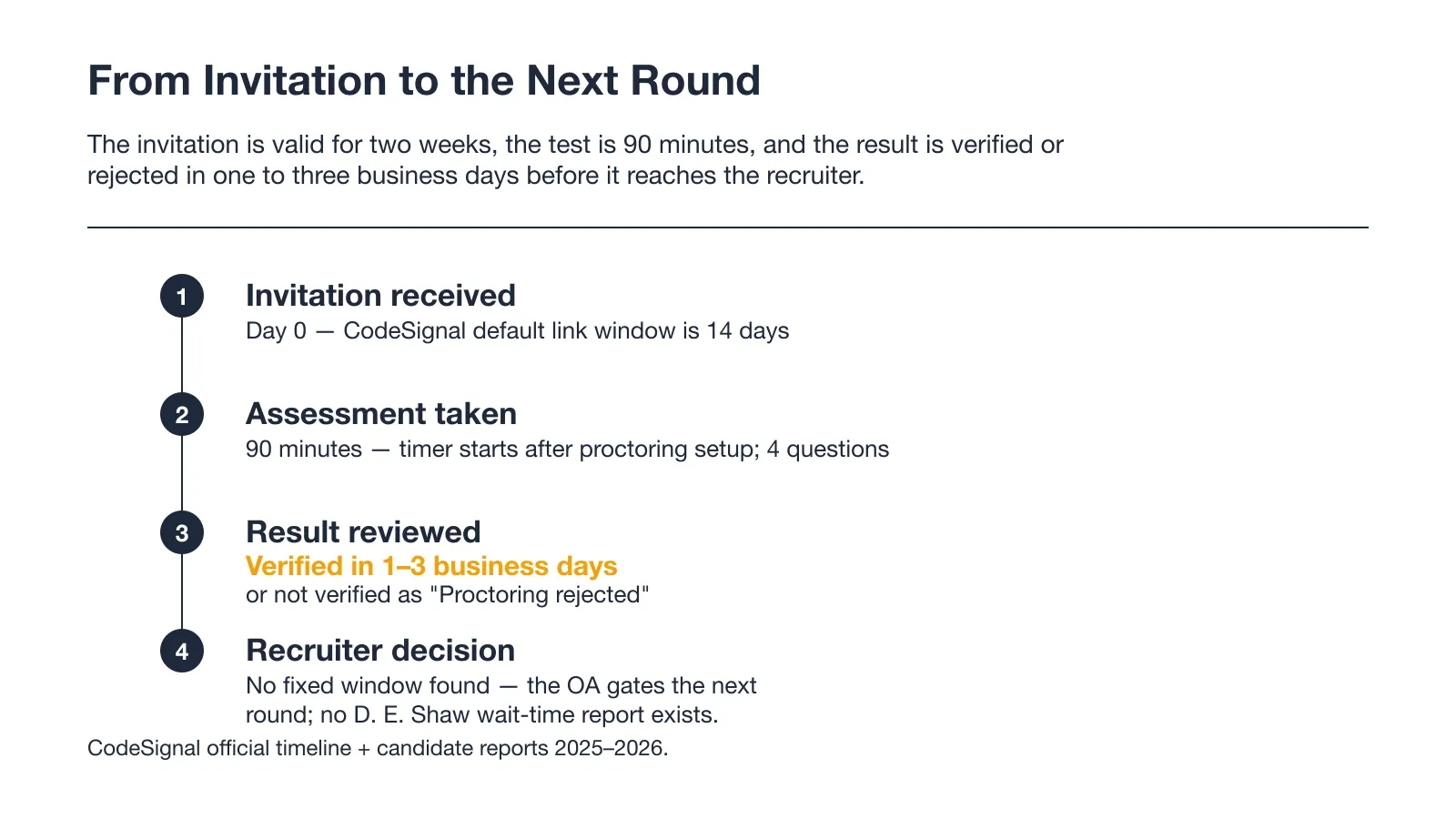
Submission starts a verification step, not a recruiter decision, and the two have different clocks. The chart below shows the sequence from invitation to the next round.
Verification Takes 1 to 3 Business Days
CodeSignal reviews the recorded session and returns the result as verified or not verified inside one to three business days. The invitation itself is valid for 14 days by default. The link window and the review window are separate things.
No D. E. Shaw-specific wait time exists. The verification figure is the platform's, not the company's.
The Loop Behind the OA Runs Same-Day for Some Candidates
A second loop ran as a virtual first round, then three technical rounds, then HR. For at least one candidate the loop ran inside a single day. That day held a CodeSignal OA, then "three interviews: two coding and one quant."
The loop varies by role and by year. The constant is that the OA sits in front of all of it as the gate.
Clearing the OA Is Not Clearing the Loop
One candidate cleared the OA round and had an interview the next day. In another college, only one person got selected. Passing the screen and passing the loop are separate events with separate failure modes.
The OA is a filter with a bar nobody publishes. The honest target is a certified score and a clean session, not a number to chase.
D. E. Shaw's OA Is Three Tests Sharing One Name
Within the last 12 months, at least three different products have carried the same D. E. Shaw OA name in dated first-person write-ups.
Three shapes exist. The recruiter-sent CodeSignal sitting runs four questions in 90 minutes. An on-campus HackerRank set runs three DSA questions with fixed non-carrying timers. A front-end HackerRank OA asks one front-end and one programming question.
Zero competitor pages name that split. Every checked page flattens the OA into a single section. That is how candidates end up preparing for a shape they will never see.
A candidate who prepares for one shape risks the others, and the wrong guess costs the whole window. That is why the most useful first question is which invitation is actually in hand.
FAQ
Does the D. E. Shaw CodeSignal test use a camera?
Yes. Setup requires a working camera, a live microphone, full screen share, and a government photo ID. The session is recorded throughout, and the timer starts only after setup finishes.
Can I use an AI tool or an invisible app during the D. E. Shaw CodeSignal OA?
Desktop overlay tools put the AI's answer on your computer screen. They render it as a hidden layer above the browser through a basic OS-layer trick. The answer stays on-screen and the hiding is basic. Proctoring software keeps adding detection capabilities as AI tools become more common. That exposure is not fixed.
InterviewFox pushes the answer to your phone, a physically separate device. No screenshot, screen recording, or session monitoring can reach it by design. The laptop screen stays on the exam editor, unchanged. If you use AI assistance during the OA, the dual-device architecture removes the answer from your screen entirely.
Land offer with Safer AI Interview Assistant
Skip the risky invisible apps. Our dual-device mode keeps it simple and undetectable. You crush the interview, we handle the answers.
Get started. It's freeLoved by 100,000+ candidates
How many questions are on the D. E. Shaw CodeSignal OA?
Four questions in 90 minutes on the recruiter-sent path, coding only. The on-campus HackerRank shape is three DSA questions with fixed per-question timers. The count depends on which invitation is in hand.
What score do I need to pass?
No D. E. Shaw cut-off is published anywhere. CodeSignal's Assessment Score runs from 200 to 600, with bonus points paid only when a module is completed at 100%. The company has published no band, no threshold, and no retake policy.
How long do I have to take the OA after the invitation arrives?
Fourteen days by default on CodeSignal, which is the platform's window rather than a stated D. E. Shaw one. Results are then verified in one to three business days before anything reaches a recruiter.
What are the D. E. Shaw interview rounds after the OA?
The OA gates a loop that has run as a same-day series for some candidates. That day held two coding interviews and one quant interview. A second loop ran as a virtual first round, then three technical rounds, then HR.