
I Passed DoorDash HackerRank in 2026: Real Questions and Prep

Quick Facts
| Assessment | DoorDash HackerRank OA (2026) |
| Questions | 2 coding problems |
| Time limit | ~90 minutes |
| Platform | HackerRank |
| Proctoring | Secure Mode / Proctor Mode |
| AI tools | Conversational agents banned |
I took the DoorDash HackerRank assessment for a new grad software role in early 2026 and solved both coding questions. What follows is the complete process and how I prepared for it.
The second problem nearly got away from me. It was a scheduling question. The one-order-per-hour rule and a deadline edge case ate my time. With minutes left I reached for a dual device AI interview helper to check the binary-search setup. It surfaced the off-by-one I kept missing, which I break down in the walkthrough below.
Before my test, I read every DoorDash HackerRank post from the past two years. I checked Reddit, LeetCode Discuss, and Teamblind. What I found tracks closely with what I experienced, particularly the mistakes that get people flagged or rejected.
The Real Questions on My DoorDash HackerRank Test
I sat down at the HackerRank screen and the assessment opened with two coding questions. Both were wrapped in DoorDash delivery scenarios, and here is exactly what each one asked.
Question 1: First Unique Restaurant in a Stream
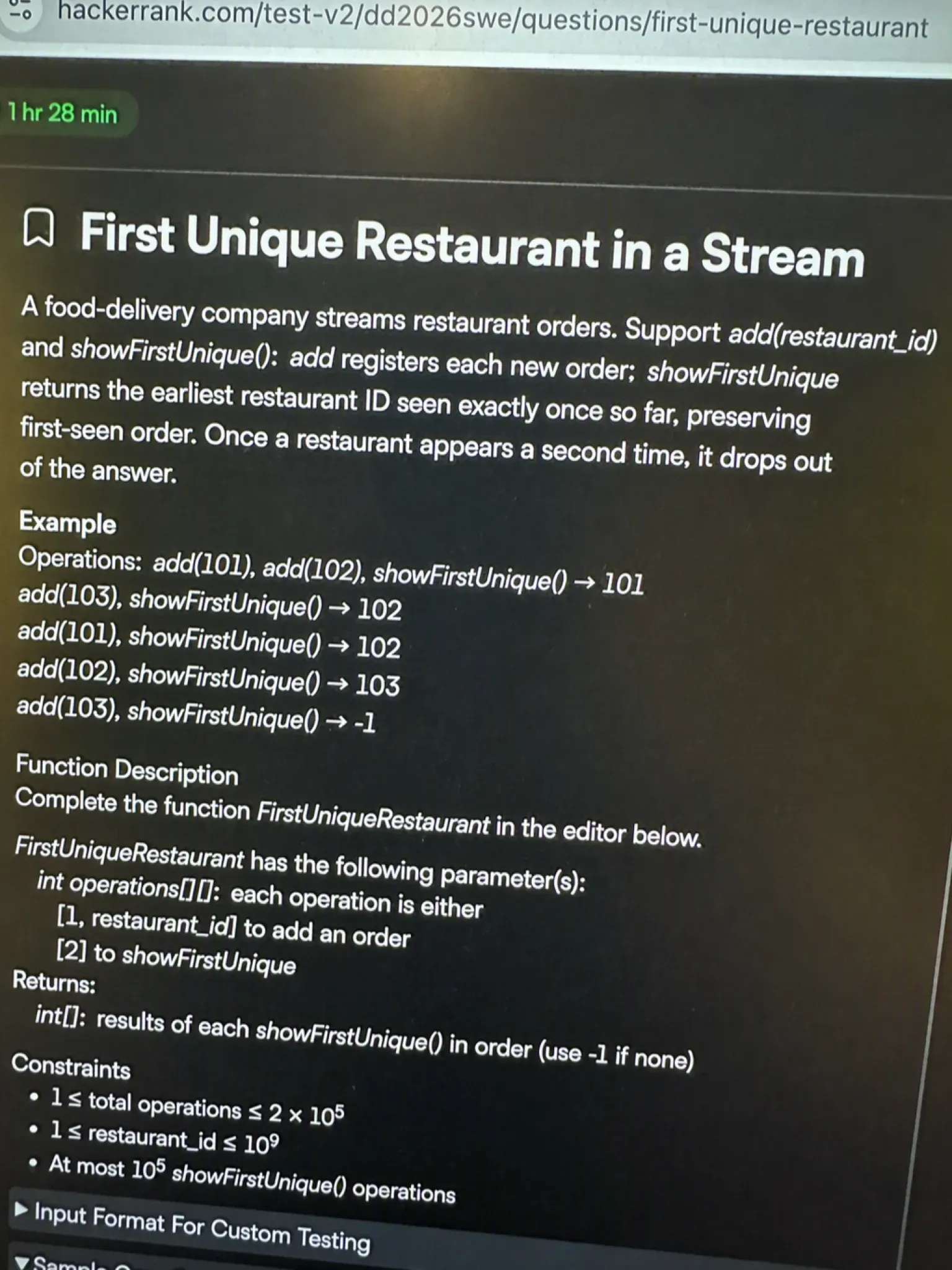
The problem I got: The first question built a live order tracker. I was given a stream of restaurant IDs as orders arrived, and I had to support two operations. add(restaurant_id) registered each new order, and showFirstUnique() had to return the earliest restaurant ID that had shown up exactly once so far, while preserving the order in which restaurants first appeared. The moment a restaurant appeared a second time, it stopped counting as unique and dropped out of the answer.
My approach: I kept a count map from restaurant ID to how many times I had seen it, plus an ordered collection that held only the IDs still unique. On the first appearance I appended the ID to that collection and set its count to one. On the second appearance I removed the ID from the collection and bumped its count to two, so later repeats never touched the collection again. That let both add and showFirstUnique run in constant time, because the answer was always sitting at the front of the ordered collection. The follow-up asked whether the metadata grows without bound: I noted that a duplicate marker for an ID cannot be reclaimed unless the contract promises that ID will never return, otherwise a later occurrence would be misread as unique.
from collections import defaultdict, OrderedDict

class FirstUnique:
    def __init__(self):
        self.count = defaultdict(int)
        self.unique = OrderedDict()

    def add(self, restaurant_id):
        self.count[restaurant_id] += 1
        if self.count[restaurant_id] == 1:
            self.unique[restaurant_id] = None
        elif restaurant_id in self.unique:
            del self.unique[restaurant_id]

    def showFirstUnique(self):
        for rid in self.unique:
            return rid
        return -1
Time complexity: O(1) amortized per add and O(1) for showFirstUnique | Space complexity: O(n), where n is the number of distinct restaurant IDs seen.
I finished the streaming question with about half the window left and moved on feeling good. The constant-time answer mattered because the hidden tests pushed long, repeating ID streams.
Question 2: Minimum Dasher Processing Speed
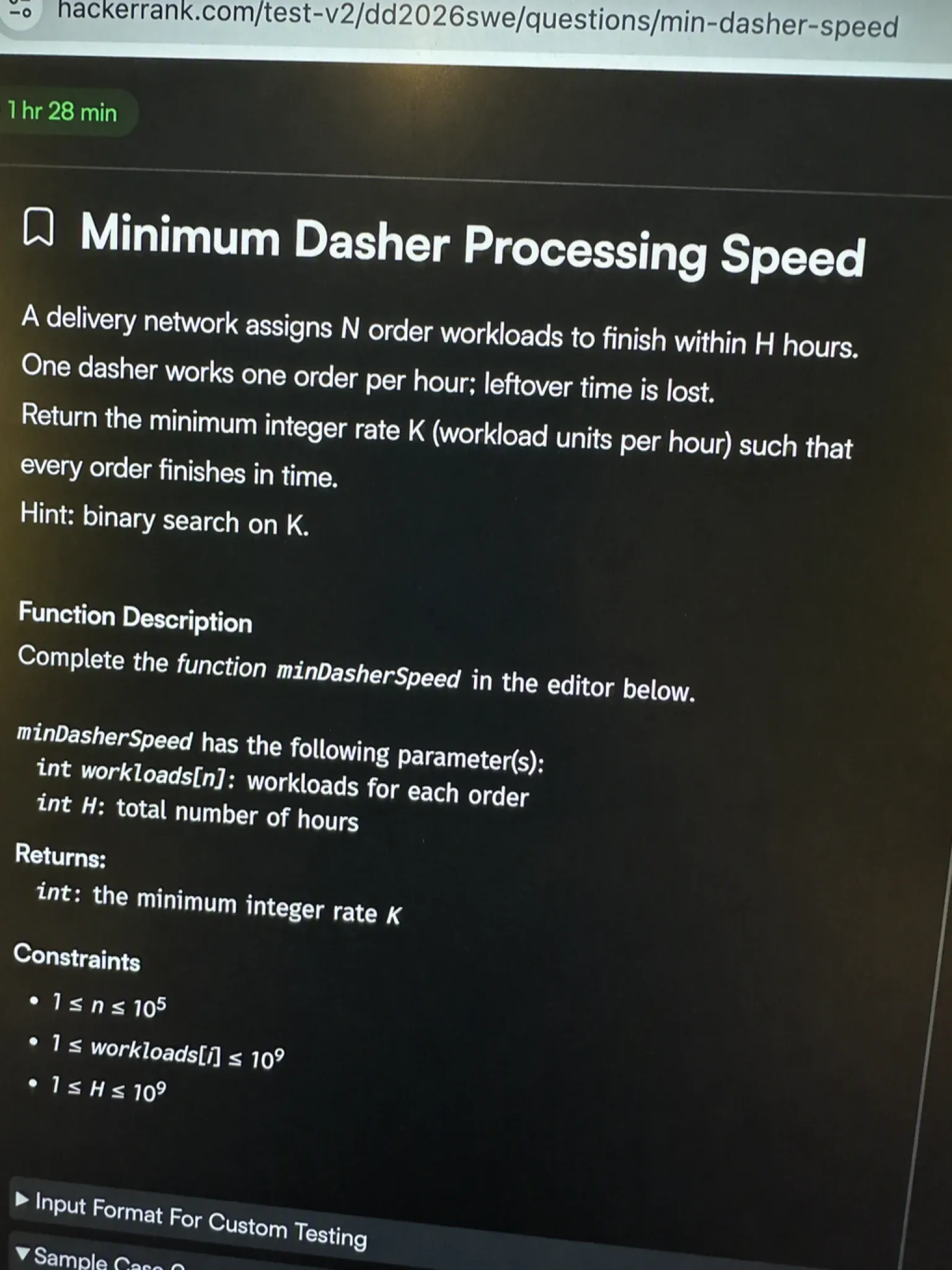
The problem I got: The second question framed a scheduling limit. I was given N order workloads and a deadline of H hours, and I had to return the minimum integer processing rate K, measured in workload units per hour, that finished every order in time. The catch was the one-order-per-hour rule: in a single hour a dasher could work on exactly one order, and if that order finished early the leftover time in that hour was lost. So the hours an order took was the ceiling of its workload divided by K, not a fractional split.
My approach: I first confirmed the constraint that H had to be at least N, because each of the N orders needs its own hour under the one-order-per-hour rule. With H equal to N, the largest single workload became a safe upper bound for K, since a rate that big clears any single order in one hour. I then checked feasibility for a trial rate K by summing ceil(workload / K) across all orders and comparing to H. That sum only shrinks as K grows, so I binary searched K across [1, max(workloads)] to land on the smallest feasible rate. The integer ceiling was (workload + K - 1) // K.
def min_dasher_speed(orders, H):
    n = len(orders)
    if H < n:
        return -1  # no finite rate finishes N orders in under N hours
    lo, hi = 1, max(orders)

    def feasible(K):
        return sum((w + K - 1) // K for w in orders) <= H

    while lo < hi:
        mid = (lo + hi) // 2
        if feasible(mid):
            hi = mid
        else:
            lo = mid + 1
    return lo
Time complexity: O(N log maxW), where maxW is the largest workload | Space complexity: O(1) auxiliary.
This one ate the rest of my time. I lost a few minutes on the boundary where H dropped below N before I locked in the binary search and cleared the hidden tests with minutes to spare.
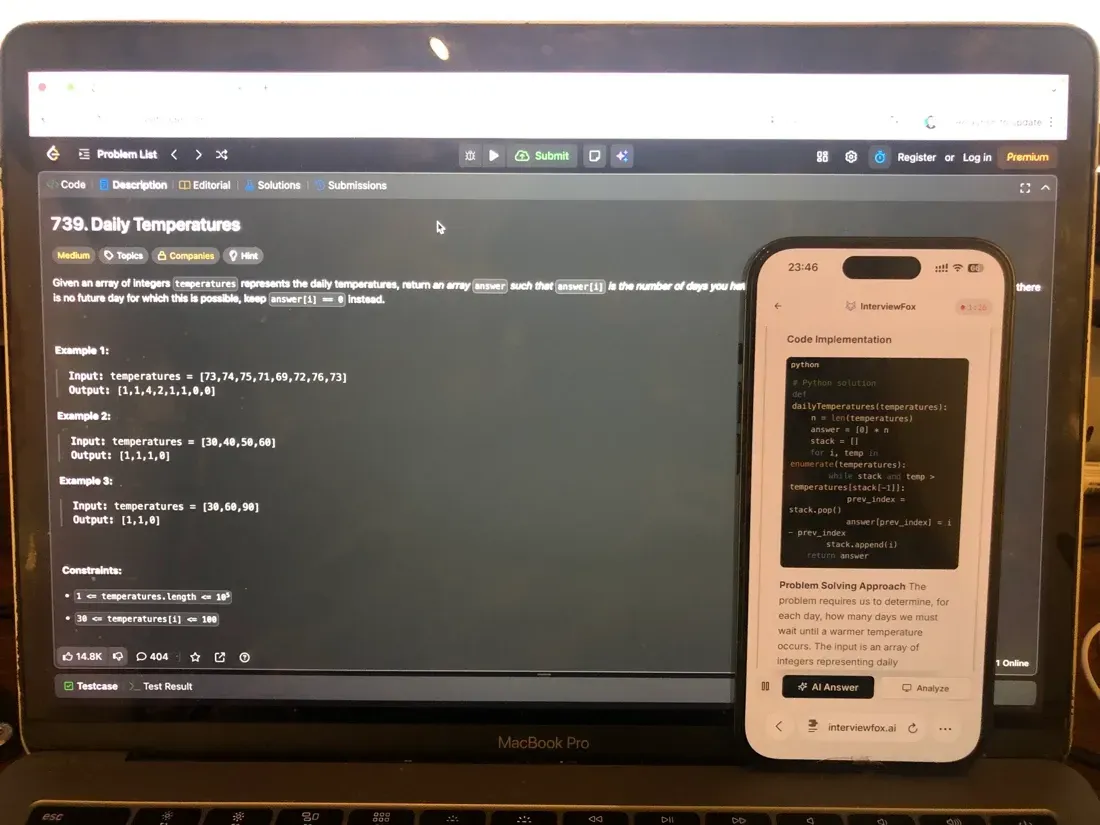
I didn't reach for a desktop overlay here. The answer would have sat on the same screen the proctoring system was monitoring, hidden by a basic rendering layer, and I didn't want that uncertainty behind me. Instead I used a dual-device setup: a keyboard shortcut auto-captured the problem and pushed the answer to my phone, so the laptop screen stayed on the exam editor, unchanged.
Land offer with Safer AI Interview Assistant
Skip the risky invisible apps. Our dual-device mode keeps it simple and undetectable. You crush the interview, we handle the answers.
Get started. It's freeLoved by 100,000+ candidates
DoorDash's Proctoring Policy for HackerRank
DoorDash runs its screen on HackerRank, and HackerRank can turn on monitoring that goes well past a plain timer. The exact level depends on the proctoring mode your OA enables. I treat the strictest realistic version as the baseline.
What HackerRank Monitors During the OA
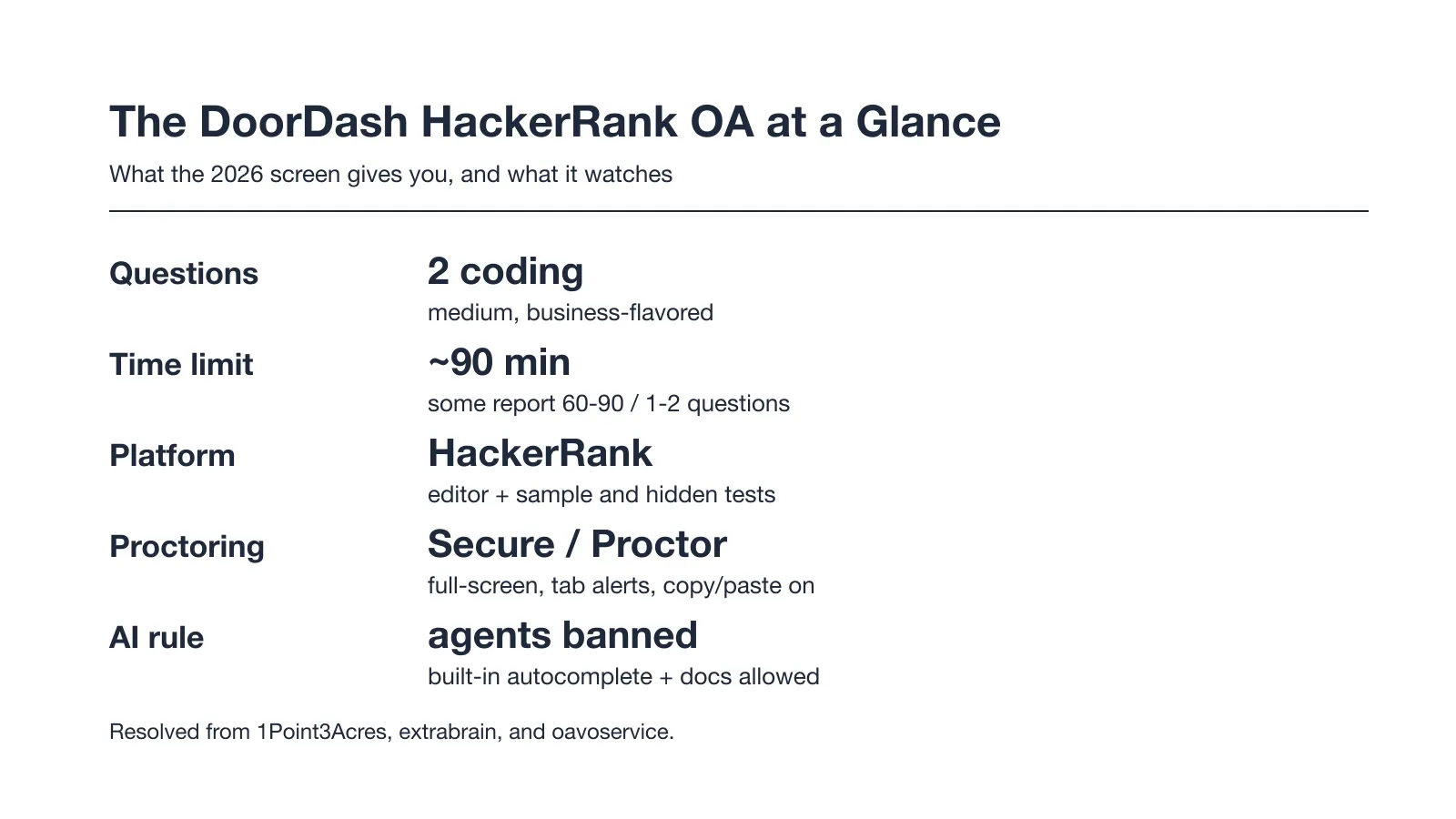
HackerRank offers two relevant modes. Secure Mode locks the test to a full-screen window. It raises a tab-switch alert when you leave and tracks copy-paste by default. Proctor Mode adds AI behavioral monitoring on top and can replay your session.
Want the precise copy-paste mechanics? how copy-paste is flagged is worth a look before you sit down.
Tab switches are the other easy-to-trip signal. what happens if you switch tabs depends on your proctoring mode.
The detection picture is bigger than any single signal. how HackerRank combines these is what most candidates miss in planning. whether your screen gets recorded changes how you arrange windows and second monitors.
HackerRank's 2026 AI cheat detection is the official write-up. It shows how integrity signals reach a reviewer.
DoorDash's Explicit AI-Tool Ban
DoorDash's own acceptable-tools policy covers AI use during interviews. It spells out when assistance crosses the line. Conversational agents such as ChatGPT are off the table for copy-paste or answer generation.
What stays allowed is the built-in, non-AI editor autocomplete and language docs. A plain Google search is fine when you are stuck on a syntax detail. The line is simple: the tool must not write or feed you the solution.
5 Other Confirmed DoorDash HackerRank Questions
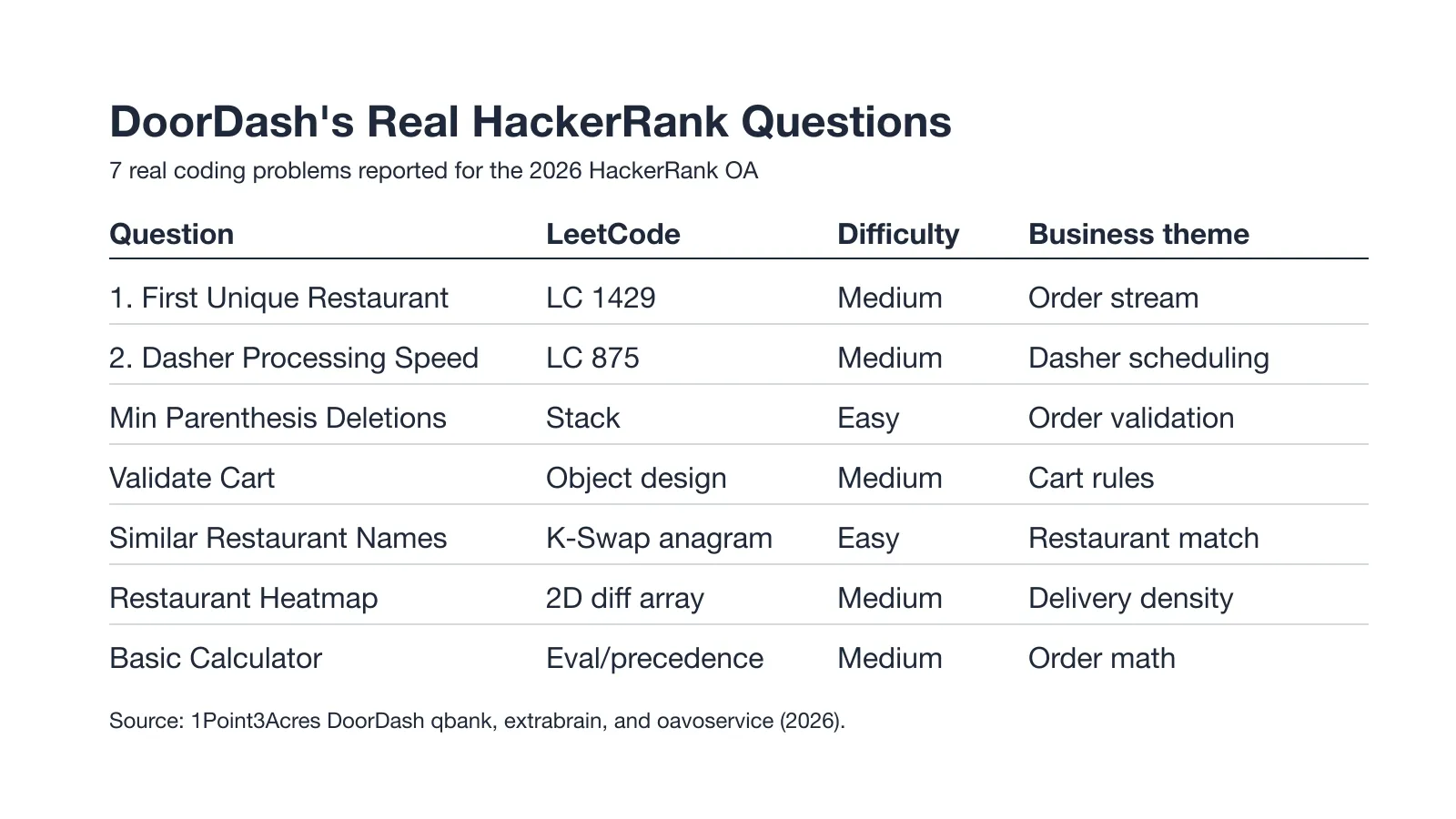
The two questions above were my exam. DoorDash's HackerRank bank clearly holds more. A 2026 1Point3Acres qbank pull lists several extra coding prompts candidates have reported. These are confirmed real questions, not my exam. I give each its own honest treatment with the solution shape the problem implies.
Minimum Parenthesis Deletions
A 2026 1Point3Acres qbank entry lists this as an easy string and stack problem: given a string of ( and ), return the minimum number of characters to delete so the remainder is valid. The count-only version is a single left-to-right scan with an unmatched-open balance. Each unmatched ) adds one deletion, and every unmatched ( left at the end adds one more.
def min_parenthesis_deletions(s):
    bal = 0
    deletions = 0
    for ch in s:
        if ch == '(':
            bal += 1
        else:  # ')'
            if bal > 0:
                bal -= 1
            else:
                deletions += 1
    return deletions + bal
Time complexity: O(n) | Space complexity: O(1). The follow-up asks for the deletion indices, not just the count, which needs a stack of unmatched ( positions.
Validate Cart
This one shows up as an open-ended Code Craft prompt. A 2026 qbank record describes it as a phone-screen question: given a cart of item lines, validate whether the cart is orderable under quantity, availability, and min or max limit rules. The interviewer wants you to negotiate the rule shape before coding, then return structured per-item errors rather than a thin boolean.
class CartValidator:
    def validate(self, cart, catalog):
        errors = []
        for line in cart:
            item = catalog.get(line.item_id)
            if item is None:
                errors.append((line.item_id, "unknown_item"))
                continue
            if line.qty <= 0:
                errors.append((line.item_id, "nonpositive_qty"))
            if not item.in_stock:
                errors.append((line.item_id, "unavailable"))
            if line.qty < item.min_qty or line.qty > item.max_qty:
                errors.append((line.item_id, "qty_out_of_bounds"))
        return errors
Time complexity: O(n) over cart lines | Space complexity: O(n) for the error list. Fail closed if the catalog service is unreachable.
Similar Restaurant Names (K-Swap Anagram)
A 2026 qbank entry frames this as a K-anagram variant: decide whether two restaurant names are "similar," meaning one becomes the other with at most k swaps of any two characters. Recent loops use k = 2; older ones use the general form. The fix is an anagram check first, then a mismatch count where each swap repairs at most two positions.
def similar_restaurant_names(s1, s2, k):
    if len(s1) != len(s2):
        return False
    if sorted(s1) != sorted(s2):
        return False
    mismatches = sum(1 for a, b in zip(s1, s2) if a != b)
    return mismatches // 2 <= k  # each swap fixes two mismatches
Time complexity: O(n) | Space complexity: O(n) for the sort or counter. At k = 1 this is LeetCode 859 (Buddy Strings).
Restaurant Delivery Heatmap
A 2026 qbank record describes a grid-coverage round seen in DoorDash SWE and MLE loops: given an n by n grid and restaurants at (i, j) with range r and expected deliveries d, build a heatmap where each cell sums the deliveries from every restaurant whose Chebyshev range covers it. The naive double loop over each restaurant's (2r+1)² neighborhood is O(K r²). The clean win is a 2D difference array: add d to the four corners of each bounding box, then run two prefix sums.
def delivery_heatmap(n, restaurants):
    diff = [[0] * (n + 2) for _ in range(n + 2)]
    for i, j, r, d in restaurants:
        r0, c0 = max(0, i - r), max(0, j - r)
        r1, c1 = min(n - 1, i + r), min(n - 1, j + r)
        diff[r0][c0] += d
        diff[r0][c1 + 1] -= d
        diff[r1 + 1][c0] -= d
        diff[r1 + 1][c1 + 1] += d
    for x in range(n):
        for y in range(n):
            if y: diff[x][y] += diff[x][y - 1]
            if x: diff[x][y] += diff[x - 1][y]
            if x and y: diff[x][y] -= diff[x - 1][y - 1]
    return [[diff[x][y] for y in range(n)] for x in range(n)]
Time complexity: O(n² + K) | Space complexity: O(n²). Clip each box to grid bounds to avoid off-by-one errors.
Basic Calculator (No Parentheses)
A 2026 qbank entry lists this phone-screen round: evaluate +, -, ×, ÷ over integers with standard precedence and no parentheses. It is LeetCode 227. A single-pass tokenizer with a stack works: push numbers for +, push negatives for -, and for × or ÷ pop the top and apply before pushing.
def basic_calculator_no_parens(expr):
    stack = []
    num = 0
    op = '+'
    for i, ch in enumerate(expr):
        if ch.isdigit():
            num = num * 10 + int(ch)
        if ch in '+-*/' or i == len(expr) - 1:
            if op == '+':
                stack.append(num)
            elif op == '-':
                stack.append(-num)
            elif op == '*':
                stack.append(stack.pop() * num)
            elif op == '/':
                stack.append(int(stack.pop() / num))  # truncate toward zero
            op = ch
            num = 0
    return sum(stack)
Time complexity: O(n) | Space complexity: O(n). Clarify the division rounding rule before you start, since Python's // rounds toward negative infinity and the expected convention is truncation toward zero.
What DoorDash's HackerRank Test Format Actually Looks Like
The format is a standard HackerRank coding screen. The at-a-glance picture below matches what candidates across reports describe.
Question Count, Time, and Languages
DoorDash's HackerRank OA is two coding questions in roughly 90 minutes. Some candidates report 60 to 90 minutes, or one to two questions, depending on the cohort. The editor supports Python, Java, C++, and JavaScript. You can run custom tests, but the hidden test results stay opaque: you see pass or fail, not the failing input.
Sample and Hidden Tests
Every problem gives a sample run you can execute freely. The real grading is the hidden suite, and HackerRank reports only pass or fail per case. A solution that clears the sample can still fail hidden tests on a misread constraint. Reading the limits twice pays off more than another attempt at the happy path.
How DoorDash's HackerRank Scoring Works
The score screen is the part candidates understand least. DoorDash does not publish a number, so what you actually see — and what a pass really means — is worth spelling out.
Pass or Fail on Hidden Tests
HackerRank scores on hidden tests and reports pass or fail. There is no public numeric scale, and DoorDash does not publish a cutoff you can aim at. The bar is the gate: every hidden test must pass for the round to count as clean.
Why a Clean Run Still Gets Filtered
Clean code is necessary, not sufficient. Multiple candidates report bug-free coding rounds that still ended in rejection. DoorDash weighs communication and your approach shape, not just correctness. A silent pass is not a guaranteed pass.
DoorDash HackerRank Exam-Day Strategy
Two habits decided whether I finished clean. Both are unglamorous, and both mattered more than any clever algorithm.
Read the Prompt Twice, Then Build a Skeleton
I spent the first few minutes writing the constraints on scratch paper before touching the editor. For the scheduling question, that meant nailing the one-order-per-hour rule. I also fixed the H-versus-N relationship before writing the binary search. A runnable skeleton that handles the sample beats a clever idea with no structure.
Recover When a Brute Force Times Out
When a first pass passes the sample but times out, build a small custom test that exposes the worst case. Then optimize the bottleneck. For the scheduling problem, the sum of ceilings is monotonic in K. That turned a simulation into a binary search on the answer. Naming the tradeoff out loud also helps if a reviewer later asks how you got there.
Why Candidates Fail the DoorDash HackerRank Assessment
Most rejections do not trace back to a single wrong answer. They come from a small set of repeatable mistakes, and the same patterns surface across reports.
Invisible-App Results Get Voided
The most concrete example I have is a private one. It was shared with me directly, not posted anywhere public. The person involved described it this way. They entered the early February 2026 assessment with a translucent AI sidebar hidden behind the browser.
After the first successful sample run, the overlay captured the shortcut first and left its answer card visible over the prompt. I was asked for an explanation, but the application was closed after review.
At least one candidate was flagged for a translucent desktop overlay, the same structural trap described above. The tool renders the AI's answer on the same screen the proctoring system monitors, hidden by a basic OS-layer trick. The window stays out of visible view but is still on-screen.
InterviewFox works differently. The answer goes to my phone. It is a physically separate device. No screenshot, screen recording, or session monitoring can reach it by design.
Land offer with Safer AI Interview Assistant
Skip the risky invisible apps. Our dual-device mode keeps it simple and undetectable. You crush the interview, we handle the answers.
Get started. It's freeLoved by 100,000+ candidates
Bug-Free Code Still Gets Rejected
A clean run is not automatic safety. Candidates report bug-free rounds that still get filtered, which points to the coding bar being necessary but not sufficient. Treat communication and the clarity of your approach as part of the score, not a separate concern.
Misreading Constraints or Trusting Brute Force
The other common failure is a constraint misread. A brute-force pass on the sample hides a timeout on hidden tests. The easy problems are often where the constraint trap lives. Reading the limits and proving your approach fits them is cheaper than debugging a silent wrong answer.
How to Prepare for the DoorDash HackerRank in 7 Days
I skipped system-design and hard graph theory. The DoorDash OA is pure coding with two HackerRank questions. Deep algorithm breadth beyond the canonical set would have been wasted time.
Days 1-2: Drill the Binary-Search and Streaming Patterns Cold
The exam's two real questions are Minimum Dasher Processing Speed and First Unique Restaurant. Binary search on the answer solves the first. A count map plus ordered structure handles the second.
I implemented both from scratch, including the ceiling-division expression and the second-occurrence removal. Each passed a stress test of repeats, empty input, and a head that flips to a duplicate. Solving each cold in under 20 minutes was my success check for that drill.
Days 3-5: Practice Business-Flavored Simulation Under the 90-Minute Cap
DoorDash wraps logistics in LeetCode-shaped problems, from dasher scheduling to delivery heatmaps. I timed two medium simulations back to back, building a skeleton first and optimizing only after the sample passed. The success check was both passing the sample and a hidden-style large input within the window.
Days 6-7: Mock the Full OA and Lock the Constraint-Reading Habit
Constraint misreads are the top failure cause. My last stretch was one full 90-minute mock. I wrote the constraints down before coding every problem. The success check was zero misread-triggered reruns in the mock.
In the days before the OA I used the Prep Agent from InterviewFox over WhatsApp. I sent it the confirmed DoorDash question patterns and got a personalized drill plan back. It slotted in as one tool among several, not the whole routine.
What Happens After You Submit the OA
Submitting the OA closes one loop and opens the next. Here is what the weeks after actually look like.
The Next Step Is the Phone Screen
A clean OA moves you to a phone screen. DoorDash's phone screen stays business-flavored coding, not a sudden jump in difficulty. Expect the same kind of problem wrapped in a delivery scenario, this time with a person on the line.
A Rough Timeline
Candidates describe the OA-to-next-round gap as a couple of weeks, then a loop of further rounds. Treat the timeline as generic. DoorDash does not publish day counts, so I plan around the next coding round, not a fixed clock.
DoorDash's Business-Flavored Question Fingerprint
After working through the real exam and the confirmed bank, one pattern is impossible to miss: every DoorDash problem is a standard algorithm wearing a delivery uniform.
How DoorDash Wraps Logistics in LeetCode-Shaped Problems
Every confirmed DoorDash problem sounds like a delivery. Order dispatch becomes a streaming uniqueness question. Dasher routing becomes binary search on a rate. Restaurant matching becomes an anagram swap check. The math is standard LeetCode, but the framing is always the business.
The Canonical Set to Drill Cold
Drill the set that actually appears. That means streaming and hash maps, binary search on the answer, string and stack, and object-design validators. Map any LeetCode pattern onto a DoorDash scenario in practice, because the wrapper changes more often than the underlying algorithm.
FAQ
How many questions are on the DoorDash HackerRank OA?
The OA is two coding questions. Some candidates report one to two questions depending on the cohort. Two is the consistent figure for the new grad software screen.
Is the DoorDash HackerRank OA timed?
Yes. The window is about 90 minutes, with some reports ranging from 60 to 90 minutes. The timer runs continuously and the test locks to a full-screen window under Secure Mode.
What happens if I fail some hidden tests on the DoorDash OA?
You see a per-case pass or fail, and any failed hidden test weakens the round. DoorDash weighs more than correctness alone. A mostly-passing run is not a guaranteed pass. A clean hidden-test sweep is the baseline you want.
Does DoorDash's HackerRank OA use a webcam?
HackerRank's Proctor Mode can add session replay and behavioral monitoring. A webcam is not a universal requirement across every DoorDash OA. The monitoring level depends on your proctoring mode. Confirm what your invite states before assuming a camera is on.
Can I use an AI tool or invisible app during the DoorDash HackerRank OA?
Desktop overlay tools put the AI's answer on your computer screen. They render it as a hidden layer above the browser using a basic OS-layer trick. The answer is on-screen and the hiding is basic. Proctoring software keeps adding detection capabilities, so the exposure is not fixed.
InterviewFox pushes the answer to your phone instead. That phone is a physically separate device. No screenshot, screen recording, or session monitoring can reach it by design. The laptop screen stays on the exam editor, unchanged.
The dual device AI interview assistant removes the answer from your screen during the OA.
Land offer with Safer AI Interview Assistant
Skip the risky invisible apps. Our dual-device mode keeps it simple and undetectable. You crush the interview, we handle the answers.
Get started. It's freeLoved by 100,000+ candidates