
Netflix CodeSignal Assessment Questions 2026: Real OA, Passed

Quick Facts
| Platform | CodeSignal, custom assessment (not the certified 70-minute GCA) |
| Tracks | Varies by role; the SWE-intern OA is reported as four coding questions |
| Time limit | Administrator-set, not a platform constant; reported around 1-2 hours |
| Sitting rule | One sitting, no pausing; leaving throws "Assessment not Found" |
| Scoring | Test-case weighted; custom assessments often show no candidate-facing score |
| Proctoring | Suspicion Score, AI proctoring (video/audio/screen), ID verification, LeakSweep, dynamic rotation |
| Result gate | A rejected proctoring status overrides a good score |
| My outcome | Finished attempt held for review, later relabeled invalid, no fresh invitation |
I took the Netflix CodeSignal for an MLE internship in early June 2026. My finished attempt went to review and the dashboard later marked it invalid, with no fresh invitation.
Before the test I worked through every public Netflix CodeSignal report I could find on Reddit, LeetCode Discuss, Teamblind, and Glassdoor. An AI interview assistant helped me sanity-check my pacing plan. The question mix below comes from candidate reports, not from me.
What I found tracks closely with the traps that get a finished attempt silently invalidated. That part is the one almost no guide covers.
The Questions Candidates Actually Report
Netflix does not publish its CodeSignal question bank, and the exact set depends on the track you applied to. The most-documented track from real candidates is the SWE-intern OA. I lead with that and note where the reports diverge.
The SWE-Intern OA Four Coding Questions
A candidate on Glassdoor described the Netflix CodeSignal SWE-intern OA as four coding questions. You are scored by test cases passed, not by a fixed cut score. Partial credit is real, and every submit matters.
- Question 1 was effectively a free point: basic loops and if-statements.
- Question 2 used dictionaries (hash maps) to track state.
- Question 3 was the hardest by far, with logic similar to how a minesweeper board auto-reveals the next safe cell without hitting a bomb.
- Question 4 sat close in difficulty to Question 2.
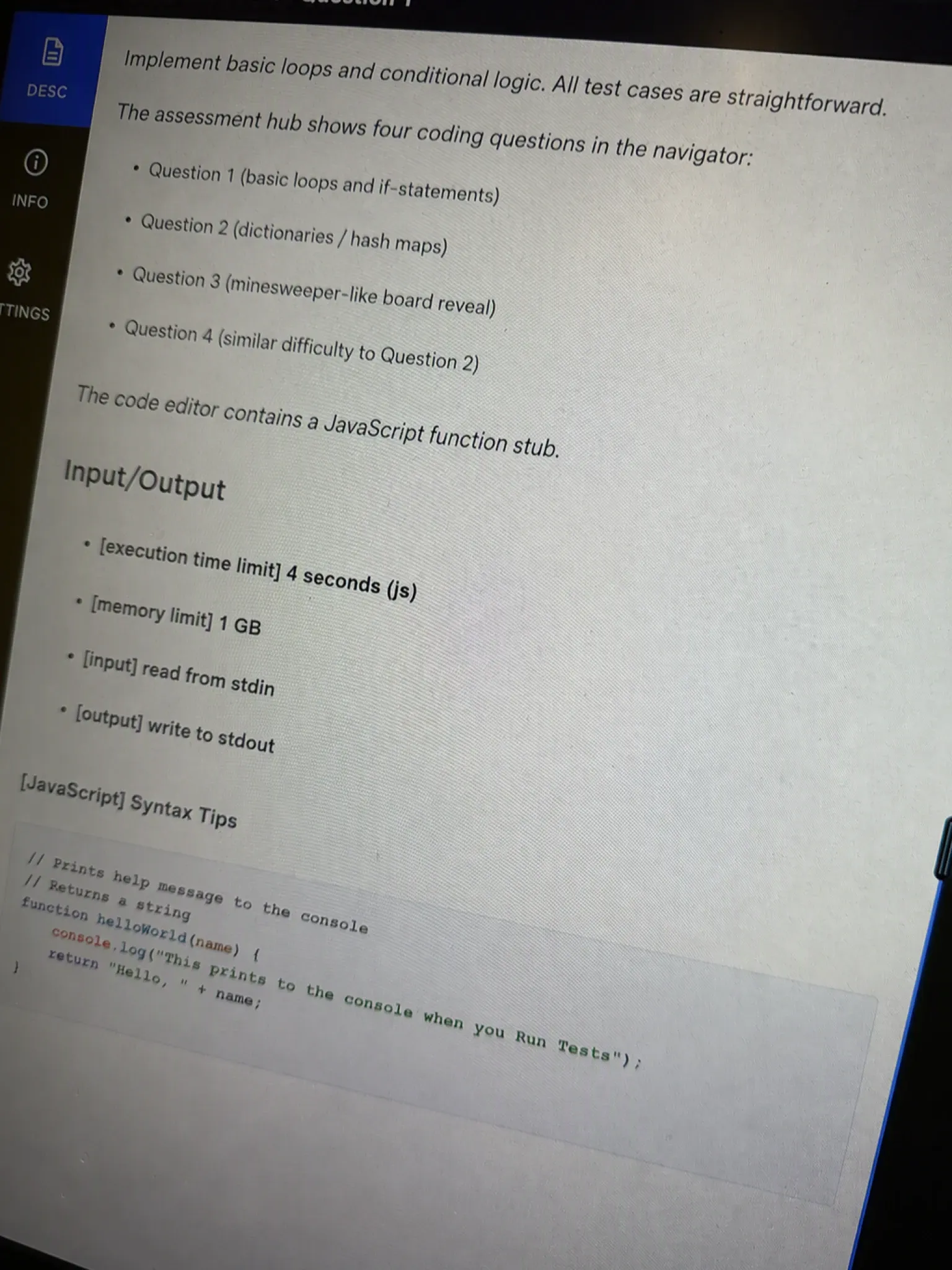
None of those four was a traditional ML question. They were standard algorithmic coding. Teamblind users call it "pretty average LeetCode" and "a LeetCode problem modified to their work."
A Real Problem Shared on LeetCode Discuss
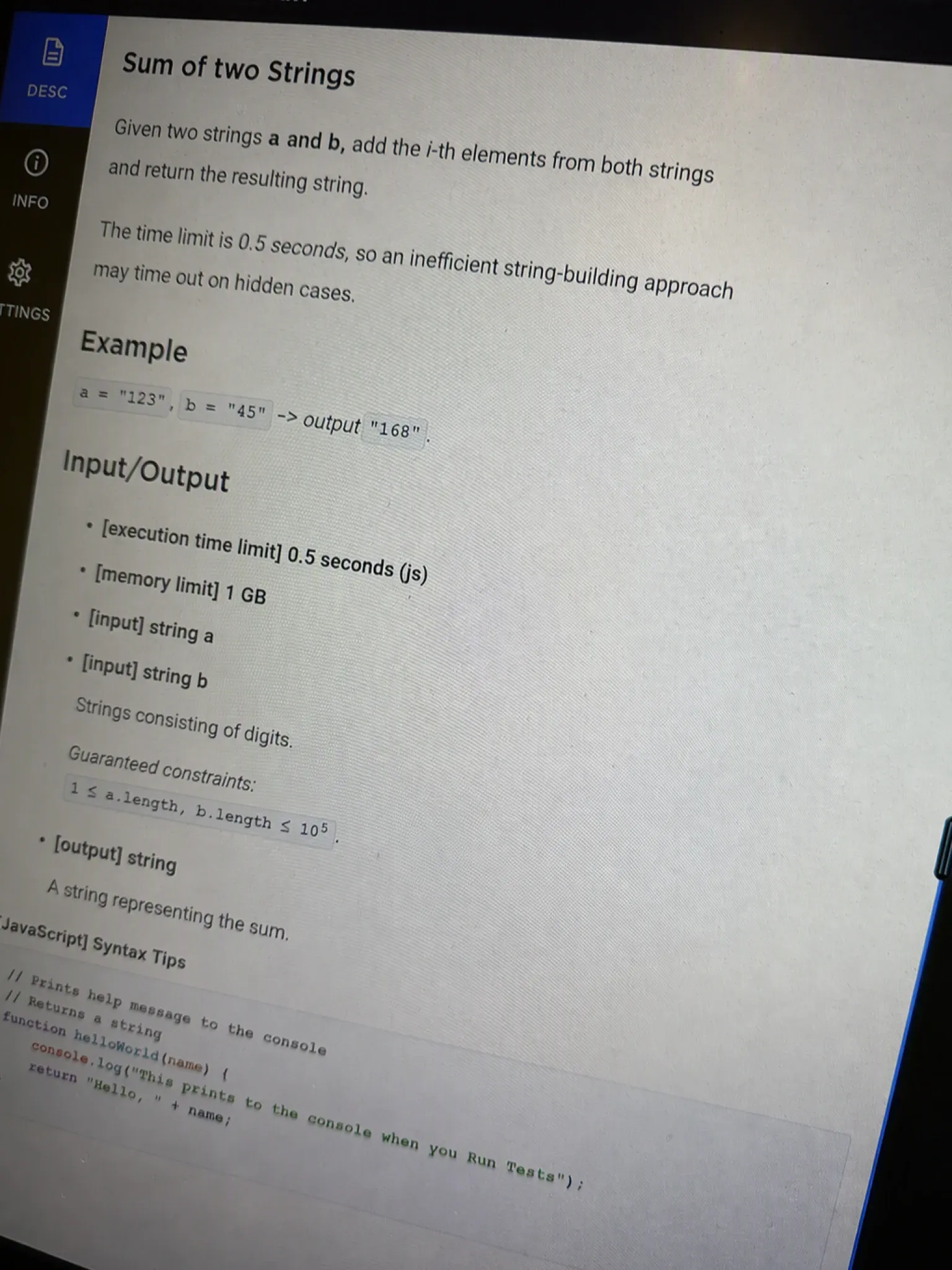
One Netflix CodeSignal problem has been shared publicly with its exact wording. The post is titled "Netflix | CodeSignal | Sum of two Strings." The author says they got it on CodeSignal with a tight time limit.
The problem: given two strings a and b, add the i-th elements from both. Candidates report the time limit was around 0.5 seconds, so a naive build-and-prepend string approach can time out on a hidden case.
def sum_two_strings(a, b):
    # add i-th digits of a and b (right-aligned), return the result string
    i, j = len(a) - 1, len(b) - 1
    carry = 0
    ans = ""
    while i >= 0 or j >= 0 or carry:
        x = int(a[i]) if i >= 0 else 0
        y = int(b[j]) if j >= 0 else 0
        s = x + y + carry
        ans = str(s % 10) + ans
        carry = s // 10
        i -= 1
        j -= 1
    return ans
Time complexity: O(max(len(a), len(b))) | Space complexity: O(max(len(a), len(b)))
That matches the "real world problems, a LeetCode problem modified to their work" description candidates give for the Netflix CodeSignal screen. The lesson is not the specific problem but the shape: string and index handling under a hard time limit, where the wrong string-building direction costs you a hidden test case.
Why the Question Mix Varies
Reports differ because Netflix sets the assessment per role. One candidate's SWE-intern OA was four coding questions; other tracks are described with different shapes, and I could not find a non-blacklisted public source that lists the MLE track's exact questions. The invitation screen is your only reliable check. It shows the question count and time limit before you start, so read it before you plan pacing.
Land offer with Safer AI Interview Assistant
Skip the risky invisible apps. Our dual-device mode keeps it simple and undetectable. You crush the interview, we handle the answers.
Get started. It's freeLoved by 100,000+ candidates
Netflix's Proctoring Policy for CodeSignal
Netflix's CodeSignal assessment runs CodeSignal's full integrity stack while you work. Five detection layers operate in parallel. A Suspicion Score flag routes your attempt to a human reviewer rather than ending it on the spot.
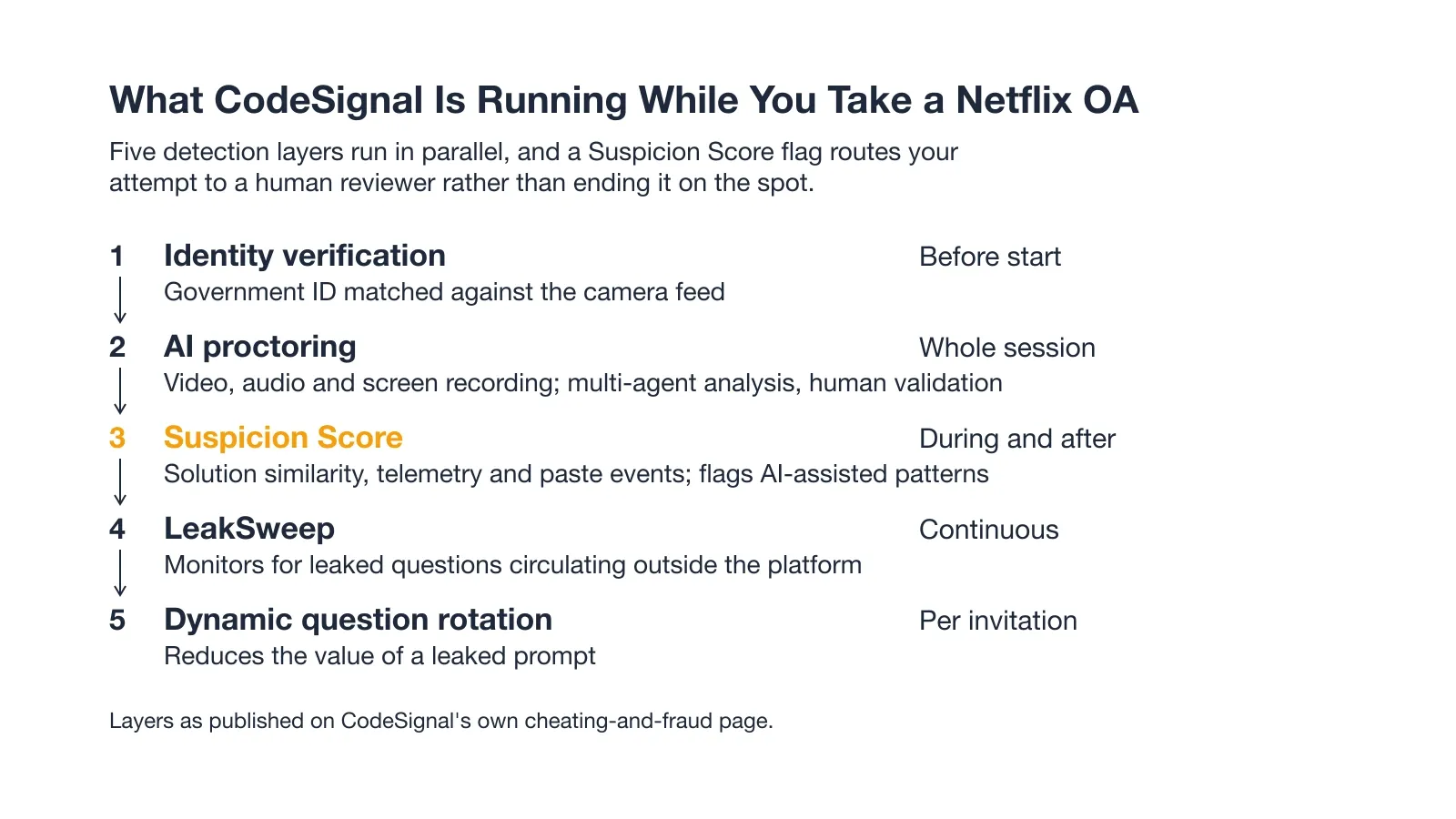
CodeSignal runs five layers at once. Identity verification matches a government ID against the camera feed before you start. AI proctoring records video, audio, and screen for the whole session, with multi-agent analysis and human validation.
The Suspicion Score watches solution similarity, telemetry, and copy-paste for patterns that may indicate AI-assisted behavior. It requires human review rather than an automatic kill. LeakSweep monitors for leaked questions, and dynamic question rotation changes the prompt per invitation.
These five layers describe what runs during the test. They do not explain how those signals become a formal cheating finding. How CodeSignal detects cheating folds the Suspicion Score, paste telemetry, and session replay into one review path.
CodeSignal records your screen the entire time. Does CodeSignal record your screen during the OA? Yes, the AI proctoring layer captures video, audio, and screen for the full session. The multi-agent analysis reviews CodeSignal's screen recording during the OA after you finish.
Launching normally is not the same as being clear. My early June 2026 assessment launched with no pre-test block and no warning. A floating answer widget was running on top of everything. The launch check did not stop it, so I had no signal anything was wrong at the start.
A primary-machine overlay sits outside the capture buffer. CodeSignal captures the screen through getDisplayMedia, so an always-on-top window on your main machine renders outside that buffer.
CodeSignal infers it from second-order signals such as a focus tracker and keystroke-rhythm anomalies, never seen directly. A separate physical device, like a phone, sits outside the capture surface altogether.
The employer sees a status, not the footage. The dashboard shows a proctoring status and a reason on hover, never the raw video.
Understanding CodeSignal's copy-paste detection early helps because CodeSignal logs every paste event into the employer report. A copied solution can fail you even with passing code.
The camera question is separate. It comes down to the identity-verification step. whether CodeSignal turns on your camera matches your ID against a webcam feed before the test begins.
What Netflix's CodeSignal Test Format Actually Looks Like
The format is a custom administrator-set assessment, not the certified 70-minute General Coding Assessment. According to the official help article, the assessment runs in one sitting with no pausing.
The countdown auto-starts on launch. You must press the green SUBMIT per question to get a score CodeSignal support article. Leaving and returning throws "Assessment not Found" while the clock keeps running.
| Aspect | What applies on Netflix's CodeSignal | | Question count | Varies by role and is shown before you start; the SWE-intern OA was reported as four coding questions | | Time limit | Custom administrator-set limit; reported around 1-2 hours, not a fixed platform number | | Sitting rule | One sitting, no pausing; countdown auto-starts on launch | | Submit rule | Press the green SUBMIT per question; a 1-minute warning precedes auto-submit | | Question order | Any order allowed | | Leaving the tab | Returns "Assessment not Found"; the clock does not stop | | Languages | Python, Java, C++, JavaScript |
The count depends on your role. The SWE-intern OA was four coding problems, per a Glassdoor candidate. Officially, the number of questions varies and the invitation screen shows it before you start. That screen is your only reliable check.
There is no 70-minute answer. An administrator sets the duration, not a fixed platform limit. Candidates on the SWE-intern track reported "around 1-2 hours." Treat any fixed chart from the certified GCA as not applying here.
The custom-assessment rules resolve the contradiction every other page leaves standing. Coverage conflicts on whether this is four coding questions or "2-3 coding." It also conflicts on whether it is a timed test or a take-home.
The official "custom time limit set by the administrator" plus "number of questions varies" rules explain all of it. Netflix runs a custom assessment, so the GCA counts and the 70-minute chart simply do not apply.
The green SUBMIT button is load-bearing. No submit press means no score for that question, however good the code. If time expires, the attempt submits exactly as you left it after a single 1-minute warning.
How Netflix's CodeSignal Scoring Works
A proctoring status you cannot see decides the outcome, not a score that may never appear to you.
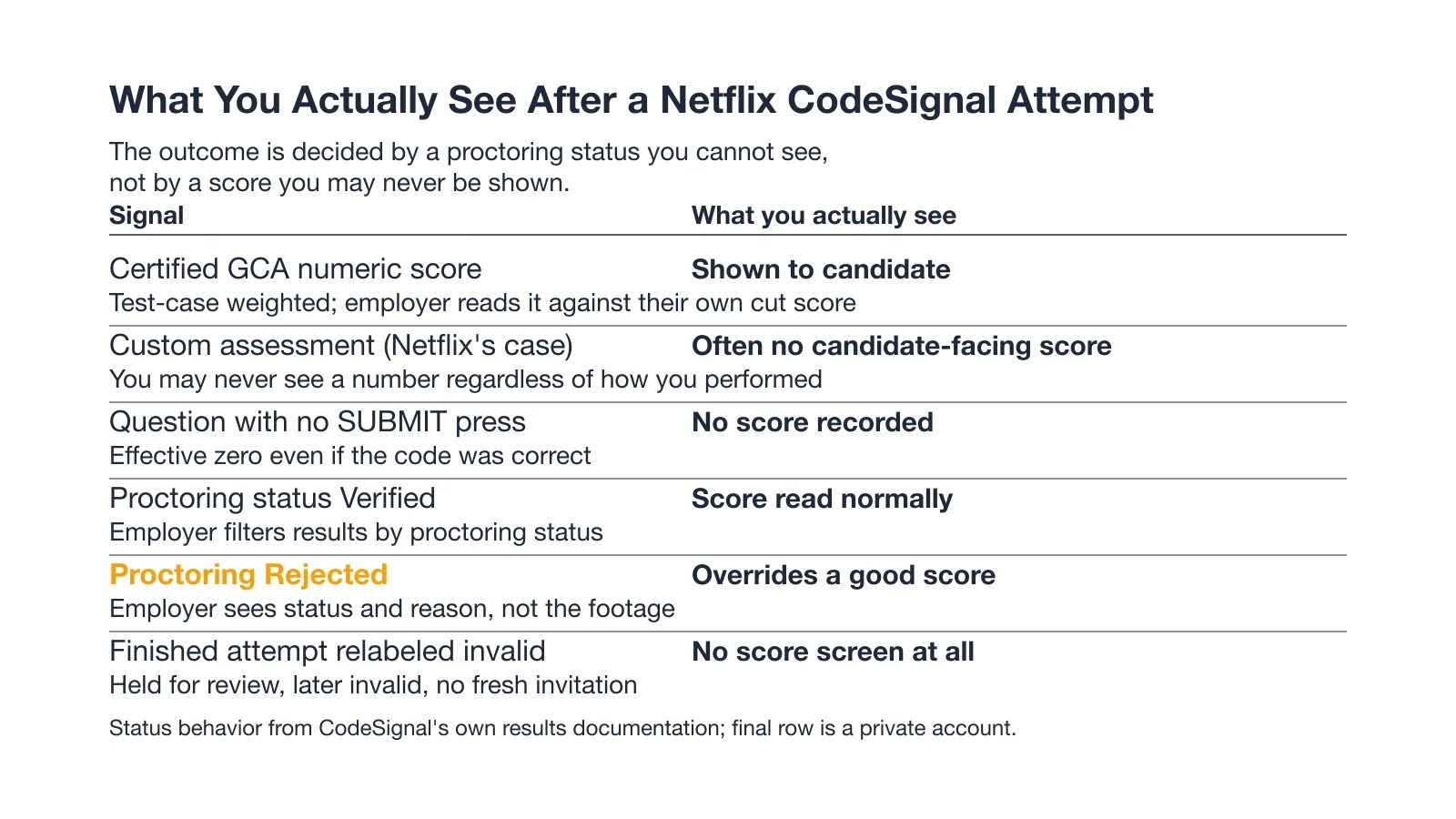
The platform model is real but platform-level. CodeSignal weights scores by test case, and partial credit is real.
On the certified GCA the scale runs 200-600, but custom assessments like Netflix's often show no candidate-facing score at all. I will not repeat the 296/396/496/500/600 ladder some guides cite, because no official CodeSignal doc verifies it.
Nobody publishes a Netflix score model. No source states a Netflix pass line, and no official doc confirms whether the custom OA shows you a score. I state that gap plainly rather than invent a threshold.
The status outranks the number. A rejected proctoring status overrides a good score. The employer filters results by proctoring status, so a clean solution set can still lose to a review failure.
CodeSignal does not guarantee the score screen. In my own attempt, the final score screen never appeared. A finished attempt can end without the candidate ever seeing a number.
The employer report holds behavior signals, not just a score. It shows per-question scores, starter versus final code with diffs, and session replay. It also lists time open per question and paste events. It adds skill labels too. That is why the proctoring side matters more than a single grade.
Why Candidates Fail the Netflix CodeSignal Assessment
The Score Screen That Never Appeared
My early June 2026 Netflix CodeSignal assessment started normally even though a floating answer widget was running. When a notification stole focus, the final score screen never appeared and the attempt was held for review. The dashboard later relabeled my finished attempt as invalid and issued no fresh invitation.
That failure was silent and delayed, not an instant kill. The overlay did not block the launch, so I had no signal anything was wrong until the score screen failed to appear. Instead, the invalidation only surfaced later in the dashboard. This is materially different from an immediate "session terminated" popup.
Detection runs through CodeSignal's official path. The Suspicion Score flags patterns that may indicate AI-assisted behavior and routes the attempt to human review.
The employer's dashboard records the Proctoring-Rejected status. Default-on detection included an AI-code classifier, a focus tracker, and a paste detector.
From there, the Suspicion Score buckets escalate from score-only review to session-replay review to a full proctoring-team review of video, screen, and edit history. That is exactly how a held-for-review attempt becomes a later invalid label.
A Rejected Status Overrides a Good Score
Reported rejection reasons include not being alone in the room, leaving camera view, and failing to maintain required shares. ID issues also appear CodeSignal results documentation.
A rejected status overrides an otherwise good score, and reviewers verify or reject the outcome. The employer sees the status and reason, not the footage.
Code That Was Never Submitted Scores Zero
The green SUBMIT press per question records a score. Code you never submit earns zero on that question, even when it was correct. No submit means no score recorded.
Leaving the Tab Ends the Attempt
Returning to the assessment produces "Assessment not Found" while the clock keeps running. The one-sitting rule has no pause, so any exit forfeits the in-progress attempt rather than freezing it.
How to Prepare for the Netflix CodeSignal in 7 Days
I built the plan below from this exam's reported question shapes and platform rules, not a generic study template. I had seven days between the invitation and my early June 2026 attempt.
In the days before the test I used the Prep Agent from InterviewFox over WhatsApp.
I sent it the question patterns candidates describe for the Netflix CodeSignal — string and dictionary problems, plus the tight time limits reported on LeetCode Discuss and Glassdoor — and got back a personalized drill plan. It slotted into the day-by-day plan below as one practical tool among the others.
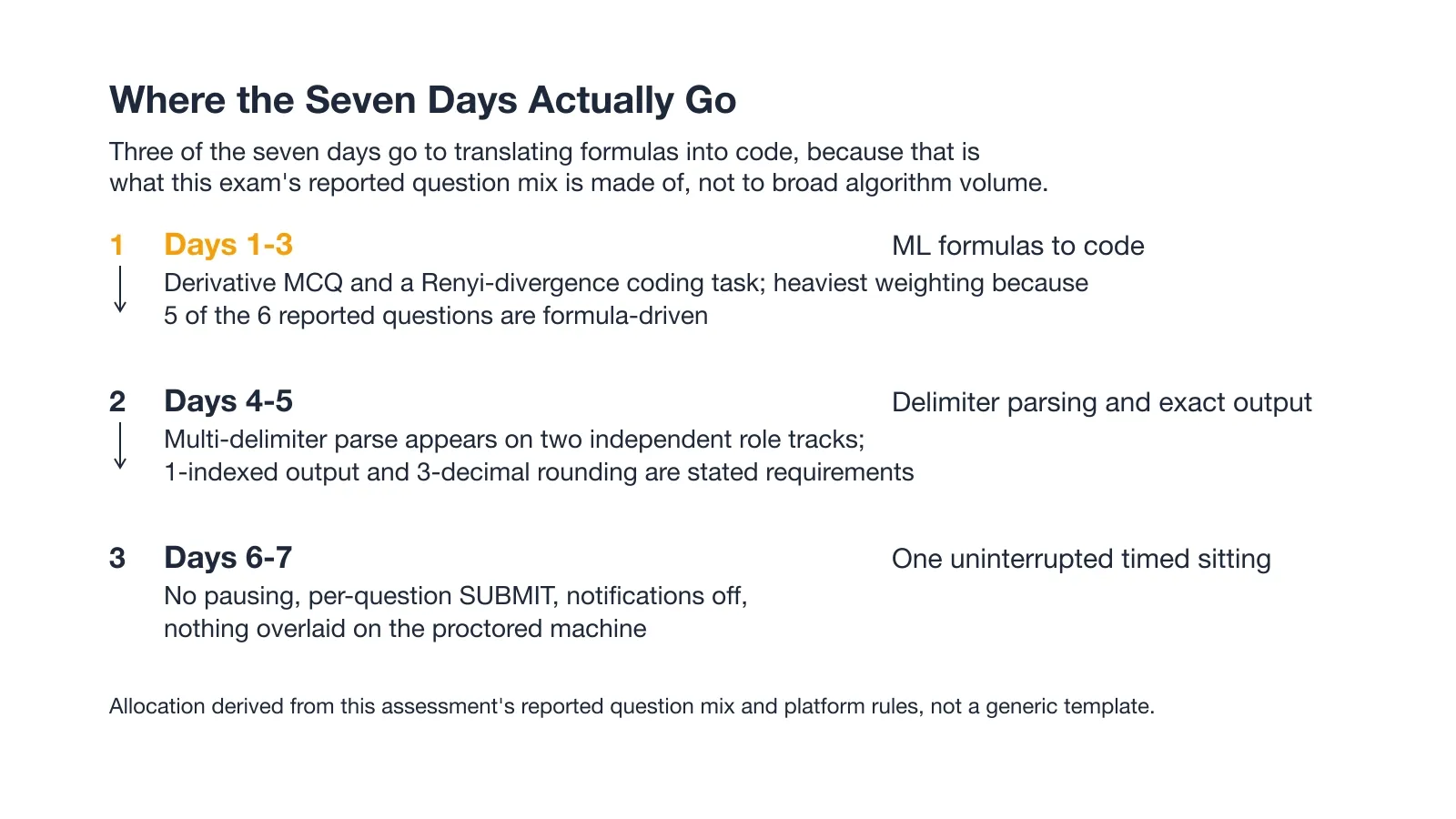
Days 1-3 String and Parsing Drills
The best-documented Netflix CodeSignal problems run on strings and index handling. The shared "Sum of two Strings" problem is the cleanest example: add digits position by position, carry correctly, and build the result in the right direction.
Training action: implement string-addition and multi-delimiter parsing from scratch, asserting exact stdout including index base and decimal places. Success check: correct on first submit, no off-by-one, no direction bug.
I skipped broad LeetCode tag grinding on graphs, trees, and DP for this attempt, because the reported problems were string and dictionary shaped rather than heavy data-structure drills.
I also skipped system-design preparation for the OA stage, because no confirmed Netflix CodeSignal OA report contains a design prompt, and the system-design entries in the Netflix pool belong to the later loop.
Days 4-5 String Indexing and 1-Indexed Output
Output formatting is where test-case-weighted partial credit leaks silently. The shared problem returns a result string, and the SWE-intern track candidates describe dictionary and state-tracking problems where off-by-one and index-base mistakes cost hidden cases.
Training action: five string and dictionary problems, asserting exact stdout including index base. Success check: 1-indexed output and edge cases correct on first submit, no off-by-one.
Days 6-7 A Full Sitting With No Focus Changes
The one documented failure in this evidence pool was a session-integrity event, not a wrong answer. The sitting rehearsal earns a full two days. I ran one full timed dry run with notifications disabled and one monitor. Nothing sat always-on-top on the proctored machine, my ID was ready, and I pressed the green SUBMIT on every question.
Training action: complete a 90-minute run with zero focus changes and every question submitted. Success check: finish the run with no overlay running and no notification stealing focus.
What Happens After You Submit the OA
A proctoring review gates your result, so silence after submitting is a real outcome state rather than a delay.
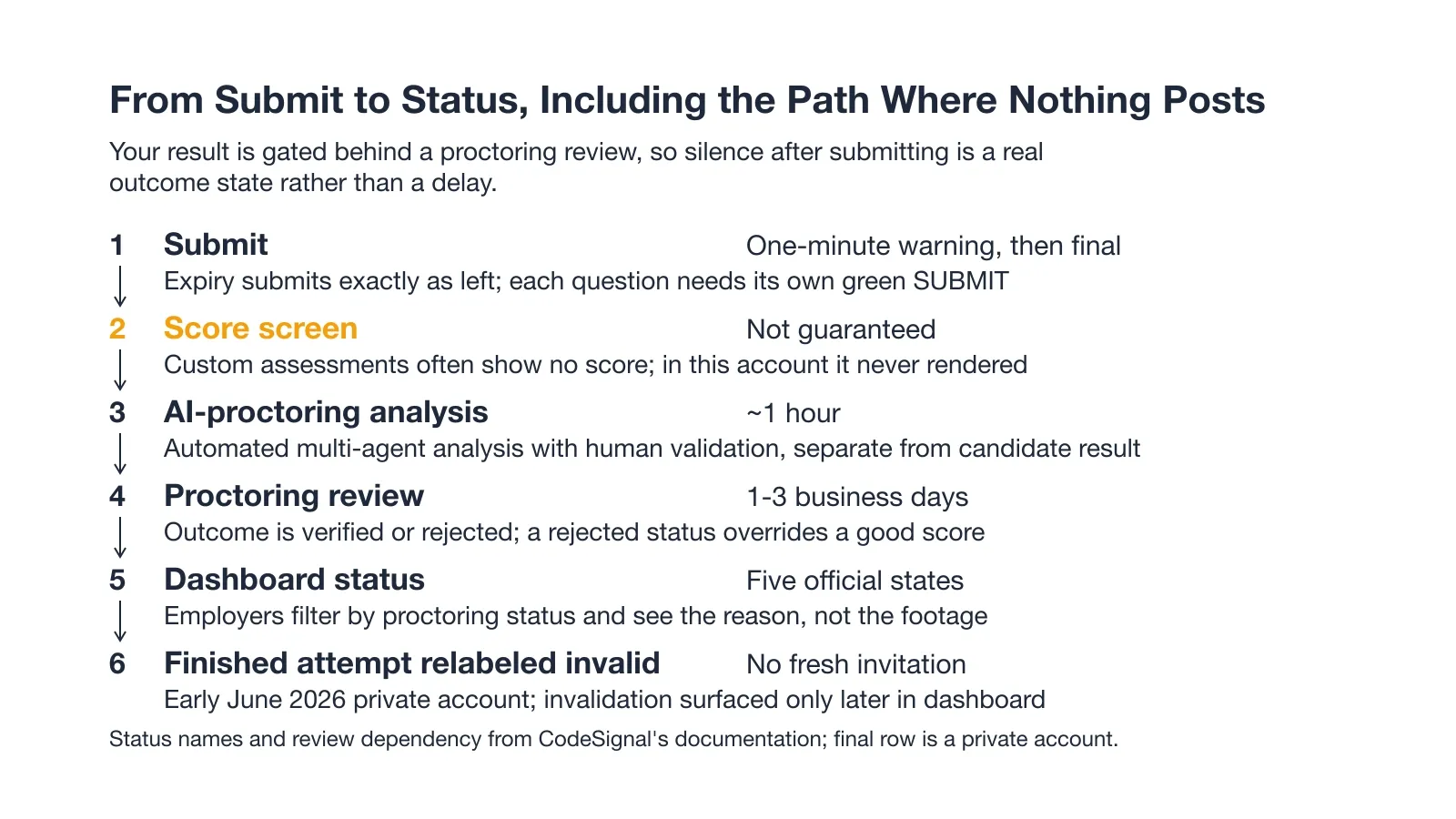
Proctoring gates the result, not a queue. Proctoring review decides whether anyone reads the score at all. The reported review window is 1-3 business days, after which reviewers verify or reject the outcome. A rejected status overrides a good score.
The dashboard states that actually exist are status labels. They include Proctoring status, "Proctoring Rejected," Invite Expired, and Invite Declined. Rejected carries a reason on the candidate record. The employer filters by proctoring status and sees the reason, not the footage.
When nothing posts at all, that is the outcome I lived. The score screen never appeared and the attempt was held for review. The dashboard later relabeled my finished attempt invalid, and no fresh invitation was issued. This answers the follow-up question no other page covers.
If the result never shows, the attempt may simply be held or relabeled without a new invitation.
Fix an expired or unusable link yourself. If the invitation link expires, you must contact the hiring company. The employer decides whether to re-administer.
The numbers that do not exist are worth naming. There is no public Netflix invite-to-result silence window. There is also no confirmed cooldown for a custom assessment. I state the gap rather than invent a number.
Land offer with Safer AI Interview Assistant
Skip the risky invisible apps. Our dual-device mode keeps it simple and undetectable. You crush the interview, we handle the answers.
Get started. It's freeLoved by 100,000+ candidates
Netflix Runs More Than One CodeSignal Shape
There is no single Netflix CodeSignal exam, so the shape to prepare for depends on the track you applied to.
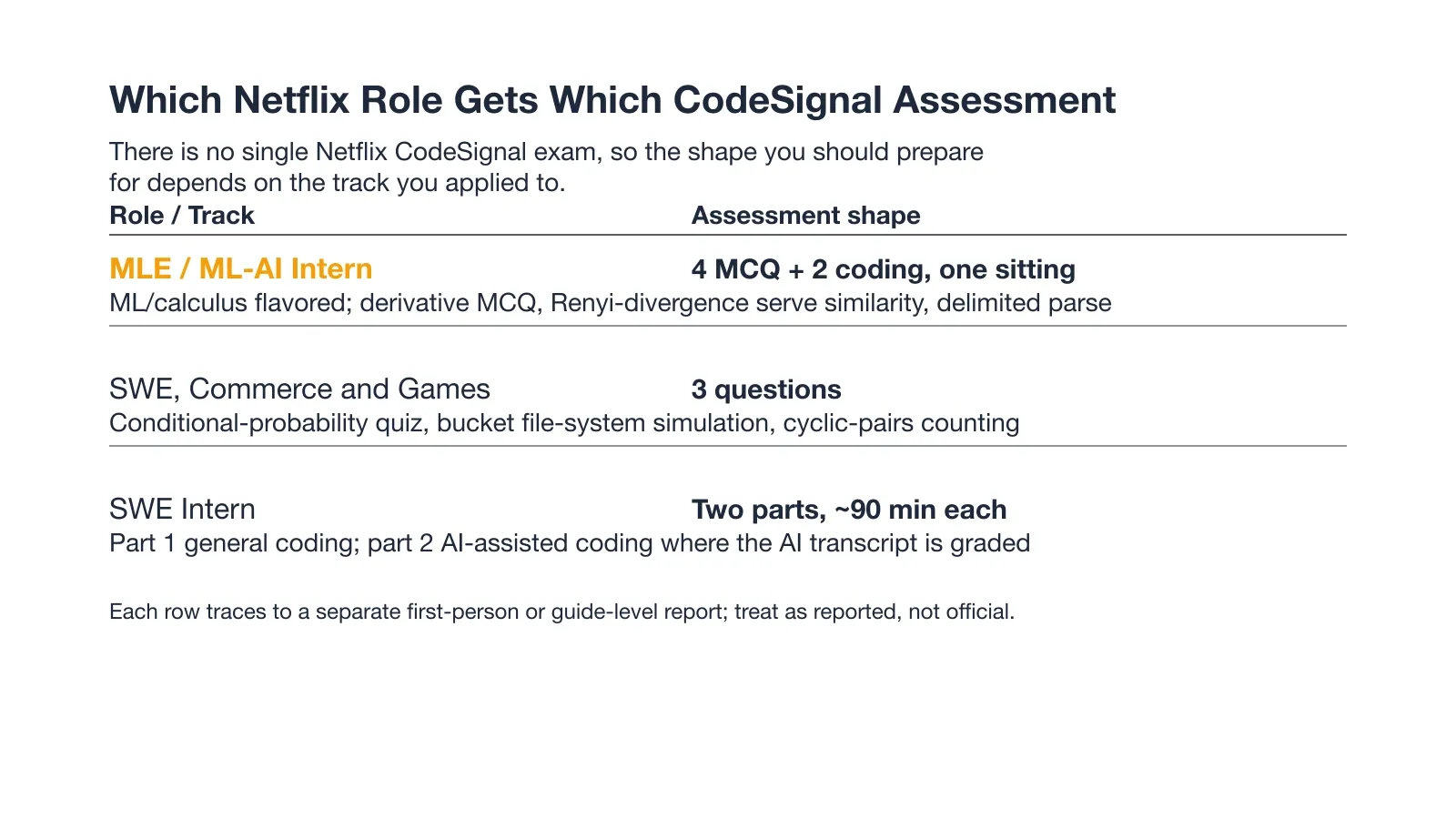
Candidates report at least two distinct shapes. The SWE-intern OA is four coding questions, which is the best-documented track from public candidate reports. Other tracks are described with different mixes, and Netflix sets the assessment per role.
The invitation screen is your only reliable check. The official rule states the question count appears before you begin, and an administrator sets the time limit. Read that screen before you plan your pacing.
The AI-assisted track inverts the usual advice. On that variant the graded artifact can include the AI-interaction transcript itself. That is the opposite of the covert-overlay situation above, where hiding help on the proctored machine caused the failure.
The same silent-failure exposure spans every shape. Whichever shape you get, the one-sitting rules and the proctoring-status gate stay the same. The sitting-hygiene rehearsal applies to every track.
FAQ
Does an invalidated Netflix CodeSignal attempt get a fresh invitation
No. In my early June 2026 attempt the dashboard relabeled the finished attempt invalid and issued no fresh invitation. Officially, an expired or declined invitation leaves re-administration to the employer's decision, so do not assume a retry lands in your inbox.
How long is the Netflix CodeSignal assessment
The time limit is a custom administrator-set value, not a fixed platform number, and SWE-intern candidates reported "around 1-2 hours." Read the invitation screen for your specific window, because it varies by role.
Does the Netflix CodeSignal OA show you a score
Often it does not. Custom assessments like Netflix's frequently show no candidate-facing score, and in my attempt the final score screen never appeared at all. Treat a visible number as a bonus, not an expectation.
Is the Netflix CodeSignal assessment proctored with a camera
Yes. CodeSignal's AI proctoring records video, audio, and screen for the whole session. Identity verification matches a government ID against a webcam feed before you start. The employer sees the resulting status and reason, not the raw footage.
Can I use an AI tool or invisible app during the Netflix CodeSignal OA
Desktop overlay tools put the AI's answer on your computer screen. It renders as a hidden layer above the browser using a basic OS-layer trick. The answer stays on-screen and the hiding is basic.
Proctoring software keeps adding detection capabilities as AI tools get more common, so the exposure is not fixed. InterviewFox pushes the answer to your phone instead.
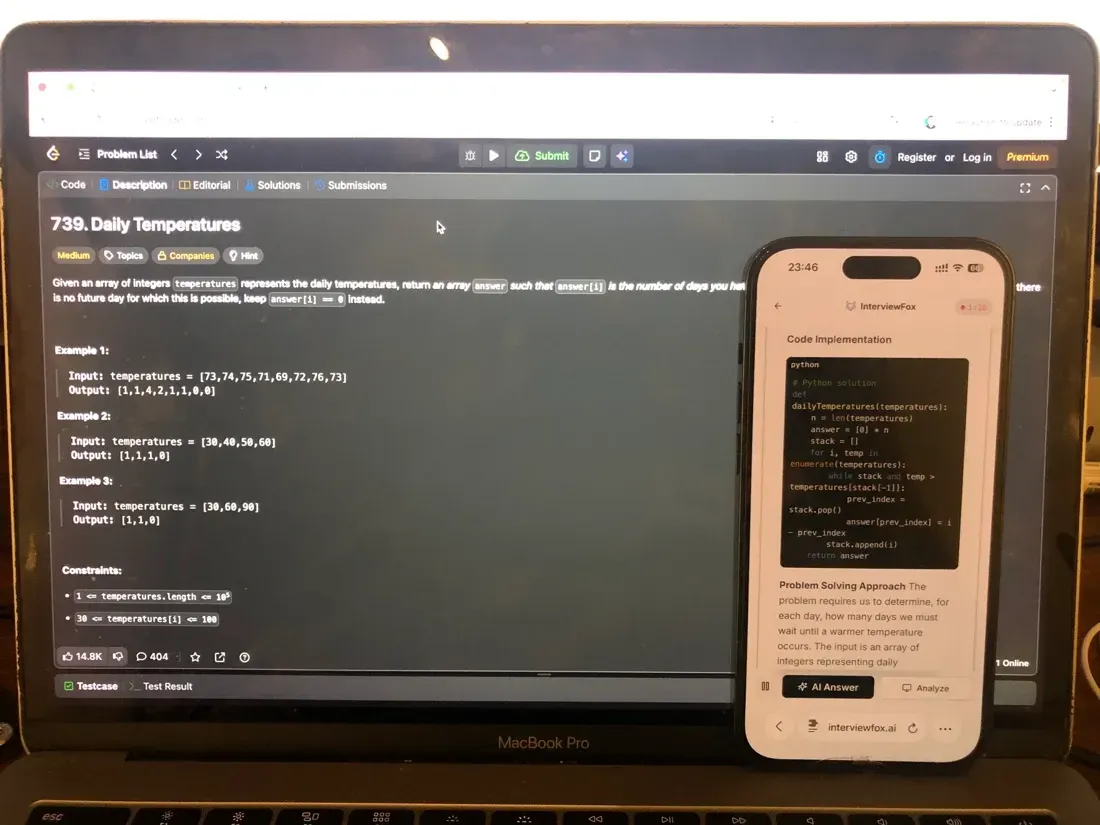
That is a physically separate device that no screenshot, screen recording, or session monitoring can reach by design, so the laptop screen stays on the exam editor, unchanged. If you are going to use AI assistance during the OA, the dual-device architecture removes the answer from your screen entirely.
What should I do if my result never posts
Wait through the 1-3 business day proctoring review, because silence is a real outcome state, not just a delay. If a rejected status overrides your score or the link expired, contact the hiring company, since re-administration is their call.
Can I retake it, and is there a cooldown
There is no published Netflix cooldown for a custom assessment. The flat 14-day claim from one guide is blacklisted and contradicts the official "set by employer" rule. Whether you retry depends entirely on the hiring company's decision after an invalidation.
Which questions should I actually practice
Practice string and parsing problems and read your invitation screen before planning pacing, because the question mix varies by role. The best-documented Netflix CodeSignal problems are string and dictionary shaped, so drill those rather than assuming a fixed question list.