
I Passed Robinhood CodeSignal in 2026: Real Questions and Prep

Quick Facts
| Format | CodeSignal General Coding Assessment, 4 coding questions |
| Time window | ~70 minutes, one sitting |
| Proctoring | Always-on Suspicion Score; AI proctoring optional |
| AI-use rule | No AI tools in the live assessment unless authorized |
| Question bank | Stable recurring set (load-factor, OOD, fractional-share) |
| Year | 2026 |
I took the Robinhood CodeSignal assessment for a new-grad backend role in 2026, chose Python, and solved all four coding questions clean. What follows is the complete process and how I prepared for it.
With the money-transfer parser's edge cases still failing and twelve minutes left, I used dual device AI interview tool to check the validation logic. It surfaced the non-friend transfer case, which I break down in the walkthrough below.
Before my test, I went through every Robinhood CodeSignal post from the past two years on Reddit, LeetCode Discuss, and Teamblind. What I found tracks closely with what I experienced, including the mistakes that get people flagged or rejected.
The Real Questions on My Robinhood CodeSignal Test
I took the Robinhood CodeSignal General Coding Assessment for a new-grad backend role in 2026. The test gave me four coding questions in one timed block. Here is exactly what I got on each one, in the order they appeared.
Question 1: Service Load Factor / Referral Count
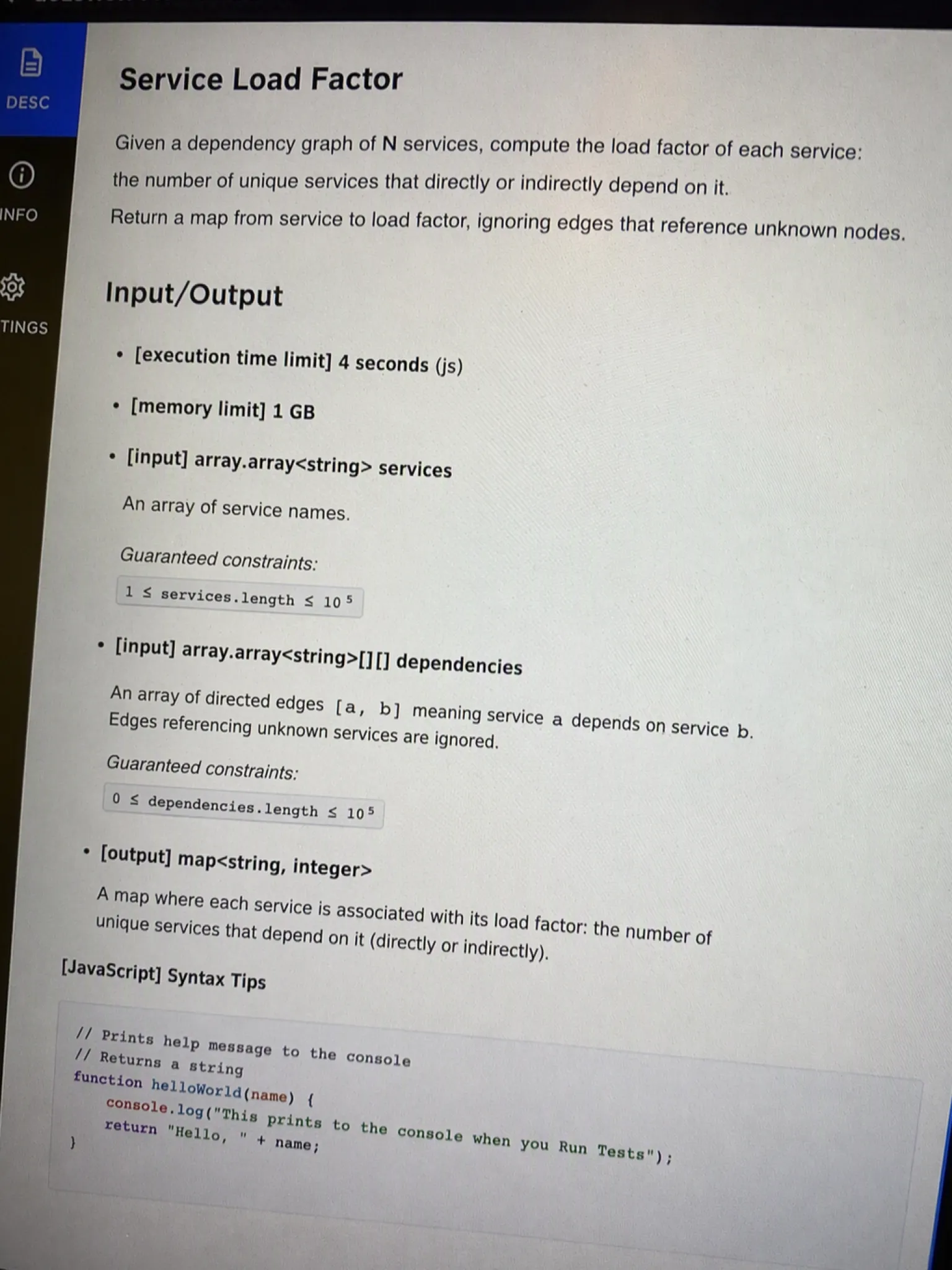
The problem I got: Robinhood asked me to compute the load factor of every service in a dependency graph. A service's load factor is the number of unique services that depend on it, directly or indirectly. The input was a map from each service to the list of services it depends on. I had to ignore any edge that pointed at a service not in the node list, and return a map from service to its load factor.
My approach: I first built the reverse graph: for each dependency edge u -> v, v has u as a dependent. Then for every node I walked the dependent adjacency set with a stack, collecting unique nodes. The count of that set was the load factor. I used a set per node to de-duplicate services reached through multiple paths.
from collections import defaultdict


def load_factor(graph):
    # graph: dict node -> list of nodes it depends on
    dependents = defaultdict(list)
    nodes = set(graph.keys())
    for u, deps in graph.items():
        for v in deps:
            dependents[v].append(u)
            nodes.add(v)

    result = {}
    for node in nodes:
        seen = set()
        stack = list(dependents[node])
        while stack:
            x = stack.pop()
            if x in seen:
                continue
            seen.add(x)
            stack.extend(dependents[x])
        result[node] = len(seen)
    return result
Time complexity: O(V * (V + E)) naive, O(V + E) with memoized topological aggregation | Space complexity: O(V + E)
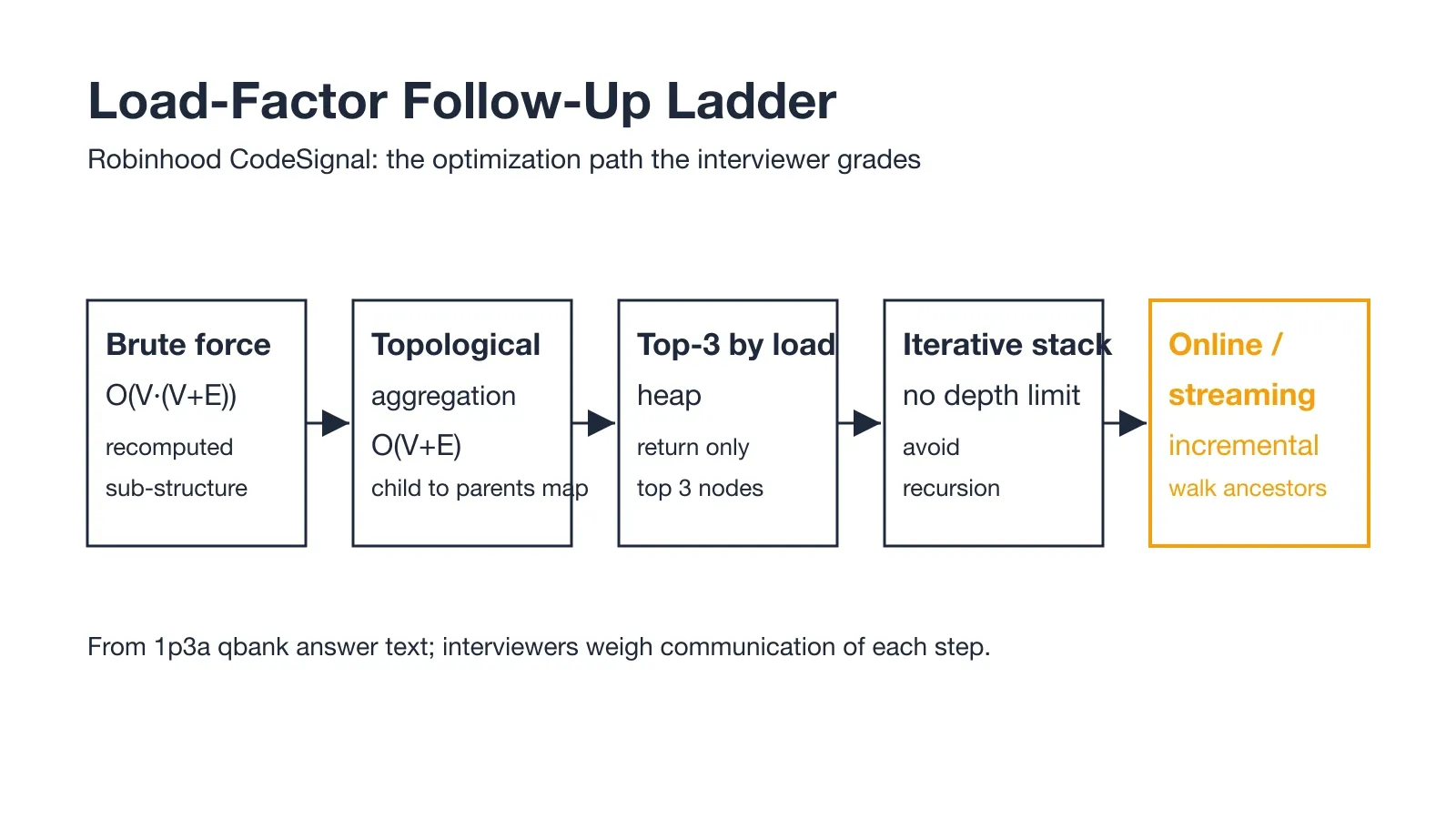
The interviewer did not stop at a working answer. They asked how I would return only the top three services by load, then how I would handle a new node added mid-stream. I walked through a heap for top three and an incremental walk over ancestors for the streaming case. That communication mattered as much as the code.
The grading path from brute force to online streaming looks like this:
Question 2: Friend / Money-Transfer Request Parsing
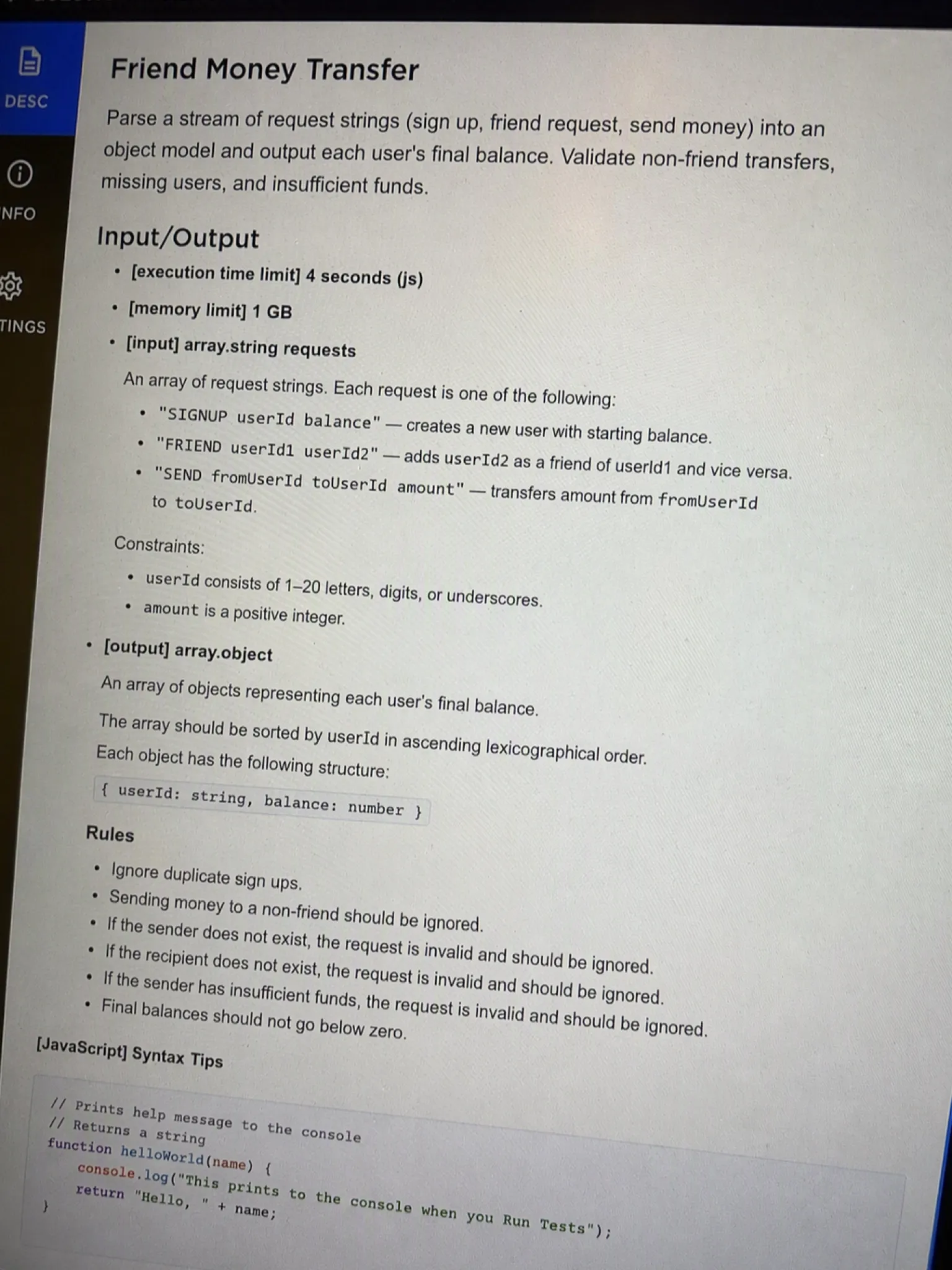
The problem I got: I received a stream of request strings and had to model them as objects, then print each user's final balance. The streams were sign up <user>, friend <a> <b>, and send <a> <b> <amount>. A transfer had to be rejected if the two users were not friends, if either user did not exist, or if the sender had insufficient funds. Duplicate sign-ups had to be ignored.
My approach: I built a User class holding a friend set and a balance, and a TransferSystem class holding the user map. I parsed each line, dispatched on the verb, and validated before mutating state. The hard part was keeping the validation tight without over-building the class hierarchy.
class User:
    def __init__(self, name):
        self.name = name
        self.balance = 0.0
        self.friends = set()


class TransferSystem:
    def __init__(self):
        self.users = {}

    def sign_up(self, name):
        if name not in self.users:
            self.users[name] = User(name)

    def friend(self, a, b):
        if a in self.users and b in self.users:
            self.users[a].friends.add(b)
            self.users[b].friends.add(a)

    def send(self, a, b, amount):
        if a not in self.users or b not in self.users:
            return False
        if b not in self.users[a].friends:
            return False
        if self.users[a].balance < amount:
            return False
        self.users[a].balance -= amount
        self.users[b].balance += amount
        return True

    def balances(self):
        return {name: u.balance for name, u in self.users.items()}
Time complexity: O(N) for N requests | Space complexity: O(U) for U users
I burned twenty minutes on the class layout and the non-friend validation edge case. The clock showed twelve minutes left and my main path still did not run end to end. That gap is what I describe in the exam-day walkthrough below.
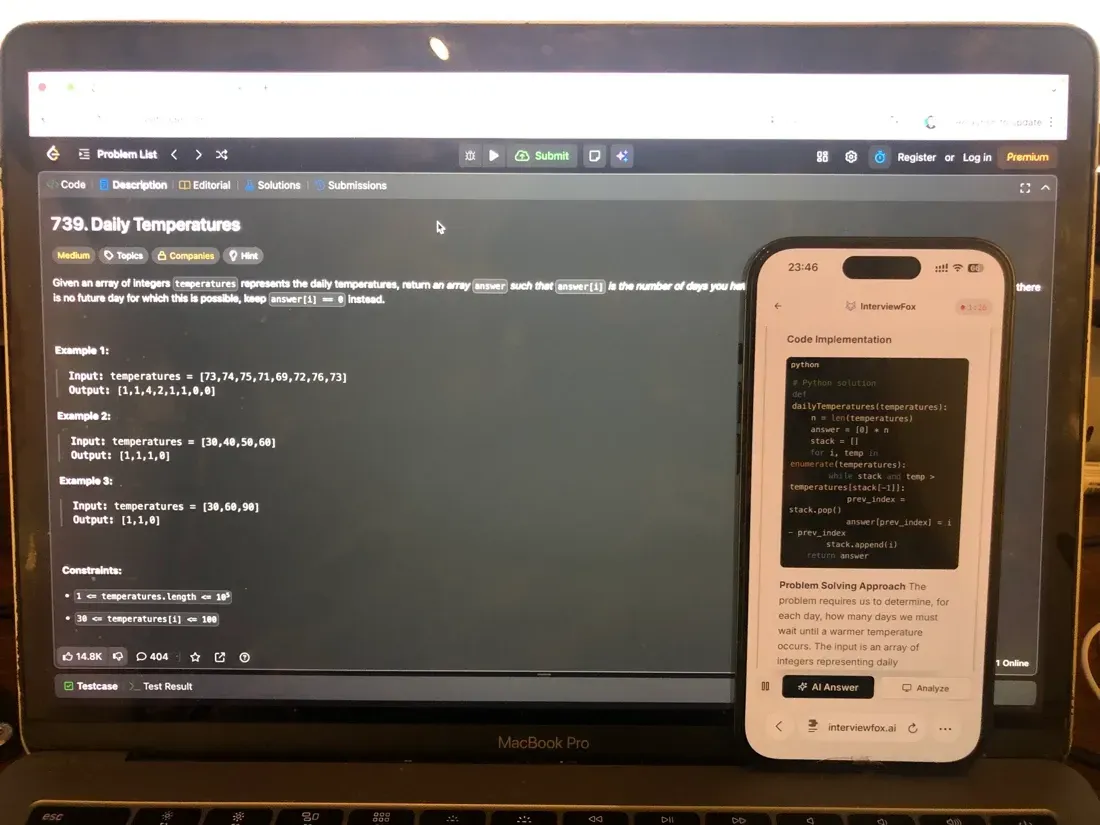
A desktop overlay would have put that answer on the same screen the proctoring system was monitoring, hidden by a basic rendering layer. I did not want that uncertainty in the background, so I used a keyboard shortcut that auto-captured the question panel and pushed the answer to my phone. The laptop screen stayed on the exam editor, unchanged, and the validation case cleared.
Land offer with Safer AI Interview Assistant
Skip the risky invisible apps. Our dual-device mode keeps it simple and undetectable. You crush the interview, we handle the answers.
Get started. It's freeLoved by 100,000+ candidates
Question 3: Fractional Share Buy/Sell Inventory
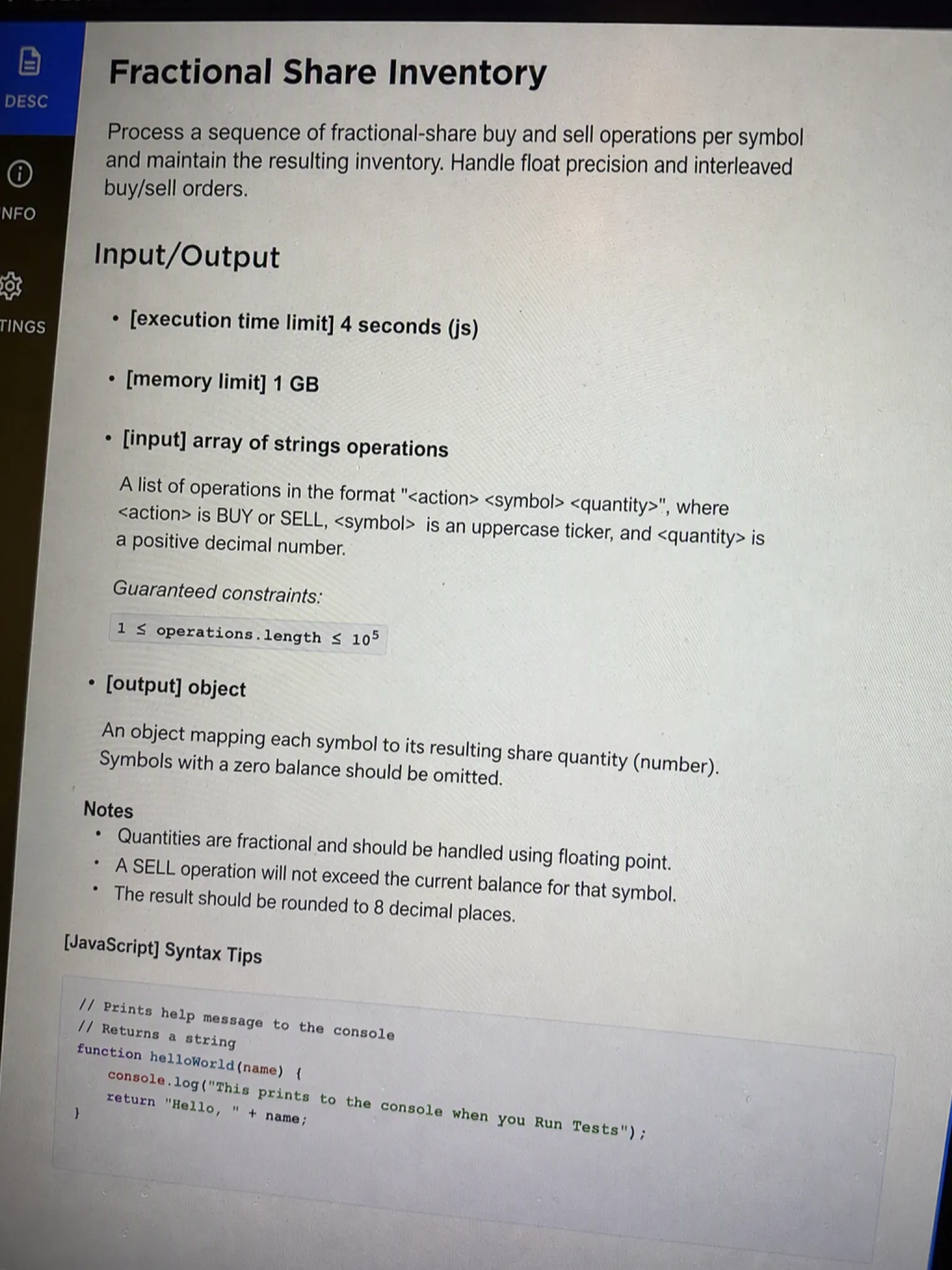
The problem I got: Robinhood gave me a sequence of fractional-share buy and sell operations and asked me to maintain the resulting inventory per symbol. Quantities were fractional, so I had to watch float precision across interleaved orders.
My approach: I kept a dictionary keyed by symbol holding the net position as a Decimal. Each buy added, each sell subtracted, and I guarded against negative inventory only when the problem called for it. Using Decimal avoided the drift I would have seen with plain floats.
from decimal import Decimal
from collections import defaultdict


def inventory(operations):
    # operations: list of ("buy"|"sell", symbol, qty_str)
    pos = defaultdict(lambda: Decimal("0"))
    for op, symbol, qty in operations:
        amount = Decimal(qty)
        if op == "buy":
            pos[symbol] += amount
        else:
            pos[symbol] -= amount
    return {sym: float(v) for sym, v in pos.items()}
Time complexity: O(N) for N operations | Space complexity: O(S) for S symbols
The question was short, but the interviewer asked what happened if a sell drove a position negative. I explained the business rule I would apply and moved on with time to spare.
Question 4: Word Frequency from a Large Paragraph
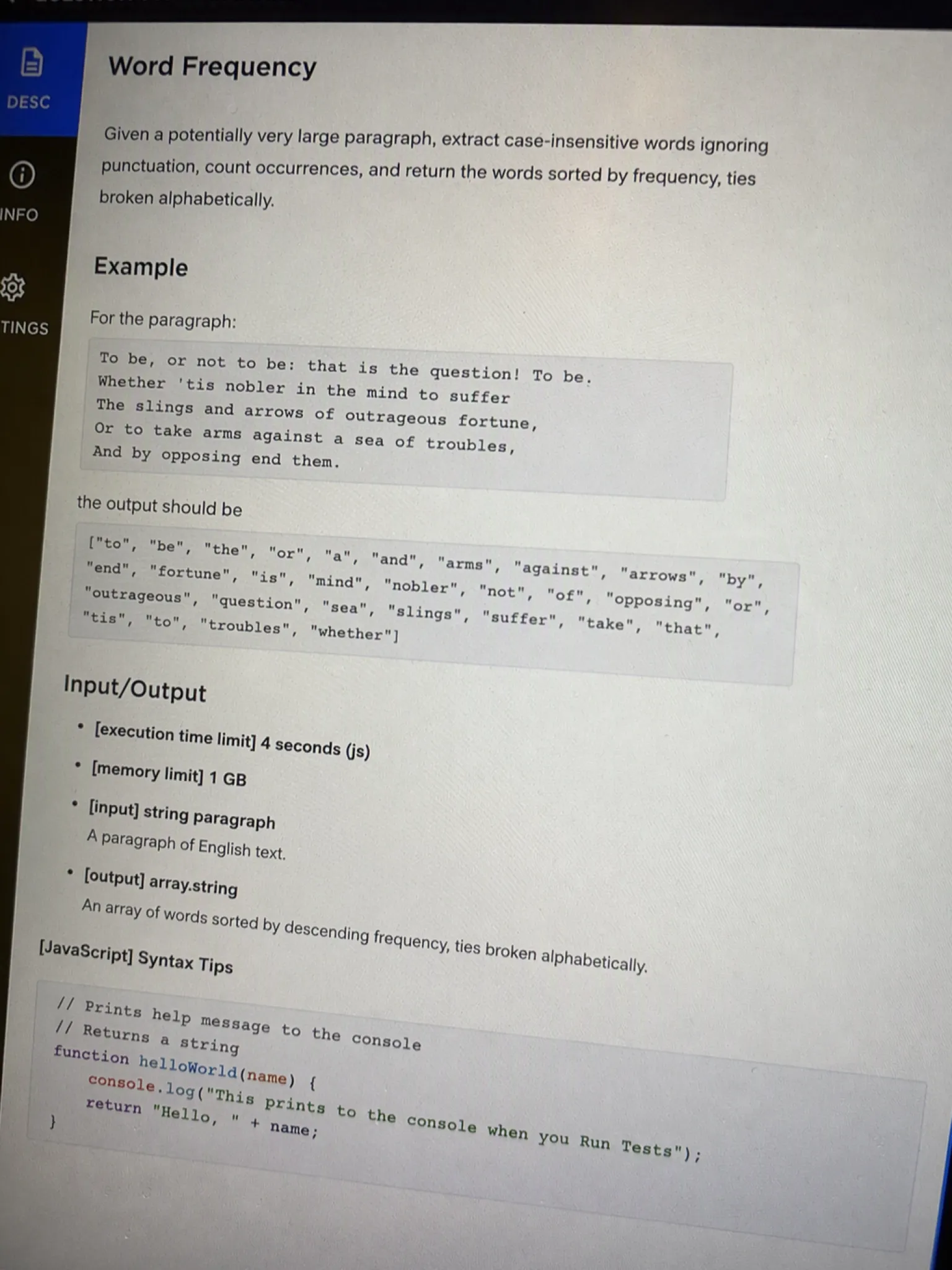
The problem I got: The last question handed me a potentially very large paragraph. I had to split it into case-insensitive words, ignore punctuation, count each word, and return the words sorted by frequency. For equal frequencies the tie-break was alphabetical.
My approach: I scanned the text once, building a word with a pointer and resetting on any non-alphanumeric character. I lowered each word and tallied with a counter, then sorted by frequency descending and word ascending.
import re
from collections import Counter


def word_frequency(paragraph):
    counts = Counter(w.lower() for w in re.findall(r"[a-z0-9]+", paragraph.lower()))
    return sorted(counts.items(), key=lambda kv: (-kv[1], kv[0]))
Time complexity: O(T + K log K) for T text length and K distinct words | Space complexity: O(K)
The follow-up pushed past memory: what if the paragraph no longer fit in RAM? I described chunked counting and a merge of partial tallies under a size cap. That answer closed the section with a few minutes to spare.
Robinhood's Proctoring Policy for CodeSignal
Robinhood runs its CodeSignal OA on a layered integrity stack. CodeSignal's own recruiting guide explains the Suspicion Score and LeakSweep layers in detail (CodeSignal's recruiting guide on cheating prevention ). I read it before the test so I knew what the platform watched.
The Always-On Suspicion Score
CodeSignal runs an always-on Suspicion Score on every assessment. It studies solution structure, typing rhythm, and paste events to flag AI-assisted patterns. No camera is needed for this layer. I looked into how CodeSignal detects cheating to see exactly what that layer watches.
LeakSweep and Copy-Paste Controls
LeakSweep watches public sites for leaked questions and swaps them out. Paste events are tracked and the pasted text is visible to the reviewer, with IP and location logged. That is why I checked whether CodeSignal can detect copy-paste before I reused any snippet.
AI Proctoring Is Optional
Screen, camera, and mic recording run only if Robinhood enables AI proctoring for the round. The candidate sees a setup flow first if it is on. If Robinhood turns it on, you should know up front whether CodeSignal records your camera during the session. The same optional toggle decides if your screen gets recorded.
Robinhood's AI-Use Rule
Robinhood's rule is binding: no AI tools in the live assessment unless explicitly authorized. Browser extensions and overlays must come off before you start. Treat that as a hard line, not advice.
4 Other Confirmed Robinhood CodeSignal Questions
Beyond my four exam questions, Robinhood's recurring bank holds several more confirmed problems. These come from candidate reports and the question bank, not from my own sitting, so I attribute each to its source.
Question 5: Chainable Rectangle Manipulation API
A 2026 frontend candidate described a chainable JavaScript class that selects rectangles in a 3x3 grid, changes color, delays actions, and shifts by a pixel offset. The catch is keeping every public method returning this, while a Promise tail serializes the delayed work. The trap is returning a Promise from afterDelay, which breaks the fluent chain.
class RectangleAPI {
  constructor() {
    this.selected = [];
    this.tail = Promise.resolve();
  }
  select(id) {
    this.selected.push(id);
    return this;
  }
  afterDelay(ms, fn) {
    this.tail = this.tail.then(
      () => new Promise((res) => setTimeout(() => { fn(); res(); }, ms))
    );
    return this;
  }
}
Question 6: Weekly Calendar in React
A candidate built a 7-day calendar grid where clicking a cell opens a dialog to create a named event. The graded point was a single source of truth: store events, derive the grid. One candidate lost points reaching for useEffect side effects instead of useMemo derived state.
Question 7: Analytics Engineer SQL and Python
This role-specific question pairs SQL over a sharded user table with an edit log, then Python sessionization with a 30-minute cap. The shard column is a deliberate trap: joins must key on both (id, shard). Residency hinges on reconstructing state history from the edit log.
Question 8: Security-Flavored Constrained Data Structure
A staff security-track candidate faced a resource-constrained data structure plus a hardened string validator. Interviewers likened it to an LRU cache crossed with IP validation, then probed it under concurrency and malicious input. The grade rewards sound design over clever tricks.
Question 9: Stock Trading and Real-Time Quote System Design
This is one of two fixed system-design prompts. It asks for order placement against an external exchange and real-time quotes with historical ranges. Storage choice for price history is the differentiator, and down-sampling a one-year view comes up fast.
Question 10: Job Scheduler System Design
The anchor system-design prompt asks for typed jobs under an SLA with at-most-once delivery. The common strong answer is conditional writes, a compare-and-set lease on the claim. Open-book status means reliability and fault tolerance must be covered early.
Question 11: Photo Album Frontend System Design
A frontend design question covering album list, detail, and cross-device sync. The expected answer leans on a normalized client store and derived views. Follow-ups push sorting and upload flows.
What Robinhood's CodeSignal Test Format Actually Looks Like
CodeSignal's General Coding Assessment packs four coding questions into one timed block (CodeSignal's example GCA questions ). The standard window is about 70 minutes. Robinhood's specific window was not separately confirmed, so I treat the platform default as the shape. The four problems in my sitting matched the array, string, hashmap, and graph mix the format expects.
How Robinhood's CodeSignal Scoring Works
CodeSignal scores every submission. Each question's test-case pass rate feeds the score, and the Suspicion Score adds an integrity layer on top. Robinhood's exact pass bar was not published, so I describe it at the platform level rather than invent a number. A clean run on all four questions is the realistic target.
Robinhood CodeSignal Exam-Day Strategy
Get something running before you design. On the money-transfer OOD question, the named failure is over-designing classes and leaving the working code unfinished. A runnable path first, then refactor, is the safer order.
Cover reliability early in design prompts. The Job Scheduler follow-up walks candidates who leave fault tolerance thin into traps and runs out their time. Name your at-most-once mechanism up front.
Narrate brute force to optimization out loud. On the load-factor question, the interviewer graded the communication of each step, not just a working answer. Say the complexity, the edge cases, and the online extension even when the core finishes fast.
Why Candidates Fail the Robinhood CodeSignal Assessment
AI-Tool Detection Ends the Attempt
One applicant I spoke with took the Robinhood CodeSignal test in late April 2026. They relied on a translucent AI sidebar and expected it to stay invisible. Just after they pasted a revised function, a warning appeared the moment they used the overlay hotkey. The page locked immediately, and they were marked ineligible for a retake.
CodeSignal's Suspicion Score flags AI-assisted patterns from typing and paste behavior, so an overlay tool is exactly the kind of signal it watches.
Desktop overlay tools render the AI's answer on the same screen the proctoring system watches, hidden by a basic OS-layer trick. InterviewFox works differently: the answer goes to my phone, a physically separate device that no screenshot or session recording can reach by design.
Land offer with Safer AI Interview Assistant
Skip the risky invisible apps. Our dual-device mode keeps it simple and undetectable. You crush the interview, we handle the answers.
Get started. It's freeLoved by 100,000+ candidates
Elegant-but-Unfinished Code
The other common failure is elegant-but-unfinished code. On the money-transfer OOD question, spending too long on class design and leaving the runnable solution missing is a named miss. Interviewers weight finished, edge-case-correct code above a pretty hierarchy.
How to Prepare for the Robinhood CodeSignal in 7 Days
Robinhood reuses a small, stable problem bank, so a focused week beats a vague month. I plan the days around the categories that actually appear. In the days before the OA, I used the Prep Agent from InterviewFox over WhatsApp to turn these confirmed patterns into a daily drill plan.
Days 1-2: Graph and DFS Speed
Spend the first two days on graph and DFS speed under the GCA clock. Load-factor is the most frequent screen, and the graded follow-up is topological optimization. Implement memoized DFS plus topological aggregation, then state the complexity. The success check is a fresh referral DAG solved in under twenty minutes with the top-three heap explained.
Do not pre-build elaborate class hierarchies first on the OOD questions. Get the working path running, then refactor.
Days 3-4: OOD and Hashmap Drill
The next two days drill OOD and hashmap code. Type a request-dispatch, handler, and state skeleton fast, then layer validation: non-friend, missing user, insufficient funds, duplicate sign-up. A 150 to 200 line runnable solution with edge cases beats a class diagram.
Days 5-7: String Drill and One Timed Simulation
The final stretch is string and hashmap drill plus one full four-question timed simulation. Punctuation-aware, case-insensitive tokenization and a frequency sort cover the word-frequency question. Run the whole GCA once at about 70 minutes. The success check is all four questions attempted with partial credit and zero blanks.
Do not study system-design deep dives for the OA. Job Scheduler and stock-quote are onsite rounds, not the CodeSignal coding screen. The OA is coding.
What Happens After You Submit the OA
After the OA, Robinhood's early-talent loop moves to a recruiter or hiring-manager screen, then a remote onsite. The OA score feeds the advance decision, but the exact bar is not public. A clean four-question submission is what gets you into the next stage.
Robinhood's Stable Recurring Question Bank
Robinhood's fingerprint is a small, stable bank that keeps coming back. Load-factor, Job Scheduler, stock-quote design, friend-money-transfer OOD, and fractional-share inventory show up across reports. Knowing the set lets you prep the specific shapes instead of guessing.
FAQ
Is the Robinhood CodeSignal OA proctored?
The Suspicion Score runs on every assessment with no camera. Screen, camera, and mic recording only turn on if Robinhood enables AI proctoring for that round. You see a setup flow first if it is on.
Can you use AI on the Robinhood CodeSignal assessment?
No, not unless Robinhood explicitly authorizes it. The company's rule binds candidates, and the platform's behavioral scoring watches for assistance patterns. Remove overlays and extensions before you start.
How many questions are on the Robinhood CodeSignal OA?
Four coding questions in one timed block, per the CodeSignal General Coding Assessment format. The window is about 70 minutes for early-career talent.
Can I use an AI tool or invisible app during the Robinhood CodeSignal OA?
Desktop overlay tools put the AI's answer on your computer screen, rendered as a hidden layer above the browser using a basic OS-layer trick. Proctoring software keeps adding detection capabilities as AI tools become more common, so the risk exposure is not fixed.
InterviewFox pushes the answer to your phone, a physically separate device that no screenshot, screen recording, or session monitoring can reach by design, so the laptop screen stays on the exam editor, unchanged. If you are going to use AI assistance during the OA, the dual-device architecture removes the answer from your screen entirely.
Land offer with Safer AI Interview Assistant
Skip the risky invisible apps. Our dual-device mode keeps it simple and undetectable. You crush the interview, we handle the answers.
Get started. It's freeLoved by 100,000+ candidates