
How I Took the Expedia HackerRank in 2026: Real Questions and Prep

Quick Facts
| Assessment | Expedia HackerRank OA, timed coding test sent after the strengths round |
| Time limit | 60 min DS&A, 90 min SDE and Security, 120 min Cloud, 120 to 150 min ML Science |
| Question count | 2 to 3 coding problems on most SDE tracks, often with MCQs; intern and ML tracks mix formats |
| Sitting rules | One sitting, any order, no negative marking for a skipped question |
| Languages | Any language HackerRank supports, STDIN and STDOUT, default template in C |
| Proctoring | Image Proctoring exists but is off by default; Expedia enablement unconfirmed |
| Cutoff | No published score; solving everything has not guaranteed advancement |
| Before the OA | Cappfinity strengths assessment, 45 to 60 minutes, gates the coding test |
| After the OA | Two virtual final interviews, one technical and one behavioral |
I took the Expedia HackerRank OA for an SDE role in 2026. The track gave me 105 minutes and three DSA problems. I picked Python 3, solved all three, and submitted with time on the clock.
I never got a callback either. That turned out to be the most useful lesson: finishing the OA is not the same as passing it. On the question where I stalled, an AI interview assistant on my phone got me the approach in about thirty seconds.
Before my test I read every Expedia HackerRank post from the past two years on LeetCode Discuss, Glassdoor, and GeeksforGeeks. What I found tracked with what I experienced. The hardest pattern this guide covers is the one nobody warns you about: candidates who solved everything and still got filtered.
The Real Questions on My Expedia HackerRank Test
My Expedia HackerRank OA landed in my inbox after I cleared the Cappfinity strengths assessment. It was the SDE version: three DSA problems, one sitting, a 105 minute clock, any language I wanted.
I picked Python 3 and opened the tab on a Tuesday morning. I got one geometry problem, one string problem, and one graph problem. Here is exactly what I got, in the order the platform showed them.
Question 1: Area of Triangle
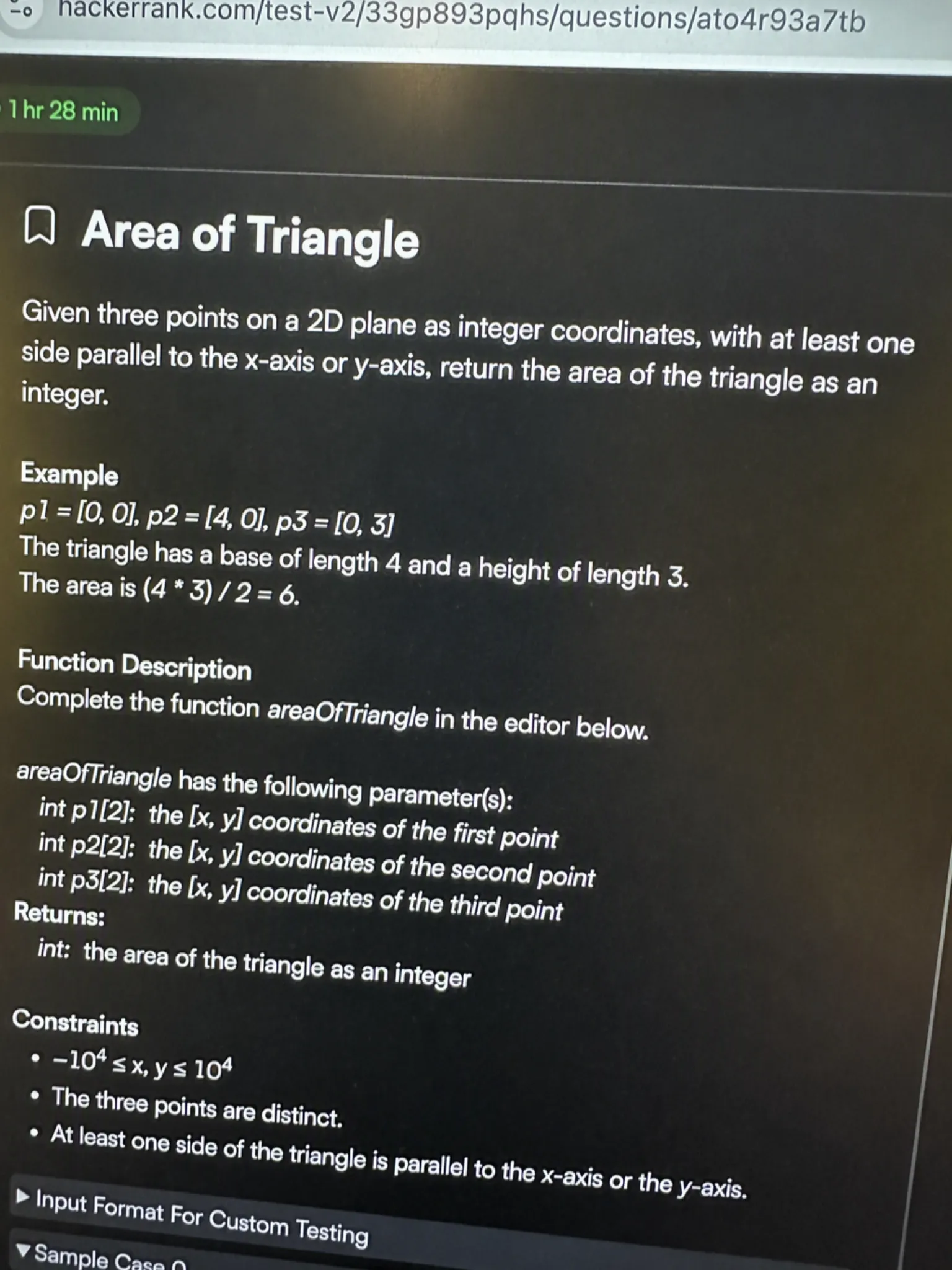
The problem I got: I was given three points on a 2D plane as integer coordinates, with a guarantee that at least one side of the triangle is parallel to the x axis or the y axis. I had to return the area as an integer.
My approach: My first instinct was to use the guarantee literally. I started writing case logic: compare y values to find a horizontal side, compare x values to find a vertical side, take that side as the base, then measure the perpendicular distance from the third point as the height. That is three comparisons for the horizontal case, three more for the vertical case, and a branch for the point that is left over. About four minutes in I had six branches on screen and no confidence in any of them. Then I looked at the guarantee again and understood what it was actually for. The axis-parallel side is not there to tell me how to compute the area, it is there to promise me that base times height is always even, so the answer divides cleanly by two and I never have to deal with a .5. Once I saw that, the shoelace formula replaced every branch with one line, and integer division was safe by construction.
import sys


def area_of_triangle(points):
    (x1, y1), (x2, y2), (x3, y3) = points
    twice_area = abs(x1 * (y2 - y3) + x2 * (y3 - y1) + x3 * (y1 - y2))
    return twice_area // 2


if __name__ == "__main__":
    values = list(map(int, sys.stdin.read().split()))
    coords = [(values[0], values[1]), (values[2], values[3]), (values[4], values[5])]
    print(area_of_triangle(coords))
Time complexity: O(1) | Space complexity: O(1)
Sample trace: The first sample gives x = [0, 3, 6] and y = [0, 3, 0]. By index, those arrays give the points (0, 0), (3, 3), and (6, 0). The formula produces |0 + 0 - 18| = 18, and integer division returns 9. The second sample gives x = [0, 1, 0] and y = [0, 0, 2]. That pair produces 2, so the area is 1. Both numbers match the expected output, so you can walk this problem on paper before you write a line.
I deleted the branch version and submitted the four line one, all test cases green, about nine minutes gone including the wasted case logic. The lesson I took into question two: read a constraint as a promise about the answer before treating it as an instruction about the method.
Question 2: Simple Cipher
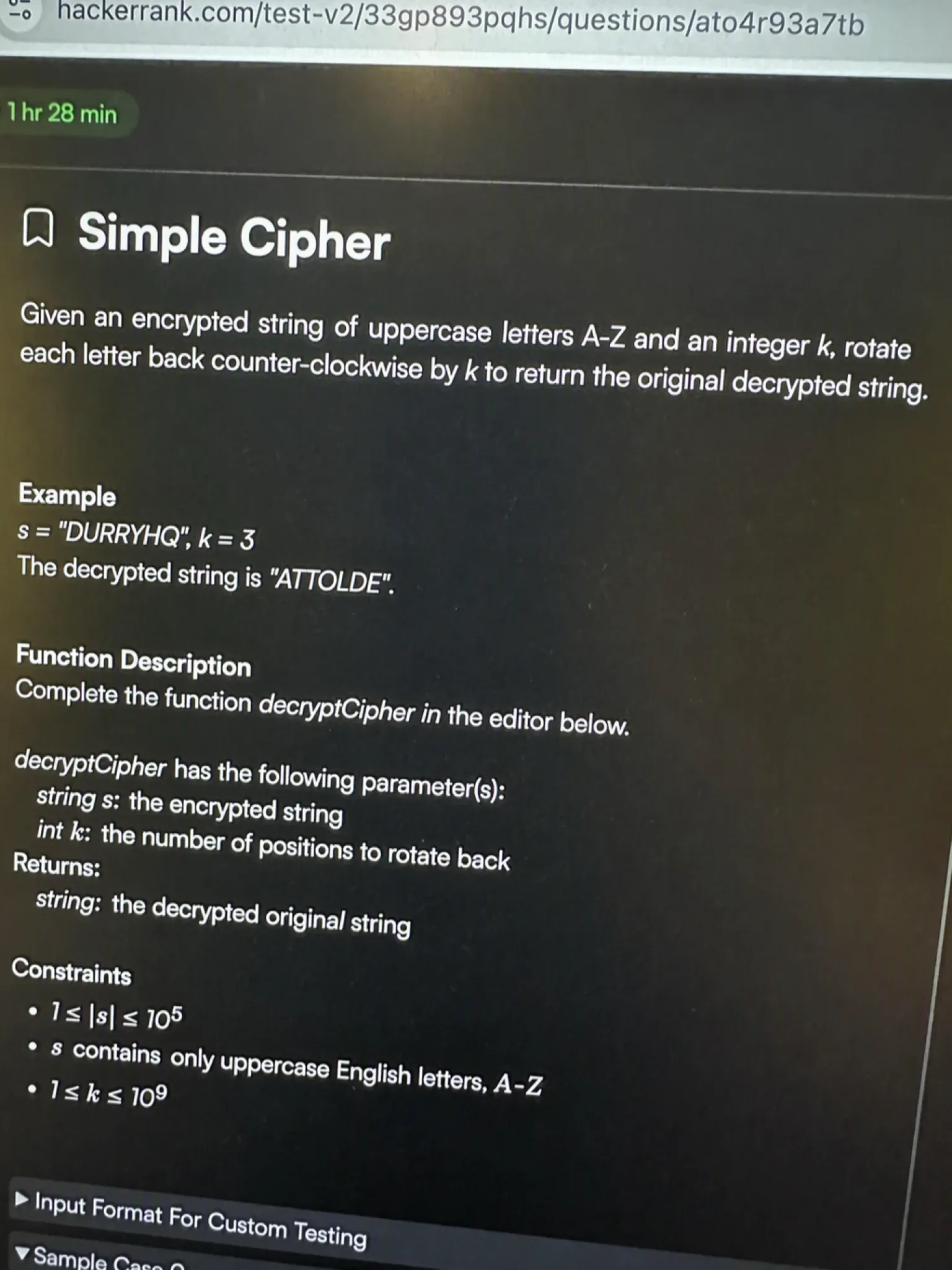
The problem I got: I was given an encrypted string of uppercase letters A to Z and an integer k. Each original letter had been rotated forward through the alphabet by k, and my job was to rotate it back, counter clockwise by k, and return the decrypted string.
My approach: This is a Caesar shift with the direction reversed, so the whole problem is one modular subtraction per character. I mapped each letter to 0..25 with ord(ch) - ord('A'), subtracted the shift, took mod 26 to wrap, and mapped back. I also reduced k with k % 26 first, because nothing in the problem stopped k from being larger than the alphabet. My mistake was the direction. I wrote the plus sign on the first pass, ran the sample, and got a string that was wrong by exactly k positions in the wrong direction. I had encrypted the input a second time instead of decrypting it. The fix was one character, but I only caught it because I checked a single letter against the sample by hand before running the full loop.
import sys


def simple_cipher(encrypted, k):
    shift = k % 26
    base = ord('A')
    decrypted = []
    for ch in encrypted:
        decrypted.append(chr((ord(ch) - base - shift) % 26 + base))
    return "".join(decrypted)


if __name__ == "__main__":
    tokens = sys.stdin.read().split()
    print(simple_cipher(tokens[0], int(tokens[1])))
Time complexity: O(n) | Space complexity: O(n)
Sample trace: The first sample decrypts CDEF with k = 2. Every letter moves two places counter clockwise, so C becomes A and D becomes B, which gives ABCD. The second sample decrypts DGEO with k = 3 and returns ADBL. Both pairs sit in the problem statement, so one letter of either case exposes a wrong sign immediately.
Twelve minutes on question two, most of it spent on that sign. Verifying one character against the sample before writing the loop is the cheapest check in the whole exam, and it is the only reason I did not burn a submission on a fully backwards string.
Question 3: Connected Groups
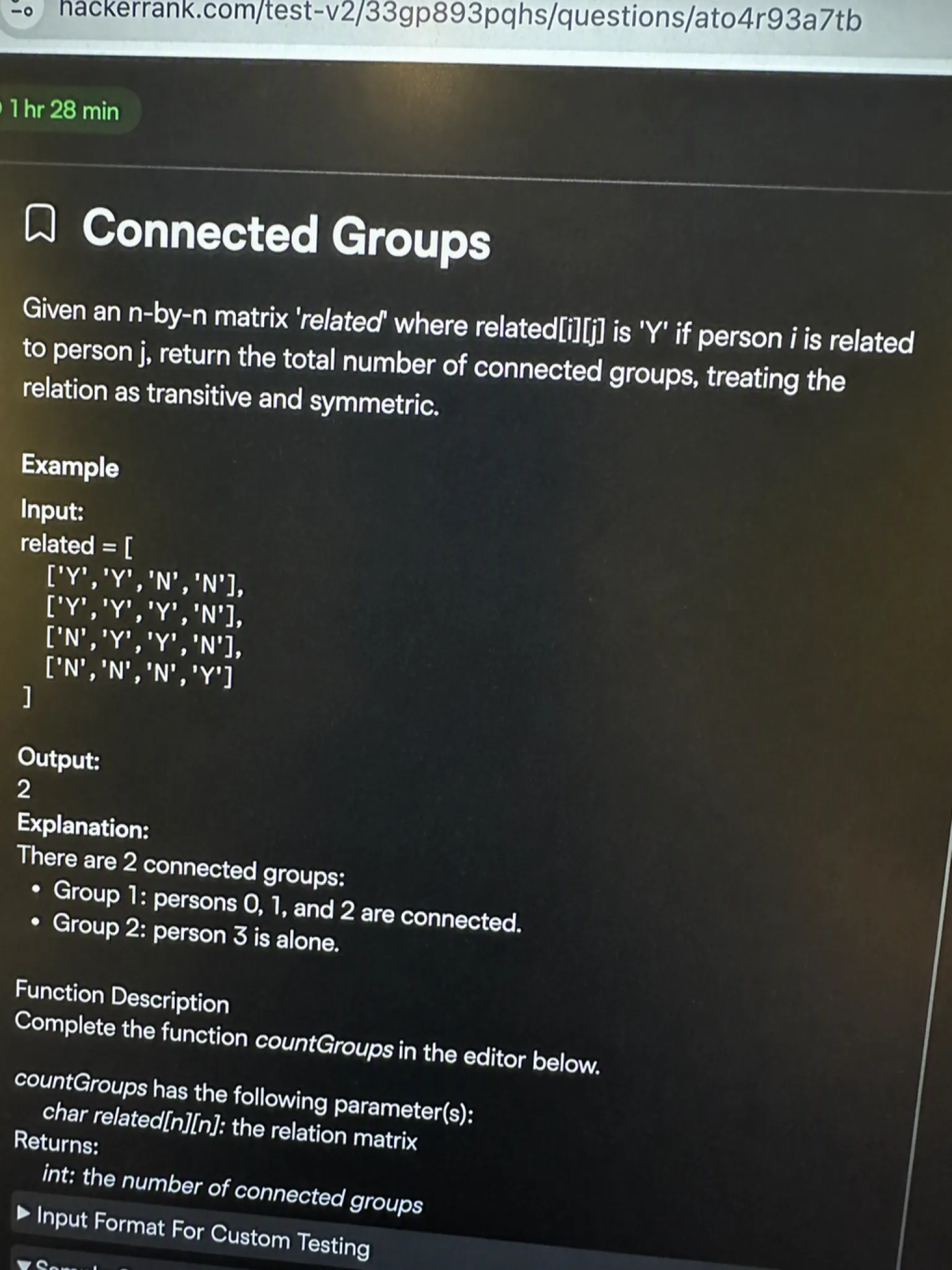
The problem I got: I was given an n by n matrix called related, where related[i][j] is Y if person i is directly related to person j and N otherwise. The relation is transitive, so if i is related to j and j is related to m, all three belong to the same group. I had to return how many groups exist in total.
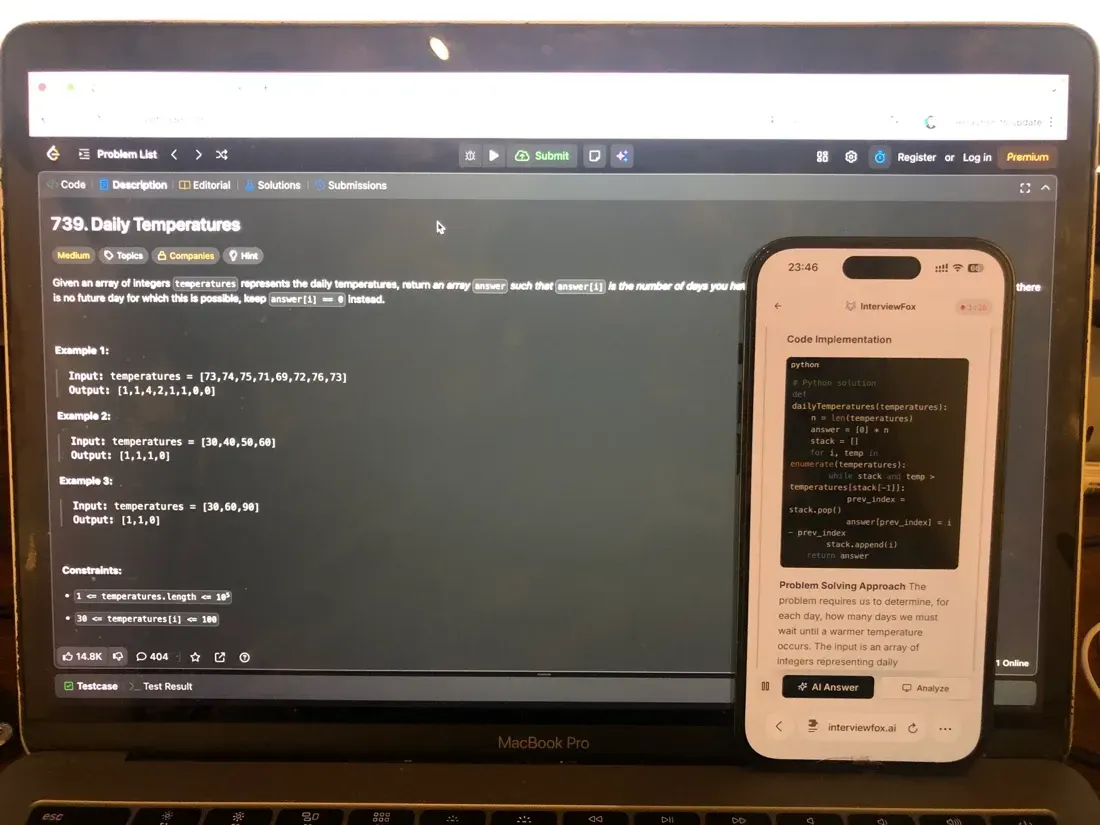
My approach: I misread it first. I treated the matrix as a directed structure and started building an explicit list of related pairs, planning to merge pairs into groups as I walked the list. That works eventually, but it is the long way around, and my merge logic kept producing duplicate groups on the sample. I had roughly forty minutes left on the clock and had already spent close to eight on a data structure I did not need. That was the point where I stopped typing and picked up my phone. I hit the InterviewFox capture shortcut, and the problem statement landed on my phone automatically. The approach came back in about thirty seconds: transitive plus symmetric means this is an undirected graph. The matrix is already the adjacency matrix, so counting groups is just counting connected components. Nothing to build, nothing to merge. From there it was a visited array and one traversal per unvisited node. I used an explicit stack instead of recursion. The constraints allowed n to run large enough that a recursive DFS would risk hitting Python's default recursion limit on a dense hidden case.
import sys


def count_groups(related):
    n = len(related)
    visited = [False] * n
    groups = 0
    for start in range(n):
        if visited[start]:
            continue
        groups += 1
        stack = [start]
        visited[start] = True
        while stack:
            node = stack.pop()
            row = related[node]
            for neighbor in range(n):
                if row[neighbor] == 'Y' and not visited[neighbor]:
                    visited[neighbor] = True
                    stack.append(neighbor)
    return groups


if __name__ == "__main__":
    tokens = sys.stdin.read().split()
    n = int(tokens[0])
    print(count_groups(tokens[1:1 + n]))
Time complexity: O(n^2), since every cell of the matrix is examined at most once | Space complexity: O(n) for the visited array and the stack
The traversal took eleven minutes to write and pass, and I submitted all three with time still on the clock. The eight minutes I lost were not lost on the algorithm, they were lost on naming the problem wrong, and that is the failure mode I now watch for first.
Land offer with Safer AI Interview Assistant
Skip the risky invisible apps. Our dual-device mode keeps it simple and undetectable. You crush the interview, we handle the answers.
Get started. It's freeLoved by 100,000+ candidates
Expedia's Proctoring Policy for HackerRank
Expedia's own prep page says nothing about webcams, screen capture, or monitoring. The honest answer starts one level down, at what HackerRank ships and what a company chooses to switch on.
Image Proctoring captures webcam snapshots.
HackerRank's Image Proctoring takes webcam photos at regular intervals during a test. Those photos land in the candidate's Summary Report for a reviewer to look through afterwards.
A natural question is what happens to them. How HackerRank uses webcam images during a test is worth knowing before you sit down.
That feature ships switched off unless a company enables it. My own SDE invite triggered no camera prompt and no permission request.
Secure Mode locks the window without a camera.
Secure Mode is the lighter setting, and it never uses the camera. HackerRank groups four controls under it.
Full-screen enforcement stops you from minimizing or resizing the test window. Tab-switch alerts warn you the moment you navigate away. A copy-paste restriction blocks external pasting.
A monitor check runs before the test and lets you continue only on a single display. Knowing the exact trigger helps you avoid an accidental flag. I learned what HackerRank counts as a tab-switch alert before my test.
Proctor Mode adds AI and copy-paste tracking.
Proctor Mode is the heavier configuration, available on tests created since the July 2025 release. It combines the webcam with screen sharing, forces full screen, and restricts the session to a single monitor.
With it on, AI monitoring watches tab switching, unauthorized software, and face anomalies. Session screenshots are stored, pasting into the editor is disabled, and AI Plagiarism plus Image Analysis run by default.
The part candidates ask about most is how all of that turns into a cheating verdict. I covered that on how HackerRank decides a submission looks like cheating.
One question the documentation left open was how much of the screen capture actually reaches. I also worked through what a proctored HackerRank session can and cannot see on screen.
Expedia has not confirmed proctoring on its OA.
The Expedia careers hub documents durations, languages, and the hiring journey. It stays silent on proctoring, and candidate reports diverge.
Some applicants describe a webcam plus screen recording. Others report screen-only monitoring, and a few say they saw no proctoring at all. The same spread shows up in r/csMajors threads from recent years.
The platform capability exists, and it is off unless someone turns it on. Expedia has not confirmed turning it on. The only safe assumption is to read your own invite. I prepared as though it were live.
3 Other Confirmed Expedia HackerRank Questions
My three problems were one draw from a much larger bank. Dated sets from 2025 and 2026 keep landing in the same handful of categories. The chart below shows where the confirmed problems cluster.
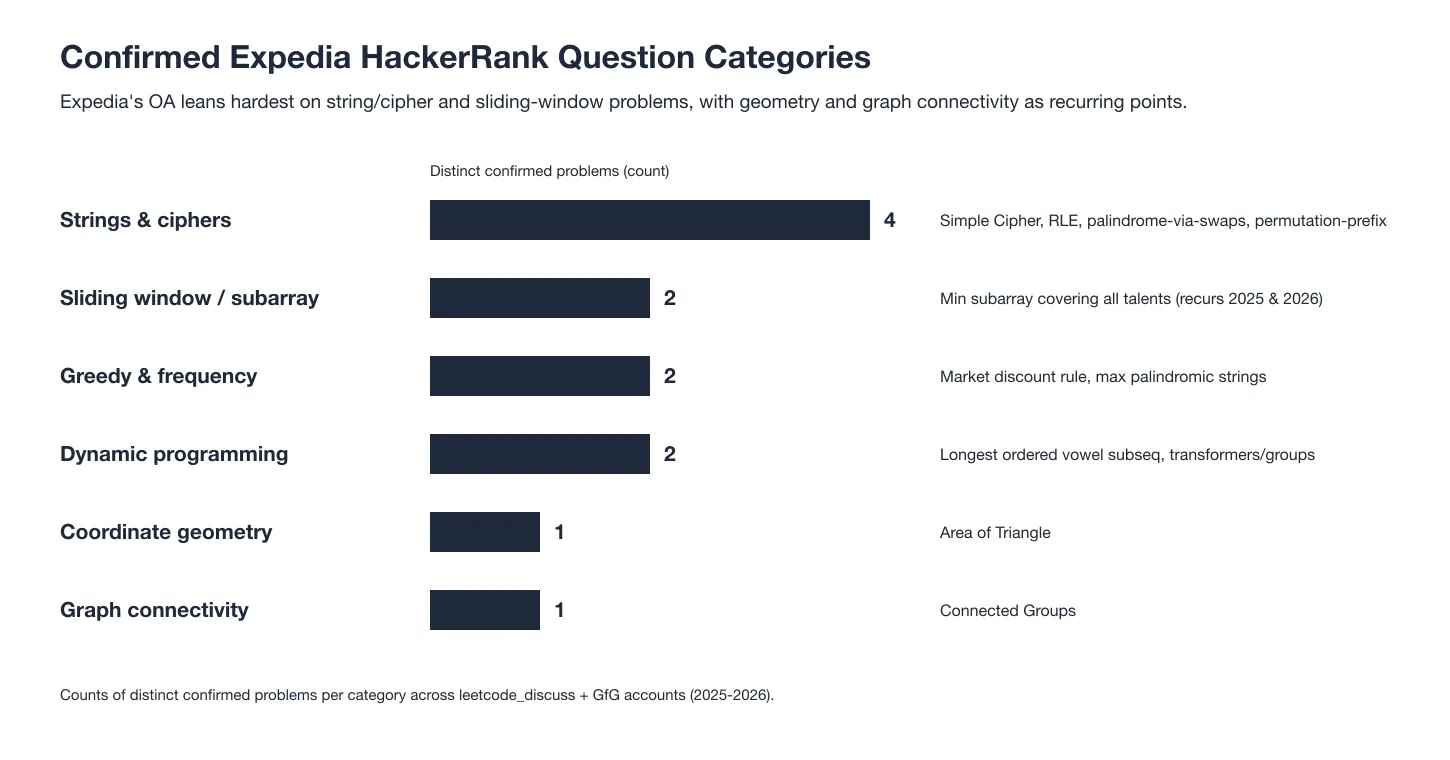
Three of those problems are documented in enough detail to solve here.
Minimum Subarray Covering All Talents
This one appeared in an August 2025 SWE II assessment. It came back in a March 2026 Software Engineer 2 set, the most reliable repeat in the pool. A row of students each hold one talent numbered 1 to talentCount. The task is to find the shortest contiguous run of students that covers every talent.
It is a standard sliding window with a frequency map. The window expands right until every talent is present, then contracts from the left while coverage holds.
def min_window_covering_all(talents, talent_count):
    counts = {}
    missing = talent_count
    left = 0
    best = 0
    for right, talent in enumerate(talents):
        counts[talent] = counts.get(talent, 0) + 1
        if counts[talent] == 1:
            missing -= 1
        while missing == 0:
            width = right - left + 1
            if best == 0 or width < best:
                best = width
            drop = talents[left]
            counts[drop] -= 1
            if counts[drop] == 0:
                missing += 1
            left += 1
    return best
Time complexity: O(n) | Space complexity: O(k) for k distinct talents
Market Discount Rule
From the same March 2026 Software Engineer 2 set: each item's price drops by the lowest price seen before it. A discounted price can never fall below zero. The first item has no prior price, so it stays as it is.
The whole problem is one running minimum. No sorting, no stack, and the zero floor is the part hidden test cases probe.
def discounted_prices(prices):
    result = []
    min_so_far = float("inf")
    for index, price in enumerate(prices):
        if index == 0:
            result.append(price)
        else:
            result.append(max(price - min_so_far, 0))
        min_so_far = min(min_so_far, price)
    return result
Time complexity: O(n) | Space complexity: O(n) for the output list
Maximum Palindromic Strings via Swaps
Also from March 2026: you get a list of strings and the freedom to swap characters between any of them. The task is to return how many of the strings can become palindromes at once. The solution is greedy over the global character frequency counts. A swap moves letters between strings without changing the global pool.
I am not going to publish code for this one. The reports preserve the shape and the greedy insight, but not the exact constraints. A solution written against guessed constraints would fail the hidden tests it matters on. My transferable takeaway is the reasoning: count characters across all strings, then spend odd-count letters on string centers.
What Expedia's HackerRank Test Format Actually Looks Like
The Expedia Group HackerRank OA has no single length, which is why the numbers online contradict each other so badly. Your clock is set by the track you applied to, as the chart below breaks down.
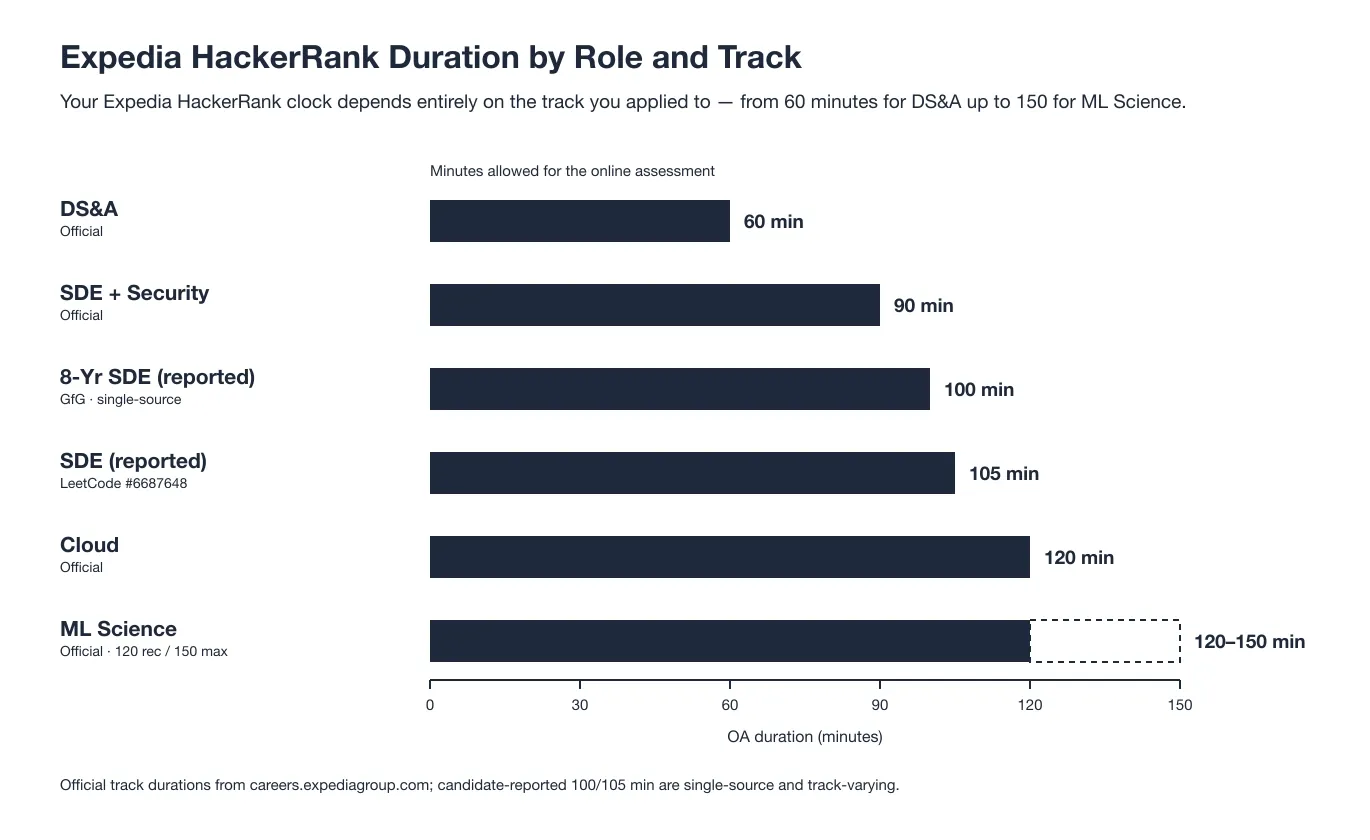
Duration and Question Count Vary by Role and Track
The durations Expedia publishes by track run from 60 minutes for DS&A up to 150 for ML Science. Most SDE and Security roles sit at 90.
My own SDE invite ran 105 minutes, and an eight year SDE reported 100. The number on your invite is the only one worth planning around.
One Sitting, Any Order, No Negative Marking
You have to finish the test in one go, so there is no pausing to think overnight. You can attempt the questions in any order, and skipping one carries no negative marking.
HackerRank accepts any language it supports, with C as the default template. Java submissions need a class named Solution reading from STDIN. The older SDE and Manager format bundled six MCQs with two coding problems into 60 minutes. An old writeup will not match the track you get today.
Coding-Only for Most SDE Tracks, MCQs on Some
Full-time SDE sets in the confirmed pool were three coding problems with no multiple choice at all. Intern rounds are the ones that mix formats.
One intern OA ran 2 coding problems plus 6 MCQs inside 90 minutes. Those MCQs covered OOP, algorithms, Java exceptions, and C++ or C# output prediction. Another intern set paired 2 coding problems with 5 MCQs on OOP and DBMS in 60 minutes.
What Other Candidates Actually Reported
My three problems were one draw from a wide pool. To see how far the experience diverges, I read r/csMajors threads from recent years. The posts are rarely full writeups, but the signal is steady.
The format shifts by role and cohort. New grad and intern reports split between a coding-plus-MCQ shape and a pure three-problem set. One intern got two coding problems and six multiple choice in sixty minutes. Another got three problems, one easy and two intermediate, ending on a sweep-line question.
A machine learning track ran six multiple choice and two coding questions in a Jupyter-style environment, with no proctoring. None matched my SDE set exactly. Your invite is built from the track you applied to, not one fixed test.
Difficulty is usually easy to medium, but a hard DP shows up. Most posters described array and DP questions at an easy or medium level. A meaningful share reported something harder: a LeetCode hard DP or a hard string problem. They called the mix random within the same cohort. Prepare for both ends.
Silence after the OA is the norm, not a red flag. The most repeated line across these threads is some version of "passed every test case, heard nothing back." One applicant brute-forced two hard problems in fifty minutes and still waited.
Another finished all questions and got no response for over a month. That silence tracks the scoring section: finishing is not the same as advancing, and batch review takes time.
How Expedia's HackerRank Scoring Works
Scoring Is Not Binary Completion
Expedia publishes no numeric cutoff, and HackerRank reports only hidden test case results against each problem. Nothing in the invite or the platform tells you what score moves you forward.
Completion by itself is clearly not the bar. One SWE II candidate solved all three problems in 30 minutes and heard nothing. A Not Selected status showed up on that portal later. Another candidate finished every question in about 45 minutes and got a rejection email.
The Hardest, Most-Weighted Problem Carries the Real Risk
Problems in these sets are not weighted equally, and the heaviest one usually sits last. An eight year SDE passed the first two problems at 100 percent of test cases. That candidate then failed the DP problem carrying the most weight, and Expedia rejected the application.
Two clean solves did not offset one weighted miss. That single data point changed how I allocated my own clock more than any other thing I read.
Expedia HackerRank Exam-Day Strategy
Give the Weighted Last Problem the Most Time
I treated the first two problems as points I had to bank quickly, not as work to savor. My rule going in was simple: get through them fast, then hand the remainder of the clock to the last problem.
That ordering exists because the last problem in these sets is repeatedly the DP or graph question with the most weight attached. Nine minutes on the triangle and twelve on the cipher bought me the room I needed later.
Don't Read "Finish All" as "Pass"
Finishing early feels like a result, and it is not one. Candidates have closed this OA in 30, 40, and 45 minutes and still been filtered out.
So I spent my leftover time on edge cases rather than on submitting sooner. I ran a manual pass over each one before moving on. Empty inputs, single element arrays, a price of zero, and a matrix where every person sits alone.
Mirror Proctored Constraints While Practicing
I ran my last few practice sets the way Proctor Mode would run them. Full screen, one monitor, no second window, and no pasting anything into the editor.
Typing every solution by hand changes your speed estimate more than people expect. If the real test turns out to be unproctored, nothing is lost; if it is proctored, none of it is a surprise.
Why Candidates Fail the Expedia HackerRank Assessment
The most common failure here is not an unsolved problem. It is a full solve that goes nowhere, as the outcomes below show.
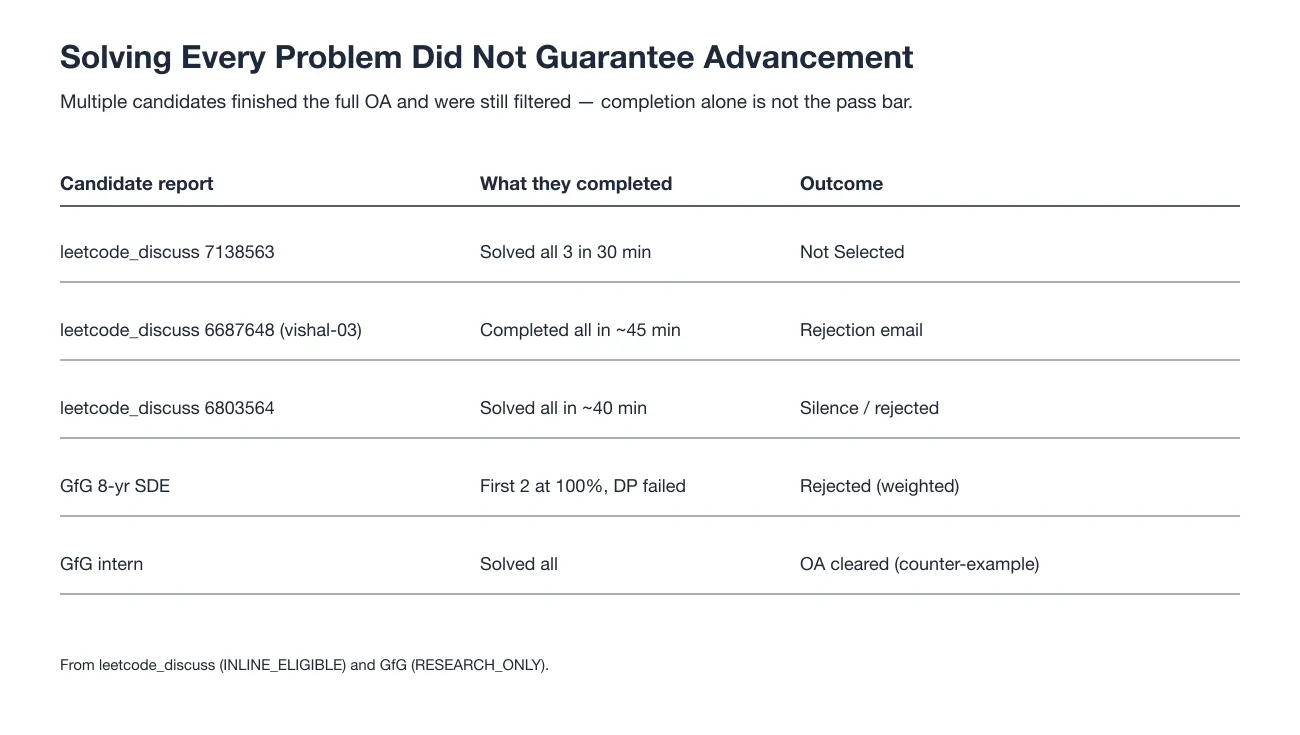
Solved Every Problem and Still Got Rejected
Three separate accounts finished the whole set and did not advance. The 30 minute full solve turned into a Not Selected status. A 45 minute full solve turned into a rejection email, and a 40 minute full solve turned into silence.
One of those candidates asked openly whether years of experience was the reason. That reading fits the evidence better than a technical failure does, since the code passed. Cohort ranking and role fit decide the rest.
Partial Credit on the Weighted Problem Wasn't Enough
Partial credit is real on this platform, and it does not rescue a weighted miss. The eight year SDE who cleared two problems at full marks still lost the seat on the DP question.
I read that as a scoring shape, not bad luck. Points concentrate in the hardest problem, so a clean finish on the easy two is the floor, not the achievement.
AI-Tool Detection Is a Real Risk, Not Just Structural
No Expedia candidate has publicly posted about being caught using an AI tool on this OA. The exposure is still real: Proctor Mode logs unauthorized software, stores session screenshots, and scores submissions for AI plagiarism.
HackerRank blocks pasting into the editor and records the attempt. I traced how a paste attempt gets logged and surfaced to the employer on a separate page.
One Candidate's Overlay Got the Score Voided
One candidate kept a borderless answer window on the desktop at low opacity during a March 2026 Expedia HackerRank. With 23 minutes left, a macOS notification briefly pulled the supposedly invisible panel above the code editor. The assessment kept running with no on-screen warning, so nothing looked wrong at the time.
Three days later an integrity-review email said the score had been voided, and the recruiter canceled a scheduled final-round interview instead of offering a retake. The tool stayed hidden through the whole session, which is exactly why the trap is so easy to walk into.
A desktop overlay renders the answer on the same screen the session is watching. The hiding happens at the OS rendering layer, which is a basic trick, and monitoring keeps adding capability as these tools spread.
InterviewFox works differently as a dual device AI interview assistant, so the answer arrives on my phone. That is a physically separate device, outside anything a screenshot or session recording can reach by design.
Land offer with Safer AI Interview Assistant
Skip the risky invisible apps. Our dual-device mode keeps it simple and undetectable. You crush the interview, we handle the answers.
Get started. It's freeLoved by 100,000+ candidates
How to Prepare for the Expedia HackerRank in 7 Days
Seven days is enough here because the confirmed question pool is unusually narrow. The plan below spends each day on a category that has actually appeared.
I did not build the schedule from scratch either. I sent the confirmed Expedia question patterns to the InterviewFox Prep Agent over WhatsApp. It came back with a day-by-day drill list and a time allocation weighted toward the last problem. That is the skeleton the seven days below follow.
Days 1-2: Lock Coordinate Geometry and Cipher Basics
Area of Triangle and Simple Cipher were two of my three problems. Strings and ciphers are the largest confirmed category in the pool. I drilled area from coordinates with an axis-parallel side and counter clockwise Caesar decryption. Palindrome construction through swaps and run-length encoding came next.
I skipped broad system design and general LeetCode tag grinding entirely. The confirmed Expedia pool is four categories wide: geometry, strings, graphs, and sliding window. So 2000 mixed problems would have bought me almost nothing.
My success check was a timer. An Area of Triangle variant solved in under 5 minutes, and any string problem in the set finished in under 20.
Days 3-5: Drill Graph Connectivity and Sliding Windows
Connected Groups and the minimum subarray covering all talents are the two recurring mid-difficulty problems here. The subarray one shows up across both 2025 and 2026 sets. I implemented connected component counting with an explicit stack, then the talent coverage window with a running frequency map.
I wrote both from scratch each day rather than rereading old solutions. The check was a 25 minute timer per problem with all edge cases passing, not a feeling of familiarity.
Days 6-7: Three-Problem Mock Under Proctor Constraints
The last two days went to full three-problem mocks under the constraints Proctor Mode imposes. Full screen, one monitor, nothing pasted, everything typed. I built each mock from one easy problem and two mediums to match the confirmed shape.
Inside the mock I gave the hardest problem the largest block of time, because that is where the weighting sits. I forced the hidden cases myself as well. Large n, a price of zero, and a single talent covering the whole row.
The check was specific: finish the hardest problem with full edge case coverage before the clock ran out. Finishing all three fast did not count as a pass, since that outcome has already failed plenty of real candidates.
What Happens After You Submit the OA
Top Candidates Move to Two Virtual Final Interviews
Strong OA results lead to two virtual interviews, one technical and one behavioral. Your application stays active in the meantime, until Expedia either moves it forward or notifies you.
There is no separate phone screen documented between the OA and those interviews. The coding test is the filter that decides whether the loop happens at all.
Silence Can Mean Cohort Ranking, Not a Technical Fail
Response times stretch. One new grad I tracked posted a full timeline. They applied September 23 and finished the strengths assessment that same day. The HackerRank came on September 26, a recruiter message on September 28, and an offer on October 13.
From OA to interview, reports range from one day to about nine business days. Another candidate heard from a recruiter more than a month after finishing the OA. Someone else sat in silence before the portal flipped to Not Selected.
A long gap says more about batch review than about your code. I kept every other application moving during that window, and I would do the same again.
Expedia's Cappfinity Test Comes Before the HackerRank OA
Round 1 Is a 45-60 Minute Cappfinity Strengths Assessment
The coding test is not the first round. Expedia's journey runs application, then a Cappfinity strengths-based assessment, and only then the HackerRank OA.
That assessment takes 45 to 60 minutes and reads as situational judgment rather than aptitude testing. It probes traits Expedia recruits for, including curiosity, inclusion, and agility.
Most Candidates Pass but It Still Gates the OA
Pass rates on this round appear high, and most students in one 2025 intern cohort cleared it. It is still a gate, and no amount of DSA preparation moves you past it.
I gave it one evening of thought instead of one hour of panic. Reading the trait list and having two concrete work examples ready for each was enough.
FAQ
Is the Expedia HackerRank test proctored?
HackerRank ships Image Proctoring disabled by default, and Expedia has not publicly confirmed switching it on. My own SDE test triggered no webcam prompt. Other candidates in r/csMajors report camera plus screen, so do not assume your invite matches mine. So practice in full screen, on one monitor, with nothing pasted, which costs you nothing either way.
What questions are on the Expedia HackerRank test?
The confirmed pool is narrow. Area of Triangle, Simple Cipher, and Connected Groups made up my own three problem set. Other dated sets include the minimum subarray covering all talents, a market discount rule, and maximum palindromic strings via swaps. Strings and ciphers, sliding window, graph connectivity, and coordinate geometry cover nearly all of it.
How long is the Expedia HackerRank test?
It depends entirely on the track. DS&A runs 60 minutes, SDE and Security Engineering 90, Cloud 120, and ML Science 120 with a 150 maximum. Candidate reports of 100 and 105 minutes come from specific SDE invites. The duration printed on your own invite is the only reliable number.
What does Reddit say about the Expedia HackerRank OA?
I read through a dozen r/csMajors threads from recent years. Most are not full problem writeups, but the signal is steady across posters. The format and the proctoring both shift by cohort. The line "passed every test case, heard nothing back" comes up again and again.
This guide pulls the actual question wording from dated LeetCode Discuss posts. The Reddit threads are what told me how widely the experience diverges from one applicant to the next.
Can I paste code from my IDE into HackerRank?
On a plain test, pasting works. Secure Mode and Proctor Mode both block external pasting, so that route can close depending on how the company configured your test.
A quieter risk sits underneath it. Your local harness reads input differently from the platform template, and pasted Python can arrive with broken indentation. I wrote directly in the HackerRank editor for that reason, not only because pasting is sometimes blocked.
Can I use an AI tool or invisible app during the Expedia HackerRank OA?
Desktop overlay tools stay on the watched screen. A physically separate device keeps the answer outside that screen. That single difference decides your exposure. Overlays render a hidden layer above the browser, which is a basic OS-layer trick. HackerRank keeps adding detection capability as these tools spread, so the exposure is not fixed.
InterviewFox pushes the answer to your phone instead. That is a physically separate device, outside what any screenshot, screen recording, or session monitoring can reach by design. The laptop screen stays on the exam editor. If AI assistance is part of your OA at all, the dual-device setup keeps the answer off the watched screen.
Land offer with Safer AI Interview Assistant
Skip the risky invisible apps. Our dual-device mode keeps it simple and undetectable. You crush the interview, we handle the answers.
Get started. It's freeLoved by 100,000+ candidates