
I Aced Marshall Wace Codility in 2026: Real Questions and Prep

Quick Facts
| Assessment | Marshall Wace Codility is Step One for Technology Early Careers |
| Format | Online Codility programming assessment |
| Named areas | General coding aptitude, error handling, and sequence processing |
| Invitation | Sent directly by Codility; candidates may begin within the invitation window |
| Completion window | 7 days for the current Technology process |
| Language rules | Some questions allow language choice; others require a specified language |
| Adjustments | Request before starting the assessment |
| Question types | Community reports sequence processing, SQL, sliding window, JSON, and debug tasks |
| Scoring | No Marshall Wace score, cutoff, or pass threshold is verified |
| Proctoring | Invitation-specific camera, screen, audio, tab, copy/paste, and device settings are not confirmed |
I aced the Marshall Wace Codility assessment for the 2026 Technology Early Careers process. I am an early-career software engineer, and I applied to several companies at once.
During the test, I used a dual device live AI interview assistant. The answer stayed on my phone, so the laptop screen stayed clean for any monitoring.
Before drafting this guide, I reviewed Marshall Wace Codility posts from the past two years on Reddit, LeetCode Discuss, and TeamBlind. A peer's October 2025 internship-cycle assessment lost focus at final submission and was later invalidated, which is why I focus on integrity signals and role drift.
The Real Questions on My Marshall Wace Codility Test
My 2026 Technology Early Careers Codility assessment opened with real, named tasks. The 1point3acres community reports on Marshall Wace OA confirm the same shape: a sequence task, a SQL data-processing task, and a sliding-window task. I will walk through the three I saw.
Question 1: The Sequence Problem — Longest Alternating Slope
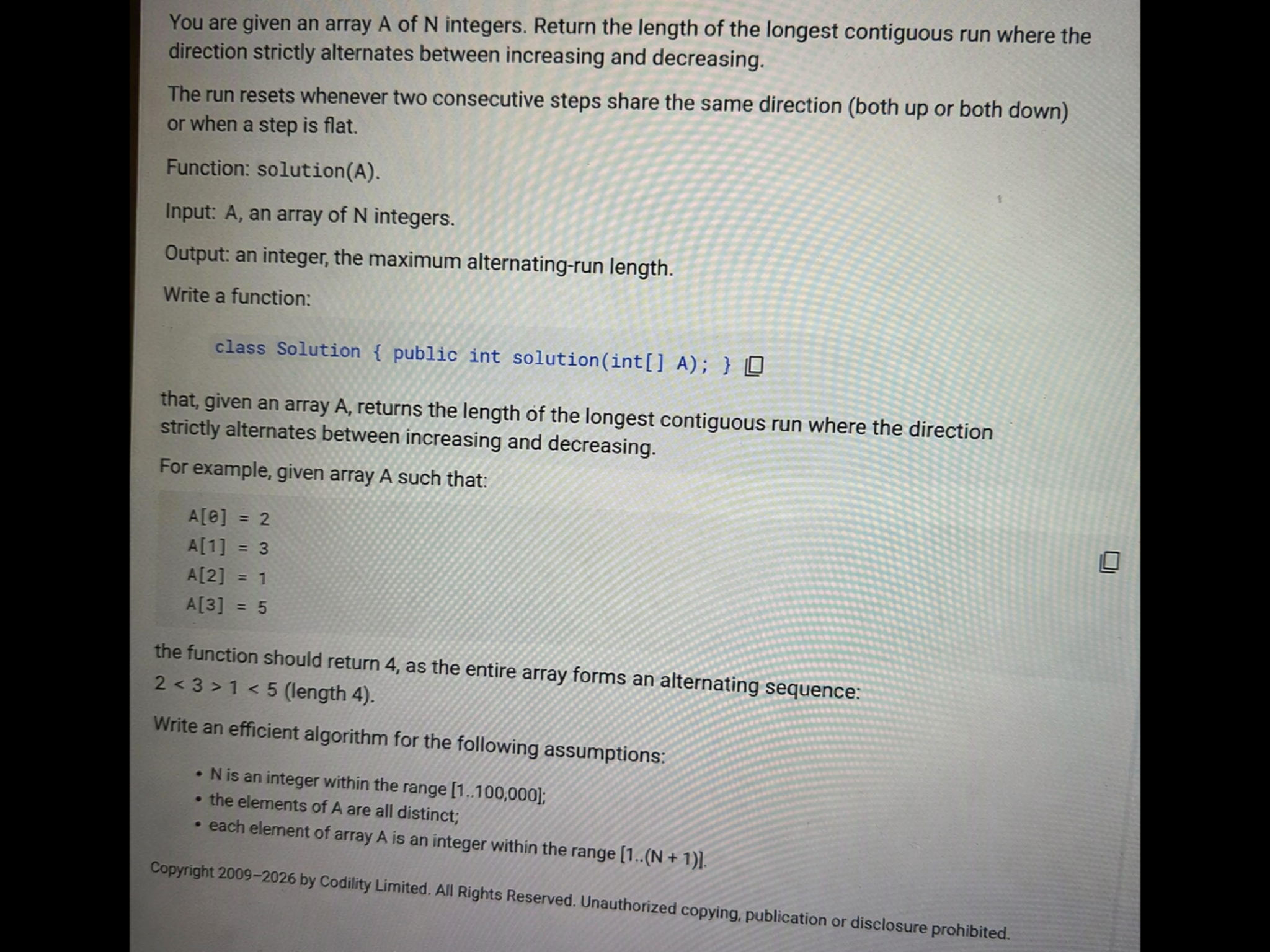
Sequence processing opened the assessment. It matched the "frog jump" pattern Marshall Wace candidates share on 1point3acres. I read an integer array and returned the longest alternating uphill-and-downhill run. A single O(n) pass resets its counters whenever the slope changes direction.
Question 2: The SQL Task — Login Success Across Countries
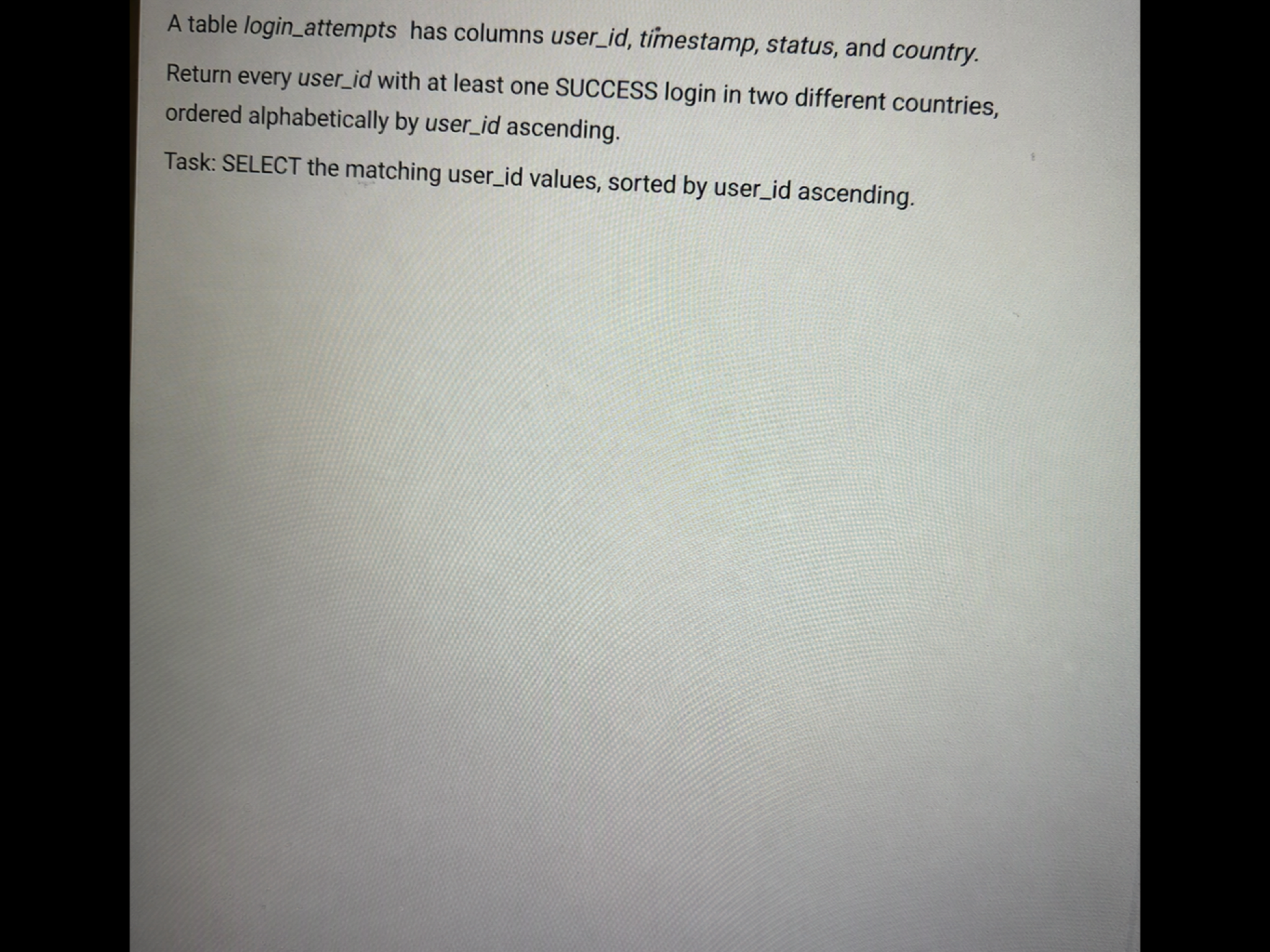
A SQL data-processing question came next. I received a login_attempts table with user_id, timestamp, status, and country. I returned every user_id with at least one SUCCESS login in two different countries, ordered alphabetically. A GROUP BY user_id with HAVING COUNT(DISTINCT country) >= 2 solved it cleanly.
Question 3: The Sliding-Window Problem — Most Events in 60 Seconds
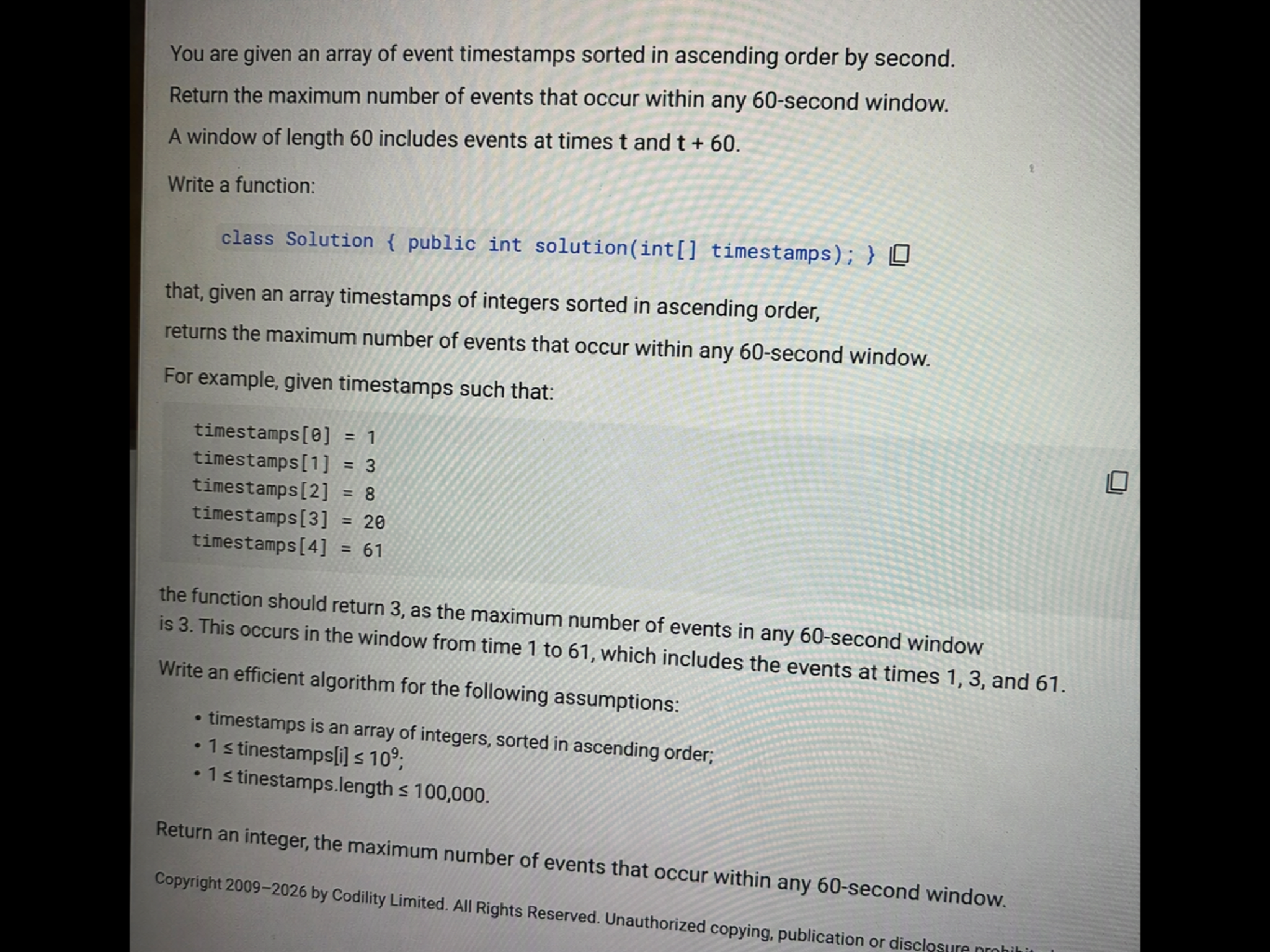
The third task was a sliding-window question from the same community reports. Given event timestamps sorted by second, I returned the most events inside any 60-second window. A two-pointer scan over the sorted list tracked the window in O(n) time. The shared sample peaks at seven events in any 60-second span. That sample is [1, 10, 20, 30, 40, 50, 60, 70, 80, 90, 100].
These three tasks line up with the confirmed material's named areas. In short, they cover general coding aptitude, error handling, and sequence processing. Other candidates also report a JSON-processing task and a debug task in an unfamiliar language, which the assessment can include.
Keeping the Screen Clean During the Test
I did not want a desktop overlay. Instead, the answer would sit on the same screen that active Codility monitoring can inspect. A basic rendering layer would hide it, but I did not trust what the detection setup might catch.
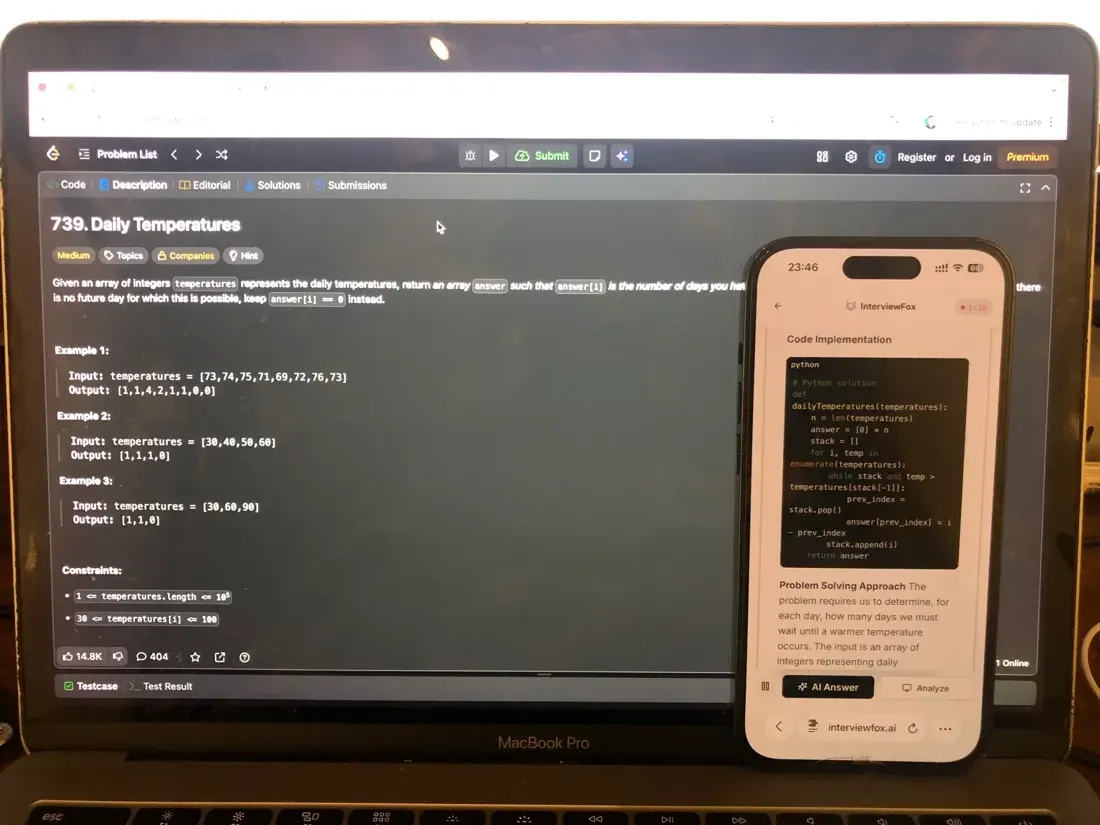
When I needed to clarify an approach, I used InterviewFox's dual device AI interview assistant. A keyboard shortcut captured the screen and pushed the answer to my phone. The phone is a separate device, outside the platform's screenshot monitoring.
It never pointed at the screen. Meanwhile, the laptop stayed on the exam editor while the approach became clear.
Land offer with Safer AI Interview Assistant
Skip the risky invisible apps. Our dual-device mode keeps it simple and undetectable. You crush the interview, we handle the answers.
Get started. It's freeLoved by 100,000+ candidates
Marshall Wace's Proctoring Policy for Codility
I cannot state that Marshall Wace enables camera, screen, audio, tab, copy/paste, or device monitoring for every invitation. The current Technology process confirms Codility as the platform. Yet it does not publish the settings for a specific invitation.
The setup screen is the controlling evidence for that test. I read a camera request, recording notice, permission prompt, or device-app requirement as a test-specific setting. The camera question is narrow. Codility's webcam snapshot scope explains the platform's capture, not whether this invitation requests it.
At platform level, Codility can log many signals. These include tab switches, copy and paste, fast completion, task-description copying, webcam snapshots, and screen or audio recording. These capabilities do not prove that every signal is active here.
A logged action is not a verdict. Codility's paste-event rules separate a logged action from later employer review. A paste or focus event is a record of behavior, not a Marshall Wace decision.
Device Integrity for Screen is separate from recording. On supported macOS or Windows devices, the Codility App can find known cheating tools. It does not record the screen or watch keystrokes. Codility's screen-capture options set the mechanisms apart.
The focus question is what an event reveals. Codility's tab-switching explanation separates leaving the assessment tab from recording the other tab. I keep that distinction, because the Marshall Wace invitation's exact controls are not public.
Invitation Settings Are Not Publicly Confirmed
The current Technology invitation does not say whether it requests a webcam, microphone, screen capture, or device-integrity check. It also does not settle whether copy and paste or tab switching is logged.
I check the invitation and the pre-start flow before treating any setting as active. A permission or install request describes the assessment in front of me. A general Codility page describes what the platform can support, not what Marshall Wace enabled.
Codility Can Log Focus and Copy Signals
These are configurable events. Furthermore, I read a focus change, paste, or device-integrity prompt against the invitation's displayed controls.
I treat each event as context, not proof of misconduct. The hiring team can review the event with the rest of the candidate report. The available evidence does not show that Marshall Wace uses every listed signal.
Moreover, Codility's candidate report can show an imported external source in the Timeline. I treat that as a platform activity record. It is not evidence of a Marshall Wace monitoring rule or company-specific outcome.
One Flag Is Not Proof of Cheating
Codility's boundary is clear. A single fraud-detection flag is not proof of cheating. The Codility fraud-detection policy puts that signal into review, not an automatic result.
The larger question is how signals combine. Codility's full detection and review model follows that path from event logging to human review. I do not turn the platform boundary into a company-specific promise.
What Marshall Wace's Codility Test Format Looks Like
For Technology Early Careers, the current application process places an online Codility programming assessment at Step One. It gives candidates seven days to complete it. The invitation comes directly from Codility.
Technology Candidates Get Seven Days
The current Technology process lets the assessment begin within the invitation window. It requires completion within seven days. Additionally, adjustments must be requested before the assessment starts.
I treat those seven days as a completion window, not a seven-day timer. The invitation's deadline and setup instructions decide the exact start and submission.
Three Coding Areas Are Named
Specifically, the current Technology assessment covers three areas. They are general coding aptitude, error handling, and sequence processing. Some questions allow a language choice. Others require a specified language.
I use those labels as the strongest confirmed preparation targets. They describe assessment areas, not three confirmed questions. Likewise, they do not set how many tasks appear in one invitation.
Quant Reports Do Not Set This Format
By contrast, the current Quant Associate process describes a 2-hour in-person Pearson exam. It covers core maths and logical reasoning. An 80-minute Codility coding test appeared in a dated 2026 Quant applicant account.
I keep those records separate from the current Technology Codility process. Role, cycle, invitation, and instructions decide which format applies. The older 80-minute setup cannot supply a current Technology timer or question count.
How Marshall Wace's Codility Scoring Works
However, I could not verify a Marshall Wace score, cutoff, pass threshold, or score-result pair. A partial percentage cannot be a known pass bar. It cannot predict the next stage.
No Marshall Wace Cutoff Is Verified
Still, no company-specific numeric cutoff is confirmed. I do not assign a percentage, score band, or rejection threshold to this assessment.
The absence of a verified cutoff limits what any generic Codility result implies. The platform can show performance. Therefore, it does not reveal Marshall Wace's private decision rule.
Correctness and Performance Are Separate
To be clear, Codility separates correctness from performance. Correctness uses test cases. Performance uses large datasets and time complexity. A solution can pass visible cases yet show a performance weakness on larger inputs.
For practice, I review both dimensions. I write time and space complexity before coding. Then I test the boundary cases that could expose a slow approach. This is a preparation method, not a claim about a Marshall Wace formula.
Why Candidates Fail Marshall Wace's Codility Assessment
I aced the assessment, but I still see two evidence-backed risks. The first is a peer's overlay case below. The second is role and cycle drift, which can send preparation toward the wrong format.
A Transparent Overlay Ended in Invalidation
Private evidence, no public source.
A candidate I know used a transparent AI answer overlay in their October 2025 internship-cycle assessment. They saw no issue at first. During the final submission check, the test window lost focus repeatedly. Then it showed an unusual-activity notice. They were allowed to close the app, but the session was still flagged and later invalidated.
Land offer with Safer AI Interview Assistant
Skip the risky invisible apps. Our dual-device mode keeps it simple and undetectable. You crush the interview, we handle the answers.
Get started. It's freeLoved by 100,000+ candidates
This case is specific and private. I do not attach a public URL. Nor do I claim that every Marshall Wace invitation uses the same detection controls. It is also not a route for evading monitoring.
Role Drift Can Produce the Wrong Playbook
The current Technology process uses Codility. The current Quant Associate process uses Pearson. A dated applicant's experience used a different Quant Codility setup. These records are not one universal Marshall Wace assessment.
I confirm the role, cycle, platform, deadline, language rules, and setup screen before choosing a plan. That check stops an older Quant report from becoming a false Technology assumption.
Platform Flags Need Context
Codility documents configurable signals. The Marshall Wace invitation settings remain unknown. A single flag is not proof of cheating. A platform capability is not a company-specific verdict.
I keep three things separate: an integrity event, a candidate report, and a hiring decision. That separation matters more than guessing which optional controls were enabled.
How to Prepare for Marshall Wace Codility in 5 Days
I built this five-day plan from the confirmed seven-day Technology window. I kept two days for final review, submission, or technical problems. It is a reasoned plan from the named areas, not a claim that a candidate followed it.
During the days before the OA, I used InterviewFox's Prep Agent through WhatsApp and SMS. I sent it the confirmed Marshall Wace question patterns: general coding aptitude, error handling, and sequence processing. It returned a personalized drill plan and strategy. It fit alongside the coding drills, not in place of them.
Days 1-2: Error Handling and Sequence Processing
I start with one error-handling task and one sequence-processing task. Those are the only named technical areas beyond general coding aptitude. Moreover, I include boundary cases and explain each failure instead of copying a pattern.
My check is concrete. I finish one task from each category. Then I explain the failure cases. Neither task needs a memorized template. However, I did not spend time on system design or an unverified SQL-only track. The current Technology assessment names coding aptitude, error handling, and sequence processing, not those sections.
Days 3-4: Language Constraints and Performance
I rehearse one prompt with a specified language and one large-input review. Before coding, I state time and space complexity. Only then do I test whether the approach still works when the input grows.
My success check is two timed drills. One respects a language constraint. One includes an explicit large-input complexity review. The target stays tied to the confirmed language rule and Codility's correctness versus performance split, not a generic practice score.
Day 5: Timed Run With a Two-Day Buffer
I run one Codility-style timed session on the intended device and language setup. I finish the practice run early enough to reread the prompt, test edge cases, and submit deliberately. After that, I keep the final two days before the real deadline for review or technical problems.
The seven-day window makes this buffer possible. It does not reveal the invitation's exact timer or integrity controls. I request any needed adjustment before starting. I use the assessment's own setup screen as the final source of truth.
What Happens After You Submit the OA
For the current Technology process, strong performance can lead to a 15-minute Zoom recruitment screening. Feedback is expected within one working week. I treat both as a role-specific signal, not a guaranteed result for every assessment.
Strong Performance Can Lead to a 15-Minute Zoom Screen
The current Technology process names a 15-minute Zoom recruitment screening as a possible next step. The wording leaves the step conditional. I do not present it as automatic progression. After I aced the assessment, this screening is the step I prepared for.
Feedback Is Expected Within One Working Week
The current Technology process sets an expectation of feedback within one working week. I use that as a process target. It is not proof that silence means rejection, or that every role follows the same timing.
Recruiter Calls Are Reported as Behavioral
The recruiter call in one dated account was a standard behavioral conversation. It focused on why Marshall Wace and resume experience. It included no technical questions beyond those skills. Instead, I keep that detail anecdotal and role-specific, not a guaranteed next round.
FAQ
Does Marshall Wace use Codility for Technology roles and Pearson for Quant roles?
Yes. The current Technology Early Careers process uses Codility at Step One. In contrast, the current Quant Associate process describes a 2-hour in-person Pearson exam. A dated 80-minute Quant Codility test is a separate historical configuration, not a universal rule.
How long do I have to complete the Marshall Wace Codility assessment?
The current Technology invitation gives a seven-day completion window. That invitation comes directly from Codility. Candidates may begin within that window. Also, adjustments must be requested before starting.
What happens after a strong Marshall Wace Codility assessment?
Strong performance can lead to a 15-minute Zoom recruitment screening in the current Technology process. Feedback is expected within one working week. Neither point is a guaranteed outcome for every role or cycle.
Can an overlay trigger an integrity review on a Marshall Wace Codility test?
Private evidence, no public source. Yes. The peer case above shows that an overlay can be followed by an unusual-activity flag and later invalidation. It does not establish a universal company rule.
Codility states that a single fraud-detection flag is not proof of cheating. The specific Marshall Wace invitation settings remain unknown. This case does not establish a universal company rule.
Can I use an AI tool or invisible app during the Marshall Wace Codility OA?
I would not use an overlay or invisible app during the OA. The specific Marshall Wace invitation settings remain unknown. Codility states that a single fraud-detection flag is not proof of cheating.
Land offer with Safer AI Interview Assistant
Skip the risky invisible apps. Our dual-device mode keeps it simple and undetectable. You crush the interview, we handle the answers.
Get started. It's freeLoved by 100,000+ candidates