
I Aced Rakuten Codility Test Questions in 2026: Real Questions

Quick Facts
| What it tests | Rakuten Codility test questions cover two timed coding problems for the software engineer track, one easy and one medium |
| Platform | Codility, Rakuten's assessment provider |
| Scoring | Correctness and runtime performance are both scored; a slow-but-correct answer can still fail |
| Score visibility | Not shown to the candidate; a recruiter relays a pass or fail decision |
| Passing bar | Not published by Rakuten |
| Proctoring | Configured per test and disabled by default; webcam and screen capture are optional add-ons |
| Invite window | No published expiry; treat the link as time-bound |
| Year covered | 2026 |
I sat the Rakuten Codility test questions for a software engineer role in the summer of 2026, working through two timed coding problems on Codility's assessment platform. I passed the first one cleanly, struggled with the second, and heard back from a recruiter about a week later. What follows is the complete process and how I prepared for it.
On the second problem, a base -2 array conversion, my solution passed every sample case but timed out near the 100,000-element cap. Performance tests kept failing with fifteen minutes left. I hit a keyboard shortcut, and the failing case reached the dual device AI interview helper on my phone. The missing approach became clear within a minute, a moment I unpack further down.
Before my test, I went through every Rakuten Codility post from the past two years on Reddit, LeetCode Discuss, and Teamblind. What I found tracks closely with what I experienced. Two traps stood out. An invisible AI tool that gets flagged mid-test can lock the workspace. A correct answer can still fail if it isn't fast enough.
The Rakuten Codility Questions I Actually Got
The Rakuten Codility test questions I got were the same two problems that keep showing up in confirmed candidate reports. They were a bitwise XOR range problem and a base -2 array conversion. My own test matched both exactly. My track was software engineer, with no separate system design or SQL section.
In a 2019 fresh-grad software engineer interview report from Singapore, the Codility test came as "two questions: one easy and one medium difficulty." My own test matched this format exactly, question for question and difficulty for difficulty.
The test opened with a language picker: C#, PHP, Java, JavaScript, or Python. I picked Python since that's what I'd drilled the most. Two problems were already queued in an easy-then-medium order.
Here's exactly what I got, problem by problem.
Question 1: Bitwise XOR of a Range
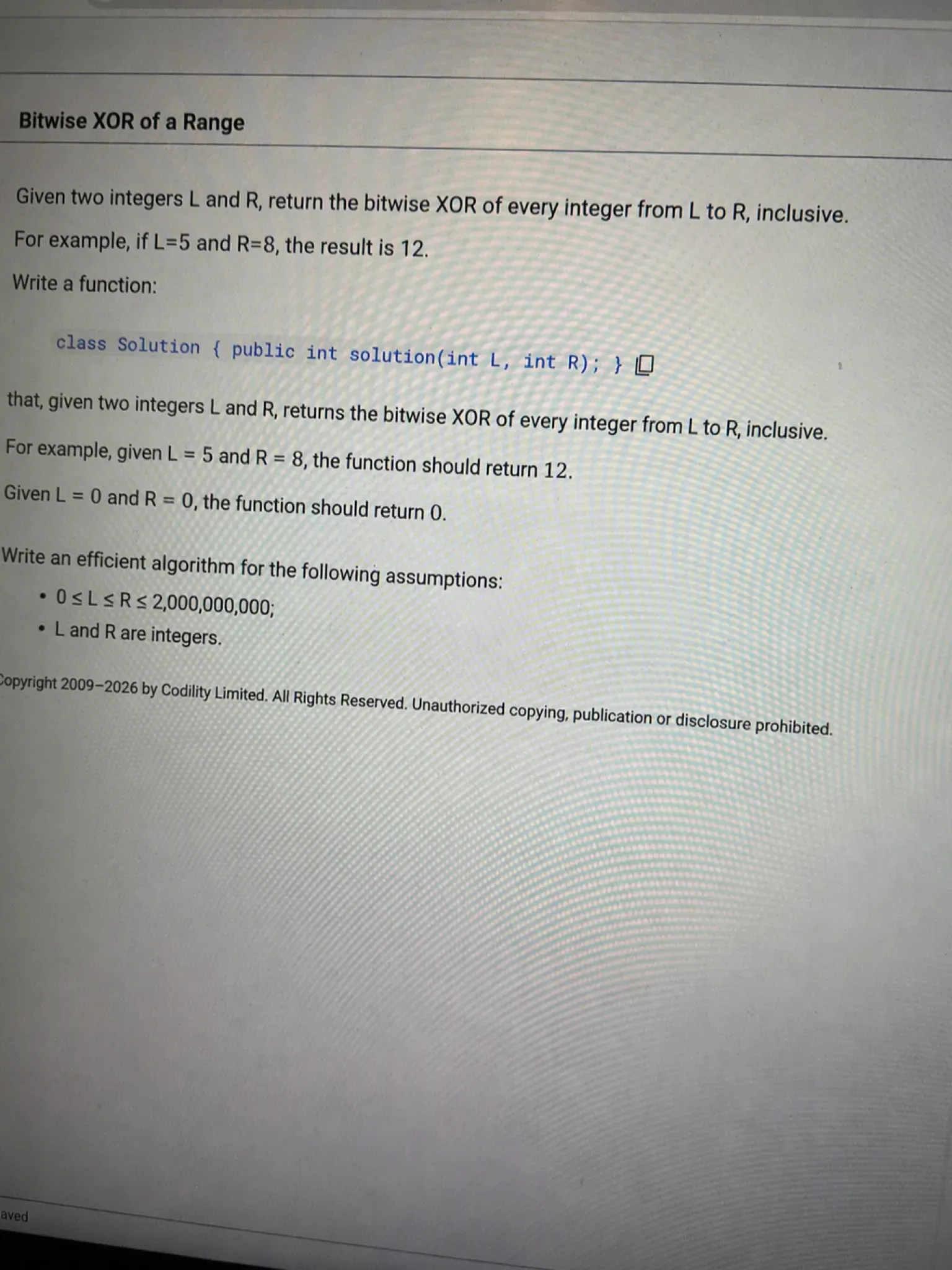
The problem I got: The first task gave me two integers, L and R, and asked me to return the bitwise XOR of every integer in that range, inclusive. The prompt's own example used L=5 and R=8, which meant 5 XOR 6 XOR 7 XOR 8, working out to 12. In a 2016 first-person account, a Rakuten Codility candidate got a task asking for the bitwise XOR of every integer between two bounds, inclusive, in the exact same L-to-R framing.
My approach: XORing every number in a range one at a time was never going to hold up if R got large, so I used the standard prefix trick instead: the XOR of every integer from 0 to n cycles in a pattern with period 4, based on n mod 4. XOR(L..R) is just XOR(0..R) XOR XOR(0..L-1), since everything below L cancels itself out.
def solution(L, R):
    def xor_upto(n):
        remainder = n % 4
        if remainder == 0:
            return n
        elif remainder == 1:
            return 1
        elif remainder == 2:
            return n + 1
        else:
            return 0

    return xor_upto(R) ^ xor_upto(L - 1)
Time complexity: O(1) | Space complexity: O(1)
I'd run into the mod-4 XOR pattern during prep, so this one took about ten minutes end to end, most of it spent double-checking what happened when L was small.
Question 2: Shortest Negabinary Ceiling
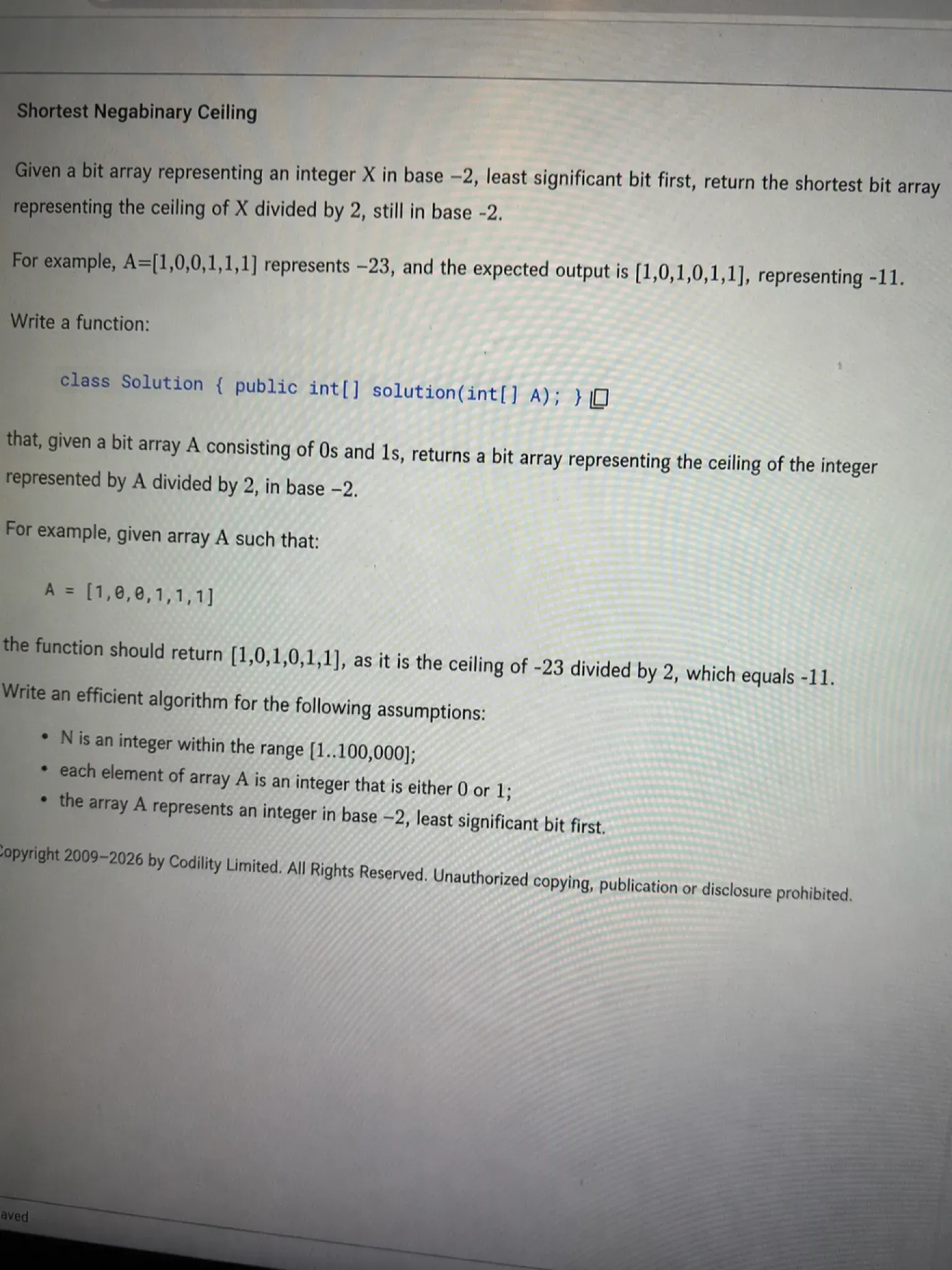
The problem I got: The second task worked in base -2. I was given a bit array representing an integer X in that base, least significant bit first, and had to return the shortest bit array representing the ceiling of X divided by 2, still in base -2. The prompt's own example used A = [1,0,0,1,1,1], which is -23 in base -2, and the expected output was [1,0,1,0,1,1], which is -11. This exact task turns up in a LeetCode Discuss post titled "Rakuten | Online Assessment | Base -2 Interpretation", from a software engineer OA.
My approach: I converted the input array to a normal integer by summing each bit times the matching power of -2, took the ceiling of that value divided by two with integer math, then converted the result back into base -2 by repeatedly dividing by -2 and correcting any negative remainder into a valid 0 or 1 digit.
def solution(A):
    # Convert base -2 array (least significant bit first) to an integer
    X = 0
    power = 1
    for bit in A:
        X += bit * power
        power *= -2

    # Ceiling of X / 2 using integer math
    Y = -((-X) // 2)

    if Y == 0:
        return [0]

    result = []
    y = Y
    while y != 0:
        y, remainder = divmod(y, -2)
        if remainder < 0:
            remainder += 2
            y += 1
        result.append(remainder)

    return result
Time complexity: O(M) steps, but the real cost is closer to O(M^2), since each step does arbitrary-precision arithmetic on a number that grows to M bits | Space complexity: O(M)
This passed every correctness test on the sample and the small cases. On the largest arrays, close to the 100,000-element cap, it started timing out, and I had about fifteen minutes left when I watched the performance tests fail one after another with no clean way left to avoid rebuilding a giant integer on every pass.
I'd already ruled out a desktop overlay for this test: anything rendering on-screen sits right there for the assessment to scan, and that wasn't a risk worth taking.
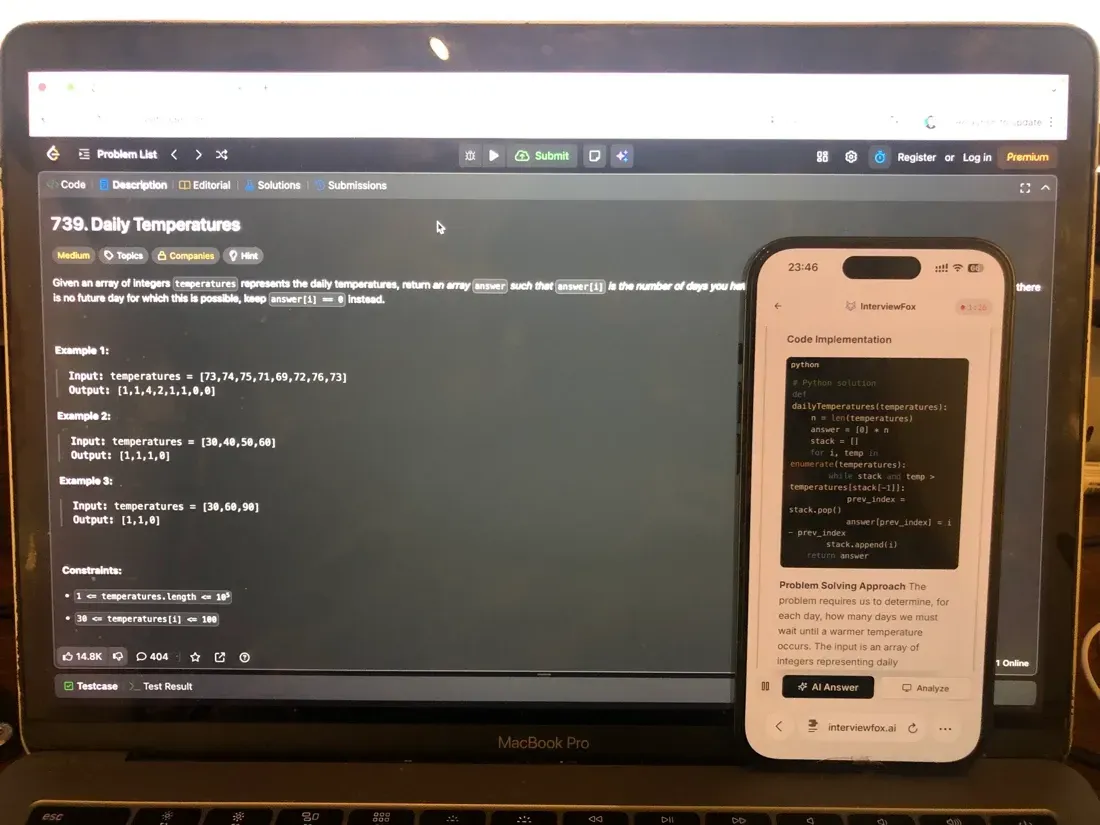
So I hit a keyboard shortcut, and the failing test case auto-captured and pushed straight to the dual device AI interview copilot on my phone, a separate device outside the platform's screenshot monitoring, without me touching the code editor.
The approach I'd been missing (adjusting the base -2 array directly instead of rebuilding it as a full integer on every step) got clear inside a minute, and my laptop screen never changed.
Land offer with Safer AI Interview Assistant
Skip the risky invisible apps. Our dual-device mode keeps it simple and undetectable. You crush the interview, we handle the answers.
Get started. It's freeLoved by 100,000+ candidates
What I'd Tell a Friend Who Just Opened the Invite
The real ceiling here is beatable Easy-to-Medium, not LeetCode Hard territory. Both confirmed questions map to patterns that show up constantly in interview prep, a prefix-XOR trick and a base-conversion routine, so the actual risk on this test is running out of time or missing a performance edge case, not raw difficulty.
The invite-to-deadline window
Rakuten didn't put a countdown anywhere in the invite email. It just said the assessment link would expire, without naming a number of days. I treated that silence as a warning rather than a comfort and started the test the same day the email landed, working off roughly a week as my own deadline rather than waiting to find out how long the link actually held.
How results came back
There was no dashboard, no score, and no pass-or-fail message on submission, just a confirmation that my responses had been recorded. About a week later, a recruiter followed up by email to set up the next step, and that call was the real result: no score, no breakdown of which task I'd passed, just a decision that had already been made on the other end. From there, the next steps depend on role and team, and I'm not covering the full interview loop here.
What Codility's Proctoring Sees on the Rakuten Test
Codility's proctoring is not one fixed setting Rakuten applies the same way to every hire. Codility's own Behavioral Events Detection documentation says Codility sets monitoring per test. Every layer stays off until a company turns it on.
As the chart below shows, the platform includes a group of behavioral signals. It can log activity whenever a company enables that category. Webcam capture, screen capture, and full session recording sit in a separate, higher-tier opt-in category.
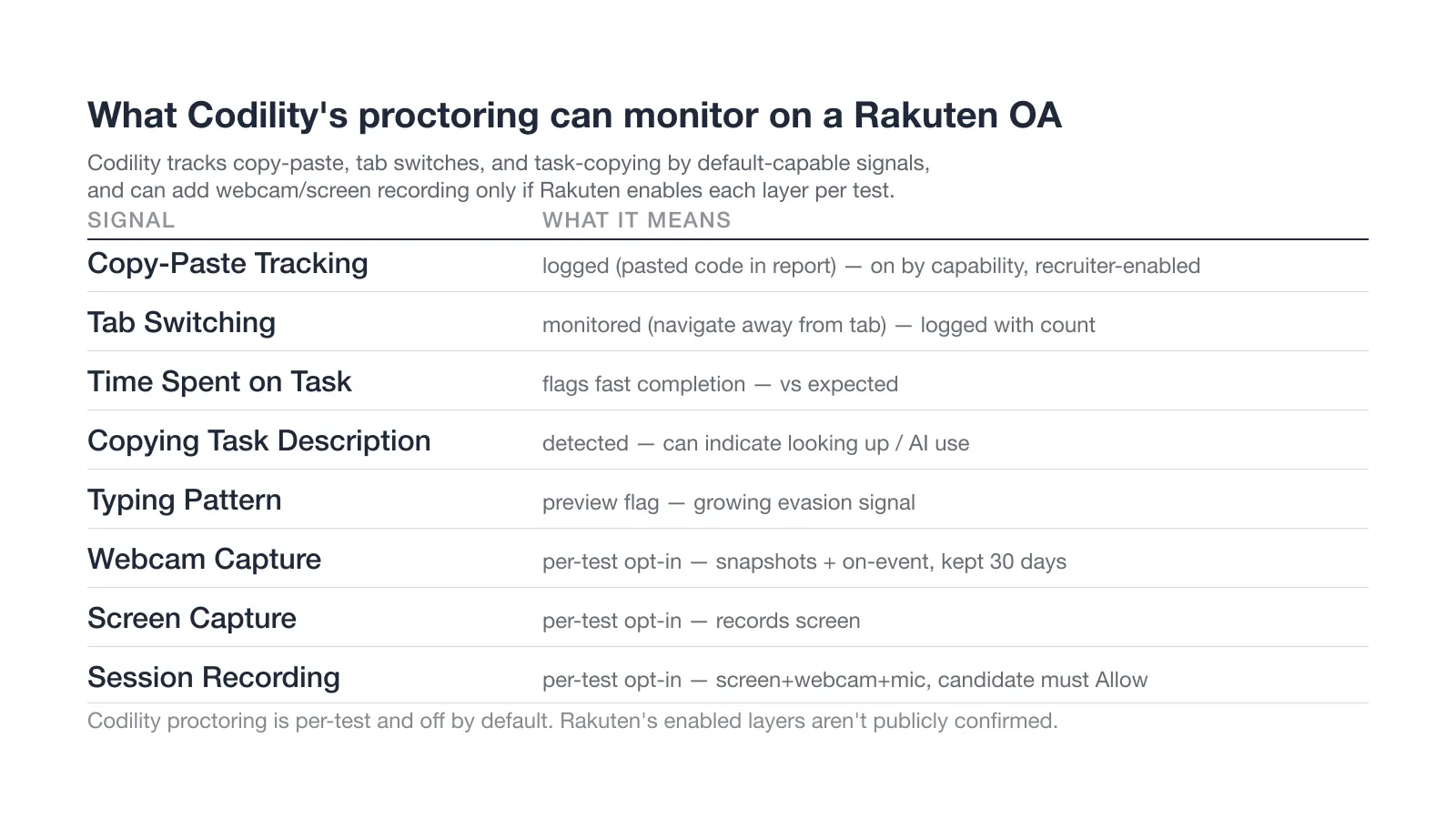
Default vs Enabled Signals
Copy-paste tracking, tab switching, time spent on a task, copying the task description, and typing-pattern preview all sit in the same behavioral category. Codility can log any of them once Rakuten turns that category on for a given test.
That still leaves an open question. Once a recruiter flips screen capture on, what gets recorded, and when does it stop? The mechanics of how Codility's screen capture behaves once it's turned on go deeper than any single Rakuten candidate account can confirm.
The Honesty Gap
No candidate account I found states which of these layers Rakuten enables. I'm not going to guess in either direction.
It helps to know how Codility's webcam layer behaves, instead of assuming based on other platforms. That knowledge separates real caution from needless worry before the test starts. A closer look at how Codility's webcam monitoring actually functions when it's enabled lays out what gets captured, kept, and reviewed.
Device-Integrity Angle
Invisible overlay apps are not a safe workaround here. What I've described so far only covers the behavioral layer. It doesn't explain how Codility catches a hidden desktop tool running under the browser. The fuller mechanics behind how Codility detects these hidden cheating tools cover the device-scanning layer in more depth than this section can.
I go through a real case of exactly this happening later in this guide.
Other Confirmed Rakuten Codility Questions
The two-question format is confirmed for the fresh-grad software engineer track. Other role families report a different mix.
The Data Engineer Track
In a Data Engineer candidate's report from a Tokyo interview in September 2024, the pairing was different entirely. The first task was a hard SQL problem. The second was a Python problem counting valid string permutations under a constraint.
That write-up does not include the exact SQL schema or the permutation rule. So there is no working solution to reconstruct here. What is confirmed is the shape: multi-step SQL for the data task, algorithmic counting in Python for the second.
Two Glassdoor Fragments
Two more fragments show up in Glassdoor's interview-question database. Both are short snippets rather than full write-ups. I'm treating them as leads rather than confirmed problem statements. One centers on finding the area of two possibly overlapping rectangles. The other centers on counting the distinct digit arrangements of a given integer. Neither snippet includes enough detail to verify constraints, examples, or a working solution.
The Stale "Area of Two Rectangles" Folklore
In a 2018 candidate account from Rakuten's Tokyo HQ, the candidate had prepped the overlapping-rectangles problem before a Codility test. The actual test turned out "fairly moderate" and didn't include that question at all. That account is a useful reminder: a problem in prep folklore is not the same as a problem confirmed on a recent test.
How Rakuten Codility Scoring Really Works
Correctness and Performance Are Both Scored
The base -2 problem makes the point on its own. On that same OA, one correct-but-slow answer read: "I failed a few test cases and failed many performance test cases," straight from the LeetCode Discuss thread.
That matches my own experience on the same problem. A fully correct but too-slow approach ran out of runway on the largest inputs. The same trap shows up in a 2018 Rakuten Tokyo candidate's own words, put a different way. Solving the problem was one thing. Optimizing it was another.
Your Score Is Not Shown to You
Nothing on Codility's submission screen shows a score at all. In one fresh-grad candidate's process, the only feedback offered was "you did well enough to get here" once things moved forward. The recruiter shared no number, percentage, or breakdown at any point.
There Is No Published Passing Bar
Rakuten does not publish a passing score for its Codility test. Correctness and performance are both scored, and a slow-but-correct answer can still fail. That makes the performance tests the real gate, even without a stated number attached to them.
Why Candidates Fail the Rakuten Codility OA
A hotkey-activated tool that's supposed to stay invisible can still trigger a device-level warning. That warning locks the entire workspace mid-test, with no way to recover in that same session.
The AI-Tool Detection Case
In a candidate's account from mid-2026, a hotkey-activated invisible app was running during a Rakuten assessment. It was expected to stay hidden. The candidate moved between the prompt and the code editor. A background-process warning appeared, and the coding workspace stopped accepting input. The page locked right away, and the candidate was marked ineligible for a retake.
This lines up with what Codility's own device-scanning tools are built to catch. The check runs at the desktop level, not just the browser tab. That closes off the idea that an invisible overlay app is safe from detection.
Codility's device-scanning flagged at least one candidate for exactly this kind of tool. It renders the answer right on the screen the assessment is scanning. Nothing stronger than a basic OS-layer trick hides it, and a device-level scan looks straight through that trick.
InterviewFox is built as a dual device AI interview tool, so the answer never touches that screen at all. It surfaces on a second, physically separate phone. That keeps it out of reach of any screenshot, recording, or process-monitoring layer running on the laptop.
Land offer with Safer AI Interview Assistant
Skip the risky invisible apps. Our dual-device mode keeps it simple and undetectable. You crush the interview, we handle the answers.
Get started. It's freeLoved by 100,000+ candidates
Timer Blindness
In a 2016 candidate account, the clock slipped by while the candidate stayed lost in thought on a problem. The candidate had little time left to react once it registered. The failure there wasn't the problem itself. It was not checking the clock often enough to react before the window closed.
Timeouts and Correct-but-Slow Solutions
That same 2016 candidate also ran out of time on the coding test outright. Paired with the correctness-versus-performance trap from the base -2 problem, the pattern across both failure types is the same. Getting to a working answer isn't the finish line on this test. Getting to a fast enough answer inside the time limit is.
Your Rakuten Codility Prep Plan
Rakuten doesn't publish how long the assessment link stays open. I planned around a seven-day window and worked backward from there.
In the days before the OA, I texted InterviewFox's Prep Agent on WhatsApp. I gave it the question patterns I'd confirmed for the Rakuten Codility test (base -2 conversions, prefix-XOR ranges). It sent back a drill plan built around that exact pairing.
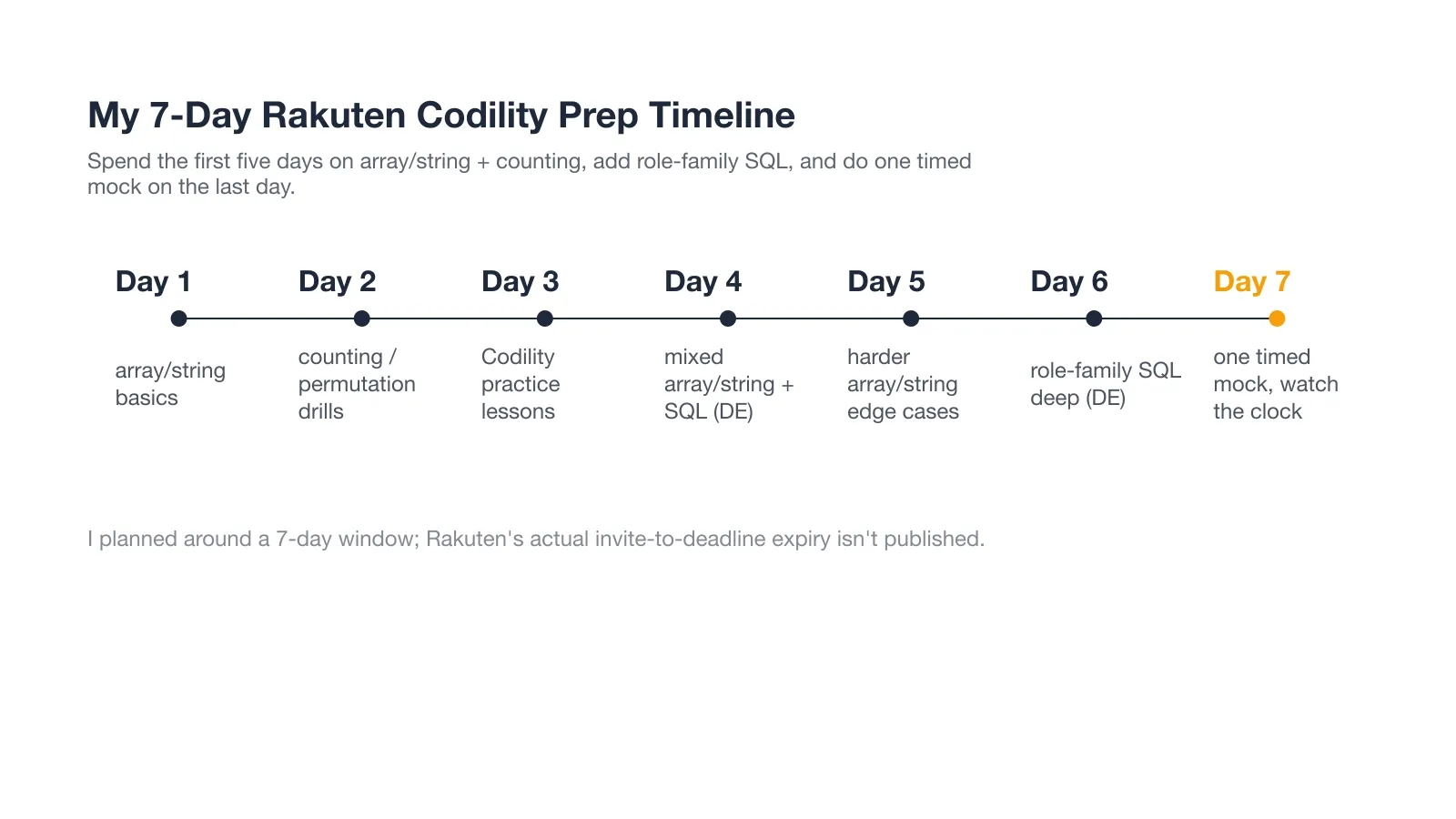
Array and String Manipulation (Days 1-3)
I spent my first three days almost entirely on array and string manipulation plus counting and permutation problems. That covers most of what shows up on this test. I also worked straight through Codility's own practice lessons on their site. I didn't split time across a dozen different prep sources. Those lessons match the platform's own problem style and scoring rules directly.
SQL for Data Roles and Codility's Own Lessons (Days 4-6)
I kept working the same array and string patterns through day five. This time I used harder edge cases with larger inputs. The base -2 problem had punished exactly that kind of gap.
Data and DE roles get a different pairing on this test. The first task is hard SQL joins and aggregations, confirmed by a 2024 Data Engineer candidate report. The second is a Python counting problem. My own track was software engineer, so I skipped that SQL block. It's still the shape worth knowing for that variant.
One Timed Mock and the Skip List (Day 7)
On the last day, I ran one full mock under a real timer instead of practicing more untimed problems. The failure pattern I kept seeing in other candidates' accounts was losing track of the clock, not lacking the technique. By day seven, I could solve the XOR-range problem in about ten minutes without notes. That's close to how the real test went.
I skipped prepping the "area of two rectangles" problem that circulates in older Rakuten prep write-ups. One 2018 candidate account specifically flagged studying that problem and then not seeing it on a moderate-difficulty test. My own test didn't include it either.
FAQ
Can Rakuten see my screen or webcam during the Codility test?
Codility can monitor screen activity and webcam video, but only when a company turns on those layers for that test. Every layer is off by default. No public account confirms which layers Rakuten turns on for its own assessments. Treat webcam and screen capture as features Codility offers, not a confirmed Rakuten setting.
Can I use an AI tool or invisible app during the Rakuten Codility OA?
Desktop overlay tools stay on the same screen a proctoring system can scan. Nothing stronger than a basic OS-layer trick hides them, and that risk doesn't go away as detection keeps adding new ways to catch it.
InterviewFox pushes the answer to a phone instead, a physically separate device. The laptop screen stays on the exam editor the whole time. That dual-device setup removes the answer from the screen completely, instead of trying to hide it better on the same one.
Land offer with Safer AI Interview Assistant
Skip the risky invisible apps. Our dual-device mode keeps it simple and undetectable. You crush the interview, we handle the answers.
Get started. It's freeLoved by 100,000+ candidates
What is the passing score for the Rakuten Codility test?
Rakuten does not publish a passing score. Correctness and performance are both scored on each task. No score is ever shown to the candidate directly. The outcome comes back as a pass-or-fail decision, relayed by a recruiter, not a number.
How should I prepare for the Rakuten Codility OA in the time I have?
The plan that worked for me put most of my prep time on array and string manipulation. It also covered counting and permutation problems. Those cover the confirmed question types across multiple role families. Codility's own practice lessons matched the platform's problem style directly. One timed mock on the final day kept the clock from becoming the real obstacle.
What happens if I'm flagged for using an AI tool during the Rakuten Codility test?
In a confirmed 2026 candidate account, a hotkey-activated invisible app triggered a background-process warning. That warning locked the entire coding workspace mid-test. There was no way to continue in that session, and no retake was offered. Codility's device-level scanning is built to catch hidden tools running under the browser, not just what's visible in the tab.