
My Oracle HackerRank Interview Questions 2026: 2 Medium DSA, 90 Min

Quick Facts
| Company | Oracle |
| Platform | HackerRank, connected natively through Oracle Recruiting |
| My test (experienced screen) | 90 minutes, 2 medium DSA problems (arrays, hashmaps, sliding window) |
| Campus OA variant | ~1.5 hr, 3 coding (1 DSA + 1 SQL + 1 API) plus 10–15 MCQ |
| Proctoring baseline | Copy/Paste tracked on every test; tab-switch and webcam flags are employer opt-in |
| Scoring | Partial credit counts; one report shortlisted on 9/15 coding cases |
| Internal link | How HackerRank detects cheating |
I sat the Oracle HackerRank interview questions round in 2026 as an experienced engineer. My sitting was a 90-minute HackerRank round they called CodePair: two medium problems from the arrays, hashmaps, and sliding-window family. Oracle connects to HackerRank natively, so the assessment ran on Oracle's own tenant.
The first problem came out clean. The second pinned me for close to twenty minutes before the answer clicked. I walk through both below, including the tooling choice I made when I hit that wall: an AI interview assistant that keeps the answer off the monitored screen.
To place my own sitting against other candidates', I pulled Oracle HackerRank reports from LeetCode Discuss and Medium. Reddit was unreachable this pass, so the rest below come from those two sources. The traps they kept repeating are proctoring flags, partial-credit scoring, and the swap problem that nearly ran my clock out. I break all three down below.
The Real Questions on My Oracle HackerRank Test
My Oracle loop opened with a 90-minute HackerRank round (they called it CodePair on the invite). Two coding problems, both medium, both squarely in the arrays, hashmaps, and sliding-window family. No SQL, no MCQ on this track. Here is exactly what I got.
Question 1: Sliding-Window Maximum
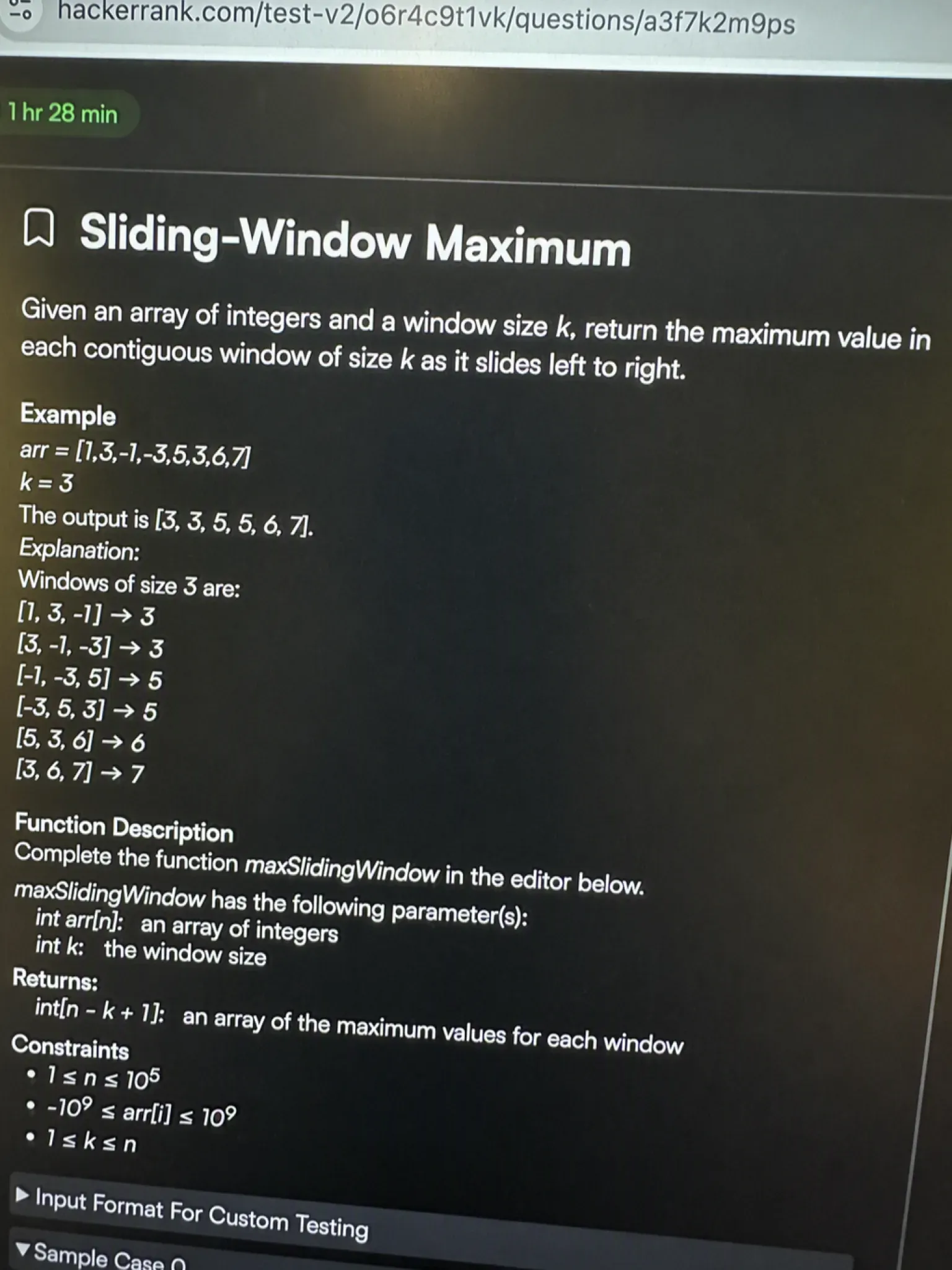
The problem I got: Given an array of integers and a window size k, return a list with the maximum value in each contiguous window of size k as it slides left to right. For nums = [1, 3, -1, -3, 5, 3, 6, 7] and k = 3, the answer is [3, 3, 5, 5, 6, 7].
My approach: A naive scan per window is O(n*k), which I knew would time out on the larger hidden cases. I reached for a monotonic deque: keep indices in the deque such that their values stay strictly decreasing. Before adding the current index, I pop from the back every index whose value is <= the current value (they can never be the max again). The front is the current window maximum; I drop it when it falls outside the window's left edge. Each index enters and leaves the deque once, so the whole pass is linear.
from collections import deque

def sliding_window_max(nums, k):
    dq = deque()          # stores indices, values strictly decreasing
    out = []
    for i, x in enumerate(nums):
        while dq and nums[dq[-1]] <= x:
            dq.pop()       # x dominates everything smaller behind it
        dq.append(i)
        if dq[0] == i - k:
            dq.popleft()   # front fell out of the window
        if i >= k - 1:
            out.append(nums[dq[0]])
    return out
Time complexity: O(n) | Space complexity: O(k)
I finished this one in about 30 minutes, including a quick test on the sample. Clean, and I could explain the "why each element visits the deque once" line clearly when I talked it through.
Question 2: Distinct-Element Swap
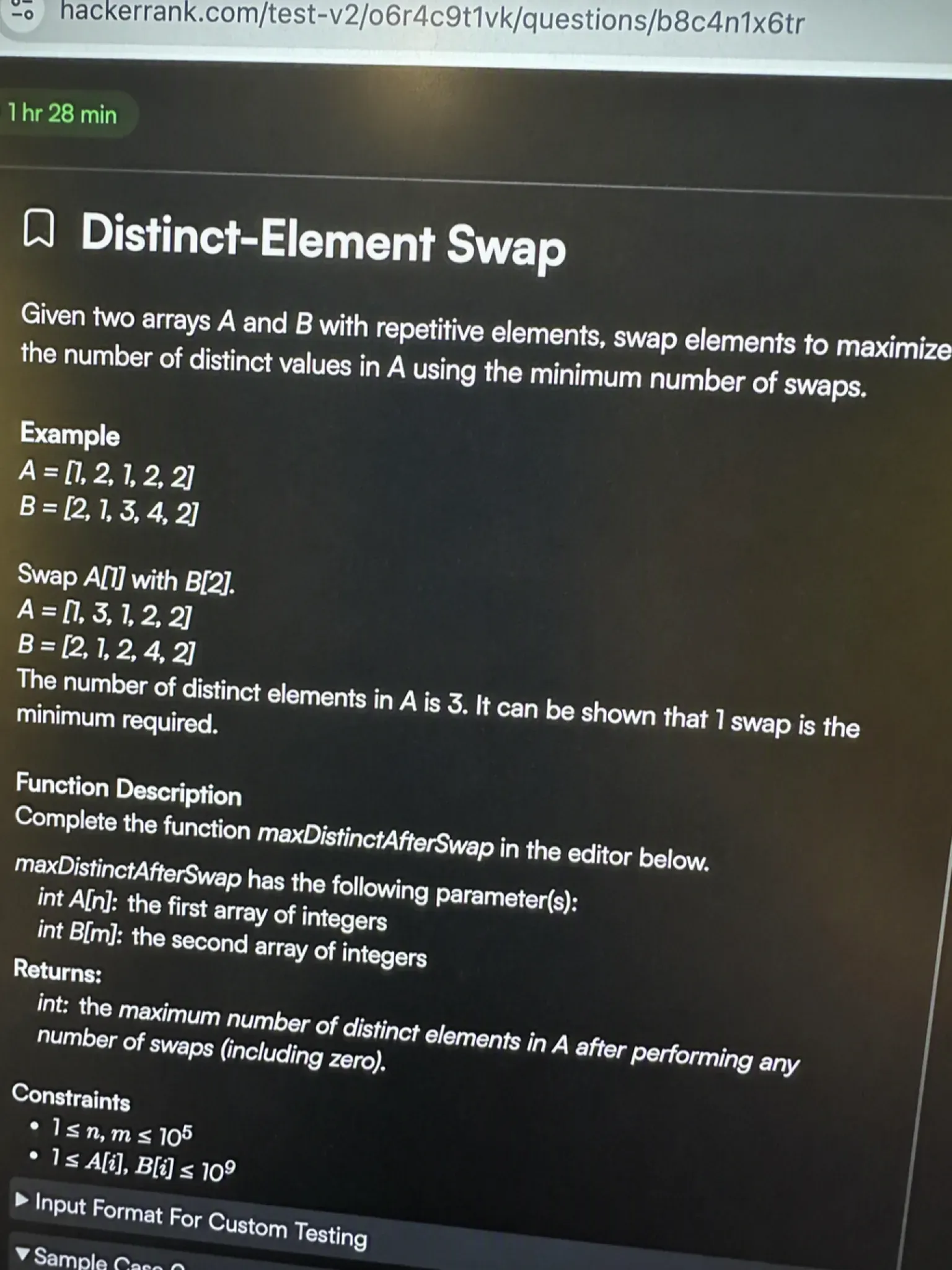
The problem I got: I was given two arrays, A and B, both containing repetitive elements. I could swap any element of A with any element of B. The goal was to end up with the maximum number of distinct elements in A, using the minimum number of swaps. For A = [1, 1, 2] and B = [2, 3, 3], the best I could do was A = [1, 2, 3] with one swap, giving 3 distinct values.
My approach: I counted frequencies in both arrays. The waste in A is every duplicate beyond the first occurrence. For each wasted slot in A, I wanted to pull in a value that A does not already have and that B actually contains. I kept a set of what A has, a frequency map of B, and a frequency map of A. Greedily, for every duplicate position in A I looked for a B value not present in A's set, performed the swap, and updated the counts. Stop when A has no more duplicates or B has nothing new to offer. I argued the swap count equals the number of duplicates I actually replaced, which is minimal because each replacement fixes exactly one wasted slot.
from collections import Counter

def max_distinct(A, B):
    a = Counter(A)
    b = Counter(B)
    have = set(A)                 # values already present in A
    swaps = 0
    for val, cnt in list(a.items()):
        # "cnt - 1" wasted copies of this value in A
        needed = cnt - 1
        while needed > 0:
            # find a B value A does not have
            donor = next((v for v in b if v not in have and b[v] > 0), None)
            if donor is None:
                return len(have), swaps
            a[val] -= 1
            b[donor] -= 1
            a[donor] = a.get(donor, 0) + 1
            have.add(donor)
            swaps += 1
            needed -= 1
    return len(have), swaps
Time complexity: O(n + m) | Space complexity: O(n + m)
This one cost me more time than I expected. I sketched the brute-force "try every swap" first, saw it was exponential, then rebuilt it around the frequency maps. I was maybe 20 minutes in with no clean code yet, and the clock was starting to press.
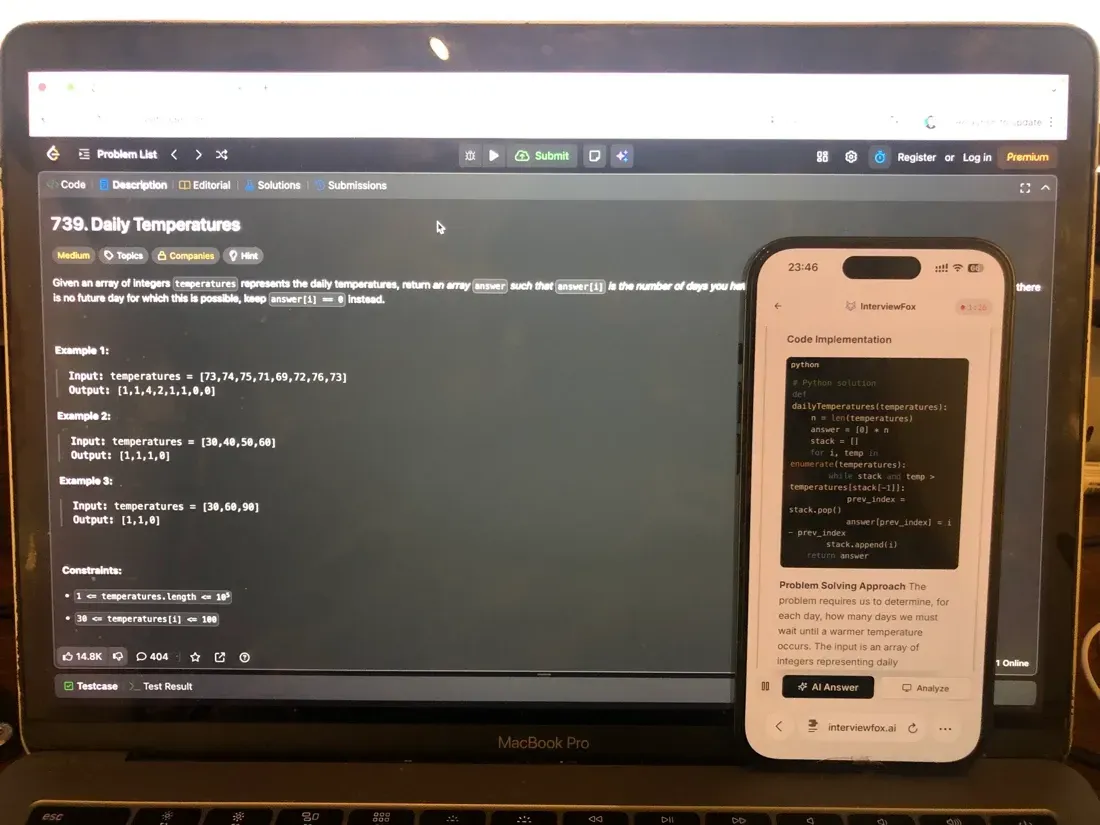
A desktop overlay was never an option I considered for this sitting. That kind of tool draws the answer onto the same screen the proctoring system watches, hidden by a basic rendering layer, and whether it gets flagged depends on what detection is currently running. I didn't want that uncertainty behind a ninety-minute clock. What I used instead was InterviewFox: a keyboard shortcut captured the question panel and pushed the answer to my phone, a separate device outside HackerRank's screenshot monitoring, so the frequency-map angle on that swap problem came together off the machine being recorded. My laptop screen stayed on the exam editor the whole time, unchanged.
Land offer with Safer AI Interview Assistant
Skip the risky invisible apps. Our dual-device mode keeps it simple and undetectable. You crush the interview, we handle the answers.
Get started. It's freeLoved by 100,000+ candidates
Oracle's Proctoring Policy for HackerRank
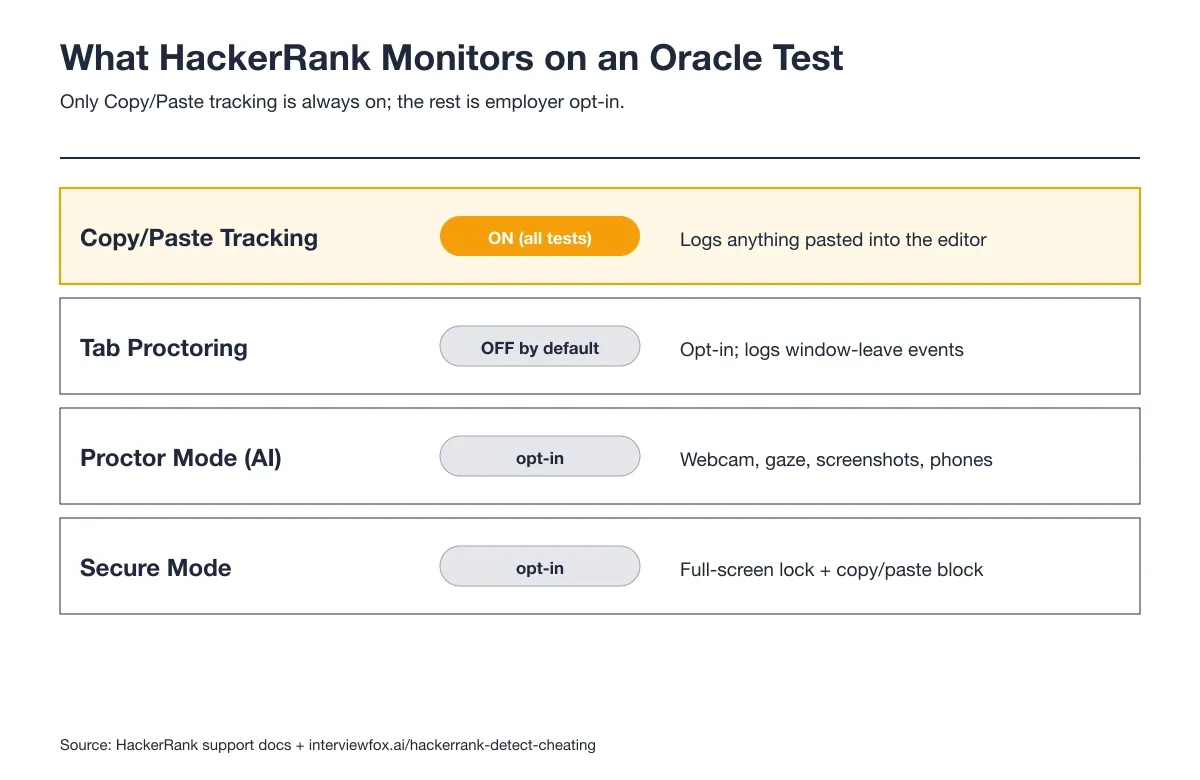
Oracle's HackerRank proctoring in 2026 has one layer that is always on and three that an employer turns on per test. My sitting ran on the same HackerRank tenant and the same Proctor Mode feature set that the platform documents for every customer.
Copy/Paste Tracking Stays On for Every Test
Copy/Paste tracking is on for all HackerRank tests by default. The editor logs anything you paste from outside the window. I kept my own notes in a separate app and typed the final version by hand to stay clean. HackerRank documents how its editor flags pasted clipboard code, and the same logging runs on an Oracle test — our breakdown of HackerRank copy-paste tracking covers the mechanics.
HackerRank publishes the proctoring model in its support docs, and the same signals apply to Oracle's instance.
Tab-Switch and Webcam Flags Are Employer Opt-In
Tab Proctoring is off by default. Oracle may or may not enable it for your req. Webcam monitoring is also an opt-in layer, not a guarantee. When it is enabled, HackerRank watches for tab-switching and flags each leave.
HackerRank's webcam, gaze, and object detection is covered in our full guide on how HackerRank detects cheating. The same pipeline applies to an Oracle test when Oracle switches it on.
Proctor Mode Adds AI Behavioral Monitoring
Proctor Mode is available on tests created after July 2025. It adds webcam capture, gaze tracking, object detection for phones and tablets, and screenshot analysis. Screenshot analysis fires roughly every 15 seconds when enabled. The webcam and gaze capture runs through HackerRank's standard camera pipeline, switched on or off at Oracle's discretion.
A flag reaches a human reviewer, not an auto-fail bot. One candidate whose plagiarism was flagged drew an extra verification round rather than an instant rejection.
Other Confirmed Oracle HackerRank Questions
Every question below came from someone else's sitting, not mine. All three are real Oracle HackerRank reports I found while researching this guide.
Campus Format Uses 3 Coding Problems, SQL, and 10–15 MCQs
Om Mule (Medium, April 2023) reported a 1.5-hour Oracle HackerRank round: three coding problems (one DSA, one SQL, one API design) plus 10–15 MCQs on DSA and aptitude. That is the campus and early-career shape, distinct from my experienced screen.
The Minimum-Swaps Distinct-Elements Problem
Om Mule's second-round problem was the same distinct-elements swap shape I hit in my own test: two arrays with repeats, maximize unique values in the first using the fewest swaps. His brute force was O(n²); the frequency-map greedy drops it to O(n). Seeing it reported twice tells me Oracle reuses this family across rounds.
Four-Section OA With DBMS Query, REST API, Coding, and MCQ
Sripriya (Medium, August 2023) described a four-section Oracle HackerRank OA: a DBMS query, a REST API task, a coding problem, and six technical MCQs on topological sort, minimum spanning trees, and tree traversals. The breadth confirms the campus OA tests more than pure DSA.
What Oracle's HackerRank Test Format Actually Looks Like
Your Oracle OA takes one of two shapes, decided by the role on your req. The experienced screen is short and DSA-heavy. A campus OA runs longer and broader.
Two Common OA Shapes
The experienced screen is two medium DSA problems. A campus OA is three coding problems (DSA, SQL, API) plus 10–15 MCQs. My sitting was the first kind; the second shows up in new-grad and intern reports.
Time Limit and Question Mix
My experienced screen ran 90 minutes for two problems. Campus reports describe roughly 1.5 hours across the longer mixed set. Read the duration on your own invite as the authority.
Oracle's Native HackerRank ATS Integration
Oracle Recruiting connects to HackerRank directly, so candidates are assessed on Oracle's own tenant. That native link is why the Oracle HackerRank experience is consistent across reports rather than a one-off generic test. Other firms running HackerRank OAs, such as Akuna Capital, show the same proctoring baseline.
How Oracle's HackerRank Scoring Works
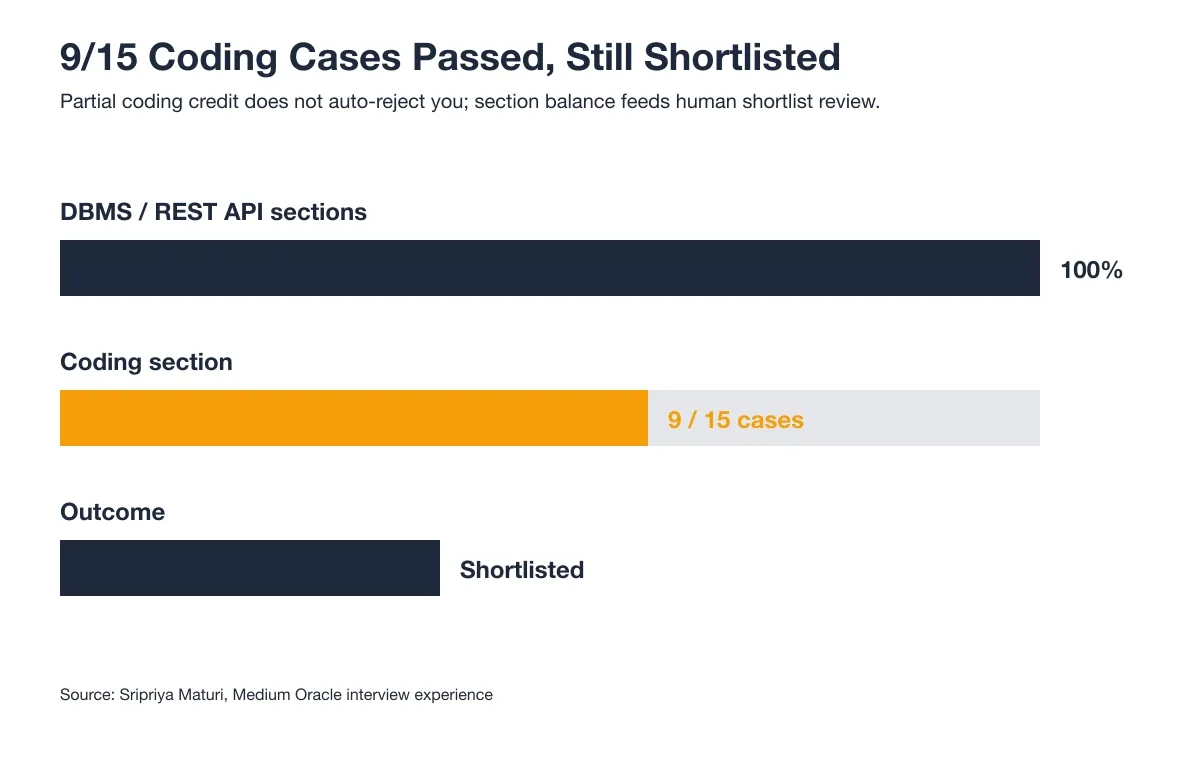
Oracle's scoring is not a single pass-or-fail line. Test-case pass rate per problem feeds a human shortlist review, and partial progress can still advance you.
Partial Credit Does Not Mean Rejection
Sripriya passed 9 of 15 coding test cases while every other section passed fully. She was still shortlisted for the Applications Developer role. The lesson is simple: keep coding, because partial credit is real.
How Plagiarism and Behavior Flags Feed Review
HackerRank's plagiarism model runs at about 85 percent precision and routes to a human reviewer. An auto-flag is not an instant fail. It is a signal the hiring team weighs alongside your section balance.
Oracle HackerRank Exam-Day Strategy
The exam rewards process as much as correct code. Three habits showed up across every Oracle report I read, including my own.
Think Aloud and Ask for Time
Om Mule was told to be vocal while coding and to ask for two minutes to think. I narrated my sliding-window approach as I built it. Speaking the plan keeps the interviewer with you when the code lags.
Show the Brute Force Before the Optimization
Walk the brute force first, then optimize. My Question 2 started as exponential "try every swap" before the frequency-map greedy. Showing that arc impressed more than silently shipping the final answer.
Keep Coding Even When Test Cases Fail
Sripriya advanced on 9 of 15 coding cases. I kept my Question 2 running through failures until the sample passed. Stopping early forfeits partial credit you have already earned.
Why Candidates Fail the Oracle HackerRank Assessment
Failures on this test are rarely about a single wrong answer. They come from process gaps the format is built to expose.
AI-Tool Detection on a Proctored Test
On a proctored Oracle test with screenshot analysis on, on-screen AI help is exactly what HackerRank built its cheating detection to catch. Anything drawn on the monitored screen is captured. HackerRank's screen recording is built to pick up exactly that. A phone-based assistant avoids that screen entirely.
Desktop overlay tools render the AI's answer on the same screen the proctoring system is monitoring. The hiding is done at the OS rendering layer, a basic trick.
Whether the current version of that monitoring actively catches it isn't something you can verify, and proctoring software keeps adding detection capabilities. InterviewFox works differently: the answer goes to my phone, a physically separate device that no screenshot or session recording can reach by design.
One Approach Is Not Enough
Oracle asks for every feasible approach, not one. A single solution that happens to pass can still lose points if you cannot elaborate the alternatives. Practice explaining two or three paths per problem.
Silent Problem-Solving Costs You
Unexplained code loses points even when it is correct. Both my report and Om Mule's stress "explain your approach clearly." If the interviewer cannot follow your reasoning, the score does not reflect your skill.
How to Prepare for the Oracle HackerRank in 7 Days
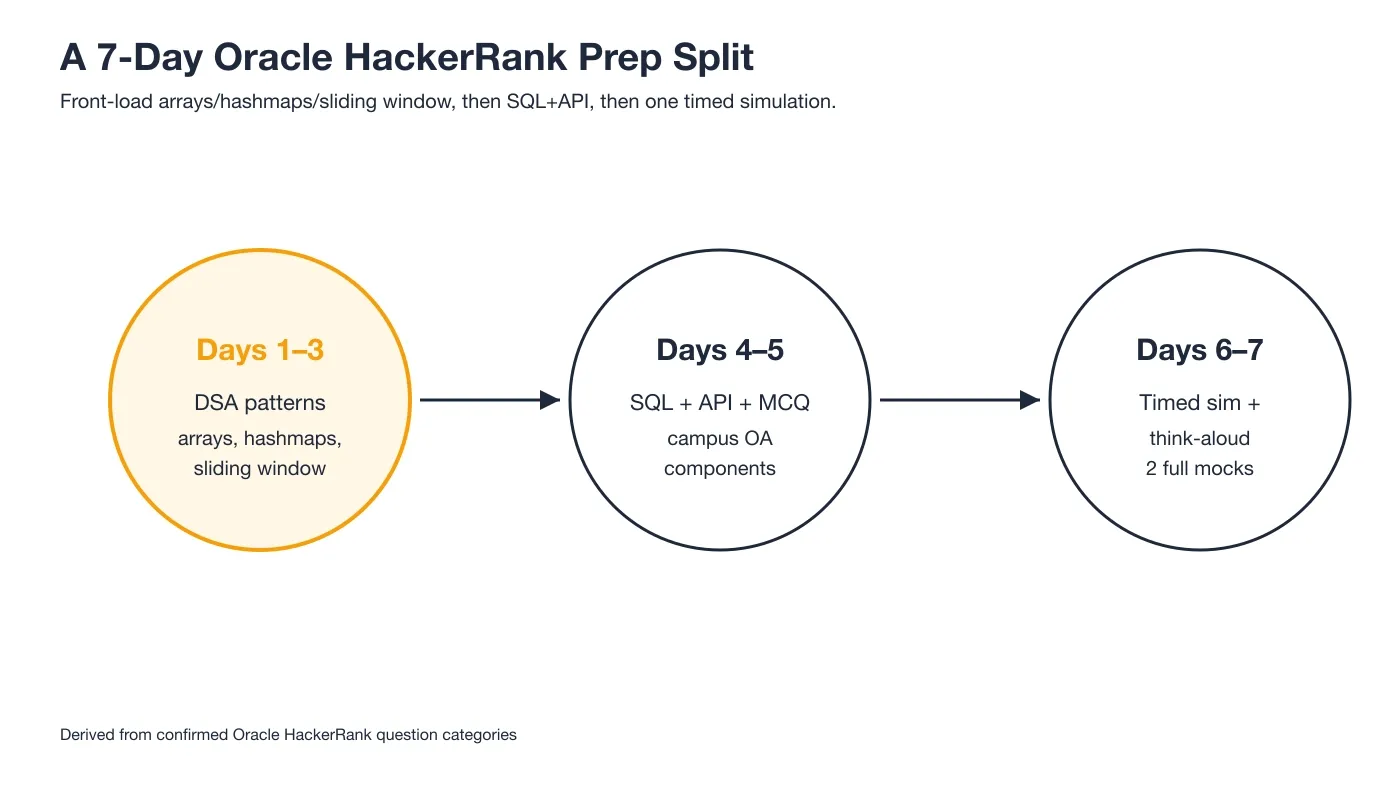
I built my prep around the categories Oracle actually asks, weighted by how often they appear. The split below front-loads DSA, then adds SQL and API, then simulates the real clock.
In the days before the test I also sent my confirmed Oracle patterns to InterviewFox's Prep Agent over WhatsApp and got a personalized drill plan back: one tool among several, not the centerpiece.
Days 1-3: Arrays, Hashmaps, Sliding Window
This is Tier 1. My Round-1 problems were medium arrays, hashmaps, and sliding window. I solved twenty timed medium problems in this family and forced myself to explain each solution aloud. Target: any sliding-window sum in under twenty minutes.
Days 4-5: SQL, REST API, and MCQ Drills
This is Tier 2, aimed at the campus OA. I wrote ten SQL tasks covering JOINs and window functions, then designed five small REST API specs. I also drilled DSA and aptitude MCQs, since campus reports carry 10–15 of them.
Days 6-7: Timed Simulation and Thinking-Aloud
This is the mixed tier. I ran two full timed mocks and narrated every step. Oracle scores explanation, not just code, so the verbal walkthrough is part of the practice, not an afterthought.
Skip deep system-design prep. It is not in the OA; Oracle's later interview rounds cover it. Protecting the DSA and SQL days mattered more than broad architecture reading.
What Happens After You Submit the OA
Submission is not the end of the loop. Oracle's next steps depend on the track you applied to, but the shape is consistent across reports.
The Interview Sequence After the OA
My experienced loop ran five rounds: the HackerRank screen, two DSA rounds, a system-design round, then HR. Campus reports describe a shorter three-round path after the OA. Either way, the OA is the gate, not the whole process.
How Long Results Take
Sripriya received her interview results about 24 hours after the OA. Other reports vary by role and volume. Treat a day as a rough floor, not a promise, and keep your other applications moving while you wait.
Land offer with Safer AI Interview Assistant
Skip the risky invisible apps. Our dual-device mode keeps it simple and undetectable. You crush the interview, we handle the answers.
Get started. It's freeLoved by 100,000+ candidates
FAQ
Oracle uses HackerRank via native recruiting integration
Yes. Oracle Recruiting integrates HackerRank natively, so candidates are assessed on Oracle's own HackerRank tenant rather than a generic link.
Oracle's HackerRank test tracks copy-paste on every attempt
Copy/Paste tracking is on for every test. Tab-switch and webcam monitoring are employer opt-in, so they may or may not be enabled for your req.
HackerRank catches AI help only when screen monitoring is on
Only if screen or behavior monitoring is enabled on your test. A phone-based assistant that never draws on the monitored PC stays outside that capture pipeline.
Using an AI or invisible app on the Oracle HackerRank OA
Desktop overlay tools put the AI's answer on your computer screen. The answer is rendered as a hidden layer above the browser using a basic OS-layer trick.
InterviewFox pushes the answer to your phone instead, a physically separate device that no screenshot, screen recording, or session monitoring can reach by design, so the laptop screen stays on the exam editor, unchanged. If you use AI assistance during the OA, the dual-device architecture removes the answer from your screen entirely.
Land offer with Safer AI Interview Assistant
Skip the risky invisible apps. Our dual-device mode keeps it simple and undetectable. You crush the interview, we handle the answers.
Get started. It's freeLoved by 100,000+ candidates
The Oracle HackerRank OA asks two or five problems by track
The experienced screen is two medium DSA problems. The campus OA is three coding problems (DSA, SQL, API) plus 10–15 MCQs.
The Oracle HackerRank test runs 90 minutes or 1.5 hours
My experienced screen ran 90 minutes. Campus reports describe roughly 1.5 hours across the longer mixed set.
Oracle asks arrays, hashmaps, and sliding window
The experienced screen focuses on arrays, hashmaps, and sliding window. The campus OA also covers SQL, REST API design, and DSA or aptitude MCQs.